AI Generated Quiz
Primary 5 Science Life Cycles Quiz
Free P5 Science Life Cycles quiz, HY3 AI version, with questions, answers, and syllabus-aligned practice for Singapore students.
These static practice materials are generated from the site's syllabus and paper-generation workflow, with source and model context shown so students and parents can evaluate the material before use.
Questions
Free quiz and exam paper access
Enter your details to view this paper
Your access is remembered on this device.
Answers
Primary 5 Science Quiz - Life Cycles (Answer Key)
Total Marks: 40
Topic: Life Cycles (syllabus-first; no past-year paper evidence used)
Section A (1 mark each)
-
B) Seed
Teaching note: The life cycle of a flowering plant begins as a seed. The seed sprouts (germinates) to become a young plant, then an adult plant that makes flowers. -
B) stamen, pistil
Teaching note: Pollen is made in the stamen (male part). It must reach the pistil (female part) for pollination to happen. -
B) A sperm cell fuses with an egg cell to form a seed
Teaching note: Fertilisation is when the male cell (sperm/pollen) joins the female cell (egg) to start a new living thing. In plants this makes a seed. -
B) Hen
Teaching note: Birds like hens lay eggs. Cats, dogs, and humans are mammals that give birth to live young. -
B) womb
Teaching note: In humans, the fertilised egg grows inside the mother’s womb until the baby is born. -
B) Egg → Larva → Pupa → Adult
Teaching note: Butterfly has complete metamorphosis: egg, larva (caterpillar), pupa (in cocoon), adult (butterfly). -
D) By boiling
Teaching note: Seeds spread by wind, water, animals, or bursting. Boiling is not a natural dispersal method. -
B) temperature
Teaching note: Germination needs water, air (oxygen), and suitable temperature. Too cold and the seed will not grow. -
B) Tadpole
Teaching note: Frog life cycle: egg → tadpole (lives in water) → froglet → adult frog. Pupa/cocoon is for insects; seedling is for plants. -
B) A male reproductive cell fuses with a female reproductive cell
Teaching note: Both plants and humans use fertilisation: male cell + female cell join. This is the key similarity taught in P5.
Section B (2 marks each)
-
Two ways: (1) Born as live young (e.g., cat, human); (2) Hatched from eggs (e.g., hen, fish).
Marking: 1 mark per correct method. -
Pollination is important because it moves pollen from stamen to pistil so fertilisation can happen and seeds can form.
Marking: 1 mark for “pollen transferred to female part”, 1 mark for link to seed/fruit formation. -
Examples: Butterfly – complete metamorphosis; Frog – incomplete/metamorphosis (or state frog has tadpole stage); Grasshopper – incomplete metamorphosis.
Marking: 1 mark per animal + type correctly matched. -
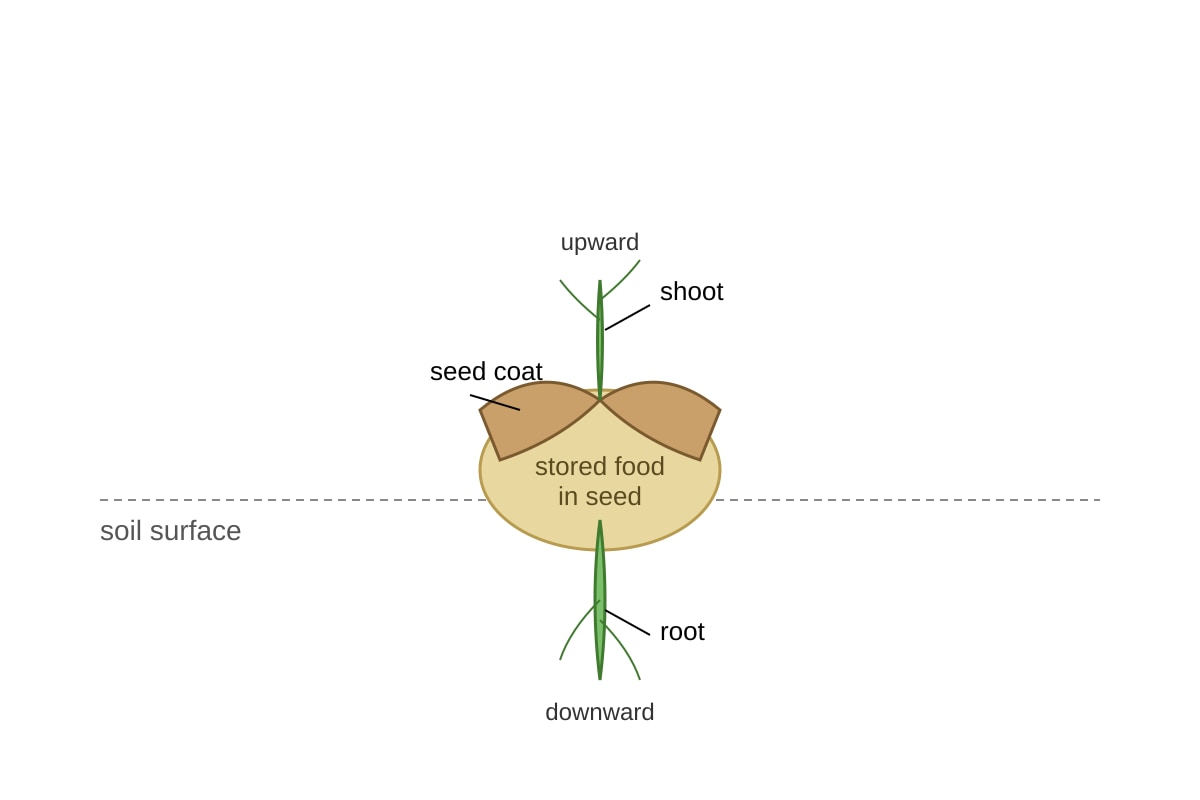
The seed takes in water and air, the root grows down to absorb water, and the shoot grows up to get light. Stored food is used until it can make its own food.
Marking: 1 mark for water/air uptake + root/shoot growth; 1 mark for use of stored food or green leaves later. -
Examples: (1) Birds eat fruits and drop seeds elsewhere; (2) Seeds stick to fur and are carried away.
Marking: 1 mark per correct example with brief mechanism. -
Living things reproduce to make sure their kind continues (continuity of life) and to pass characteristics to offspring.
Marking: 1 mark for continuity, 1 mark for passing traits.
Section C (3–4 marks each)
-
Order: Seed → Germination → Adult plant → Pollination → Fertilisation → Fruit formation. (2 marks: 1 for first three, 1 for last three in correct sequence)
Pollination explanation: Pollen from the stamen is transferred to the pistil, often by insects, wind, or water. This allows fertilisation to happen. (2 marks: 1 for transfer of pollen, 1 for purpose)
Total: 4 marks. -
Similarities (2 marks, 1 each): Both start from eggs; both change body form as they grow (metamorphosis).
Differences (2 marks, 1 each): Butterfly lives on land and has wings as adult; frog starts life in water as tadpole and breathes with gills then lungs. Butterfly has 4 stages; frog has 3 main stages (egg, tadpole, adult).
Total: 4 marks. -
Root: label downward part; Shoot: label upward part. (1 mark)
Explanation: Root grows down to find water and anchor the plant; shoot grows up to reach light for making food. (2 marks: 1 for root reason, 1 for shoot reason)
Image note: Diagram must show root down, shoot up, broken seed coat, stored food.
Total: 3 marks. -
Hen: Fertilisation happens inside the body (egg + sperm), but the egg is laid and the chick develops outside the mother using food in the egg. (2 marks)
Cat: Fertilisation happens inside the body and the baby develops inside the mother’s womb, born as live young. (2 marks)
Marking descriptors: state internal/external development difference and fertilisation site.
Total: 4 marks.