AI Generated Quiz

Primary 5 Science Heat Quiz

Free Nemo AI-generated P5 Science Heat quiz with questions, answers, and syllabus-aligned practice for Singapore students preparing for school assessments.

These static practice materials are generated from the site's syllabus and paper-generation workflow, with source and model context shown so students and parents can evaluate the material before use.

Primary 5 Science AI Generated Generated by NVIDIA Nemotron 3 Ultra 550B A55B Free Updated 2026-06-14

Questions

<!-- TuitionGoWhere generation metadata: stage=5-1; model=nvidia/nemotron-3-ultra-550b-a55b:free; model_label=NVIDIA Nemotron 3 Ultra 550B A55B Free; generated=2026-06-12; Sources: Stage 4-0 LLM templates, syllabus context, and Stage 2 evidence where available. -->

Primary 5 Science Quiz - Heat

Name: ___________________________
Class: Primary 5 _______
Date: ___________________________
Score: _______ / 40

Duration: 45 minutes
Total Marks: 40

Instructions:

  1. Answer all questions.
  2. Write your answers in the spaces provided.
  3. For multiple-choice questions, write the letter (A, B, C, or D) in the bracket provided.
  4. For open-ended questions, write your answers clearly in complete sentences.
  5. Diagrams are not drawn to scale unless stated.

Section A: Multiple-Choice Questions (10 × 1 mark = 10 marks)

1. Which of the following statements about heat is correct?
A. Heat is a form of matter.
B. Heat travels from a colder region to a hotter region.
C. Heat is a form of energy.
D. Heat cannot be transferred through a vacuum.

Answer: [ ]

2. A metal spoon feels colder than a wooden spoon at room temperature because:
A. metal is at a lower temperature than wood.
B. metal is a better conductor of heat than wood.
C. wood is a better conductor of heat than metal.
D. metal absorbs less heat from the hand than wood.

Answer: [ ]

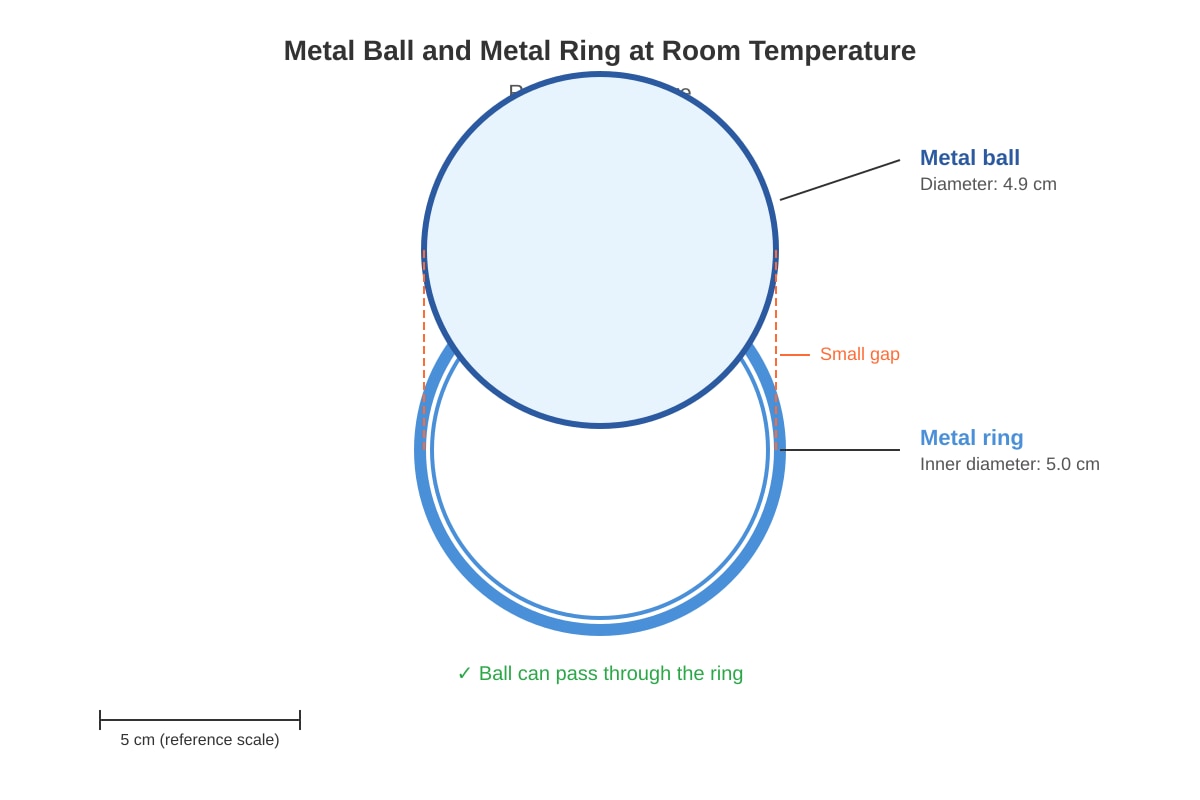
3. The diagram below shows a metal ball and a metal ring. The metal ball can just pass through the ring at room temperature.

<image_placeholder> id: Q3-fig1 type: diagram linked_question: Q3 description: A metal ball positioned above a metal ring with a small gap between them. The ball diameter is slightly smaller than the ring's inner diameter. Labels: "Metal ball", "Metal ring", "Room temperature". labels: Metal ball, Metal ring, Room temperature values: Ball diameter = 4.9 cm, Ring inner diameter = 5.0 cm must_show: Clear gap between ball and ring, labels for ball and ring </image_placeholder>

When the metal ball is heated, it cannot pass through the ring. What is the reason?
A. The mass of the metal ball increases.
B. The metal ball expands when heated.
C. The metal ring contracts when the ball is heated.
D. The density of the metal ball increases.

Answer: [ ]

4. Which of the following materials is the best conductor of heat?
A. Plastic
B. Wood
C. Copper
D. Air

Answer: [ ]

5. A student places a metal rod and a plastic rod of the same size into a beaker of hot water. After a few minutes, the metal rod feels hotter than the plastic rod. This shows that:
A. metal absorbs more heat than plastic.
B. metal conducts heat faster than plastic.
C. plastic conducts heat faster than metal.
D. metal expands more than plastic.

Answer: [ ]

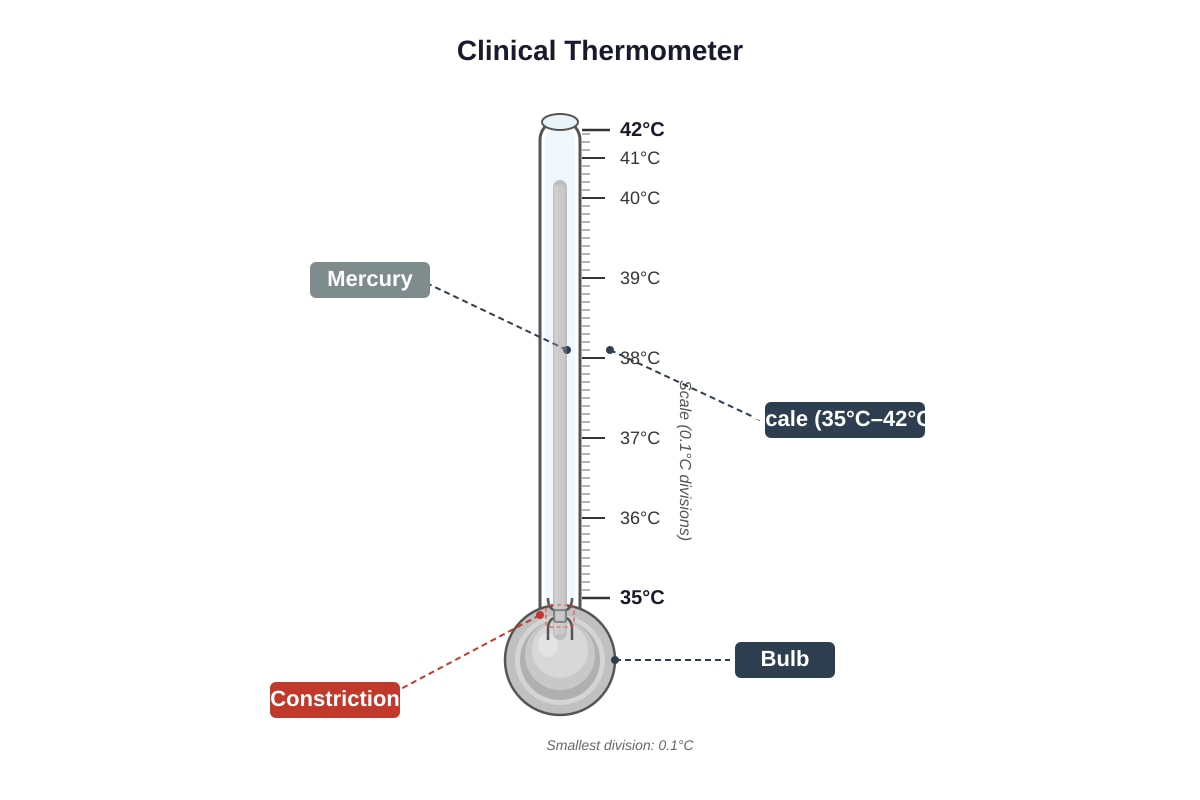
6. The diagram below shows a clinical thermometer.

<image_placeholder> id: Q6-fig1 type: diagram linked_question: Q6 description: A clinical thermometer showing mercury column, bulb, constriction, and scale from 35°C to 42°C. Labels: "Bulb", "Mercury", "Constriction", "Scale". labels: Bulb, Mercury, Constriction, Scale (35°C to 42°C) values: Scale range 35°C to 42°C, smallest division 0.1°C must_show: Constriction clearly visible, mercury column, scale markings </image_placeholder>

What is the function of the constriction in a clinical thermometer?
A. To prevent the mercury from expanding.
B. To allow the mercury to flow back quickly after use.
C. To prevent the mercury from flowing back into the bulb immediately after removal from the mouth.
D. To make the thermometer more sensitive.

Answer: [ ]

7. Heat from the Sun reaches the Earth by:
A. conduction only.
B. convection only.
C. radiation only.
D. conduction and convection.

Answer: [ ]

8. A pot of water is heated on a stove. The water at the bottom becomes hot first and rises, while cooler water sinks. This process is called:
A. conduction.
B. convection.
C. radiation.
D. expansion.

Answer: [ ]

9. Which of the following does NOT involve convection?
A. Sea breeze during the day.
B. Land breeze at night.
C. Heat from a campfire warming your face.
D. Hot air balloon rising.

Answer: [ ]

10. A student wants to keep a cup of hot chocolate warm for as long as possible. Which material should she use to wrap the cup?
A. Aluminium foil
B. Cotton wool
C. Copper sheet
D. Steel plate

Answer: [ ]


Section B: Short Answer Questions (5 × 2 marks = 10 marks)

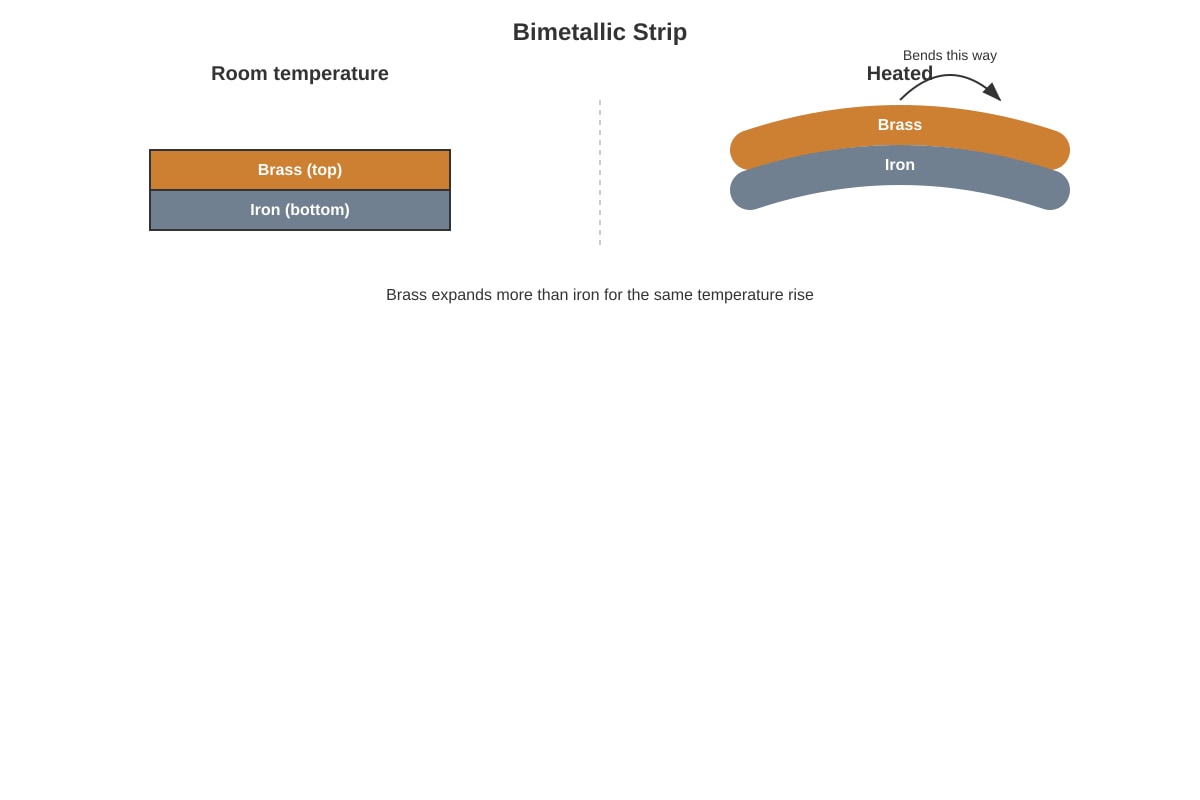
11. The diagram below shows a bimetallic strip made of brass and iron at room temperature and when heated.

<image_placeholder> id: Q11-fig1 type: diagram linked_question: Q11 description: Two diagrams side by side. Left: Bimetallic strip straight at room temperature, labelled "Brass (top)" and "Iron (bottom)". Right: Same strip bent into a curve when heated, with brass on the outer curve and iron on the inner curve. Arrows show direction of bending. labels: Brass, Iron, Room temperature, Heated values: Brass expands more than iron for same temperature rise must_show: Clear bending direction, labels for both metals, temperature states </image_placeholder>

(a) Explain why the bimetallic strip bends when heated.


(b) State which metal expands more when heated.


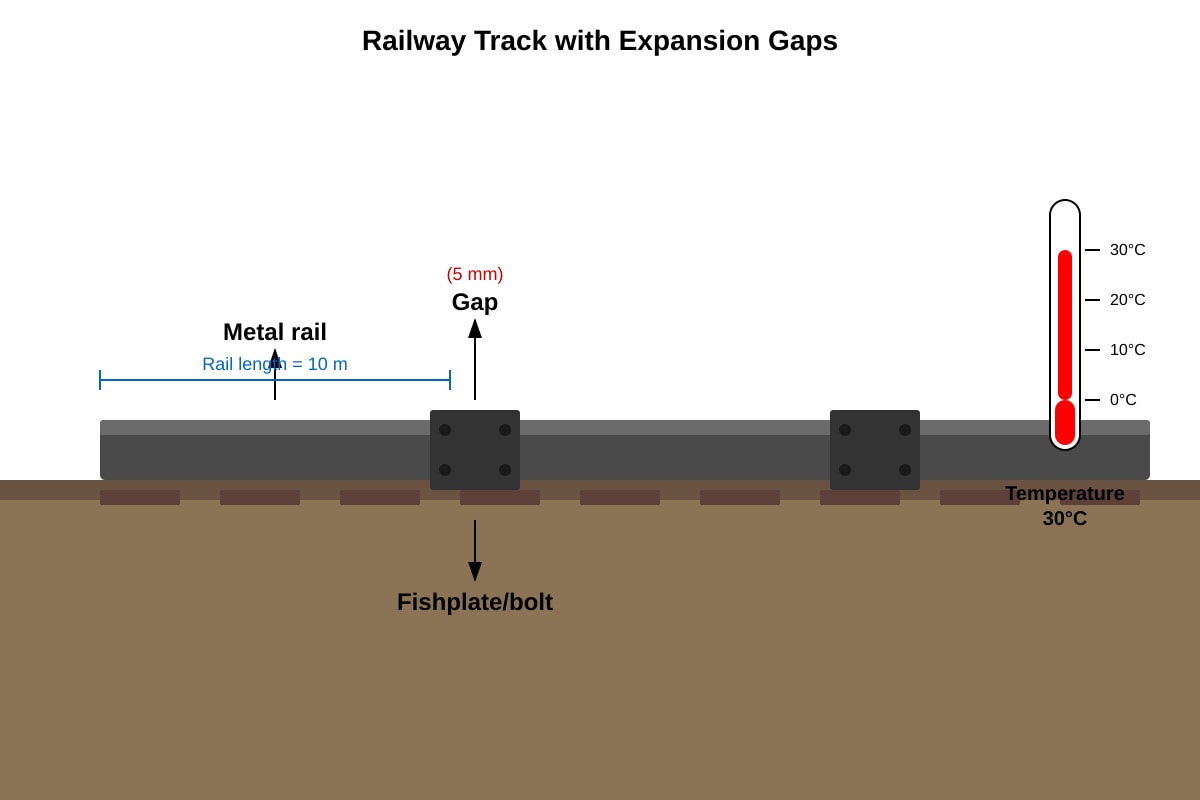
12. A metal railway track has gaps between sections.

<image_placeholder> id: Q12-fig1 type: diagram linked_question: Q12 description: Railway tracks with small gaps between sections. Labels: "Metal rail", "Gap", "Fishplate/bolt". A thermometer shows 30°C. labels: Metal rail, Gap, Fishplate/bolt, Temperature 30°C values: Gap = 5 mm, Rail length = 10 m must_show: Visible gaps between rail sections, labels </image_placeholder>

(a) Explain why gaps are left between the metal rails.


(b) What would happen to the rails on a very hot day if there were no gaps?


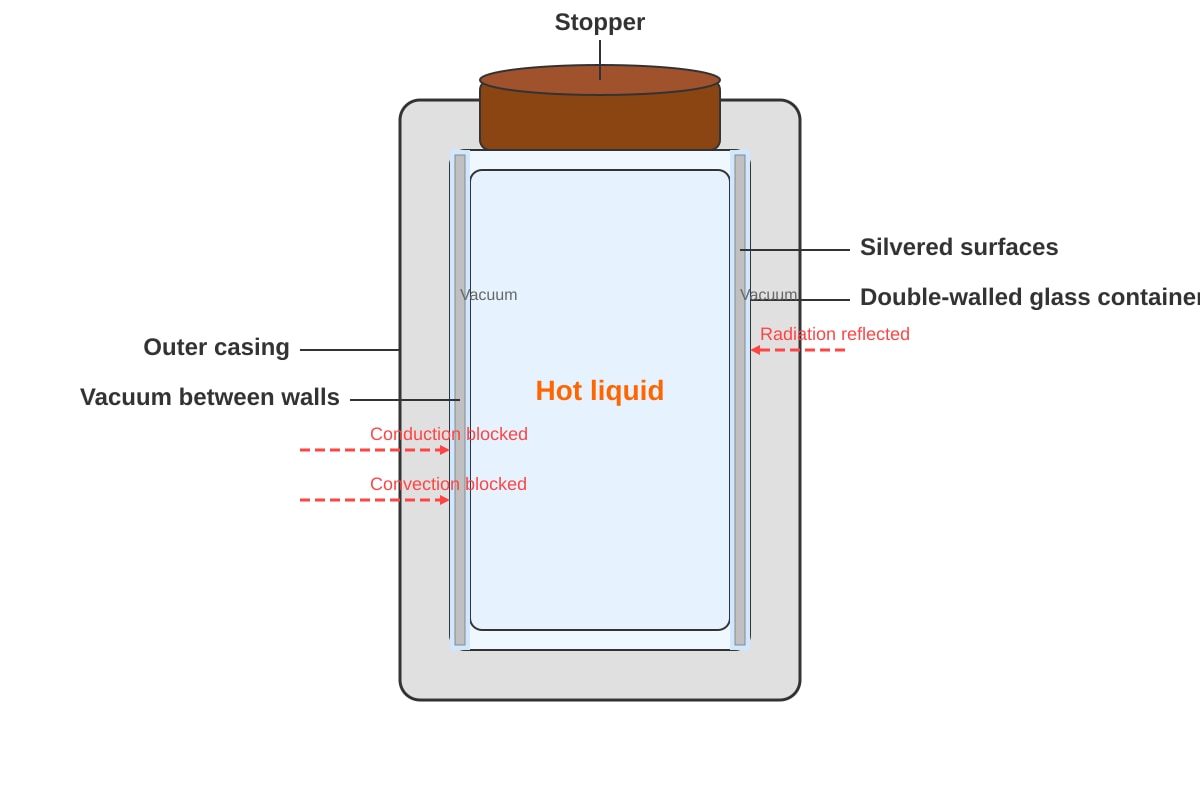
13. The diagram below shows a vacuum flask.

<image_placeholder> id: Q13-fig1 type: diagram linked_question: Q13 description: Cross-section of a vacuum flask. Labels: "Stopper", "Double-walled glass container", "Vacuum between walls", "Silvered surfaces", "Outer casing". Arrows show heat transfer paths blocked. labels: Stopper, Double-walled glass container, Vacuum, Silvered surfaces, Outer casing values: Vacuum space between walls, reflective coating on inner surfaces must_show: Double walls, vacuum space, silvered surfaces, stopper </image_placeholder>

(a) Explain how the vacuum between the double walls reduces heat loss.


(b) Explain how the silvered surfaces reduce heat loss.


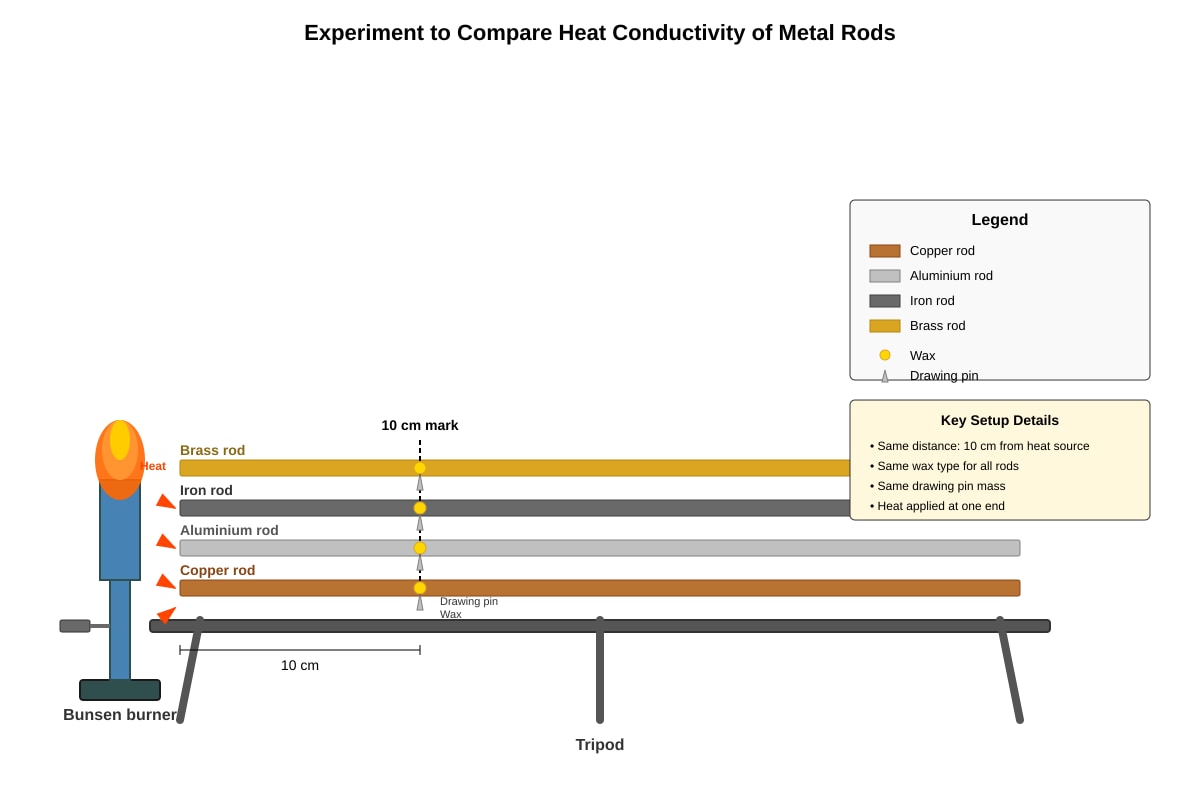
14. The diagram below shows an experiment to compare the conductivity of four different metal rods (copper, aluminium, iron, and brass). Each rod has a drawing pin attached with wax at the same distance from the heat source.

<image_placeholder> id: Q14-fig1 type: experimental_setup linked_question: Q14 description: Four metal rods (copper, aluminium, iron, brass) fixed to a tripod stand, heated at one end by a Bunsen burner. Each rod has a drawing pin attached with wax at 10 cm from the heated end. Labels: "Bunsen burner", "Tripod", "Drawing pin", "Wax", "10 cm". labels: Copper rod, Aluminium rod, Iron rod, Brass rod, Bunsen burner, Drawing pin, Wax, 10 cm mark values: Distance from heat source = 10 cm for all rods, same wax type, same drawing pin mass must_show: Four rods side by side, equal distance markings, drawing pins with wax </image_placeholder>

(a) State the variable that is changed (independent variable) in this experiment.


(b) State the variable that is measured (dependent variable) in this experiment.


15. A student places a thermometer in a beaker of ice water and another in a beaker of boiling water. The readings are 0°C and 100°C respectively.

(a) What is the temperature of pure melting ice?


(b) What is the temperature of pure boiling water at sea level?


Section C: Structured / Open-Ended Questions (5 × 4 marks = 20 marks)

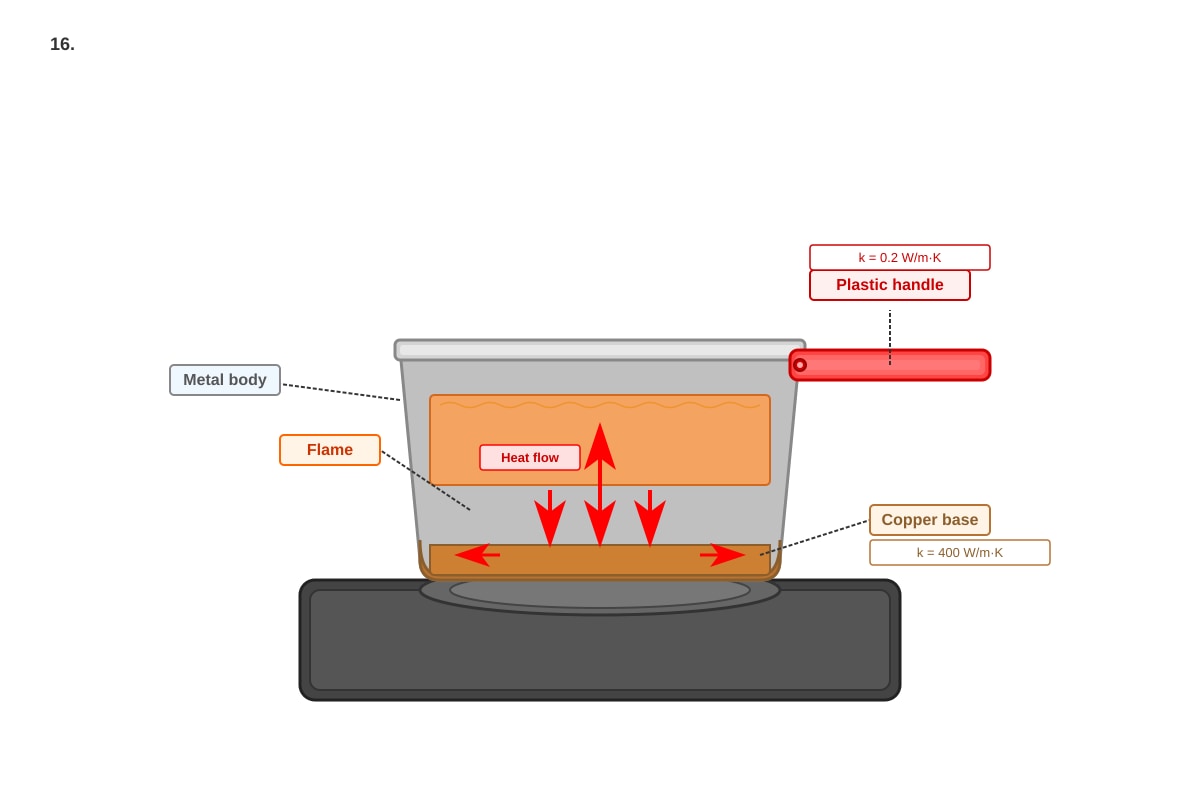
16. The diagram below shows a saucepan with a copper base and a plastic handle.

<image_placeholder> id: Q16-fig1 type: diagram linked_question: Q16 description: Saucepan on a stove. Labels: "Copper base", "Plastic handle", "Metal body", "Flame". Arrows show heat flow from flame to base to food. labels: Copper base, Plastic handle, Metal body, Flame values: Copper conductivity = 400 W/m·K, Plastic conductivity = 0.2 W/m·K must_show: Copper base in contact with flame, plastic handle away from heat </image_placeholder>

(a) Explain why the base of the saucepan is made of copper.


(b) Explain why the handle is made of plastic.


(c) The saucepan is left on the stove with the flame turned off. After some time, the copper base and the food inside reach the same temperature. Explain why.


(d) If the plastic handle is replaced with a metal handle, state one disadvantage.


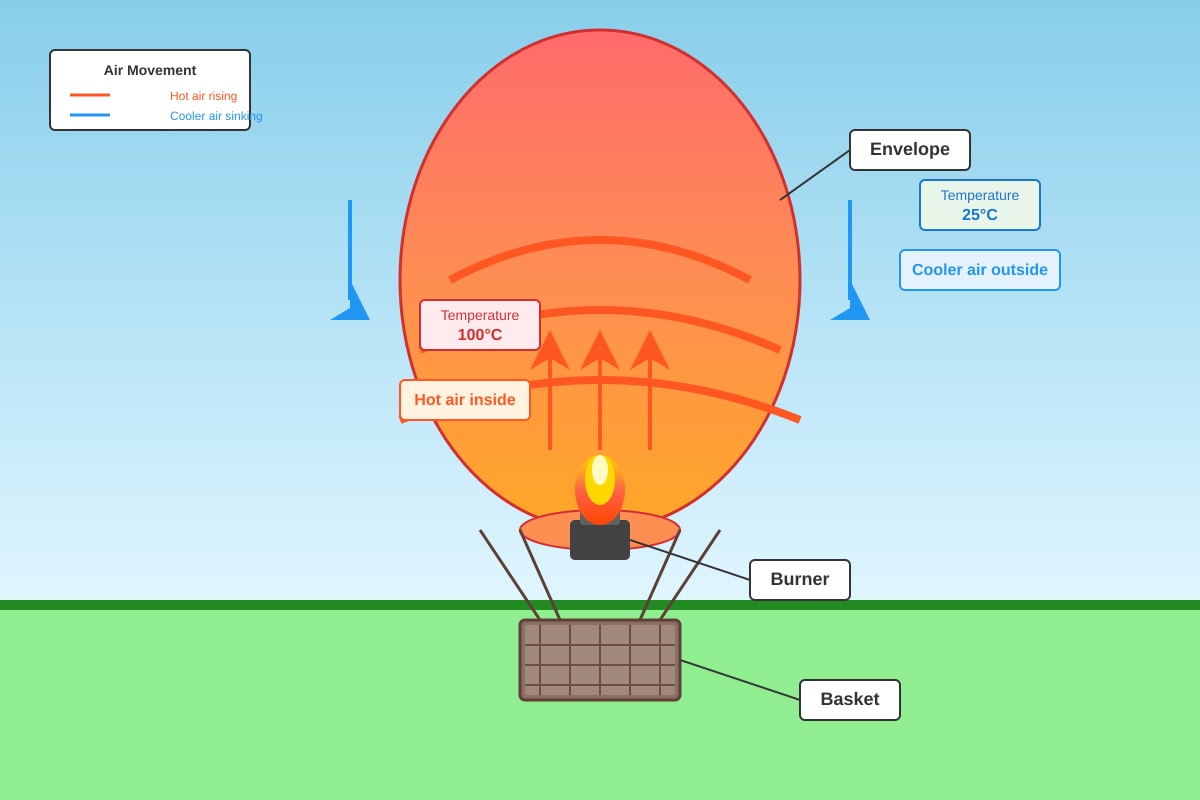
17. The diagram below shows a hot air balloon.

<image_placeholder> id: Q17-fig1 type: diagram linked_question: Q17 description: Hot air balloon with burner heating air inside envelope. Labels: "Envelope", "Burner", "Basket", "Hot air inside", "Cooler air outside". Arrows show hot air rising, cooler air sinking. labels: Envelope, Burner, Basket, Hot air inside, Cooler air outside values: Temperature inside = 100°C, Temperature outside = 25°C must_show: Burner flame, envelope inflated, basket, temperature labels </image_placeholder>

(a) Explain why the hot air balloon rises when the air inside the envelope is heated.


(b) The pilot wants to descend. State what the pilot should do to the burner and explain why this causes the balloon to descend.


(c) At night, the air outside cools down. Explain how this affects the balloon's ability to stay afloat if the burner is not used.


(d) State one safety precaution the pilot must take when using the burner.


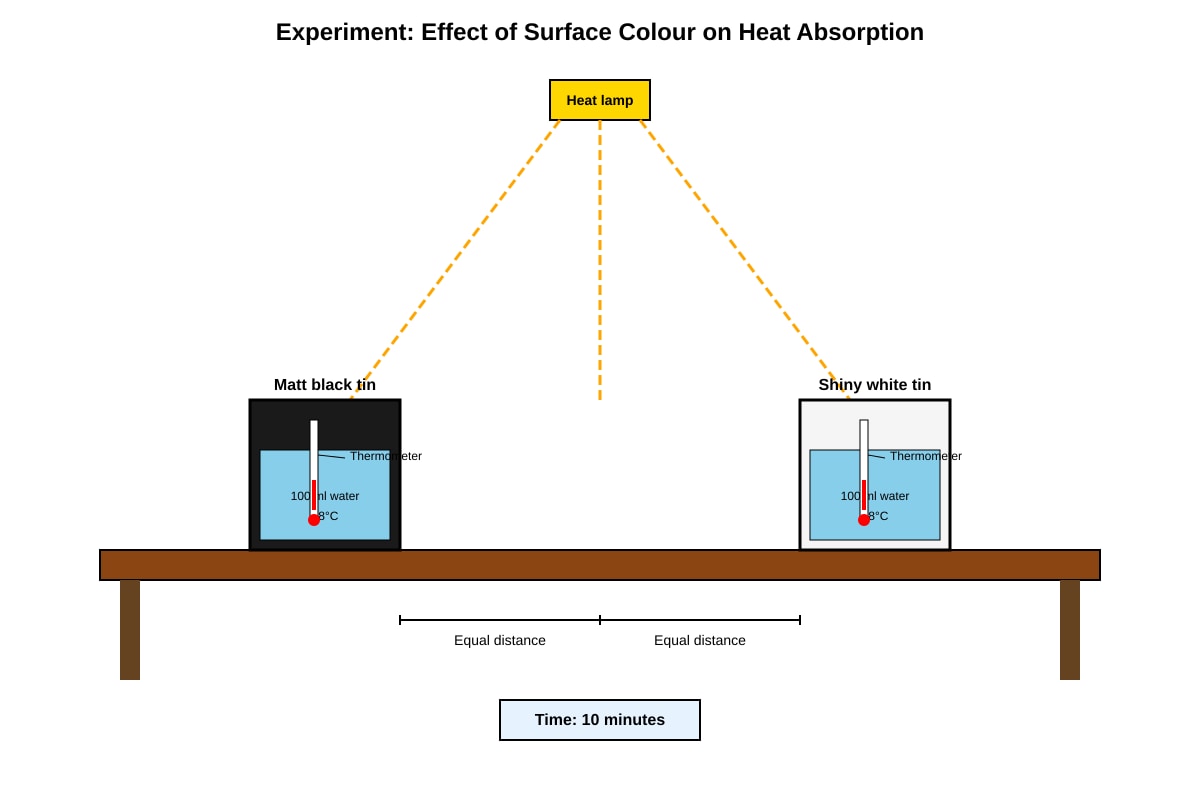
18. A student conducts an experiment to investigate how the colour of a surface affects the amount of heat absorbed by radiation. She uses two identical tins, one painted matt black and the other painted shiny white. Each tin contains 100 ml of water at room temperature. The tins are placed at equal distances from a heat lamp for 10 minutes.

<image_placeholder> id: Q18-fig1 type: experimental_setup linked_question: Q18 description: Two identical tins (one matt black, one shiny white) on a bench, each with a thermometer in water. A heat lamp is positioned equidistant from both tins. Labels: "Matt black tin", "Shiny white tin", "Heat lamp", "Thermometer", "100 ml water", "Equal distance". labels: Matt black tin, Shiny white tin, Heat lamp, Thermometer, 100 ml water, Equal distance values: Water volume = 100 ml each, Time = 10 minutes, Initial temperature = 28°C for both must_show: Two tins with different colours, heat lamp centred, thermometers in water </image_placeholder>

(a) State the hypothesis for this experiment.


(b) Identify two variables that must be kept constant for a fair test.


(c) After 10 minutes, the water in the matt black tin is at 35°C and the water in the shiny white tin is at 31°C. Explain the difference in temperature.


(d) Suggest one way to improve the reliability of the results.


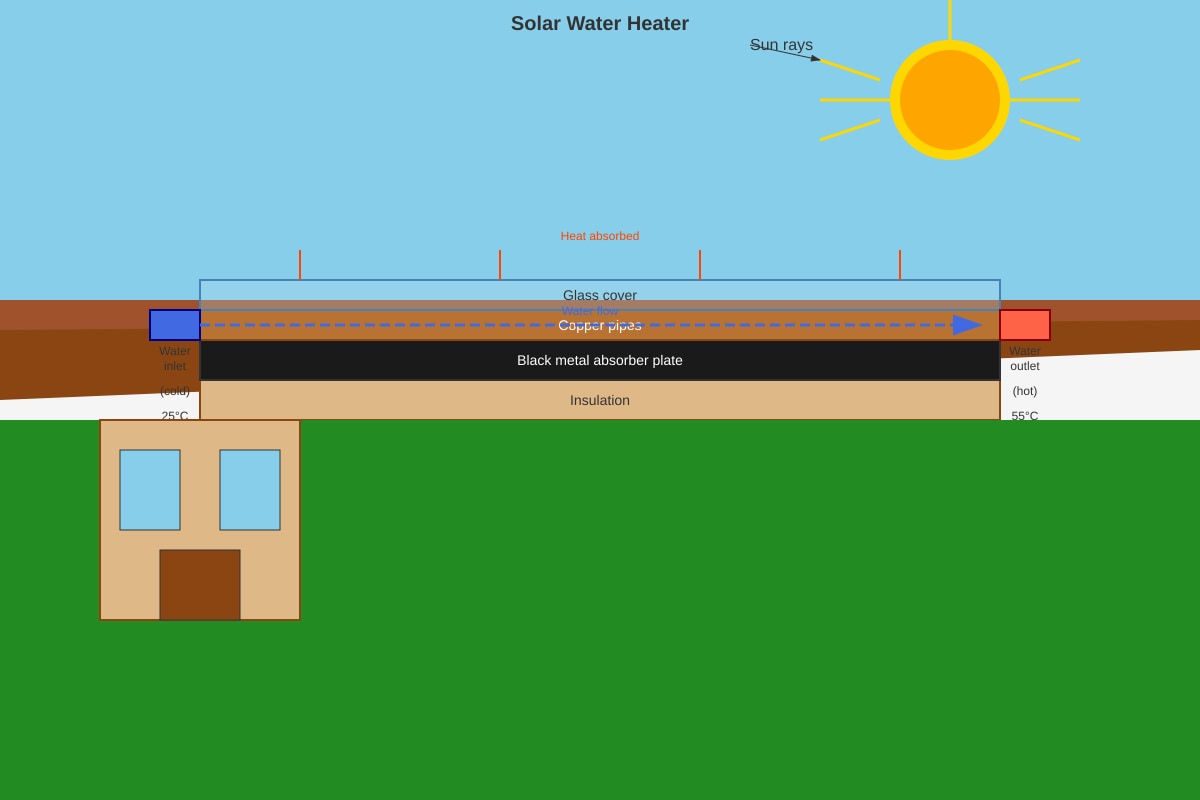
19. The diagram below shows a solar water heater on a roof.

<image_placeholder> id: Q19-fig1 type: diagram linked_question: Q19 description: Solar water heater panel on roof. Labels: "Glass cover", "Black metal absorber plate", "Copper pipes", "Water inlet (cold)", "Water outlet (hot)", "Insulation at back", "Sun rays". Arrows show water flow and sun rays. labels: Glass cover, Black metal absorber plate, Copper pipes, Water inlet, Water outlet, Insulation, Sun rays values: Water inlet temperature = 25°C, Water outlet temperature = 55°C must_show: Glass cover, black absorber, copper pipes, insulation, water flow direction </image_placeholder>

(a) Explain why the absorber plate is painted black.


(b) Explain why the pipes are made of copper.


(c) Explain the purpose of the glass cover.


(d) Explain why insulation is placed at the back of the absorber plate.


20. A metal ball is heated and then placed into a beaker of cold water. The temperature of the water rises while the temperature of the metal ball falls.

(a) State the direction of heat transfer between the metal ball and the water.


(b) Explain why the temperature of the water rises.


(c) The metal ball is replaced with a plastic ball of the same mass and initial temperature. The temperature rise of the water is smaller. Explain why.


(d) If the experiment is repeated with a larger mass of water, state how the final temperature of the water will compare to the first experiment. Explain your answer.


End of Quiz

Answers

<!-- TuitionGoWhere generation metadata: stage=5-1; model=nvidia/nemotron-3-ultra-550b-a55b:free; model_label=NVIDIA Nemotron 3 Ultra 550B A55B Free; generated=2026-06-12; Sources: Stage 4-0 LLM templates, syllabus context, and Stage 2 evidence where available. -->

Primary 5 Science Quiz - Heat (Answer Key)

Total Marks: 40


Section A: Multiple-Choice Questions (10 × 1 mark = 10 marks)

1. Answer: C
Explanation: Heat is a form of energy, not matter. It transfers from hotter to colder regions (not colder to hotter). Heat can travel through a vacuum by radiation (e.g., Sun's heat reaching Earth).

2. Answer: B
Explanation: Metal is a good conductor of heat. It conducts heat away from your hand quickly, making it feel colder. Wood is a poor conductor (insulator), so it does not draw heat from your hand as fast. Both are at room temperature.

3. Answer: B
Explanation: When heated, the metal ball expands (thermal expansion). Its diameter increases, becoming larger than the ring's inner diameter, so it cannot pass through. Mass and density do not increase with heating (mass stays same, density decreases as volume increases).

4. Answer: C
Explanation: Copper is a metal and an excellent conductor of heat. Plastic, wood, and air are poor conductors (insulators).

5. Answer: B
Explanation: The metal rod conducts heat from the hot water to your hand faster than the plastic rod. Both rods absorb heat, but the rate of conduction differs. This demonstrates that metal is a better conductor than plastic.

6. Answer: C
Explanation: The constriction (narrow section) in a clinical thermometer prevents the mercury from flowing back into the bulb immediately after removal from the mouth. This allows the temperature reading to be taken after the thermometer is removed. The mercury must be shaken down to reset.

7. Answer: C
Explanation: Heat from the Sun travels through the vacuum of space by radiation. Conduction and convection require a medium (particles), but space is a vacuum.

8. Answer: B
Explanation: Convection is heat transfer in fluids (liquids and gases) through the movement of the fluid itself. Hot water rises (less dense), cold water sinks (more dense), creating a convection current.

9. Answer: C
Explanation: Heat from a campfire warming your face is primarily by radiation (infrared waves). Sea breeze, land breeze, and hot air balloons involve convection (movement of air due to temperature differences).

10. Answer: B
Explanation: Cotton wool is a good insulator (poor conductor) because it traps air. It reduces heat loss by conduction and convection. Aluminium foil, copper, and steel are metals and good conductors, so they would allow heat to escape quickly.


Section B: Short Answer Questions (5 × 2 marks = 10 marks)

11.
(a) Answer: The bimetallic strip bends because the two metals (brass and iron) expand at different rates when heated. Brass expands more than iron, so the brass side becomes longer, causing the strip to bend towards the iron side.
Marks: 1 mark for "different expansion rates" or "brass expands more than iron", 1 mark for "bends towards the metal that expands less (iron)".

(b) Answer: Brass expands more than iron when heated.
Marks: 1 mark

12.
(a) Answer: Gaps are left to allow for expansion of the metal rails on hot days. Without gaps, the rails would expand and buckle or bend, which could cause train derailment.
Marks: 1 mark for "allow expansion", 1 mark for "prevent buckling/bending/derailment".

(b) Answer: The rails would expand and buckle (bend sideways) or push against each other, potentially causing damage to the track and danger to trains.
Marks: 1 mark for "buckle/bend", 1 mark for "damage/danger" (or combined 2 marks for complete answer).

13.
(a) Answer: The vacuum prevents heat loss by conduction and convection because there are no particles (or very few) in a vacuum to transfer heat through these methods.
Marks: 1 mark for "no particles", 1 mark for "stops conduction and convection".

(b) Answer: The silvered (shiny) surfaces reflect radiant heat back into the flask (or reflect external heat away), reducing heat loss by radiation.
Marks: 1 mark for "reflect heat/radiation", 1 mark for "reduces radiation heat loss".

14.
(a) Answer: The type of metal rod (copper, aluminium, iron, brass).
Marks: 1 mark

(b) Answer: The time taken for the wax to melt and the drawing pin to drop (or the distance the heat travels along the rod in a fixed time).
Marks: 1 mark

15.
(a) Answer: 0°C
Marks: 1 mark

(b) Answer: 100°C
Marks: 1 mark


Section C: Structured / Open-Ended Questions (5 × 4 marks = 20 marks)

16.
(a) Answer: Copper is a good conductor of heat. It allows heat from the flame to transfer quickly and evenly to the food in the saucepan.
Marks: 1 mark for "good conductor", 1 mark for "quick/even heat transfer to food".

(b) Answer: Plastic is a poor conductor of heat (insulator). It prevents heat from the saucepan body from reaching the handle, so the handle stays cool and safe to hold.
Marks: 1 mark for "poor conductor/insulator", 1 mark for "handle stays cool/safe to hold".

(c) Answer: Heat continues to transfer from the hotter copper base to the cooler food until both reach the same temperature (thermal equilibrium). At this point, there is no net heat transfer between them.
Marks: 1 mark for "heat transfers from hot to cold", 1 mark for "reach same temperature/thermal equilibrium".

(d) Answer: The metal handle would become very hot and could burn the user's hand. (Metal is a good conductor of heat.)
Marks: 1 mark for "handle gets hot/burn risk", 1 mark for "metal conducts heat well" (or combined 1 mark for complete answer).

17.
(a) Answer: When the air inside the envelope is heated, it expands and becomes less dense than the cooler air outside. The less dense hot air rises, creating an upward buoyant force that lifts the balloon.
Marks: 1 mark for "air expands/less dense", 1 mark for "less dense than outside air", 1 mark for "buoyant force/upward force lifts balloon".

(b) Answer: The pilot should turn off the burner (or reduce the flame). This allows the air inside to cool down, become denser, and the buoyant force decreases, causing the balloon to descend.
Marks: 1 mark for "turn off/reduce burner", 1 mark for "air cools/becomes denser", 1 mark for "buoyant force decreases/balloon descends".

(c) Answer: As the outside air cools at night, it becomes denser. This increases the density difference between the inside (heated) air and outside air, increasing the buoyant force. The balloon would rise higher or require less burner use to stay afloat. If the burner is not used, the inside air also cools, and the balloon will eventually descend as the temperature difference decreases.
Marks: 1 mark for "outside air cools/becomes denser", 1 mark for "greater density difference/increased buoyancy", 1 mark for "balloon rises higher or needs less burner" (or "descends if burner off").

(d) Answer: The pilot must ensure there are no flammable materials near the burner, or must have a fire extinguisher on board, or must check for gas leaks before flight. (Any one valid safety precaution.)
Marks: 1 mark for any reasonable safety precaution related to burner/fire/gas.

18.
(a) Answer: A matt black surface absorbs more heat by radiation than a shiny white surface.
Marks: 1 mark

(b) Answer: (Any two) Volume of water (100 ml), initial temperature of water, distance from heat lamp, time of heating (10 minutes), size and shape of tins, type of thermometer, surrounding conditions.
Marks: 1 mark each for two correct variables.

(c) Answer: The matt black surface is a better absorber of radiant heat than the shiny white surface. It absorbs more heat from the heat lamp, transferring more heat to the water, causing a greater temperature rise. The shiny white surface reflects more radiation.
Marks: 1 mark for "black absorbs more heat/radiation", 1 mark for "white reflects more", 1 mark for "more heat transferred to water/higher temperature rise".

(d) Answer: Repeat the experiment multiple times and calculate the average temperature rise for each tin. (Or: Use more than one tin of each colour and take average.)
Marks: 1 mark for "repeat experiment" or "multiple trials" and "average".

19.
(a) Answer: Black surfaces are good absorbers of radiation. The black absorber plate absorbs maximum heat from the Sun's rays.
Marks: 1 mark for "good absorber of radiation", 1 mark for "absorbs maximum heat from Sun".

(b) Answer: Copper is a good conductor of heat. It quickly transfers the heat absorbed by the plate to the water flowing through the pipes.
Marks: 1 mark for "good conductor of heat", 1 mark for "quickly transfers heat to water".

(c) Answer: The glass cover allows sunlight (short-wave radiation) to pass through to the absorber plate but traps the longer-wave infrared radiation (heat) emitted by the hot plate, reducing heat loss by convection and radiation (greenhouse effect).
Marks: 1 mark for "lets sunlight in", 1 mark for "traps heat/reduces heat loss by convection and radiation".

(d) Answer: Insulation at the back reduces heat loss from the absorber plate to the surroundings by conduction and convection, ensuring more heat is transferred to the water in the pipes.
Marks: 1 mark for "reduces heat loss to surroundings", 1 mark for "by conduction/convection" or "more heat to water".

20.
(a) Answer: Heat transfers from the metal ball to the water. (From hotter object to colder object.)
Marks: 1 mark

(b) Answer: The metal ball is at a higher temperature than the water. Heat energy flows from the hotter ball to the cooler water, increasing the kinetic energy of the water molecules, which raises the water temperature.
Marks: 1 mark for "heat flows from hot to cold", 1 mark for "increases kinetic energy of water molecules/temperature rises".

(c) Answer: Plastic is a poor conductor of heat compared to metal. Heat transfers more slowly from the plastic ball to the water, so less heat is transferred in the same time, resulting in a smaller temperature rise.
Marks: 1 mark for "plastic is poor conductor", 1 mark for "slower heat transfer/less heat transferred in same time".

(d) Answer: The final temperature of the water will be lower than in the first experiment. With a larger mass of water, the same amount of heat from the ball is distributed among more water molecules, resulting in a smaller temperature increase per unit mass.
Marks: 1 mark for "lower final temperature", 1 mark for "same heat shared among more water molecules/smaller temperature rise per unit mass".


Marking Notes:

  • For multi-mark questions, award partial marks for partially correct answers as indicated.
  • Accept scientifically accurate alternative phrasing.
  • Deduct marks for missing units where required (though not heavily tested in this quiz).
  • Common misconceptions to watch for: "cold flows", "heat is a substance", "metal attracts cold", "vacuum 'sucks' heat".