AI Generated Quiz
Primary 5 Science Heat Quiz
Free P5 Science Heat quiz, HY3 AI version, with questions, answers, and syllabus-aligned practice for Singapore students.
These static practice materials are generated from the site's syllabus and paper-generation workflow, with source and model context shown so students and parents can evaluate the material before use.
Questions
Free quiz and exam paper access
Enter your details to view this paper
Your access is remembered on this device.
Answers
Primary 5 Science Quiz - Heat (Answer Key)
Total Marks: 40
Topic: Heat (syllabus-first, LLM-inferred; not past-year derived)
Section A Answers (1 mark each)
1. B) Heat
Teaching note: Heat is the form of energy associated with warmth. Light is seen, sound is heard, kinetic is motion energy.
Common mistake: Choosing kinetic because particles move; but "feel as warmth" points to heat.
2. C) Melting
Teaching note: Solid (ice) to liquid (water) by heat gain = melting. Freezing is opposite, condensation is gas to liquid, evaporation is liquid to gas.
3. B) 0 °C
Teaching note: Melting point of pure ice is 0 °C (syllabus value). 100 °C is boiling point of water.
4. A) Conduction
Teaching note: Heat through a solid (metal spoon) by particle collision = conduction.
5. C) 100 °C
Teaching note: Boiling point of water is 100 °C at standard condition.
6. B) Evaporation
Teaching note: Liquid water to water vapour at surface = evaporation; puddle disappears without boiling.
7. C) Wood
Teaching note: Wood is insulator (poor conductor). Metals listed are good conductors.
8. C) Convection
Teaching note: Movement of warm fluid up and cool fluid down = convection.
9. C) Radiation
Teaching note: Heat through empty space (no matter) from Sun = radiation.
10. B) Thick curtains
Teaching note: Thick curtains trap air, reduce conduction/convection loss; metal increases loss.
Section B Answers (2 marks each)
11. Condensation (2 marks)
Teaching note: Gas (water vapour) to liquid on cold surface = condensation. 2 marks for correct term.
12. Increase surface area / increase temperature / place in windy area (2 marks)
Teaching note: Any one correct factor from syllabus (exposed surface area, temperature, wind) = 2 marks.
Marking: 2 marks for valid factor; if vague like "make it hot" without clarity, 1 mark.
13. Metal conducts heat away from hand faster than wood, so hand loses heat quickly and feels cold. (2 marks)
Teaching note: Both at same temp, but metal is good conductor, draws heat from skin; wood is poor conductor.
Marking: 1 mark for "metal conducts heat better", 1 mark for link to feeling cold.
14. Temperature stays at 100 °C while boiling. (2 marks)
Teaching note: During boiling, heat energy breaks bonds, temperature constant at boiling point.
Marking: 2 marks for stating constant at 100 °C; 1 mark if says "does not rise" only.
15. Boiling water (warm water rises, cool sinks) / warm air from radiator rising (2 marks)
Teaching note: Daily example of convection in fluid.
Marking: 2 marks for clear example; 1 mark if incomplete.
16. Woollen clothes trap air, which is a poor conductor, reducing heat loss from body. (2 marks)
Teaching note: Air pockets insulate.
Marking: 1 mark wool traps air, 1 mark poor conductor reduces loss.
Section C Answers (3–4 marks each)
17. (4 marks total)
(a) 0 °C (1 mark)
(b) Melting (1 mark)
(c) Boiling / evaporation (1 mark)
(d) 100 °C (1 mark)
Teaching note: While melting, temp constant at melting point; boiling point is 100 °C. All values from syllabus.
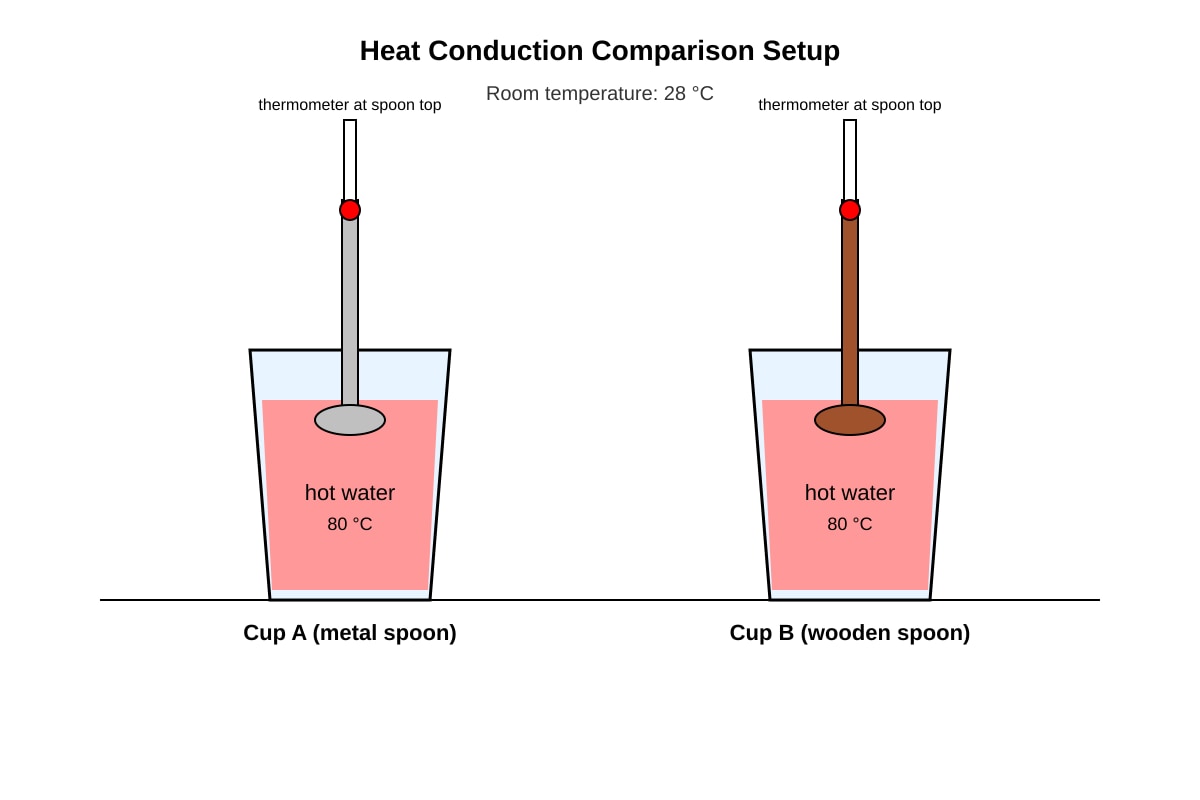
18. (4 marks total, based on image_placeholder Q18-fig1)
Expected visual: Two cups with hot water 80 °C, metal spoon in A, wooden in B, thermometers at tops.
(a) Metal spoon (Cup A) (1 mark)
(b) Metal is good conductor, heat travels from water up spoon to thermometer; wood is poor conductor so less heat reaches top. (2 marks: 1 for conduction mention, 1 for compare)
(c) To measure temperature at spoon top / record heat transfer. (1 mark)
19. (4 marks total)
(a) Radiation (from flame to pot) OR conduction if direct contact; syllabus: stove to pot often conduction/radiation. Accept conduction if flame touches. (1 mark)
(b) Convection (1 mark)
(c) Water at bottom heated, becomes less dense and rises; cooler water sinks, gets heated, forming circulation. (2 marks: 1 rise of warm, 1 sink of cool/current)
Teaching note: Convection needs fluid movement.
20. (4 marks total)
(a) Lid, thick pot, towel, flask (any two) (2 marks: 1 each)
(b) Lid reduces evaporation and convection loss; towel/insulator traps air, poor conductor. (2 marks: 1 explanation each)
Teaching note: Link object to heat transfer reduction.