AI Generated Quiz
Primary 5 Science Diversity Quiz
Free Kimi AI-generated P5 Science Diversity quiz with questions, answers, and syllabus-aligned practice for Singapore students preparing for school assessments.
These static practice materials are generated from the site's syllabus and paper-generation workflow, with source and model context shown so students and parents can evaluate the material before use.
Questions
Primary 5 Science Quiz - Diversity
Name: _________________________________ Class: _______ Date: _____________
Score: _______ / 40
Duration: 40 minutes
Total Marks: 40 marks
Instructions:
- Answer all questions.
- Write your answers in the spaces provided.
- For multiple-choice questions, circle the correct answer.
Section A: Multiple Choice (Questions 1–8)
Choose the correct answer. Each question carries 2 marks.
1. Which of the following groups of living things are all plants?
| A | B | C | D |
|---|---|---|---|
| Rose, mushroom, fern | Fern, moss, grass | Mushroom, mould, yeast | Grass, bird, fern |
Answer: _______
2. Animals can be grouped by how they reproduce. A crocodile lays eggs on land, while a whale gives birth to live young. This difference is used to classify them into:
A. Mammals and reptiles B. Vertebrates and invertebrates C. Carnivores and herbivores D. Amphibians and fish
Answer: _______
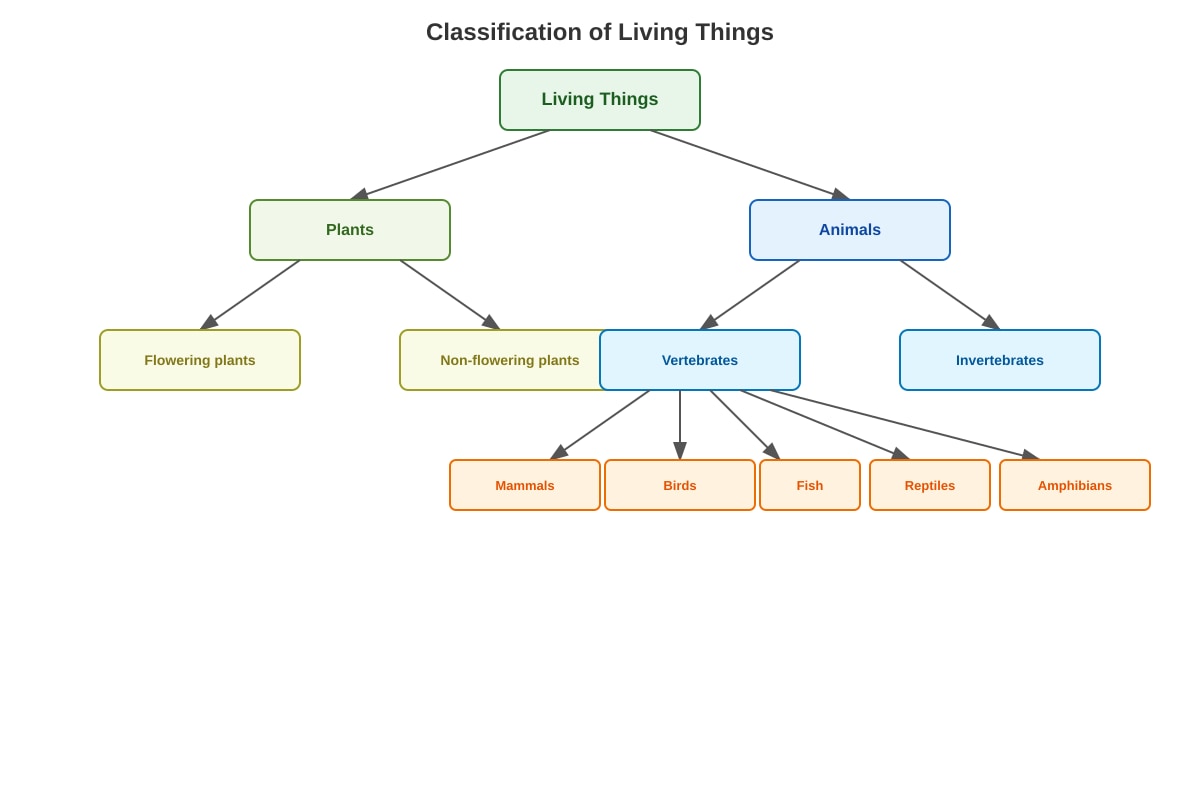
3. The diagram below shows how organisms are classified into groups based on their characteristics.
<image_placeholder> id: Q3-fig1 type: diagram linked_question: Q3 description: Classification flowchart showing branching from "Living Things" to "Plants" and "Animals", then further branches labels: Living Things, Plants, Animals, Flowering plants, Non-flowering plants, Vertebrates, Invertebrates, Mammals, Birds, Fish, Reptiles, Amphibians values: None must_show: Clear hierarchical branching with all labels readable; arrows showing classification direction; boxes around each category </image_placeholder>
Study the flowchart. Which statement about the flowchart is correct?
A. All vertebrates are warm-blooded B. All flowering plants produce seeds C. All invertebrates do not have bones D. All non-flowering plants reproduce using spores only
Answer: _______
4. Four different organisms were observed. Their characteristics are recorded below:
| Organism | Has backbone | Lives in water | Has feathers | Lays eggs |
|---|---|---|---|---|
| P | Yes | Yes | No | Yes |
| Q | Yes | No | Yes | Yes |
| R | No | Yes | No | No |
| S | Yes | Yes | No | No |
Which organism is most likely a fish?
A. P B. Q C. R D. S
Answer: _______
5. Fungi such as mushrooms and moulds are placed in a separate group from plants because fungi:
A. cannot move from place to place B. do not carry out photosynthesis C. do not grow or reproduce D. do not need water to survive
Answer: _______
6. A student found an organism in a garden. It had six legs, two pairs of wings, and three body parts (head, thorax, abdomen). To which group does this organism belong?
A. Crustaceans B. Arachnids C. Insects D. Molluscs
Answer: _______
7. Bacteria are often grouped with other microorganisms. Which of the following statements about bacteria is true?
A. All bacteria cause diseases in humans B. Bacteria are larger than plant cells C. Some bacteria can make their own food D. Bacteria have a nucleus and chloroplasts
Answer: _______
8. The table below shows how four different vertebrates regulate their body temperature.
| Animal | Body temperature regulation |
|---|---|
| W | Constant body temperature; not affected by surroundings |
| X | Body temperature changes with surroundings |
| Y | Constant body temperature; not affected by surroundings |
| Z | Body temperature changes with surroundings |
Which animals are most likely a bird and a reptile?
A. W = bird; Z = reptile B. X = bird; Y = reptile C. W = reptile; X = bird D. Z = bird; W = reptile
Answer: _______
Section B: Fill in the Blanks and Short Answer (Questions 9–14)
Write your answers in the spaces provided.
9. Complete the classification of living things by filling in the missing words. The first one is done for you. [4 marks]
(a) Living things can be grouped into Plants and Animals.
(b) Animals can be further grouped into those with backbones, called ________________, and those without backbones, called ________________.
(c) Vertebrates include mammals, birds, fish, ________________, and ________________.
(d) Plants that produce seeds are called ________________ plants, while those that do not produce seeds are called ________________ plants.
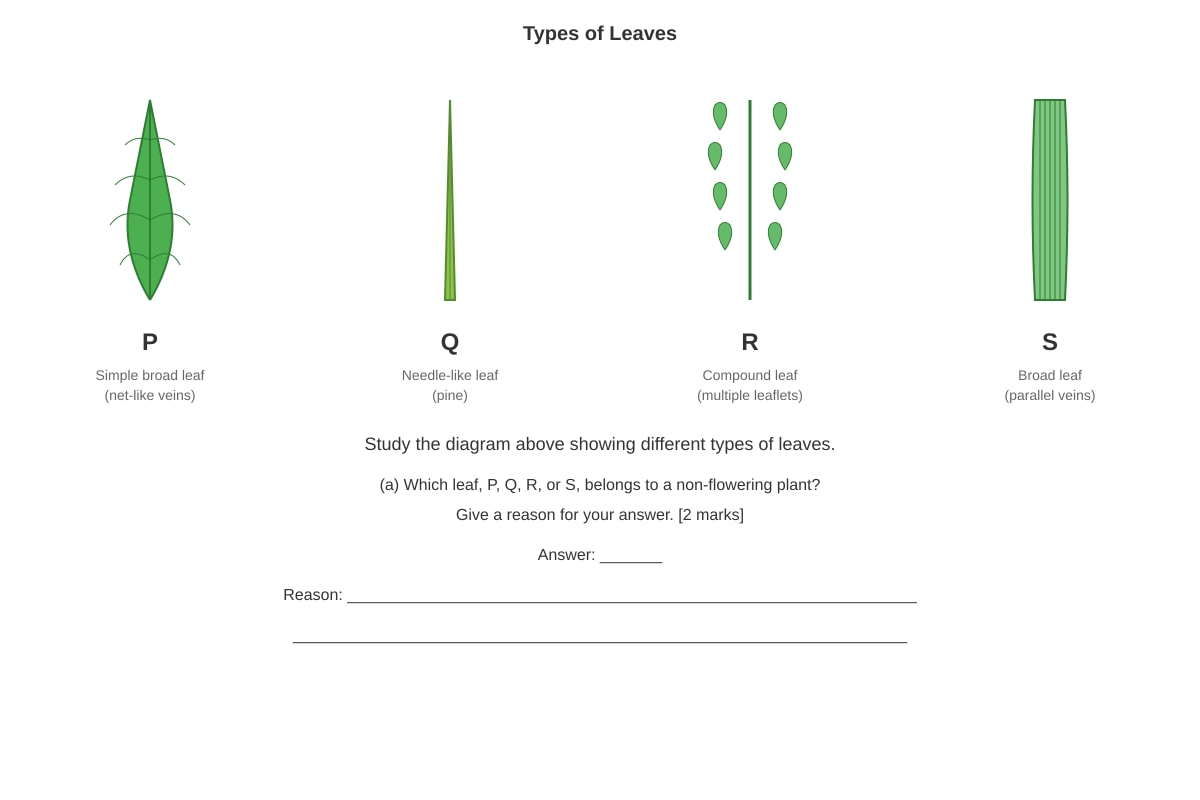
10. Study the diagram below showing different types of leaves.
<image_placeholder> id: Q10-fig1 type: diagram linked_question: Q10 description: Four different leaf shapes arranged in a row, labeled P, Q, R, S labels: P, Q, R, S values: None must_show:
- Leaf P: simple broad leaf with net-like veins (e.g., hibiscus)
- Leaf Q: simple needle-like leaf (e.g., pine)
- Leaf R: compound leaf with multiple leaflets (e.g., mimosa)
- Leaf S: broad leaf with parallel veins (e.g., grass/lily)
- All leaves clearly labeled P, Q, R, S below each leaf </image_placeholder>
(a) Which leaf, P, Q, R, or S, belongs to a non-flowering plant? Give a reason for your answer. [2 marks]
Answer: _______
Reason: ________________________________________________________________
(b) Explain why scientists use leaf shape and vein patterns to classify plants. [2 marks]
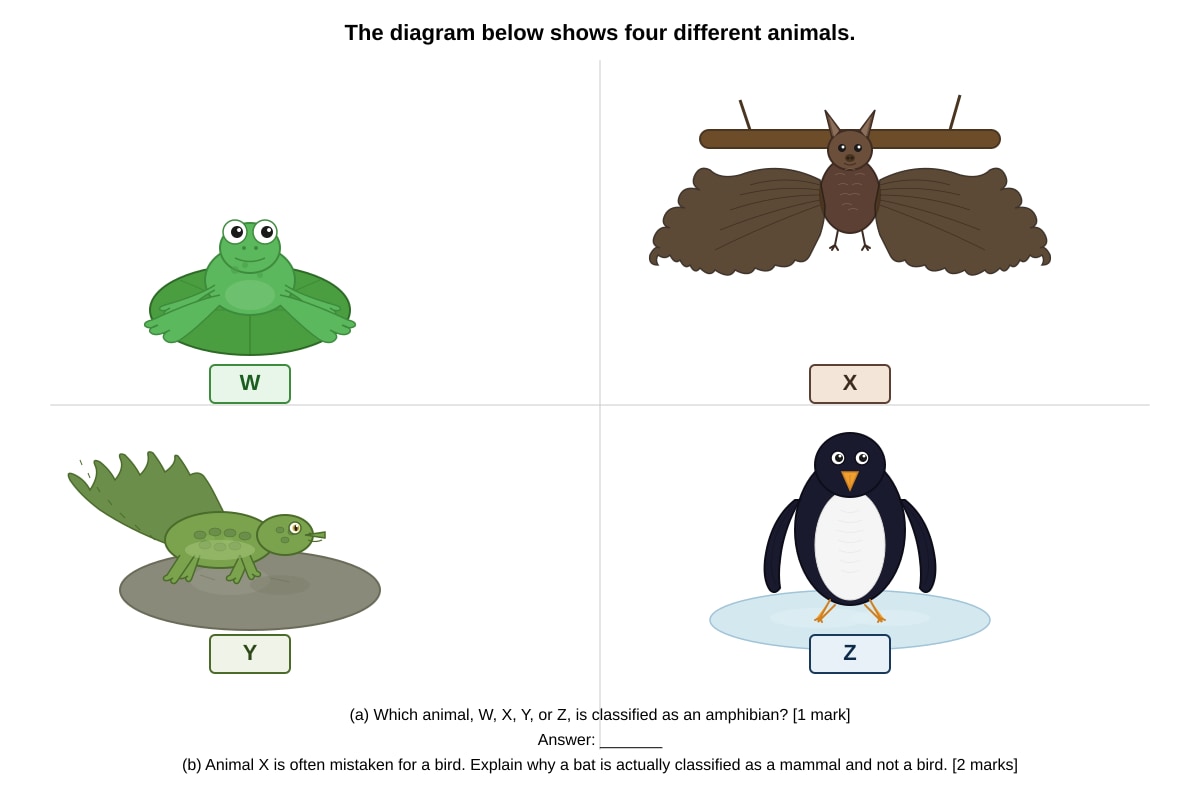
11. The diagram below shows four different animals.
<image_placeholder> id: Q11-fig1 type: diagram linked_question: Q11 description: Four animals arranged in a grid: frog, bat, lizard, penguin labels: W (frog), X (bat), Y (lizard), Z (penguin) values: None must_show:
- Animal W: frog with moist skin, webbed feet, sitting on lily pad
- Animal X: bat with wings extended, fur visible, hanging upside down
- Animal Y: lizard with scales, four legs, tail, on rock
- Animal Z: penguin with black and white feathers, wings adapted as flippers, standing
- Each animal clearly labeled W, X, Y, Z below </image_placeholder>
(a) Which animal, W, X, Y, or Z, is classified as an amphibian? [1 mark]
Answer: _______
(b) Animal X is often mistaken for a bird. Explain why a bat is actually classified as a mammal and not a bird. [2 marks]
(c) Animal Z lives in very cold conditions. Describe two adaptations that help it survive in its environment. [2 marks]
12. Microorganisms are too small to be seen with the unaided eye. However, they play important roles in our lives.
(a) Name one beneficial use of bacteria. [1 mark]
(b) Name one harmful effect of microorganisms. [1 mark]
(c) Explain why fungi such as yeast are important in bread-making. [2 marks]
13. The table below shows characteristics of four different organisms.
| Characteristic | Organism A | Organism B | Organism C | Organism D |
|---|---|---|---|---|
| Has chloroplasts | Yes | No | No | No |
| Has a nucleus | Yes | Yes | Yes | No |
| Can move on its own | No | Yes | Yes | Yes |
| Can make own food | Yes | No | No | No |
| Is multicellular | Yes | Yes | No | No |
(a) Which organism is most likely a bacterium? Explain your answer. [2 marks]
Answer: _______
Explanation: ___________________________________________________________
(b) Which two organisms are most likely animals? [1 mark]
Answer: _______ and _______
(c) Explain why organisms that can make their own food are important in any ecosystem. [2 marks]
14. Plant diversity is important for maintaining healthy ecosystems.
(a) Explain why having many different types of plants in a forest is better than having only one type of plant. [2 marks]
(b) Name one way that humans threaten plant diversity, and suggest one action we can take to protect it. [2 marks]
Threat: _______________________________________________________________
Solution: _____________________________________________________________
Section C: Application and Reasoning (Questions 15–20)
Answer all questions. Show your working and reasoning clearly.
15. A student was given four unknown specimens to classify: J, K, L, and M. She recorded her observations in the table below.
| Specimen | Can move | Make own food | Has wings | Has feathers | Has moist skin |
|---|---|---|---|---|---|
| J | Yes | No | Yes | No | No |
| K | Yes | No | No | No | Yes |
| L | No | Yes | No | No | No |
| M | Yes | No | Yes | Yes | No |
(a) Which specimen is most likely a plant? Give a reason. [1 mark]
Answer: _______
Reason: ________________________________________________________________
(b) Specimen J and Specimen M can both fly. Explain how you would tell them apart using other characteristics from the table. [2 marks]
(c) To which group of vertebrates does Specimen K most likely belong? [1 mark]
Answer: _________________________________________________________________
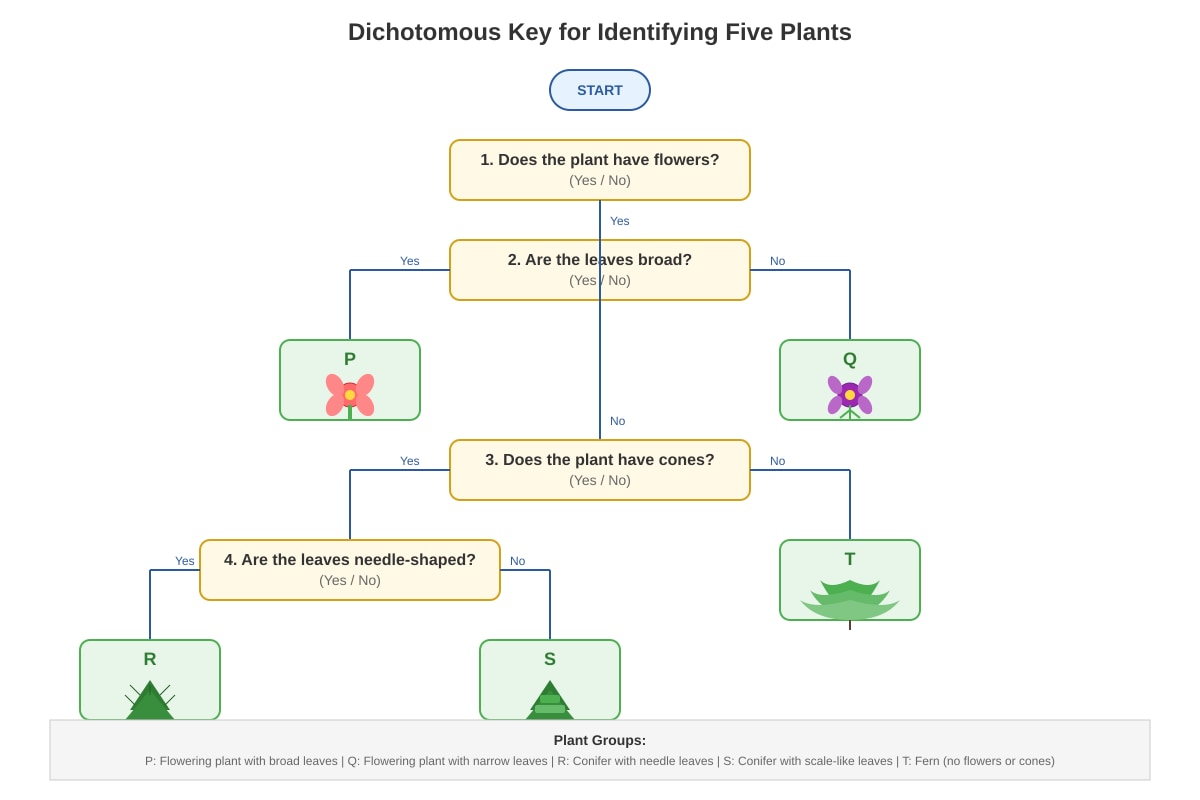
16. The diagram below shows the branching keys used to identify five different plants: P, Q, R, S, and T.
<image_placeholder> id: Q16-fig1 type: diagram linked_question: Q16 description: Dichotomous key (branching diagram) for identifying five plants based on yes/no questions labels: P, Q, R, S, T and various questions about plant characteristics values: None must_show:
- Start: "1. Does the plant have flowers?"
- Yes branch leads to "2. Are the leaves broad?" → Yes: P, No: Q
- No branch leads to "3. Does the plant have cones?"
- Yes branch leads to "4. Are the leaves needle-shaped?" → Yes: R, No: S
- No branch leads to: T
- All five plants (P, Q, R, S, T) at endpoints with simple illustrations </image_placeholder>
Answer the following questions based on the key.
(a) Which plant is a fern? Explain how you used the key to identify it. [2 marks]
Answer: _______
Explanation: ___________________________________________________________
(b) Plants P and Q are both flowering plants. State one characteristic you could use to tell them apart in real life, based on the key. [1 mark]
(c) Plant R is most likely a pine tree. Explain why pine trees are classified as non-flowering plants even though they produce seeds. [2 marks]
17. Seaweeds and seagrasses look similar and both grow in the sea. However, scientists classify them in different groups.
| Feature | Seaweed | Seagrass |
|---|---|---|
| Has true roots, stems, leaves | No | Yes |
| Has chloroplasts | Yes | Yes |
| Type of organism | Algae (Protist) | Flowering plant |
| Reproduction | Spores | Seeds and flowers |
(a) Explain why seagrass is classified as a plant but seaweed is not, despite both having chloroplasts. [2 marks]
(b) A fisherman finds a green organism in the sea. It has no true roots, stems, or leaves. Is it more likely to be seaweed or seagrass? Explain your answer. [2 marks]
18. The table below shows information about different groups of invertebrates.
| Group | Number of legs | Body covering | Example |
|---|---|---|---|
| Insects | 6 | Hard outer skeleton (exoskeleton) | Butterfly |
| Arachnids | 8 | Hard outer skeleton (exoskeleton) | Spider |
| Crustaceans | More than 8 (usually 10+) | Hard outer skeleton (exoskeleton) | Crab |
| Molluscs | 0 (usually have a muscular foot) | Soft body, often with shell | Snail |
(a) Based on the table, suggest one feature that all insects, arachnids, and crustaceans share. [1 mark]
(b) A student finds an invertebrate with 10 legs and a hard outer covering. To which group does it belong? [1 mark]
(c) Explain why having an exoskeleton is useful for insects like grasshoppers. [2 marks]
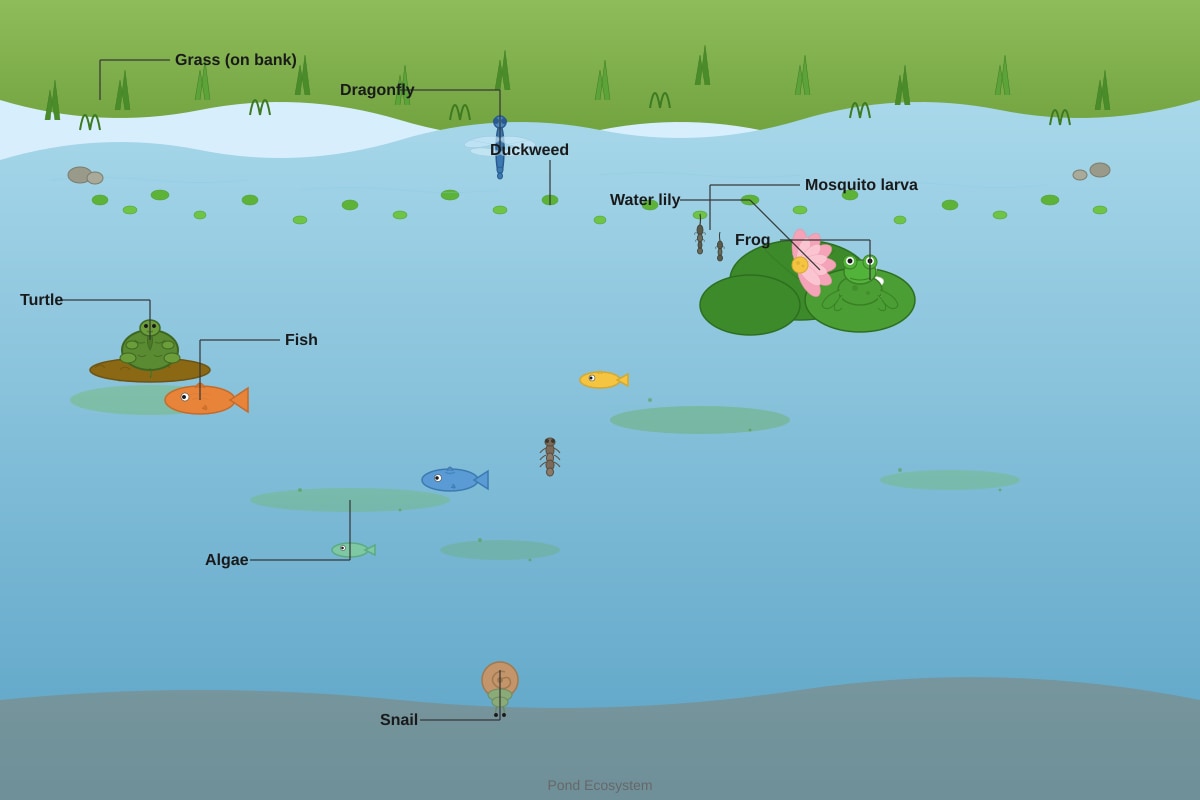
19. The photograph below shows a habitat with many different types of organisms.
<image_placeholder> id: Q19-fig1 type: diagram linked_question: Q19 description: Illustration of a pond ecosystem with various organisms and plants labels: Fish, Frog, Water lily, Algae, Dragonfly, Duckweed, Turtle, Mosquito larva, Snail, Grass (on bank) values: None must_show:
- Pond with water area and grassy bank
- Water lily with broad floating leaves and flowers
- Duckweed as small floating green dots
- Algae as green film/suspension in water
- Fish swimming underwater (various sizes)
- Frog on lily pad
- Dragonfly flying above water and larva in water
- Turtle basking on log
- Snail on pond bottom
- Mosquito larva near surface
- Grass and small plants on bank
- Labels pointing to each organism </image_placeholder>
(a) Name one flowering plant and one non-flowering plant shown in the diagram. [2 marks]
Flowering plant: _______________________________________________________
Non-flowering plant: ___________________________________________________
(b) The fish, frog, and turtle are all vertebrates. State two ways they are alike as vertebrates, and one way they differ in how they breathe. [3 marks]
Similarities (vertebrates):
Difference in breathing:
(c) Explain why having both flowering plants and non-flowering plants in the pond makes the ecosystem more stable. [2 marks]
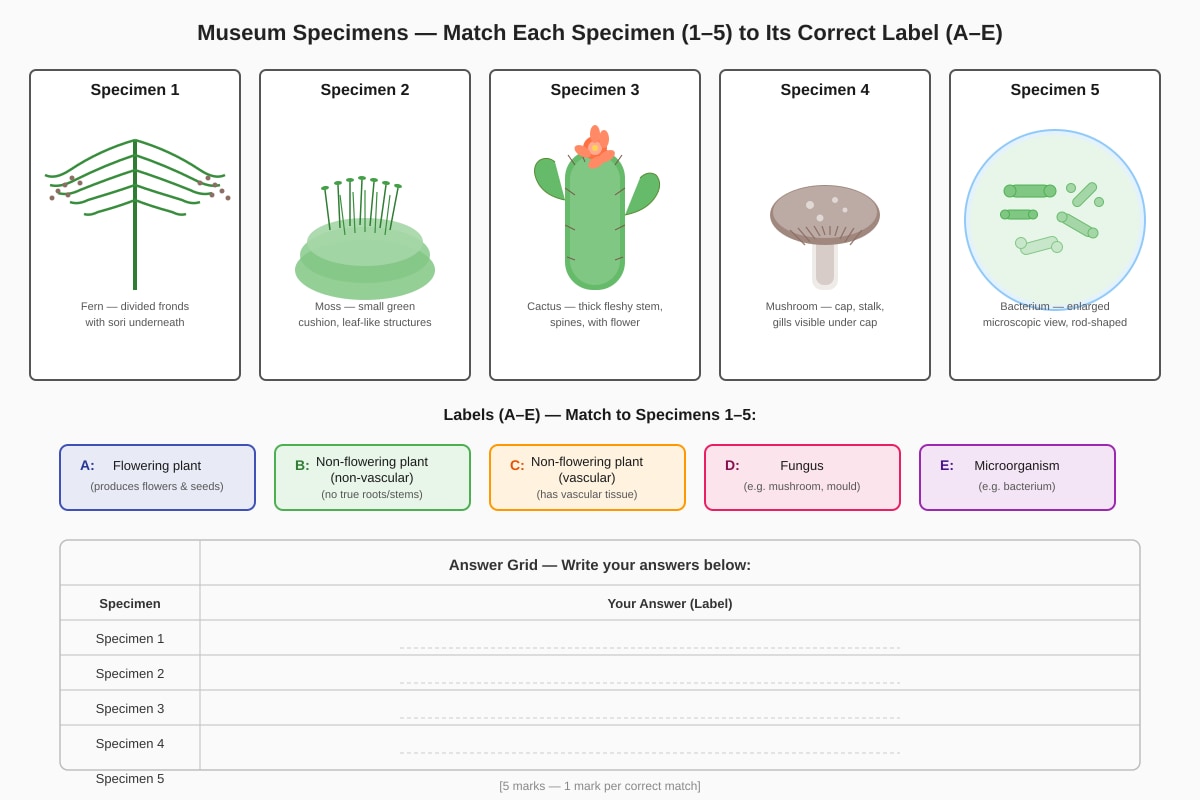
20. A museum has received five preserved specimens to label for a diversity exhibition. The labels were accidentally mixed up. The specimens are: fern, moss, cactus, mushroom, and bacterium.
<image_placeholder> id: Q20-fig1 type: diagram linked_question: Q20 description: Five museum specimens in display cases, labeled 1-5 with mixed-up labels A-E labels: Specimen 1, Specimen 2, Specimen 3, Specimen 4, Specimen 5; Labels A-E values: None must_show:
- Specimen 1: Fern with divided fronds and visible spore cases (sori) underneath
- Specimen 2: Moss as small green cushion with tiny leaf-like structures
- Specimen 3: Cactus with thick fleshy stem, spines, and possibly showing flower
- Specimen 4: Mushroom with cap and stalk, gills visible under cap
- Specimen 5: Bacterium (shown as enlarged microscopic view: rod-shaped, no distinct nucleus)
- Labels A-E as cards below: "Flowering plant", "Non-flowering plant", "Fungus", "Microorganism", "Non-flowering plant (vascular)"
- Simple display case frames around each </image_placeholder>
(a) Match each specimen (1–5) to its correct label (A–E) from the choices below. Write your answers in the format: Specimen ___ = Label ___ [5 marks]
Labels available:
- A: Flowering plant
- B: Non-flowering plant (non-vascular)
- C: Non-flowering plant (vascular)
- D: Fungus
- E: Microorganism
Your matching:
| Specimen | Correct Label | ||
|---|---|---|---|
| 1 | = | ||
| 2 | = | ||
| 3 | = | ||
| 4 | = | ||
| 5 | = |
(b) Explain why the mushroom is not classified as a plant, even though it is often found growing on dead wood in forests. [2 marks]
(c) The cactus has a thick, fleshy stem. Explain how this adaptation helps it survive in its natural habitat. [2 marks]
END OF QUIZ
Answers
Primary 5 Science Quiz - Diversity: Answer Key
Total Marks: 40 marks
Section A: Multiple Choice (Questions 1–8)
2 marks each
1. B — Fern, moss, grass [2 marks]
Explanation: Ferns and mosses are non-flowering plants, and grass is a flowering plant. All three are plants. Mushrooms (A, C) and mould/yeast (C) are fungi, not plants. Birds (D) are animals, not plants.
Common mistake: Choosing A because fern and rose are plants but forgetting mushroom is a fungus.
2. A — Mammals and reptiles [2 marks]
Explanation: Crocodiles are reptiles (lay eggs on land, have scales). Whales are mammals (give birth to live young, feed young with milk). This difference in reproduction method is a key way to distinguish these two groups of vertebrates.
Key concept: Reproduction method (eggs vs. live birth) is a major classification criterion for vertebrates.
3. C — All invertebrates do not have bones [2 marks]
Explanation: Looking at the flowchart, invertebrates are defined as animals without backbones (no vertebral column/bones). This is the defining characteristic.
- A is incorrect: Fish are vertebrates but are cold-blooded, not warm-blooded.
- B is incorrect: While most flowering plants produce seeds, some flowering plants can reproduce vegetatively (without seeds) as well.
- D is incorrect: Some non-flowering plants like ferns reproduce by spores, but others like mosses also reproduce by spores; however, the word "only" makes this too absolute and incorrect since some non-flowering plants can reproduce in other ways.
4. A — P [2 marks]
Explanation: Fish are vertebrates (have backbone/backbone), live in water, do NOT have feathers, and LAY EGGS.
- Organism P: backbone ✓, water ✓, no feathers ✓, lays eggs ✓ — matches fish
- Organism Q: has feathers — this is a bird
- Organism R: no backbone — invertebrate (perhaps a jellyfish or shrimp)
- Organism S: no eggs — this is a mammal (like a whale or dolphin) that gives live birth
5. B — do not carry out photosynthesis [2 marks]
Explanation: Fungi are not plants because they cannot make their own food through photosynthesis. They lack chlorophyll and chloroplasts. Instead, fungi absorb nutrients from decaying matter or living hosts.
- A is incorrect: Neither plants nor fungi can move from place to place as adults.
- C is incorrect: Fungi do grow and reproduce (by spores).
- D is incorrect: Fungi do need water to survive and grow.
Key concept: The ability to photosynthesize (make own food) is a defining feature of plants that fungi lack.
6. C — Insects [2 marks]
Explanation: Insects are defined by having six legs, three body parts (head, thorax, abdomen), and usually one or two pairs of wings.
- Crustaceans (A) include crabs and shrimps with more than 6 legs and typically two body parts.
- Arachnids (B) such as spiders have 8 legs and two body parts.
- Molluscs (D) such as snails have soft bodies and no distinct jointed legs.
7. C — Some bacteria can make their own food [2 marks]
Explanation: Some bacteria are chemosynthetic — they can make their own food using chemical energy instead of sunlight. Examples include bacteria found near deep-sea vents.
- A is incorrect: Many bacteria are beneficial (e.g., in yoghurt, nitrogen-fixing bacteria in soil).
- B is incorrect: Bacteria are much smaller than plant cells; bacteria are single-celled microorganisms.
- D is incorrect: Bacteria do NOT have a true nucleus (they are prokaryotes) and do NOT have chloroplasts.
8. A — W = bird; Z = reptile [2 marks]
Explanation: Birds are warm-blooded (endothermic), meaning they maintain a constant body temperature regardless of surroundings. Reptiles are cold-blooded (ectothermic), meaning their body temperature changes with the environment.
- W and Y have constant body temperature = warm-blooded = birds or mammals
- X and Z have changing body temperature = cold-blooded = reptiles, amphibians, or fish
Since the question asks for bird and reptile, and birds are the only option with feathers (typically), W = bird and Z = reptile is correct.
Section B: Fill in the Blanks and Short Answer (Questions 9–14)
9. [4 marks: 1 mark for each correct pair of answers]
(a) Living things can be grouped into Plants and Animals. [Given]
(b) Animals can be further grouped into those with backbones, called vertebrates, and those without backbones, called invertebrates.
(c) Vertebrates include mammals, birds, fish, reptiles, and amphibians. [Either order]
(d) Plants that produce seeds are called flowering plants, while those that do not produce seeds are called non-flowering plants. [Accept: seed-producing / non-seed-producing]
10. (a) Q (1 mark); Reason: It has needle-like leaves, which is characteristic of conifers/pine trees, a type of non-flowering plant. (1 mark) [2 marks total]
Explanation: Non-flowering plants like conifers (pine, fir, spruce) have needle-like or scale-like leaves instead of broad leaves. Leaf P has net-like veins typical of dicot flowering plants. Leaf R is compound, common in some flowering plants like peas or mimosa. Leaf S has parallel veins typical of monocot flowering plants like grasses or lilies.
(b) Explanation: Scientists use leaf shape and vein patterns because these features are consistent within plant groups and help identify whether a plant is a flowering or non-flowering plant. (1 mark) For example, broad leaves with net-like veins usually indicate flowering plants (dicots), while needle-like leaves usually indicate non-flowering conifers. These features are observable and reliable for classification. (1 mark) [2 marks total]
11. (a) W (frog) [1 mark]
(b) A bat is classified as a mammal because it has fur/hair on its body and gives birth to live young (rather than laying eggs). (1 mark for each correct feature, max 2 marks) [2 marks total]
Explanation: Although bats have wings and can fly like birds, they possess mammal characteristics: fur/hair, live birth, and females feed their young with milk. Birds have feathers, lay eggs, and do not have fur.
(c) Any two of: [2 marks total — 1 mark each]
- Layer of fat (blubber) under the skin insulates against cold
- Thick, waterproof feathers provide insulation and keep out water
- Streamlined body reduces heat loss and helps swimming
- Darker feathers on back absorb heat from sunlight
- Huddling together in groups to share body heat
12. (a) Any one of: [1 mark]
- Making yoghurt / cheese from milk
- Breaking down waste in composting / decomposition
- Nitrogen fixation in soil for plant growth
- Making medicine (antibiotics like penicillin)
- Sewage treatment
(b) Any one of: [1 mark]
- Causing diseases (food poisoning, sore throats, etc.)
- Making food rot / spoil
- Causing tooth decay
(c) Yeast is a fungus that ferments the sugars in bread dough. (1 mark) This process produces carbon dioxide gas, which makes the bread rise and become soft and fluffy. (1 mark) [2 marks total]
Explanation: Fermentation is a process where yeast breaks down sugar without using oxygen, producing carbon dioxide and a small amount of alcohol (which evaporates during baking). The CO₂ creates air pockets in the dough.
13. (a) Organism D (1 mark); Explanation: It has no nucleus (prokaryotic cell structure), which is the defining feature of bacteria. All other organisms have a nucleus. Additionally, it is unicellular and can move. (1 mark) [2 marks total]
Key concept: Bacteria are prokaryotes — they lack a membrane-bound nucleus and other organelles.
(b) B and C [1 mark — both required]
(c) Organisms that make their own food (producers/autotrophs) are important because they convert energy from sunlight into food through photosynthesis. (1 mark) This food then provides energy for all other organisms in the ecosystem (consumers) that cannot make their own food. They are the base of the food chain. (1 mark) [2 marks total]
14. (a) Different types of plants support more different types of animals (providing various foods and habitats). (1 mark) If one plant type fails due to disease or weather, other plants can still support the ecosystem, making it more resilient. (1 mark) [2 marks total]
(b) Threat: Any one of — deforestation, pollution, overharvesting, urban development, climate change (1 mark)
Solution: Matching solution — reforestation, protected reserves/national parks, sustainable harvesting, reducing pollution, habitat corridors (1 mark) [2 marks total]
Section C: Application and Reasoning (Questions 15–20)
15. (a) L (1 mark); Reason: It is the only specimen that can make its own food (has the characteristic of a plant/producer). (1 mark)
(b) Specimen M has feathers while Specimen J does not have feathers (J has wings but no feathers). (1 mark) Having feathers is a defining characteristic of birds, so M is a bird and J is likely an insect. (1 mark) [2 marks total]
Alternatively: J could also be accepted as a bat (mammal) if student explains about mammal features vs bird features.
(c) Amphibian (1 mark) [Accept: frog/toad/newt/salamander group]
Explanation: Specimen K can move, cannot make its own food, lacks wings and feathers, but has moist skin. These are key characteristics of amphibians like frogs.
16. (a) T (1 mark); Explanation: Following the key: Start at "Does the plant have flowers?" → No. Then "Does the plant have cones?" → No. This leads to T, which has neither flowers nor cones. Ferns are non-flowering plants that do not produce cones (unlike conifers); they reproduce using spores. (1 mark) [2 marks total]
(b) Leaf shape: Plant P has broad leaves while Plant Q does not (has narrow/non-broad leaves). (1 mark)
(c) Pine trees are non-flowering plants because they do not produce flowers or fruits. (1 mark) Their seeds develop on the scales of cones rather than inside fruits. The cone is not a flower — it is a reproductive structure unique to conifers/gymnosperms. (1 mark) [2 marks total]
17. (a) Seagrass is classified as a plant because it has true roots, stems, and leaves — the structural organization of a plant. (1 mark) Seaweed lacks these true structures; it is simpler in body organization and belongs to the algae/protists group. (1 mark) [2 marks total]
(b) Seaweed (1 mark); Explanation: The organism has no true roots, stems, or leaves, which matches the description of seaweed in the table. Seagrass would have all three structures. (1 mark) [2 marks total]
18. (a) They all have a hard outer skeleton (exoskeleton). (1 mark)
(b) Crustaceans (1 mark)
(c) The exoskeleton provides protection from predators and physical damage. (1 mark) It also helps prevent water loss from the body, which is important for survival on land. (1 mark) [2 marks total]
Alternative acceptable answer: The exoskeleton provides support and a framework for muscles to attach to, enabling movement.
19. (a) Flowering plant: Water lily (accept if student names any plant with visible flowers: water lily) (1 mark)
Non-flowering plant: Algae (accept: duckweed if student considers it non-flowering, but duckweed is actually a flowering plant; algae is the clearest correct answer) (1 mark) [2 marks total]
Note: Duckweed does flower but flowers are tiny and often overlooked; algae is the safest correct answer for non-flowering.
(b) Similarities: Any two of — all have backbones/are vertebrates; all can swim in water; all are animals/consumers; all breathe oxygen (2 marks — 1 mark each)
Difference in breathing: Fish breathe using gills; frog breathes using lungs and moist skin (or just lungs/skin); turtle breathes using lungs. (1 mark for any accurate difference stated) [3 marks total]
(c) Different types of plants provide different food sources and habitats for different organisms. (1 mark) If one type of plant is affected by disease or environmental change, the other types can continue to support the ecosystem, making it more stable and resilient. (1 mark) [2 marks total]
20. (a) [5 marks — 1 mark each]
| Specimen | Correct Label | Reasoning |
|---|---|---|
| 1 (Fern) | = | C — Non-flowering plant (vascular) |
| 2 (Moss) | = | B — Non-flowering plant (non-vascular) |
| 3 (Cactus) | = | A — Flowering plant |
| 4 (Mushroom) | = | D — Fungus |
| 5 (Bacterium) | = | E — Microorganism |
Key reasoning:
- Fern has vascular tissues (xylem/phloem) and reproduces by spores — non-flowering but vascular
- Moss lacks true vascular tissues — non-vascular plant
- Cactus produces flowers (though may be brief) — flowering plant
- Mushroom is a fungus, not a plant
- Bacterium is a single-celled microorganism/prokaryote
(b) The mushroom is not a plant because it cannot carry out photosynthesis (has no chlorophyll/chloroplasts). (1 mark) It absorbs nutrients from decaying matter as a decomposer, rather than making its own food like plants do. (1 mark) [2 marks total]
(c) The thick, fleshy stem stores water for long periods. (1 mark) This helps the cactus survive in dry/desert conditions where rainfall is scarce and irregular. (1 mark) [2 marks total]
Alternative: The thick waxy covering on the stem also reduces water loss through evaporation.
TOTAL: 40 MARKS
Marking notes:
- Accept equivalent scientifically accurate phrasing
- Do not penalize spelling errors unless they change the meaning
- For "explain" questions, award marks only if reasoning is provided, not just identification