AI Generated Quiz
Primary 5 Science Diversity Quiz
Free P5 Science Diversity quiz, HY3 AI version, with questions, answers, and syllabus-aligned practice for Singapore students.
These static practice materials are generated from the site's syllabus and paper-generation workflow, with source and model context shown so students and parents can evaluate the material before use.
Questions
Free quiz and exam paper access
Enter your details to view this paper
Your access is remembered on this device.
Answers
Primary 5 Science Quiz - Diversity (Answer Key)
Total Marks: 40
Topic: Diversity
Caveat: No past-year paper evidence exists for P5 Science; this quiz is syllabus-first using LLM-inferred patterns from Stage 4. It is not exam-derived.
Section A Answers (1 mark each)
-
C (Body structure and features)
Teaching note: Diversity means differences among living things. Scientists group them by observable body features, not by human objects. -
C (Fish)
Teaching note: Fish typically have scales and use gills to breathe underwater. -
B (Fungus)
Teaching note: Mushrooms are fungi, a separate group from plants and animals. -
D (By electricity)
Teaching note: Seeds disperse by wind, water, animals, or explosion — not electricity. -
B (Ferns)
Teaching note: Ferns reproduce via spores, not seeds. -
C (Frog)
Teaching note: Vertebrates have backbones; frog is an amphibian with backbone. -
B (Survive in different environments)
Teaching note: Diversity allows species to occupy different habitats. -
B (Have 3 body parts and 6 legs)
Teaching note: Insects have head, thorax, abdomen and 6 legs. -
C (Birds)
Teaching note: Birds lay eggs and have feathers. -
A (To make them easier to study and understand)
Teaching note: Classification helps scientists organise knowledge.
Section B Answers (2 marks each)
-
Two ways: (1) By whether they are plants or animals; (2) By reproduction method (seeds vs spores) OR by presence of backbone.
Marking: 1 mark per correct way.
Teaching note: Grouping helps show diversity. -
Difference: Flowering plants produce flowers and seeds; ferns do not have flowers and reproduce by spores.
Marking: 2 marks for clear difference.
Teaching note: This shows plant diversity. -
Two characteristics: (1) Have hair/fur; (2) Feed young with milk.
Marking: 1 mark each.
Teaching note: These define mammals. -
Vertebrates have backbone (e.g., frog); invertebrates have no backbone (e.g., spider).
Marking: 1 mark definition, 1 mark examples.
Teaching note: This is a main animal diversity split. -
Two reasons: (1) Keeps ecosystems balanced; (2) Provides food and resources for humans.
Marking: 1 mark each.
Teaching note: Biodiversity supports life. -
Method: Dispersal by animals. Useful because hooks attach to fur and drop elsewhere, reducing competition.
Marking: 1 mark method, 1 mark reason.
Section C Answers (3 marks each)
-
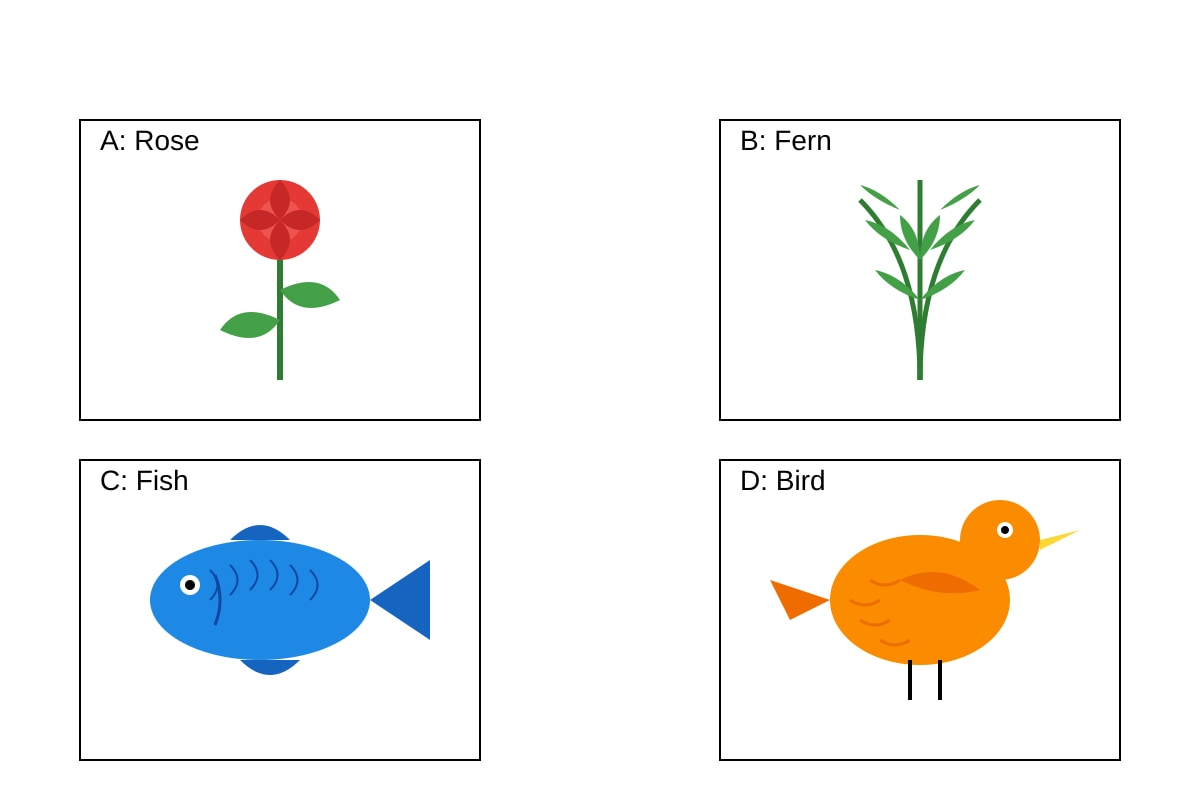
Plants: A (Rose), B (Fern). Animals: C (Fish), D (Bird). Feature: Plants make their own food / do not move about.
Marking: 1 mark plants group, 1 mark animals group, 1 mark feature.
Image note: Diagram shows rose & fern as plants; fish & bird as animals. -
Explanation: Diversity means different traits exist. If environment changes (e.g., drier climate), some variants survive. Example: plants with deep roots survive drought.
Marking: 1 mark diversity, 1 mark example, 1 mark link. -
Similarity: Both reproduce to make new plants. Difference: Flowering plant uses seeds; fern uses spores.
Marking: 1 mark similarity, 2 marks difference (or 1+1). -
Explanation: Leaf shape varies (diversity). Narrow/needle leaves reduce water loss in dry/cold places; broad leaves catch more light in wet areas.
Marking: 1 mark diversity stated, 2 marks link to function.