From Real Exams Quiz

Primary 5 Science Systems Quiz

Free Exam-Derived NVIDIA Nemotron 3 Ultra 550B A55B Free Primary 5 Science Systems quiz with questions and answers for Singapore students. This page is rendered as a direct URL so the questions and answers can be discovered without pressing in-page buttons.

These static practice materials are generated from the site's syllabus and paper-generation workflow, with source and model context shown so students and parents can evaluate the material before use.

Primary 5 Science From Real Exams Generated by NVIDIA Nemotron 3 Ultra 550B A55B Free Updated 2026-06-07

Questions

<!-- TuitionGoWhere generation metadata: stage=3-0; model=nvidia/nemotron-3-ultra-550b-a55b:free; model_label=NVIDIA Nemotron 3 Ultra 550B A55B Free; generated=2026-06-05; Sources: Stage 2-1 real exam-derived templates and Stage 2-2 exam-enriched syllabus. -->

Primary 5 Science Quiz - Systems

Name: ___________________________
Class: Primary 5 _______
Date: _______________
Score: _____ / 40

Duration: 45 minutes
Total Marks: 40

Instructions:

  1. Answer all questions.
  2. For Section A, choose the correct answer and write its number (1, 2, 3, or 4) in the brackets provided.
  3. For Section B and C, write your answers in the spaces provided.
  4. The number of marks for each question is shown in brackets [ ] at the end of each question.

Section A: Multiple-Choice Questions (10 × 1 mark = 10 marks)

For each question from 1 to 10, four options are given. Choose the correct answer and write its number (1, 2, 3, or 4) in the brackets provided.

1. Which of the following systems in the human body is responsible for transporting oxygen and nutrients to all parts of the body?
(1) Digestive system
(2) Respiratory system
(3) Circulatory system
(4) Skeletal system
[ ] [1]

2. The diagram below shows a plant cell.
<image_placeholder> id: Q1-fig1 type: diagram linked_question: Q1 description: A typical plant cell with cell wall, cell membrane, nucleus, cytoplasm, chloroplasts, and a large central vacuole. Parts are labelled A, B, C, D, E, F. labels: A: Cell wall, B: Cell membrane, C: Nucleus, D: Cytoplasm, E: Chloroplast, F: Vacuole values: None must_show: Clear labels A-F on the correct organelles </image_placeholder>
Which part controls all the activities in the cell?
(1) A
(2) B
(3) C
(4) D
[ ] [1]

3. In the human respiratory system, where does the exchange of gases (oxygen and carbon dioxide) take place?
(1) Trachea
(2) Bronchi
(3) Alveoli (air sacs)
(4) Diaphragm
[ ] [1]

4. The diagram below shows the human heart.
<image_placeholder> id: Q4-fig1 type: diagram linked_question: Q4 description: A cross-section of the human heart showing four chambers (right atrium, right ventricle, left atrium, left ventricle), major blood vessels (vena cava, pulmonary artery, pulmonary vein, aorta), and valves. Chambers and vessels are labelled P, Q, R, S, T, U. labels: P: Right atrium, Q: Right ventricle, R: Left atrium, S: Left ventricle, T: Pulmonary artery, U: Aorta values: None must_show: Four chambers clearly shown with correct relative wall thickness; major vessels connected to correct chambers; arrows showing direction of blood flow </image_placeholder>
Which chamber pumps deoxygenated blood to the lungs?
(1) P
(2) Q
(3) R
(4) S
[ ] [1]

5. In plants, which vascular tissue transports water and mineral salts from the roots to the leaves?
(1) Phloem
(2) Xylem
(3) Stomata
(4) Root hairs
[ ] [1]

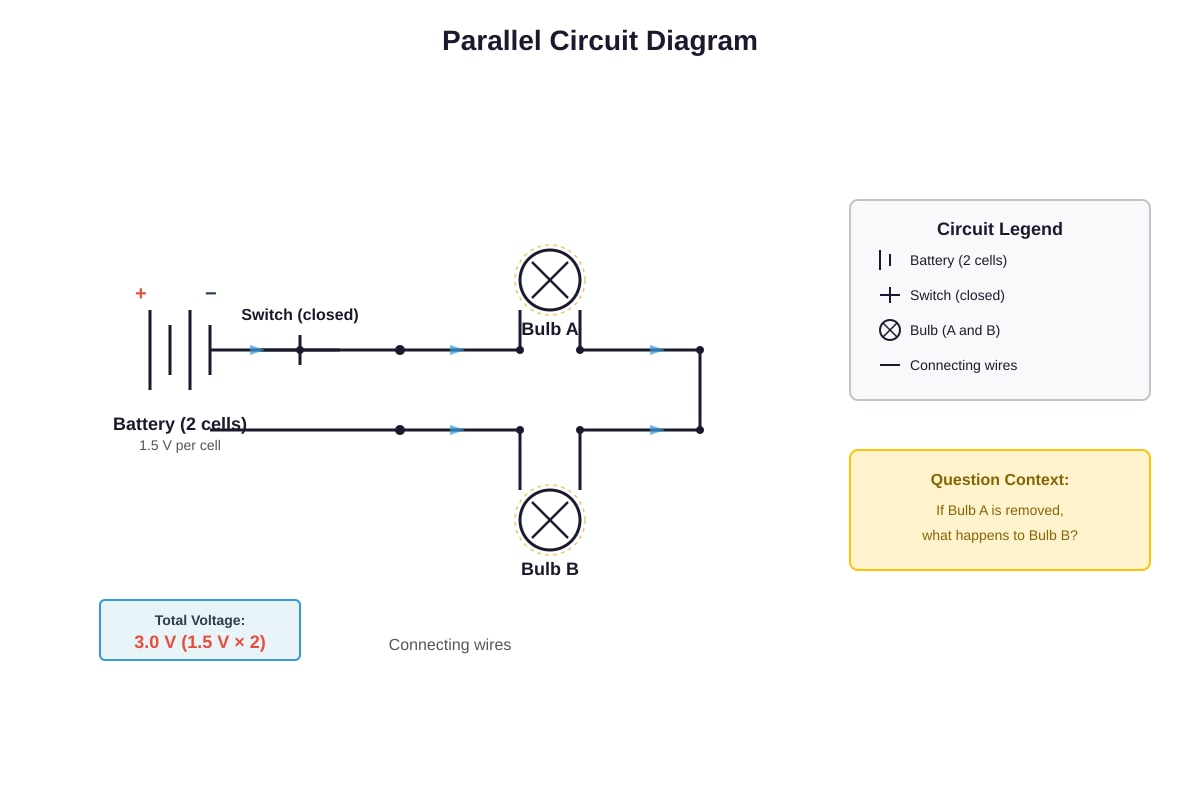
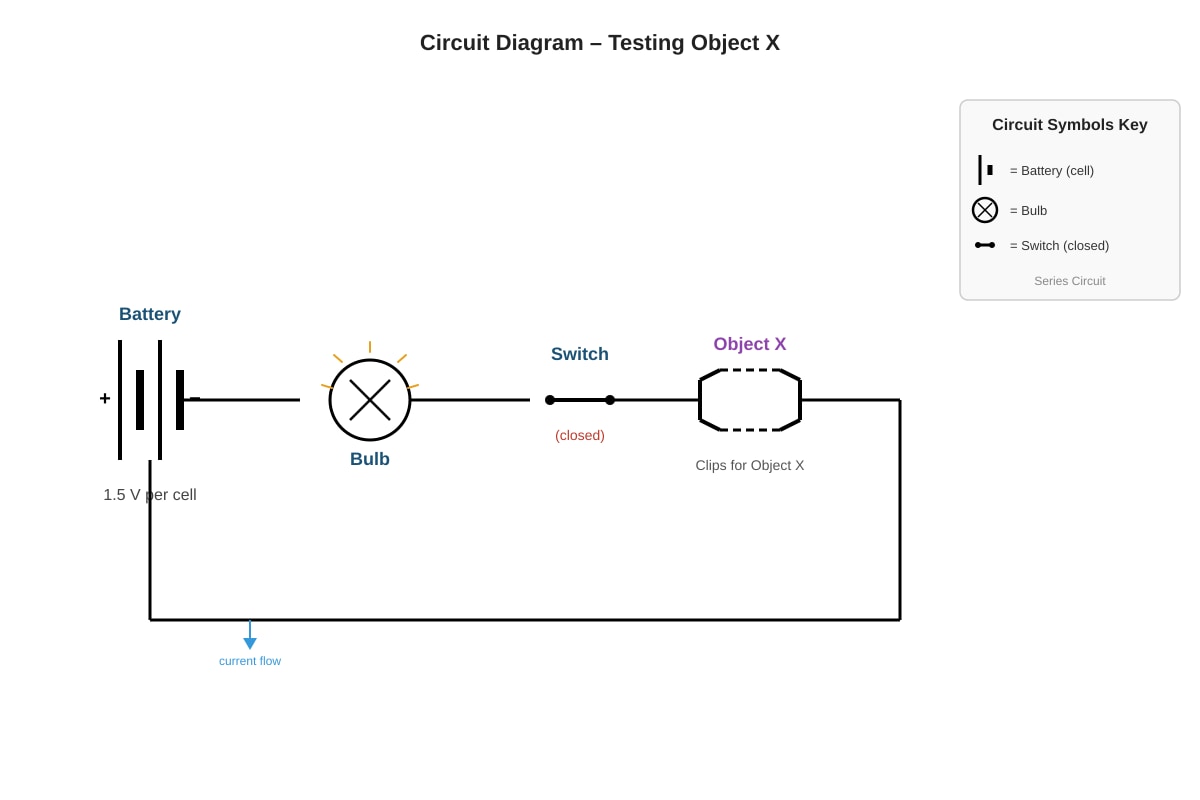
6. The diagram below shows a simple electrical circuit.
<image_placeholder> id: Q6-fig1 type: diagram linked_question: Q6 description: A simple series circuit with a battery (two cells), a switch (open), a bulb, and connecting wires. Components are labelled. labels: Battery, Switch (open), Bulb, Connecting wires values: Battery: 2 cells × 1.5 V each must_show: Correct circuit symbols; open switch; series arrangement </image_placeholder>
Why does the bulb not light up when the switch is open?
(1) The battery is too weak.
(2) The circuit is incomplete.
(3) The bulb is fused.
(4) The wires are too long.
[ ] [1]

7. Which of the following shows the correct energy conversion in a battery-operated torch when it is switched on?
(1) Electrical energy → Chemical energy → Light energy + Heat energy
(2) Chemical energy → Electrical energy → Light energy + Heat energy
(3) Light energy → Electrical energy → Chemical energy + Heat energy
(4) Heat energy → Chemical energy → Electrical energy → Light energy
[ ] [1]

8. Three bulbs are connected in series in a circuit. One bulb is removed from its holder. What happens to the other two bulbs?
(1) They light up more brightly.
(2) They remain lit with the same brightness.
(3) They go off.
(4) They flicker and then go off.
[ ] [1]

9. The diagram below shows the water cycle.
<image_placeholder> id: Q9-fig1 type: diagram linked_question: Q9 description: The water cycle showing evaporation from water bodies, condensation forming clouds, precipitation as rain, and collection in water bodies. Processes are labelled W, X, Y, Z. labels: W: Evaporation, X: Condensation, Y: Precipitation, Z: Collection values: None must_show: Sun, water bodies, clouds, rain, arrows showing cycle; labels W, X, Y, Z on the correct processes </image_placeholder>
At which stage does water vapour lose heat and change into tiny water droplets?
(1) W
(2) X
(3) Y
(4) Z
[ ] [1]

10. Which of the following factors does not increase the rate of evaporation of water?
(1) Increasing the temperature of the water
(2) Increasing the exposed surface area of the water
(3) Increasing the humidity of the surrounding air
(4) Increasing the wind speed over the water surface
[ ] [1]


Section B: Structured Questions (5 × 2 marks = 10 marks)

Answer all questions. Write your answers in the spaces provided.

11. The diagram below shows a cross-section of a human artery and a vein.
<image_placeholder> id: Q11-fig1 type: diagram linked_question: Q11 description: Cross-sections of an artery and a vein side by side. Artery has thick muscular wall, small lumen. Vein has thinner wall, larger lumen, valves. labels: Artery: Thick wall, Small lumen, No valves; Vein: Thinner wall, Larger lumen, Valves present values: None must_show: Clear structural differences: wall thickness, lumen size, presence of valves in vein </image_placeholder>

(a) State one structural difference between the artery and the vein shown in the diagram.


______________________________________________________________________________ [1]

(b) Explain how this difference is related to the function of the artery.


______________________________________________________________________________ [1]

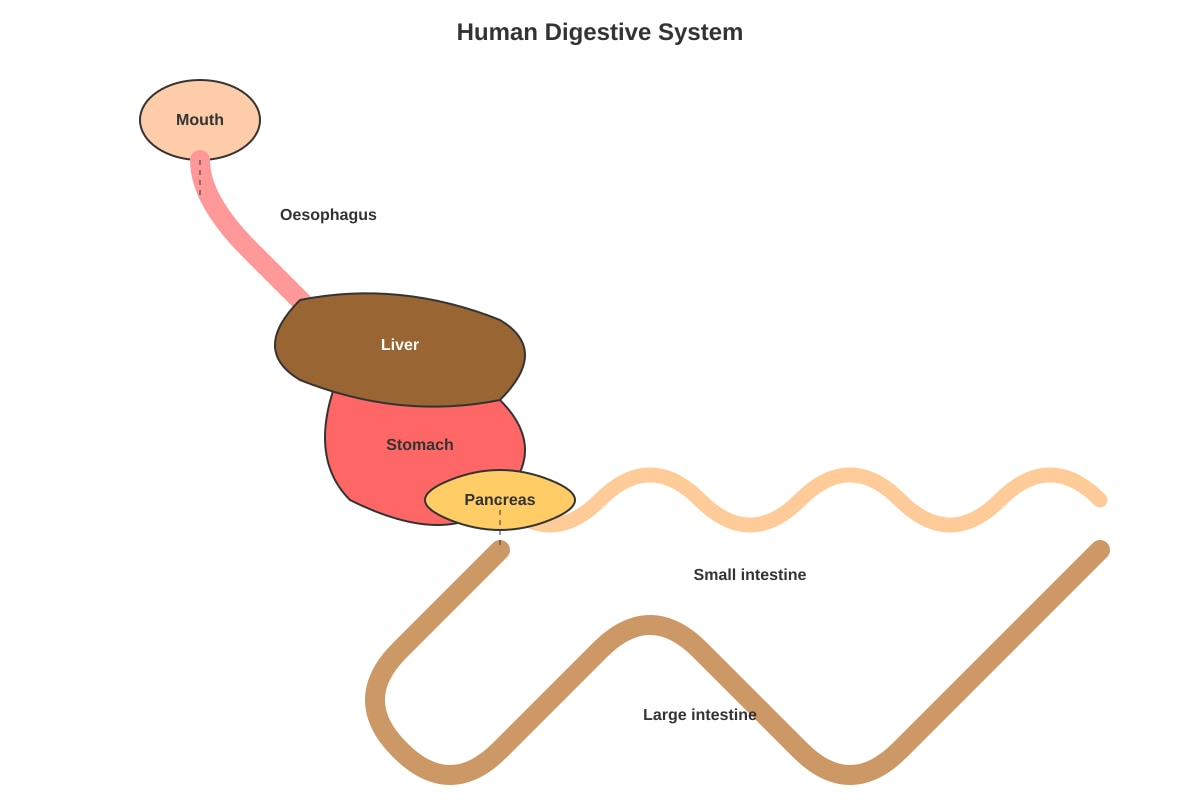
12. The diagram below shows the human digestive system.
<image_placeholder> id: Q12-fig1 type: diagram linked_question: Q12 description: Human digestive system with mouth, oesophagus, stomach, small intestine, large intestine, liver, pancreas labelled. labels: A: Mouth, B: Oesophagus, C: Stomach, D: Small intestine, E: Large intestine, F: Liver, G: Pancreas values: None must_show: All major organs in correct anatomical position and relative size </image_placeholder>

(a) In which labelled part (A, B, C, D, E, F, or G) is most of the digested food absorbed into the blood?
______________________________________________________________________________ [1]

(b) Name the substance produced by the liver that helps in the digestion of fats.
______________________________________________________________________________ [1]

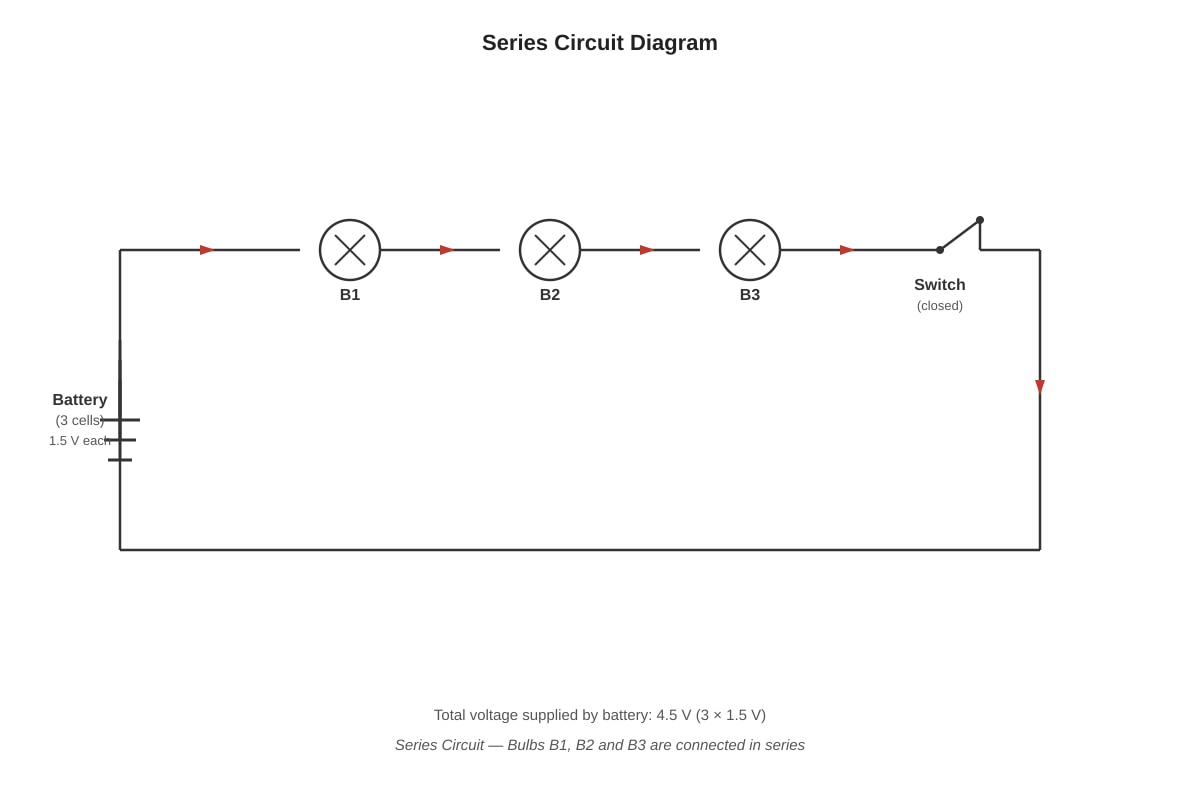
13. Study the electrical circuit diagram below.
<image_placeholder> id: Q13-fig1 type: diagram linked_question: Q13 description: A circuit with a battery of 3 cells, three identical bulbs (B1, B2, B3). B1 is in series with a parallel combination of B2 and B3. Switch is closed. labels: Battery (3 cells), B1, B2, B3, Switch (closed), Connecting wires values: Each cell: 1.5 V; Each bulb: identical resistance must_show: Correct series-parallel arrangement; closed switch; proper symbols </image_placeholder>

(a) If bulb B2 is removed from its holder, what will happen to the brightness of bulb B1?
______________________________________________________________________________ [1]

(b) Explain your answer in (a).


______________________________________________________________________________ [1]

14. The diagram below shows the reproductive parts of a flowering plant.
<image_placeholder> id: Q14-fig1 type: diagram linked_question: Q14 description: Longitudinal section of a flower showing sepal, petal, stamen (anther, filament), carpel (stigma, style, ovary, ovule). labels: P: Stigma, Q: Style, R: Ovary, S: Ovule, T: Anther, U: Filament values: None must_show: All parts clearly labelled; ovules inside ovary; pollen grains on anther </image_placeholder>

(a) Where does fertilisation take place in the flower?
______________________________________________________________________________ [1]

(b) After fertilisation, which part of the flower develops into the fruit?
______________________________________________________________________________ [1]

15. The table below shows the amount of undigested food leaving the stomach and entering the small intestine at different times after a meal.

Time after meal (hours)Amount of undigested food (arbitrary units)
0100
180
250
320
45
50

(a) What happens to the amount of undigested food in the stomach over time?
______________________________________________________________________________ [1]

(b) Explain why the amount of undigested food becomes zero after 5 hours.


______________________________________________________________________________ [1]


Section C: Open-Ended Questions (5 × 4 marks = 20 marks)

Answer all questions. Write your answers in the spaces provided.

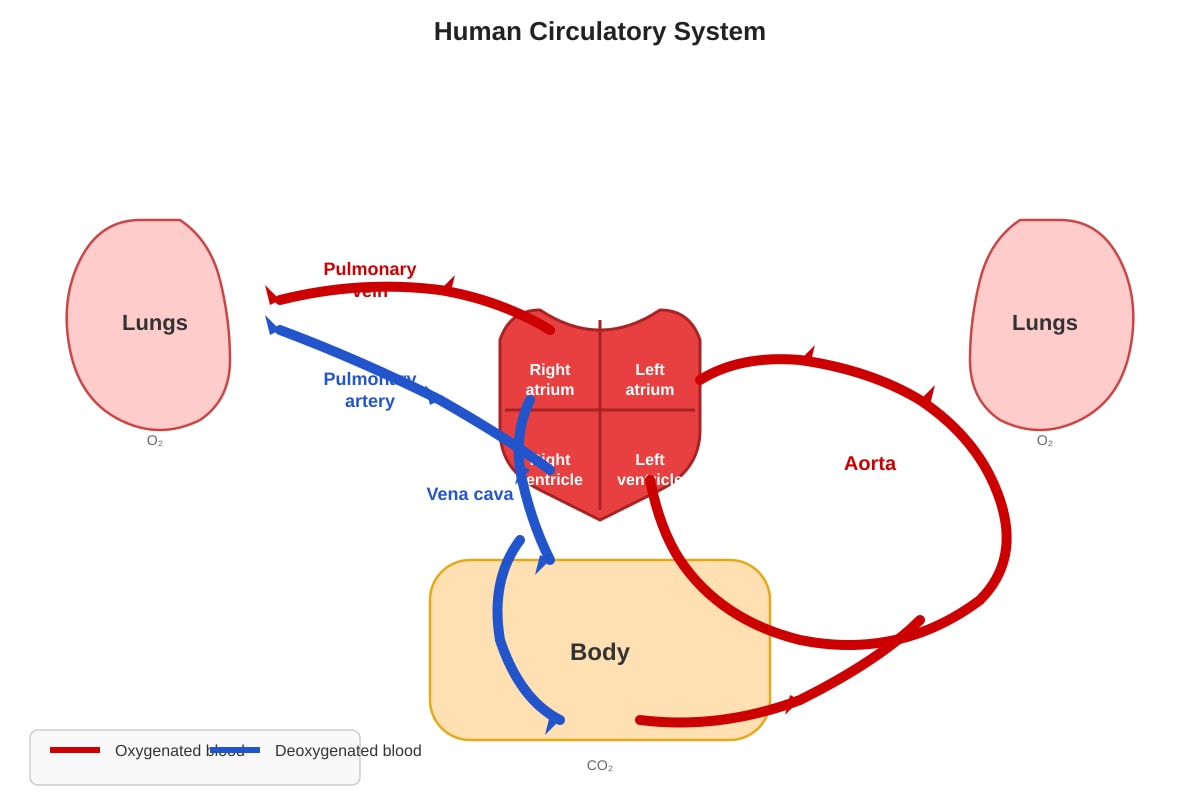
16. The diagram below shows the human circulatory system.
<image_placeholder> id: Q16-fig1 type: diagram linked_question: Q16 description: Simplified human circulatory system showing heart (four chambers), lungs, body cells. Arrows show blood flow: deoxygenated blood (blue) from body → right heart → lungs → oxygenated blood (red) → left heart → body. labels: Right atrium, Right ventricle, Left atrium, Left ventricle, Lungs, Body cells, Pulmonary artery, Pulmonary vein, Aorta, Vena cava values: None must_show: Double circulation clearly shown; colour-coded or labelled oxygenated/deoxygenated blood paths; all chambers and major vessels labelled </image_placeholder>

(a) Name the blood vessel that carries oxygenated blood from the lungs to the heart.
______________________________________________________________________________ [1]

(b) Describe the path taken by deoxygenated blood from the body back to the heart and then to the lungs.


______________________________________________________________________________ [2]

(c) Why is the wall of the left ventricle thicker than the wall of the right ventricle?


______________________________________________________________________________ [1]

17. Ali set up an experiment to investigate the conditions needed for germination. He used four set-ups as shown below.
<image_placeholder> id: Q17-fig1 type: experimental_setup linked_question: Q17 description: Four test tubes labelled A, B, C, D. A: Wet cotton wool, seeds, room temperature. B: Dry cotton wool, seeds, room temperature. C: Wet cotton wool, seeds, in freezer (0°C). D: Wet cotton wool, boiled seeds (dead), room temperature. labels: A: Water + Air + Suitable temperature, B: No water + Air + Suitable temperature, C: Water + Air + Unsuitable temperature (too cold), D: Water + Air + Suitable temperature + Dead seeds values: Room temperature: 25°C; Freezer: 0°C must_show: Clear labels on each set-up; conditions for each clearly indicated </image_placeholder>

(a) In which set-up(s) will the seeds germinate?
______________________________________________________________________________ [1]

(b) What is the purpose of set-up B?


______________________________________________________________________________ [1]

(c) What is the purpose of set-up D?


______________________________________________________________________________ [1]

(d) State the three conditions necessary for seed germination.


______________________________________________________________________________ [1]

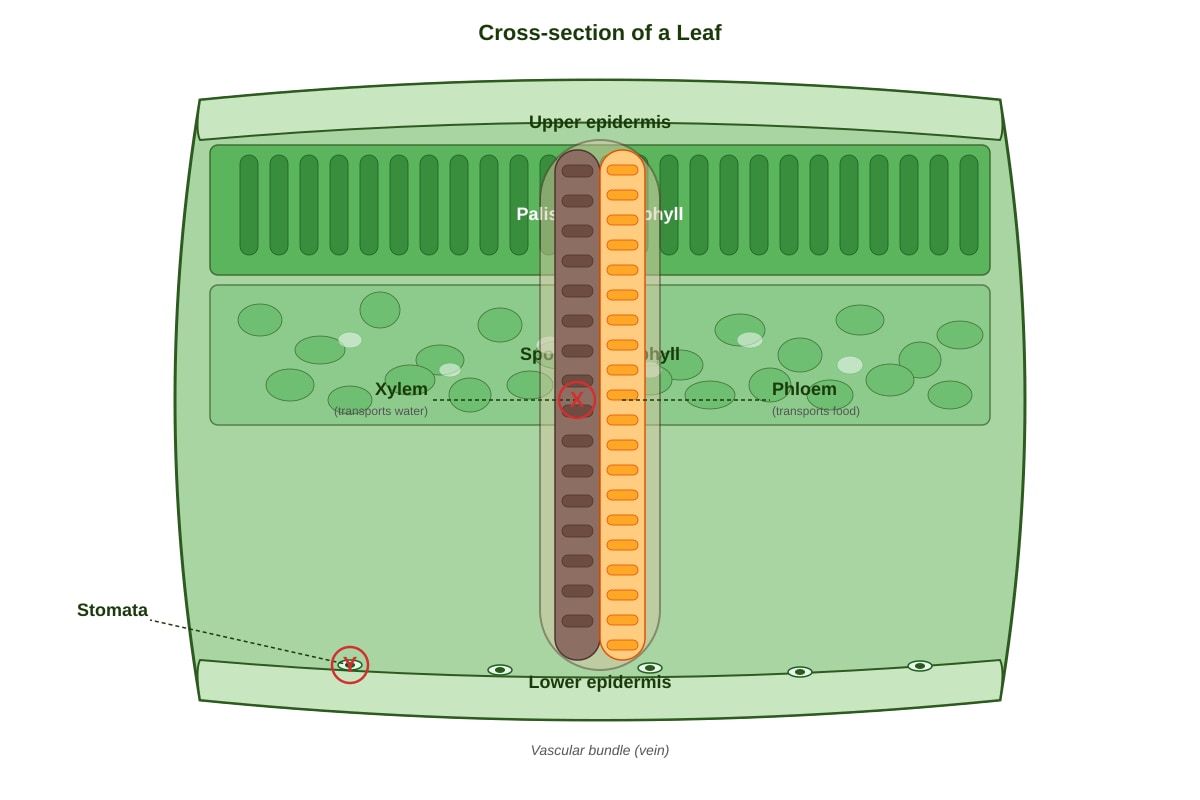
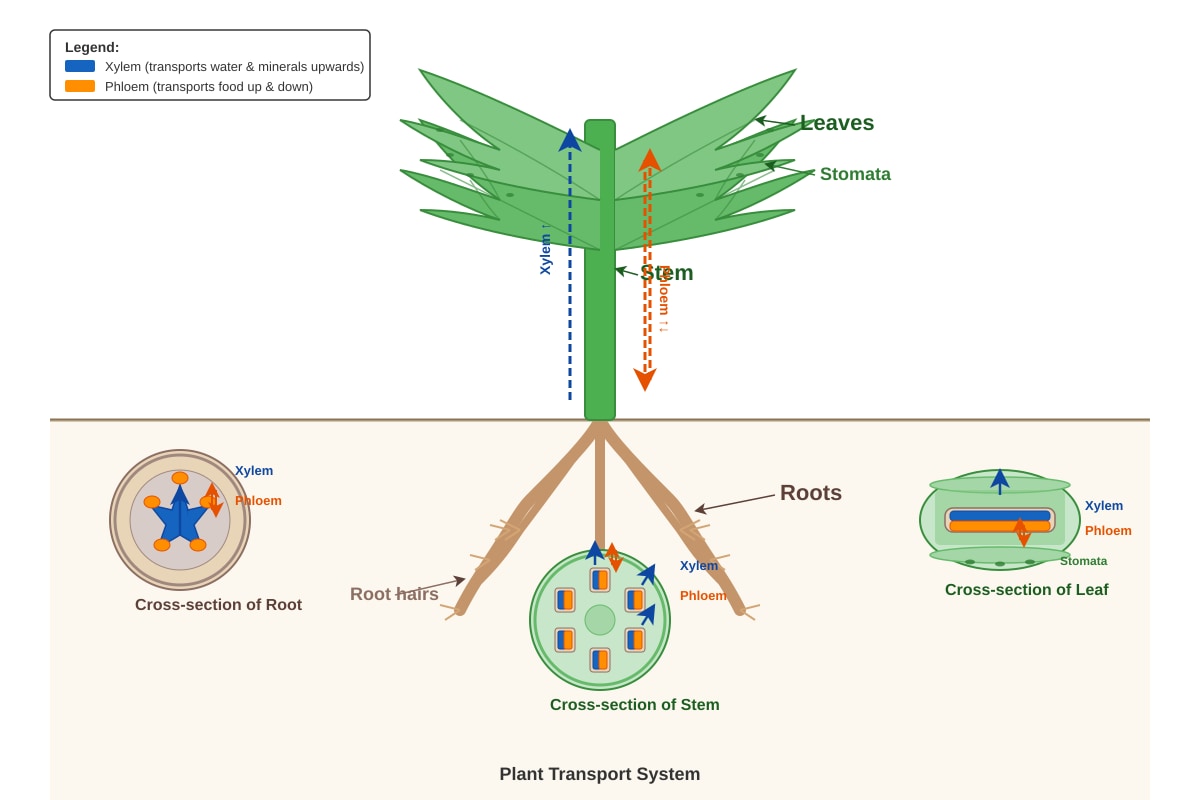
18. The diagram below shows a plant transport system.
<image_placeholder> id: Q18-fig1 type: diagram linked_question: Q18 description: Cross-section of a stem showing vascular bundles. Xylem and phloem labelled. Arrows show direction of transport in each. labels: Xylem: transports water and mineral salts (upwards); Phloem: transports food (sucrose) (upwards and downwards) values: None must_show: Xylem and phloem in vascular bundle; arrows showing unidirectional flow in xylem, bidirectional in phloem </image_placeholder>

(a) Name the two types of transport tissues in plants.
______________________________________________________________________________ [1]

(b) State one difference in the substances transported by these two tissues.


______________________________________________________________________________ [1]

(c) The diagram shows a ring of bark (including phloem) removed from a tree trunk. After some time, the upper part of the trunk above the cut becomes swollen.
<image_placeholder> id: Q18-fig2 type: diagram linked_question: Q18 description: Tree trunk with a ring of bark removed (girdling). Area above cut is swollen; area below cut is normal. labels: Cut ring (phloem removed), Swollen area above cut, Normal area below cut values: None must_show: Clear girdling; swelling above cut </image_placeholder>
Explain why the upper part of the trunk becomes swollen.


______________________________________________________________________________ [2]

19. Mei Ling set up three circuits using identical batteries and identical bulbs.
<image_placeholder> id: Q19-fig1 type: diagram linked_question: Q19 description: Three circuits: Circuit X: 1 bulb. Circuit Y: 2 bulbs in series. Circuit Z: 2 bulbs in parallel. All with same battery (2 cells). labels: Circuit X: Single bulb; Circuit Y: Two bulbs in series; Circuit Z: Two bulbs in parallel values: Battery: 2 cells × 1.5 V; All bulbs identical must_show: Correct circuit symbols; clear series vs parallel arrangement </image_placeholder>

(a) Arrange the brightness of the bulbs in circuits X, Y, and Z from brightest to dimmest.
______________________________________________________________________________ [1]

(b) Explain why the bulbs in circuit Y are dimmer than the bulb in circuit X.


______________________________________________________________________________ [1]

(c) State one advantage of connecting bulbs in parallel (circuit Z) compared to in series (circuit Y).


______________________________________________________________________________ [1]

(d) If one bulb in circuit Z is removed, what happens to the other bulb? Explain.


______________________________________________________________________________ [1]

20. The diagram below shows the water cycle.
<image_placeholder> id: Q20-fig1 type: diagram linked_question: Q20 description: Water cycle with sea, sun, clouds, rain, river, groundwater. Processes: evaporation, condensation, precipitation, collection. Two locations marked: P (sea surface), Q (puddle on ground). labels: P: Sea surface, Q: Puddle on ground, Sun, Clouds, Rain, River values: Temperature at P: 30°C; Temperature at Q: 30°C; Wind at P: strong; Wind at Q: calm; Surface area at P: very large; Surface area at Q: small must_show: Two distinct locations P and Q with different conditions; all water cycle processes labelled </image_placeholder>

(a) Name the process that occurs at both location P and location Q where water changes from liquid to gas.
______________________________________________________________________________ [1]

(b) The rate of evaporation at location P is faster than at location Q. Give two reasons for this difference based on the conditions shown.


______________________________________________________________________________ [2]

(c) Water vapour rises and forms clouds. Explain how clouds are formed.


______________________________________________________________________________ [1]


End of Quiz

Answers

<!-- TuitionGoWhere generation metadata: stage=3-0; model=nvidia/nemotron-3-ultra-550b-a55b:free; model_label=NVIDIA Nemotron 3 Ultra 550B A55B Free; generated=2026-06-05; Sources: Stage 2-1 real exam-derived templates and Stage 2-2 exam-enriched syllabus. -->

Primary 5 Science Quiz - Systems (Answer Key)

Total Marks: 40


Section A: Multiple-Choice Questions (10 marks)

1. Answer: (3) Circulatory system [1]
Explanation: The circulatory system (heart, blood vessels, blood) transports oxygen, nutrients, hormones, and waste products throughout the body. The digestive system breaks down food, the respiratory system exchanges gases, and the skeletal system provides support and protection.

2. Answer: (3) C [1]
Explanation: The nucleus (C) contains genetic material (DNA) and controls all cellular activities including growth, division, and protein synthesis. The cell wall (A) provides support, the cell membrane (B) controls movement of substances, and the cytoplasm (D) is where most chemical reactions occur.

3. Answer: (3) Alveoli (air sacs) [1]
Explanation: Gas exchange occurs in the alveoli, which are tiny air sacs with thin walls (one cell thick) surrounded by capillaries. Oxygen diffuses into the blood and carbon dioxide diffuses out. The trachea and bronchi are air passages; the diaphragm is a muscle for breathing.

4. Answer: (2) Q [1]
Explanation: Chamber Q is the right ventricle. It receives deoxygenated blood from the right atrium (P) and pumps it through the pulmonary artery (T) to the lungs to pick up oxygen. The left ventricle (S) pumps oxygenated blood to the body via the aorta (U).

5. Answer: (2) Xylem [1]
Explanation: Xylem transports water and mineral salts from roots to leaves (unidirectional, upward). Phloem transports food (sucrose) from leaves to other parts (bidirectional). Stomata are pores for gas exchange; root hairs absorb water.

6. Answer: (2) The circuit is incomplete. [1]
Explanation: An open switch creates a gap in the circuit. Electric current can only flow in a complete (closed) circuit. The battery strength, bulb condition, and wire length are irrelevant if the circuit is open.

7. Answer: (2) Chemical energy → Electrical energy → Light energy + Heat energy [1]
Explanation: A battery stores chemical energy. When the circuit is closed, chemical energy is converted to electrical energy. The electrical energy powers the bulb, converting to light and heat energy.

8. Answer: (3) They go off. [1]
Explanation: In a series circuit, there is only one path for current. Removing one bulb breaks the circuit, stopping current flow to all bulbs. All bulbs in series go off.

9. Answer: (2) X [1]
Explanation: Condensation (X) is the process where water vapour loses heat and changes into tiny liquid water droplets, forming clouds. Evaporation (W) is liquid to gas; precipitation (Y) is droplets falling as rain; collection (Z) is water gathering in bodies.

10. Answer: (3) Increasing the humidity of the surrounding air [1]
Explanation: Higher humidity means more water vapour already in the air, which slows evaporation. The other three factors (higher temperature, larger surface area, faster wind) all increase evaporation rate.


Section B: Structured Questions (10 marks)

11.
(a) Any one of:

  • Artery has a thicker muscular wall; vein has a thinner wall.
  • Artery has a smaller lumen; vein has a larger lumen.
  • Vein has valves; artery does not have valves.
    [1]

(b) Explanation: The thick muscular wall of the artery withstands the high pressure of blood pumped from the heart. The heart pumps blood into arteries at high pressure, so arteries need strong, elastic walls to handle this pressure without bursting. [1]
Marking note: Must link structure (thick wall) to function (withstand high pressure).

12.
(a) D (Small intestine) [1]
Explanation: The small intestine has villi (finger-like projections) that greatly increase surface area for absorption of digested nutrients into the bloodstream.

(b) Bile [1]
Explanation: The liver produces bile, which is stored in the gall bladder and released into the small intestine. Bile emulsifies fats (breaks large fat globules into smaller droplets), increasing surface area for lipase action.

13.
(a) Bulb B1 becomes dimmer. [1]

(b) Explanation: When B2 is removed, the parallel branch is broken. The total resistance of the circuit increases (only B1 and B3 remain in series). With higher total resistance, the current from the battery decreases. Since B1 is in series with the battery, the current through B1 decreases, making it dimmer. [1]
Marking note: Must mention increased resistance and decreased current.

14.
(a) In the ovule (inside the ovary) / At the ovule (S). [1]
Explanation: Fertilisation occurs when the male reproductive cell (from pollen grain) fuses with the female reproductive cell (in the ovule) inside the ovary.

(b) Ovary (R) [1]
Explanation: After fertilisation, the ovary develops into the fruit, and the ovules develop into seeds. The petals, sepals, stamens, and stigma usually wither and fall off.

15.
(a) The amount of undigested food decreases over time. [1]

(b) Explanation: The stomach churns food and secretes gastric juice (containing pepsin and hydrochloric acid) to digest proteins. Over time, food is progressively digested into a semi-liquid mixture (chyme) and released in small amounts into the small intestine. By 5 hours, all food has left the stomach. [1]
Marking note: Accept "food is digested and moves to small intestine" or similar.


Section C: Open-Ended Questions (20 marks)

16.
(a) Pulmonary vein [1]
Explanation: The pulmonary vein carries oxygenated blood from the lungs to the left atrium. (Note: Most veins carry deoxygenated blood, but pulmonary vein is an exception.)

(b) Path: Deoxygenated blood from the body enters the right atrium via the vena cava → flows to the right ventricle → pumped through the pulmonary artery to the lungs to pick up oxygen. [2]
Marking note: 1 mark for correct sequence of chambers/vessels; 1 mark for mentioning deoxygenated blood going to lungs.

(c) The left ventricle pumps blood to the whole body (systemic circulation), which requires higher pressure to overcome the greater distance and resistance. The right ventricle pumps blood only to the nearby lungs (pulmonary circulation), which requires lower pressure. Therefore, the left ventricle has a thicker muscular wall to generate higher pressure. [1]
Marking note: Must compare destinations (body vs lungs) and link to pressure/wall thickness.

17.
(a) Set-up A only [1]
Explanation: Set-up A has all three conditions: water (wet cotton wool), air (oxygen), and suitable temperature (room temperature).

(b) To show that water is necessary for germination. (Control for water) [1]
Explanation: Set-up B lacks water (dry cotton wool) but has air and suitable temperature. If seeds don't germinate, it shows water is needed.

(c) To show that the seeds must be alive/viable for germination. (Control for living seeds) [1]
Explanation: Set-up D has water, air, and suitable temperature, but the seeds are boiled (dead). If they don't germinate, it shows living seeds are required.

(d) The three conditions are: (1) Water, (2) Air (oxygen), (3) Suitable temperature (warmth). [1]
Marking note: All three must be stated for the mark.

18.
(a) Xylem and Phloem [1]

(b) Xylem transports water and mineral salts (from roots to leaves). Phloem transports food (sucrose) made during photosynthesis (from leaves to all parts of the plant). [1]
Marking note: Must state the different substances transported.

(c) Explanation: Removing the bark removes the phloem. Food (sucrose) produced in the leaves is transported downwards through the phloem. At the cut, the food cannot pass further down, so it accumulates above the cut, causing swelling. The xylem (inside) is intact, so water transport continues. [2]
Marking note: 1 mark for "food accumulates above cut because phloem is removed"; 1 mark for "food cannot be transported downwards past the cut".

19.
(a) Brightest: Circuit Z (parallel) → Circuit X (single) → Circuit Y (series) : Dimmest [1]
Explanation: In parallel (Z), each bulb gets full battery voltage. In single (X), the bulb gets full voltage. In series (Y), voltage is shared between two bulbs, so each gets half the voltage and is dimmer.

(b) In circuit Y (series), the two bulbs share the voltage from the battery (each gets half). In circuit X, the single bulb gets the full battery voltage. Lower voltage across each bulb in Y means less current through each bulb, so they are dimmer. [1]
Marking note: Must mention voltage sharing in series.

(c) Any one of:

  • If one bulb fuses/removes, the other bulb still lights up (independent control).
  • Each bulb receives the full battery voltage, so they are brighter than bulbs in series.
  • Bulbs can be switched on/off independently. [1]

(d) The other bulb remains lit with the same brightness. [1]
Explanation: In a parallel circuit, each bulb has its own separate path to the battery. Removing one bulb breaks only that branch; the other branch remains complete, so current continues to flow through the other bulb. The voltage across it remains unchanged.

20.
(a) Evaporation [1]
Explanation: At both P (sea) and Q (puddle), liquid water gains heat from surroundings and changes to water vapour (gas).

(b) Two reasons (any two):

  1. Larger exposed surface area at P (sea surface) compared to Q (small puddle).
  2. Stronger wind at P blows away water vapour faster, reducing humidity near the surface.
  3. (Temperature is the same at 30°C, so not a reason.) [2]
    Marking note: 1 mark per valid reason based on given conditions. Must use data from diagram description.

(c) As water vapour rises, it reaches higher altitudes where the air is cooler. The water vapour loses heat to the cooler surrounding air and condenses into tiny water droplets. These droplets gather to form clouds. [1]
Marking note: Must mention rising, cooling, condensation, and droplet formation.


End of Answer Key