From Real Exams Quiz
Primary 5 Science Systems Quiz
Free Kimi AI-generated P5 Science Systems quiz with questions, answers, and syllabus-aligned practice for Singapore students preparing for school assessments.
These static practice materials are generated from the site's syllabus and paper-generation workflow, with source and model context shown so students and parents can evaluate the material before use.
Questions
Primary 5 Science Quiz - Systems
Name: _________________________________ Class: _______ Date: ____________
Duration: 40 minutes
Total Marks: 40 marks
Instructions: Answer ALL questions. Write your answers in the spaces provided. Each question carries 2 marks unless otherwise stated.
Section A: Electrical Systems (Questions 1–5)
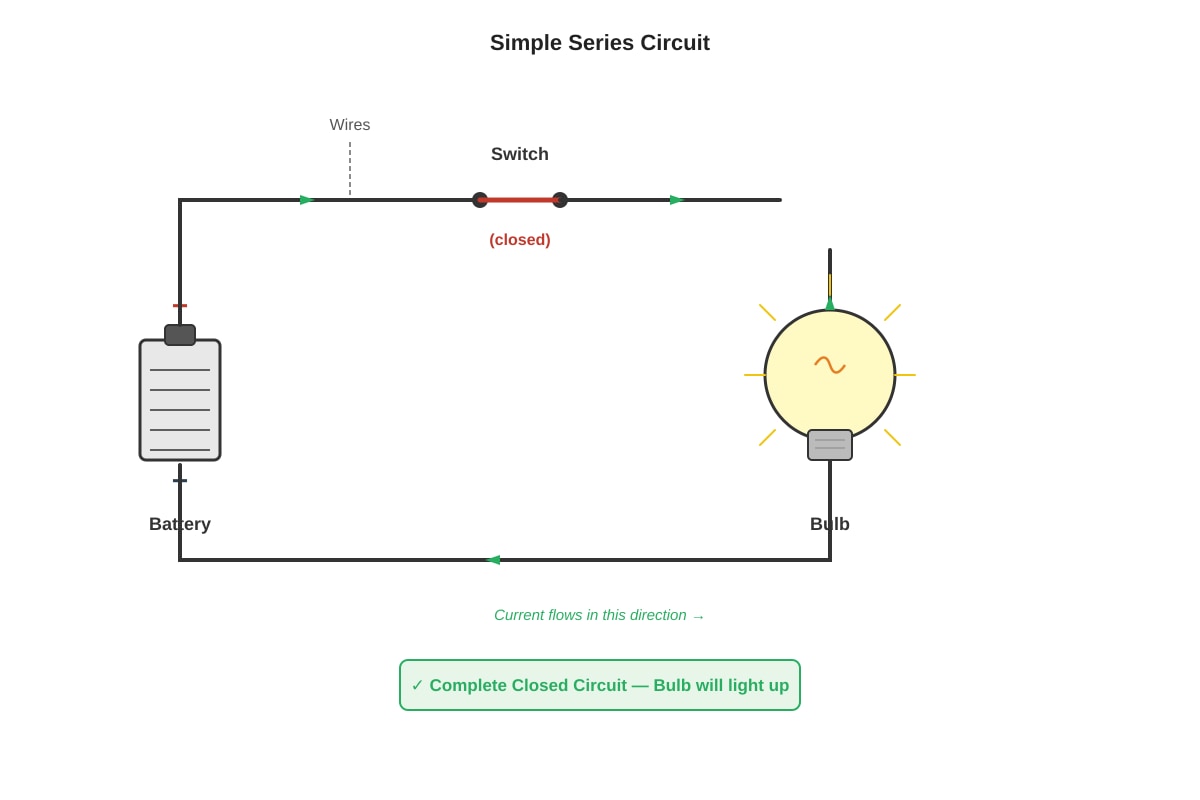
1. The diagram below shows a simple circuit.
<image_placeholder> id: Q1-fig1 type: diagram linked_question: Q1 description: A simple series circuit with one battery, one closed switch, one light bulb, and connecting wires labels: Battery (labelled + and -), Switch (labelled "closed"), Bulb, Wires values: Battery voltage not specified (generic single cell appearance) must_show: Complete closed loop circuit with all components connected in series; clear component symbols or recognizable drawings </image_placeholder>
(a) Is the light bulb on or off? ______________________________ [1]
(b) Explain your answer. ______________________________________ [1]
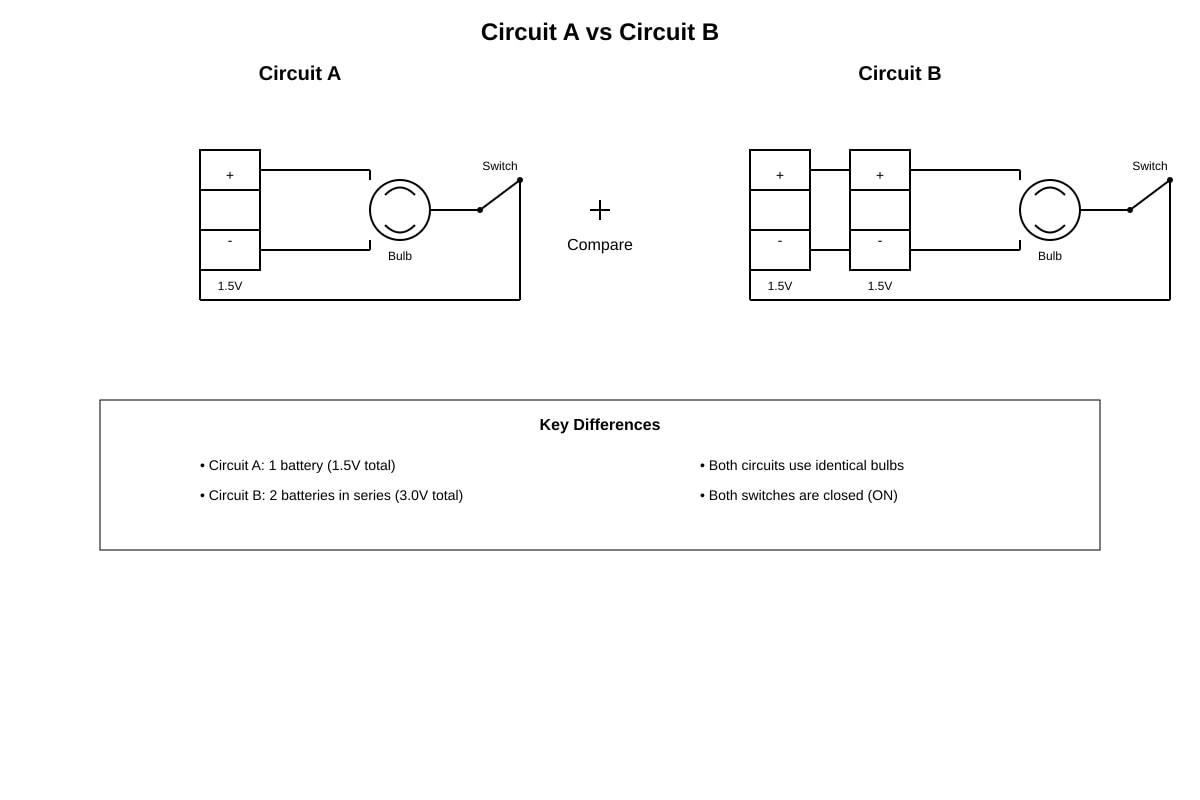
2. Study the circuit below.
<image_placeholder> id: Q2-fig1 type: diagram linked_question: Q2 description: Two circuits side by side for comparison labels: Circuit A: one battery, one bulb; Circuit B: two batteries in series, one bulb (same type as Circuit A) values: None specified must_show: Clear distinction between single battery and dual battery arrangement; identical bulb types; both circuits with closed switches </image_placeholder>
In which circuit, A or B, will the bulb be brighter? ______________________________ [1]
Explain why. _________________________________________________________________ [1]
3. Name the material that is commonly used to make electrical wires because it allows electricity to flow through easily. ____________________________________________ [2]
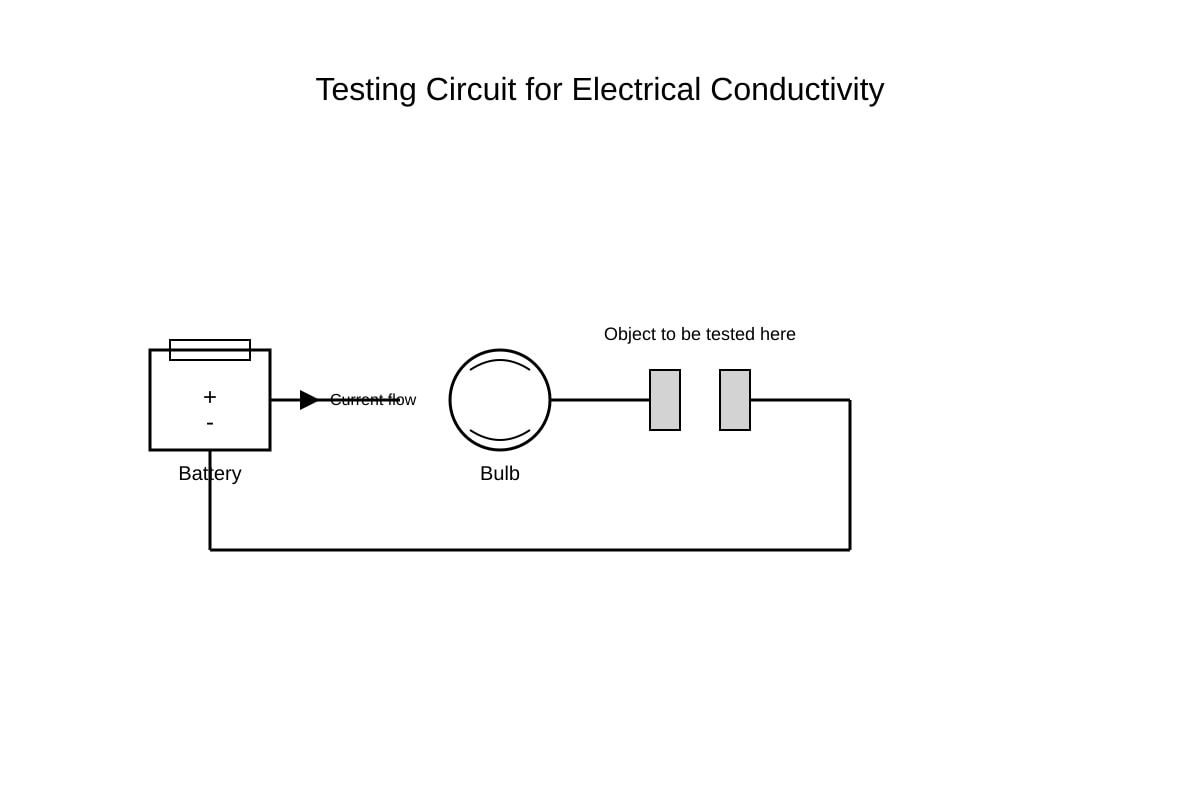
4. Siti sets up a circuit to test if different materials allow electricity to pass through.
<image_placeholder> id: Q4-fig1 type: diagram linked_question: Q4 description: A simple testing circuit with a battery, bulb, and gap where objects can be inserted labels: Battery, Bulb, Gap with two metal clips labelled "Object to be tested here" values: None specified must_show: Open gap in circuit with metal clips for inserting test materials; bulb as indicator; complete circuit when object bridges gap </image_placeholder>
She tests a plastic ruler, a metal spoon, and a wooden chopstick.
(a) Which materials will make the bulb light up? ________________________________ [1]
(b) Explain why the other materials will not make the bulb light up. _________________ [1]
5. Draw a circuit diagram that will make two bulbs light up with the same brightness using one battery. [2]
<image_placeholder> id: Q5-fig1 type: diagram linked_question: Q5 description: Empty space for student to draw circuit diagram labels: (none - student creates own) values: (none - student creates own) must_show: Student-drawn diagram space with grid dots or blank area for drawing </image_placeholder>
Section B: Human Transport Systems (Questions 6–10)
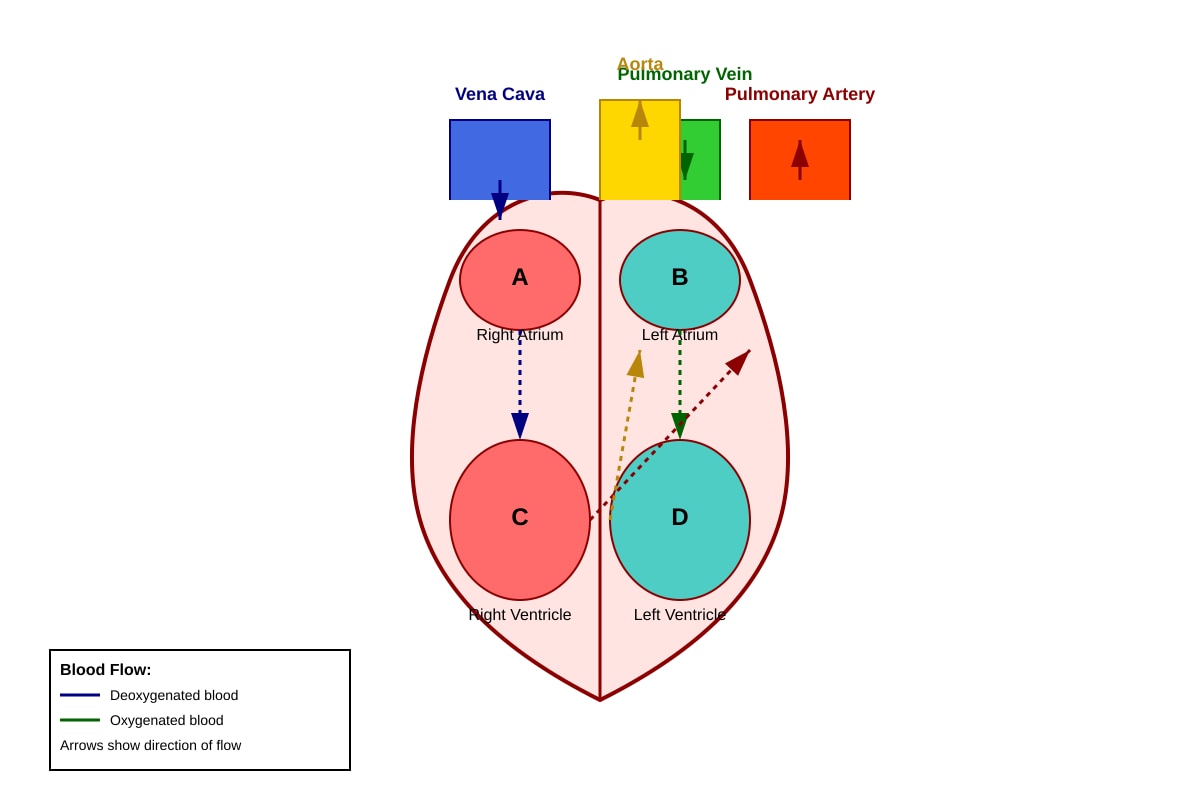
6. The diagram shows the human heart and main blood vessels.
<image_placeholder> id: Q6-fig1 type: diagram linked_question: Q6 description: Simplified diagram of human heart showing four chambers and major blood vessels labels: A (right atrium), B (left atrium), C (right ventricle), D (left ventricle), Pulmonary artery, Pulmonary vein, Aorta, Vena cava values: None specified must_show: Four distinct chambers; correct relative positions; labelled arrows showing blood flow direction; major vessels connected correctly </image_placeholder>
(a) Which chamber, A, B, C, or D, pumps blood to the rest of the body? ______________ [1]
(b) Name the blood vessel that carries blood from the lungs to the heart. _____________ [1]
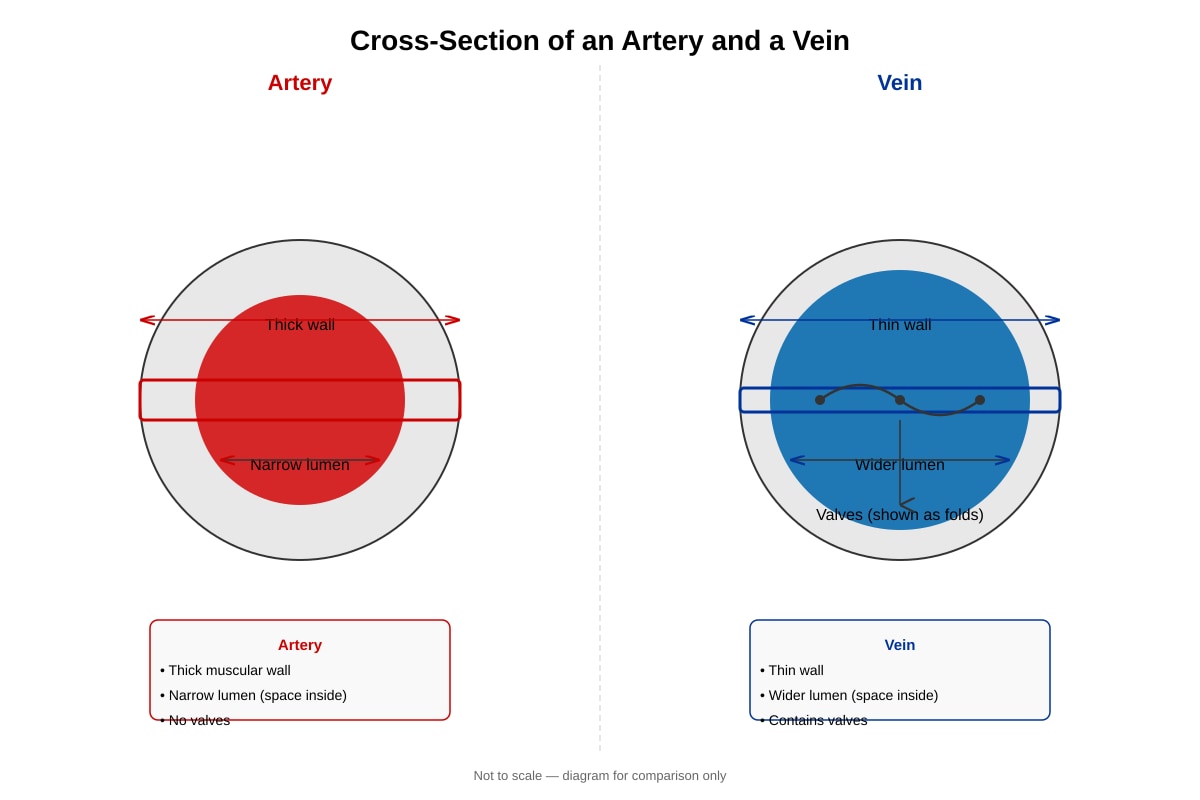
7. Arteries and veins are two types of blood vessels.
<image_placeholder> id: Q7-fig1 type: diagram linked_question: Q7 description: Cross-section comparison of artery and vein labels: Artery (thick wall, narrow space), Vein (thin wall, wider space, valves shown) values: None specified must_show: Clear wall thickness difference; valve visible in vein only; relative lumen sizes; labels for identification </image_placeholder>
(a) Which blood vessel is shown to have valves? ___________________________________ [1]
(b) Explain why this blood vessel needs valves. ____________________________________ [1]
8. The table below shows some information about blood components.
| Component | Function | Part of blood? |
|---|---|---|
| Red blood cell | Carries oxygen | Yes |
| White blood cell | Fights germs | (i) _______ |
| Platelet | Helps blood to clot | Yes |
| Water and dissolved nutrients | Transports food | (ii) _______ |
(a) Complete the table by filling in "Yes" or "No" for (i) and (ii). [2]
(i) ______________________________ (ii) ______________________________
(b) Name the liquid part of blood that contains water and dissolved nutrients. __________ [1]
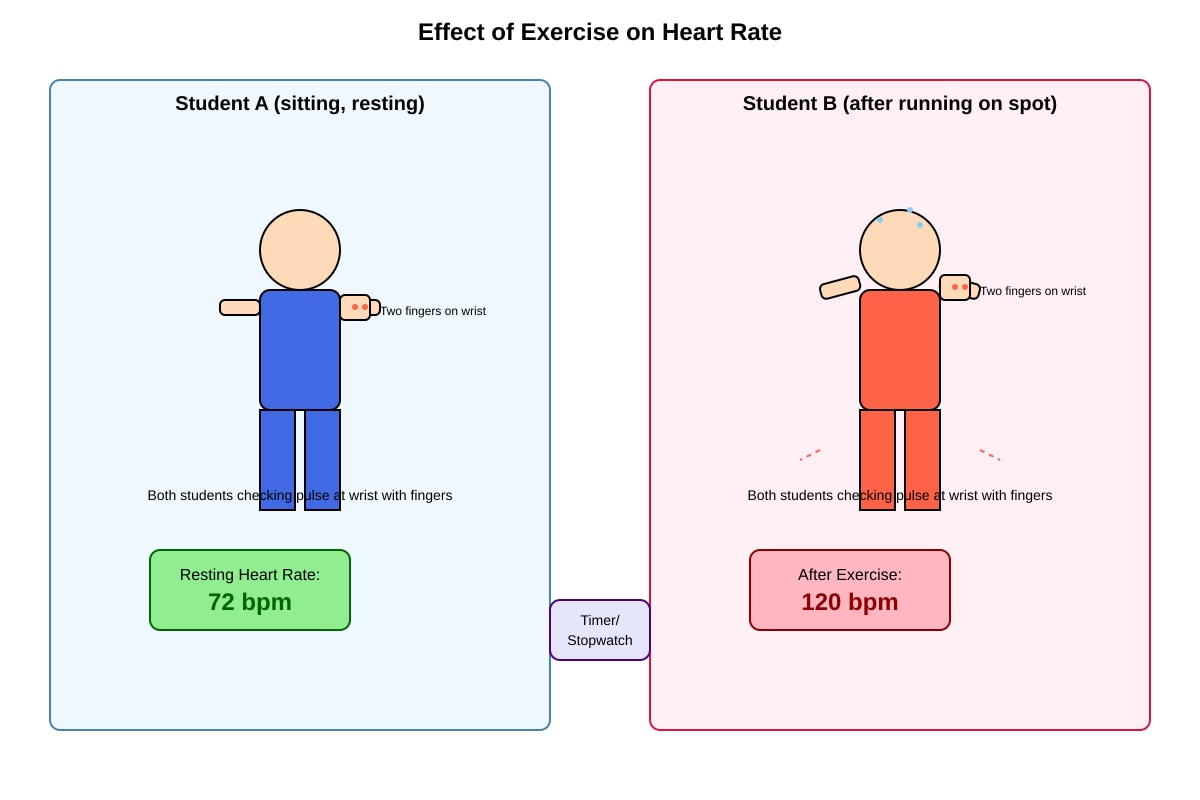
9. The diagram below shows an experiment to demonstrate the effect of exercise on heart rate.
<image_placeholder> id: Q9-fig1 type: diagram linked_question: Q9 description: Experimental setup showing a student before and after exercise with pulse measurement labels: Student A (sitting, resting), Student B (after running on spot), Both students checking pulse at wrist with fingers, Timer/stopwatch on table values: Resting heart rate: 72 beats per minute; After exercise heart rate: 120 beats per minute must_show: Two scenarios (resting vs after exercise); correct pulse-checking technique (two fingers on wrist); numerical data displayed; clear activity difference </image_placeholder>
(a) Why does the heart beat faster during exercise? ________________________________ [2]
(b) Name two other body systems that work with the circulatory system during exercise. [1]
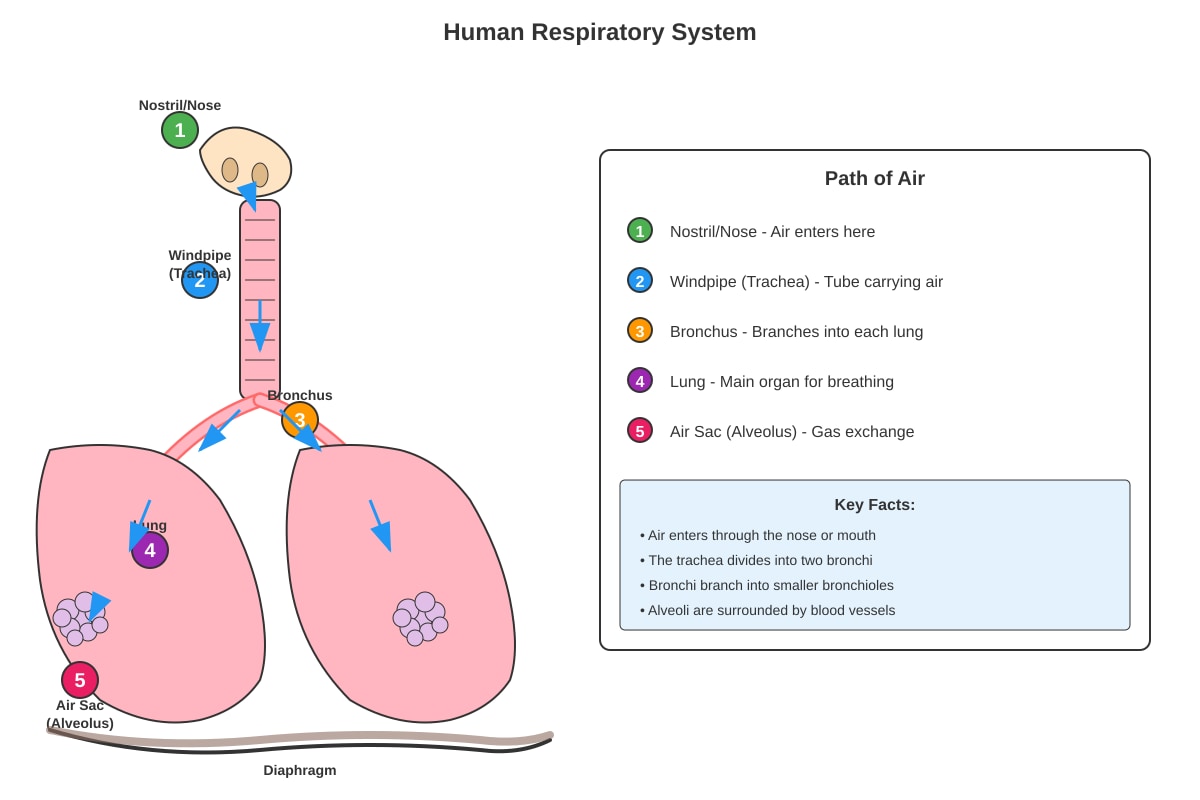
10. The diagram shows the path of air into the human body.
<image_placeholder> id: Q10-fig1 type: diagram linked_question: Q10 description: Diagram showing human respiratory system with numbered parts labels: 1 (nostril/nose), 2 (windpipe/trachea), 3 (bronchus), 4 (lung), 5 (air sac/alveolus) values: None specified must_show: Clear numbering 1-5 along air pathway; branching bronchioles visible; alveoli shown as cluster; diaphragm indicated but not numbered </image_placeholder>
(a) Name the structures labelled 1 and 5. [2]
1: ______________________________ 5: ______________________________
(b) Explain how structure 5 is adapted for gas exchange. __________________________ [2]
Section C: Plant Transport Systems (Questions 11–15)
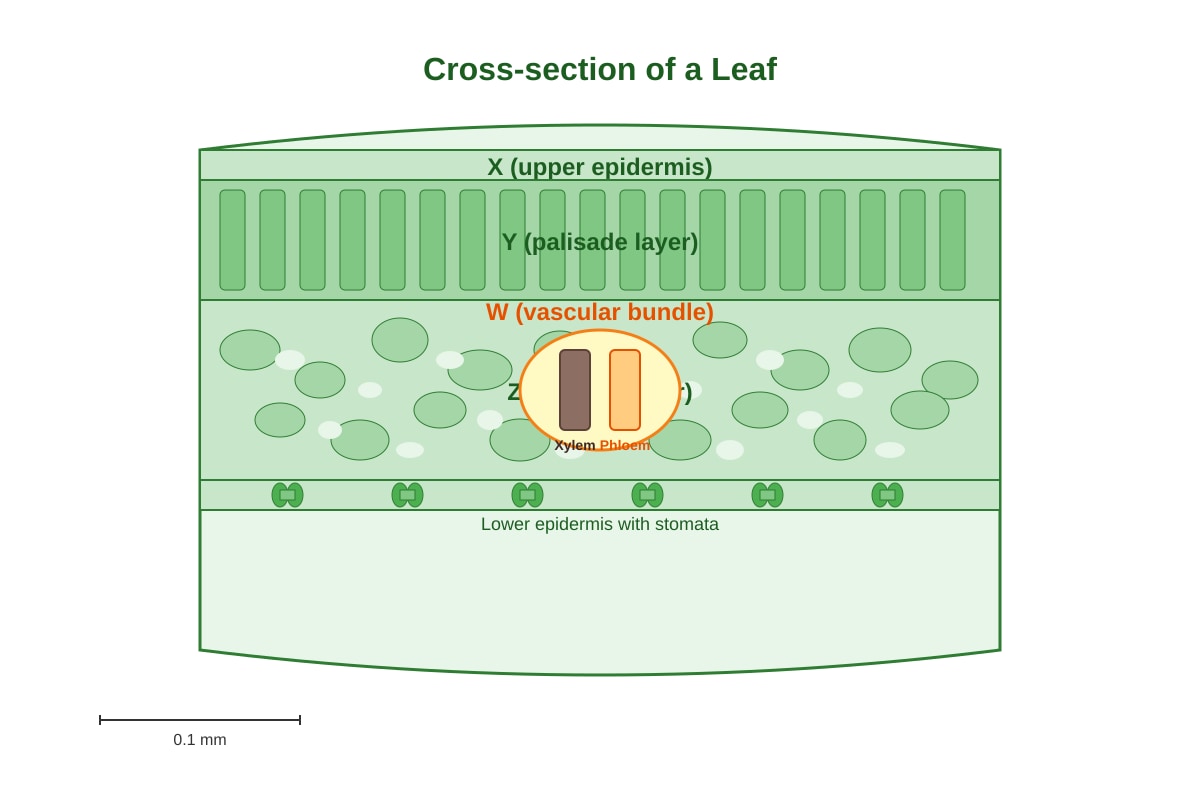
11. The diagram shows a section of a leaf.
<image_placeholder> id: Q11-fig1 type: diagram linked_question: Q11 description: Cross-section of a leaf showing transport tissues labels: X (upper epidermis), Y (palisade layer), Z (spongy layer), W (vascular bundle containing xylem and phloem) values: None specified must_show: Clear tissue layers; vascular bundle labelled W centrally located; palisade cells elongated and packed; stomata visible on lower surface </image_placeholder>
(a) Name the tissue in the vascular bundle (labelled W) that transports water from the roots to the leaf. ________________________________________________ [1]
(b) Name the other tissue in the vascular bundle that transports food made in the leaf to other parts of the plant. ______________________________________________ [1]
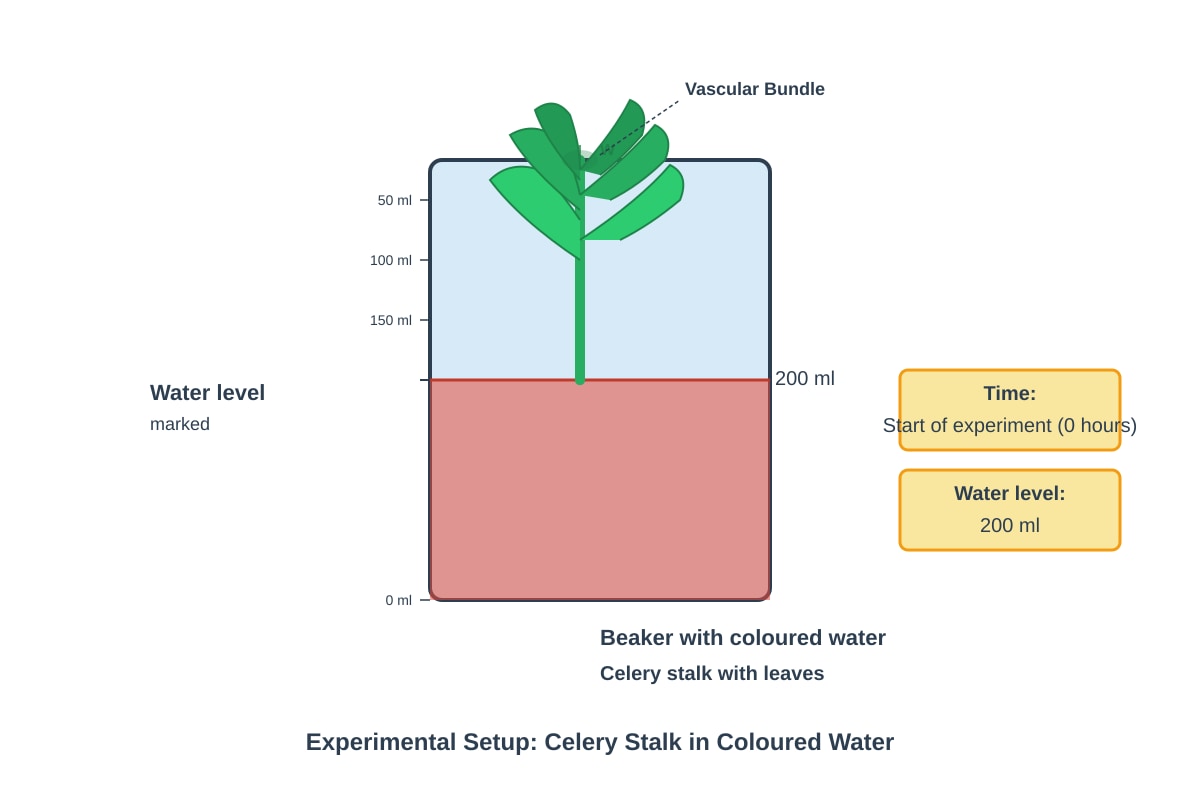
12. An experiment is set up to show the movement of water in a plant.
<image_placeholder> id: Q12-fig1 type: diagram linked_question: Q12 description: Experimental setup with celery stalk in coloured water labels: Beaker with red/blue coloured water, Celery stalk with leaves, Water level marked values: Water level: 200 ml; Time: start of experiment (0 hours) must_show: Clear container with coloured liquid; celery stalk upright; leaves at top; water level clearly marked; time indication </image_placeholder>
(a) Predict what will happen to the water level in the beaker after 24 hours. ____________ [1]
(b) Predict what you will observe in the celery stalk and leaves after 24 hours. Explain your answer. __________________________________________________________ [2]
13. The table shows some features of the transport systems in plants and humans.
| Feature | Plant transport system | Human transport system |
|---|---|---|
| Has tubes | Yes | Yes |
| Has a pump | (i) _______ | Yes |
| Substance transported in tubes | Water and food | (ii) _______ |
(a) Fill in the blanks with "Yes" or "No" for (i), and an appropriate phrase for (ii). [2]
(i) ______________________________ (ii) ______________________________
(b) Explain your answer for (i). ________________________________________________ [2]
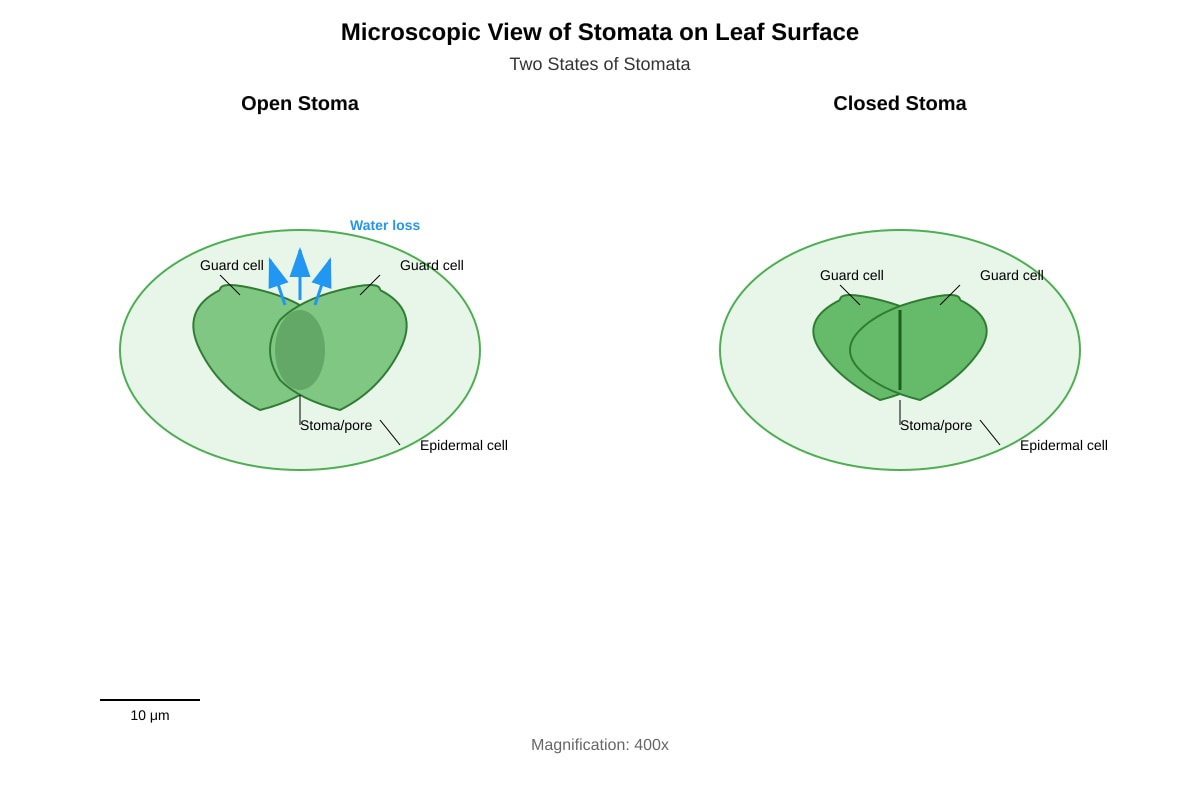
14. The diagram shows stomata on the underside of a leaf.
<image_placeholder> id: Q14-fig1 type: diagram linked_question: Q14 description: Microscopic view of stomata on leaf surface labels: Guard cell (two surrounding each pore), Stoma/pore (opening between guard cells), Epidermal cell values: Stoma shown in two states: open (left) and closed (right) must_show: Pair of kidney-shaped guard cells clearly visible; central pore opening; comparison between open and closed states; arrow indicating water loss in open state </image_placeholder>
(a) What is the function of the stoma? ___________________________________________ [1]
(b) Explain how the guard cells control whether the stoma is open or closed. __________ [2]
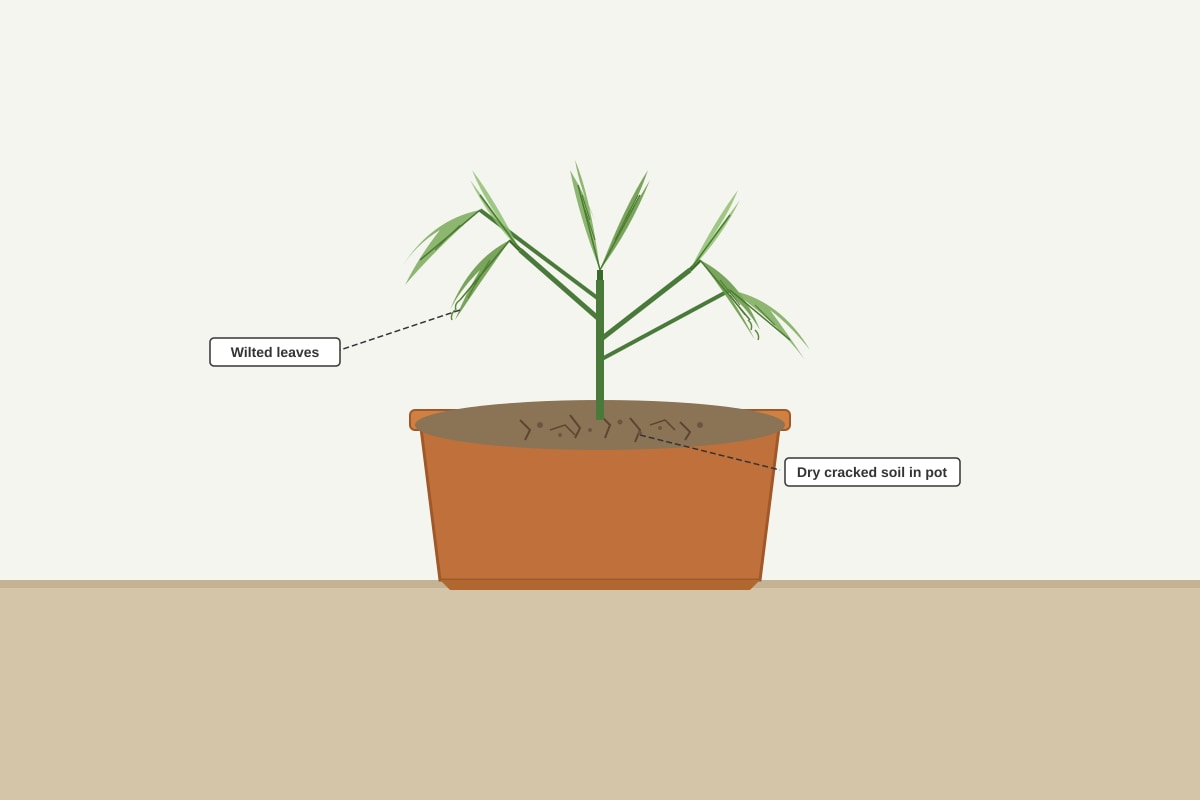
15. The photograph shows a plant with wilted leaves.
<image_placeholder> id: Q15-fig1 type: photograph linked_question: Q15 description: Potted plant with drooping, wilted leaves, dry soil visible labels: Wilted leaves, Dry cracked soil in pot values: None specified must_show: Clear wilting symptoms (drooping, curled leaves); dry soil texture visible; plant still green but stressed </image_placeholder>
(a) Suggest one reason why the leaves have wilted. _________________________________ [1]
(b) Explain how this affects the plant's ability to make food. ______________________ [2]
Section D: Integration and Application (Questions 16–20)
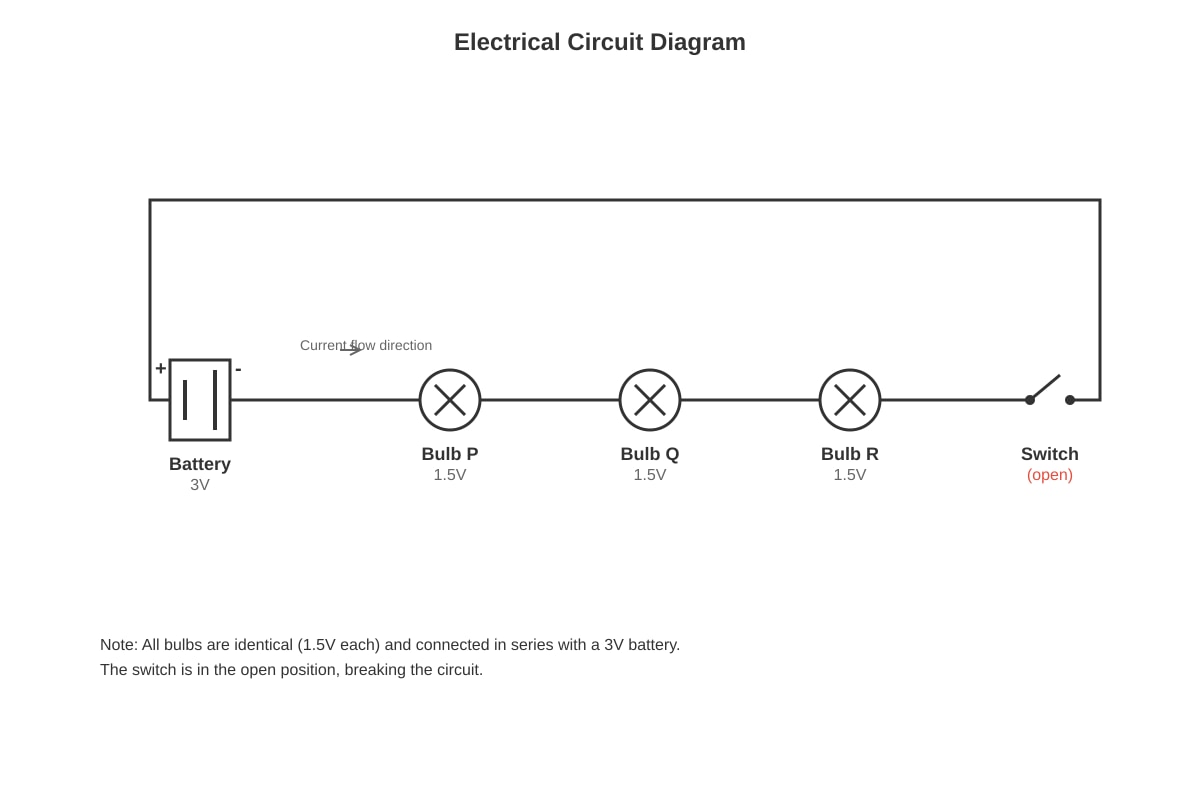
16. The diagram shows an electrical circuit that a student has built.
<image_placeholder> id: Q16-fig1 type: diagram linked_question: Q16 description: Circuit with one battery, three bulbs in series, open switch labels: Battery, Switch (labelled "open"), Bulb P, Bulb Q, Bulb R (all in single loop) values: Battery: 3V; Bulbs: identical 1.5V bulbs must_show: Series arrangement with all bulbs in one continuous loop; open switch clearly indicated; bulb ratings visible </image_placeholder>
(a) Will any bulbs light up? Explain your answer. __________________________________ [2]
(b) What will happen to the brightness of the remaining bulbs if Bulb P is removed from its socket? Explain. _____________________________________________________ [2]
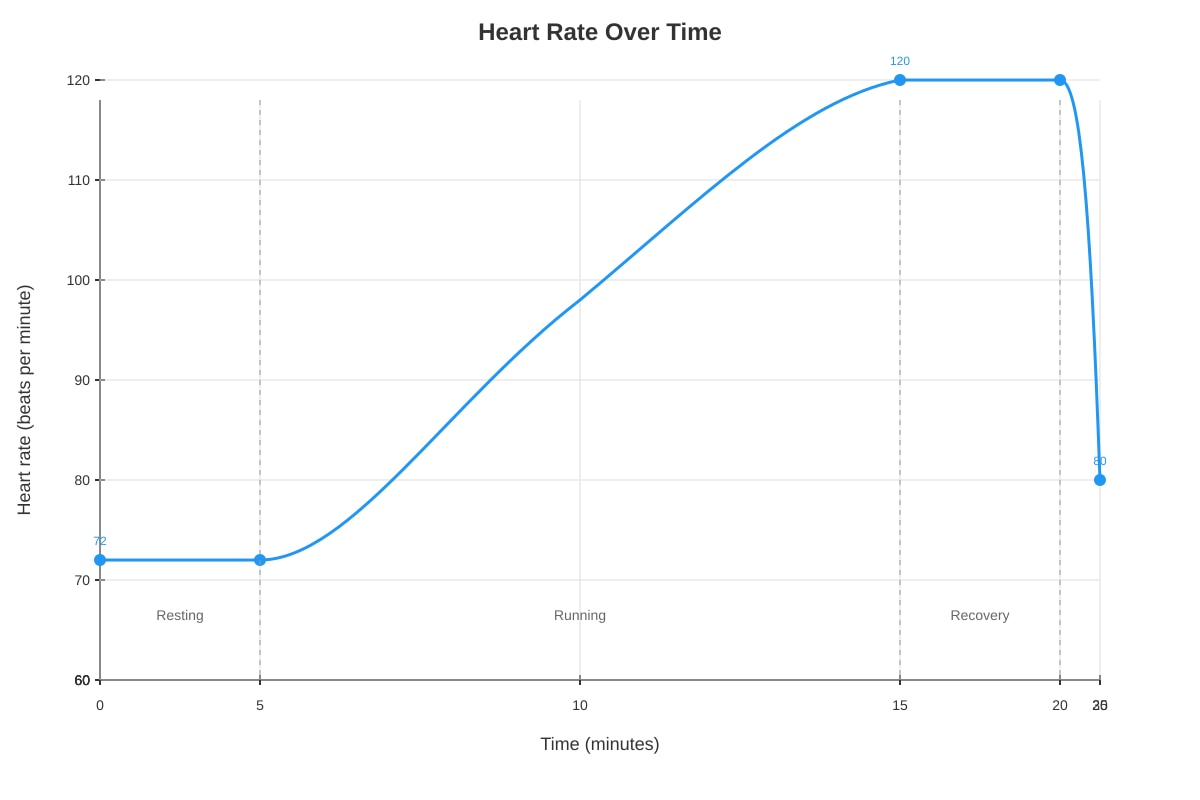
17. The graph shows a student's heart rate before, during, and after running.
<image_placeholder> id: Q17-fig1 type: graph linked_question: Q17 description: Line graph showing heart rate over time labels: X-axis: Time (minutes) with markings 0, 5, 10, 15, 20, 25, 30; Y-axis: Heart rate (beats per minute) from 60 to 140 values: 0-5 min: 72 bpm (resting); 5-15 min: rises to 120 bpm (running); 15-20 min: stays at 120 bpm; 20-30 min: falls to 80 bpm (recovery) must_show: Clear axis labels with units; smooth curve showing three phases; grid lines for reading values; numerical values at key points </image_placeholder>
(a) At what time did the student start running? ____________________________________ [1]
(b) Calculate the increase in heart rate from resting to maximum during exercise. Show your working. _________________________________________________________ [2]
Working:
Answer: ______________________________ beats per minute
(c) Explain why the heart rate does not return immediately to resting rate after the student stops running. ______________________________________________________ [2]
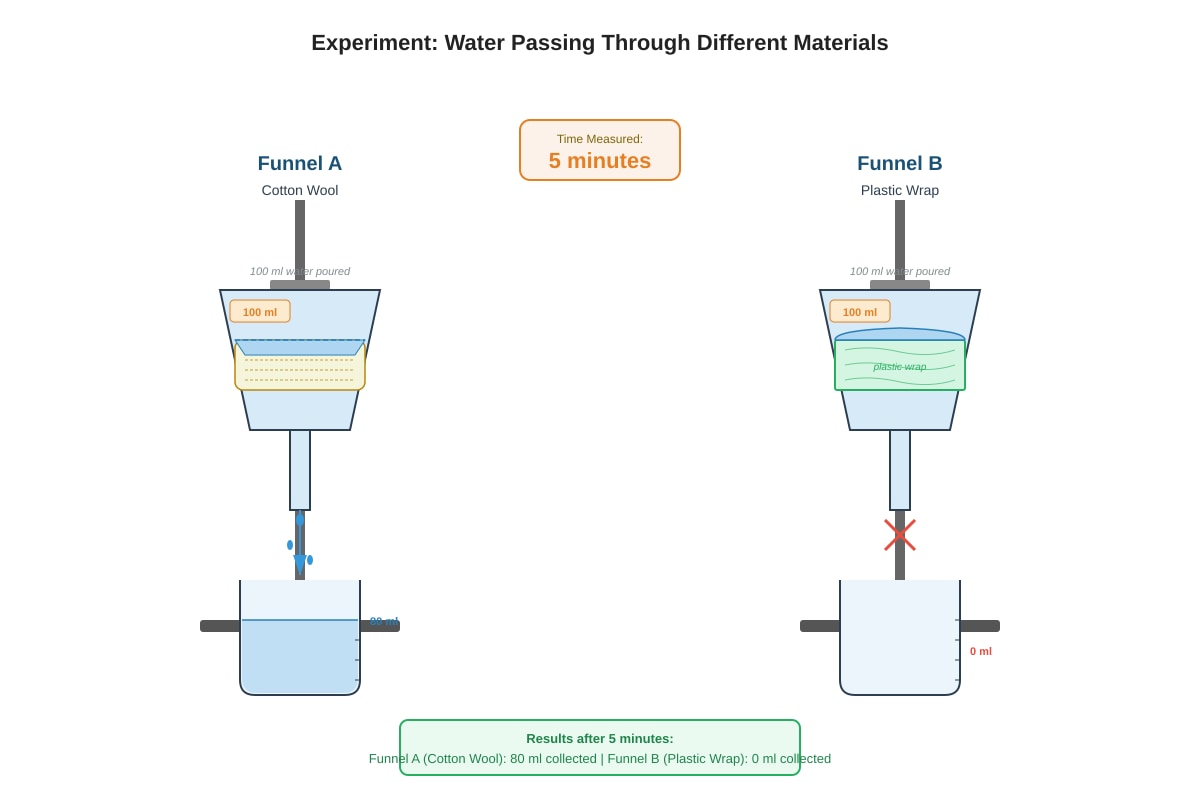
18. The diagram shows an experiment to compare how water moves through different materials.
<image_placeholder> id: Q18-fig1 type: experimental_setup linked_question: Q18 description: Two identical filter funnels with different materials, collecting water in beakers labels: Funnel A: cotton wool; Funnel B: plastic wrap; Both funnels with 100ml water poured in; Beakers below collecting water values: 100 ml water in each funnel; Time measured: 5 minutes must_show: Identical setup except for filter material; clear material labels; measuring cylinders or marked beakers for collection; timer indication </image_placeholder>
After 5 minutes, 80 ml of water was collected in the beaker below Funnel A, but no water was collected below Funnel B.
(a) Explain why water passed through the cotton wool but not through the plastic wrap. [2]
(b) Which material would be more suitable to make a waterproof jacket? Explain your choice. _____________________________________________________________ [2]
19. The passage below describes how a vacuum flask works.
A vacuum flask is used to keep drinks hot or cold. It has two walls with a vacuum (empty space) between them. The inside wall is shiny. The stopper is made of plastic.
(a) Explain how the vacuum between the walls helps to keep the drink hot. ____________ [2]
(b) Explain why the plastic stopper is a better choice than a metal stopper for keeping drinks hot. ______________________________________________________________ [2]
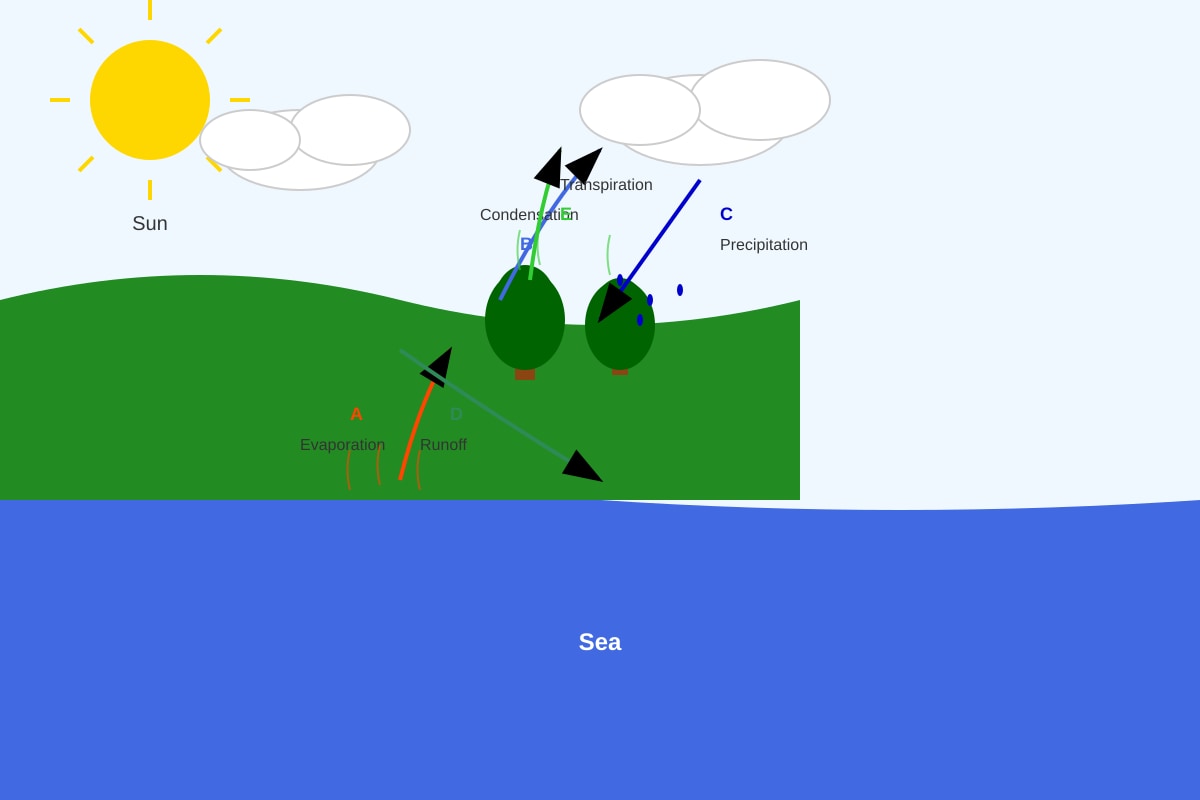
20. The diagram shows two ways that water can travel through the environment.
<image_placeholder> id: Q20-fig1 type: diagram linked_question: Q20 description: The water cycle diagram showing main processes labels: A (evaporation from sea), B (condensation forming clouds), C (precipitation as rain), D (runoff into sea), E (transpiration from trees) values: Large arrow labels for each process; sun shown heating water source must_show: Complete cycle with ocean, land, clouds, trees; sun as energy source; arrows showing direction of water movement; all five labelled processes visible </image_placeholder>
(a) Name the processes labelled A and E. [2]
A: ______________________________ E: ______________________________
(b) Explain how transpiration (process E) helps to pull more water up from the roots of the plant. ______________________________________________________________ [2]
(c) Explain why the water cycle is important for living things. ______________________ [2]
END OF QUIZ
Answers
Primary 5 Science Quiz - Systems: Answer Key
Total Marks: 40 marks
Section A: Electrical Systems
1. (a) On [1]
(b) The switch is closed, so the circuit is complete. Electricity can flow from the battery, through the switch and bulb, and back to the battery. [1]
Teaching note: A complete/closed circuit is needed for electricity to flow. The switch closes the gap in the circuit.
2. Circuit B [1]
Circuit B has two batteries connected in series, which provides more electrical energy than one battery. More energy means more current flows, making the bulb brighter. [1]
Teaching note: Batteries in series add their voltages (roughly). More voltage pushes more current through the bulb, which glows brighter. The bulb's brightness depends on the electrical energy it receives.
3. Copper [2]
Teaching note: Copper is a good conductor of electricity. It has free electrons that can move easily, allowing electric current to flow. Other acceptable answers: aluminium, silver, gold (any metal). Common mistake: students may write "metal" only — this is too vague for full marks unless specified as "metals like copper."
4. (a) Metal spoon [1]
Teaching note: Metals allow electricity to pass through — they are conductors.
(b) Plastic and wood are insulators. They do not allow electricity to pass through easily because their electrons are held tightly and cannot move freely. [1]
Teaching note: Insulators resist the flow of electricity. The bulb stays off because no current can flow through the plastic ruler or wooden chopstick to complete the circuit.
5. Circuit should show two bulbs connected in parallel with one battery [2]
Marking points:
- [1] Two bulbs both connected to allow current flow
- [1] Parallel arrangement (both bulbs connected across same two points so they have equal brightness)
Teaching note: In parallel, each bulb gets the full voltage of the battery, so both shine equally bright. In series, bulbs share the voltage and would be dimmer. Draw: battery with two separate loops, each with one bulb, returning to battery.
Section B: Human Transport Systems
6. (a) D (left ventricle) [1]
Teaching note: The left ventricle has the thickest muscular wall because it needs to pump blood to all parts of the body through the aorta. The right ventricle only pumps to the lungs, which is a shorter distance.
(b) Pulmonary vein [1]
Teaching note: Veins typically carry blood toward the heart. The pulmonary vein is special — it carries oxygen-rich blood from the lungs back to the heart (left atrium). Don't confuse with pulmonary artery, which carries blood away from the heart to the lungs.
7. (a) Vein [1]
Teaching note: Valves are visible in the diagram as flap-like structures.
(b) Veins carry blood back to the heart against gravity (especially in legs). Valves prevent backflow and ensure blood flows in one direction toward the heart. [1]
Teaching note: Arteries have thick, muscular walls and high pressure from the heart pump, so they don't need valves. Veins have lower pressure and need valves to stop blood pooling or flowing backward due to gravity.
8. (a) (i) Yes [1] (ii) Yes [1]
(b) Plasma [1]
Teaching note: All listed components are parts of blood. Plasma is the yellowish liquid that makes up about 55% of blood volume. It carries dissolved nutrients, hormones, waste products, and blood cells.
9. (a) During exercise, muscles need more energy. They need more oxygen and glucose for respiration, and need to remove more carbon dioxide. The heart beats faster to pump more blood carrying these substances to and from the muscles faster. [2]
Marking breakdown:
- [1] Muscles need more oxygen/glucose/energy during exercise
- [1] Faster heart rate delivers blood (with these substances) more quickly
(b) Respiratory system and muscular system (any two correct systems: muscular, respiratory, nervous) [1]
Teaching note: The respiratory system breathes faster to get more oxygen and remove more CO₂. The nervous system sends signals to increase heart and breathing rates. The muscular system is the one doing the work.
10. (a) 1: Nose/Nostril [1] 5: Air sac/Alveolus [1]
(b) The alveolus has thin walls (one cell thick) and a large surface area. It is surrounded by blood capillaries, allowing oxygen to diffuse quickly into the blood and carbon dioxide to diffuse out. [2]
Marking breakdown:
- [1] Thin walls / large surface area / surrounded by blood capillaries (any one structural feature)
- [1] Allows efficient gas exchange / diffusion of gases
Teaching note: The alveolus is adapted for maximum gas exchange efficiency. Thin walls reduce diffusion distance; large surface area maximizes exchange area; rich blood supply maintains concentration gradient.
Section C: Plant Transport Systems
11. (a) Xylem [1]
Teaching note: Xylem vessels are dead, hollow tubes that transport water and minerals upward from roots to leaves. They have thick, lignified walls for support.
(b) Phloem [1]
Teaching note: Phloem transports food (sugars/glucose produced in photosynthesis) from leaves to other plant parts — roots, fruits, growing areas. Unlike xylem, phloem consists of living cells.
12. (a) The water level will decrease / go down. [1]
(b) The celery stalk and leaves will turn red/blue (the colour of the water). This happens because water is absorbed by the roots and transported up the stem through the xylem to the leaves. [2]
Marking breakdown:
- [1] Observation: coloured water visible in stalk/leaves
- [1] Explanation: water transported up through xylem from roots to leaves
Teaching note: This classic experiment demonstrates capillary action and xylem transport. The coloured water makes the invisible process visible. The water level drops because water is absorbed and also evaporates from the leaf surface.
13. (a) (i) No [1] (ii) Blood / Blood cells and plasma [1]
(b) Plants do not have a muscular pump (heart) like animals. Water moves up through xylem by capillary action and transpiration pull, not by pumping. [2]
Marking breakdown:
- [1] Plants lack a heart / muscular pump / pumping organ
- [1] Water movement relies on transpiration pull / capillary action / evaporation from leaves creating suction
Teaching note: This is a key difference between plant and animal transport. Plant transport is passive (no energy needed for water movement up), while animal circulation is active (heart pumps using energy).
14. (a) Allows gas exchange / allows carbon dioxide to enter and oxygen/water vapour to leave the leaf [1]
Teaching note: Stomata are pores primarily on the leaf underside that regulate gas exchange and transpiration.
(b) When guard cells take in water, they swell and curve apart, opening the stoma. When they lose water, they become flaccid and close together, closing the stoma. [2]
Marking breakdown:
- [1] Turgid/swollen guard cells → stoma open
- [1] Flaccid/shrunken guard cells → stoma closed
Teaching note: Guard cells are the only epidermal cells with chloroplasts (containing chlorophyll). They photosynthesize, producing glucose, which increases solute concentration, causing water to enter by osmosis. The inner wall is thicker, so they bend away from each other when turgid.
15. (a) The plant has not been watered / lacks water / the soil is too dry [1]
(b) Without enough water, the plant cannot transport water to the leaves. The leaves lose turgor pressure and wilt. Also, water is needed for photosynthesis — less water means less food can be made. [2]
Marking breakdown:
- [1] Less water reaching cells / loss of turgor pressure / cells become flaccid
- [1] Water is a raw material for photosynthesis
Teaching note: Turgor pressure keeps plant cells rigid. When water enters plant cells, they push against cell walls, keeping leaves firm. Without water, cells become flaccid (soft) and the leaf droops. Water is also one of the reactants in photosynthesis: CO₂ + H₂O → glucose + O₂.
Section D: Integration and Application
16. (a) No. The switch is open, so the circuit is broken. Electricity cannot flow around a broken circuit. [2]
Marking breakdown:
- [1] No / None of the bulbs will light up
- [1] Switch is open / circuit is broken / incomplete circuit / gap in circuit
(b) The remaining bulbs will not light up. In a series circuit, if one component is removed, the circuit is broken and electricity cannot flow to any other component. [2]
Marking breakdown:
- [1] No bulbs light / circuit stops working
- [1] All components in series / one break stops entire circuit / current path is interrupted
Teaching note: This is a disadvantage of series circuits. A single fault breaks everything. In parallel, other branches continue to work.
17. (a) 5 minutes [1]
(b) Working: Maximum heart rate − Resting heart rate = 120 − 72 = 48 [2]
Answer: 48 beats per minute
Marking breakdown:
- [1] Correct working shown (identifying 72 and 120, subtraction)
- [1] Correct answer with unit
(c) The body still needs extra oxygen to repay the "oxygen debt" / remove lactic acid built up during exercise. The heart continues working harder until the body returns to resting metabolic state. [2]
Marking breakdown:
- [1] Body still needs to remove extra CO₂ / lactic acid / repay oxygen debt
- [1] Metabolism is still elevated / muscles need continued blood flow to recover
Teaching note: During intense exercise, muscles may respire anaerobically (without oxygen), producing lactic acid. After exercise, extra oxygen is needed to break down this lactic acid. This is called "oxygen debt."
18. (a) Cotton wool has tiny spaces/pores between its fibres that allow water to pass through. Plastic wrap has no pores / is non-porous, so water cannot pass through. [2]
Marking breakdown:
- [1] Cotton wool is porous / has spaces / allows water through
- [1] Plastic wrap is non-porous / has no spaces / waterproof
(b) Plastic wrap. It does not allow water to pass through, so it will keep rain/water out and keep the wearer dry. [2]
Marking breakdown:
- [1] Plastic wrap
- [1] Waterproof / does not allow water through / keeps water out
Teaching note: This connects material properties to real-world applications. Porous materials allow fluids to pass; non-porous materials block them. The experiment demonstrates permeability differences.
19. (a) A vacuum contains no matter (no air particles). Heat cannot be transferred by conduction or convection through the vacuum because these need particles. This reduces heat loss from the hot drink. [2]
Marking breakdown:
- [1] Vacuum has no air / no particles / empty space
- [1] Prevents conduction and convection / heat cannot travel through vacuum easily / reduces heat transfer
(b) Plastic is a poor conductor of heat / an insulator. Metal is a good conductor and would allow heat to escape quickly from the drink to the surroundings. Plastic keeps the heat in. [2]
Marking breakdown:
- [1] Plastic is an insulator / poor conductor; metal is a good conductor
- [1] Metal would allow heat loss / plastic reduces heat loss / keeps drink hot longer
Teaching note: The vacuum flask uses multiple methods to reduce heat transfer: vacuum stops conduction/convection; shiny inner surface reflects radiation; plastic/b cork stopper reduces conduction at the opening.
20. (a) A: Evaporation [1] E: Transpiration [1]
(b) When water evaporates from leaf surfaces (transpiration), it creates a suction/pull that draws more water up from the roots through the xylem. This is called the transpiration pull. [2]
Marking breakdown:
- [1] Evaporation from leaves creates suction / pull / low pressure
- [1] This pulls water up from roots / through xylem
(c) The water cycle provides fresh water for drinking and for plants to absorb. It also distributes water around Earth, supports all living things that need water to survive, and helps regulate temperature. [2]
Marking breakdown:
- [1] Provides water for living things / drinking / plant growth / survival
- [1] Distributes water / part of ecosystems / maintains water supply / temperature regulation
Teaching note: Without the water cycle, water would collect in oceans and not return to land. All living things need water for life processes: as a solvent, transport medium, reactant in photosynthesis, temperature regulator, and habitat.
END OF ANSWER KEY