From Real Exams Quiz
Primary 5 Science Materials Quiz
Free Exam-Derived NVIDIA Nemotron 3 Ultra 550B A55B Free Primary 5 Science Materials quiz with questions and answers for Singapore students. This page is rendered as a direct URL so the questions and answers can be discovered without pressing in-page buttons.
These static practice materials are generated from the site's syllabus and paper-generation workflow, with source and model context shown so students and parents can evaluate the material before use.
Questions
Primary 5 Science Quiz - Materials
Name: ___________________________
Class: Primary 5 ______
Date: _______________
Score: ______ / 40
Duration: 45 minutes
Total Marks: 40
Instructions:
- Answer all questions.
- For Section A, choose the correct option and write its letter (A, B, C, or D) in the brackets provided.
- For Section B and C, write your answers in the spaces provided.
- The number of marks for each question is shown in brackets [ ].
Section A: Multiple-Choice Questions (10 × 1 mark = 10 marks)
For each question, choose the correct answer and write its letter in the brackets.
1. Which of the following is a property of metals?
A. Dull appearance
B. Poor conductor of heat
C. Malleable and ductile
D. Brittle and breaks easily
[ ]
2. Four objects are made of different materials. Which object is most likely made of a transparent material?
A. A wooden door
B. A glass window pane
C. A metal key
D. A rubber eraser
[ ]
3. Study the classification table below.
| Group X | Group Y |
|---|---|
| Copper wire | Plastic ruler |
| Iron nail | Wooden spoon |
| Aluminium foil | Rubber band |
What is a suitable heading for Group X and Group Y?
| Group X | Group Y |
|---|---|
| A. Good conductor of heat | Poor conductor of heat |
| B. Magnetic | Non-magnetic |
| C. Flexible | Stiff |
| D. Transparent | Opaque |
| [ ] |
4. Which material is most suitable for making a cooking pot handle?
A. Copper
B. Iron
C. Wood
D. Aluminium
[ ]
5. A student wants to test whether a material is waterproof. Which of the following set-ups is correct?
A. Place the material in a freezer and observe if it becomes hard.
B. Pour water on the material and observe if water passes through.
C. Hit the material with a hammer and observe if it breaks.
D. Shine a light on the material and observe if light passes through.
[ ]
6. Which of the following statements about plastics is correct?
A. All plastics are biodegradable.
B. Plastics are good conductors of electricity.
C. Plastics can be moulded into different shapes when heated.
D. Plastics are naturally occurring materials.
[ ]
7. The diagram below shows a tent.
<image_placeholder> id: Q7-fig1 type: diagram linked_question: Q7 description: A simple tent structure with labelled parts: outer fabric, poles, pegs, and ground sheet. labels: Outer fabric, Poles, Pegs, Ground sheet values: None must_show: Distinct parts of a tent made from different materials (fabric, metal poles, plastic pegs, waterproof ground sheet) </image_placeholder>
Which property is most important for the material used to make the outer fabric of the tent?
A. Flexibility
B. Waterproof
C. Transparency
D. Magnetic
[ ]
8. Four strips of different materials (W, X, Y, Z) of the same size and thickness are tested for flexibility. The results are shown below.
| Material | Distance bent (cm) before breaking |
|---|---|
| W | 2 |
| X | 8 |
| Y | 5 |
| Z | 10 |
Which material is the most flexible?
A. W
B. X
C. Y
D. Z
[ ]
9. Why are electrical wires usually made of copper and covered with plastic?
A. Copper is magnetic and plastic is waterproof.
B. Copper is a good conductor of electricity and plastic is an insulator.
C. Copper is transparent and plastic is flexible.
D. Copper is strong and plastic is a good conductor of heat.
[ ]
10. Which of the following objects is made of a material that comes from a natural source?
A. Nylon rope
B. Polyester shirt
C. Wooden chair
D. Styrofoam cup
[ ]
Section B: Short-Answer Questions (5 × 2 marks = 10 marks)
Write your answers in the spaces provided.
11. The table below shows the properties of four materials A, B, C, and D. A tick (✓) means the material has that property.
| Property | Material A | Material B | Material C | Material D |
|---|---|---|---|---|
| Waterproof | ✓ | ✓ | ||
| Flexible | ✓ | ✓ | ||
| Transparent | ✓ | ✓ | ||
| Strong | ✓ | ✓ | ✓ |
(a) Which material (A, B, C, or D) is most suitable for making a raincoat? Give a reason for your answer. [1]
Answer: _________________________________________________________________________
(b) Which material (A, B, C, or D) is most suitable for making a pair of spectacles (eyeglasses)? Give a reason for your answer. [1]
Answer: _________________________________________________________________________
12. John wants to find out which of three materials (X, Y, Z) is the strongest. He hangs weights on each material until it breaks.
<image_placeholder> id: Q12-fig1 type: experimental_setup linked_question: Q12 description: Three identical strips of materials X, Y, Z clamped at the top with weights hung from the bottom. A ruler measures the extension. labels: Material X, Material Y, Material Z, Clamp, Weights (100g each), Ruler (cm) values: Weights added in 100g increments until break must_show: Fair test setup with same length, width, thickness of strips; same method of adding weights; measurement of weight at breaking point </image_placeholder>
(a) State one variable that John must keep the same to ensure a fair test. [1]
Answer: _________________________________________________________________________
(b) If Material X holds 500 g before breaking, Material Y holds 800 g, and Material Z holds 300 g, which material is the strongest? [1]
Answer: _________________________________________________________________________
13. The diagram below shows a saucepan with a metal body and a plastic handle.
<image_placeholder> id: Q13-fig1 type: diagram linked_question: Q13 description: A saucepan with metal body and plastic handle. Arrows show heat from stove to metal body. labels: Metal body, Plastic handle, Heat source (stove), Direction of heat flow values: None must_show: Clear distinction between metal body (conducts heat) and plastic handle (insulates heat) </image_placeholder>
(a) Explain why the body of the saucepan is made of metal. [1]
Answer: _________________________________________________________________________
(b) Explain why the handle is made of plastic. [1]
Answer: _________________________________________________________________________
14. Study the flowchart below.
<image_placeholder> id: Q14-fig1 type: diagram linked_question: Q14 description: Flowchart for classifying materials. Start: Is it waterproof? Yes -> Is it flexible? Yes -> Material P; No -> Material Q. No -> Is it transparent? Yes -> Material R; No -> Material S. labels: Start, Is it waterproof?, Yes, No, Is it flexible?, Is it transparent?, Material P, Material Q, Material R, Material S values: None must_show: Clear decision diamond boxes and rectangular outcome boxes with arrows </image_placeholder>
Based on the flowchart, state one property of Material R. [1]
Answer: _________________________________________________________________________
15. Mary placed four different materials (A, B, C, D) in water. She observed whether they floated or sank.
| Material | Observation |
|---|---|
| A | Floats |
| B | Sinks |
| C | Floats |
| D | Sinks |
(a) What property of materials is Mary investigating? [1]
Answer: _________________________________________________________________________
(b) If Material A is wood and Material B is iron, explain why Material A floats while Material B sinks. [1]
Answer: _________________________________________________________________________
Section C: Structured / Open-Ended Questions (5 × 4 marks = 20 marks)
Write your answers in the spaces provided. Show your reasoning clearly.
16. A toy car has wheels made of rubber and a body made of plastic. The axle (rod through the wheels) is made of metal.
(a) State one property of rubber that makes it suitable for making the wheels. [1]
Answer: _________________________________________________________________________
(b) State one property of plastic that makes it suitable for making the car body. [1]
Answer: _________________________________________________________________________
(c) State one property of metal that makes it suitable for making the axle. [1]
Answer: _________________________________________________________________________
(d) The toy car is left in the sun for a long time. The plastic body becomes slightly soft and changes shape. What property of plastic does this show? [1]
Answer: _________________________________________________________________________
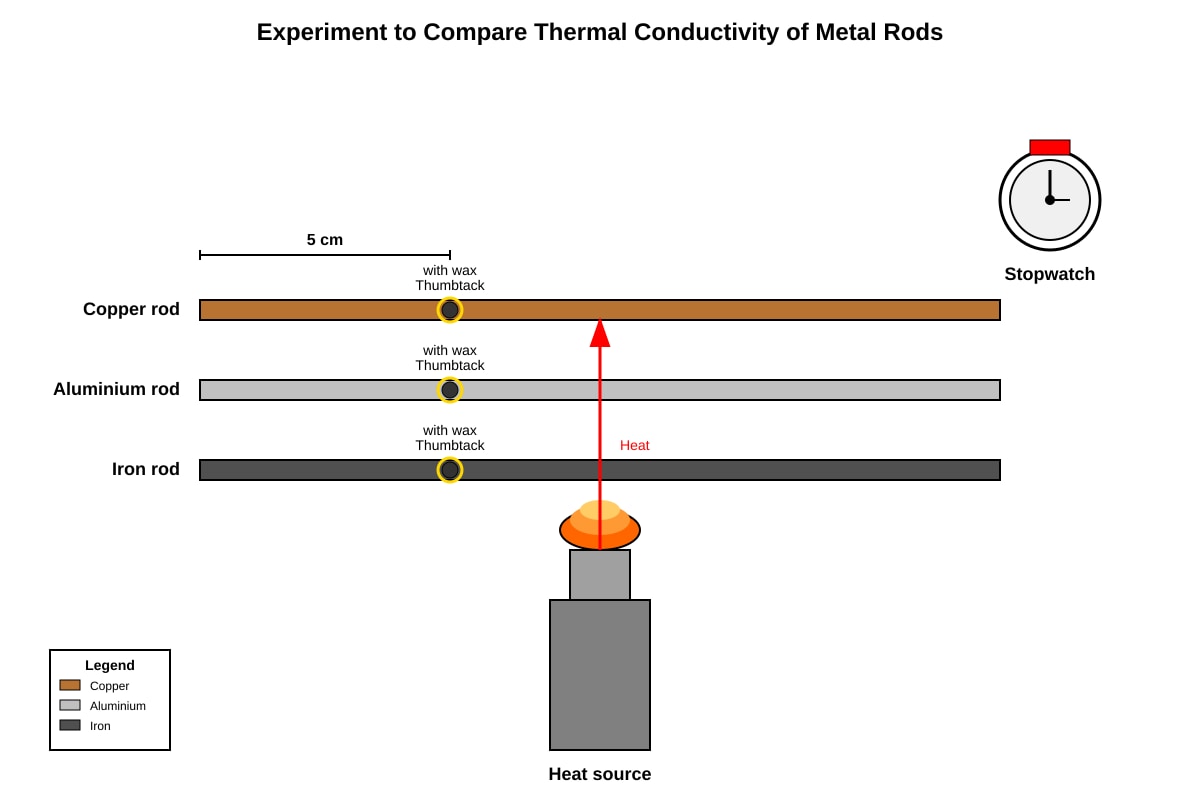
17. Four beakers are set up as shown below. Each beaker contains 200 ml of water at room temperature. A spoon made of a different material is placed in each beaker. Hot water (80°C) is poured into each spoon.
<image_placeholder> id: Q17-fig1 type: experimental_setup linked_question: Q17 description: Four beakers with water at room temperature. Each has a spoon of different material (metal, plastic, wood, ceramic) submerged with handle sticking out. Hot water poured into spoon bowl. labels: Beaker 1: Metal spoon, Beaker 2: Plastic spoon, Beaker 3: Wooden spoon, Beaker 4: Ceramic spoon, Hot water (80°C) poured into spoon, Thermometer in beaker water values: Initial water temp: 25°C, Hot water: 80°C, Volume: 200 ml each, Time: 5 minutes must_show: Four identical setups differing only in spoon material; thermometers in beaker water to measure temperature rise </image_placeholder>
After 5 minutes, the temperature of the water in each beaker is measured.
(a) In which beaker will the water temperature rise the most? Explain your answer. [2]
Answer: _________________________________________________________________________
(b) In which beaker will the water temperature rise the least? Explain your answer. [1]
Answer: _________________________________________________________________________
(c) What is the aim of this experiment? [1]
Answer: _________________________________________________________________________
18. The diagram below shows a cross-section of a vacuum flask.
<image_placeholder> id: Q18-fig1 type: diagram linked_question: Q18 description: Cross-section of vacuum flask showing double walls with vacuum between, silvered inner surfaces, plastic stopper, and outer casing. labels: Inner wall (silvered), Outer wall (silvered), Vacuum space, Plastic stopper, Outer casing, Hot liquid inside values: None must_show: Double-walled structure with vacuum gap; silvered surfaces facing vacuum; stopper at top </image_placeholder>
(a) Explain how the vacuum between the two walls helps to keep the liquid hot for a long time. [2]
Answer: _________________________________________________________________________
(b) Explain how the silvered surfaces help to keep the liquid hot. [1]
Answer: _________________________________________________________________________
(c) The plastic stopper is a poor conductor of heat. How does this help? [1]
Answer: _________________________________________________________________________
19. A scientist tests three materials (K, L, M) for their absorbency. She cuts each material into a 10 cm × 10 cm square, weighs it, submerges it in water for 5 minutes, removes it, lets it drip for 30 seconds, and weighs it again.
| Material | Dry mass (g) | Wet mass (g) |
|---|---|---|
| K | 5 | 25 |
| L | 5 | 15 |
| M | 5 | 10 |
(a) Calculate the mass of water absorbed by each material. [1]
Material K: ______ g
Material L: ______ g
Material M: ______ g
(b) Which material is the most absorbent? [1]
Answer: _________________________________________________________________________
(c) State two variables that must be kept the same to make this a fair test. [2]
Answer: _________________________________________________________________________
20. Peter wants to choose a material to make a food container that will be used in a microwave oven. The container must:
- Allow microwaves to pass through to heat the food
- Not get too hot when the food is hot
- Be safe for food contact
- Be easy to clean
He tests four materials and records the results:
| Material | Allows microwaves through? | Gets hot in microwave? | Food safe? | Easy to clean? |
|---|---|---|---|---|
| W | Yes | Yes | Yes | Yes |
| X | Yes | No | Yes | Yes |
| Y | No | No | Yes | Yes |
| Z | Yes | No | No | Yes |
(a) Which material (W, X, Y, or Z) is the most suitable? [1]
Answer: _________________________________________________________________________
(b) Explain why Material W is not suitable, even though it allows microwaves through and is food safe. [1]
Answer: _________________________________________________________________________
(c) Explain why Material Y is not suitable. [1]
Answer: _________________________________________________________________________
(d) State one property of Material X that makes it suitable for the food container. [1]
Answer: _________________________________________________________________________
End of Quiz
Answers
Primary 5 Science Quiz - Materials (Answer Key)
Total Marks: 40
Section A: Multiple-Choice Questions (10 × 1 mark = 10 marks)
1. C — Metals are malleable (can be hammered into shapes) and ductile (can be drawn into wires). They are shiny (not dull), good conductors of heat, and not brittle.
Marking note: 1 mark for correct option.
2. B — Glass is transparent (allows light to pass through so we can see through it). Wood, metal, and rubber are opaque.
Marking note: 1 mark for correct option.
3. A — Group X (copper, iron, aluminium) are metals → good conductors of heat. Group Y (plastic, wood, rubber) are non-metals → poor conductors of heat.
Marking note: 1 mark for correct option. Common mistake: choosing B (only iron is magnetic; copper and aluminium are not).
4. C — Wood is a poor conductor of heat (insulator), so the handle stays cool. Metals (copper, iron, aluminium) conduct heat and would burn the hand.
Marking note: 1 mark for correct option.
5. B — To test waterproofness, pour water on the material and check if water passes through. A tests freezing, C tests strength, D tests transparency.
Marking note: 1 mark for correct option.
6. C — Plastics are synthetic polymers that can be moulded when heated (thermoplastics). Not all are biodegradable (A), they are insulators (B), and they are man-made (D).
Marking note: 1 mark for correct option.
7. B — The outer fabric of a tent must be waterproof to keep rain out. Flexibility (A) is useful but secondary; transparency (C) is not needed; magnetism (D) is irrelevant.
Marking note: 1 mark for correct option.
8. D — Material Z bends the most (10 cm) before breaking, meaning it is the most flexible. Flexibility = how much it can bend without breaking.
Marking note: 1 mark for correct option.
9. B — Copper is an excellent conductor of electricity (lets current flow). Plastic is an insulator (stops current flow), preventing electric shocks.
Marking note: 1 mark for correct option.
10. C — Wood comes from trees (natural source). Nylon, polyester, and styrofoam are synthetic (man-made from petroleum).
Marking note: 1 mark for correct option.
Section B: Short-Answer Questions (5 × 2 marks = 10 marks)
11.
(a) Material A — It is waterproof (keeps rain out) and strong (durable).
Reasoning: A raincoat must repel water (waterproof) and withstand wear (strong). Material C is also waterproof and flexible but not strong.
[1 mark for correct material + reason]
(b) Material C — It is transparent (allows light to pass through so the wearer can see) and flexible (comfortable to wear).
Reasoning: Spectacle lenses must be transparent; frames benefit from flexibility. Material D is transparent and strong but not flexible.
[1 mark for correct material + reason]
12.
(a) Length / width / thickness of the material strips (or "size of the strips", "type of clamp", "way weights are added").
Reasoning: Fair test → only the material (independent variable) changes. All other factors (dimensions, method) must be constant.
[1 mark for any valid controlled variable]
(b) Material Y — It holds the most weight (800 g) before breaking. Strength = maximum load a material can withstand.
[1 mark for correct material]
13.
(a) Metal is a good conductor of heat — it transfers heat quickly from the stove to the food, cooking evenly.
[1 mark for "good conductor of heat" or "conducts heat well"]
(b) Plastic is a poor conductor of heat (insulator) — it does not get hot easily, so the handle stays cool and safe to hold.
[1 mark for "poor conductor of heat" or "insulator" or "does not conduct heat well"]
14. Material R is not waterproof but is transparent.
Reasoning: Flowchart: Start → "Is it waterproof?" → No → "Is it transparent?" → Yes → Material R. So R = not waterproof + transparent.
[1 mark for stating either property correctly; both needed for full understanding but 1 mark question]
15.
(a) Density (or "whether the material floats or sinks in water", "buoyancy").
Reasoning: Floating/sinking depends on density relative to water.
[1 mark for correct property]
(b) Wood (Material A) has a lower density than water, so it floats. Iron (Material B) has a higher density than water, so it sinks.
Reasoning: Objects less dense than water float; objects denser than water sink.
[1 mark for correct explanation mentioning density]
Section C: Structured / Open-Ended Questions (5 × 4 marks = 20 marks)
16.
(a) Rubber is flexible / elastic / has high friction (grip).
Reasoning: Wheels need to grip the ground and absorb bumps. Flexibility/elasticity allows deformation and return.
[1 mark for any valid property: flexible, elastic, high friction, waterproof, durable]
(b) Plastic is lightweight / mouldable into shapes / strong / waterproof.
Reasoning: Car body must be light for movement, shaped easily, and protect interior.
[1 mark for any valid property: lightweight, mouldable, strong, waterproof, colourful]
(c) Metal is strong / rigid / hard / does not bend easily.
Reasoning: Axle must support weight and not bend when wheels turn.
[1 mark for any valid property: strong, rigid, hard, durable]
(d) Plastic softens / melts when heated (thermoplastic property).
Reasoning: Many plastics are thermoplastics — they become soft and mouldable when heated, harden when cooled.
[1 mark for "softens when heated", "melts when heated", "thermoplastic", "changes shape when heated"]
17.
(a) Beaker 1 (Metal spoon) — Metal is a good conductor of heat. Heat from the hot water in the spoon conducts quickly through the metal into the beaker water, raising its temperature the most.
[2 marks: 1 for correct beaker, 1 for explanation with "good conductor of heat"]
(b) Beaker 3 (Wooden spoon) — Wood is a poor conductor of heat (insulator). Very little heat transfers from the spoon to the beaker water, so the temperature rises the least.
[1 mark for correct beaker + explanation with "poor conductor" or "insulator"]
(c) To find out which material is the best conductor of heat (or "to compare how well different materials conduct heat").
[1 mark for correct aim]
18.
(a) The vacuum prevents heat loss by conduction and convection. There are no particles (air molecules) in a vacuum to transfer heat through collisions (conduction) or bulk movement (convection).
[2 marks: 1 for "no conduction", 1 for "no convection" / "no particles to transfer heat"]
(b) The silvered surfaces reflect heat radiation back into the flask (or "reduce heat loss by radiation"). Shiny/silvered surfaces are poor emitters and good reflectors of infrared radiation.
[1 mark for "reflect heat radiation" or "reduce radiation heat loss"]
(c) The plastic stopper reduces heat loss by conduction through the top opening. Being a poor conductor, it slows heat transfer from the hot liquid to the cooler outside air.
[1 mark for "reduces conduction through the top" or "poor conductor so less heat escapes"]
19.
(a) Mass of water absorbed = Wet mass – Dry mass
- Material K: 25 g – 5 g = 20 g
- Material L: 15 g – 5 g = 10 g
- Material M: 10 g – 5 g = 5 g
[1 mark for all three correct calculations]
(b) Material K — It absorbed the most water (20 g).
[1 mark for correct material]
(c) Any two of:
- Size of material (10 cm × 10 cm)
- Thickness of material
- Time submerged in water (5 minutes)
- Dripping time (30 seconds)
- Temperature of water
- Same type of water (e.g., tap water)
[2 marks: 1 mark each for any two valid controlled variables]
20.
(a) Material X
[1 mark for correct choice]
(b) Material W gets hot in the microwave. A suitable container should not get hot (so it is safe to handle and does not overheat the food unevenly).
[1 mark for "gets hot" or "poor insulator" or "unsafe to handle"]
(c) Material Y does not allow microwaves to pass through. The food would not be heated because microwaves cannot reach it.
[1 mark for "does not allow microwaves through" or "blocks microwaves"]
(d) Material X allows microwaves to pass through but does not get hot (or "is a poor conductor of heat" / "insulator" / "microwave-safe").
[1 mark for any one key property: allows microwaves through, does not get hot, food safe, easy to clean]
End of Answer Key