From Real Exams Quiz
Primary 5 Science Materials Quiz
Free P5 Science Materials quiz, Exam version, with questions, answers, and syllabus-aligned practice for Singapore students.
These static practice materials are generated from the site's syllabus and paper-generation workflow, with source and model context shown so students and parents can evaluate the material before use.
Questions
Free quiz and exam paper access
Enter your details to view this paper
Your access is remembered on this device.
Answers
Primary 5 Science Quiz - Materials: Answer Key
Total Marks: 30
Section A: Multiple-Choice Questions (10 × 1 mark = 10 marks)
1. C) Wood
- Explanation: Wood comes from trees, which are natural. Plastic, glass, and steel are all made by humans from natural resources, so they are synthetic or man-made materials.
- Marking: 1 mark for correct answer.
2. C) Transparent
- Explanation: A transparent material allows light to pass through it clearly, so you can see objects on the other side clearly. Translucent materials let some light through but scatter it, so objects look blurry. Opaque materials do not let any light through.
- Marking: 1 mark for correct answer.
3. B) It is flexible and waterproof.
- Explanation: Shoe soles need to bend with the foot (flexible) and keep water out (waterproof). Rubber has both these properties. Hardness and shininess are not the main reasons for this use.
- Marking: 1 mark for correct answer.
4. B) Conductor of heat
- Explanation: Heat travels from the hot soup up the metal spoon to the handle. A material that allows heat to flow through it easily is called a conductor of heat. Metal is a good conductor of heat.
- Marking: 1 mark for correct answer.
5. C) Iron nail
- Explanation: Only magnetic materials are attracted to magnets. Iron, nickel, and cobalt are magnetic metals. Aluminium and copper are not magnetic. Plastic is not magnetic.
- Marking: 1 mark for correct answer.
6. A) Brittleness
- Explanation: Brittleness is the property of a material that breaks or shatters easily when hit or dropped. Glass is brittle because it breaks into pieces easily.
- Marking: 1 mark for correct answer.
7. C) Nylon
- Explanation: Nylon is a synthetic material made by humans from chemicals. Cotton, silk, and leather all come from plants or animals, so they are natural materials.
- Marking: 1 mark for correct answer.
8. B) Insulator
- Explanation: An insulator is a material that does not allow electricity to flow through it easily. Examples include plastic, rubber, and wood. A conductor allows electricity to flow through it.
- Marking: 1 mark for correct answer.
9. D) Plastic sheet
- Explanation: A raincoat must be waterproof to keep the wearer dry. Plastic is waterproof. Paper and cotton cloth absorb water, and woollen cloth absorbs water and becomes heavy.
- Marking: 1 mark for correct answer.
10. B) Less dense than water
- Explanation: Density is how much mass is in a given volume. If a material is less dense than water, it floats. If it is more dense than water, it sinks. Wood is less dense than water, so it floats.
- Marking: 1 mark for correct answer.
Section B: Short-Answer Questions (5 × 2 marks = 10 marks)
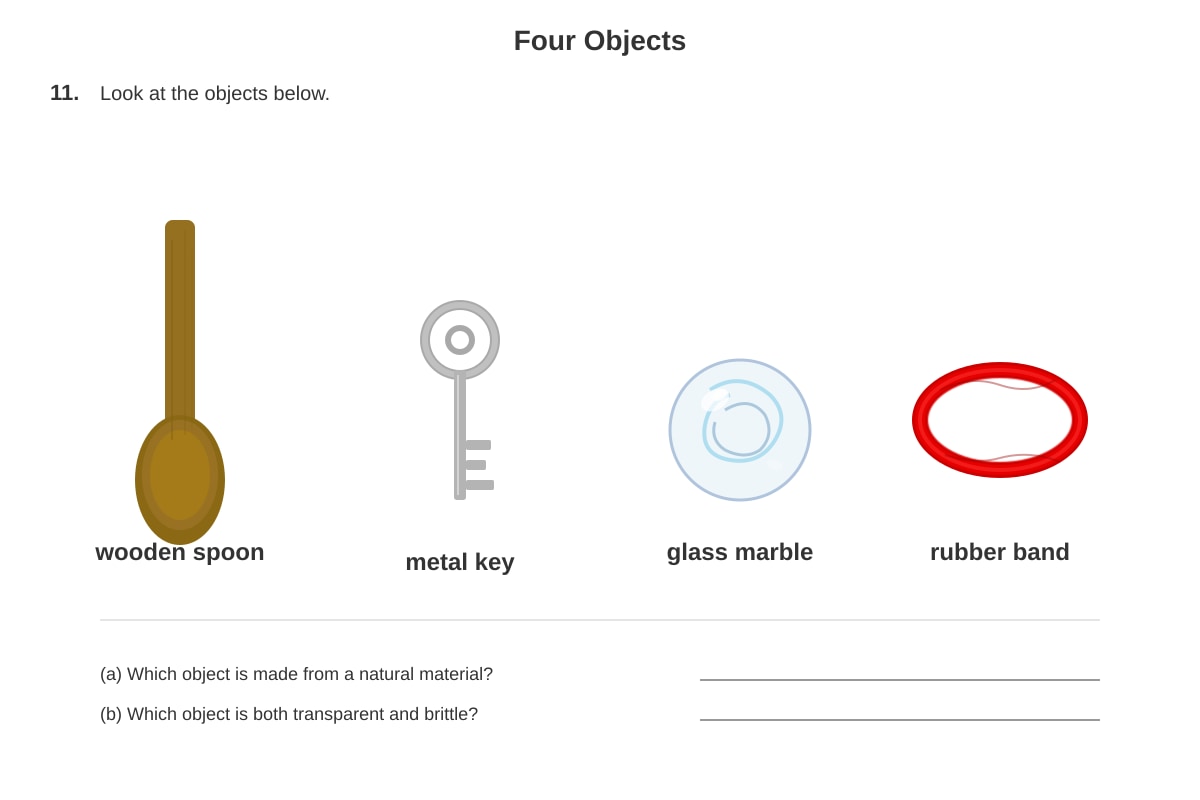
11. (a) Wooden spoon [1]
- Explanation: Wood is a natural material that comes from trees. The metal key is made from metal (processed from ore), the glass marble is made from sand (processed), and the rubber band is made from processed rubber or synthetic materials.
- Marking: 1 mark for correct answer.
(b) Glass marble [1]
- Explanation: Glass is transparent (you can see through it clearly) and brittle (it breaks easily). The wooden spoon is opaque, the metal key is opaque and not brittle, and the rubber band is flexible.
- Marking: 1 mark for correct answer.
12. (a) Plastic / Nylon / Polyester (or any suitable lightweight, strong, waterproof material) [1]
- Explanation: A kite needs to be light so it can fly, strong so it doesn't tear, and waterproof so it doesn't get damaged by rain or moisture. Plastic and synthetic fabrics have these properties.
- Marking: Accept any reasonable material with these properties.
(b) It is light, strong, and does not absorb water. [1]
- Explanation: The material must have all three properties mentioned in the question. The answer should explain how the chosen material meets these requirements.
- Marking: 1 mark for a clear explanation linking the material to the required properties.
13. Malleable / Ductile (accept "flexible" or "bendable") [2]
- Explanation: Malleability is the property of a material that allows it to be hammered or pressed into different shapes without breaking. Ductility is the ability to be drawn into wires. Both describe how metal can be reshaped. The question shows that the paperclip can be bent into a new shape, demonstrating this property.
- Marking: 2 marks for "malleable" or "ductile". 1 mark for "flexible" or "bendable" if the concept of holding a new shape is implied.
14. (a) Clay tiles / Metal sheets / Slate (or any suitable roofing material) [1]
- Explanation: Roofing materials must be waterproof to keep rain out, strong to support their own weight and withstand weather, and fire-resistant for safety.
- Marking: Accept any reasonable material.
(b) It is waterproof / It does not catch fire easily. [1]
- Explanation: The reason should directly address one of the required properties. For example, "Clay tiles are waterproof and do not burn."
- Marking: 1 mark for a correct reason linked to the chosen material.
15. Aluminium is not a magnetic material. Only magnetic materials like iron, nickel, and cobalt are attracted to magnets. [2]
- Explanation: Even though aluminium is a metal, it is not magnetic. The aluminium foil does not become magnetic just by being near a magnet. The plastic straw is also not magnetic. Therefore, the straw wrapped in aluminium foil is not attracted to the magnet.
- Marking: 2 marks for a complete explanation. 1 mark for stating that aluminium is not magnetic. Common mistake: Students may think all metals are magnetic.
Section C: Structured Questions (5 × 2 marks = 10 marks)
16. (a) Q [1]
- Explanation: A window pane needs to be transparent so light can pass through and people can see outside. Material Q is the only one that is transparent. It is also waterproof, which is useful for a window.
- Marking: 1 mark for correct answer.
(b) S [1]
- Explanation: A wire for an electrical circuit must conduct electricity. Material S is the only one that conducts electricity. It is also waterproof and not flexible, which are acceptable for a wire.
- Marking: 1 mark for correct answer.
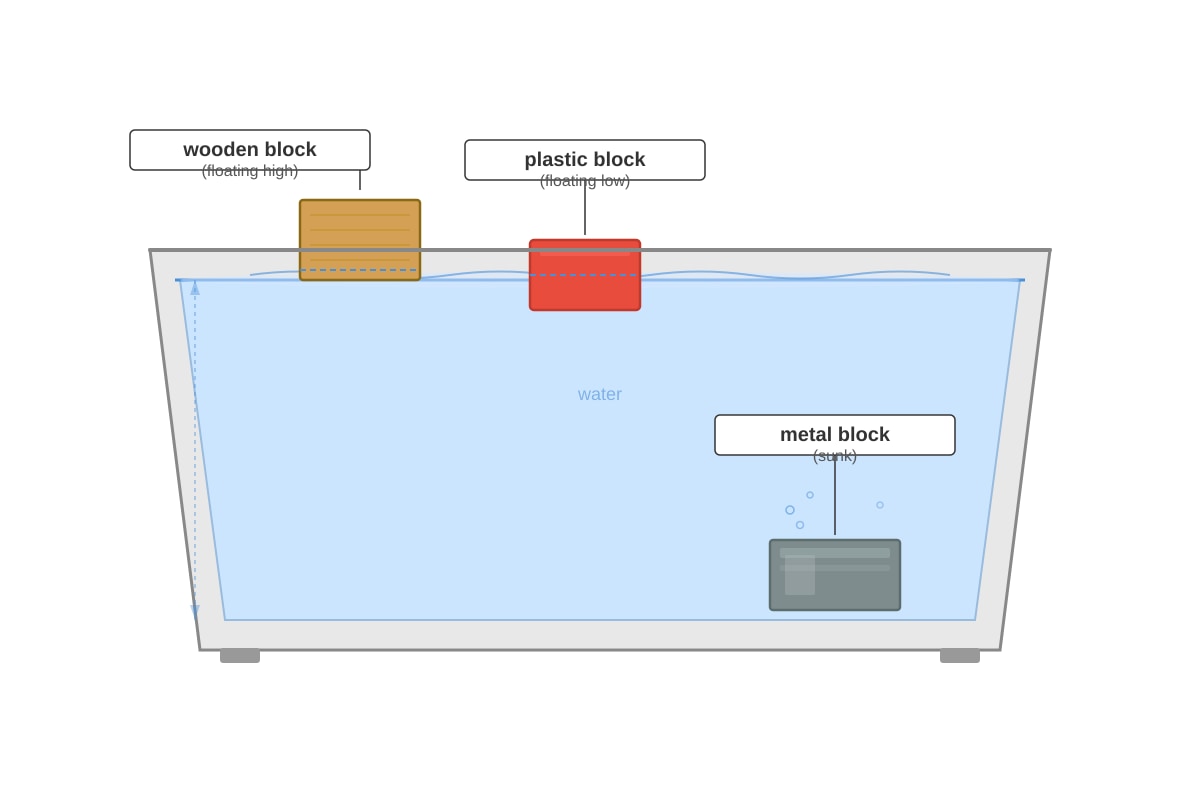
17. (a) Wooden block [1]
- Explanation: The wooden block floats the highest in the water, which means it is the least dense. The less dense a material is compared to water, the more it floats.
- Marking: 1 mark for correct answer.
(b) The metal block is denser than water, so it sinks. [1]
- Explanation: When an object is denser than the liquid it is placed in, it sinks. The metal block has more mass in the same volume compared to water, so it sinks to the bottom.
- Marking: 1 mark for a clear explanation using the concept of density. Accept "the metal block is heavier for its size" or "the metal block is more dense than water."
18. (a) The iron filings will be attracted to the magnet. [1]
- Explanation: Iron is a magnetic material. When a magnet is brought near the mixture, the magnetic force will pull the iron filings towards the magnet.
- Marking: 1 mark for correct answer.
(b) Sand is not a magnetic material, so it is not attracted to the magnet. [1]
- Explanation: Sand is made of non-magnetic materials like silicon dioxide. Only magnetic materials are attracted to magnets.
- Marking: 1 mark for correct answer.
19. (a) Plastic is an insulator of heat, so the handle does not get hot and burn the chef's hand. [1]
- Explanation: The handle needs to stay cool while the pan is hot. Plastic is a poor conductor of heat (an insulator), so heat does not travel easily from the metal pan body to the plastic handle.
- Marking: 1 mark for a clear explanation. Accept "plastic does not conduct heat well."
(b) Metal is a good conductor of heat. [1]
- Explanation: The pan body needs to get hot quickly and transfer heat evenly to the food. Metal conducts heat well, making it suitable for cooking.
- Marking: 1 mark for correct answer.
20. (a) Aluminium foil [1]
- Explanation: Aluminium foil is malleable, meaning it can be folded and will hold its new shape. Cloth is flexible but tends to spring back or wrinkle rather than hold a sharp fold.
- Marking: 1 mark for correct answer.
(b) Malleability (or "it is malleable") [1]
- Explanation: Malleability is the property of a material that allows it to be hammered, pressed, or folded into different shapes and hold that shape. Aluminium is a malleable metal.
- Marking: 1 mark for "malleability" or "malleable". Accept "it can be bent and stay in shape."
End of Answer Key