From Real Exams Quiz
Primary 5 Science Materials Quiz
Free P5 Science Materials quiz, Exam version, with questions, answers, and syllabus-aligned practice for Singapore students.
These static practice materials are generated from the site's syllabus and paper-generation workflow, with source and model context shown so students and parents can evaluate the material before use.
Questions
Free quiz and exam paper access
Enter your details to view this paper
Your access is remembered on this device.
Answers
Answer Key: Primary 5 Science Quiz - Materials
Total Marks: 30
Section A: Multiple-Choice Questions (10 × 1 Mark = 10 Marks)
Q1. (2) Metal
- Explanation: Metals are typically shiny, malleable (can be hammered into sheets), and good conductors of electricity. Wood, plastic, and rubber do not share all these properties.
- Marking Note: 1 mark for correct option.
Q2. (3) Copper wire
- Explanation: Copper is a metal, and metals are generally good conductors of electricity. Wood, plastic, and glass are insulators, meaning they do not conduct electricity well.
- Marking Note: 1 mark for correct option.
Q3. (2) It is denser than water.
- Explanation: An object will sink in water if it is denser than water. The glass marble is denser than water, so it sinks. Transparency, hardness, and electrical conductivity do not determine whether an object sinks or floats.
- Marking Note: 1 mark for correct option.
Q4. (2) It is waterproof.
- Explanation: A raincoat's primary function is to keep a person dry. A waterproof material prevents water from passing through it. Transparency, heat conduction, and hardness are not the most important properties for this purpose.
- Marking Note: 1 mark for correct option.
Q5. (3) Different materials have different properties that make them useful for different purposes.
- Explanation: This is a core concept about materials. Materials are chosen for specific uses based on their properties. Options 1, 2, and 4 are incorrect because they make absolute statements that are not always true (e.g., some solids can be bent, not all bendable materials are metals, and material properties like shape can be changed).
- Marking Note: 1 mark for correct option.
Q6. (2) good conductor of heat
- Explanation: The heat from the soup travels through the metal spoon to the handle, making it hot. This shows that the metal spoon allows heat to pass through it easily, which is the definition of a good conductor of heat.
- Marking Note: 1 mark for correct option.
Q7. (3) Wood
- Explanation: The handle of a frying pan needs to be a poor conductor of heat so that it does not become hot and burn the user's hand. Wood is a poor conductor of heat, while iron, aluminium, and copper are good conductors of heat.
- Marking Note: 1 mark for correct option.
Q8. (1) Its size and shape
- Explanation: Tearing paper changes its physical size and shape. Its colour, ability to burn, and ability to float are properties of the material itself and do not change when the paper is torn.
- Marking Note: 1 mark for correct option.
Q9. (2) A rubber rain boot
- Explanation: Rubber is a flexible material that can be bent easily, and it is also waterproof, making it suitable for a rain boot. Glass is rigid, wood is hard, and steel is not flexible.
- Marking Note: 1 mark for correct option.
Q10. (3) The wooden block is less dense than water, and the metal block is denser than water.
- Explanation: An object floats if it is less dense than the liquid it is placed in. An object sinks if it is denser than the liquid. Since the blocks are the same size, we can directly compare their densities based on whether they float or sink.
- Marking Note: 1 mark for correct option.
Section B: Short-Answer Questions (5 × 2 Marks = 10 Marks)
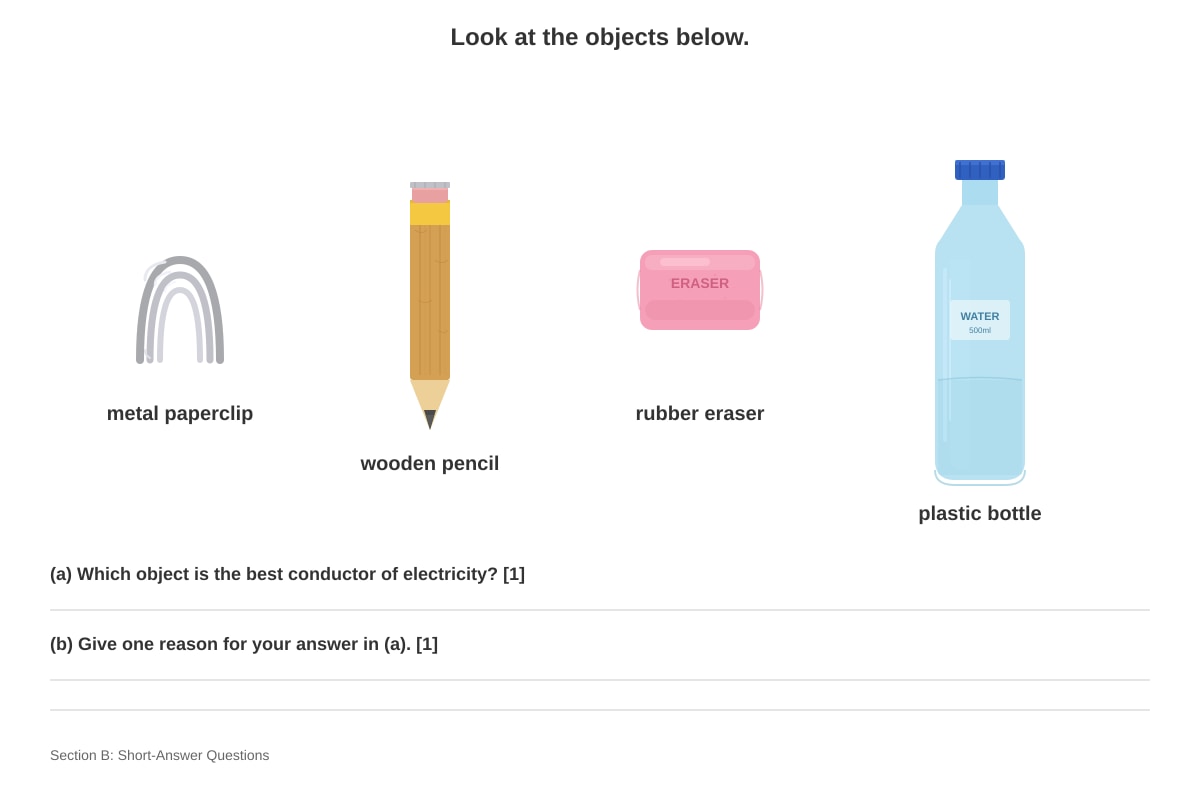
Q11. (a) The metal paperclip. [1]
- Explanation: Metals are good conductors of electricity. The paperclip is made of metal.
(b) It is made of metal, and metals are good conductors of electricity. [1]
- Explanation: This directly states the property of the material that makes it a good conductor.
- Marking Note: 1 mark for mentioning that it is a metal or that metals conduct electricity.
Q12. (a) Flexibility (or elasticity). [1]
- Explanation: The ability of the rubber band to be stretched and return to its original shape is called flexibility or elasticity.
(b) It is strong/durable (or it can return to its original shape). [1]
- Explanation: The rubber band needs to be strong enough to hold the objects together without breaking. Alternatively, its ability to return to its original shape (elasticity) is also a useful property.
- Marking Note: Accept "strong", "elastic", or "can return to its original shape".
Q13. (a) Material B (metal sheets). [1]
- Explanation: Metal sheets are waterproof, strong, and do not catch fire easily. Straw is flammable and not as strong.
(b) Metal sheets are waterproof/strong/do not catch fire easily, while straw can catch fire easily. [1]
- Explanation: The reason must directly compare the properties of the two materials and explain why metal is more suitable.
- Marking Note: 1 mark for any valid reason, e.g., "Metal is waterproof and strong, but straw can burn easily."
Q14. (a) The steel ball bearing is denser than water. [1]
- Explanation: An object sinks when it is denser than the liquid it is in.
(b) The plastic ball bearing is less dense than water. [1]
- Explanation: An object floats when it is less dense than the liquid it is in.
Q15. (a) The wooden spoon will not become hot, so the chef will not burn his hand. [1]
- Explanation: Wood is a poor conductor of heat, so it does not allow heat to pass through it easily.
(b) It is a poor conductor of heat (or a heat insulator). [1]
- Explanation: This is the specific property of wood that makes it suitable for this task.
- Marking Note: Accept "poor conductor of heat" or "heat insulator".
Section C: Structured Questions (5 × 2 Marks = 10 Marks)
Q16. (a) Iron. [1]
- Explanation: Iron is the only material in the table that conducts electricity.
(b) Iron is a metal, and metals are good conductors of electricity. Glass, rubber, and plastic are non-metals and are poor conductors of electricity (insulators). [1]
- Explanation: This explains why iron is different based on its material group and property.
- Marking Note: 1 mark for stating that iron is a metal or that it is a conductor while the others are insulators.
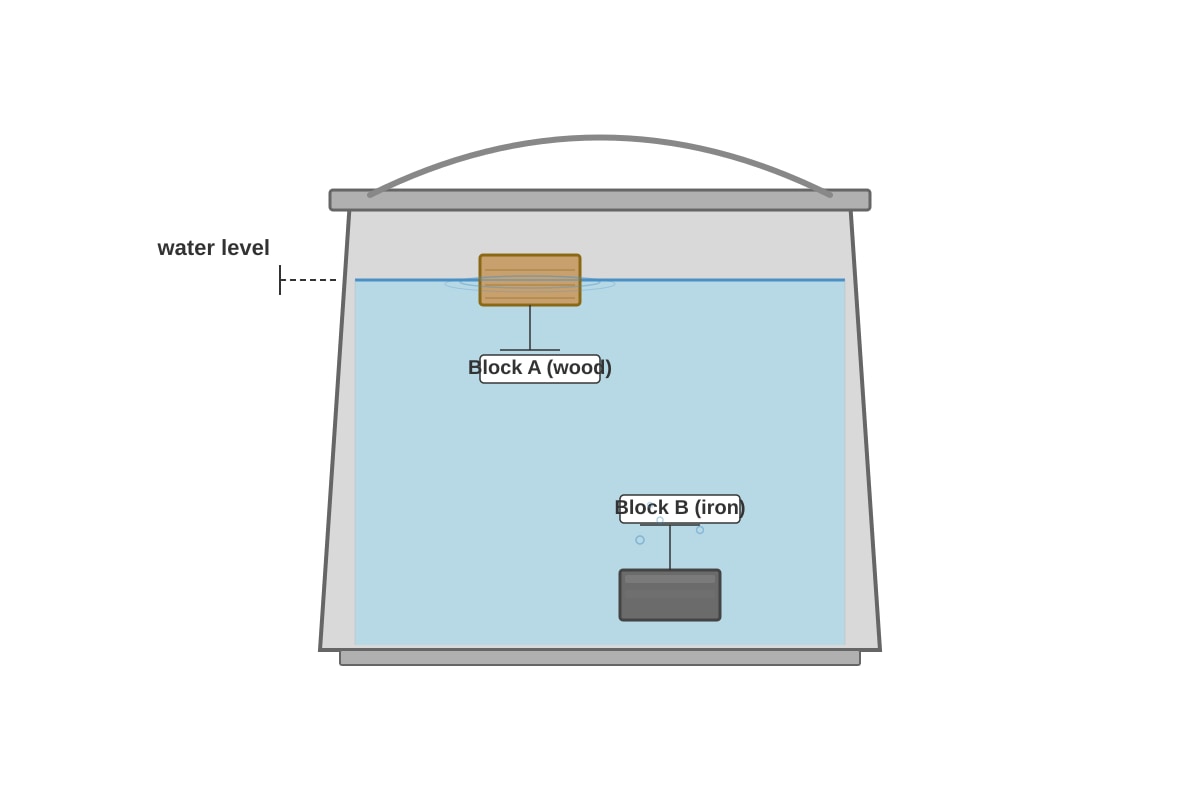
Q17. (a) Block B (iron). [1]
- Explanation: Block B sinks, which means it is denser than water.
(b) Block A (wood) is less dense than water, so it floats. [1]
- Explanation: An object floats if it is less dense than the liquid it is placed in. The wood block is less dense than water.
- Marking Note: 1 mark for stating that the wood is less dense than water.
Q18. (a) The plastic sheet. [1]
- Explanation: Plastic is waterproof and can be shaped easily. A metal sheet is also waterproof but is harder to shape. Cloth is not waterproof.
(b) Plastic is waterproof and can be shaped into a boat. [1]
- Explanation: The reason must explain why plastic is the most suitable choice compared to the other materials.
- Marking Note: 1 mark for any valid reason, e.g., "It is waterproof and can be shaped easily."
Q19. (a) The metal rod is a good conductor of heat. [1]
- Explanation: The heat from the hot water travelled along the metal rod, making it hot.
(b) The cotton cloth is a poor conductor of heat (or it is a heat insulator). [1]
- Explanation: The cotton cloth did not catch fire because it did not get hot enough. This shows that it does not conduct heat well.
- Marking Note: Accept "poor conductor of heat" or "heat insulator".
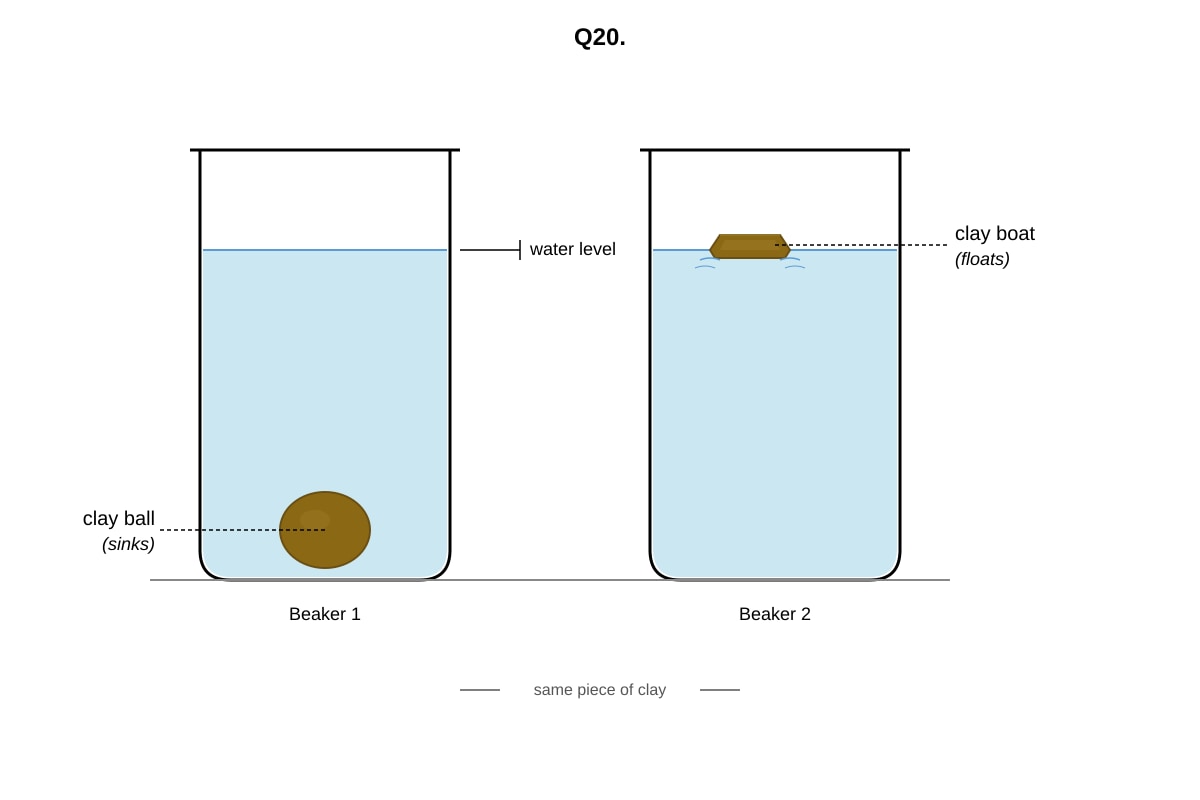
Q20. (a) No, the amount of clay did not change. [1]
- Explanation: The same piece of clay was used. Only its shape changed.
(b) The clay boat floats because it is shaped to displace more water, making the overall density of the boat (clay + trapped air) less than the density of water. The clay ball sinks because it is denser than water. [1]
- Explanation: This is a key concept. The mass of the clay is the same, but the boat shape traps air, increasing its volume. Since density = mass ÷ volume, the larger volume of the boat shape makes its overall density lower than water, so it floats. The solid ball has a smaller volume, so its density is higher than water, and it sinks.
- Marking Note: 1 mark for explaining that the boat shape traps air, making it less dense than water, or for stating that the boat displaces more water.