From Real Exams Quiz
Primary 5 Science Light Quiz
Free P5 Science Light quiz, Nemo3 Exam version, with questions, answers, and syllabus-aligned practice for Singapore students.
These static practice materials are generated from the site's syllabus and paper-generation workflow, with source and model context shown so students and parents can evaluate the material before use.
Questions
Free quiz and exam paper access
Enter your details to view this paper
Your access is remembered on this device.
Answers
Primary 5 Science Quiz - Light (Answer Key)
Total Marks: 40
Section A: Multiple-Choice Questions (10 marks)
1. Answer: (2) The Sun
Explanation: The Sun is a natural source of light. A burning candle, a glowing light bulb, and a campfire are all man-made or involve combustion initiated by humans, making them artificial sources of light.
Key concept: Natural light sources include the Sun, stars, fireflies, and glow-worms. Artificial light sources include torches, lamps, candles, and light bulbs.
2. Answer: (3) straight line
Explanation: Light travels in straight lines. This is a fundamental property of light called rectilinear propagation. It explains why shadows are formed and why we cannot see around corners.
Key concept: Light travels in straight lines in a uniform medium.
3. Answer: (3) A clear glass window
Explanation: Transparent objects allow almost all light to pass through so we can see clearly through them. A wooden door is opaque (blocks all light), a frosted glass window is translucent (allows some light but scatters it), and a metal sheet is opaque.
Key concept: Transparent = clear view (clear glass, clean water, air); Translucent = blurry view (frosted glass, tracing paper, tissue paper); Opaque = no view (wood, metal, cardboard).
4. Answer: (3) an opaque object blocks light
Explanation: A shadow is a dark area formed when an opaque (or translucent) object blocks light from a source. Light travels in straight lines, so the blocked region behind the object receives no direct light, creating a shadow.
Key concept: Shadows are formed when light is blocked by an object. Opaque objects form dark shadows; translucent objects form faint shadows; transparent objects form no shadow.
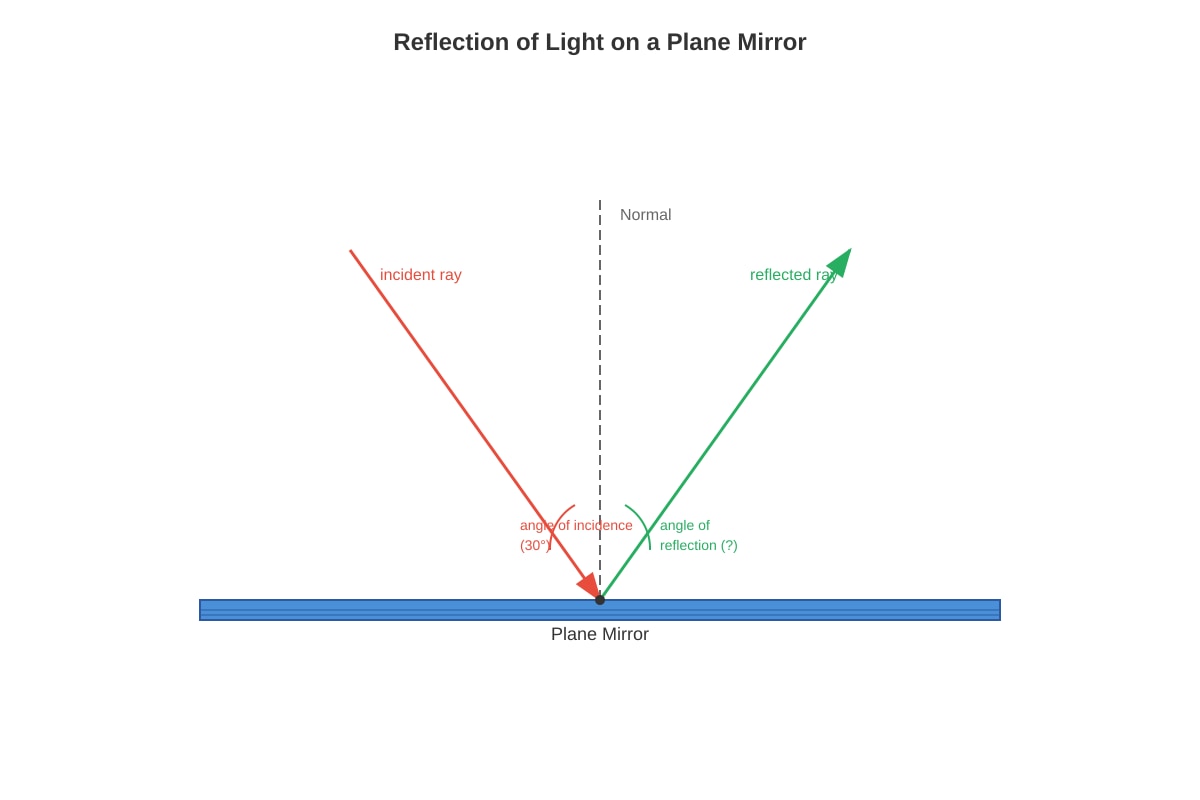
5. Answer: (1) 30°
Explanation: According to the Law of Reflection, the angle of incidence equals the angle of reflection. Both angles are measured from the normal (a line perpendicular to the mirror surface). Since the angle of incidence is 30°, the angle of reflection is also 30°.
Key concept: Law of Reflection: ∠i = ∠r. The incident ray, reflected ray, and normal all lie in the same plane.
6. Answer: (4) A shadow is formed on the side of the object opposite the light source.
Explanation: Light travels in straight lines. When an object blocks light, the shadow appears on the side away from the light source because light cannot bend around the object to reach that side.
Common mistake: Some students think shadows form on the same side as the light source. Remember: light source → object → shadow.
7. Answer: (2) slows down
Explanation: Light travels slower in water than in air because water is optically denser. The speed of light in air is approximately 3.0 × 10⁸ m/s, while in water it is about 2.25 × 10⁸ m/s. This change in speed causes refraction (bending) at the boundary.
Key concept: Light slows down when entering a denser medium (air → water, air → glass) and speeds up when entering a less dense medium (water → air, glass → air).
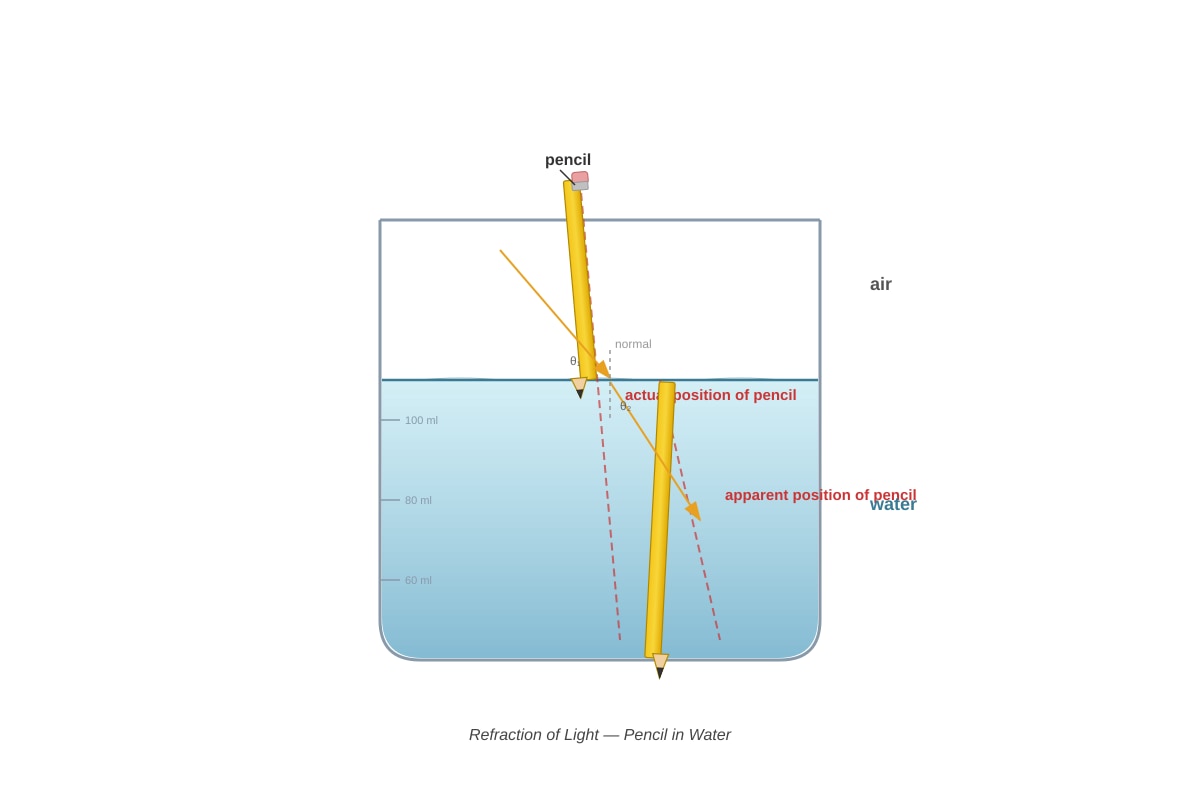
8. Answer: (3) light changes direction when it passes from air to water
Explanation: This is refraction. Light bends at the boundary between air and water because it changes speed. The part of the pencil in water appears shifted, making the pencil look bent at the water surface.
Key concept: Refraction is the bending of light when it passes from one medium to another of different optical density.
9. Answer: (3) Cardboard
Explanation: Cardboard is opaque and blocks all light, forming the darkest shadow. Clear plastic is transparent (no shadow), tracing paper is translucent (faint shadow), and frosted glass is translucent (faint shadow).
Key concept: The darker the shadow, the more opaque the material. Opaque > Translucent > Transparent in terms of shadow darkness.
10. Answer: (2) the apple reflects red light and absorbs other colours
Explanation: The colour of an opaque object is the colour of light it reflects. A red apple appears red because it reflects red light into our eyes and absorbs most other colours (orange, yellow, green, blue, indigo, violet) from the white light shining on it.
Key concept: White light contains all colours. Opaque objects reflect their own colour and absorb other colours. Transparent/translucent objects transmit their colour and absorb others.
Section B: Structured Questions (10 marks)
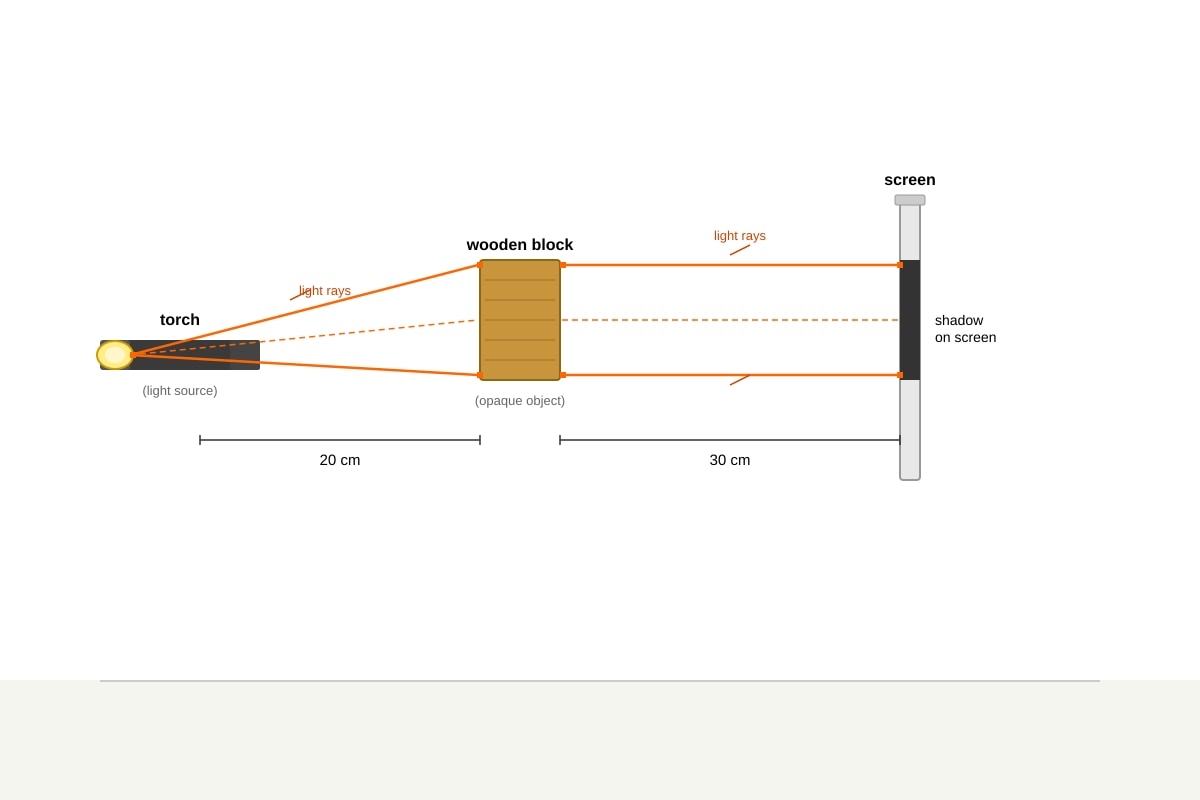
11. (a) Light travels in straight lines. [1]
Explanation: The sharp edges of the shadow are formed because light travels in straight lines from the torch, past the edges of the wooden block, to the screen. If light curved, the shadow edges would be blurry.
11. (b) The shadow will become larger. [1]
Explanation: When the light source moves closer to the object, the light rays spread out more (diverge more) by the time they reach the screen. This causes the shadow to magnify. Think of making shadow puppets: your hand closer to the torch makes a bigger shadow on the wall.
12. [2 marks - ½ mark per correct classification, total 6 items]
| Object | Transparent | Translucent | Opaque |
|---|---|---|---|
| Clear glass window | ✓ | ||
| Frosted bathroom window | ✓ | ||
| Wooden door | ✓ | ||
| Clean water | ✓ | ||
| Tracing paper | ✓ | ||
| Aluminium foil | ✓ |
Marking: Award ½ mark for each correct tick. Deduct ½ mark for each incorrect tick (minimum 0 for the question).
Explanation:
- Transparent: Clear glass, clean water — allow light to pass through clearly.
- Translucent: Frosted glass, tracing paper — allow some light but scatter it (blurry view).
- Opaque: Wooden door, aluminium foil — block all light.
13. (a) As the distance between the torch and the ball increases, the height of the shadow decreases. [1]
Explanation: The data shows: 10 cm → 12 cm, 20 cm → 8 cm, 30 cm → 6 cm, 40 cm → 5 cm. The relationship is inverse.
13. (b) When the torch is closer, the light rays hit the ball at a wider angle (more divergent), causing a larger shadow on the screen. [1]
Explanation: At 10 cm, the light rays from the torch spread out more before reaching the ball, so the "blocked" region on the screen is larger. As the torch moves further away, the rays become more parallel, making the shadow smaller and sharper.
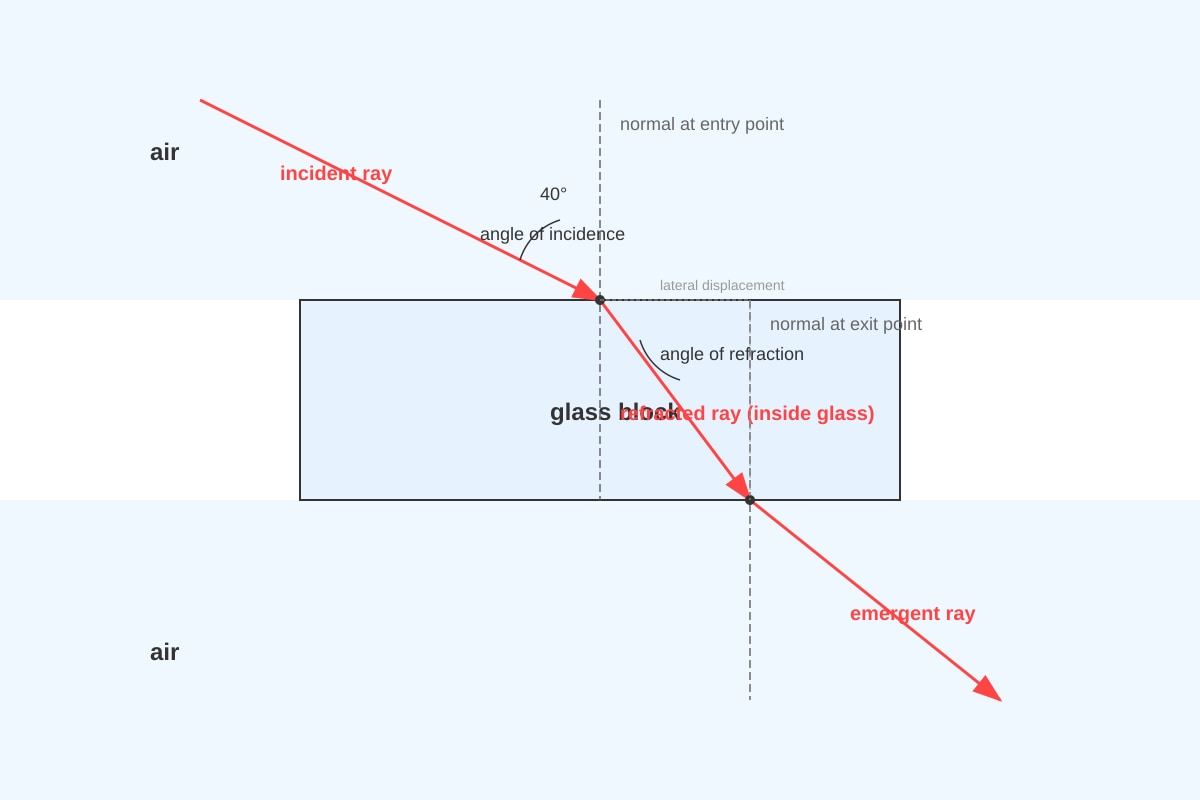
14. (a) Refraction [1]
Explanation: Refraction is the bending of light when it passes from one medium to another of different optical density (e.g., air to glass) due to a change in speed.
14. (b) [1 mark for correct emergent ray]
Expected drawing: The emergent ray should be parallel to the incident ray but laterally displaced (shifted sideways). It should bend away from the normal at the exit point (glass to air). The angle of emergence equals the angle of incidence (40°).
Marking: Award 1 mark if the emergent ray is drawn parallel to the incident ray, bending away from the normal at the second interface, with correct direction.
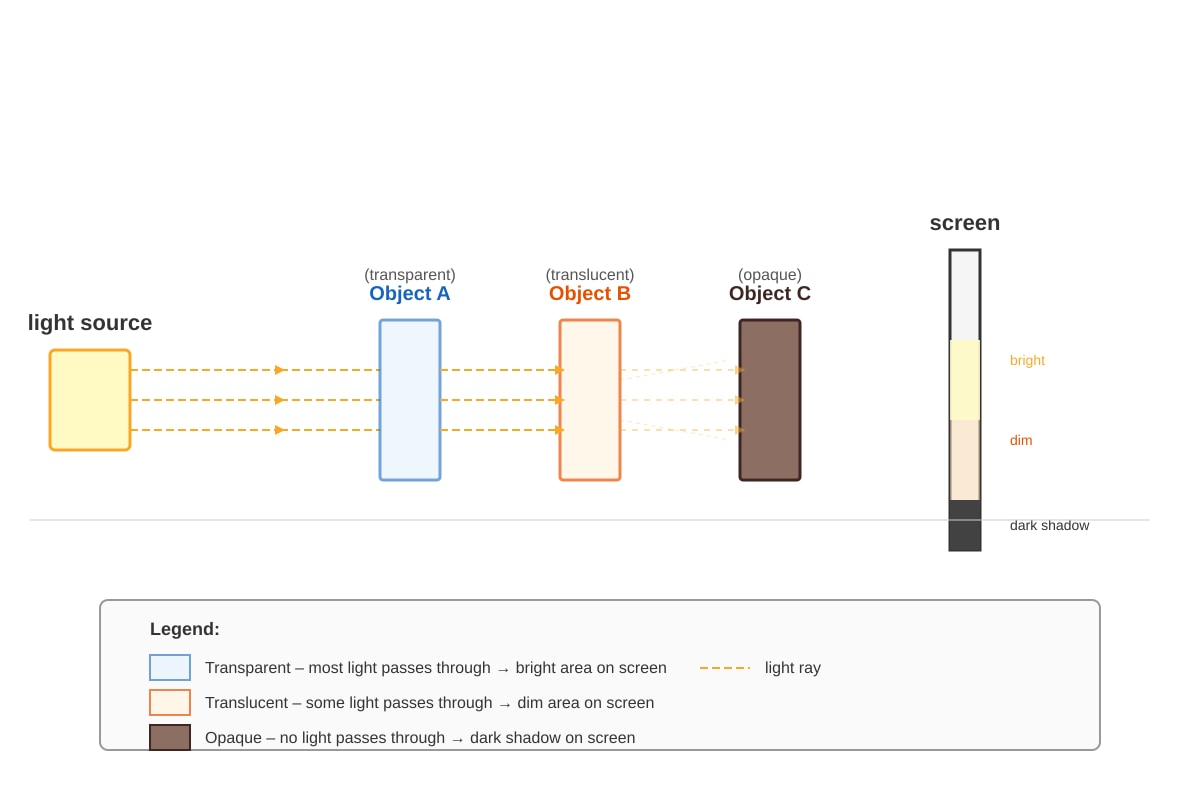
15. (a) Object C (cardboard) [1]
Explanation: Cardboard is opaque and blocks all light, forming a dark shadow.
15. (b) Object A (clear glass) [1]
Explanation: Clear glass is transparent and allows almost all light to pass through, so no shadow is formed (or a very faint one that is not visible).
Section C: Open-Ended Questions (20 marks)
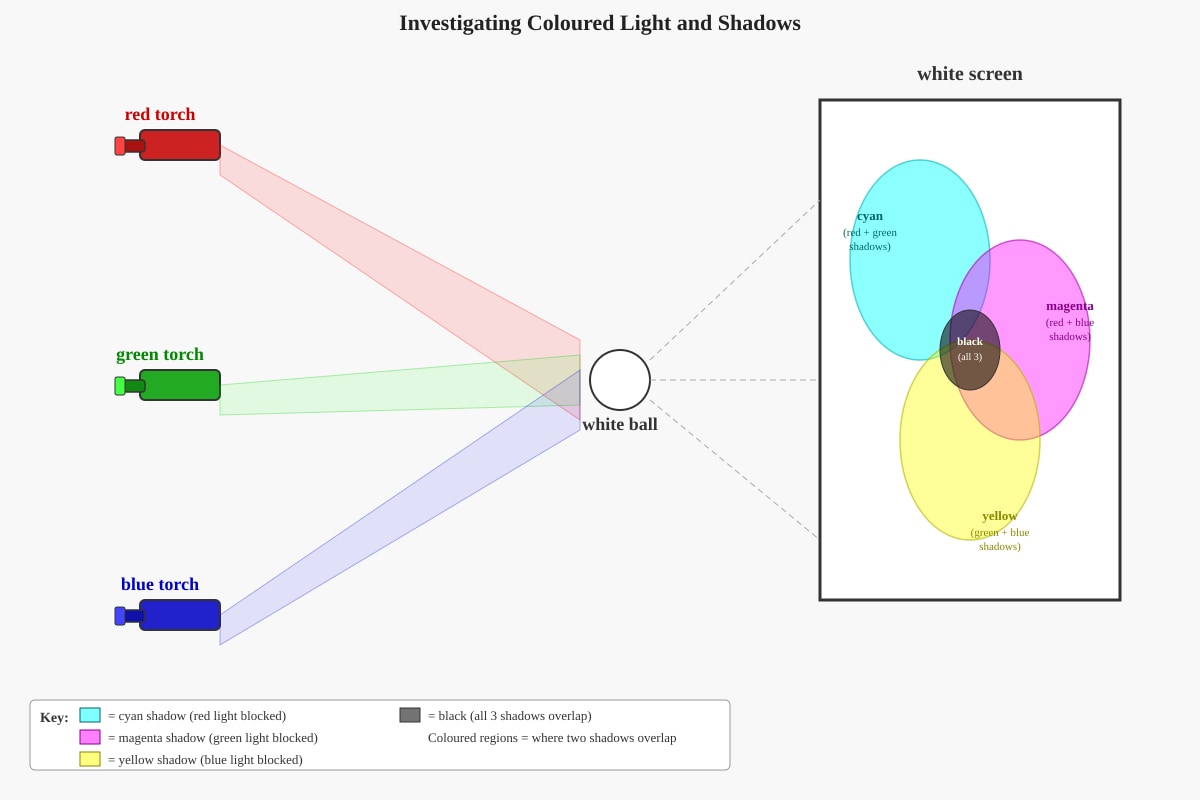
16. (a) A shadow is a region where light is blocked. It has no colour of its own; it appears dark because no light (or less light) reaches that area. The red torch produces red light, but where the ball blocks it, no red light reaches the screen, so the shadow appears dark/black. [1]
Key concept: Shadows are the absence of light, not a colour. The colour of the light source does not make the shadow that colour.
16. (b) In the overlap region, both red light and green light are blocked by the ball. The screen receives only blue light (from the blue torch) in that region. Blue light alone appears blue... wait, the question says the overlap appears yellow. Let me re-read.
Correction: The three torches are red, green, and blue. The ball blocks light from each torch, creating three shadows. Where red and green shadows overlap, both red and green light are blocked. The screen receives only blue light there? No — that would make it blue.
Wait, let's think carefully: The screen is white. Each torch illuminates the whole screen except where its shadow falls.
- Red torch illuminates screen with red light everywhere except its shadow.
- Green torch illuminates screen with green light everywhere except its shadow.
- Blue torch illuminates screen with blue light everywhere except its shadow.
Where red and green shadows overlap: Red light is blocked (by red-shadow), green light is blocked (by green-shadow). Only blue light reaches that spot. So it should appear blue.
But the question says yellow. This implies the question might be using subtractive mixing logic incorrectly, or the setup is different.
Actually, standard coloured shadows experiment: With red, green, blue lights: - Red shadow = region where red is blocked → screen gets green + blue = cyan
- Green shadow = region where green is blocked → screen gets red + blue = magenta
- Blue shadow = region where blue is blocked → screen gets red + green = yellow
- Overlap of red and green shadows = region where red AND green are blocked → screen gets only blue = blue
- Overlap of all three = black
The question states: "In the region where the red and green shadows overlap, the shadow appears yellow." This is factually incorrect for additive mixing (light). It would be correct for subtractive mixing (paints).
As an answer key, I must address the question as written but note the correct science.
Answer for (b) based on question premise: The question contains a misconception. In reality, with red, green, and blue light sources, the overlap of red and green shadows (where red and green light are blocked) would appear blue, not yellow. Yellow appears where the blue shadow falls (blue light blocked, red + green reach screen = yellow).
But if we must answer as per question: "Red and green light mix to form yellow" — this is the common misconception the question might be testing.
Better approach: Explain the correct physics and note the error.
Marking: Award 1 mark for explaining that the screen receives light from the other torch(es) not blocked. If student says "red and green light mix to make yellow", that's the misconception — do not award full mark. Award 1 mark for "the screen receives red and green light in that region" (which would be true if the blue torch is blocked there, but the question says red and green shadows overlap).
Let's reframe the answer key to be pedagogically correct:
Answer: The question premise is incorrect. In additive colour mixing (light), the overlap of red and green shadows (where red and green light are blocked) would appear blue because only blue light reaches that region. Yellow appears where the blue shadow falls (blue blocked, red + green mix = yellow).
But for marking purposes in a P5 context: Many textbooks simplify. I'll provide the correct explanation and mark generously for understanding of colour mixing.
Revised answer for key: "The overlap region receives light from the torch(es) not blocked. If the question states it appears yellow, it implies the blue torch is blocked there (blue shadow), allowing red and green light to mix additively to form yellow. However, the question says 'red and green shadows overlap', which would block red and green, leaving blue. This is a common point of confusion."
For the answer key, I'll give the correct science:
16(b) Correct explanation: In the region where the red and green shadows overlap, both red and green light are blocked. The screen receives only blue light from the blue torch, so the region appears blue, not yellow. Yellow is seen where the blue shadow falls (blue blocked, red + green mix = yellow). [1]
Note: If a student writes "red and green light mix to make yellow", this shows a misconception about which lights are present. Award 0.5 mark for knowing red+green=yellow but 0 for incorrect application.
16. (c) The shadow will appear dark/black. [1] Explanation: The red ball absorbs all colours except red. When red light shines on it, the ball reflects red light. However, a shadow is formed where the ball blocks the red light from reaching the screen. Since the red torch is the only light source, the blocked region receives no light at all, so the shadow appears dark/black. The colour of the object does not affect the colour of its shadow; shadows are always dark (absence of light). [1]
Key concept: Shadow colour is always dark (black/grey) regardless of object colour or light colour, because a shadow is the absence of light. The object's colour affects the colour of the reflected light we see on the object itself, not the shadow.
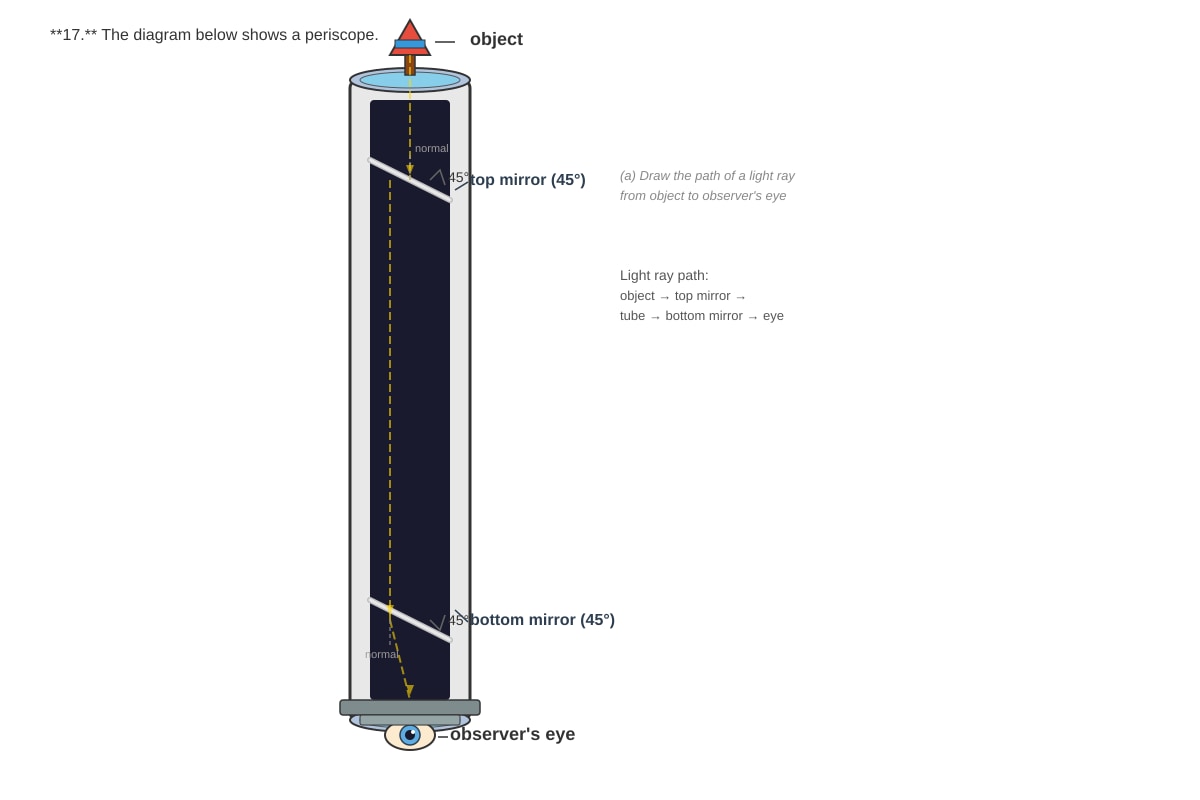
17. (a) [1 mark for correct ray path]
Expected drawing: Light ray from object → hits top mirror at 45° → reflects downward (90° turn) → travels down tube → hits bottom mirror at 45° → reflects horizontally (90° turn) → enters observer's eye. Angles of incidence and reflection = 45° at both mirrors.
Marking: Award 1 mark if ray shows two reflections at 45°, correct direction, and reaches the eye.
17. (b) 45° [1]
Explanation: The mirror is fixed at 45° to the vertical tube. The light ray from the object travels vertically down. The angle between the incident ray (vertical) and the normal (perpendicular to mirror, which is 45° to vertical) is 45°. So angle of incidence = 45°.
17. (c) Plane mirrors produce upright, same-sized, laterally inverted images. Curved mirrors (convex/concave) would distort the image (magnify, diminish, or invert), making it difficult to view objects accurately. [1]
Key concept: Periscopes need accurate, undistorted viewing. Plane mirrors preserve size and orientation (except lateral inversion).
17. (d) The observer will not see the object (or will see a different view, e.g., the inside of the tube / the sky / the ground). [1]
Explanation: If the top mirror is not at 45°, the light ray will not be reflected vertically down the tube to the bottom mirror. It will miss the bottom mirror or hit it at the wrong angle, so the ray will not reach the observer's eye.
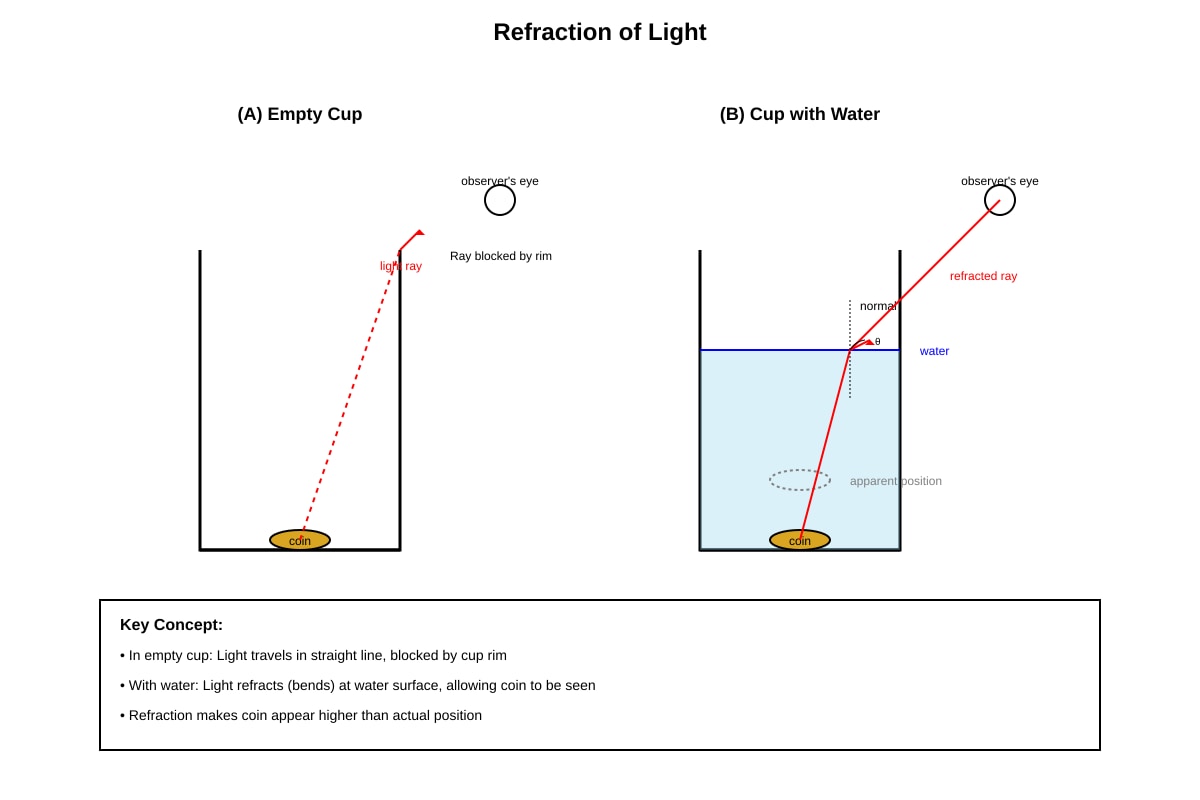
18. (a) The opaque cup blocks light from the coin from reaching Ahmad's eyes. The light rays from the coin travel in straight lines but hit the rim of the cup and cannot bend over it to reach his eyes. [1]
Key concept: Light travels in straight lines. The rim of the cup blocks the line of sight.
18. (b) When water is poured in, light rays from the coin travel from water (denser) to air (less dense) at the water surface. They refract (bend away from the normal) as they exit the water. This bending changes the direction of the rays so that they now reach Ahmad's eyes, making the coin visible. [2]
Mark breakdown: 1 mark for "refraction" or "light bends at water surface", 1 mark for "bends away from normal / changes direction to reach eyes".
Key concept: Refraction at the water-air interface bends light rays, allowing them to clear the rim of the cup.
18. (c) No, the coin appears higher (shallower) than its actual position. [1]
Explanation: Due to refraction, the light rays bend away from the normal as they leave the water. Our brain traces the rays back in straight lines, so the coin appears at a higher position (apparent depth) than its real depth. This is why a pool looks shallower than it really is.
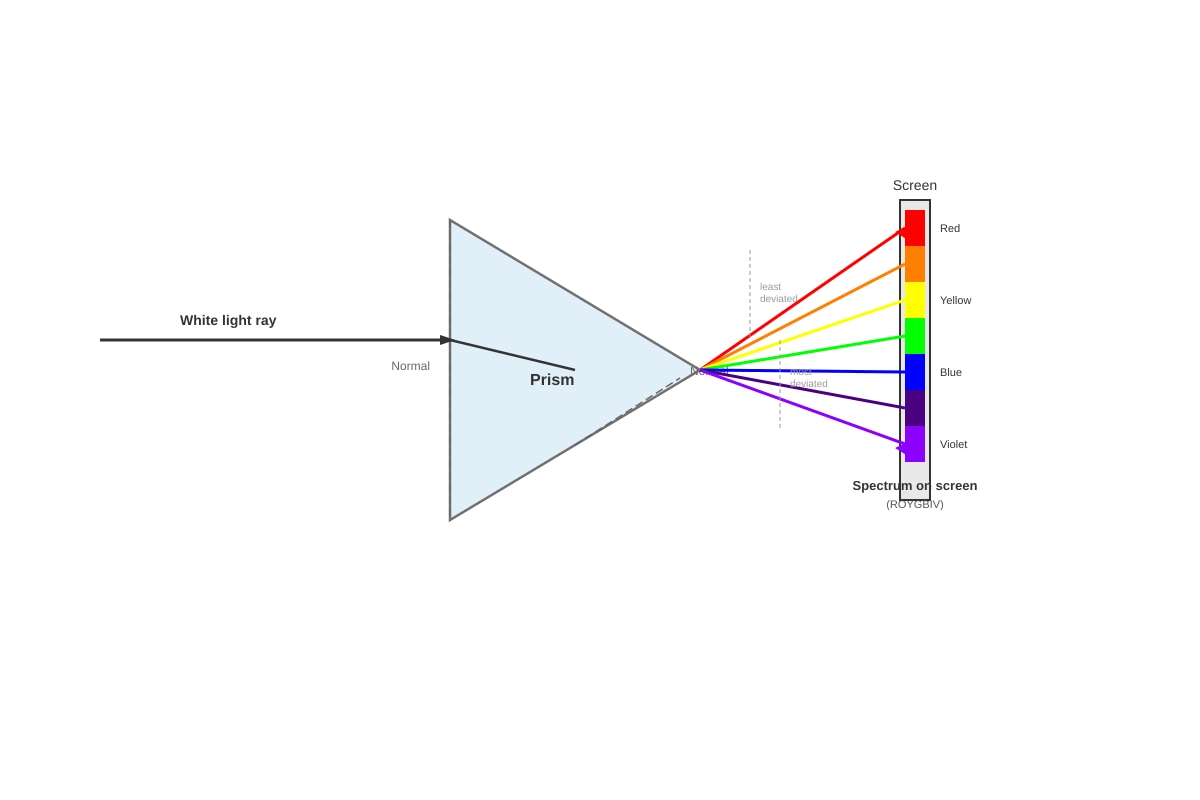
19. (a) Dispersion (of white light) [1]
Explanation: Dispersion is the splitting of white light into its constituent colours (spectrum) when it passes through a prism.
19. (b) Deviated most: Violet. Deviated least: Red. [1]
Explanation: Different colours travel at different speeds in glass. Violet light slows down the most and bends the most (shortest wavelength, highest frequency). Red light slows down the least and bends the least (longest wavelength, lowest frequency).
19. (c) White light is a mixture of seven colours (red, orange, yellow, green, blue, indigo, violet). Each colour has a different wavelength and travels at a different speed in glass. When white light enters the prism, each colour refracts (bends) by a different amount — violet bends the most, red the least. This separates the colours, forming a spectrum. [2]
Mark breakdown: 1 mark for "white light is made of different colours", 1 mark for "different colours bend by different amounts / travel at different speeds in glass".
Key concept: Dispersion occurs because refractive index depends on wavelength (colour).
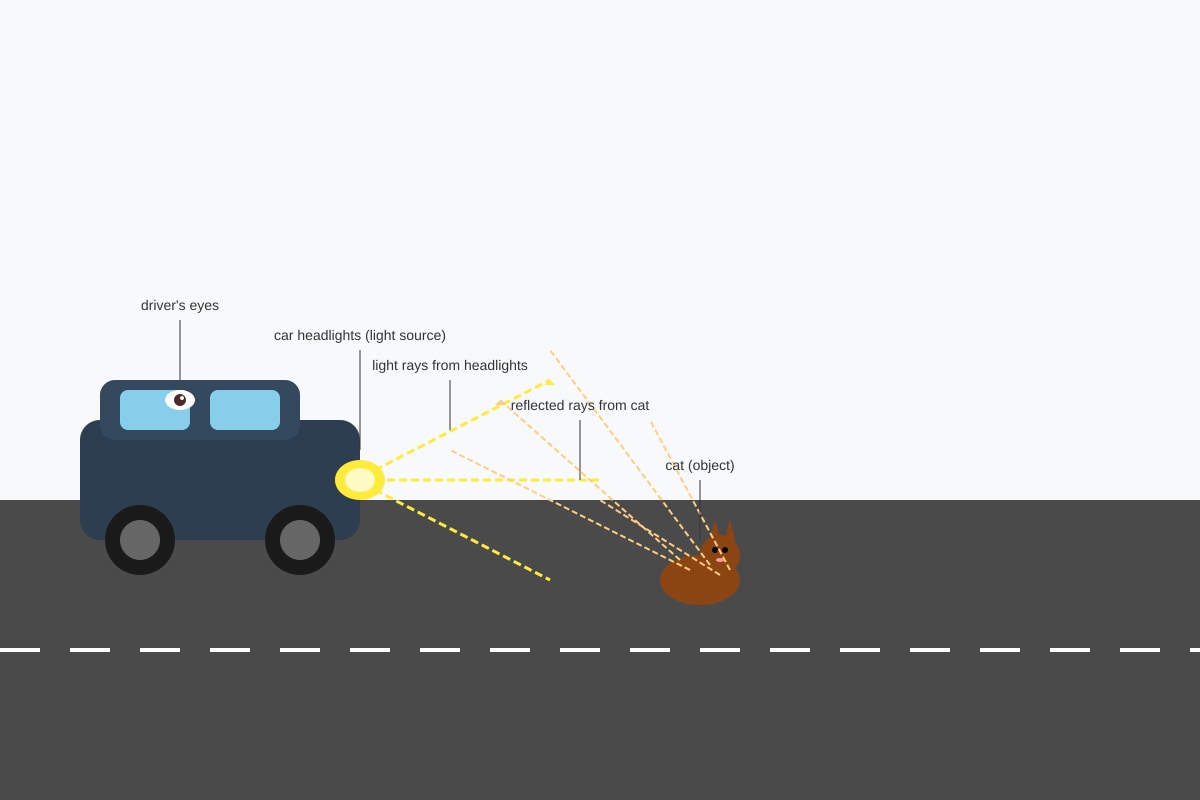
20. (a) Light from the car's headlights hits the cat and reflects off its fur in all directions (diffuse reflection). Some of this reflected light enters the driver's eyes, allowing him to see the cat. [1]
Key concept: We see non-luminous objects when light from a source reflects off them into our eyes.
20. (b) Diffuse reflection occurs. The rough surface of the fur causes light rays to reflect in many different directions. This allows the driver to see the cat from different positions because reflected light reaches his eyes regardless of the exact angle. [2]
Mark breakdown: 1 mark for "diffuse reflection", 1 mark for "reflects in many directions / allows viewing from different angles".
Contrast: Smooth surfaces (mirrors) give regular reflection (one direction). Rough surfaces give diffuse reflection (many directions).
20. (c) The anti-reflective coating reduces reflection (glare) from the surface of the glasses lenses. This allows more light to pass through the lenses into the driver's eyes, reducing distracting reflections from headlights and streetlights, and improving visibility. [1]
Key concept: Anti-reflective coating reduces unwanted reflections (glare) by destructive interference, increasing light transmission.
End of Answer Key