From Real Exams Quiz
Primary 5 Science Light Quiz
Free Kimi AI-generated P5 Science Light quiz with questions, answers, and syllabus-aligned practice for Singapore students preparing for school assessments.
These static practice materials are generated from the site's syllabus and paper-generation workflow, with source and model context shown so students and parents can evaluate the material before use.
Questions
Primary 5 Science Quiz — Light
Name: _________________________________ Class: _____________ Date: _____________
Score: _______ / 40 marks
Duration: 40 minutes
Instructions:
- Write your answers in the spaces provided.
- For multiple-choice questions, circle the correct answer.
- Read each question carefully before answering.
Section A: Multiple Choice (Questions 1–8)
Choose the correct answer and circle it. Each question carries 2 marks.
[8 × 2 = 16 marks]
1. Which of the following is needed for us to see an object?
| A | The object must produce its own light | | B | Light must travel from the object to our eyes | | C | The object must be transparent | | D | Light must bounce off our eyes to the object |
Answer: _________________________________________________
2. Light travels fastest through which material?
| A | Water | | B | Glass | | C | Air | | D | Wood |
Answer: _________________________________________________
3. A student shines a torch at a mirror in a dark room. She sees a bright spot on the wall. This happens because light undergoes
| A | refraction | | B | reflection | | C | absorption | | D | dispersion |
Answer: _________________________________________________
4. Which statement about shadows is correct?
| A | Shadows are formed when light passes through an object | | B | Shadows are darker when the light source is further away | | C | Shadows are formed when light is blocked by an opaque object | | D | Shadows can only be formed by the Sun |
Answer: _________________________________________________
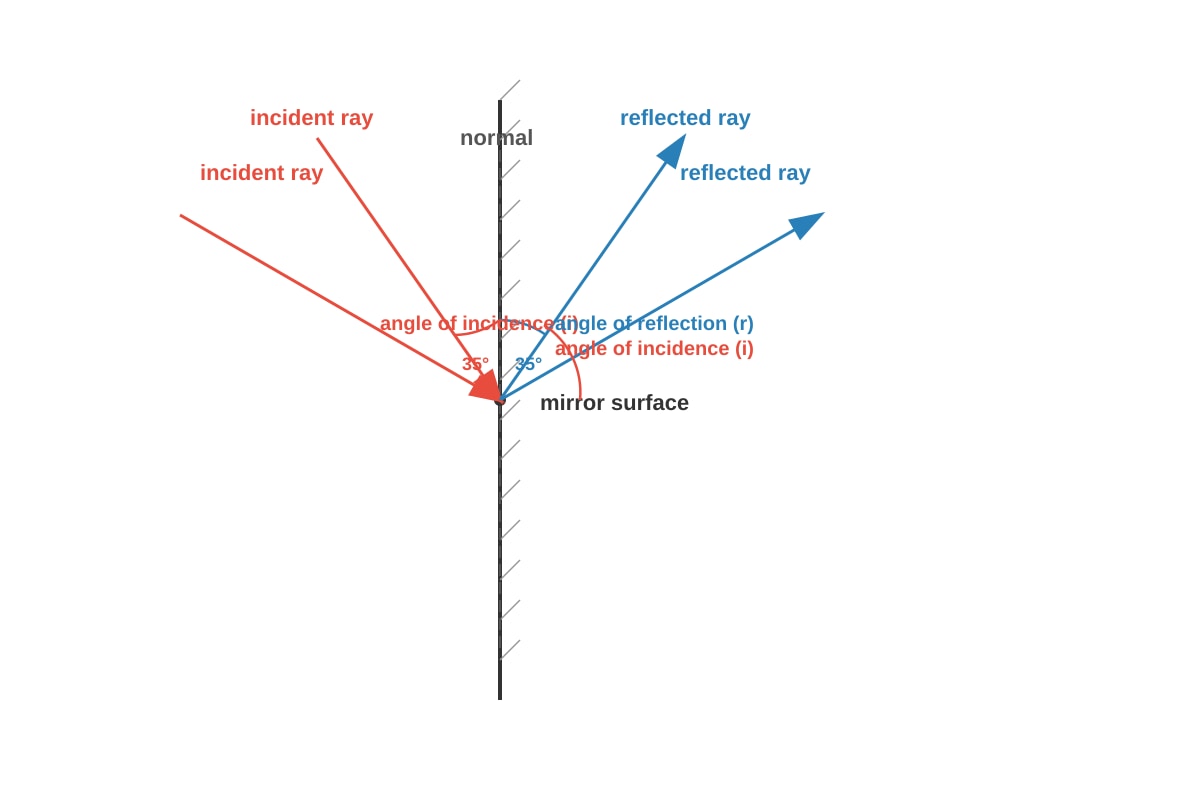
<image_placeholder> id: Q5-fig1 type: diagram linked_question: Q5 description: A ray diagram showing a light ray hitting a flat mirror at an angle, with the normal line drawn as a dashed perpendicular line at the point of incidence. The incident ray and reflected ray should be shown with arrows. labels: incident ray, reflected ray, normal, angle of incidence (i), angle of reflection (r), mirror surface values: angle of incidence = 35 degrees must_show: The normal must be perpendicular to the mirror surface; both angles must be clearly marked; arrows must show direction of light travel from left to right hitting mirror, then reflecting upward to the right. </image_placeholder>
5. Look at the diagram above. A light ray hits a mirror at an angle of 35° to the normal. What is the angle of reflection?
| A | 25° | | B | 35° | | C | 55° | | D | 70° |
Answer: _________________________________________________
6. A clear glass of water appears bent at the water surface when viewed from the side. This is caused by
| A | reflection of light at the surface | | B | refraction of light as it moves from air to water | | C | the water absorbing light energy | | D | the glass being opaque |
Answer: _________________________________________________
7. Which colours of light are mixed to produce white light on a TV screen?
| A | Red, blue and green | | B | Red, yellow and blue | | C | Red, orange and violet | | D | Yellow, cyan and magenta |
Answer: _________________________________________________
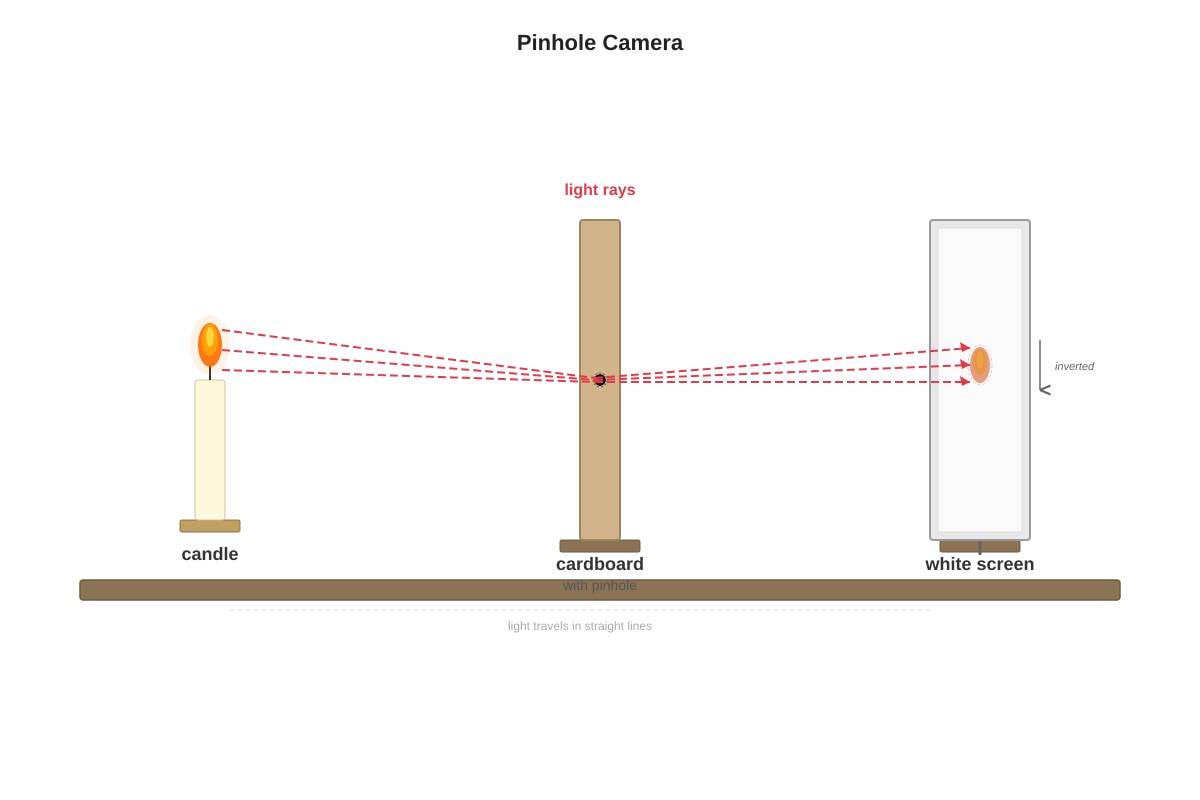
<image_placeholder> id: Q8-fig1 type: experimental_setup linked_question: Q8 description: A diagram showing an opaque cardboard with a small round hole in the centre, placed between a candle flame on the left and a white screen on the right. labels: candle, cardboard with pinhole, white screen, light rays must_show: Candle flame on left, cardboard with single small circular hole in centre, screen on right; light rays shown as straight lines passing through the pinhole and forming an inverted image of the flame on the screen. </image_placeholder>
8. What kind of image is formed on the screen in the pinhole camera setup shown above?
| A | A larger, upright image | | B | A smaller, inverted image | | C | A same-size, sideways image | | D | No image is formed |
Answer: _________________________________________________
Section B: Fill in the Blanks (Questions 9–12)
Complete each sentence with the correct word(s). Each blank carries 1 mark.
[8 × 1 = 8 marks]
9. Light travels in ________________________ lines. This is why we cannot see around corners.
10. A ________________________ object allows light to pass through it completely, so we can see clearly through it.
11. When white light passes through a glass prism, it is separated into a band of colours called a ________________________.
12. The bouncing back of light from a surface is called ________________________.
Section C: Short Answer (Questions 13–17)
Answer in the spaces provided. Marks are shown for each question.
[5 × 2 = 10 marks]
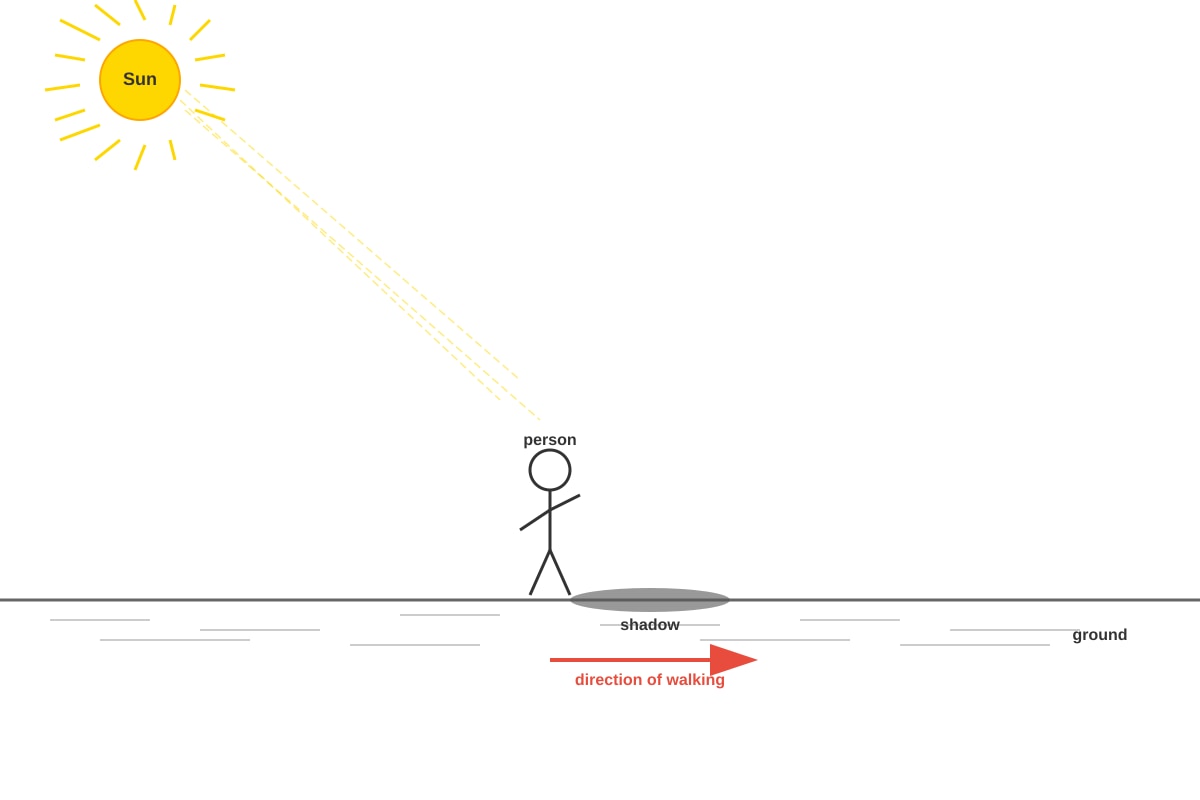
<image_placeholder> id: Q13-fig1 type: diagram linked_question: Q13 description: A simple diagram showing a person standing in sunlight with a shadow cast on the ground to their right. The Sun is shown as a circle with rays in the upper left corner. An arrow shows the person is walking towards the right side of the page. labels: Sun, person, shadow, direction of walking, ground must_show: The Sun at top-left emitting rays; person standing upright on ground level; shadow extending to the right of the person (same side as walking direction); arrow indicating walking direction to the right. </image_placeholder>
13. The diagram shows a person walking towards the right in bright sunlight.
(a) In which direction does the shadow fall? ________________________ [1]
(b) Explain why the shadow falls in that direction. [1]
14. Mei Ling places a wooden spoon, a glass of water, and a piece of tracing paper in a beam of sunlight.
(a) Which object would cast the darkest shadow? ________________________ [1]
(b) Give a reason for your answer. [1]
15. Explain why a swimming pool looks shallower than it really is when viewed from above the water.
_________________________________________________________________ [2]
16. A torch is placed in front of a concave mirror. The light rays that hit the mirror are reflected and meet at a point.
(a) What is the point where reflected rays meet called? ________________________ [1]
(b) Give one use of a concave mirror that makes use of this property. [1]
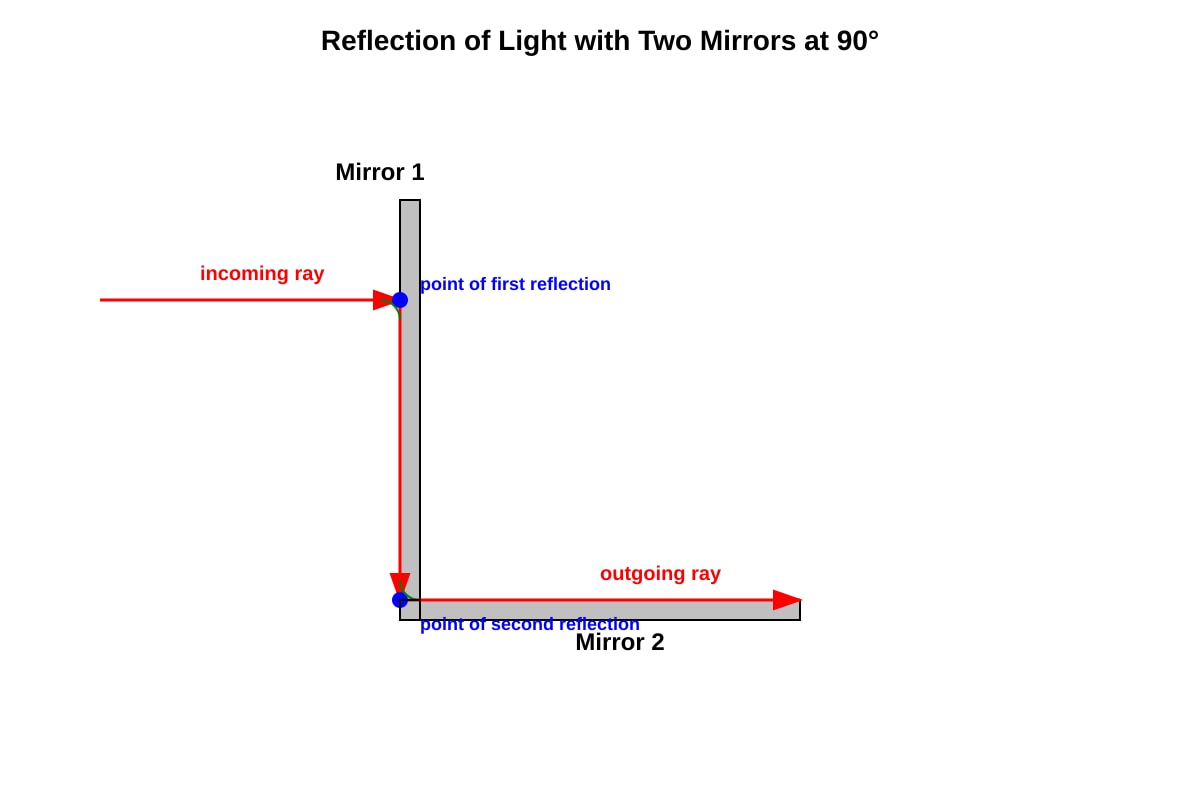
<image_placeholder> id: Q17-fig1 type: diagram linked_question: Q17 description: A diagram showing two mirrors placed at right angles (90 degrees) to each other, forming a corner. A single light ray enters from the left, hits the first mirror, reflects to the second mirror, then reflects again and exits. The two mirrors are labelled Mirror 1 (vertical) and Mirror 2 (horizontal). labels: Mirror 1, Mirror 2, incoming ray, outgoing ray, point of first reflection, point of second reflection must_show: Two mirrors at exactly 90 degrees; incoming horizontal ray from left hits first (vertical) mirror; reflects downward to second (horizontal) mirror; reflects again to exit horizontally rightward; all angles of incidence and reflection should appear equal by construction. </image_placeholder>
17. Look at the diagram of two mirrors at right angles to each other.
(a) What is the angle between the two mirrors? ________________________ [1]
(b) If the incoming light ray is parallel to the outgoing light ray, what has happened to the direction of the light? [1]
Section D: Structured Questions (Questions 18–20)
Answer all parts in the spaces provided.
[6 marks]
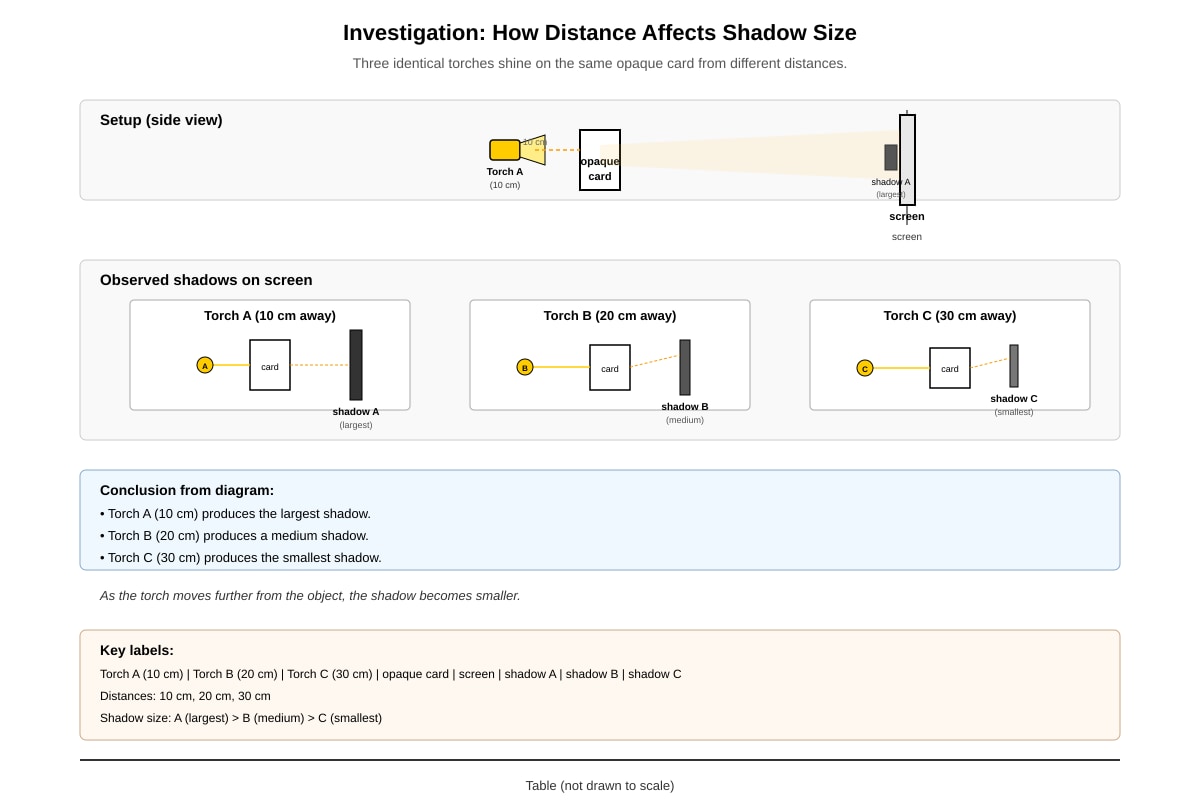
<image_placeholder> id: Q18-fig1 type: diagram linked_question: Q18 description: A diagram showing an investigation setup with three identical torches labelled A, B, and C, each shining at the same opaque white card from different distances. Torch A is 10 cm away, Torch B is 20 cm away, Torch C is 30 cm away. The shadows formed on a screen behind the card are shown for each torch. labels: Torch A (10 cm), Torch B (20 cm), Torch C (30 cm), opaque card, screen, shadow A, shadow B, shadow C values: Distances: 10 cm, 20 cm, 30 cm must_show: Three separate sub-diagrams or one diagram with three arrangements showing decreasing shadow size from A to C; all other variables (torch, card, screen) identical; labels clearly showing distance relationship. </image_placeholder>
18. A group of students investigates how the distance of a light source affects the size of a shadow.
(a) What is changed in this investigation (the changed variable)? [1]
(b) What should be kept the same to make this a fair test? Name two things. [2]
(c) Predict which shadow (A, B, or C) would be the largest. [1]
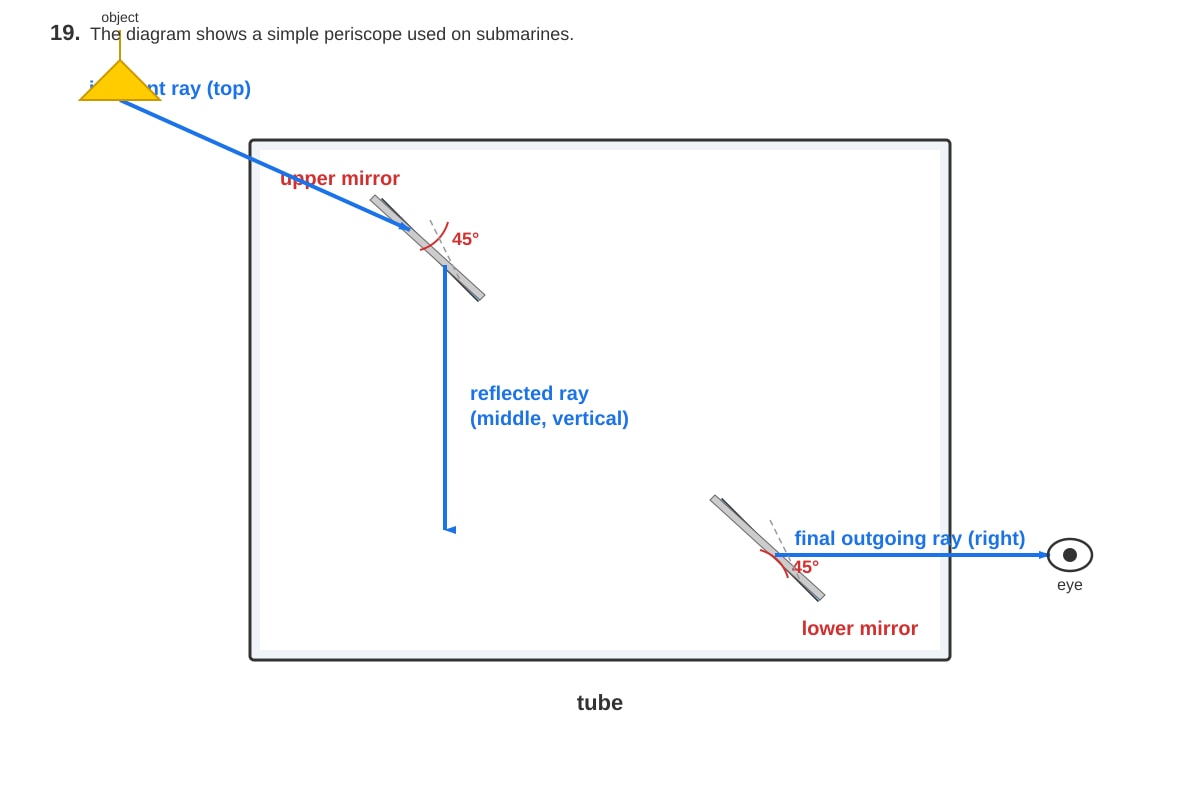
<image_placeholder> id: Q19-fig1 type: diagram linked_question: Q19 description: A periscope diagram showing two parallel plane mirrors placed at 45-degree angles inside a rectangular tube. Light enters from the top left, hits the upper mirror, reflects down the tube, hits the lower mirror, and exits to the right. The tube is shown in cross-section. labels: upper mirror, lower mirror, incident ray (top), reflected ray (middle, vertical), final outgoing ray (right), tube, 45° angle marks on both mirrors must_show: Two plane mirrors both at 45 degrees to the horizontal; upper mirror faces down-right; lower mirror faces up-right; light path with arrows showing: enters from top-left, reflects down vertically, reflects again to exit rightward; clear 45° angle markings. </image_placeholder>
19. The diagram shows a simple periscope used on submarines.
(a) Explain how the periscope allows a sailor to see objects above the water surface while the submarine stays underwater. [2]
(b) What property of light does the periscope make use of? [1]
20. The seven colours of the visible spectrum can be remembered using the name "ROY G. BIV".
(a) Write down the full names of the three primary colours of light. [3]
(b) What colour would you see if you mixed red light and green light together? [1]
(c) Why is it impossible to see your face clearly in a piece of frosted (translucent) glass? [2]
END OF QUIZ
[Page 2 — for rough working if needed]
Answers
Primary 5 Science Quiz — Light: Answer Key
Total Marks: 40
Section A: Multiple Choice
| Question | Answer | Explanation |
|---|---|---|
| 1 | B | We see objects when light from them (or reflected off them) enters our eyes. The object does not need to produce its own light (A is wrong — that's luminous objects only). Transparency (C) is not required to see something. |
| 2 | C | Light travels fastest in a vacuum, and almost as fast through air. It slows down in liquids (water) and solids (glass). Wood (D) is opaque so light cannot pass through at all. Speed ranking: air > water > glass. |
| 3 | B | Reflection is when light bounces off a surface. A mirror reflects light, directing it to the wall. Refraction (A) is bending through materials; absorption (C) is taking in light; dispersion (D) is splitting white light into colours. |
| 4 | C | Shadows form when an opaque object blocks light. A (wrong) — light passing through makes no shadow. B (wrong) — shadow darkness depends on light brightness, not distance. D (wrong) — any light source works. |
| 5 | B | By the Law of Reflection: angle of incidence = angle of reflection. Both angles are measured from the normal (not the mirror surface). If incidence is 35°, reflection is 35°. |
| 6 | B | Refraction is the bending of light when it passes from one medium to another (air → water). This makes the straw/water appear bent. Reflection (A) would show a mirror image, not bending. |
| 7 | A | Red, green, and blue are the primary colours of light (additive colour mixing). Red + green + blue light = white. Note: This differs from paint pigments, which use red, yellow, blue (subtractive mixing). |
| 8 | B | A pinhole camera forms a smaller, inverted (upside-down) image because light travels in straight lines through the tiny hole. The top of the candle sends rays through the bottom of the hole, appearing at the bottom of the screen. |
Section A Total: 16 marks
Section B: Fill in the Blanks
| Question | Answer | Marks | Notes |
|---|---|---|---|
| 9 | straight | 1 | Light travels in straight lines in a uniform medium — the principle of rectilinear propagation. |
| 10 | transparent | 1 | Transparent objects (clear glass, clean water) transmit light; we see clearly through them. Translucent objects diffuse light; opaque objects block it completely. |
| 11 | spectrum | 1 | Specifically a visible spectrum or colour spectrum. Also accept "spectrum of colours." This is caused by dispersion — different colours refract by different amounts through the prism. |
| 12 | reflection | 1 | The angle of incidence equals the angle of reflection. Both are measured from the normal, not the surface. |
Section B Total: 8 marks
Section C: Short Answer
Question 13
(a) The shadow falls to the right / in the same direction as the walking direction / away from the Sun. [1]
(b) The Sun is on the left side of the person, so light comes from the left. The person blocks this light, and the shadow forms on the side away from the light source (the right). [1]
Teaching note: Shadows always fall on the side opposite to the light source. The person walking right is irrelevant to shadow direction — what matters is the Sun's position. The diagram shows Sun top-left, so shadow extends to the right.
Question 14
(a) The wooden spoon [1]
(b) Wood is opaque, so it blocks all light passing through it. The glass is transparent (little shadow) and tracing paper is translucent (some light passes through, so shadow is faint). [1]
Common misconception: Students often think all objects cast the same shadow. Emphasise: opacity determines shadow darkness.
Question 15
Light from the bottom of the pool refracts (bends) as it moves from water to air. [1]
Our brain assumes light travelled in a straight line, so the pool bottom appears closer/higher than it really is. [1]
Key concept: Refraction at the water-air boundary bends light away from the normal (since water is optically denser). This makes objects underwater look closer to the surface and therefore the water seems shallower.
Question 16
(a) The principal focus / focal point [1]
(b) Any one of: torch/headlight reflectors, dentist's mirror, shaving mirror, solar furnace, astronomical telescope. [1]
Teaching note: Concave mirrors concentrate parallel rays to the focus, making them useful for concentrating light/heat energy. This is the opposite use of convex mirrors (which spread light out for wider views).
Question 17
(a) 90° / right angle [1]
(b) The light ray has been turned back / reversed / returned parallel but in the opposite direction / retrodirective reflection. [1]
Explanation: Two mirrors at 90° create a corner reflector. The light undergoes two reflections. By geometry: first reflection changes direction by , second by , and since , total deviation is . So incoming and outgoing rays are parallel but opposite.
Section C Total: 10 marks
Section D: Structured Questions
Question 18
(a) The distance of the light source from the opaque card / the distance from torch to card. [1]
Accept: distance of torch/card from screen if clearly meaning the light-to-object distance is what's varied.
(b) Any two of: [2]
- The brightness/power of the torch
- The size of the opaque card
- The distance from card to screen
- The type of torch used
- The angle of the torch beam
(c) Shadow A / the shadow from the torch 10 cm away. [1]
Reasoning: The closer the light source, the larger the shadow. Light rays diverge more from a nearby source, so the shadow spreads wider. From farther away, rays are more parallel, making a sharper, smaller shadow.
Question 18 Total: 4 marks
Question 19
(a) Light from the object above water hits the upper mirror and is reflected downwards. [1] This reflected light then hits the lower mirror and is reflected again into the sailor's eyes, so the sailor can see the object even though the submarine is underwater. [1]
Mark breakdown: One mark for describing the two reflections path; one mark for connecting this to the sailor's view.
(b) Reflection (of light). [1]
Accept: multiple reflection / law of reflection. The periscope does NOT use refraction — the tube is filled with air, and mirrors are the active optical elements.
Question 19 Total: 3 marks
Question 20
(a) Red, green, and blue. [3 marks — 1 mark each]
These are the additive primary colours of light. When combined in equal intensity, they produce white light.
(b) Yellow [1]
Red light + green light = yellow light. This is additive colour mixing, not paint mixing. In paint, red + green would make a muddy brown.
(c) Frosted glass is translucent, not transparent. [1] It scatters/diffuses light as it passes through, so the light rays do not travel straight. Our eyes cannot form a clear image from scattered light. [1]
Marking note: Need both parts — identification of translucency AND explanation of scattering/diffusion. Simply saying "it's not clear" is insufficient for full marks.
Question 20 Total: 6 marks
Section Totals Summary
| Section | Marks |
|---|---|
| A (MCQ) | 16 |
| B (Fill in blanks) | 8 |
| C (Short answer) | 10 |
| D (Structured) | 6 |
| TOTAL | 40 |
Common Student Errors to Watch For
| Error | Why Wrong | Correct Understanding |
|---|---|---|
| "Angle of reflection is 55°" (Q5) | Measured from mirror surface, not normal | Always measure from the normal |
| "Plants don't respire" | Confusing photosynthesis with respiration | All living things respire continuously |
| "Shadow size doesn't change with distance" | Not understanding light divergence | Closer source = diverging rays = larger shadow |
| "Red + green = brown" (Q20b) | Confusing light mixing with paint mixing | Additive primaries: R+G+B = white; R+G = yellow |
| "Periscope uses refraction" (Q19b) | Thinking bends = refraction always | Periscope uses two reflections at plane mirrors |