From Real Exams Quiz
Primary 5 Science Light Quiz
Free P5 Science Light quiz, HY3 Exam version, with questions, answers, and syllabus-aligned practice for Singapore students.
These static practice materials are generated from the site's syllabus and paper-generation workflow, with source and model context shown so students and parents can evaluate the material before use.
Questions
Free quiz and exam paper access
Enter your details to view this paper
Your access is remembered on this device.
Answers
Primary 5 Science Quiz - Light (Answer Key)
Total Marks: 40
Topic: Light
Section A Answers (1 mark each)
-
C) The Sun
Teaching note: The Sun makes its own light and is a luminous source. A mirror, the Moon, and a white wall only reflect light from other sources. -
B) straight
Teaching note: Light travels in straight lines. This is why shadows have sharp edges when the light source is small. -
B) absorbed
Teaching note: A wooden table does not let light pass through and is not a good reflector, so most light is absorbed and turned into a little heat. -
C) Thick cardboard
Teaching note: Thick cardboard is opaque and blocks light. Clear glass and plastic wrap let light through; thin paper lets some light through. -
B) blocked
Teaching note: A shadow forms when an object blocks the straight path of light. -
A) Seeing your face in a pond
Teaching note: The pond surface reflects light from your face to your eyes. The other options show absorption, refraction, or blocking. -
B) reflect
Teaching note: Non-luminous objects do not make light; they are seen only when light reflects from them into our eyes. -
C) Shadows are formed when light is blocked.
Teaching note: Shadows need a light source and an object that blocks light. They can form in day or night with a lamp. -
B) larger
Teaching note: Moving the ball closer to the lamp makes the light rays spread more behind it, so the shadow on the wall becomes larger. -
B) A candle flame
Teaching note: A candle flame makes its own light. The other items are non-luminous.
Section B Answers (2 marks each)
-
The Moon does not make its own light. It is seen because it reflects sunlight into our eyes. (2 marks: 1 for "no own light", 1 for "reflects sunlight")
Teaching note: The Moon is non-luminous. Sunlight hits the Moon and reflects to Earth. -
The apple does not make light. It reflects red light from the torch and absorbs other colours, so our eyes see red. (2 marks: 1 reflect, 1 red reflected/absorbed others)
Teaching note: Coloured objects reflect their own colour and absorb the rest. -
(a) Light travels in straight lines. (b) Light can be reflected by surfaces. (2 marks: 1 each)
Teaching note: Other acceptable: light is blocked by opaque objects; light can be absorbed. -
The book is opaque and blocks light, so light cannot pass through it and a dark shadow forms behind it. (2 marks: 1 opaque/blocks, 1 dark shadow)
Teaching note: Opaque means no light passes; the shadow is dark because little/no light reaches behind. -
The mirror reflects light into another direction. The cloth absorbs most light and does not let it pass through. (2 marks: 1 mirror reflects, 1 cloth absorbs/blocks)
Teaching note: Comparing behaviours shows reflection vs absorption. -
When the torch is close to the object, light spreads out more after the object, making a larger shadow; far away, rays are more parallel so shadow is smaller. (2 marks: correct reason on distance and size)
Teaching note: This is based on light travelling straight from a point source.
Section C Answers (3 marks each)
-
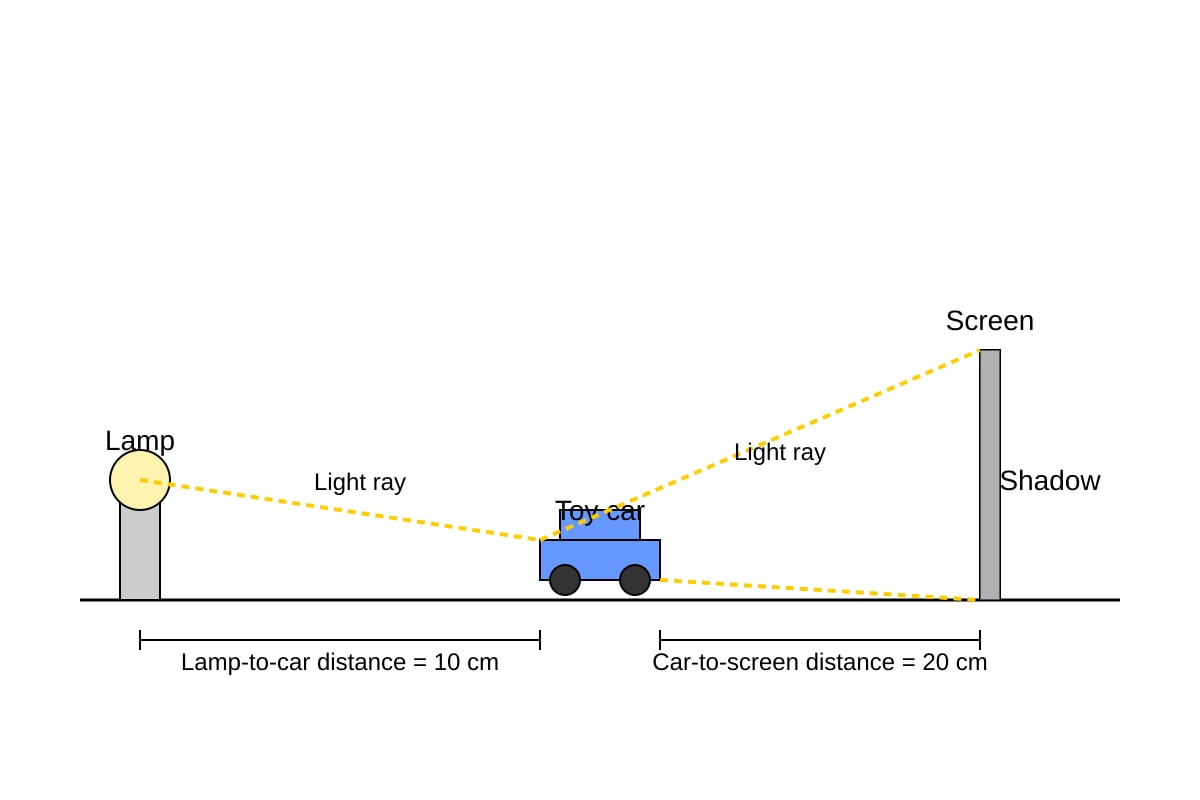
The lamp gives out light in straight lines. The toy car blocks the light. The screen catches the light that goes around the car, so a shadow of the car appears on the screen. (3 marks: 1 straight light from lamp, 1 car blocks, 1 shadow on screen)
Teaching note: Image must show straight ray blocked; shadow matches car shape. -
In early morning, the Sun is low so light comes at a slant and makes a long shadow. At noon, the Sun is high above, so light comes down more directly and the shadow is short. (3 marks: 1 low sun slant, 1 high sun direct, 1 links to length)
Teaching note: Shadow length depends on angle of light source. -
Clear window: light passes through (transmits). Black paper: light is absorbed. Silver spoon: light is reflected. (3 marks: 1 each)
Teaching note: Transmission = pass through; absorption = taken in; reflection = bounces off. -
The glowing sticker can be seen because it makes its own light (luminous). The spoon and book cannot be seen because they are non-luminous and no torch light reflects off them in the dark. (3 marks: 1 sticker luminous, 1 spoon/book non-luminous, 1 no light to reflect)
Teaching note: In a dark room with torch off, only luminous objects are visible.