From Real Exams Quiz
Primary 5 Science Life Cycles Quiz
Free P5 Science Life Cycles quiz, Exam version, with questions, answers, and syllabus-aligned practice for Singapore students.
These static practice materials are generated from the site's syllabus and paper-generation workflow, with source and model context shown so students and parents can evaluate the material before use.
Questions
Free quiz and exam paper access
Enter your details to view this paper
Your access is remembered on this device.
Answers
Primary 5 Science Quiz - Life Cycles: Answer Key
Total Marks: 40
Section A: Multiple-Choice Questions (10 × 1 Mark = 10 Marks)
1. A) Egg → Tadpole → Adult frog
- Explanation: A frog's life cycle is a three-stage process. It starts as an egg, hatches into a tadpole (which lives in water and breathes through gills), and then undergoes metamorphosis to become an adult frog that can live on land.
- Common mistake: Option B is incorrect because the tadpole stage comes before the adult stage.
2. C) The adult butterfly looks very different from the young caterpillar.
- Explanation: The butterfly undergoes complete metamorphosis. The caterpillar (larva) looks completely different from the adult butterfly. The caterpillar has a worm-like body and eats leaves, while the adult butterfly has wings and feeds on nectar.
- Common mistake: Option A is wrong because the caterpillar is the larval stage, not the adult stage.
3. A) Warmth, water, and air
- Explanation: For a seed to germinate, it needs three essential conditions: water (to activate enzymes and soften the seed coat), air (for oxygen for respiration), and warmth (for the chemical reactions to occur at a suitable rate). Sunlight is not needed for germination.
- Common mistake: Students often include sunlight, but germination occurs underground before the seedling has leaves.
4. C) Fertilisation
- Explanation: Fertilisation is the process where the male reproductive cell (sperm/pollen nucleus) fuses with the female reproductive cell (egg/ovule) to form a fertilised egg (zygote).
- Common mistake: Pollination is the transfer of pollen, not the fusion of cells.
5. C) Anther
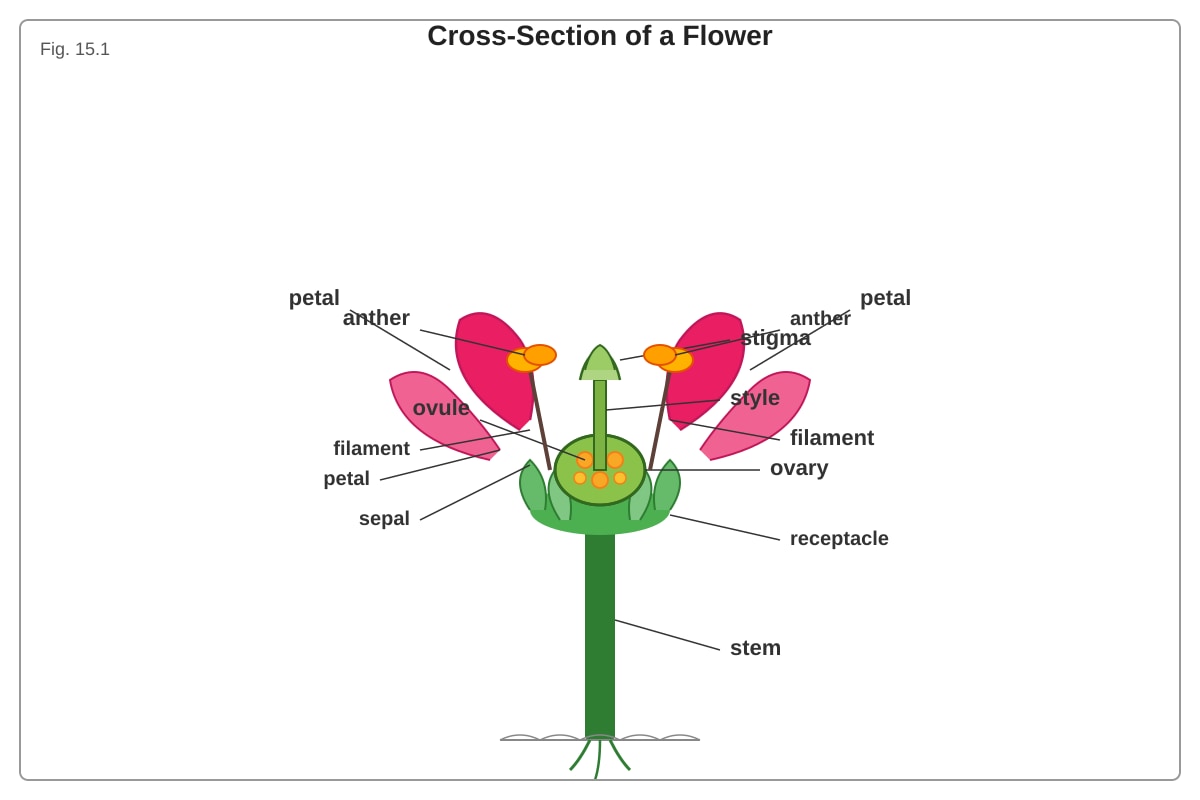
- Explanation: The anther is the part of the stamen (male part of the flower) that produces and holds the pollen grains, which contain the male reproductive cells.
- Common mistake: The stigma is the part that receives pollen, not produces it.
6. B) Taking a cutting from a stem and planting it
- Explanation: Taking a cutting is a form of vegetative reproduction, which does not involve seeds. The other options all involve seeds.
- Common mistake: Students may confuse this with methods that use seeds.
7. C) By wind
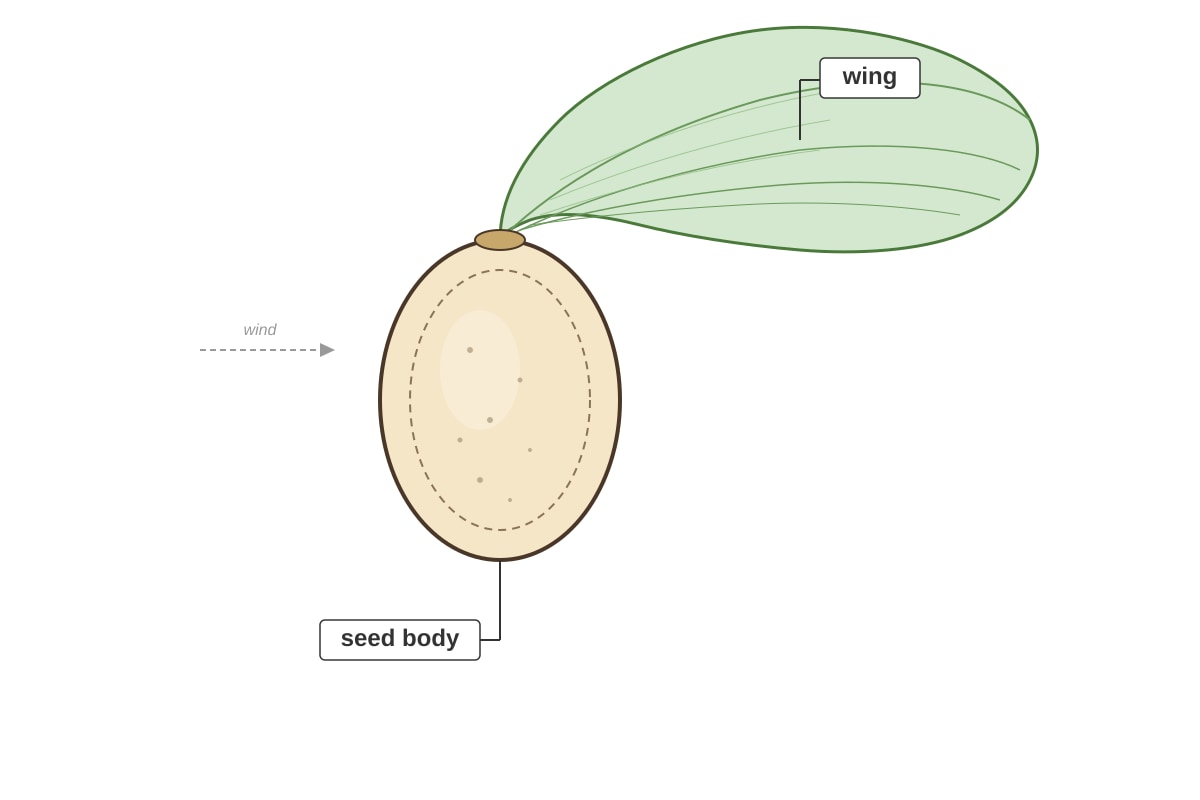
- Explanation: Seeds with wing-like structures are adapted for wind dispersal. The wing increases the surface area, allowing the seed to be carried by the wind over longer distances.
- Common mistake: Students might think of water, but the wing structure is a classic adaptation for wind.
8. C) Whale
- Explanation: A whale is a mammal. Mammals give birth to live young. Chickens, frogs, and butterflies lay eggs.
- Common mistake: Students might think all aquatic animals lay eggs, but whales are mammals.
9. B) Brightly coloured petals and a sweet scent
- Explanation: Insect-pollinated flowers are typically brightly coloured and have a sweet scent to attract insects. The insects visit the flower for nectar and, in the process, transfer pollen.
- Common mistake: Small, dull-coloured flowers are more likely to be wind-pollinated.
10. B) To ensure the survival of their species
- Explanation: Reproduction is a life process that ensures the continuity of a species. If organisms did not reproduce, their species would become extinct.
- Common mistake: Growth is a separate life process.
Section B: Short-Answer Questions (5 × 2 Marks = 10 Marks)
11. (a) Germination [1 mark]
- Explanation: Germination is the process by which a seed begins to grow and develop into a new plant. It requires water, air, and warmth.
(b) The fruit protects the seeds / The fruit helps in seed dispersal (Accept either) [1 mark]
- Explanation: The fruit has two main roles in reproduction: it protects the developing seeds and it aids in their dispersal. For example, fleshy fruits are eaten by animals, and the seeds are passed out in their droppings, dispersing them away from the parent plant.
12. (a) The plant could not carry out photosynthesis without light, so it could not produce chlorophyll/food. [1 mark]
- Explanation: Chlorophyll is the green pigment needed for photosynthesis. Without light, the plant cannot produce new chlorophyll, and the existing chlorophyll breaks down, causing the leaves to turn yellow.
(b) The plant would eventually die. [1 mark]
- Explanation: Without light, the plant cannot photosynthesise to make its own food. It will use up its stored food and eventually die from lack of energy.
13. (a) The fish has a lower chance of survival for each egg, so it lays more eggs to increase the chance that some will survive to adulthood. [1 mark]
- Explanation: Fish and frogs provide no care for their young, and many eggs/young are eaten by predators. Laying a huge number of eggs is a survival strategy. The bird, on the other hand, invests in caring for its few young, so it doesn't need to lay as many.
(b) The parents feed the chicks, providing them with food to grow. / The parents protect the chicks from danger/predators. (Accept either) [1 mark]
- Explanation: Parental care, such as feeding and protecting, greatly increases the survival rate of the young.
14. (a) Plant Y has the same genetic material (genes) as Plant X. [1 mark]
- Explanation: A cutting is a form of vegetative reproduction. The new plant is a clone of the parent plant, meaning it is genetically identical.
(b) Plant X was produced from a seed (sexual reproduction), while Plant Y was produced from a cutting (asexual reproduction). [1 mark]
- Explanation: Plant X involves the fusion of male and female reproductive cells (sexual reproduction), while Plant Y is produced from a part of a single parent plant (asexual reproduction).
15. (a) Ovary (or ovule) [1 mark]
- Explanation: The ovary is the part of the female reproductive organ (pistil) that contains the ovules. The ovules contain the female reproductive cells (egg cells).
(b) Ovary [1 mark]
- Explanation: After fertilisation, the ovule develops into the seed, and the ovary wall develops into the fruit, which surrounds and protects the seeds.
Section C: Structured Questions (5 × 4 Marks = 20 Marks)
16. (a) The larva lives in water, while the adult mosquito flies in the air. / The larva does not have wings, while the adult has wings. (Accept any valid difference) [1 mark]
- Explanation: The larva is an aquatic, worm-like stage that breathes through a siphon tube. The adult is a flying insect.
(b) Stagnant water provides a breeding ground for mosquitoes. Removing it prevents mosquitoes from laying eggs and reproducing, which helps control the mosquito population and reduces the spread of diseases. [2 marks]
- Marking notes:
- 1 mark for stating that stagnant water is where mosquitoes lay eggs/breed.
- 1 mark for explaining the consequence (e.g., reduces mosquito population, prevents diseases).
(c) The pupa is a resting/non-feeding stage where the body is reorganising into the adult form. [1 mark]
- Explanation: During the pupa stage, the insect does not feed. It is a period of transformation where the larval body is broken down and rebuilt into the adult form.
17. (a) To find out if light is needed for seeds to germinate. [1 mark]
- Explanation: The aim is a clear statement of what the experiment is trying to investigate. Here, the student is testing the effect of light on germination.
(b) The amount of light (light vs. dark). [1 mark]
- Explanation: The changed variable (independent variable) is the factor that is deliberately changed by the experimenter. In this case, one dish is in the light, and the other is in the dark.
(c) The seeds do not need light to germinate. [2 marks]
- Marking notes:
- 1 mark for stating the conclusion clearly.
- 1 mark for linking it to the observation (both germinated).
- Explanation: Since seeds in both the light and dark conditions germinated, the conclusion is that light is not a necessary condition for germination. The other conditions (water, air, warmth) were the same for both.
18. (a) To protect the embryo/seed from damage and from drying out. [1 mark]
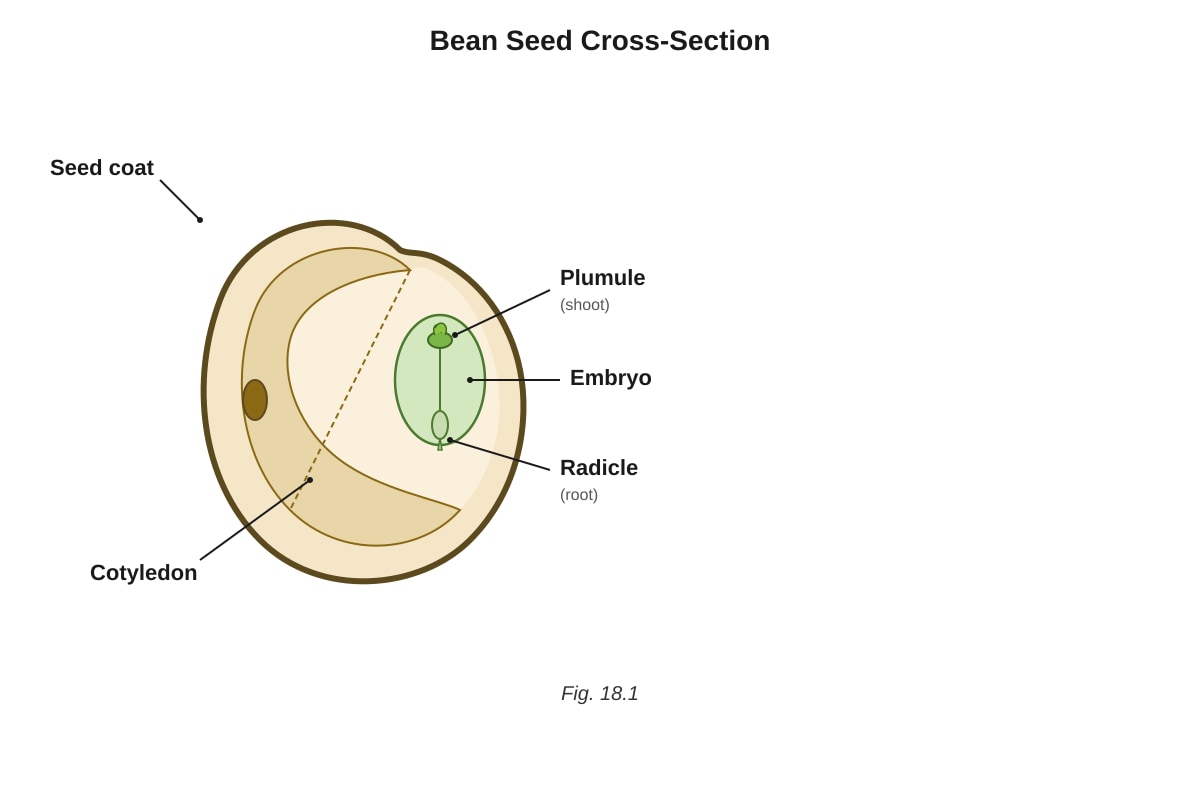
- Explanation: The seed coat is a tough outer layer that protects the delicate embryo inside from physical damage, pests, and dehydration.
(b) Radicle [1 mark]
- Explanation: The radicle is the embryonic root. It is the first part to emerge from the seed during germination and grows downwards into the soil to anchor the plant and absorb water and minerals.
(c) The cotyledon shrinks/withers as the food stored in it is used up for the growth of the seedling. Once the seedling has developed green leaves, it can make its own food through photosynthesis, so the cotyledon is no longer needed. [2 marks]
- Marking notes:
- 1 mark for stating that the cotyledon shrinks/becomes smaller.
- 1 mark for explaining that the food is used for growth and the leaves take over food-making.
- Explanation: The cotyledon is a food store. During germination, the energy and nutrients from this store are used to fuel the growth of the plumule and radicle. Once the leaves are formed and exposed to light, the plant becomes autotrophic (makes its own food) and the cotyledon is depleted.
19. (a) By taking a cutting/stem cutting from the mango tree and planting it. (Accept: grafting, but for P5, cutting is the expected method) [1 mark]
- Explanation: This is a method of vegetative reproduction, which produces offspring that are genetically identical to the parent plant.
(b) The new trees grown from cuttings will be identical to the parent tree and will also produce sweet fruits. Trees grown from seeds may not be identical to the parent and may not produce sweet fruits. [2 marks]
- Marking notes:
- 1 mark for stating that the cutting will produce identical fruits.
- 1 mark for stating that seeds may produce different/not sweet fruits.
- Explanation: Sexual reproduction (from seeds) involves the mixing of genetic material from two parents, leading to variation. Asexual reproduction (from cuttings) produces clones, ensuring the desirable trait (sweetness) is preserved.
(c) Seeds can be dispersed over long distances, helping the plant species to spread to new areas. / Seeds can survive harsh conditions (e.g., drought) in a dormant state until conditions are favourable. (Accept either) [1 mark]
- Explanation: Seeds are a product of sexual reproduction and offer advantages like dispersal and dormancy, which cuttings do not.
20. (a) Butterfly [1 mark]
- Explanation: The butterfly undergoes complete metamorphosis, with four distinct stages (egg, larva, pupa, adult) where the young looks completely different from the adult.
(b) The grasshopper's young (nymph) looks similar to the adult, while the frog's young (tadpole) looks very different from the adult. [1 mark]
- Explanation: The grasshopper undergoes incomplete metamorphosis (egg → nymph → adult), while the frog undergoes a metamorphosis where the tadpole is an aquatic, fish-like creature that changes into a land-dwelling adult.
(c) The young chicken can find its own food more easily / can protect itself from danger more effectively / does not need to undergo a risky transformation. [2 marks]
- Marking notes:
- 1 mark for a valid advantage.
- 1 mark for explaining how it helps survival.
- Explanation: Because the chick looks like a miniature adult, it can mimic the adult's behaviour, such as pecking for food and running away from danger, which increases its chances of survival from a young age.