From Real Exams Quiz

Primary 5 Science Heat Quiz

Free Exam-Derived NVIDIA Nemotron 3 Ultra 550B A55B Free Primary 5 Science Heat quiz with questions and answers for Singapore students. This page is rendered as a direct URL so the questions and answers can be discovered without pressing in-page buttons.

These static practice materials are generated from the site's syllabus and paper-generation workflow, with source and model context shown so students and parents can evaluate the material before use.

Primary 5 Science From Real Exams Generated by NVIDIA Nemotron 3 Ultra 550B A55B Free Updated 2026-06-07

Questions

<!-- TuitionGoWhere generation metadata: stage=3-0; model=nvidia/nemotron-3-ultra-550b-a55b:free; model_label=NVIDIA Nemotron 3 Ultra 550B A55B Free; generated=2026-06-05; Sources: Stage 2-1 real exam-derived templates and Stage 2-2 exam-enriched syllabus. -->

Primary 5 Science Quiz - Heat

Name: ___________________________
Class: Primary 5 ______
Date: ___________________________
Score: ______ / 40

Duration: 45 minutes
Total Marks: 40

Instructions:

  1. Answer all questions.
  2. Write your answers in the spaces provided.
  3. For multiple-choice questions, write the letter (A, B, C, or D) in the bracket provided.
  4. For open-ended questions, write your answers clearly in complete sentences.
  5. Diagrams are not drawn to scale unless stated.

Section A: Multiple-Choice Questions (10 × 1 mark = 10 marks)

For each question, choose the correct answer and write its letter in the bracket.

1. Which of the following statements about heat is correct?
A. Heat is a form of matter.
B. Heat travels from a colder region to a hotter region.
C. Heat is a form of energy.
D. Heat cannot be transferred through a vacuum.
[ ]

2. The diagram below shows a metal spoon placed in a cup of hot tea.
<image_placeholder> id: Q2-fig1 type: diagram linked_question: Q2 description: A metal spoon placed vertically in a cup of hot tea. The spoon handle is above the tea level. Heat arrows show conduction from the tea up the spoon handle. labels: Cup, Hot tea, Metal spoon, Handle, Heat transfer arrows (conduction) values: Tea temperature: 80°C, Room temperature: 28°C must_show: Metal spoon submerged in hot tea, handle extending out, conduction arrows pointing upward along spoon </image_placeholder>
After a few minutes, the handle of the spoon becomes hot. Which process explains this?
A. Convection
B. Conduction
C. Radiation
D. Evaporation
[ ]

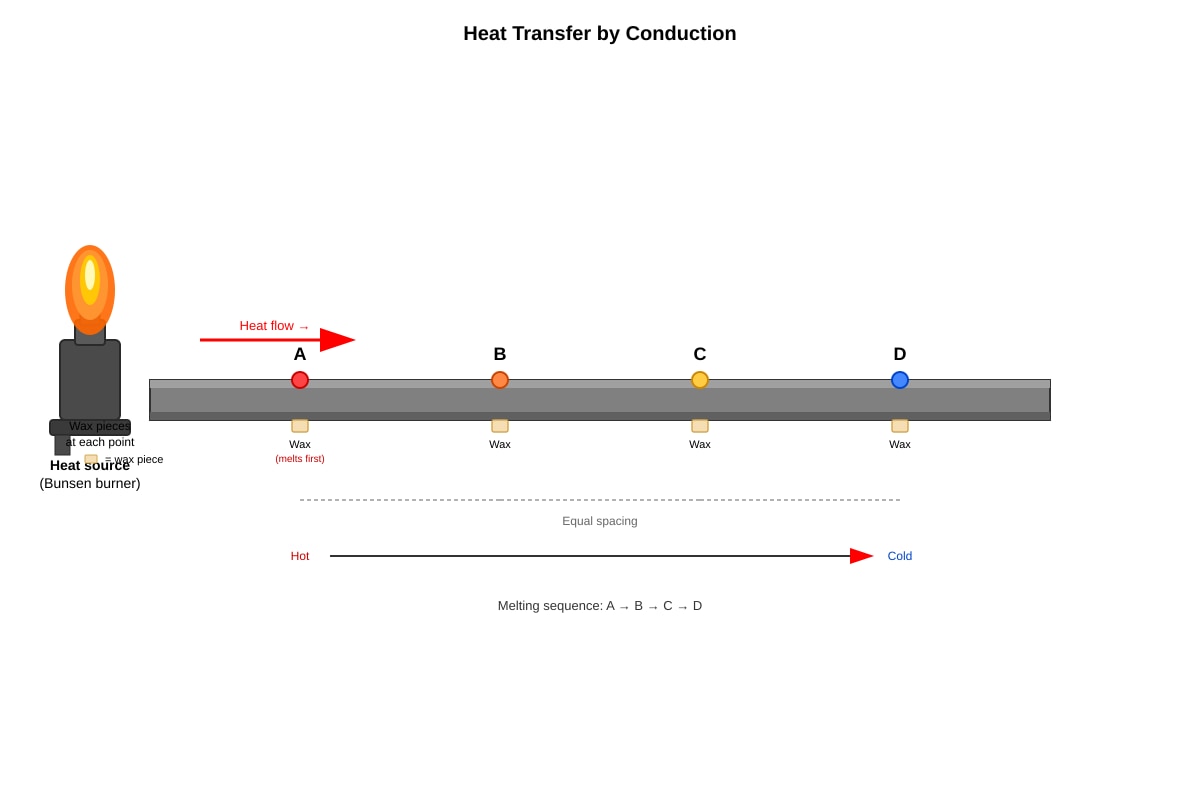
3. Four rods made of different materials are heated at one end. The time taken for the other end to become hot is recorded below.

MaterialTime taken for other end to become hot (s)
Copper15
Aluminium25
Iron40
Glass120

Which material is the best conductor of heat?
A. Copper
B. Aluminium
C. Iron
D. Glass
[ ]

4. A student places an ice cube on a metal tray and another identical ice cube on a plastic tray at room temperature. The ice cube on the metal tray melts faster. What is the main reason?
A. Metal is a better conductor of heat than plastic.
B. Metal absorbs more heat from the surroundings than plastic.
C. Metal is at a higher temperature than plastic.
D. Metal reflects heat better than plastic.
[ ]

5. Which of the following shows heat transfer by radiation?
A. A pot of water boiling on a stove
B. Feeling warmth from the Sun on your skin
C. A metal rod heated at one end becoming hot at the other end
D. Hot air rising from a heater
[ ]

6. The diagram below shows a vacuum flask.
<image_placeholder> id: Q6-fig1 type: diagram linked_question: Q6 description: Cross-section of a vacuum flask showing double walls with vacuum between them, silvered surfaces, stopper, and outer casing. labels: Outer casing, Inner wall, Outer wall, Vacuum, Silvered surfaces, Stopper, Hot liquid values: Vacuum space: no particles, Silvered surfaces: reflect radiation must_show: Double-walled structure with vacuum gap, silvered inner surfaces, tight-fitting stopper </image_placeholder>
The vacuum between the double walls reduces heat loss mainly by preventing:
A. Conduction and convection
B. Conduction and radiation
C. Convection and radiation
D. Conduction only
[ ]

7. A beaker of water is heated from the bottom. After some time, the water at the top becomes hot. Which process transfers heat through the water?
A. Conduction
B. Convection
C. Radiation
D. Evaporation
[ ]

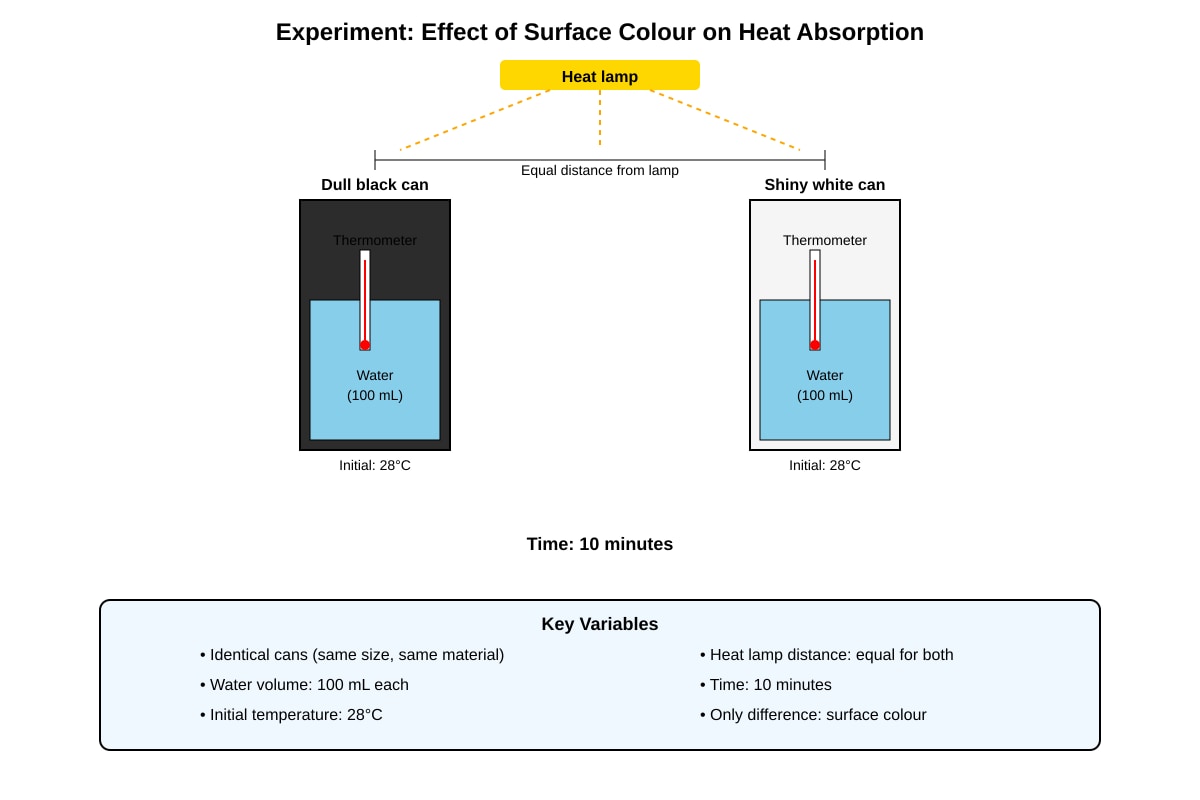
8. Two identical cans, one painted dull black and the other shiny white, are filled with the same amount of hot water at 80°C. They are left in a room at 25°C. After 20 minutes, which can will have cooler water?
A. The dull black can
B. The shiny white can
C. Both will have the same temperature
D. Cannot be determined
[ ]

9. A bimetallic strip is made of two metals, X and Y, bonded together. When heated, the strip bends as shown.
<image_placeholder> id: Q9-fig1 type: diagram linked_question: Q9 description: Bimetallic strip before and after heating. Metal X on top, Metal Y on bottom. After heating, strip bends downward (Metal X expands more). labels: Metal X, Metal Y, Before heating (straight), After heating (bent downward) values: Temperature increase: 50°C must_show: Two distinct metal layers bonded, straight at room temperature, curved after heating with Metal X on outer curve </image_placeholder>
Which statement is correct?
A. Metal X expands more than Metal Y when heated.
B. Metal Y expands more than Metal X when heated.
C. Both metals expand equally.
D. Metal X contracts when heated.
[ ]

10. Which of the following applications uses the principle of convection?
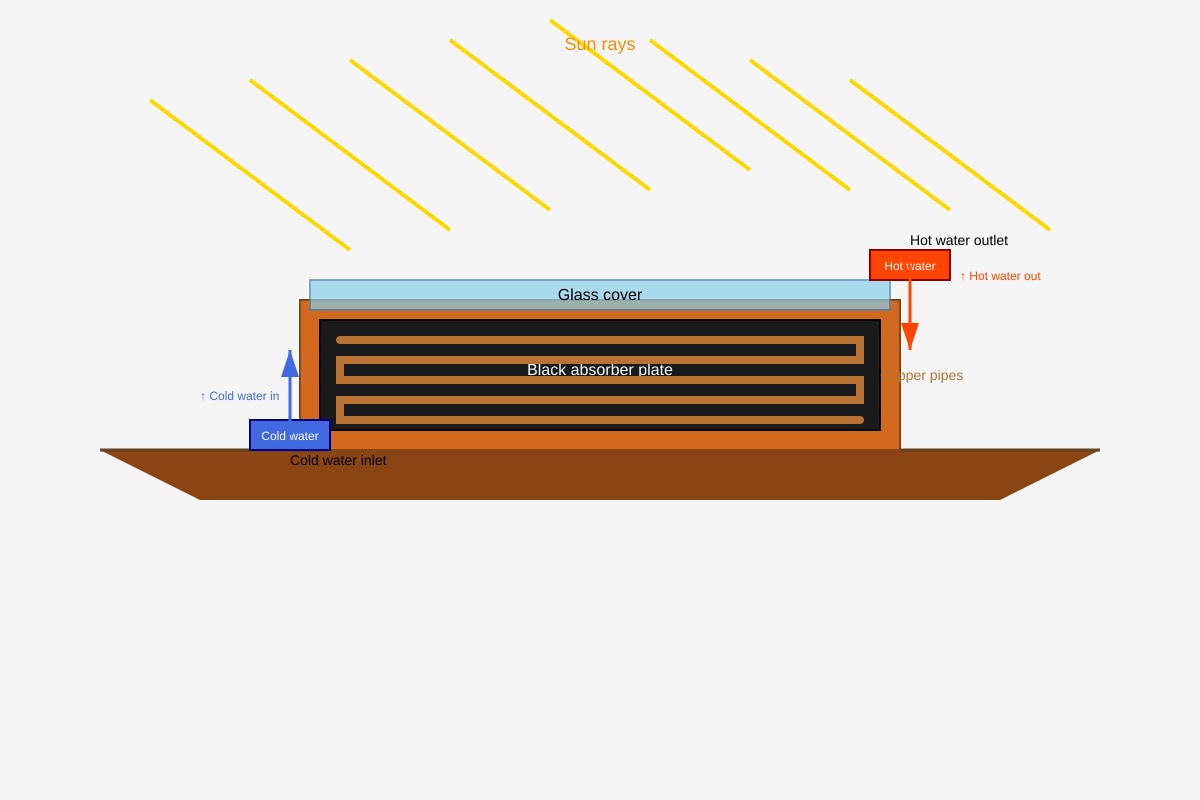
A. Solar water heater panels painted black
B. Air conditioner installed near the ceiling
C. Vacuum flask keeping drinks hot
D. Metal saucepan with wooden handle
[ ]


Section B: Short Answer Questions (5 × 2 marks = 10 marks)

Write your answers in the spaces provided.

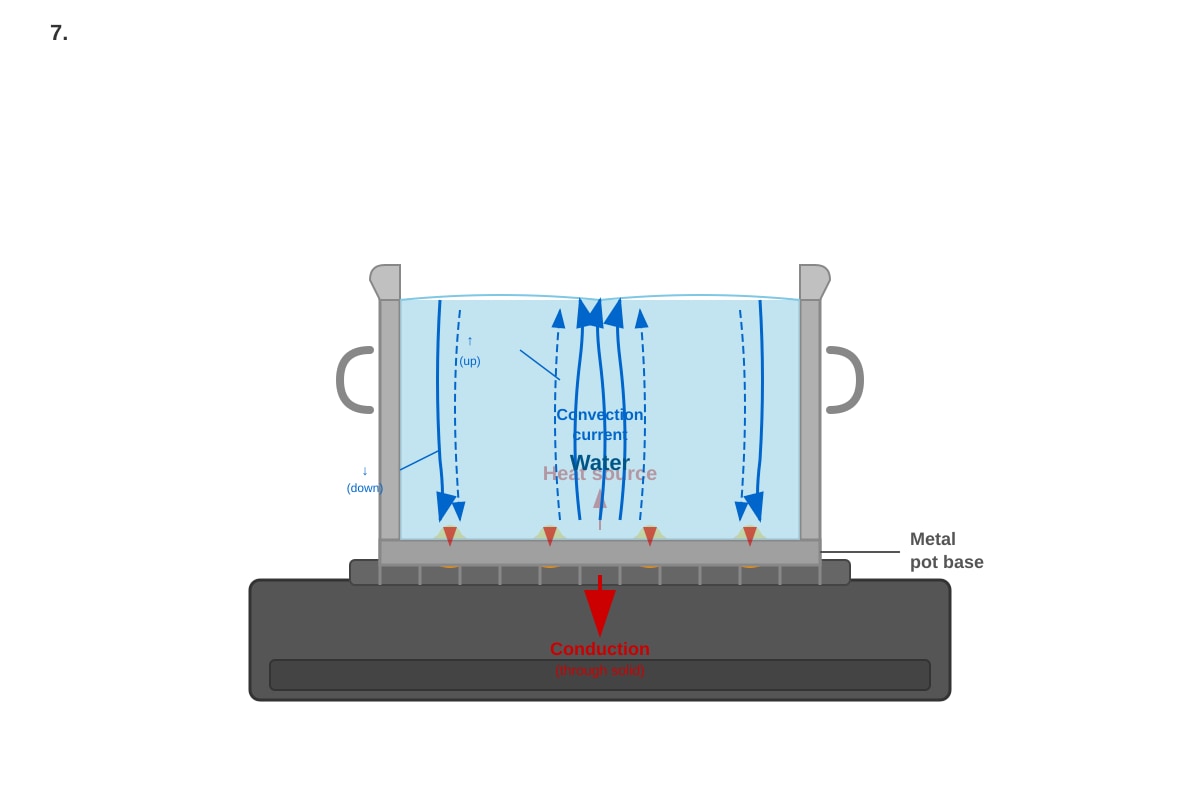
11. The diagram below shows a pot of soup being heated on a stove.
<image_placeholder> id: Q11-fig1 type: diagram linked_question: Q11 description: Pot of soup on a stove. Heat source at bottom. Arrows showing convection currents in soup (rising in center, sinking at sides). Pot material conducting heat. labels: Stove/heat source, Pot, Soup, Convection current arrows (up in middle, down at sides), Conduction arrows through pot base values: Soup temperature at bottom: 95°C, Soup temperature at top: 85°C must_show: Clear convection current loops in liquid, heat source at base, pot conducting heat </image_placeholder>
(a) Name the process that transfers heat from the stove to the pot.
_________________________________________________________________________ [1]

(b) Name the process that transfers heat through the soup.
_________________________________________________________________________ [1]

12. Explain why the handle of a metal cooking pan is often made of plastic or wood.


_________________________________________________________________________ [2]

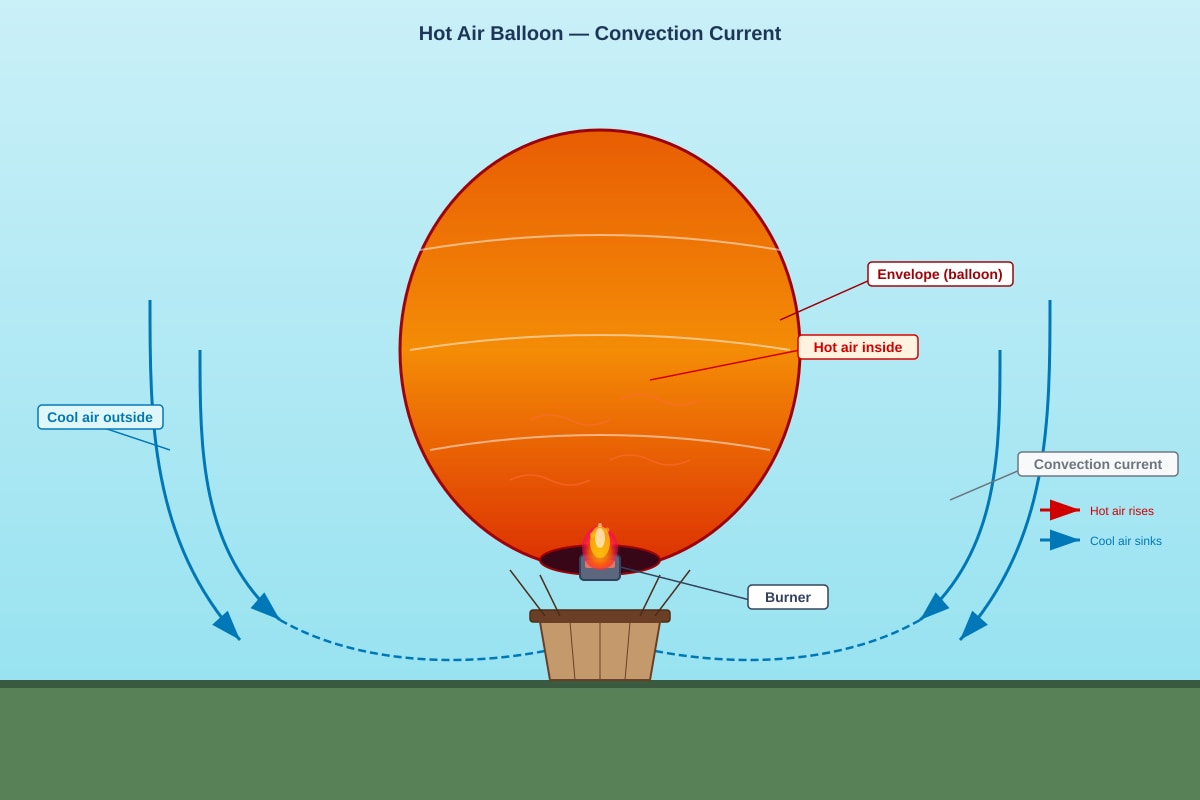
13. The diagram below shows a room heater.
<image_placeholder> id: Q13-fig1 type: diagram linked_question: Q13 description: Room heater with heating element. Arrows showing hot air rising from heater, circulating across ceiling, cooling, sinking at far wall, returning along floor. labels: Heating element, Hot air rising, Cool air sinking, Room, Ceiling, Floor values: Heater temperature: 60°C, Room temperature: 22°C must_show: Clear convection current loop in air, heater at floor level, circulation pattern </image_placeholder>
(a) The air near the heater becomes hot and rises. Explain why hot air rises.


_________________________________________________________________________ [1]

(b) This movement of air forms a convection current. How does this convection current help to warm the whole room?


_________________________________________________________________________ [1]

14. A student conducts an experiment to compare how well different materials conduct heat. She places a thumbtack on each rod using wax, then heats one end of each rod. The time taken for the thumbtack to drop is recorded.

MaterialTime for thumbtack to drop (s)
Rod A30
Rod B55
Rod C15
Rod D80

(a) Which rod is the best conductor of heat?
_________________________________________________________________________ [1]

(b) Explain your answer in (a).


_________________________________________________________________________ [1]

15. The diagram shows a solar cooker.
<image_placeholder> id: Q15-fig1 type: diagram linked_question: Q15 description: Solar cooker with reflective parabolic dish concentrating sunlight onto a cooking pot at the focal point. Sun rays parallel, reflecting to focus. labels: Sun, Parallel sun rays, Reflective parabolic dish, Cooking pot at focal point, Concentrated heat values: Sunlight intensity: 1000 W/m², Focal point temperature: >200°C must_show: Parabolic reflector, parallel rays converging at focus, pot at focal point </image_placeholder>
(a) The shiny curved surface reflects sunlight to a focal point. Which heat transfer process does the sunlight use to reach the cooker?
_________________________________________________________________________ [1]

(b) The cooking pot is painted dull black. Explain why this helps the food cook faster.


_________________________________________________________________________ [1]


Section C: Structured / Open-Ended Questions (5 × 4 marks = 20 marks)

Write your answers in the spaces provided. Show your working or reasoning clearly.

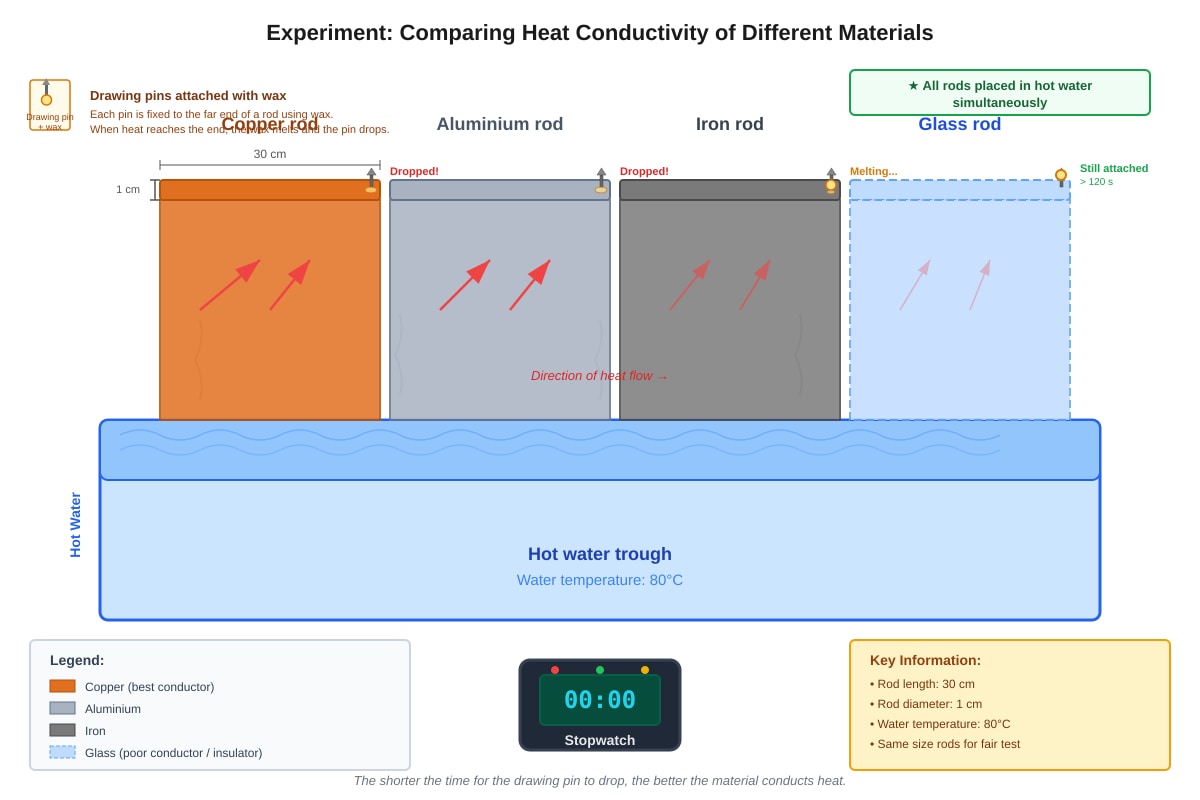
16. The diagram below shows an experiment set up to compare heat conduction in four metal rods.
<image_placeholder> id: Q16-fig1 type: experimental_setup linked_question: Q16 description: Four metal rods (copper, aluminium, iron, brass) of same length and diameter, each with a matchstick attached by wax at the far end. One end of all rods heated equally by a Bunsen burner. labels: Bunsen burner, Copper rod, Aluminium rod, Iron rod, Brass rod, Matchstick attached with wax, Heat source values: Rod length: 30 cm, Rod diameter: 1 cm, Heating time: 5 minutes must_show: Four rods side by side, equal heating at one end, matchsticks at far ends attached with wax </image_placeholder>
(a) State two variables that must be kept the same to ensure a fair test.


_________________________________________________________________________ [2]

(b) The matchstick on the copper rod drops first, followed by aluminium, then brass, and lastly iron. What conclusion can be made about copper?
_________________________________________________________________________ [1]

(c) Explain why the matchsticks drop at different times.


_________________________________________________________________________ [1]

17. A vacuum flask keeps hot soup hot for several hours.
<image_placeholder> id: Q17-fig1 type: diagram linked_question: Q17 description: Cross-section of vacuum flask with hot soup. Double walls with vacuum, silvered surfaces, plastic stopper, outer casing. Heat transfer paths blocked labeled. labels: Hot soup, Inner wall (silvered), Vacuum, Outer wall (silvered), Plastic stopper, Outer casing, Conduction blocked, Convection blocked, Radiation reflected values: Soup initial temperature: 90°C, Room temperature: 28°C, Time: 6 hours must_show: All key features of vacuum flask, annotations showing how each heat transfer method is reduced </image_placeholder>
(a) The vacuum between the double walls reduces heat loss by conduction and convection. Explain why a vacuum reduces conduction.


_________________________________________________________________________ [1]

(b) Explain why a vacuum reduces convection.


_________________________________________________________________________ [1]

(c) The inner walls are silvered. How does this reduce heat loss by radiation?


_________________________________________________________________________ [1]

(d) The stopper is made of plastic. Why is plastic used instead of metal?


_________________________________________________________________________ [1]

18. The diagram below shows a bimetallic strip used in a fire alarm.
<image_placeholder> id: Q18-fig1 type: diagram linked_question: Q18 description: Fire alarm circuit with bimetallic strip. At room temperature: strip straight, contacts touching, circuit complete, bell silent. When heated: strip bends, contacts separate, circuit breaks, bell rings. labels: Bimetallic strip (Metal A top, Metal B bottom), Contact screw, Battery, Bell, Circuit wires, Room temperature position, Heated position values: Metal A expands more than Metal B, Alarm triggers at 60°C must_show: Complete circuit at room temp, broken circuit when heated, clear bimetallic strip bending action </image_placeholder>
(a) When there is a fire, the temperature rises. The bimetallic strip bends and the bell rings. Explain how the bimetallic strip causes the bell to ring.


_________________________________________________________________________ [2]

(b) Metal A expands more than Metal B when heated. Which metal (A or B) is on the outer side of the curve when the strip bends?
_________________________________________________________________________ [1]

(c) Suggest one reason why the bimetallic strip in a fire alarm must be checked regularly.


_________________________________________________________________________ [1]

19. Two identical beakers, X and Y, contain the same volume of water at 30°C. Beaker X is wrapped with aluminium foil (shiny side out). Beaker Y is wrapped with black paper. Both are placed under identical lamps for 20 minutes.
<image_placeholder> id: Q19-fig1 type: experimental_setup linked_question: Q19 description: Two beakers under identical lamps. Beaker X wrapped in aluminium foil (shiny side out). Beaker Y wrapped in black paper. Thermometers in each beaker. labels: Lamp, Beaker X (aluminium foil), Beaker Y (black paper), Thermometer in each, Water, Initial temperature 30°C values: Lamp power: 60W each, Distance from lamp: 20 cm, Duration: 20 minutes, Initial water temp: 30°C must_show: Two identical setups side by side, different wrappings, thermometers visible, lamps at same height </image_placeholder>
(a) After 20 minutes, the water in Beaker Y is hotter than in Beaker X. Explain why.


_________________________________________________________________________ [2]

(b) The experiment is repeated with the aluminium foil wrapped shiny side in (dull side out). How would the final temperature of Beaker X change compared to the first experiment? Explain.


_________________________________________________________________________ [2]

20. The diagram shows a cross-section of a house roof on a hot sunny day.
<image_placeholder> id: Q20-fig1 type: diagram linked_question: Q20 description: House cross-section showing roof, attic space, ceiling, living space. Sun rays hitting roof. Radiation into attic. Convection in attic. Conduction through ceiling. Insulation layer on ceiling. labels: Sun, Roof tiles, Attic space, Insulation (fiberglass), Ceiling, Living space, Radiation arrows, Convection arrows in attic, Conduction arrows through ceiling values: Outside temperature: 35°C, Roof surface: 60°C, Attic air: 45°C, Living space: 28°C must_show: Sun heating roof, heat transfer through attic by radiation and convection, insulation reducing conduction to living space </image_placeholder>
(a) The roof tiles become very hot. State two processes by which heat from the roof tiles is transferred to the air in the attic.


_________________________________________________________________________ [2]

(b) Fiberglass insulation is placed on the ceiling. Explain how the insulation reduces heat transfer into the living space.


_________________________________________________________________________ [2]


End of Quiz

Answers

<!-- TuitionGoWhere generation metadata: stage=3-0; model=nvidia/nemotron-3-ultra-550b-a55b:free; model_label=NVIDIA Nemotron 3 Ultra 550B A55B Free; generated=2026-06-05; Sources: Stage 2-1 real exam-derived templates and Stage 2-2 exam-enriched syllabus. -->

Primary 5 Science Quiz - Heat (Answer Key)

Total Marks: 40


Section A: Multiple-Choice Questions (10 marks)

1. C
Explanation: Heat is a form of energy, not matter. It transfers from hotter to colder regions (not colder to hotter). Heat can travel through a vacuum by radiation (e.g., Sun's heat reaching Earth).

2. B
Explanation: The spoon handle becomes hot because heat travels through the solid metal by conduction — the transfer of heat through a material without the material itself moving. Metals are good conductors. Convection occurs in fluids (liquids/gases), radiation does not require a medium, and evaporation is a cooling process.

3. A
Explanation: The best conductor of heat transfers heat the fastest, so the other end becomes hot in the shortest time. Copper takes only 15 seconds, the least among the four materials.

4. A
Explanation: Metal is a better conductor of heat than plastic. It draws heat from the surroundings (and the ice cube's surroundings) more quickly, transferring it to the ice cube and causing it to melt faster. Both trays are at room temperature initially.

5. B
Explanation: Feeling warmth from the Sun is radiation — heat transfer by electromagnetic waves that can travel through a vacuum.

  • A: Boiling water involves convection (and conduction at the pot base).
  • C: Metal rod heating is conduction.
  • D: Hot air rising is convection.

6. A
Explanation: A vacuum has no particles (or very few). Conduction and convection both require particles to transfer heat (conduction by particle vibration/collision, convection by bulk fluid movement). With no particles, both are prevented. Radiation can travel through a vacuum, which is why the walls are silvered to reflect it.

7. B
Explanation: In fluids (liquids and gases), heat is transferred mainly by convection — the movement of the fluid itself. Hot water at the bottom expands, becomes less dense, rises; cooler water sinks, creating a convection current that heats the whole beaker.

8. A
Explanation: Dull black surfaces are better emitters (and absorbers) of radiation than shiny white surfaces. The dull black can radiates heat away faster, so its water cools more quickly. Shiny white surfaces reflect radiation and emit poorly.

9. A
Explanation: The strip bends downward, meaning the top layer (Metal X) becomes longer than the bottom layer (Metal Y). This happens because Metal X expands more than Metal Y when heated. The metal that expands more ends up on the outer side of the curve.

10. B
Explanation: An air conditioner is installed near the ceiling because cool air sinks (convection). The AC cools the warm air at the top, which then sinks, setting up a convection current that cools the whole room.

  • A: Solar panels painted black use radiation absorption.
  • C: Vacuum flask reduces all three methods.
  • D: Wooden handle uses poor conduction (insulation).

Section B: Short Answer Questions (10 marks)

11.
(a) Conduction — Heat transfers from the hot stove to the pot through direct contact between solids. [1]
(b) Convection — Heat transfers through the soup (a liquid) by the movement of the fluid itself (hot soup rises, cold soup sinks). [1]

12.
Plastic and wood are poor conductors of heat (good insulators). [1] They prevent heat from the metal pan from conducting to the handle, so the handle stays cool enough to hold safely. [1]
Common mistake: Saying "plastic doesn't conduct heat" — it does, just very poorly compared to metal.

13.
(a) When air is heated, its particles gain energy, move faster and further apart. The air expands, becomes less dense, and rises above the cooler, denser surrounding air. [1]
(b) The rising hot air and sinking cool air form a convection current that circulates heat throughout the room, warming all parts evenly instead of just the area near the heater. [1]

14.
(a) Rod C [1]
(b) Rod C took the shortest time (15 s) for the thumbtack to drop, meaning heat traveled along it the fastest. This shows it is the best conductor of heat among the four rods. [1]

15.
(a) Radiation — Sunlight (infrared radiation) travels through the vacuum of space and air without needing a medium. [1]
(b) Dull black surfaces are good absorbers of radiation. The black pot absorbs more of the concentrated sunlight (heat energy), so the food cooks faster. [1]
Key concept: Good absorbers are also good emitters, but here absorption is the key.


Section C: Structured / Open-Ended Questions (20 marks)

16.
(a) Any two of the following:

  • Length of each rod [1]
  • Diameter / cross-sectional area of each rod [1]
  • Amount of wax used to attach the matchstick [1]
  • Position of matchstick from the heated end [1]
  • Intensity / temperature of the heat source (Bunsen burner) [1]
  • Duration of heating [1]
    (Award 1 mark each for any two valid variables. Must be variables that affect conduction speed.)

(b) Copper is the best conductor of heat among the four metals. [1]

(c) Different metals conduct heat at different rates. Copper conducts heat fastest, so the wax on its rod melts first and the matchstick drops first. Iron conducts heat slowest, so its matchstick drops last. [1]
Key concept: The time for the matchstick to drop indicates the speed of heat conduction through the rod.

17.
(a) Conduction requires particles to vibrate and collide to transfer energy. A vacuum has no (or very few) particles, so conduction cannot occur. [1]

(b) Convection requires fluid particles (liquid or gas) to move in bulk. A vacuum has no fluid particles, so convection currents cannot form. [1]

(c) Silvered (shiny) surfaces are poor emitters and good reflectors of radiation. They reflect radiant heat back into the flask (or away from the inner wall), reducing heat loss by radiation. [1]

(d) Plastic is a poor conductor of heat (good insulator). A metal stopper would conduct heat away from the hot liquid quickly through the top. Plastic reduces this heat loss. [1]

18.
(a) When heated, Metal A expands more than Metal B, causing the bimetallic strip to bend (curve). This bending pushes the contact screw away, breaking the circuit. The bell is part of a separate circuit (or the break triggers a relay) that closes when the main circuit breaks, causing the bell to ring. [2]
Mark breakdown:

  • Strip bends due to different expansion rates [1]
  • Bending breaks/closes the circuit to activate the bell [1]
    Note: Accept "completes a circuit to ring the bell" if the diagram shows a normally-open contact that closes on bending. The key is linking bending → circuit change → bell rings.

(b) Metal A [1]
Reasoning: The metal that expands more becomes longer, so it ends up on the outer side of the curve (greater radius).

(c) Any one valid reason:

  • Dust/dirt may affect the contact or bending.
  • Metal fatigue over time may change expansion properties.
  • The contact screw may loosen.
  • Corrosion may affect electrical contact.
  • To ensure it still bends at the correct temperature (calibration). [1]

19.
(a) Black paper is a good absorber of radiation, while shiny aluminium foil is a poor absorber (good reflector). Beaker Y absorbs more heat from the lamp, so its water temperature rises more. [2]
Mark breakdown:

  • Identify black as good absorber / foil as poor absorber (reflector) [1]
  • Link to more heat absorbed → higher temperature [1]

(b) The final temperature of Beaker X would be higher (water hotter) than in the first experiment. [1]
Explanation: The dull side of aluminium foil is a better absorber of radiation than the shiny side. With the dull side facing out, it absorbs more heat from the lamp. [1]
Key concept: Shiny surfaces reflect radiation; dull surfaces absorb radiation. This applies to both emission and absorption.

20.
(a) Radiation and Convection [2]

  • Radiation: Hot roof tiles emit infrared radiation that travels across the attic space to the air and insulation.
  • Convection: Air in contact with the hot roof tiles heats up, expands, rises, and circulates in the attic.
    (Award 1 mark each. Conduction also occurs where air touches the tiles, but the main processes transferring heat through the attic space to the ceiling are radiation and convection.)

(b) Fiberglass insulation traps air in small pockets. Air is a poor conductor of heat. The trapped air reduces conduction through the insulation. The fibers also reduce convection currents within the insulation (air cannot move freely in small pockets). [2]
Mark breakdown:

  • Traps air / air is a poor conductor [1]
  • Reduces conduction (and convection) through the ceiling [1]
    Common mistake: Saying "insulation stops heat" — it slows down heat transfer.

End of Answer Key