From Real Exams Quiz
Primary 5 Science Heat Quiz
Free P5 Science Heat quiz, Kimi2.6 Exam version, with questions, answers, and syllabus-aligned practice for Singapore students.
These static practice materials are generated from the site's syllabus and paper-generation workflow, with source and model context shown so students and parents can evaluate the material before use.
Questions
Free quiz and exam paper access
Enter your details to view this paper
Your access is remembered on this device.
Answers
Primary 5 Science Quiz - Heat: Answer Key
Total Marks: 40 marks
Section A: Multiple Choice
| Question | Answer | Marks | Explanation |
|---|---|---|---|
| 1 | A | 1 | In a solid, particles have the least thermal energy and vibrate in fixed positions. In a liquid, particles have more energy and can move around. In a gas, particles have the most energy and move freely at high speeds. Temperature is a measure of average kinetic energy, so higher temperature means more thermal energy. |
| 2 | B | 1 | When heated, water particles gain thermal energy. They move faster (increased kinetic energy) and further apart (thermal expansion). The particles themselves do not change size. |
| 3 | A | 1 | Metal is a good conductor of heat, so thermal energy transfers quickly through the metal spoon to your hand. Plastic is a poor conductor (insulator), so heat transfers slowly, keeping the handle cooler. |
| 4 | C | 1 | Wood is a poor conductor of heat (insulator). This prevents heat from the hot pot from reaching your hand. Metals like copper, aluminium, and iron are good conductors and would become too hot to hold safely. |
| 5 | C | 1 | Dark, dull surfaces (especially black) are good absorbers of radiation. They absorb more infrared radiation from sunlight and convert it to thermal energy, reaching higher temperatures. Shiny or light-coloured surfaces reflect more radiation. |
| 6 | B | 1 | White or light-coloured surfaces reflect more of the sun's radiation (including infrared) rather than absorbing it. Black surfaces absorb more radiation, converting it to heat and making you feel warmer. |
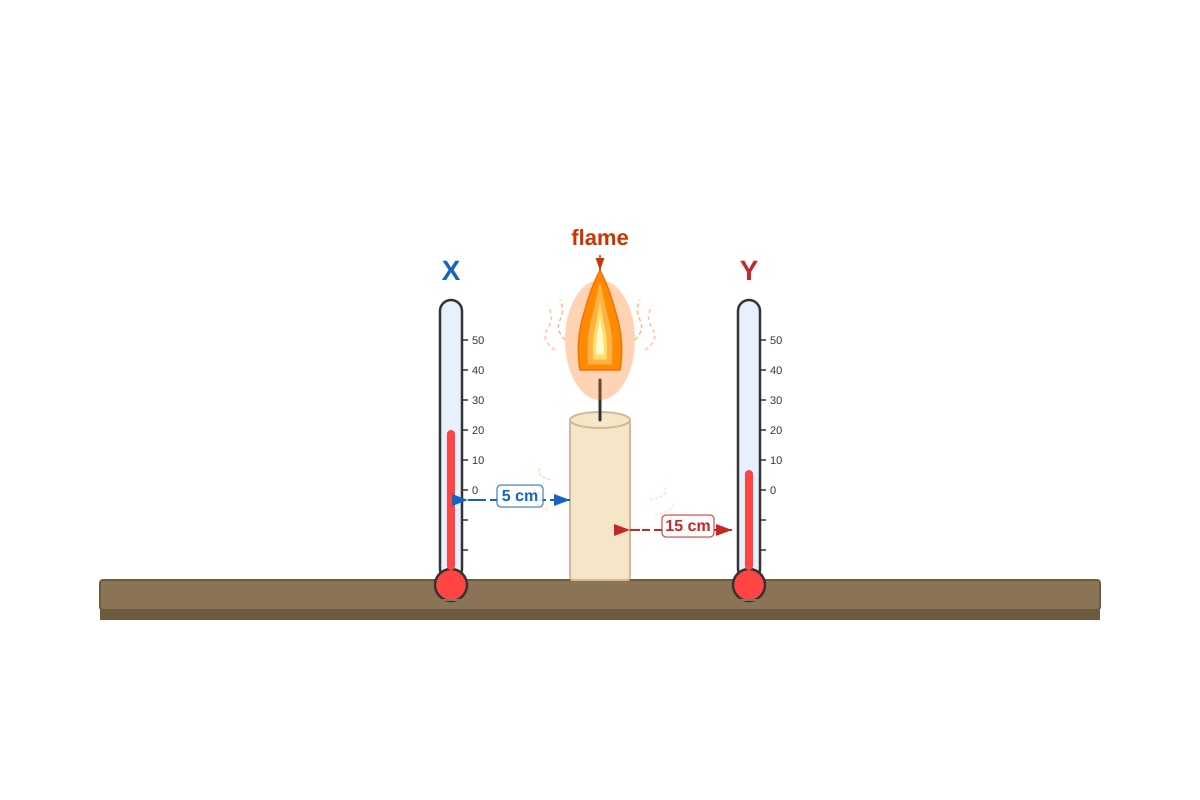
| 7 | A | 1 | Expected visual: Thermometer X at 5 cm from flame, thermometer Y at 15 cm from flame. Heat radiates outward from the flame. The closer an object is to a heat source, the more radiant heat it receives per unit area. Therefore, X (closer) shows a higher temperature than Y. |
| 8 | C | 1 | Conduction requires particles to collide and transfer energy; needs a medium. Convection requires fluid movement; needs a medium. Radiation transfers energy as electromagnetic waves (infrared); can travel through vacuum with no particles needed. |
Section A Total: 8 marks
Section B: Short Answer
9. Explain why a thick woollen blanket keeps you warm on a cold night. [2 marks]
Answer:
- Wool contains trapped air pockets (1 mark)
- Air and wool fibres are poor conductors of heat/are insulators, so they reduce heat transfer from your body to the cold surroundings (1 mark)
Teaching note: Insulators slow down heat transfer. The trapped air in wool is particularly important because still air is a very good insulator. The wool fibres prevent air from moving (stopping convection) while the air itself reduces conduction.
10. Mrs. Lim boils water in a kettle. Explain why bubbles form at the bottom first. [2 marks]
Answer:
- The bottom of the kettle is closest to/directly above the heat source/flame (1 mark)
- Water at the bottom gains heat first and reaches 100°C/boiling point first, turning to water vapour/gas which forms bubbles (1 mark)
Teaching note: Heat transfers from the hot element through the metal base by conduction, then to the water at the bottom. This water heats first. When water reaches its boiling point (100°C at standard pressure), it undergoes a state change to steam, forming visible bubbles.
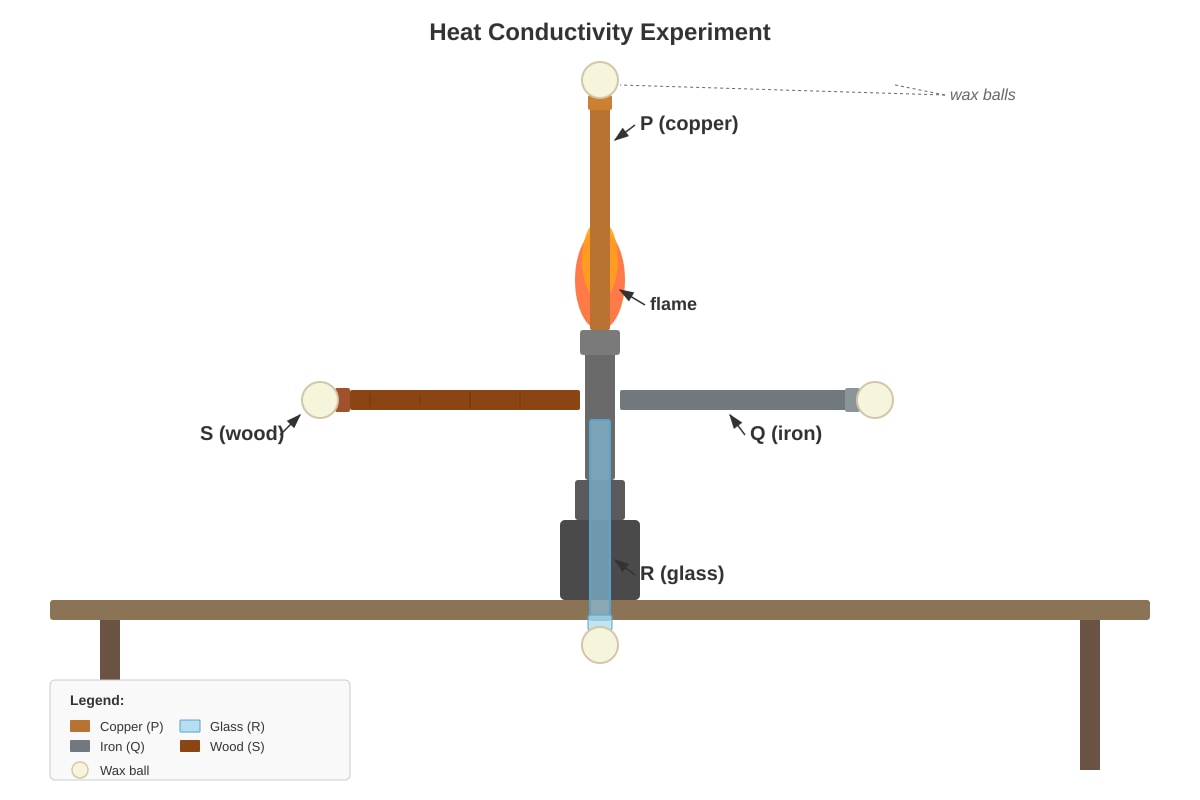
11. Study the diagram showing four rods with wax balls.
(a) Predict which wax ball will melt first. [1 mark]
Answer: P (copper) (1 mark)
(b) Explain your answer in terms of heat transfer. [2 marks]
Answer:
- Copper is the best conductor of heat among the four materials (1 mark)
- Heat travels most quickly through copper by conduction to the wax ball, causing it to melt first (1 mark)
Expected visual verification: P is copper, Q is iron, R is glass, S is wood. Metals conduct better than non-metals. Among metals, copper conducts better than iron. Glass and wood are insulators.
12. Auntie Mei wants to keep her pot of soup hot.
(a) Choose TWO materials she should use to wrap around the pot and explain why. [2 marks]
Answer:
- Newspaper AND cotton towel (1 mark for any two insulating materials)
- Both are poor conductors of heat/good insulators; they trap air and reduce heat transfer from the hot soup to the cooler surroundings (1 mark)
Teaching note: Multiple layers with trapped air work best. Newspaper has air pockets between sheets; cotton has air trapped in fibres.
(b) Explain why she should NOT use aluminium foil on its own to keep the soup hot. [1 mark]
Answer:
- Aluminium is a good conductor of heat, so it would allow heat to escape quickly from the soup to the surroundings (1 mark)
13. Jason's experiment on salt dissolving.
(a) Independent and dependent variables [2 marks]
Answer:
- Independent variable: Temperature of water / The temperature (1 mark)
- Dependent variable: Time taken for salt to dissolve / How fast the salt dissolves / Rate of dissolving (1 mark)
(b) One controlled variable [1 mark]
Answer: Any one of: Volume/mass of water; Mass/amount of salt; Size/grain size of salt; Same container/type of container; Same stirring method (1 mark)
Teaching note: A fair test changes only one variable (independent) and measures its effect on one outcome (dependent), while keeping everything else constant (controlled variables).
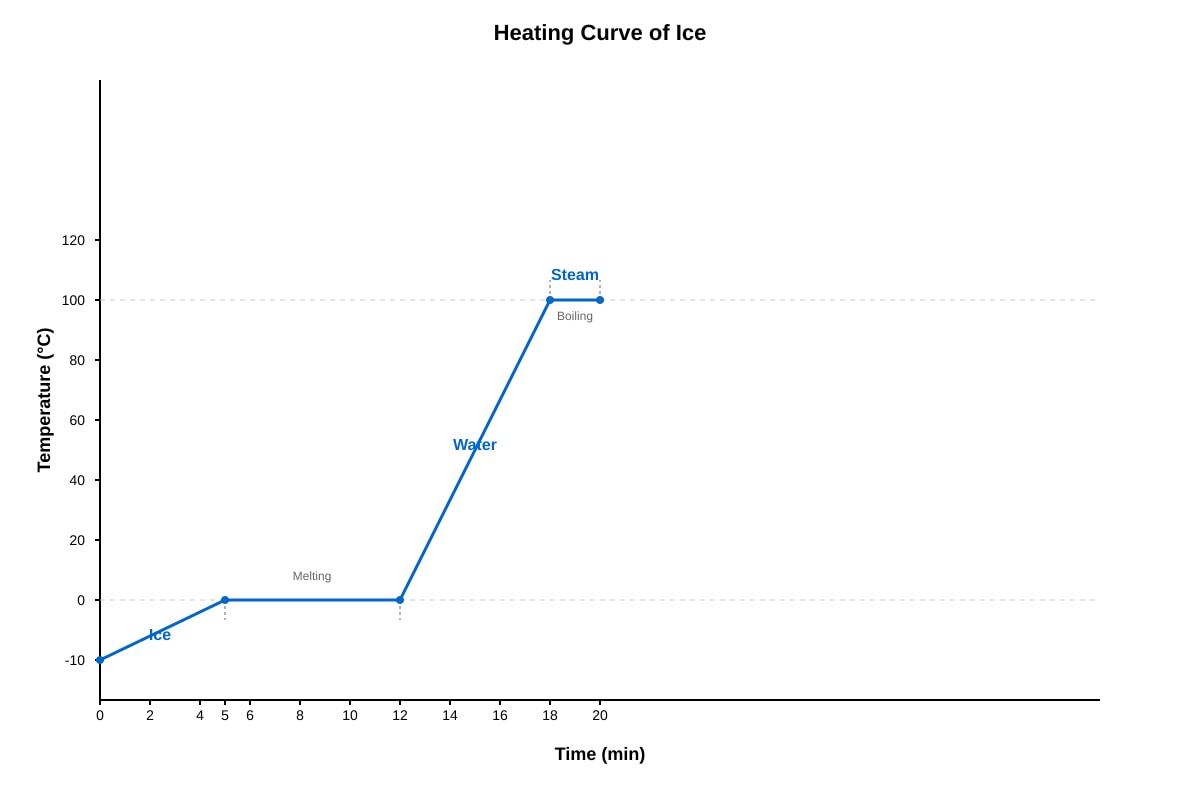
14. Temperature-time graph of ice being heated.
(a) Temperature at which ice begins to melt [1 mark]
Answer: 0°C (1 mark)
Expected visual verification: The first plateau on the graph occurs at 0°C, starting at minute 5. This is the melting point of ice.
(b) Time taken for ice to completely melt [1 mark]
Answer: 7 minutes / From minute 5 to minute 12 (1 mark)
Working: 12 − 5 = 7 minutes
(c) Why temperature stays constant at 0°C [2 marks]
Answer:
- The heat energy supplied is used to break the bonds between ice particles/change the state from solid to liquid (1 mark)
- This is called latent heat of fusion; energy goes into separating particles rather than raising kinetic energy/temperature (1 mark)
Teaching note: During a state change, temperature remains constant even with continuous heating. The energy input (latent heat) overcomes intermolecular forces. Once all ice has melted, temperature rises again.
15. Similarity and difference between conduction and convection [2 marks]
Answer:
- Similarity: Both transfer heat through a medium/substance/material; both require particles (1 mark)
- Difference: Conduction occurs mainly in solids/through particle vibration and collision without the substance moving; convection occurs in fluids (liquids and gases) through bulk movement of the fluid itself (1 mark)
16. Metal saucepan with plastic handle.
(a) Why metal gets hot quickly [1 mark]
Answer: Metal is a good conductor of heat, so thermal energy transfers quickly from the stove through the metal to heat the soup (1 mark)
(b) Why plastic handle stays cooler [1 mark]
Answer: Plastic is a poor conductor of heat/good insulator, so heat transfers very slowly through the handle to your hand (1 mark)
Section B Total: 16 marks
Section C: Application and Open Response
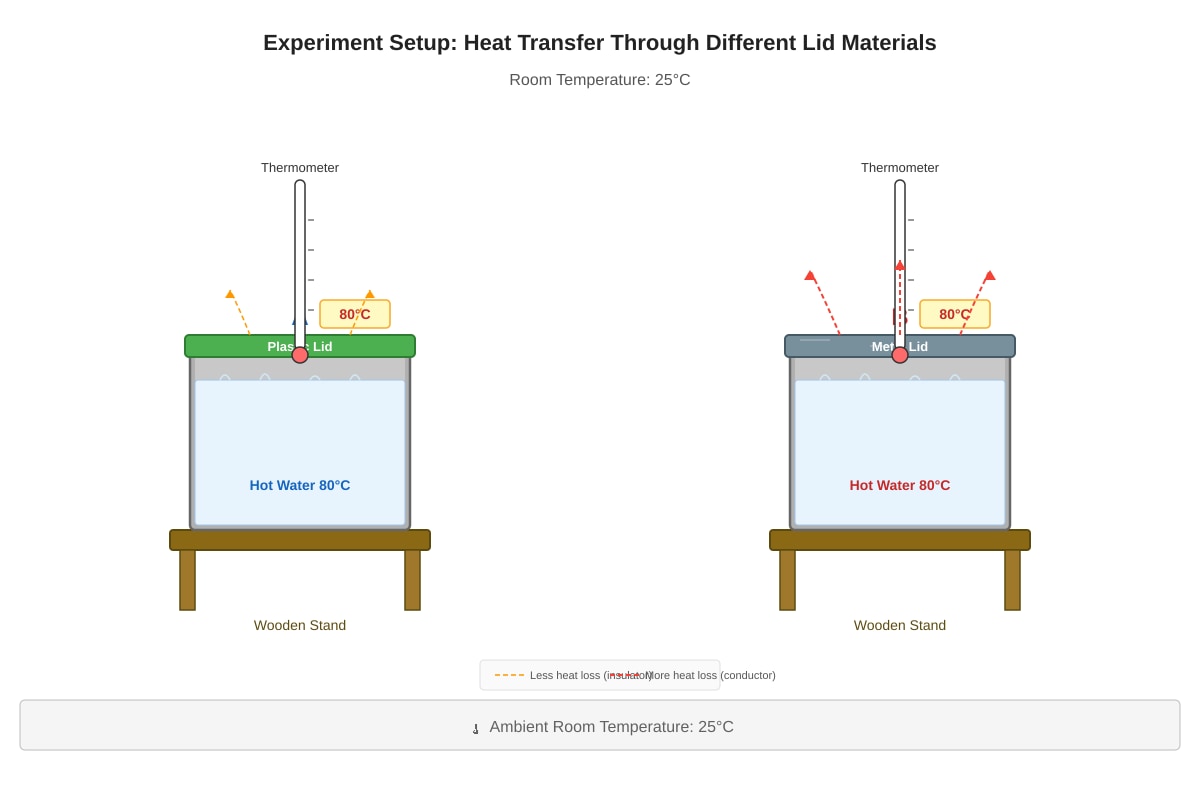
17. Experiment with containers A (plastic lid) and B (metal lid).
(a) Which cools faster [1 mark]
Answer: Container B / The container with the metal lid (1 mark)
(b) Explanation [3 marks]
Answer:
- Metal lid conducts heat well/poor insulator, so heat transfers quickly from hot water through metal lid to cooler surroundings by conduction (1 mark)
- Metal lid also radiates heat to surroundings as it is not shiny/dull metal surface emits infrared radiation (1 mark)
- Plastic lid is a poor conductor/good insulator, reducing heat transfer by conduction; plastic also radiates less heat (1 mark)
Expected visual verification: Both containers identical except lid material. Metal lid allows both conductive and radiative heat loss. Plastic lid minimises both.
18. Clara's solar water heater design.
(a) Material choices [3 marks]
| Part | Material | Reason | Marks |
|---|---|---|---|
| Pipe | Copper | Good conductor of heat, transfers heat quickly to water inside | 1 |
| Backing | Polystyrene foam | Poor conductor/good insulator, reduces heat loss to roof/behind | 1 |
| Cover | Transparent glass | Allows sunlight/radiation through but traps some heat (greenhouse effect); protects from wind | 1 |
Teaching note: Copper pipe is best because: (1) excellent thermal conductivity maximises heat transfer to water, (2) durable for outdoor use. Polystyrene's trapped air bubbles make it an excellent insulator. Glass cover allows short-wave solar radiation in but reduces convective heat loss.
(b) Roof position effectiveness [2 marks]
Answer:
- Roof facing afternoon sun receives more direct and longer exposure to solar radiation/infrared radiation (1 mark)
- More radiation absorbed means more heat energy transferred to water, making heater more efficient (1 mark)
- Shaded area receives less/no direct radiation, so less heating occurs
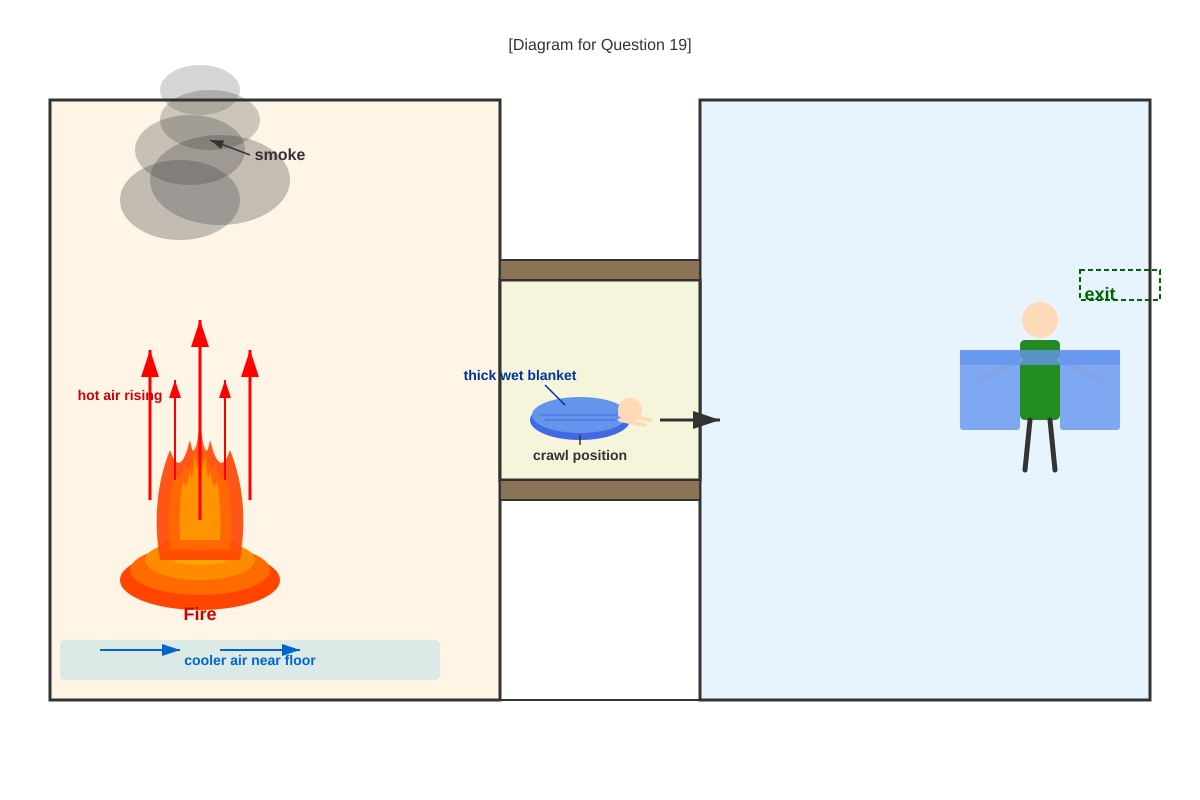
19. Rescue from burning building with wet blanket.
(a) Why crawl close to floor [2 marks]
Answer:
- Hot air and smoke rise upward due to convection/expansion becoming less dense (1 mark)
- Cooler, cleaner air remains near the floor, so crawling avoids smoke inhalation and reduces exposure to hot upper air (1 mark)
Expected visual verification: Arrows show hot air rising. Floor region should be indicated as cooler. Person low to ground avoids this rising hot layer.
(b) How wet blanket protects [2 marks]
Answer:
- Thick blanket: Poor conductor/insulator, reduces heat transfer from hot surroundings to body by conduction and traps relatively cool air near body (1 mark)
- Wet: Water has high specific heat capacity/evaporation uses latent heat, so it absorbs significant heat energy from surroundings before the person gets burned; also filters some smoke particles (1 mark)
20. Aaron's cooling experiment.
(a) Which cooled fastest [1 mark]
Answer: Metal (container) (1 mark)
Evidence: Metal dropped from 90°C to 49°C, the largest temperature decrease.
(b) Temperature drop for ceramic [2 marks]
Answer:
- Working: 90 − 67 = 23°C (1 mark for correct working, 1 mark for answer)
- Or: Final temperature − Initial temperature = 67 − 90 = −23, so drop is 23°C
(c) Improvement for reliability [2 marks]
Answer:
- Repeat the experiment / Take multiple readings / Use data logger
- OR: Stir the water before each measurement / ensure starting temperatures identical more precisely
- Explanation: Repeating allows calculation of average/average reduces effect of random errors/more reliable data (1 mark for method, 1 mark for explanation)
(d) Best material to keep drink hot [2 marks]
Answer:
- Plastic (1 mark)
- Evidence: Plastic had the smallest temperature drop (90°C to 73°C = 17°C drop after 20 minutes) / retained highest temperature after 20 minutes / cooled slowest (1 mark)
Teaching note: Looking at final temperatures or total drops: Metal (41°C drop), Ceramic (23°C), Glass (21°C), Plastic (17°C). Plastic is the best insulator among those tested.
Section C Total: 16 marks
GRAND TOTAL: 40 marks