Primary 5 Science Quiz - Heat
Name: ___________________________
Class: ___________________________
Date: ___________________________
Score: ___________ / 40
Duration: 50 minutes
Total Marks: 40
Instructions:
- This quiz has 20 questions on the topic of Heat.
- Section A: 10 multiple-choice questions (1 mark each).
- Section B: 6 short-answer questions (2 marks each).
- Section C: 4 structured questions (3 marks each, with subparts).
- Write your answers clearly in the spaces provided.
Section A (Questions 1–10, 1 mark each)
-
Which of the following is a form of energy produced when something is heated?
A) Light
B) Heat
C) Sound
D) Magnetic
-
A metal spoon is placed in a cup of hot soup. The handle becomes warm after some time. This is mainly due to:
A) Convection
B) Radiation
C) Conduction
D) Evaporation
-
Which process describes liquid water turning into water vapour at 100 °C?
A) Melting
B) Boiling
C) Condensation
D) Freezing
-
When warm air rises and cool air sinks, the heat transfer method is:
A) Conduction
B) Convection
C) Radiation
D) Insulation
-
The melting point of ice is:
A) 0 °C
B) 10 °C
C) 50 °C
D) 100 °C
-
Which material is a poor conductor of heat?
A) Steel
B) Copper
C) Wood
D) Aluminium
-
Heat from the Sun reaches the Earth through:
A) Conduction
B) Convection
C) Radiation
D) Boiling
-
Which of these is an example of heat being changed to light energy?
A) Electric fan
B) Light bulb
C) Bicycle
D) Refrigerator
-
A boy touches a cold marble table. His hand feels cold because:
A) Heat flows from hand to table
B) Cold flows from table to hand
C) Air cools the hand
D) Marble produces cold
-
Which term means the loss of heat from a liquid surface to the air at any temperature?
A) Boiling
B) Evaporation
C) Condensation
D) Melting
Section B (Questions 11–16, 2 marks each)
-
Name two ways heat can be transferred from one place to another besides conduction.
-
Explain why a woollen sweater helps keep a person warm in cold weather.
-
A puddle of water disappeared from the ground after a sunny day. Name the process and state what happened to the water.
-
State the boiling point of water and describe what happens to the particles when water boils.
-
Give one example of radiation and explain how it is different from conduction.
-
A pot of water is heated on a stove. Explain why the water at the bottom heats up first and then the whole pot becomes warm.
Section C (Questions 17–20, 3 marks each)
- (a) What is convection? (1 mark)
(b) Draw a simple diagram in the box to show convection in a pot of boiling water. (1 mark)
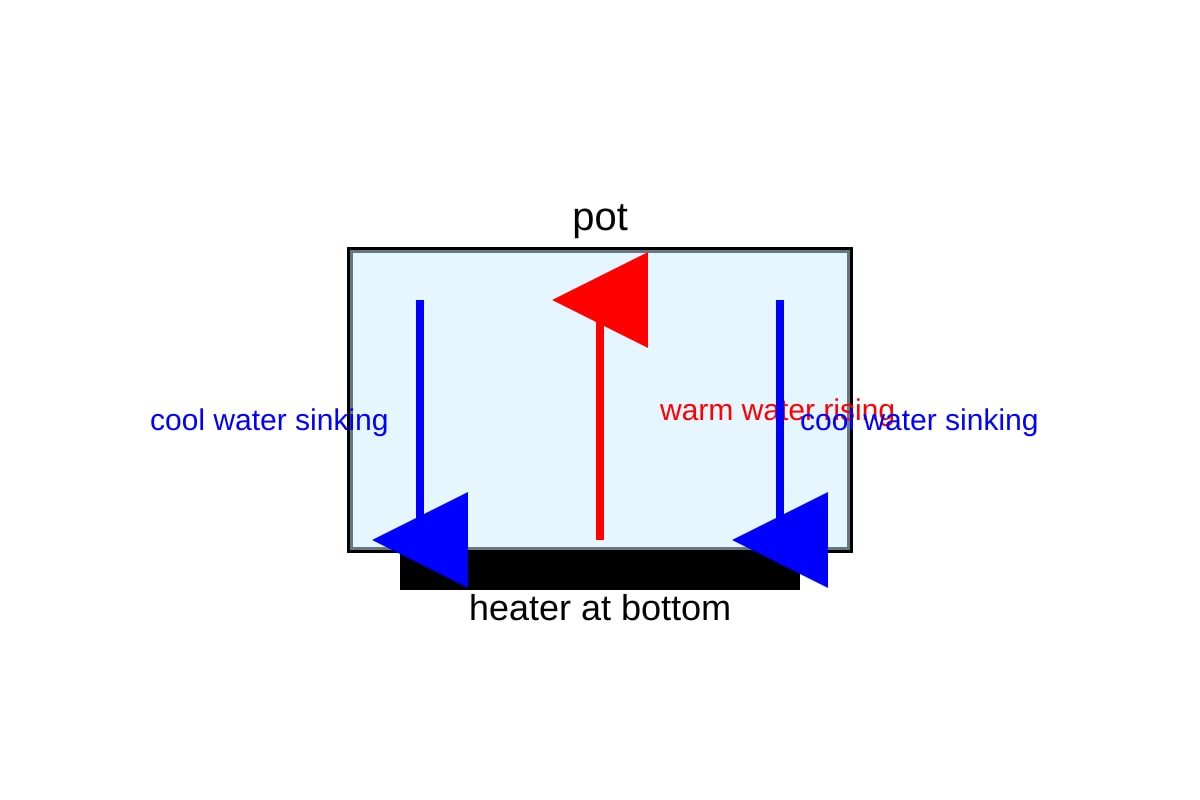
Generated diagram for Q17.
(c) Why does this movement happen? (1 mark)
_______________________________________________________
18. (a) Name the process that occurs when water vapour in the air touches a cold mirror. (1 mark)
_______________________________________________________
(b) What state does the water vapour change into? (1 mark)
_______________________________________________________
(c) Explain why the mirror must be cold for this to happen. (1 mark)
_______________________________________________________
-
(a) State one difference between melting and boiling. (1 mark)
(b) Ice at 0 °C is heated. What temperature does it stay at while melting? (1 mark)
(c) After all ice has melted, the temperature of the water begins to rise. What will the temperature reach when boiling starts? (1 mark)
-
(a) List two conductors of heat. (1 mark)
(b) List two insulators of heat. (1 mark)
(c) Explain why we use insulators on the handle of a frying pan. (1 mark)
</stage3_quiz_answers_md>
<stage3_quiz_answers_md>
Primary 5 Science Quiz - Heat (Answer Key)
Total Marks: 40
Topic: Heat
Level: Primary 5
Section A Answers (1 mark each)
-
B) Heat
Teaching note: Heat is the form of energy that flows due to temperature difference. When an object is heated, its particles gain energy and it becomes a source of heat energy. Light, sound, and magnetic are different forms not directly "produced by heating" as the main product.
-
C) Conduction
Teaching note: Conduction is heat transfer through a solid material (the metal spoon) from the hot end to the cold end without the material moving as a whole.
-
B) Boiling
Teaching note: Boiling is the change from liquid to gas at a fixed temperature (100 °C for water). Melting is solid→liquid; condensation is gas→liquid; freezing is liquid→solid.
-
B) Convection
Teaching note: Convection is heat transfer in fluids (liquids/gases) by movement of warm (less dense) parts rising and cool (denser) parts sinking.
-
A) 0 °C
Teaching note: From syllabus: melting point of ice = 0 °C; boiling point of water = 100 °C.
-
C) Wood
Teaching note: Wood is a poor conductor (insulator). Metals like steel, copper, aluminium are good conductors.
-
C) Radiation
Teaching note: Radiation is heat transfer through empty space (no material needed). Sun’s heat travels through vacuum by radiation.
-
B) Light bulb
Teaching note: A light bulb changes electrical energy to light (+ heat). Here heat → light is not exact; the bulb shows energy conversion where heat is also produced. Among options, it is the example where light (and heat) energy is produced from electricity; the question asks heat changed to light – acceptable at P5 as bulb emits light when hot. Better phrasing: bulb produces light and heat from electrical. Mark B.
-
A) Heat flows from hand to table
Teaching note: Heat always flows from warmer to cooler. Hand loses heat to cold marble, so hand feels cold. "Cold" does not flow.
-
B) Evaporation
Teaching note: Evaporation is slow change of liquid to gas at any temperature from the surface. Boiling is at 100 °C; condensation is gas→liquid; melting is solid→liquid.
Section B Answers (2 marks each)
-
Convection and radiation (1 mark each, total 2)
Teaching note: Three heat transfer methods: conduction, convection, radiation. Question asks two besides conduction.
-
Woollen sweater traps air (1 mark). Air is a poor conductor / insulator, so it reduces heat loss from body (1 mark).
Common mistake: saying sweater "produces heat". It only reduces loss.
-
Process: Evaporation (1 mark). Water changed from liquid to water vapour (gas) and entered the air (1 mark).
Teaching note: Sun’s heat gave energy to water particles to escape as gas.
-
Boiling point = 100 °C (1 mark). Particles gain energy, move faster, break free to become gas (1 mark).
Marking: 1 for value, 1 for particle explanation.
-
Example: heat from Sun / heat from fire felt on skin (1 mark). Radiation needs no medium, conduction needs direct contact/solid (1 mark).
Accept any clear radiation example and correct difference.
-
Bottom water heated by conduction from pot (1 mark). Warm water rises, cool sinks – convection spreads heat (1 mark).
Teaching note: Stove heats pot base → conduction to water at bottom; convection circulates.
Section C Answers (3 marks each)
(a) Convection is heat transfer in liquids/gases by movement of warm fluid rising and cool fluid sinking. (1 mark)
(b) Diagram shows arrows: up at centre, down at sides in pot. (1 mark)
Image requirement: pot with heater, warm arrow up middle, cool arrow down sides.
(c) Warm water is less dense so rises; cool water is denser so sinks, creating a current. (1 mark)
(a) Condensation (1 mark)
(b) Liquid (water droplets) (1 mark)
(c) Cold mirror removes heat from vapour, causing it to lose energy and change to liquid. (1 mark)
(a) Melting: solid→liquid at 0 °C; Boiling: liquid→gas at 100 °C. (1 mark for any correct difference)
(b) 0 °C (1 mark)
(c) 100 °C (1 mark)
(a) Any two: metal, steel, copper, aluminium (1 mark total for two)
(b) Any two: wood, plastic, wool, air (1 mark total for two)
(c) To prevent heat from pan reaching hand / avoid burns (1 mark).
</stage3_quiz_answers_md>
<stage3_quiz_md>
Primary 5 Science Quiz - Heat
Name: ___________________________
Class: ___________________________
Date: ___________________________
Score: ___________ / 40
Duration: 50 minutes
Total Marks: 40
Instructions:
- This quiz has 20 questions on the topic of Heat.
- Section A: 10 multiple-choice questions (1 mark each).
- Section B: 6 short-answer questions (2 marks each).
- Section C: 4 structured questions (3 marks each, with subparts).
- Write your answers clearly in the spaces provided.
Section A (Questions 1–10, 1 mark each)
-
Which of the following is a form of energy produced when something is heated?
A) Light
B) Heat
C) Sound
D) Magnetic
-
A metal spoon is placed in a cup of hot soup. The handle becomes warm after some time. This is mainly due to:
A) Convection
B) Radiation
C) Conduction
D) Evaporation
-
Which process describes liquid water turning into water vapour at 100 °C?
A) Melting
B) Boiling
C) Condensation
D) Freezing
-
When warm air rises and cool air sinks, the heat transfer method is:
A) Conduction
B) Convection
C) Radiation
D) Insulation
-
The melting point of ice is:
A) 0 °C
B) 10 °C
C) 50 °C
D) 100 °C
-
Which material is a poor conductor of heat?
A) Steel
B) Copper
C) Wood
D) Aluminium
-
Heat from the Sun reaches the Earth through:
A) Conduction
B) Convection
C) Radiation
D) Boiling
-
Which of these is an example of heat being changed to light energy?
A) Electric fan
B) Light bulb
C) Bicycle
D) Refrigerator
-
A boy touches a cold marble table. His hand feels cold because:
A) Heat flows from hand to table
B) Cold flows from table to hand
C) Air cools the hand
D) Marble produces cold
-
Which term means the loss of heat from a liquid surface to the air at any temperature?
A) Boiling
B) Evaporation
C) Condensation
D) Melting
Section B (Questions 11–16, 2 marks each)
-
Name two ways heat can be transferred from one place to another besides conduction.
-
Explain why a woollen sweater helps keep a person warm in cold weather.
-
A puddle of water disappeared from the ground after a sunny day. Name the process and state what happened to the water.
-
State the boiling point of water and describe what happens to the particles when water boils.
-
Give one example of radiation and explain how it is different from conduction.
-
A pot of water is heated on a stove. Explain why the water at the bottom heats up first and then the whole pot becomes warm.
Section C (Questions 17–20, 3 marks each)
- (a) What is convection? (1 mark)
(b) Draw a simple diagram in the box to show convection in a pot of boiling water. (1 mark)
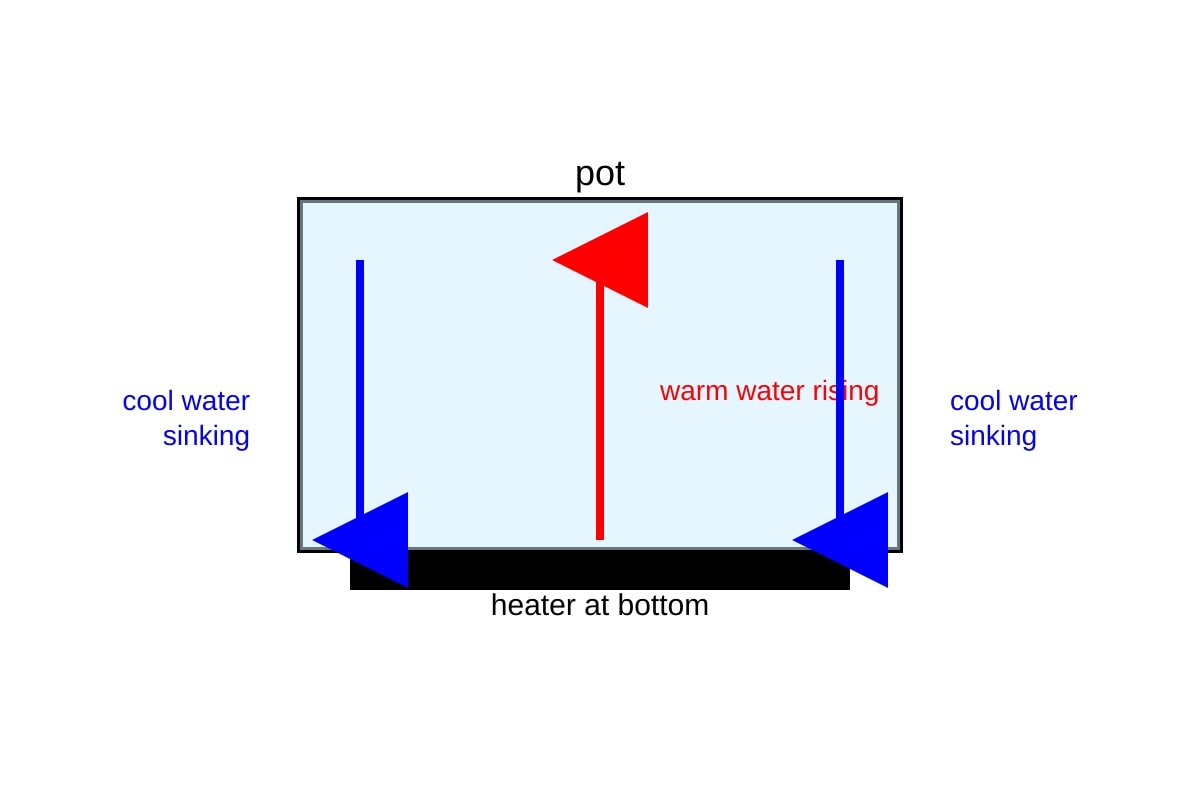
Generated diagram for Q17.
(c) Why does this movement happen? (1 mark)
_______________________________________________________
18. (a) Name the process that occurs when water vapour in the air touches a cold mirror. (1 mark)
_______________________________________________________
(b) What state does the water vapour change into? (1 mark)
_______________________________________________________
(c) Explain why the mirror must be cold for this to happen. (1 mark)
_______________________________________________________
-
(a) State one difference between melting and boiling. (1 mark)
(b) Ice at 0 °C is heated. What temperature does it stay at while melting? (1 mark)
(c) After all ice has melted, the temperature of the water begins to rise. What will the temperature reach when boiling starts? (1 mark)
-
(a) List two conductors of heat. (1 mark)
(b) List two insulators of heat. (1 mark)
(c) Explain why we use insulators on the handle of a frying pan. (1 mark)