From Real Exams Quiz
Primary 5 Science Diversity Quiz
Free P5 Science Diversity quiz, Nemo3 Exam version, with questions, answers, and syllabus-aligned practice for Singapore students.
These static practice materials are generated from the site's syllabus and paper-generation workflow, with source and model context shown so students and parents can evaluate the material before use.
Questions



Free quiz and exam paper access
Enter your details to view this paper
Your access is remembered on this device.
Answers
Primary 5 Science Quiz - Diversity (Answer Key)
Total Marks: 40
Section A: Multiple-Choice Questions (10 × 1 mark = 10 marks)
1. D
Explanation: Living things need air, food, and water (A), can reproduce (B), and respond to changes (C). Only plants (and some bacteria/algae) can make their own food through photosynthesis. Animals, fungi, and most microorganisms cannot make their own food.
Common mistake: Thinking all living things photosynthesise.
2. B
Explanation: The nucleus contains genetic material (DNA) and controls all cellular activities. The cell wall provides support and shape (plants only). Chloroplasts carry out photosynthesis. The vacuole stores water and substances.
Key concept: Nucleus = control centre of the cell.
3. B
Explanation: Bacteria are unicellular and microscopic — they can only be seen with a microscope. Not all fungi are harmful (e.g., yeast, edible mushrooms). Fungi are decomposers; they do not make their own food. Bacteria reproduce mainly by binary fission, not spores.
Key concept: Microorganisms are too small to be seen with the naked eye.
4. B
Explanation: Bats have hair/fur, give birth to live young, and feed their young with milk — they are mammals. They are not birds (no feathers, no beak), not insects (not six legs, not invertebrates), not reptiles (no dry scales, not cold-blooded).
Key concept: Mammals: hair, live birth (mostly), mammary glands.
5. B
Explanation: Bread mould is a fungus that reproduces by spores. Mango tree (flowering plant) reproduces by seeds. Butterfly (insect) reproduces by eggs. Guppy (fish) reproduces by live birth (viviparous).
Key concept: Fungi (mould, yeast) and non-flowering plants (ferns, mosses) reproduce by spores.
6. A
Explanation: Mammals have hair/fur. Organism W has hair. Organism X has gills and lives in water → fish. Organism Y lays eggs but no hair, not in water → could be bird/reptile. Organism Z has gills and lives in water → fish/amphibian larva.
Key concept: Hair is a defining characteristic of mammals.
7. B
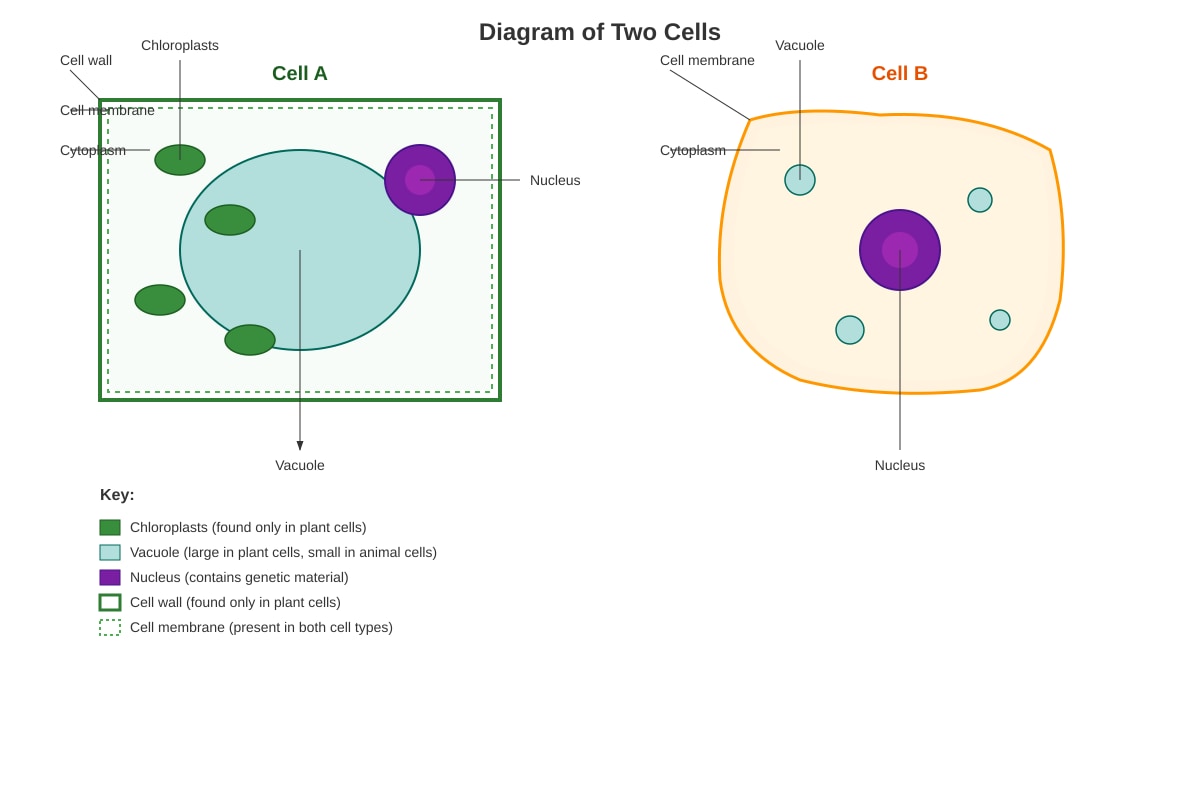
Explanation: Plant cells have a cell wall, chloroplasts, and a large central vacuole. Animal cells lack cell wall and chloroplasts, have small vacuoles. Bacterial cells have cell wall but no nucleus, no chloroplasts, no large vacuole. Fungal cells have cell wall (chitin) but no chloroplasts.
Key concept: Chloroplasts + cell wall + large vacuole = plant cell.
8. A
Explanation: The correct hierarchical order from broadest to most specific is: Kingdom → Phylum → Class → Order → Family → Genus → Species. (Mnemonic: King Philip Came Over For Good Soup)
Key concept: Taxonomic hierarchy.
9. A
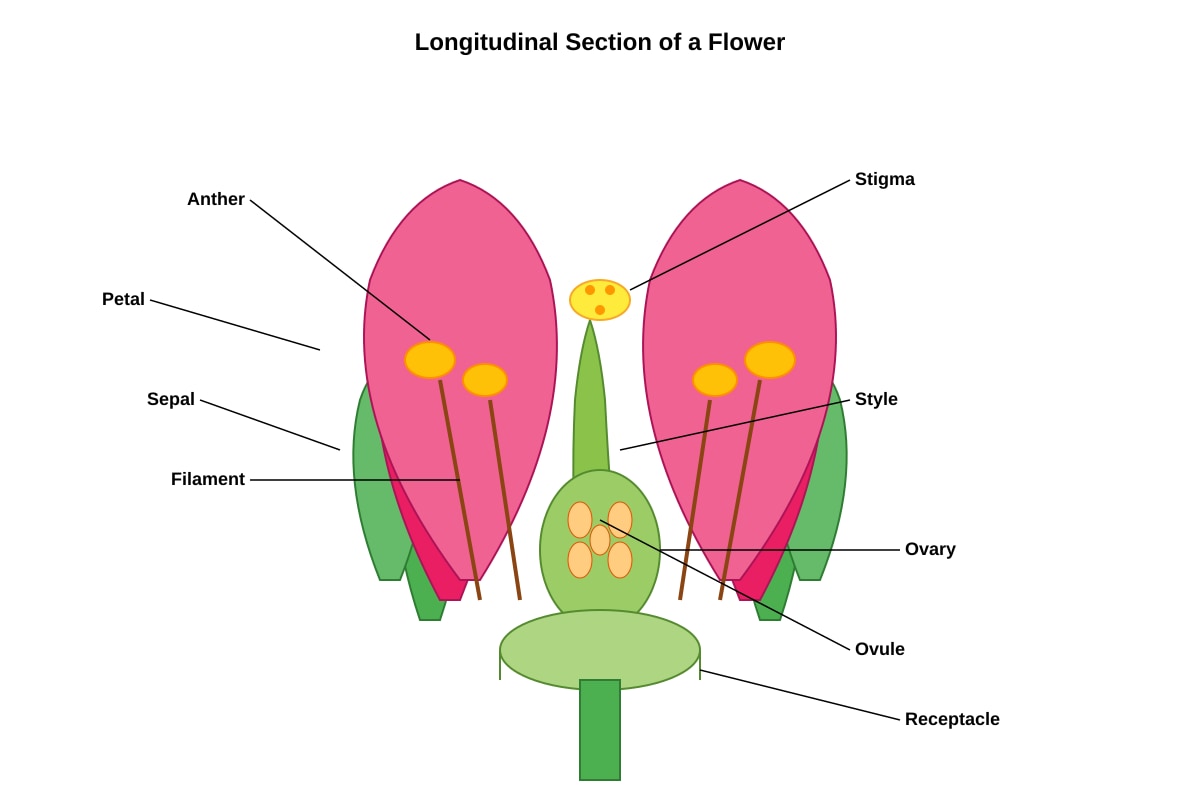
Explanation: After fertilisation, the ovary develops into the fruit, and the ovules develop into seeds. The stigma receives pollen. The anther produces pollen. Petals attract pollinators.
Key concept: Ovary → Fruit; Ovule → Seed.
10. B
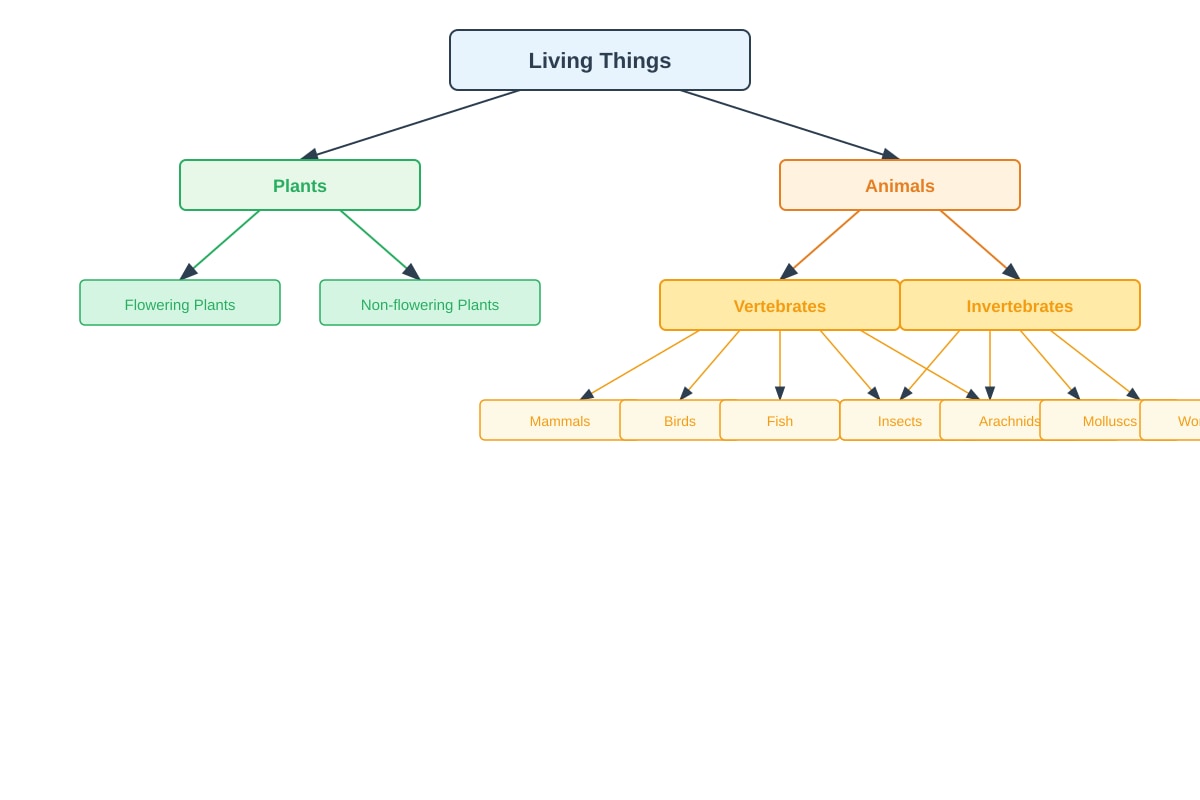
Explanation: Ferns are non-flowering plants that reproduce by spores. Hibiscus, papaya, and bougainvillea are flowering plants (produce flowers and fruits).
Key concept: Non-flowering plants: ferns, mosses, algae, conifers (gymnosperms).
Section B: Structured Questions (5 × 2 marks = 10 marks)
11.
(a) Cell A: Plant cell (1 mark)
Cell B: Animal cell (1 mark)
Marking note: Accept "Plant cell" and "Animal cell" only. No half marks.
(b) Chloroplasts contain chlorophyll which traps light energy for photosynthesis to make food (glucose) for the plant. (1 mark)
Alternative: "Site of photosynthesis" or "Traps sunlight to make food".
Marking note: Must mention light/trapping light and photosynthesis/food making.
12.
| Organism | Group |
|---|---|
| Mushroom | Fungi |
| Moss | Non-flowering Plants |
| Bacteria | Bacteria |
| Yeast | Fungi |
Marking: 0.5 marks each correct entry (total 2 marks).
Explanation: Mushroom and yeast are fungi. Moss is a non-flowering plant (bryophyte). Bacteria is its own domain/kingdom.
13.
(a) Any one: Have hair/fur / Give birth to live young (mostly) / Feed young with milk / Breathe with lungs / Warm-blooded / Have a four-chambered heart (1 mark)
Marking note: Accept any valid mammalian characteristic.
(b) Any one: Have feathers / Have beaks / Lay eggs / Have wings (though not all fly) / Have hollow bones / Warm-blooded / Breathe with lungs (1 mark)
Explanation: Penguins have feathers, beaks, lay eggs, wings modified as flippers — all bird characteristics.
14.
(a) Stamen (or "Anther and filament") (1 mark)
Marking note: "Stamen" is the male reproductive part; it consists of anther and filament.
(b) Inside the ovary (1 mark)
Explanation: The ovary contains one or more ovules. After fertilisation, ovules become seeds.
15.
(a) Plants P and R (1 mark)
Reasoning: Flowering plants bear flowers, fruits, and reproduce by seeds. Both P and R show "Yes" for all three.
(b) Ferns reproduce by spores, while flowering plants reproduce by seeds. (1 mark)
Alternative: "Ferns do not produce flowers/fruits; flowering plants do."
Marking note: Must contrast reproduction method (spores vs seeds) or structures (no flowers/fruits vs flowers/fruits).
Section C: Open-Ended Questions (4 × 5 marks = 20 marks)
16.
(a) Non-flowering plant (specifically a fern or moss) (1 mark)
Accept: Fern / Moss / Non-flowering plant.
Reasoning: Green + cell wall = plant. Reproduces by spores + no flowers = non-flowering plant.
(b) It does not produce flowers or fruits, and it reproduces by spores instead of seeds. (1 mark)
Key concept: Flowering plants reproduce by seeds (inside fruits from flowers). Non-flowering plants use spores.
(c) Similarity: Both are microorganisms / Both can only be seen under a microscope / Both reproduce by spores (some bacteria form endospores) (1 mark)
Difference: Fungi (this organism) are eukaryotes with a nucleus; bacteria are prokaryotes without a nucleus. (1 mark)
Alternative difference: Fungi have cell walls made of chitin; bacteria have cell walls made of peptidoglycan. / Fungi are mostly multicellular (except yeast); bacteria are unicellular.
(d) It is a green plant that needs light for photosynthesis to make food. In the dark, it cannot photosynthesise, so it cannot make food and eventually dies. (2 marks)
Breakdown: 1 mark for "needs light for photosynthesis", 1 mark for "cannot make food/dies".
Key concept: Green plants are autotrophs; light is essential for photosynthesis.
17.
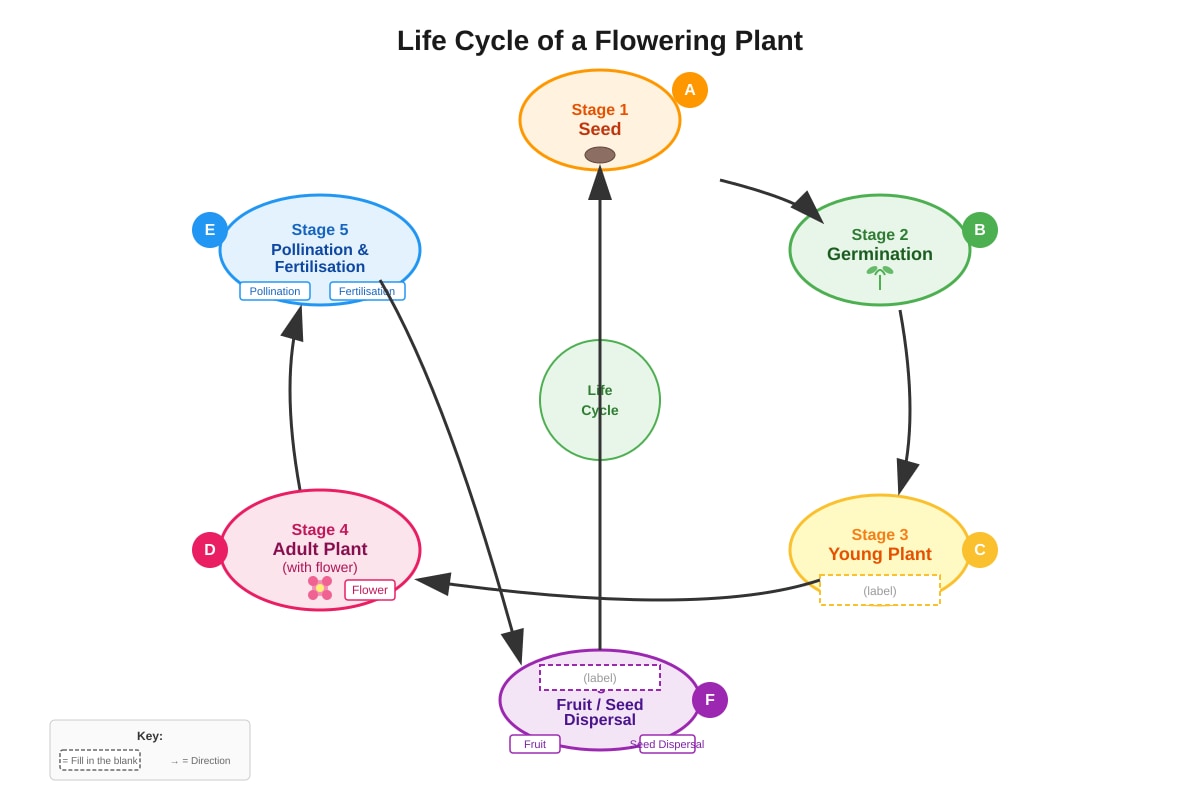
(a) Pollination and fertilisation (1 mark)
Accept: "Fertilisation" or "Pollination and fertilisation".
(b) Pollination is the transfer of pollen grains from the anther (male part) to the stigma (female part) of a flower. (1 mark)
Key concept: Transfer of pollen — can be by wind, insects, water, animals.
(c) Ovary → Fruit; Ovule → Seed (2 marks: 1 each)
Key concept: After fertilisation, ovary wall develops into fruit; fertilised ovule develops into seed.
(d) 1. By wind (e.g., dandelion, angsana)
2. By animals (e.g., love grass on fur, papaya eaten by birds)
Other accepted: By water (coconut), by splitting/explosion (touch-me-not, rubber tree). (2 marks: 1 each)
(e) Seed dispersal prevents overcrowding and competition among the parent plant and its offspring for sunlight, water, nutrients, and space. It also helps the plant colonise new areas. (2 marks)
Breakdown: 1 mark for "prevents overcrowding/competition", 1 mark for "colonise new areas" or "reduces competition for resources".
18.
(a) Reptiles (1 mark)
Reasoning: Dry scaly skin + leathery eggs on land + lungs + cold-blooded = reptile.
(b) Any two: Have a backbone (vertebrates) / Most have four legs (except snakes) / Lay eggs on land (amniotic eggs) / Have claws on toes (if legged) / Undergo incomplete metamorphosis / Breathe only with lungs (no gills at any stage) (2 marks: 1 each)
(c) The dry, scaly skin is waterproof and prevents water loss from the body, allowing the reptile to live on land without drying out. (2 marks)
Breakdown: 1 mark for "waterproof/prevents water loss", 1 mark for "survive on land/avoid drying out".
(d) Reptile eggs have leathery/shell-covered amniotic eggs laid on land; amphibian eggs are jelly-like, laid in water, and lack a shell. (1 mark)
Key concept: Amniotic egg adaptation for terrestrial life.
(e) Amphibians (1 mark)
Explanation: Most adult amphibians (frogs, toads) have a three-chambered heart (two atria, one ventricle). Reptiles (except crocodilians) also have three-chambered hearts.
19.
(a) Bat: Mammals
Frog: Amphibians
Snake: Reptiles (3 marks: 1 each)
(b) Any one: Feed young with milk / Give birth to live young (mostly) / Have a diaphragm for breathing / Have a four-chambered heart / Are warm-blooded (1 mark)
Marking note: Must be a characteristic unique to mammals among the groups shown.
(c) 1. Whales breathe air using lungs (not gills) and must surface to breathe.
2. Whales give birth to live young and feed them with milk (mammary glands).
Other accepted: Have hair (at some stage) / Are warm-blooded / Have a four-chambered heart. (2 marks: 1 each)
(d) A bat's wing is a membrane of skin stretched over elongated finger bones; a bird's wing is covered in feathers and supported by arm bones (humerus, radius, ulna) with fused hand bones. (2 marks)
Breakdown: 1 mark for bat wing structure (skin membrane + finger bones), 1 mark for bird wing structure (feathers + arm/hand bones).
Key concept: Analogous structures (same function, different structure/origin) — convergent evolution.
20.
(a) Both are fungi / Both are microorganisms / Both reproduce by spores / Both are decomposers (saprotrophs) (1 mark)
(b) Yeast carries out anaerobic respiration (fermentation) in the dough, producing carbon dioxide gas. The gas gets trapped in the dough, causing it to rise. When baked, the gas expands further and the yeast dies, leaving a fluffy texture. (2 marks)
Breakdown: 1 mark for "fermentation produces CO₂", 1 mark for "CO₂ makes dough rise".
(c) Lactobacillus ferments lactose (milk sugar) into lactic acid. The lactic acid causes the milk proteins (casein) to coagulate, thickening the milk into yogurt and giving it a sour taste. (2 marks)
Breakdown: 1 mark for "ferments lactose to lactic acid", 1 mark for "coagulates protein/thickens milk".
(d) Antibiotics kill or inhibit the growth of harmful bacteria in the human body, helping to cure bacterial infections and diseases. (2 marks)
Breakdown: 1 mark for "kill/inhibit bacteria", 1 mark for "cure infections/diseases".
Marking note: Do not accept "kill viruses" — antibiotics don't work on viruses.
(e) Decomposers break down dead organisms and waste materials into simpler substances (nutrients), returning them to the soil/environment for plants to reuse. This recycles nutrients in the ecosystem. (2 marks)
Breakdown: 1 mark for "break down dead/waste into simpler substances", 1 mark for "recycle nutrients/return to soil for plants".
End of Answer Key