Primary 5 Science Quiz - Diversity
Name: ______________________ Class: ____________ Date: ______________
Score: __________ / 50
Duration: 70 minutes | Total Marks: 50
Instructions:
- Answer ALL 20 questions.
- Section A: write the number of your chosen option in the brackets provided.
- Sections B to D: write your answers in the spaces provided.
- The number of
<stage3_quiz_md>
Primary 5 Science Quiz — Diversity
Name: ________________ Class: ____________ Date: ____________
Score: __________ / 50 | Duration: 70 minutes
Instructions:
- Answer ALL 20 questions.
- Section A: write the number of your chosen option in the brackets provided.
- Sections B to D: write your answers in the spaces provided.
- The number of marks is shown in brackets [ ].
Section A: Multiple-Choice Questions (Questions 1–10, 2 marks each)
Question 1.
Which of the following is a living thing?
- (1) a robot
- (2) a moss
- (3) rain
- (4) a cloud
Answer: ________ [2]
Question 2.
A bean seedling bends towards sunlight. Which characteristic of living things does this show?
- (1) growth
- (2) respiration
- (3) responding to changes
- (4) reproduction
Answer: ________ [2]
Question 3.
To which group does the mushroom belong?
- (1) plants
- (2) fungi
- (3) bacteria
- (4) animals
Answer: ________ [2]
Question 4.
Which of the following is NOT a mammal?
- (1) dolphin
- (2) bat
- (3) penguin
- (4) whale
Answer: ________ [2]
Question 5.
Which material is most suitable for making a window pane?
- (1) glass
- (2) iron
- (3) rubber
- (4) cardboard
Answer: ________ [2]
Question 6.
Frying pan handles are made of plastic or wood because these materials are ________.
- (1) good conductors of heat
- (2) poor conductors of heat
- (3) good conductors of electricity
- (4) strong and heavy
Answer: ________ [2]
Question 7.
Which organism is a decomposer?
- (1) fern
- (2) rabbit
- (3) bracket fungus
- (4) eagle
Answer: ________ [2]
Question 8.
Which animal's life cycle includes a pupa stage?
- (1) grasshopper
- (2) chicken
- (3) frog
- (4) butterfly
Answer: ________ [2]
Question 9.
Which of the following is a non-living natural thing?
- (1) fern
- (2) ant
- (3) rock
- (4) yeast
Answer: ________ [2]
Question 10.
Which statement about plants and fungi is correct?
- (1) Both can make their own food.
- (2) Only fungi can make their own food.
- (3) Only plants can make their own food.
- (4) Neither can make their own food.
Answer: ________ [2]
Section B: Fill in the Blanks (Questions 11–15, 2 marks each)
Question 11.
Living things are classified according to their similarities and ______________. [2]
Question 12.
Animals without backbones are called ______________. [2]
Question 13.
The process by which green plants make their own food is called ______________. [2]
Question 14.
Materials that allow electricity to pass through them are called electrical ______________. [2]
Question 15.
The young of a frog is called a ______________. [2]
Section C: Short-Answer Questions (Questions 16–19, 3 marks each)
Question 16.
State two differences between a plant and a fungus. [3]
Question 17.
State two properties of glass that make it suitable for making window panes. [3]
Question 18.
Classify the following animals into vertebrates and invertebrates: spider, goldfish, snake, ant. [3]
Question 19.
Give two reasons why scientists classify living things into groups. [3]
Section D: Structured Question (Question 20, 8 marks)
Question 20.
Study the classification chart of four organisms, A, B, C and D, below.
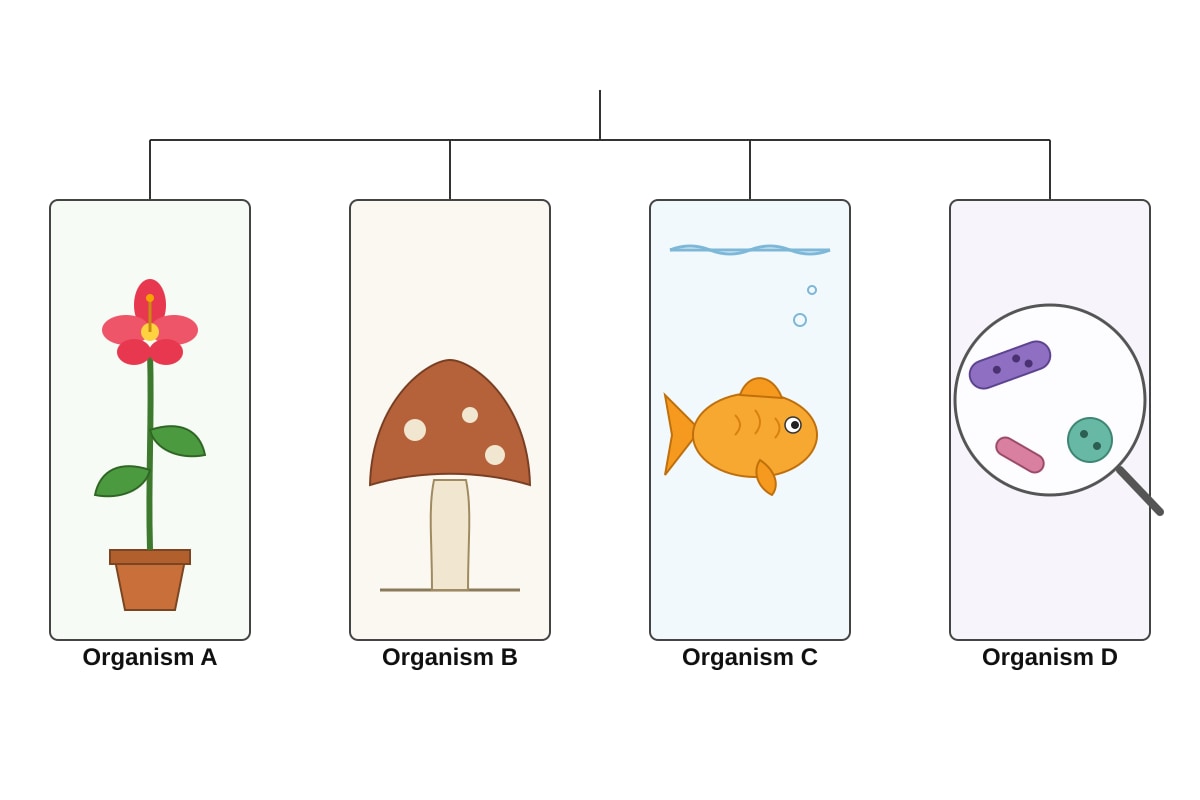
Generated image for this question.
(a) State whether each organism is a plant, a fungus, a bacterium or an animal. [4]
(b) (i) Which organism(s) cannot make their own food? [2]
(ii) Give a reason for your answer in (b)(i). [2]