From Real Exams Quiz
Primary 5 Science Diversity Quiz
Free P5 Science Diversity quiz, Exam version, with questions, answers, and syllabus-aligned practice for Singapore students.
These static practice materials are generated from the site's syllabus and paper-generation workflow, with source and model context shown so students and parents can evaluate the material before use.
Questions
Free quiz and exam paper access
Enter your details to view this paper
Your access is remembered on this device.
Answers
Answer Key: Primary 5 Science Quiz - Diversity
Total Marks: 30
Section A: Multiple-Choice Questions (10 × 1 mark = 10 marks)
| Question | Answer | Marks | Explanation |
|---|---|---|---|
| 1 | C | 1 | A cat is a living thing because it can grow, reproduce, need food, and respond to its environment. A rock, car, and pencil are non-living. |
| 2 | B | 1 | Spiders have eight legs and two body parts, which are characteristics of arachnids. Insects have six legs and three body parts. |
| 3 | A | 1 | A wooden chair was once part of a living tree. Plastic, metal, and glass are made from non-living materials. |
| 4 | C | 1 | Plants can make their own food through photosynthesis using sunlight, water, and carbon dioxide. Animals cannot make their own food; they must eat other organisms. |
| 5 | D | 1 | Having a backbone is a characteristic of vertebrates, but not all living things have a backbone (e.g., invertebrates like insects and worms). All living things grow, reproduce, and breathe. |
| 6 | B | 1 | Both a butterfly and a bird have wings, which is a similarity in their body parts. They are different types of animals (insect vs. bird) but share this feature. |
| 7 | A | 1 | A mushroom is a fungus. Fungi are a separate kingdom from plants and animals. Rose plants are plants, fish are animals, and bacteria are a different group of microorganisms. |
| 8 | B | 1 | Bacteria are living things because they can reproduce, grow, and respond to their environment. They are microscopic, not all are harmful, and they do need nutrients (food). |
| 9 | C | 1 | Materials can be classified by their physical properties such as hardness, flexibility, transparency, and whether they float or sink. Colour, size, and weight alone are not always useful for classification. |
| 10 | C | 1 | A green, leafy plant growing on a wall is a plant. Plants are living things that can make their own food and are usually green due to chlorophyll. |
Section B: Short-Answer Questions (5 × 2 marks = 10 marks)
11. (2 marks)
- Award 1 mark for each correct characteristic.
- Acceptable answers (any two):
- (a) They grow.
- (b) They reproduce.
- (c) They need food/water/air.
- (d) They respond to changes (stimuli).
- (e) They excrete waste.
- (f) They breathe/respire.
12. (2 marks)
- Award 1 mark for each correct group with a correct example.
- Natural: Wooden table (wood comes from trees)
- Man-made: Plastic toy (plastic is manufactured), Glass window (glass is manufactured), Metal coin (metal is processed)
- Note: The wooden table is made from a natural material but is man-made in form. Accept either classification with a valid reason. The key is that students understand the difference between natural and man-made objects.
13. (2 marks)
- Award 1 mark for the correct difference.
- Award 1 mark for one correct example of each.
- Difference: Vertebrates have a backbone, while invertebrates do not have a backbone.
- Example of a vertebrate: Fish, frog, bird, human, etc.
- Example of an invertebrate: Insect, spider, worm, snail, etc.
14. (2 marks)
- Award 1 mark for circling "True".
- Award 1 mark for a correct explanation.
- True. All insects have six legs. This is a defining characteristic of insects. Other arthropods like spiders (8 legs) or centipedes (many legs) are not insects.
15. (2 marks)
- Award 2 marks for a complete explanation.
- A mushroom is not classified as a plant because it cannot make its own food (it does not have chlorophyll and cannot photosynthesize). Mushrooms are fungi; they obtain nutrients by absorbing them from dead or decaying matter.
Section C: Structured Questions (5 × 2 marks = 10 marks)
16. (2 marks)
- Award 1 mark for each correct group (all animals must be correctly placed for the mark).
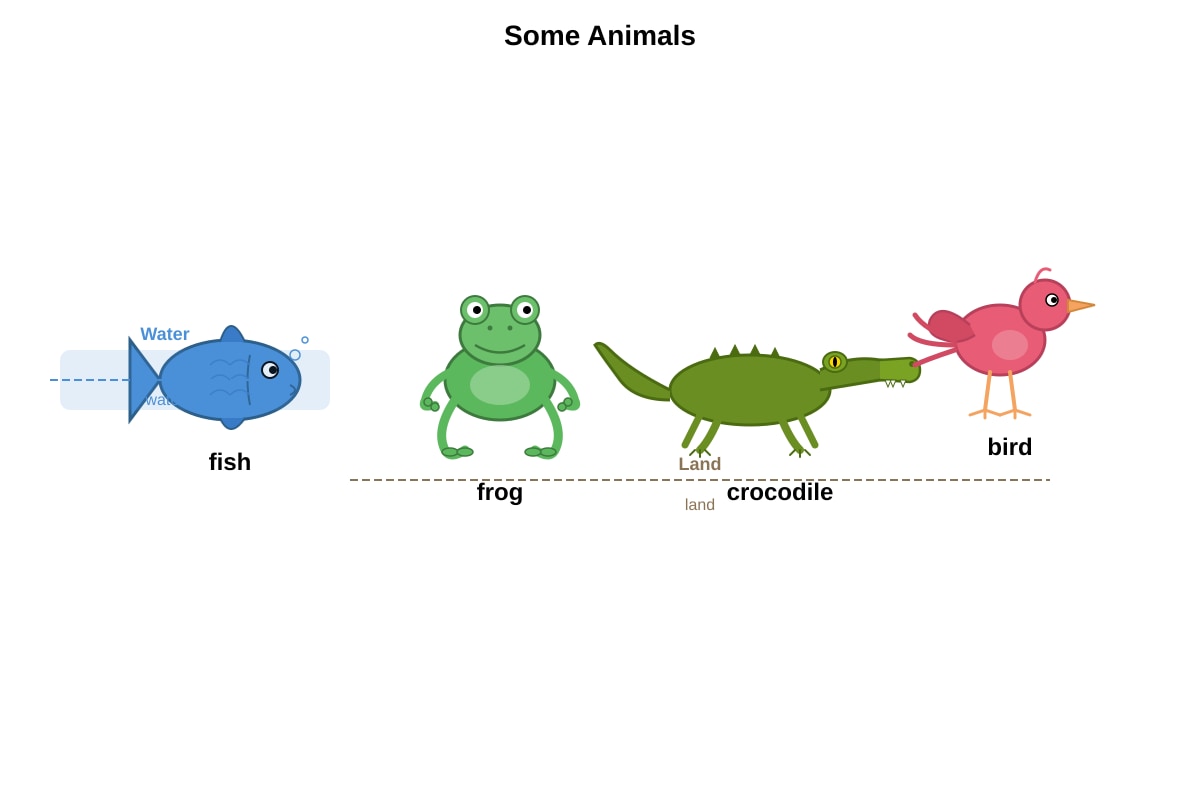
- Live in Water: Fish, Frog
- Live on Land: Crocodile, Bird
- Note: Frogs and crocodiles can live both in water and on land. Accept either grouping if the student provides a valid reason. The expected answer is based on the most common habitat.
17. (2 marks)
- Award 2 marks for a complete explanation.
- The stone is considered a non-living thing because it does not show any characteristics of life. It does not grow, reproduce, need food, respond to stimuli, or excrete waste. It is made of minerals and does not have cells.
18. (2 marks)
- Award 1 mark for identifying Animal X.
- Award 1 mark for a correct explanation.
- Animal: X
- Explanation: Animal X has a backbone (so it is a vertebrate), has fur/hair (a characteristic of mammals), and does not lay eggs (most mammals give birth to live young). These are all characteristics of mammals.
19. (2 marks)
- Award 1 mark for circling "Not correct".
- Award 1 mark for a correct reason.
- Not correct.
- Reason: Many non-living things are natural, not man-made. For example, rocks, water, air, and soil are all non-living things that occur naturally in the environment.
20. (2 marks)
- Award 2 marks for a valid reason.
- It is important to classify living things into groups because it helps us to study and understand them better. Classification helps us to identify similarities and differences, organize information, and see relationships between different organisms.
- Accept other valid reasons such as: helps in communication between scientists, helps in conservation efforts, helps in understanding evolution, etc.
End of Answer Key