AI Generated Exam Paper
Primary 5 Science Practice Paper 5
Free AI-Generated NVIDIA Nemotron 3 Ultra 550B A55B Free Primary 5 Science Practice Paper 5 practice paper with questions and answers for Singapore students. This page is rendered as a direct URL so the questions and answers can be discovered without pressing in-page buttons.
These static practice materials are generated from the site's syllabus and paper-generation workflow, with source and model context shown so students and parents can evaluate the material before use.
Questions
TuitionGoWhere Practice Paper - Science Primary 5
TuitionGoWhere Practice Paper (AI)
Subject: Science
Level: Primary 5
Paper: Practice Paper 5 (Version 5)
Duration: 1 hour 45 minutes
Total Marks: 100
Name: ________________________
Class: ________________________
Date: ________________________
Instructions to Candidates
- Do not open this booklet until you are told to do so.
- Follow all instructions carefully.
- Answer all questions.
- For Section A, shade your answers on the Optical Answer Sheet (OAS) provided.
- For Section B and Section C, write your answers in the spaces provided in this booklet.
- The number of marks is given in brackets [ ] at the end of each question or part question.
- The total marks for this paper is 100.
Section A: Multiple-Choice Questions (28 marks)
For each question from 1 to 14, four options are given. One of them is the correct answer. Make your choice (1, 2, 3 or 4) and shade the correct oval on the OAS.
Question 1 [2 marks]
Which of the following statements about the diversity of living things is correct?
(1) All living things can make their own food. (2) All living things reproduce by laying eggs. (3) All living things respond to changes in their surroundings. (4) All living things need oxygen to survive.
Question 2 [2 marks]
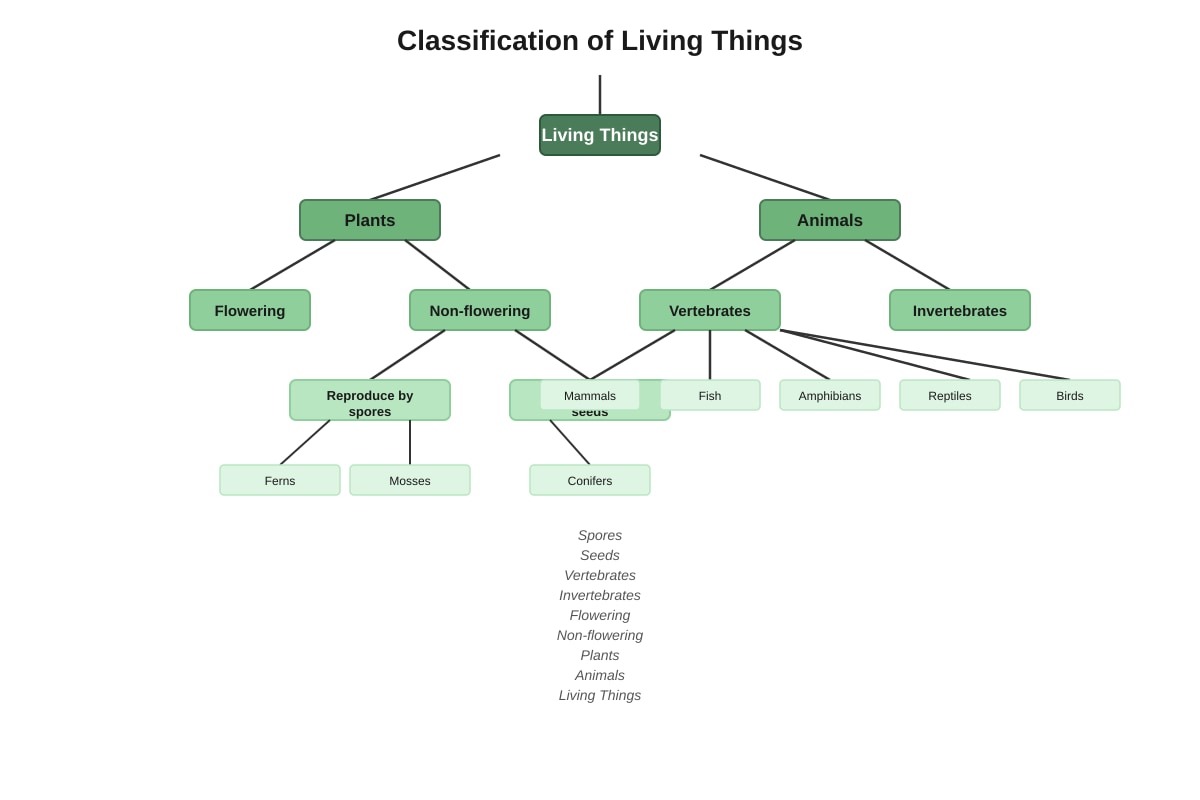
Study the classification chart below.
Living Things
├── Group X
│ ├── Mushroom
│ ├── Yeast
│ └── Mould
└── Group Y
├── Rose plant
├── Moss
└── Fern
Which of the following correctly identifies Group X and Group Y?
| Group X | Group Y | |
|---|---|---|
| (1) | Fungi | Non-flowering plants |
| (2) | Bacteria | Flowering plants |
| (3) | Fungi | Flowering plants |
| (4) | Non-flowering plants | Fungi |
Question 3 [2 marks]
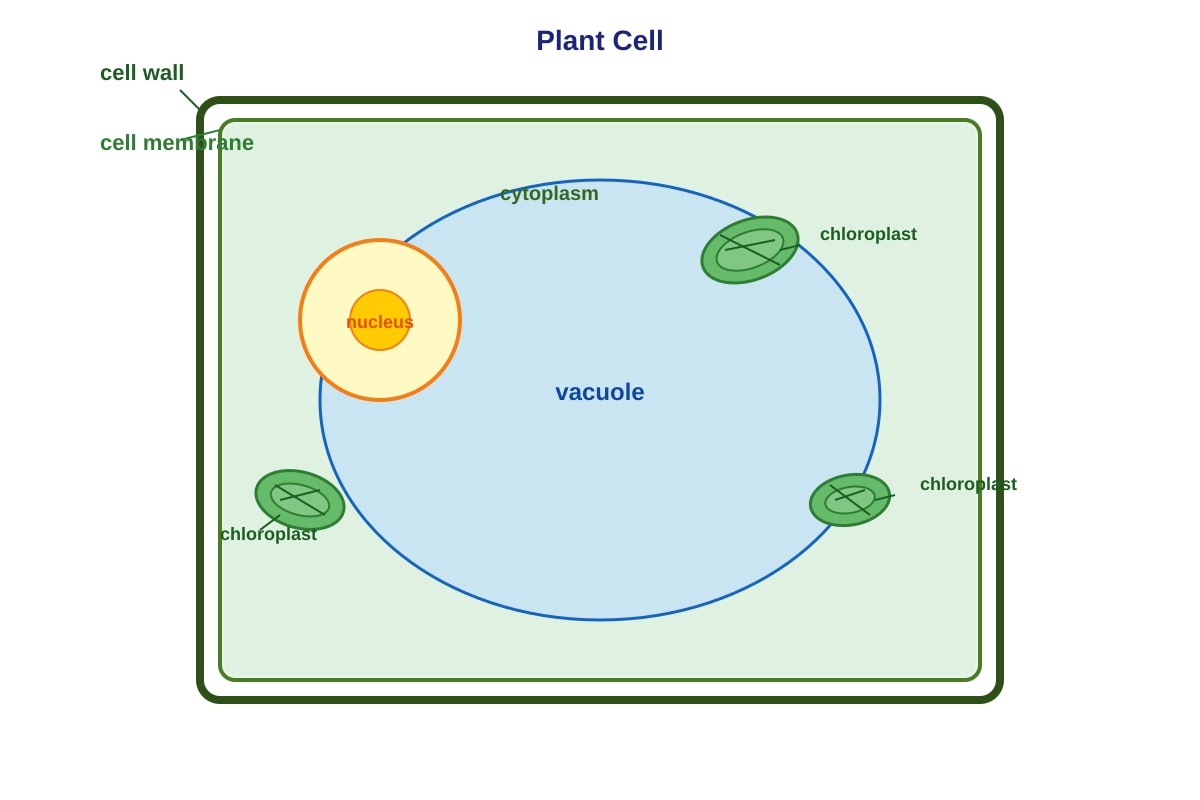
The diagram below shows a cell.
<image_placeholder> id: Q1-fig1 type: diagram linked_question: Q1 description: A typical plant cell with visible cell wall, cell membrane, cytoplasm, nucleus, chloroplasts, and a large central vacuole. All organelles should be clearly labelled. labels: Cell wall, Cell membrane, Cytoplasm, Nucleus, Chloroplasts, Vacuole values: None must_show: Distinct rectangular shape with cell wall, green chloroplasts, large central vacuole, nucleus near centre </image_placeholder>
Which of the following statements about the cell is correct?
(1) It is an animal cell because it has a nucleus. (2) It is a plant cell because it has a cell wall and chloroplasts. (3) It is a bacterial cell because it has a cell membrane. (4) It is a fungal cell because it has a vacuole.
Question 4 [2 marks]
Four students made the following statements about microorganisms.
| Student | Statement |
|---|---|
| Ali | All microorganisms are harmful. |
| Bala | Some microorganisms can make their own food. |
| Cindy | Microorganisms can only be seen with a microscope. |
| Devi | Yeast is a microorganism. |
Which two students made correct statements?
(1) Ali and Bala (2) Bala and Cindy (3) Cindy and Devi (4) Bala and Devi
Question 5 [2 marks]
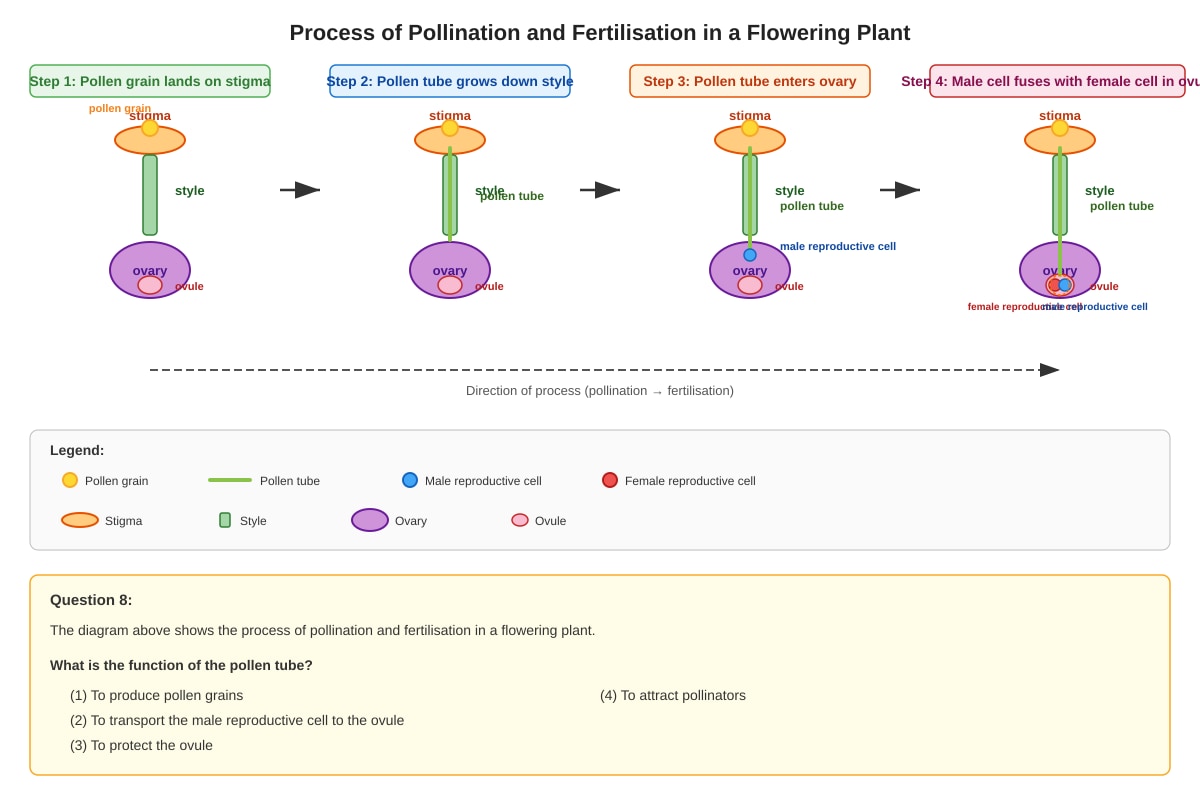
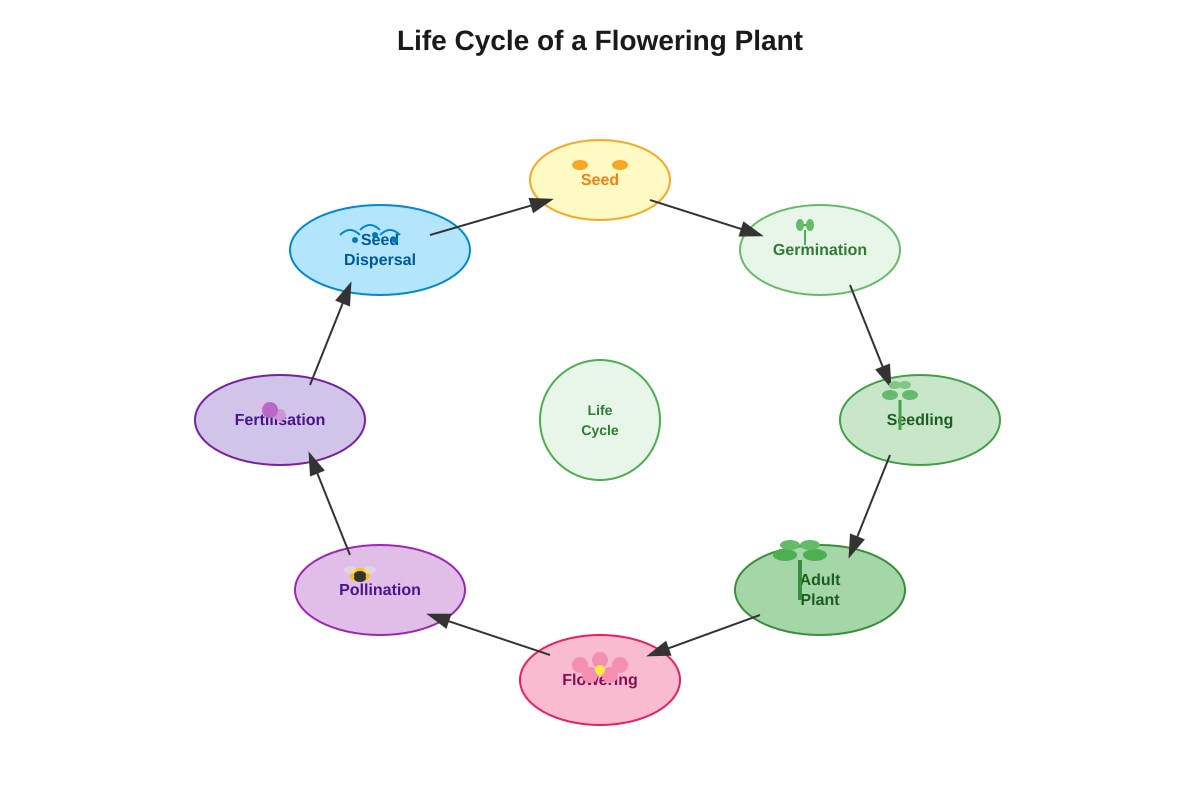
The diagram below shows the life cycle of a flowering plant.
<image_placeholder> id: Q5-fig1 type: diagram linked_question: Q5 description: Life cycle of a flowering plant showing seed → germination → seedling → adult plant → flowering → pollination → fertilisation → fruit/seed formation → seed dispersal. Arrows showing cyclic flow. labels: Seed, Germination, Seedling, Adult Plant, Flowering, Pollination, Fertilisation, Fruit/Seed Formation, Seed Dispersal values: None must_show: Clear cyclic arrows, all 9 stages labelled, pollination and fertilisation as distinct stages </image_placeholder>
Which process occurs immediately after pollination?
(1) Germination (2) Fertilisation (3) Seed dispersal (4) Flowering
Question 6 [2 marks]
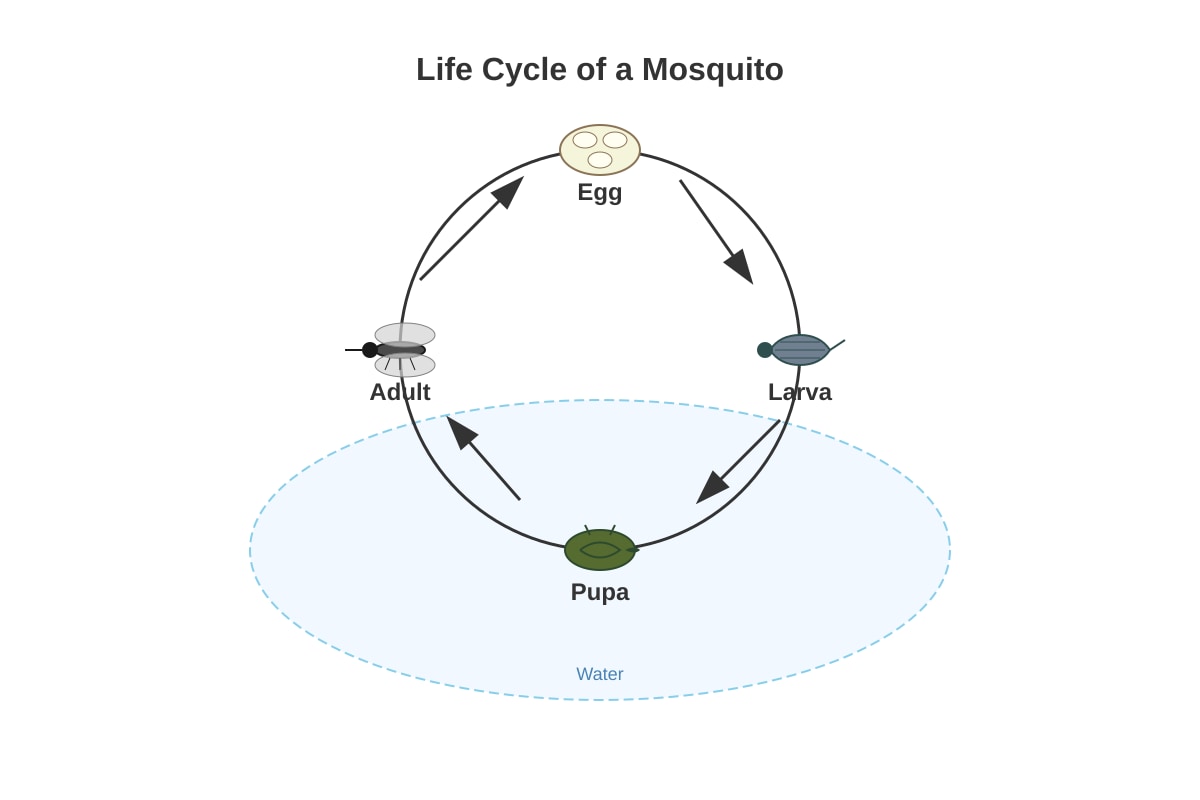
Which of the following shows the correct order of stages in the life cycle of a mosquito?
(1) Egg → Larva → Pupa → Adult (2) Egg → Pupa → Larva → Adult (3) Egg → Nymph → Larva → Adult (4) Egg → Larva → Nymph → Adult
Question 7 [2 marks]
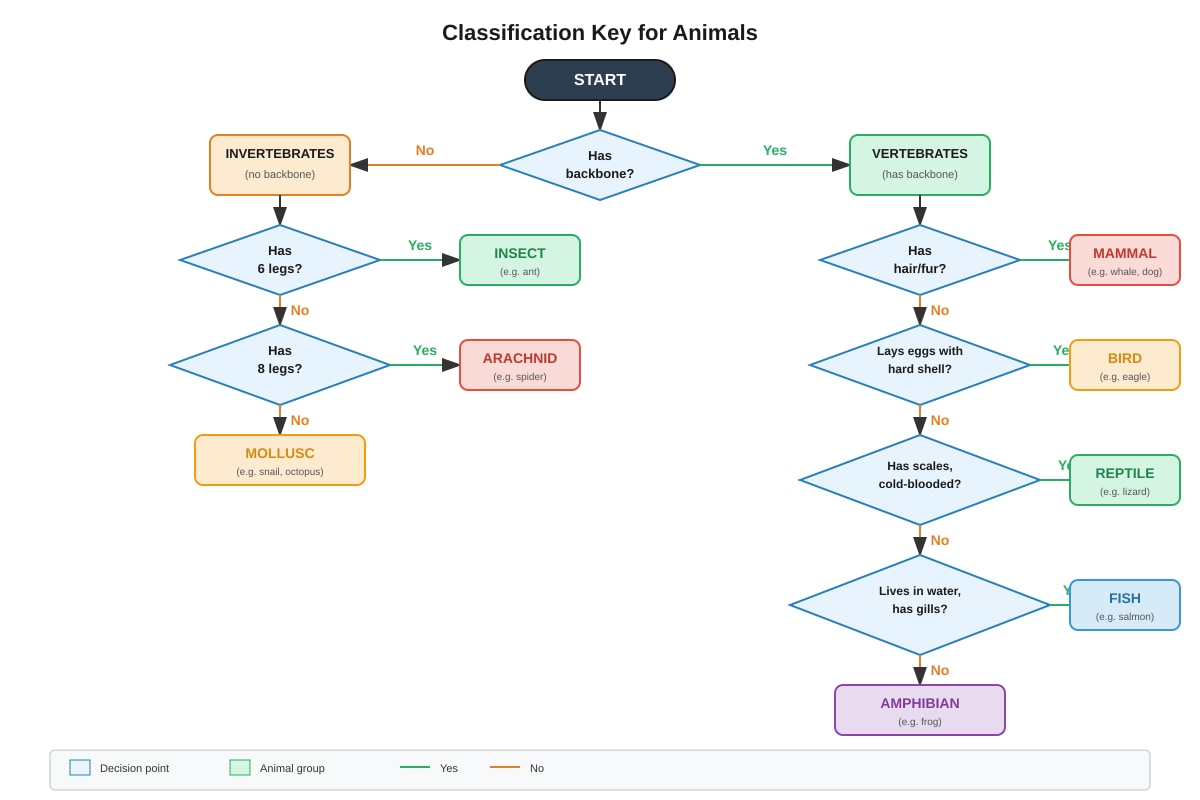
Study the flowchart below.
Organism A
│
├── Does it have feathers? → Yes → Bird
│
└── No
│
├── Does it have hair/fur? → Yes → Mammal
│
└── No
│
├── Does it have moist skin? → Yes → Amphibian
│
└── No → Reptile
Organism A lays eggs, has dry scaly skin, and breathes through lungs. Which group does Organism A belong to?
(1) Bird (2) Mammal (3) Amphibian (4) Reptile
Question 8 [2 marks]
The table below shows the characteristics of four organisms, P, Q, R, and S. A tick (✓) indicates the organism has the characteristic.
| Characteristic | P | Q | R | S |
|---|---|---|---|---|
| Has backbone | ✓ | ✓ | ✗ | ✓ |
| Lays eggs | ✓ | ✗ | ✓ | ✓ |
| Has feathers | ✗ | ✗ | ✗ | ✓ |
| Has hair/fur | ✗ | ✓ | ✗ | ✗ |
| Breathes through lungs | ✓ | ✓ | ✗ | ✓ |
Which organism is most likely a reptile?
(1) P (2) Q (3) R (4) S
Question 9 [2 marks]
Which of the following is not a function of the skeletal system in humans?
(1) Protects internal organs (2) Gives shape and support to the body (3) Produces blood cells (4) Removes waste from the body
Question 10 [2 marks]
The diagram below shows a human tooth.
<image_placeholder> id: Q10-fig1 type: diagram linked_question: Q10 description: A molar tooth showing crown, enamel, dentine, pulp cavity, root, gum line, and jaw bone. Labels for all parts. labels: Crown, Enamel, Dentine, Pulp Cavity, Root, Gum Line, Jaw Bone values: None must_show: Clear cross-section of molar, distinct enamel layer, pulp cavity with nerves/blood vessels, roots embedded in jaw bone </image_placeholder>
Which part of the tooth contains nerves and blood vessels?
(1) Enamel (2) Dentine (3) Pulp cavity (4) Crown
Question 11 [2 marks]
Which of the following statements about the digestive system is correct?
(1) Digestion of starch begins in the stomach. (2) The small intestine absorbs water from undigested food. (3) The large intestine absorbs digested food into the blood. (4) Digestion of protein begins in the stomach.
Question 12 [2 marks]
Study the food chain below.
Plant → Grasshopper → Frog → Snake → Eagle
If a disease kills most of the grasshoppers, what will most likely happen to the frog population?
(1) It will increase because there are more plants. (2) It will decrease because there is less food. (3) It will remain the same because frogs eat other animals. (4) It will increase because there are fewer snakes.
Question 13 [2 marks]
The diagram below shows a simple electrical circuit.
<image_placeholder> id: Q13-fig1 type: diagram linked_question: Q13 description: A series circuit with a battery (two cells), a switch (open), two bulbs, and connecting wires. All components clearly labelled. labels: Battery, Switch (open), Bulb 1, Bulb 2, Connecting wires values: Battery: 2 cells (1.5V each) must_show: Open switch, two bulbs in series, battery with two cells, standard circuit symbols </image_placeholder>
When the switch is closed, both bulbs light up. What happens if one bulb fuses (filament breaks)?
(1) The other bulb lights up more brightly. (2) The other bulb remains lit with the same brightness. (3) The other bulb goes off. (4) The other bulb flickers then stays on.
Question 14 [2 marks]
Which of the following materials is a good conductor of electricity?
(1) Rubber (2) Plastic (3) Copper (4) Wood
Section B: Structured Questions (44 marks)
Write your answers in the spaces provided.
Question 15 [4 marks]
The diagram below shows three organisms.
<image_placeholder> id: Q15-fig1 type: diagram linked_question: Q15 description: Three organisms side by side: (A) A fern plant with visible fronds and spores on underside, (B) A mushroom with cap, gills, and stem, (C) A balsam plant with flowers, leaves, and stem. All drawn to scale with labels. labels: Fern: Frond, Spore cases (sori), Rhizome, Roots; Mushroom: Cap, Gills, Stem, Mycelium (underground); Balsam: Flower, Leaf, Stem, Roots values: None must_show: Clear distinguishing features of each organism group </image_placeholder>
(a) Classify each organism into its correct group: Flowering Plant, Non-flowering Plant, or Fungi.
Organism A: ________________________ Organism B: ________________________ Organism C: ________________________ [3]
(b) State one difference in how Organism A and Organism C reproduce.
___________________________________________________________________________ [1]
Question 16 [3 marks]
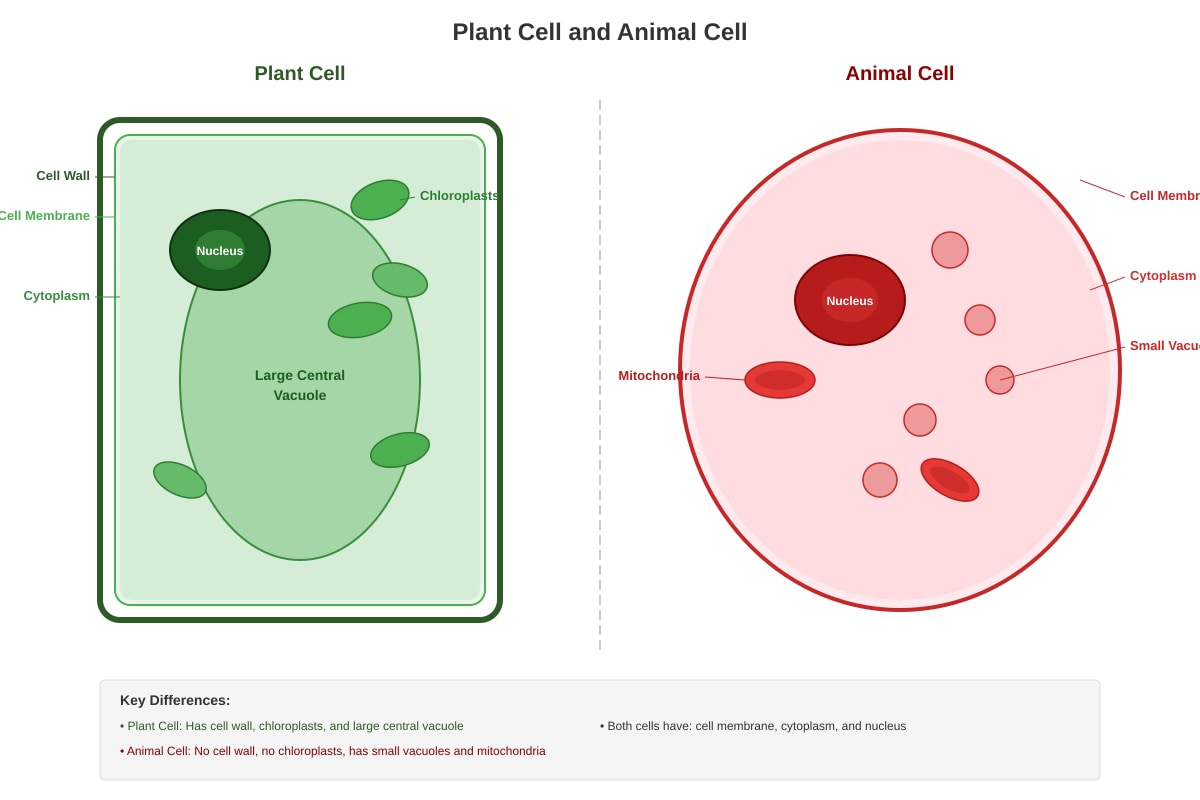
The diagram below shows a plant cell and an animal cell.
<image_placeholder> id: Q16-fig1 type: diagram linked_question: Q16 description: Side-by-side comparison of a plant cell (rectangular, cell wall, chloroplasts, large vacuole) and an animal cell (irregular shape, no cell wall, no chloroplasts, small vacuoles). Both show nucleus, cell membrane, cytoplasm. labels: Plant Cell: Cell wall, Cell membrane, Cytoplasm, Nucleus, Chloroplasts, Large vacuole; Animal Cell: Cell membrane, Cytoplasm, Nucleus, Small vacuoles values: None must_show: Clear visual contrast between plant and animal cell structures </image_placeholder>
(a) Identify one structure present in the plant cell but absent in the animal cell.
___________________________________________________________________________ [1]
(b) State the function of the structure you identified in (a).
___________________________________________________________________________ [1]
(c) Both cells have a nucleus. State the function of the nucleus.
___________________________________________________________________________ [1]
Question 17 [4 marks]
The table below shows the characteristics of five vertebrates.
| Animal | Body Covering | Breathing Method | Reproduction | Body Temperature |
|---|---|---|---|---|
| Penguin | Feathers | Lungs | Lays eggs | Constant |
| Bat | Hair/Fur | Lungs | Gives birth to live young | Constant |
| Salmon | Scales | Gills | Lays eggs | Varies with surroundings |
| Frog | Moist skin | Lungs, Skin, Gills (at different stages) | Lays eggs | Varies with surroundings |
| Crocodile | Dry scales | Lungs | Lays eggs | Varies with surroundings |
(a) Which animal is a mammal? ________________________ [1]
(b) Which two animals are warm-blooded? ________________________ and ________________________ [1]
(c) State one similarity and one difference between the frog and the crocodile in terms of their body covering.
Similarity: _________________________________________________________________ [1]
Difference: _________________________________________________________________ [1]
Question 18 [3 marks]
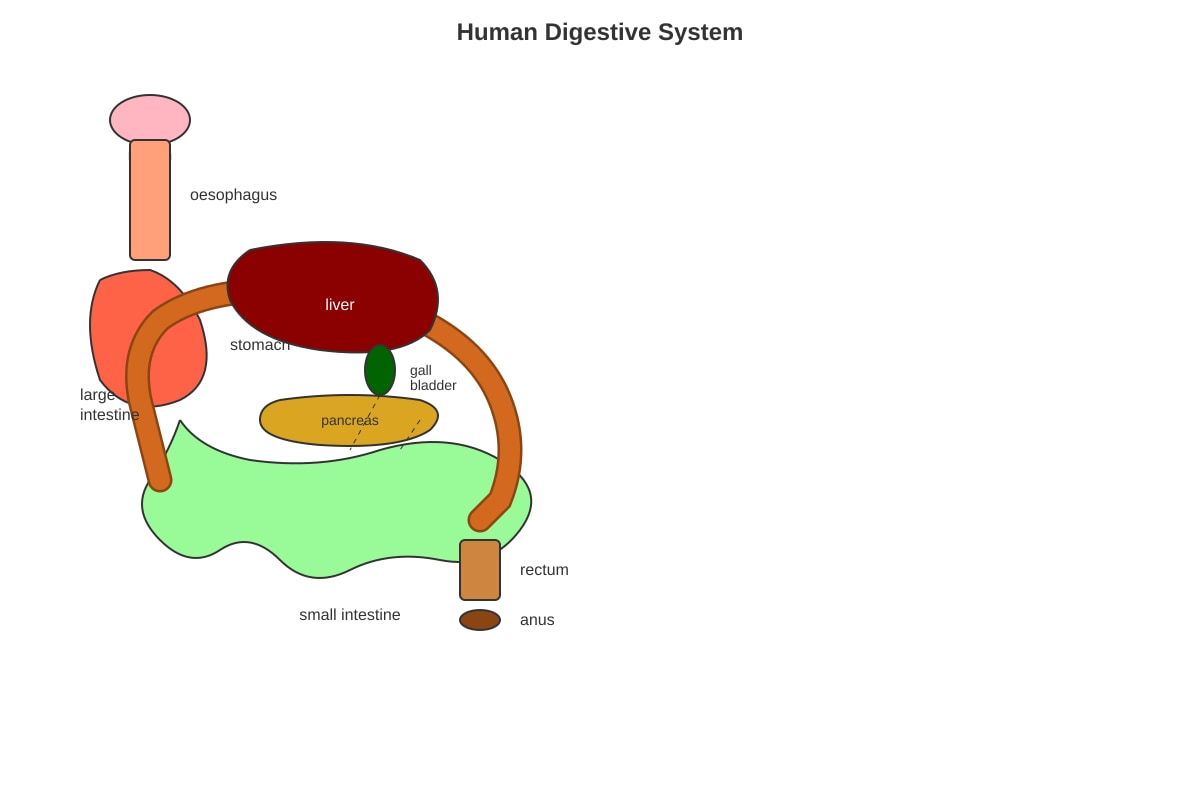
The diagram below shows the human digestive system.
<image_placeholder> id: Q18-fig1 type: diagram linked_question: Q18 description: Human digestive system with mouth, oesophagus, stomach, small intestine, large intestine, rectum, anus. Also showing liver, pancreas, gall bladder. All organs labelled. labels: Mouth, Oesophagus, Stomach, Small Intestine, Large Intestine, Rectum, Anus, Liver, Pancreas, Gall Bladder values: None must_show: Complete digestive tract with accessory organs, clear labels </image_placeholder>
(a) In which organ does digestion of food end? ________________________ [1]
(b) Name the organ that produces bile. ________________________ [1]
(c) State the function of the large intestine.
___________________________________________________________________________ [1]
Question 19 [4 marks]
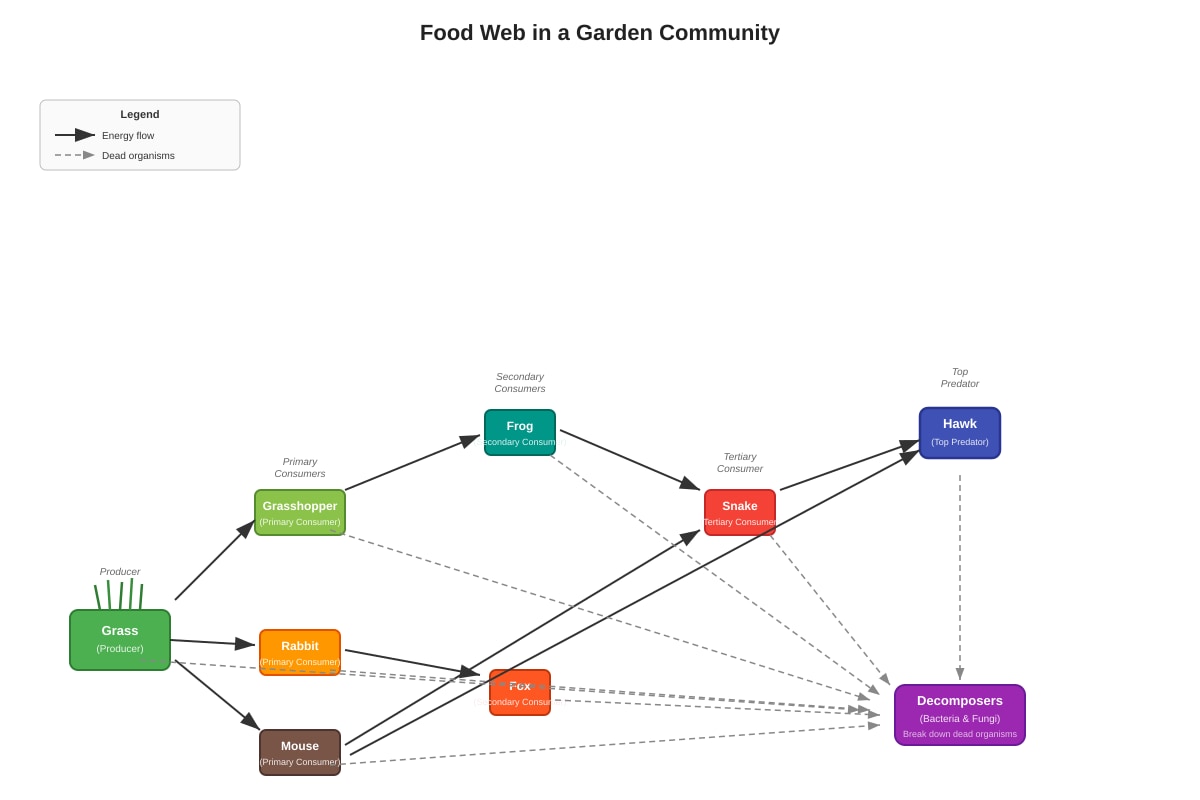
The diagram below shows a food web in a garden community.
<image_placeholder> id: Q19-fig1 type: diagram linked_question: Q19 description: Food web with: Grass (producer) → Grasshopper, Rabbit, Caterpillar (primary consumers) → Frog, Bird (secondary consumers) → Snake, Hawk (tertiary consumers). Decomposers (bacteria, fungi) breaking down all dead organisms. Arrows showing energy flow. labels: Grass, Grasshopper, Rabbit, Caterpillar, Frog, Bird, Snake, Hawk, Bacteria, Fungi values: None must_show: Clear trophic levels, arrows pointing from food to consumer, decomposers connected to all </image_placeholder>
(a) Name two primary consumers in this food web.
___________________________________________________________________________ [1]
(b) Which organism is both a predator and a prey?
___________________________________________________________________________ [1]
(c) If all the snakes are removed from this community, explain what will happen to the population of hawks.
___________________________________________________________________________ [2]
Question 20 [4 marks]
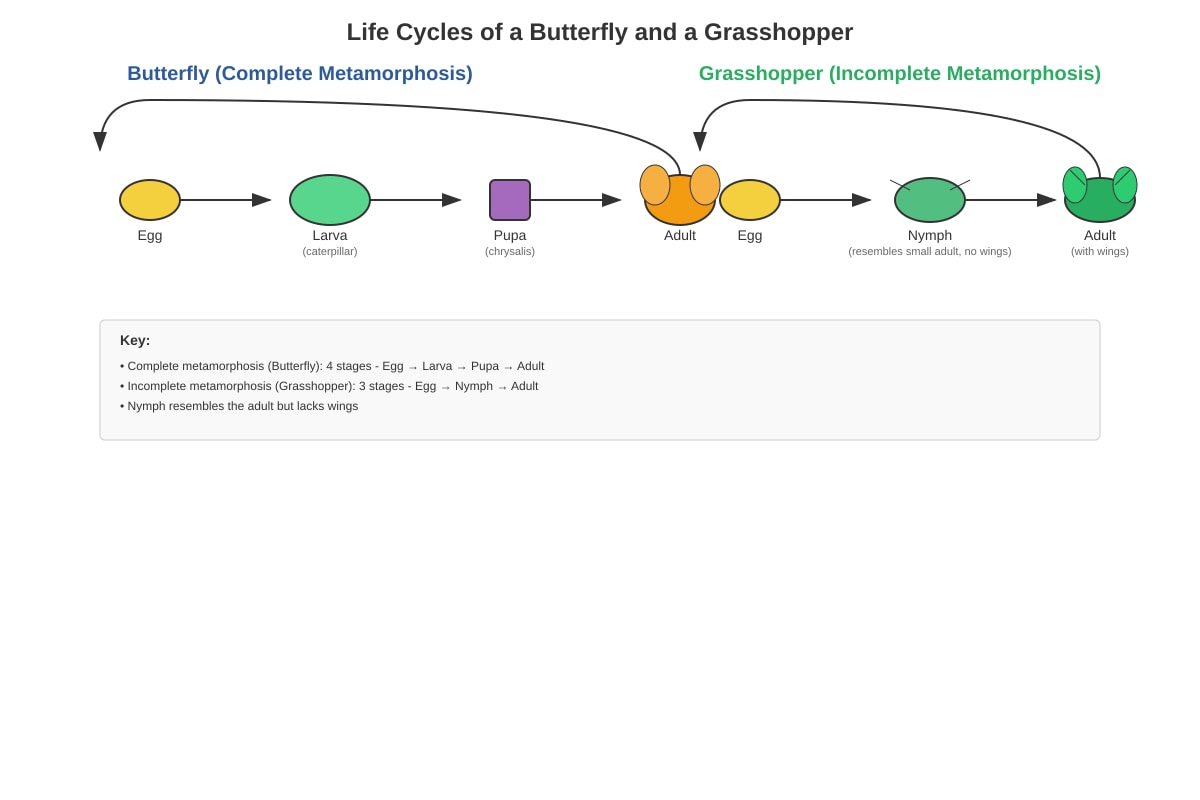
The diagram below shows the life cycle of a butterfly.
<image_placeholder> id: Q20-fig1 type: diagram linked_question: Q20 description: Complete metamorphosis: Egg → Larva (caterpillar) → Pupa (chrysalis) → Adult butterfly. Arrows showing cyclic flow. Each stage labelled with key features. labels: Egg, Larva (Caterpillar), Pupa (Chrysalis), Adult Butterfly values: None must_show: Four distinct stages, clear morphological differences, cyclic arrows </image_placeholder>
(a) Name the stage labelled X in the diagram. ________________________ [1]
(b) State two differences between the larva and the adult butterfly.
Difference 1: _________________________________________________________________ [1]
Difference 2: _________________________________________________________________ [1]
(c) Why is the pupa stage important in the life cycle of a butterfly?
___________________________________________________________________________ [1]
Question 21 [4 marks]
The diagram below shows a simple circuit with three identical bulbs arranged in parallel.
<image_placeholder> id: Q21-fig1 type: diagram linked_question: Q21 description: Parallel circuit with a battery (two cells), a closed switch, and three identical bulbs each on its own branch. All components labelled. labels: Battery (2 cells), Switch (closed), Bulb 1, Bulb 2, Bulb 3, Connecting wires values: Battery: 2 cells (1.5V each) must_show: Clear parallel arrangement, each bulb on separate branch, closed switch </image_placeholder>
(a) If Bulb 1 fuses, what will happen to Bulb 2 and Bulb 3? Explain your answer.
___________________________________________________________________________ [2]
(b) State one advantage of connecting bulbs in parallel compared to in series.
___________________________________________________________________________ [1]
(c) The bulbs are connected to a 3V battery. What is the voltage across each bulb?
___________________________________________________________________________ [1]
Question 22 [4 marks]
The diagram below shows the human respiratory system.
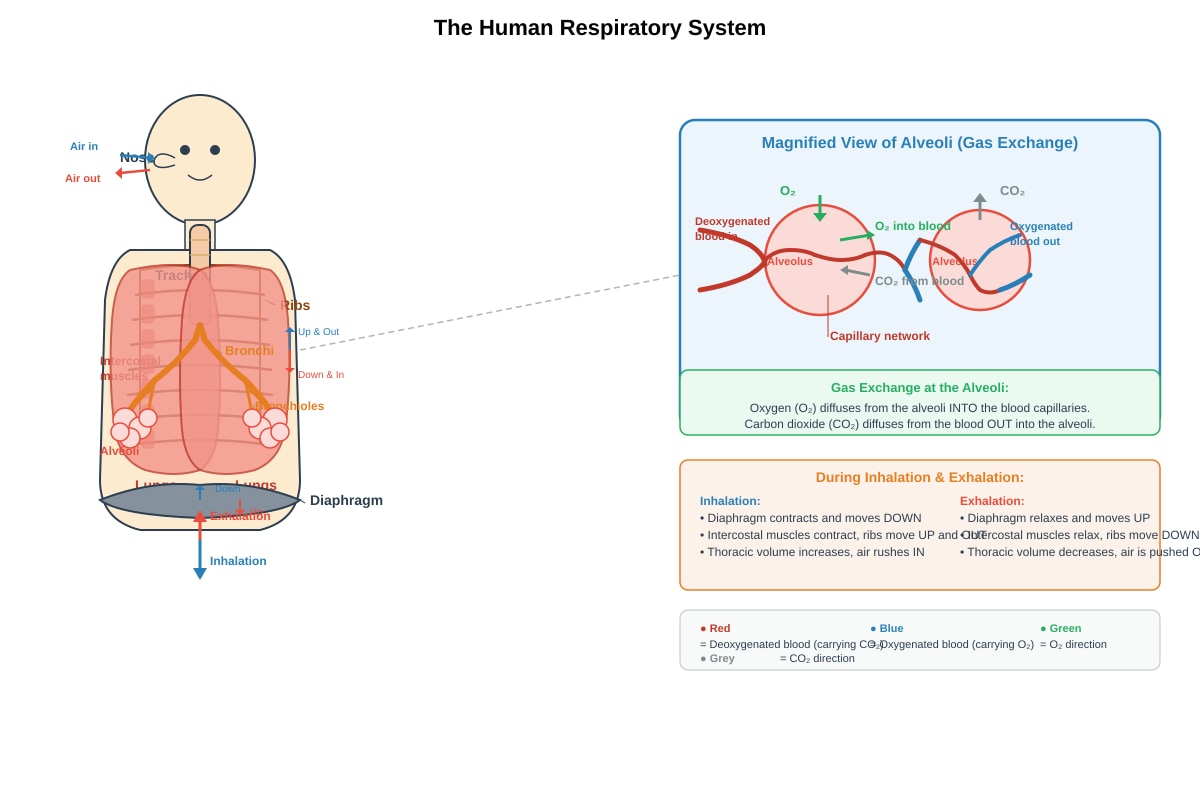
<image_placeholder> id: Q22-fig1 type: diagram linked_question: Q22 description: Human respiratory system showing nasal cavity, trachea, bronchi, bronchioles, alveoli, lungs, diaphragm, ribs. All parts labelled. labels: Nasal cavity, Trachea, Bronchi, Bronchioles, Alveoli, Lungs, Diaphragm, Ribs values: None must_show: Complete respiratory tract, alveoli detail, diaphragm position </image_placeholder>
(a) Name the part labelled X where gaseous exchange takes place. ________________________ [1]
(b) Describe how the diaphragm moves when we inhale (breathe in).
___________________________________________________________________________ [1]
(c) Explain why the alveoli are suited for gaseous exchange.
___________________________________________________________________________ [2]
Question 23 [4 marks]
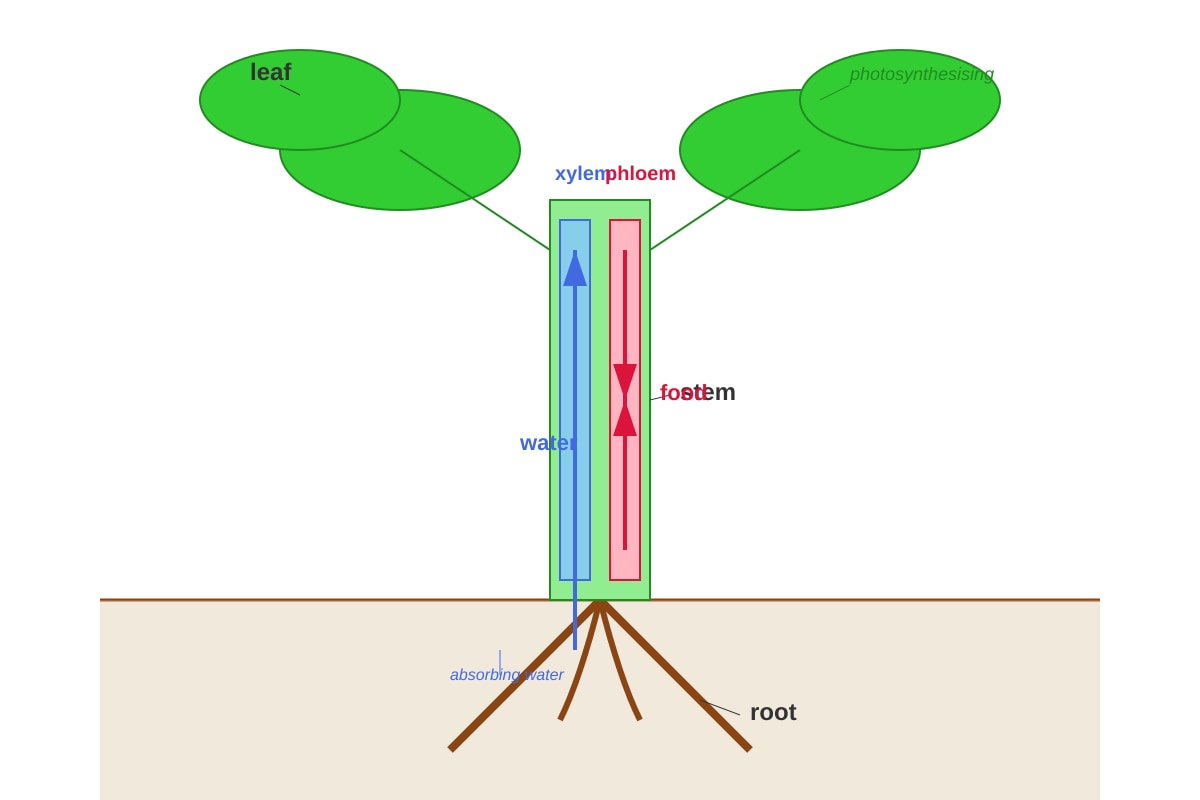
The diagram below shows a plant's transport system.
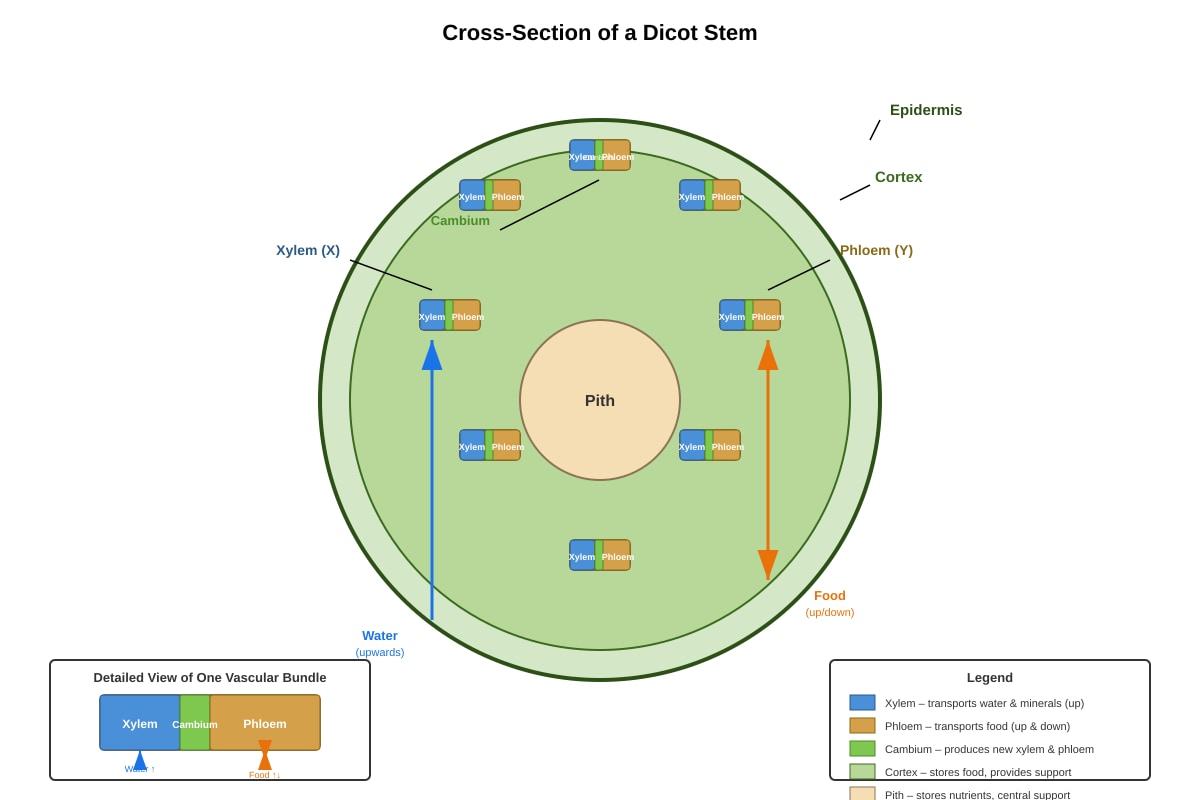
<image_placeholder> id: Q23-fig1 type: diagram linked_question: Q23 description: Cross-section of a plant stem showing xylem and phloem in vascular bundles. Roots absorbing water, leaves photosynthesising. Arrows showing water/minerals up xylem, food down phloem. labels: Xylem, Phloem, Roots, Stem, Leaves, Water and minerals (upward arrows), Food (downward arrows) values: None must_show: Clear distinction between xylem and phloem, directional arrows for transport </image_placeholder>
(a) Name the two types of transport tubes in plants.
___________________________________________________________________________ [1]
(b) Which transport tube carries water and mineral salts from the roots to the leaves?
___________________________________________________________________________ [1]
(c) What substance is transported by the phloem?
___________________________________________________________________________ [1]
(d) If the phloem is removed from a section of the stem, what will happen to the leaves above that section? Explain.
___________________________________________________________________________ [1]
Question 24 [4 marks]
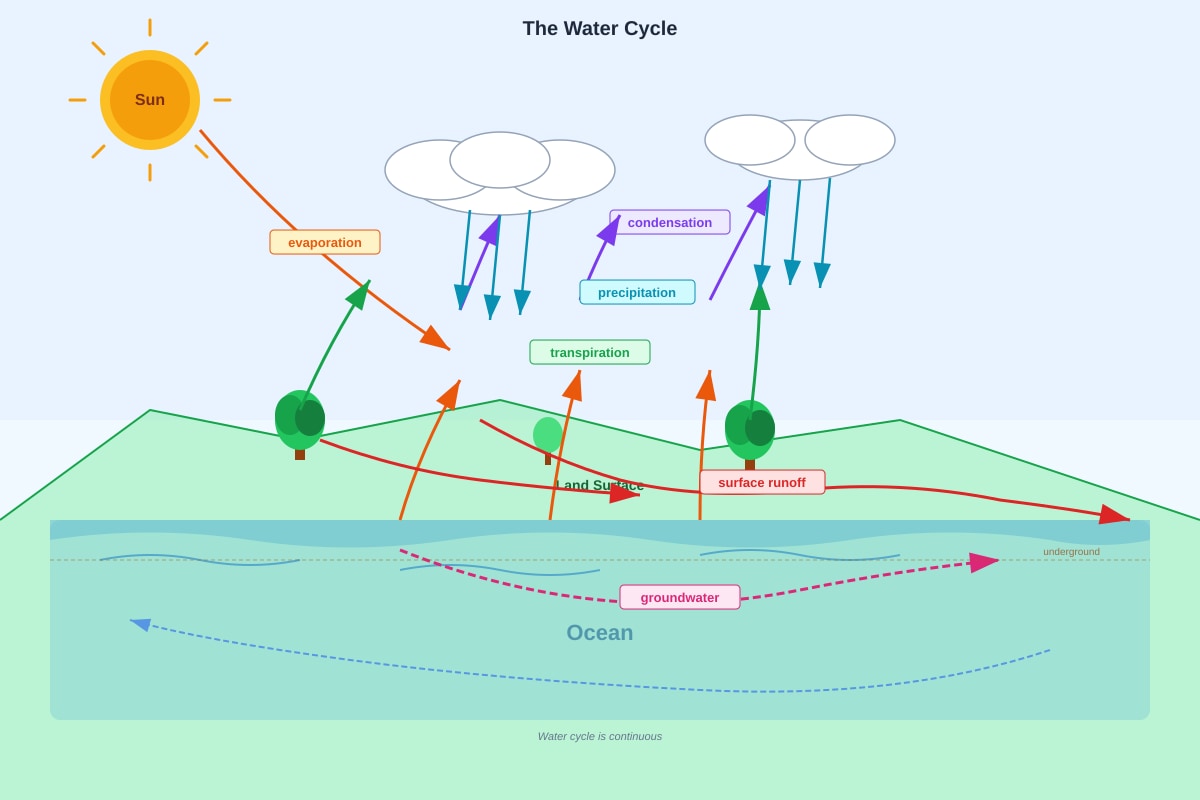
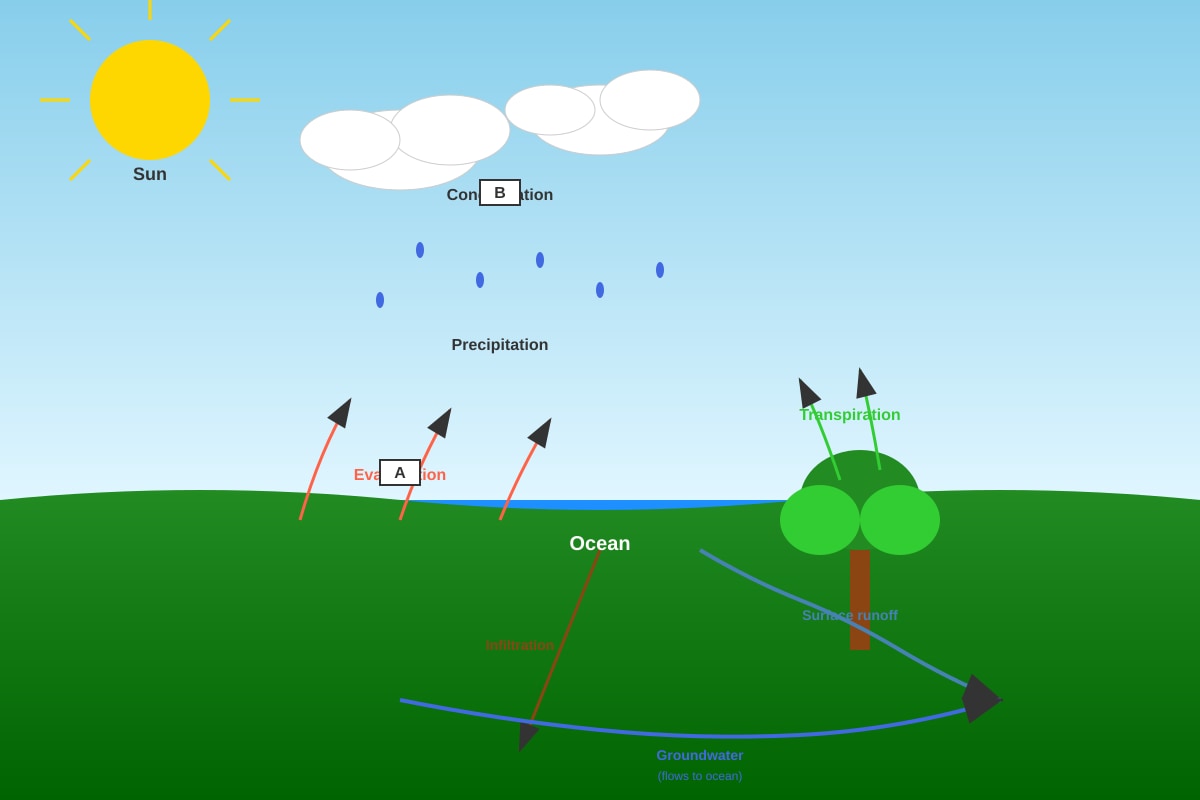
The diagram below shows the water cycle.
<image_placeholder> id: Q24-fig1 type: diagram linked_question: Q24 description: Water cycle with: Evaporation from ocean, Transpiration from plants, Condensation forming clouds, Precipitation (rain), Surface runoff, Groundwater flow back to ocean. Sun shown as energy source. All processes labelled. labels: Evaporation, Transpiration, Condensation, Precipitation, Surface Runoff, Groundwater, Sun values: None must_show: Complete cycle with all 6 processes, sun as energy source, arrows showing water movement </image_placeholder>
(a) Name the process labelled X where water vapour changes into tiny water droplets. ________________________ [1]
(b) The Sun plays an important role in the water cycle. State two processes in the water cycle that require heat from the Sun.
Process 1: _________________________________________________________________ [1]
Process 2: _________________________________________________________________ [1]
(c) Explain how deforestation (cutting down trees) can affect the water cycle.
___________________________________________________________________________ [1]
Question 25 [4 marks]
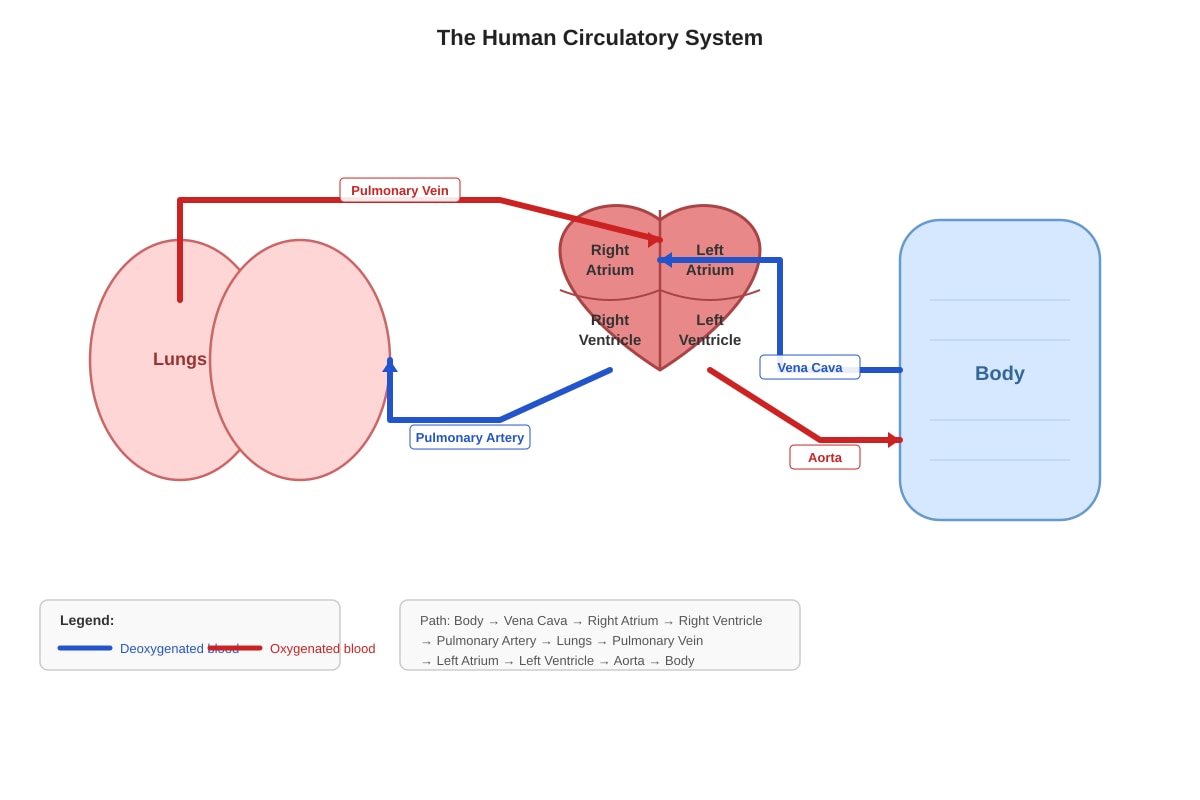
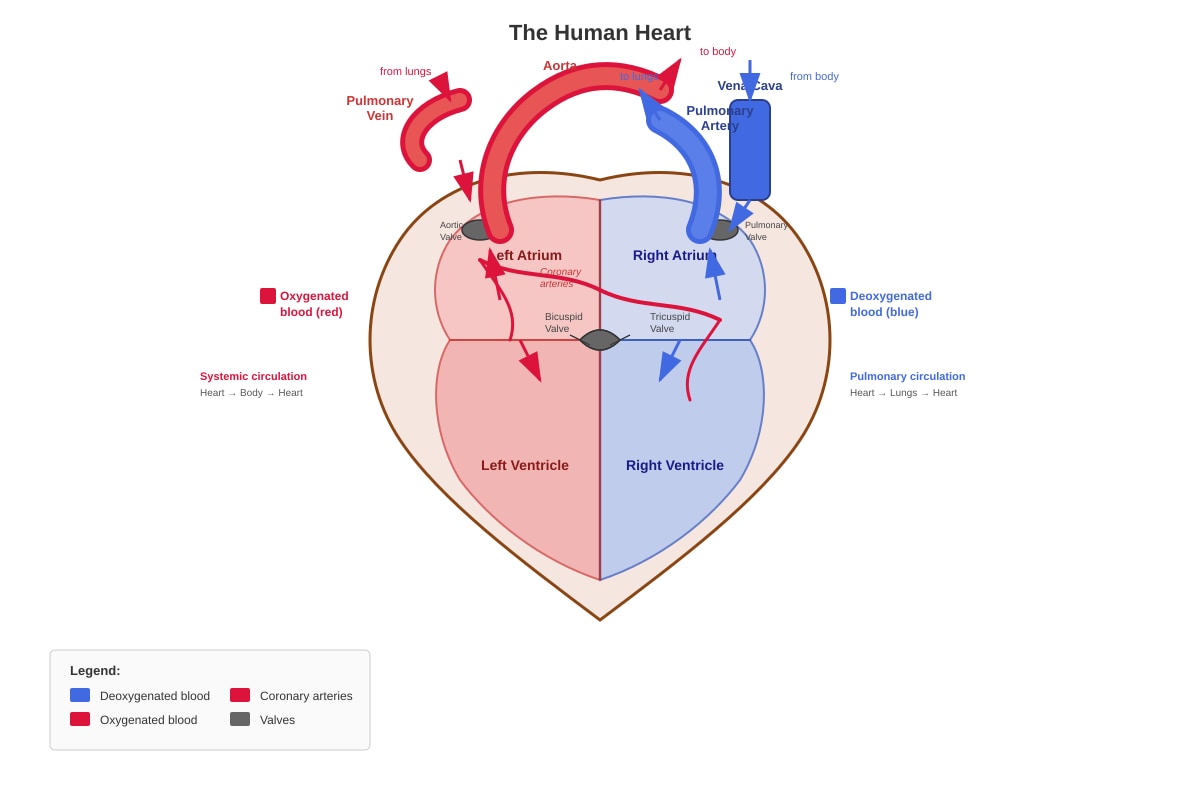
The diagram below shows the human circulatory system.
<image_placeholder> id: Q25-fig1 type: diagram linked_question: Q25 description: Simplified human circulatory system showing heart (4 chambers), lungs, body. Arrows showing deoxygenated blood (blue) → heart → lungs → oxygenated blood (red) → body → heart. Labels for all chambers and major vessels. labels: Right Atrium, Right Ventricle, Left Atrium, Left Ventricle, Lungs, Body, Pulmonary Artery, Pulmonary Vein, Aorta, Vena Cava values: None must_show: Double circulation clearly shown, colour-coded blood flow, all 4 chambers labelled </image_placeholder>
(a) Which chamber of the heart receives deoxygenated blood from the body? ________________________ [1]
(b) Name the blood vessel that carries oxygenated blood from the heart to the rest of the body. ________________________ [1]
(c) State one difference between arteries and veins.
___________________________________________________________________________ [1]
(d) Why is the circulatory system described as a "double circulation"?
___________________________________________________________________________ [1]
Question 26 [4 marks]
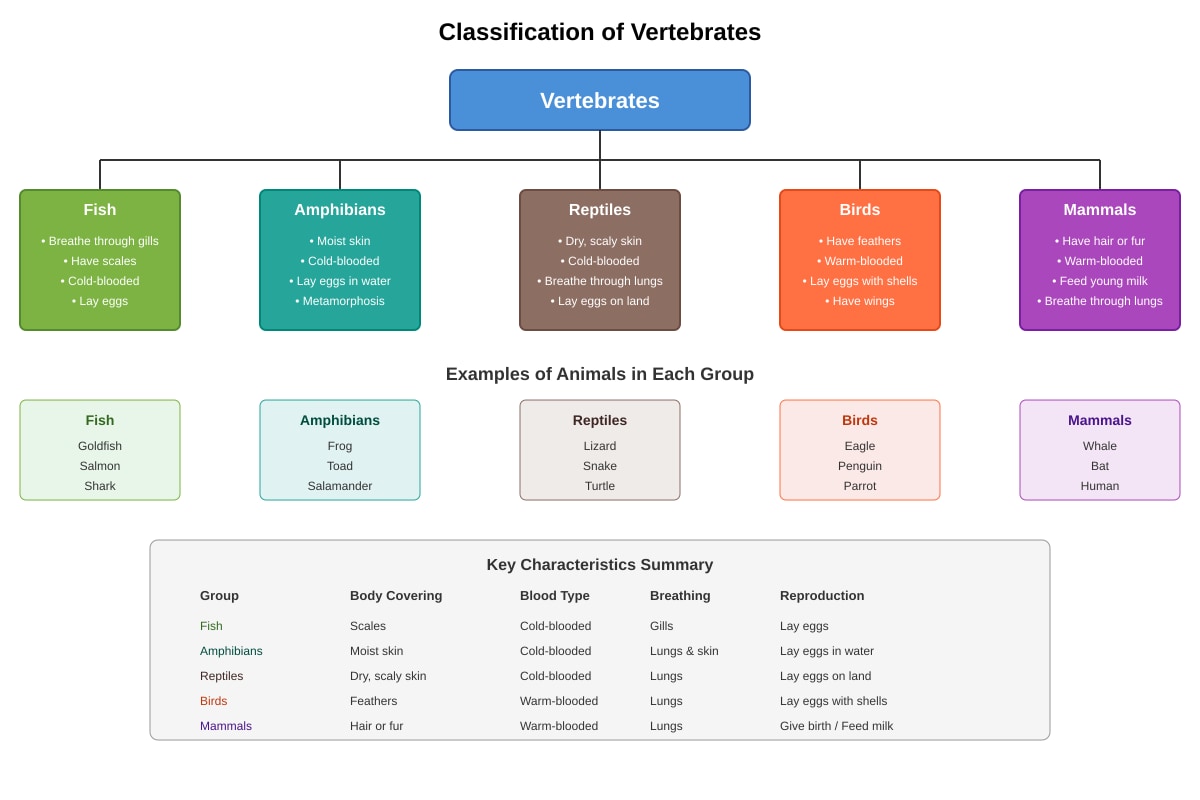
Study the classification table below.
| Group | Characteristics | Examples |
|---|---|---|
| A | Has backbone, breathes through lungs, has hair/fur, gives birth to live young, feeds young with milk | Human, Whale, Bat |
| B | Has backbone, breathes through lungs, has feathers, lays eggs | Eagle, Penguin, Ostrich |
| C | Has backbone, breathes through gills, has scales, lays eggs | Salmon, Goldfish, Shark |
| D | Has backbone, breathes through lungs and moist skin, lays eggs in water | Frog, Toad, Salamander |
| E | Has backbone, breathes through lungs, has dry scales, lays eggs | Snake, Lizard, Crocodile |
(a) Which group represents mammals? ________________________ [1]
(b) Which group represents birds? ________________________ [1]
(c) A student saw an animal that has a backbone, breathes through lungs, and has dry scales. Which group does it belong to? ________________________ [1]
(d) State one similarity between Group B and Group E.
___________________________________________________________________________ [1]
Section C: Open-Ended Questions (28 marks)
Write your answers in the spaces provided.
Question 27 [7 marks]
The diagram below shows a cell.
<image_placeholder> id: Q27-fig1 type: diagram linked_question: Q27 description: A plant cell with all major organelles labelled: Cell wall, Cell membrane, Cytoplasm, Nucleus, Chloroplasts, Large central vacuole, Mitochondria. Clear rectangular shape. labels: Cell wall, Cell membrane, Cytoplasm, Nucleus, Chloroplasts, Vacuole, Mitochondria values: None must_show: All 7 organelles clearly visible and labelled, plant cell shape </image_placeholder>
(a) Is this a plant cell or an animal cell? Give two reasons for your answer.
___________________________________________________________________________ [2]
(b) Name the part of the cell that controls all activities in the cell. ________________________ [1]
(c) In which part of the cell does photosynthesis take place? ________________________ [1]
(d) The cell membrane is described as "partially permeable". Explain what this means.
___________________________________________________________________________ [1]
(e) Plant cells have a large central vacuole. State its function.
___________________________________________________________________________ [1]
(f) Mitochondria are known as the "powerhouses of the cell". Explain why.
___________________________________________________________________________ [1]
Question 28 [7 marks]
The diagram below shows the life cycle of a flowering plant.
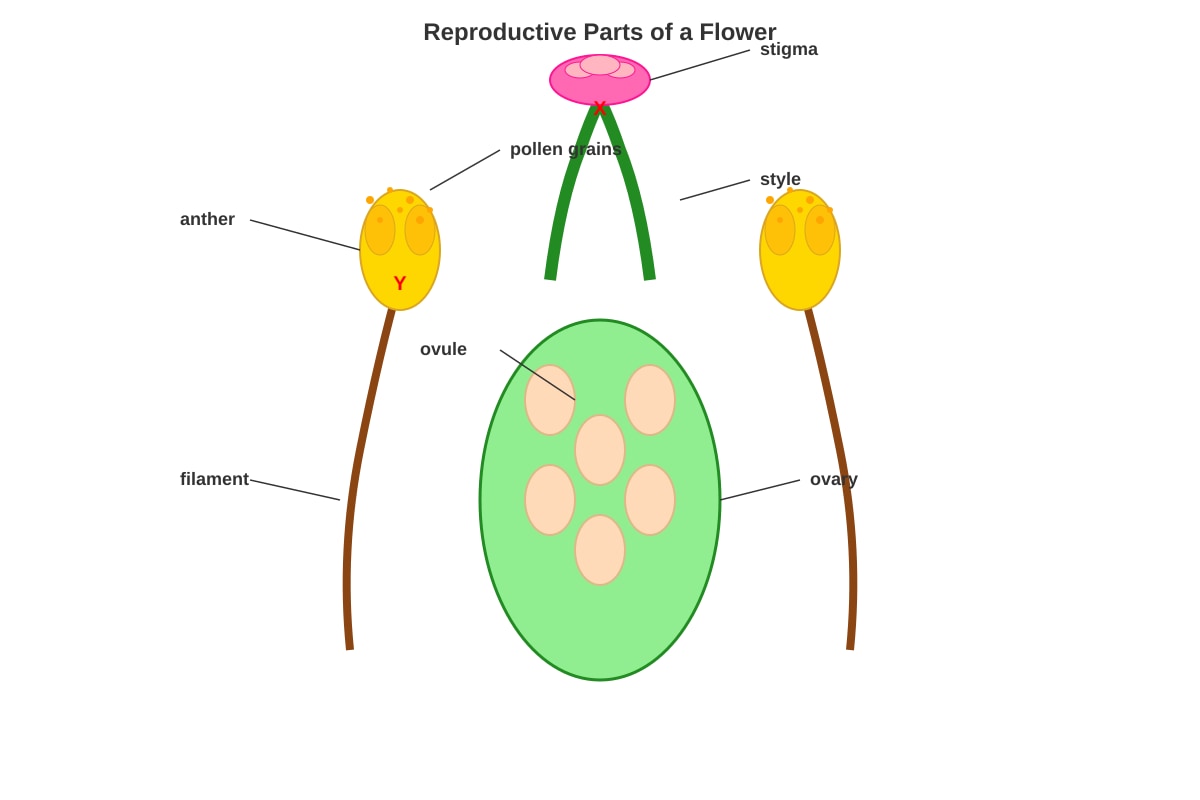
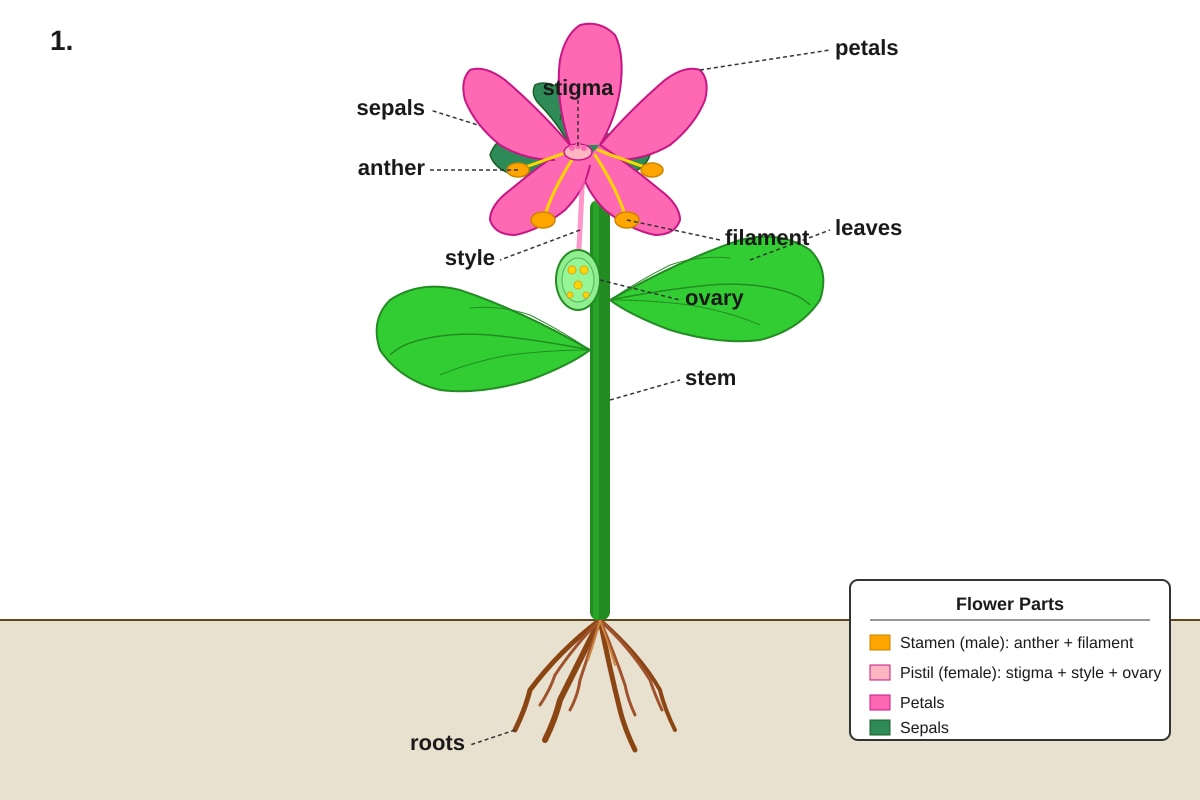
<image_placeholder> id: Q28-fig1 type: diagram linked_question: Q28 description: Detailed flowering plant life cycle: Seed → Germination (root, shoot) → Seedling → Adult Plant → Flower bud → Flower (stamen, pistil) → Pollination (insect/wind) → Fertilisation (pollen tube, ovule) → Fruit development → Seed dispersal (wind, water, animal, splitting) → back to Seed. All stages labelled. labels: Seed, Germination, Seedling, Adult Plant, Flower Bud, Flower (Stamen, Pistil), Pollination, Fertilisation, Fruit Development, Seed Dispersal values: None must_show: Complete cycle with pollination and fertilisation as distinct stages, seed dispersal methods shown </image_placeholder>
(a) Name the male and female reproductive parts of a flower.
Male part: ________________________ Female part: ________________________ [2]
(b) Describe the process of pollination.
___________________________________________________________________________ [2]
(c) What happens during fertilisation in a flowering plant?
___________________________________________________________________________ [1]
(d) State two ways in which seeds can be dispersed.
Way 1: _________________________________________________________________ [1]
Way 2: _________________________________________________________________ [1]
(e) Why is seed dispersal important for plants?
___________________________________________________________________________ [1]
Question 29 [7 marks]
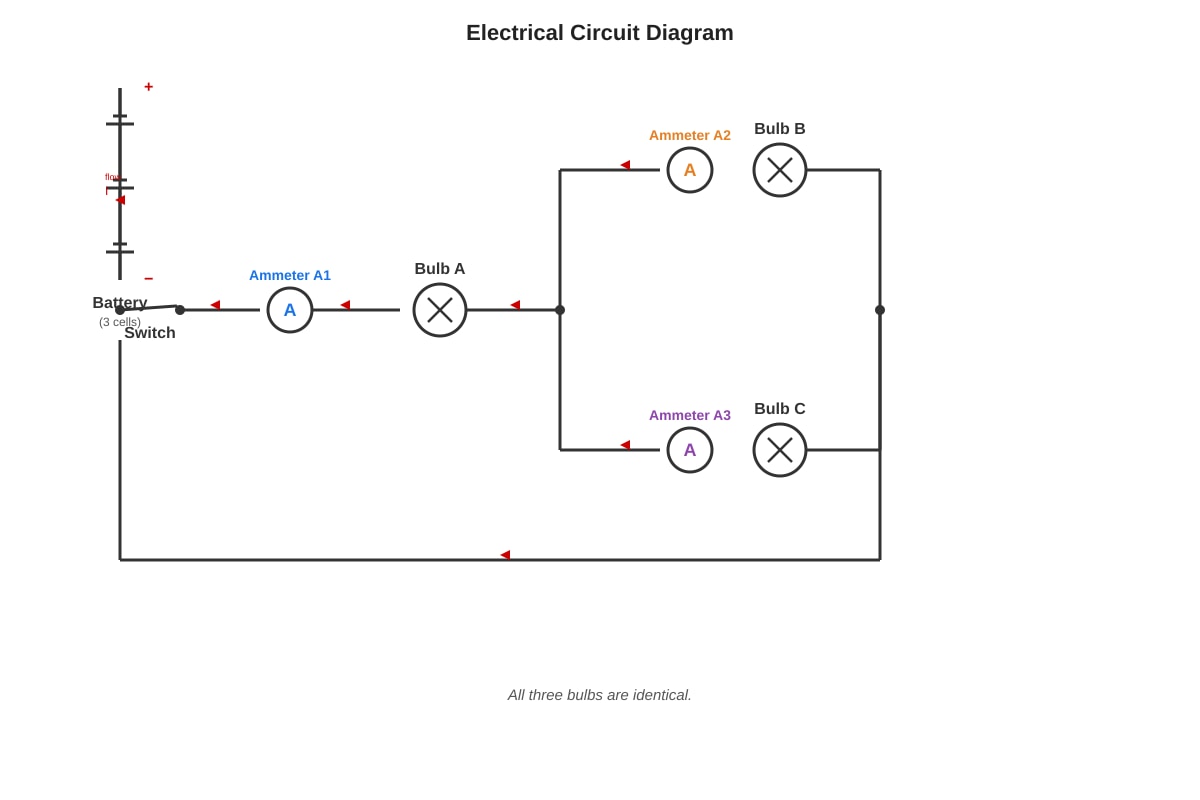
The diagram below shows an electrical circuit set-up.
<image_placeholder> id: Q29-fig1 type: diagram linked_question: Q29 description: Circuit with battery (3 cells), switch, and three bulbs. Bulbs A and B are in series with each other, and this series combination is in parallel with Bulb C. All components labelled. labels: Battery (3 cells), Switch (closed), Bulb A, Bulb B (in series), Bulb C (parallel to A+B), Connecting wires values: Battery: 3 cells (1.5V each = 4.5V total) must_show: Clear series-parallel combination, closed switch, voltage indicated </image_placeholder>
(a) Are the bulbs arranged in series, parallel, or a combination? ________________________ [1]
(b) If Bulb A fuses, what will happen to Bulb B and Bulb C? Explain.
Bulb B: _________________________________________________________________ Bulb C: _________________________________________________________________ [2]
(c) If the switch is opened, what will happen to all three bulbs?
___________________________________________________________________________ [1]
(d) The battery provides 4.5V. What is the voltage across Bulb C? ________________________ [1]
(e) State one advantage of using a combination circuit like this in household wiring.
___________________________________________________________________________ [1]
(f) Name a material that can be used to make the connecting wires. Explain why it is suitable.
Material: ________________________ Reason: _________________________________________________________________ [1]
Question 30 [7 marks]
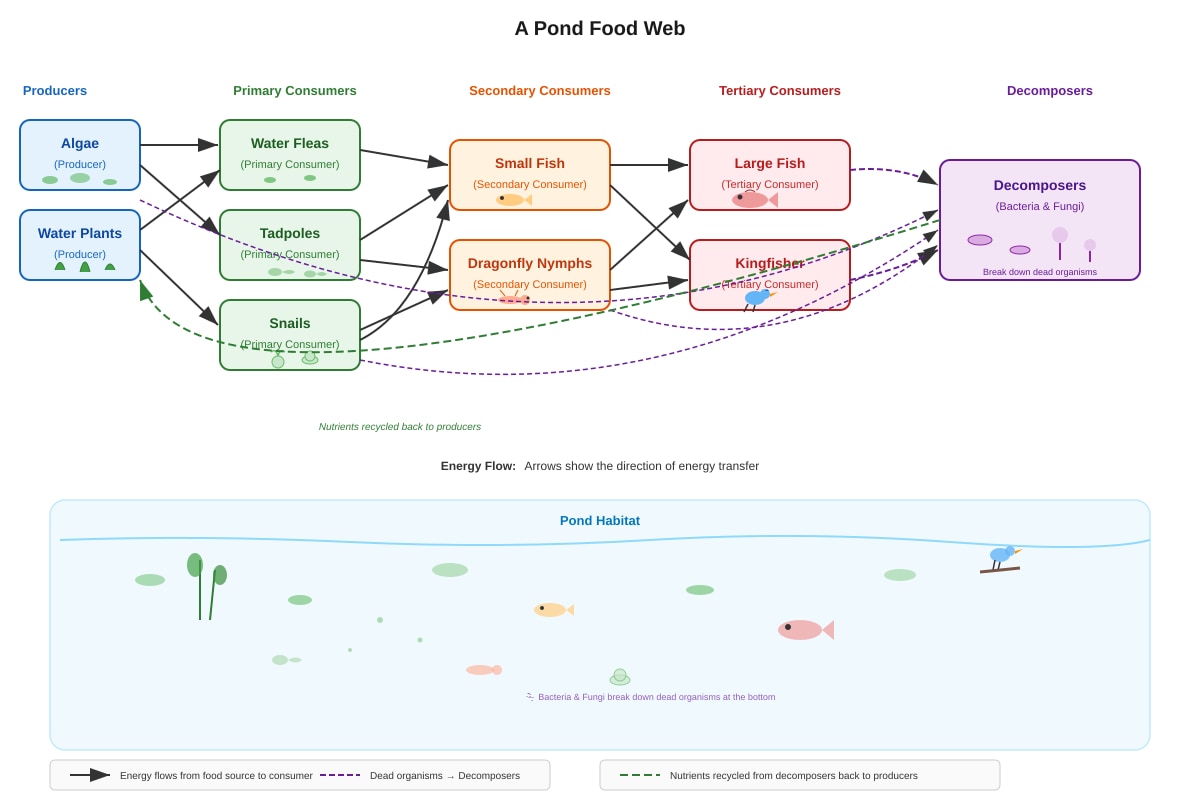
The diagram below shows a food web in a pond community.
<image_placeholder> id: Q30-fig1 type: diagram linked_question: Q30 description: Pond food web: Phytoplankton (producer) → Zooplankton, Tadpole, Water snail (primary consumers) → Small fish, Dragonfly nymph (secondary consumers) → Large fish, Kingfisher (tertiary consumers). Decomposers (bacteria, fungi) breaking down dead organisms at all levels. Arrows showing energy flow. labels: Phytoplankton, Zooplankton, Tadpole, Water Snail, Small Fish, Dragonfly Nymph, Large Fish, Kingfisher, Bacteria, Fungi values: None must_show: Clear trophic levels in aquatic setting, decomposers connected to all, energy flow arrows </image_placeholder>
(a) Name the producer in this food web. ________________________ [1]
(b) Construct a food chain with four organisms from this food web.
___________________________________________________________________________ [1]
(c) The population of zooplankton decreases due to water pollution. Explain how this will affect the population of small fish.
___________________________________________________________________________ [2]
(d) State the role of decomposers in this community.
___________________________________________________________________________ [1]
(e) Energy is transferred from one organism to another in the food web. State the main source of energy for this community.
___________________________________________________________________________ [1]
(f) Explain why the population of phytoplankton is much larger than the population of kingfishers.
___________________________________________________________________________ [1]
End of Paper
Answers
TuitionGoWhere Practice Paper - Science Primary 5 (Answer Key)
Subject: Science
Level: Primary 5
Paper: Practice Paper 5 (Version 5)
Total Marks: 100
Section A: Multiple-Choice Questions (28 marks)
Question 1 [2 marks]
Answer: (3)
Explanation: All living things respond to changes in their surroundings (sensitivity). This is one of the seven characteristics of living things.
- Option (1) is incorrect: Only plants (producers) make their own food; animals and fungi cannot.
- Option (2) is incorrect: Many animals give birth to live young (mammals); some reproduce by budding or spores.
- Option (4) is incorrect: Some microorganisms (anaerobic bacteria) do not need oxygen; plants need carbon dioxide for photosynthesis.
Question 2 [2 marks]
Answer: (1)
Explanation: Mushroom, yeast, and mould are all fungi. Rose plant is a flowering plant; moss and fern are non-flowering plants (they reproduce by spores, not seeds).
Question 3 [2 marks]
Answer: (2)
Explanation: The cell has a cell wall and chloroplasts, which are features of plant cells. Animal cells lack both. Bacterial cells lack a nucleus and membrane-bound organelles. Fungal cells have cell walls (made of chitin) but no chloroplasts.
Question 4 [2 marks]
Answer: (4)
Explanation:
- Bala is correct: Some microorganisms (e.g., algae, cyanobacteria) can photosynthesise and make their own food.
- Devi is correct: Yeast is a single-celled fungus, a microorganism.
- Ali is incorrect: Many microorganisms are beneficial (e.g., yeast in bread, bacteria in yoghurt, decomposers).
- Cindy is incorrect: Some microorganisms (e.g., bread mould, mushroom) can be seen with the naked eye.
Question 5 [2 marks]
Answer: (2)
Explanation: After pollination (transfer of pollen to stigma), the pollen tube grows down the style and fertilisation occurs (fusion of male and female reproductive cells).
Question 6 [2 marks]
Answer: (1)
Explanation: Mosquitoes undergo complete metamorphosis: Egg → Larva → Pupa → Adult. Nymph stage is found in incomplete metamorphosis (e.g., grasshopper, cockroach).
Question 7 [2 marks]
Answer: (4)
Explanation: Following the flowchart: No feathers → No hair/fur → No moist skin → Reptile. Reptiles have dry scaly skin, lay eggs, and breathe through lungs.
Question 8 [2 marks]
Answer: (1)
Explanation: Organism P has a backbone, lays eggs, breathes through lungs, but has no feathers or hair/fur. This matches a reptile.
- Q has hair/fur → Mammal
- R has no backbone, no lungs → likely amphibian (but breathes through gills/skin) or fish
- S has feathers → Bird
Question 9 [2 marks]
Answer: (4)
Explanation: The skeletal system protects organs, gives shape/support, and produces blood cells (in bone marrow). Removing waste is the function of the excretory system (kidneys, skin, lungs).
Question 10 [2 marks]
Answer: (3)
Explanation: The pulp cavity contains nerves and blood vessels. Enamel is the hard outer layer; dentine is beneath enamel; crown is the visible part above gum.
Question 11 [2 marks]
Answer: (4)
Explanation: Protein digestion begins in the stomach (enzyme pepsin). Starch digestion begins in the mouth (salivary amylase). The small intestine absorbs digested food; the large intestine absorbs water.
Question 12 [2 marks]
Answer: (2)
Explanation: Grasshoppers are the food source for frogs. Fewer grasshoppers → less food for frogs → frog population decreases.
Question 13 [2 marks]
Answer: (3)
Explanation: In a series circuit, there is only one path for current. If one bulb fuses (filament breaks), the circuit is open and all bulbs go off.
Question 14 [2 marks]
Answer: (3)
Explanation: Copper is a metal and a good conductor of electricity. Rubber, plastic, and wood are insulators.
Section B: Structured Questions (44 marks)
Question 15 [4 marks]
(a) [3 marks]
- Organism A (fern): Non-flowering plant
- Organism B (mushroom): Fungi
- Organism C (balsam): Flowering plant
(b) [1 mark]
- Fern (Organism A) reproduces by spores (produced on the underside of fronds).
- Balsam (Organism C) reproduces by seeds (formed after fertilisation in flowers).
Accept: "Fern reproduces by spores; balsam reproduces by seeds."
Question 16 [3 marks]
(a) [1 mark]
- Cell wall / Chloroplasts / Large central vacuole (any one)
(b) [1 mark]
- Cell wall: Gives the cell a fixed/regular shape and provides support/protection.
- Chloroplasts: Contain chlorophyll to trap light energy for photosynthesis.
- Large central vacuole: Stores water and substances; keeps the cell turgid/firm.
Match function to structure chosen in (a).
(c) [1 mark]
- The nucleus controls all activities in the cell / contains genetic material (DNA) that determines the cell's characteristics.
Question 17 [4 marks]
(a) [1 mark]
- Bat (has hair/fur, gives birth to live young, feeds young with milk, constant body temperature)
(b) [1 mark]
- Penguin and Bat (both have constant body temperature → warm-blooded)
(c) [2 marks]
- Similarity: Both have a body covering that protects the body / Both are vertebrates.
- Difference: Frog has moist skin; crocodile has dry scales.
Accept: Frog can breathe through skin; crocodile cannot.
Question 18 [3 marks]
(a) [1 mark]
- Small intestine (digestion ends here; absorption of digested food occurs here)
(b) [1 mark]
- Liver (produces bile; stored in gall bladder)
(c) [1 mark]
- The large intestine absorbs water and mineral salts from undigested food, forming faeces.
Question 19 [4 marks]
(a) [1 mark]
- Grasshopper and Rabbit / Caterpillar (any two primary consumers that eat grass)
(b) [1 mark]
- Frog / Bird / Snake (any organism that eats another and is eaten by another)
Example: Frog eats grasshopper (predator) and is eaten by snake (prey).
(c) [2 marks]
- Hawks eat snakes. If snakes are removed, hawks lose a food source.
- Hawk population will decrease due to less food available.
Alternative: Hawks may eat more birds/frogs, but overall food decreases → population drops.
Question 20 [4 marks]
(a) [1 mark]
- Pupa / Chrysalis (stage X in the diagram)
(b) [2 marks]
- Difference 1: Larva (caterpillar) has a long, segmented body with many legs; adult butterfly has three body parts (head, thorax, abdomen), six legs, and two pairs of wings.
- Difference 2: Larva eats leaves (chewing mouthparts); adult butterfly sucks nectar (proboscis).
Other valid differences: Larva crawls; adult flies. Larva has simple eyes; adult has compound eyes.
(c) [1 mark]
- The pupa stage allows complete transformation (metamorphosis) of the caterpillar's body into the adult butterfly with wings, different mouthparts, and reproductive organs.
Question 21 [4 marks]
(a) [2 marks]
- Bulb 2 and Bulb 3 will remain lit with the same brightness.
- In a parallel circuit, each bulb has its own path to the battery. If one bulb fuses, the other paths are unaffected.
(b) [1 mark]
- If one bulb fuses, the others stay lit / Each bulb can be controlled independently / Each bulb receives the full voltage and shines at maximum brightness.
(c) [1 mark]
- 3V (In a parallel circuit, voltage across each branch is the
<stage5_exam_answers_md>
TuitionGoWhere Practice Paper - Science Primary 5 (Answer Key)
Subject: Science
Level: Primary 5
Paper: Practice Paper 5 (Version 5)
Total Marks: 100
Section A: Multiple-Choice Questions (28 marks)
| Question | Answer | Explanation |
|---|---|---|
| 1 | (3) | All living things respond to changes in their surroundings. This is one of the key characteristics of living things. Not all living things make their own food (only plants), reproduce by laying eggs (mammals give birth), or need oxygen (some microorganisms are anaerobic). |
| 2 | (1) | Group X: Mushroom, Yeast, Mould are fungi. Group Y: Rose plant (flowering), Moss, Fern (non-flowering) are plants. Rose plant is a flowering plant; moss and fern are non-flowering plants. |
| 3 | (2) | The cell has a cell wall and chloroplasts, which are characteristic of plant cells. Animal cells lack cell walls and chloroplasts. Bacterial cells lack a nucleus and membrane-bound organelles. Fungal cells have cell walls (made of chitin) but no chloroplasts. |
| 4 | (4) | Bala: Some microorganisms (e.g., algae, cyanobacteria) can photosynthesise and make their own food. Devi: Yeast is a fungus, which is a microorganism. Ali is incorrect - many microorganisms are beneficial. Cindy is incorrect - some microorganisms (e.g., bread mould) can be seen with the naked eye. |
| 5 | (2) | After pollination (transfer of pollen to stigma), fertilisation occurs (fusion of male and female gametes). |
| 6 | (1) | Mosquitoes undergo complete metamorphosis: Egg → Larva → Pupa → Adult. Nymph stage is in incomplete metamorphosis (e.g., grasshopper). |
| 7 | (4) | Organism A lays eggs, has dry scaly skin, and breathes through lungs → Reptile. Birds have feathers. Mammals have hair/fur and most give birth to live young. Amphibians have moist skin. |
| 8 | (1) | Organism P: Has backbone, lays eggs, no feathers, no hair/fur, breathes through lungs → Reptile. Q: Has hair/fur → Mammal. R: No backbone → Invertebrate. S: Has feathers → Bird. |
| 9 | (4) | The skeletal system protects organs, gives shape/support, and produces blood cells (in bone marrow). Removing waste is the function of the excretory system (kidneys, skin, lungs). |
| 10 | (3) | The pulp cavity contains nerves and blood vessels. Enamel is the hard outer layer. Dentine is beneath enamel. Crown is the visible part of the tooth above the gum. |
| 11 | (4) | Protein digestion begins in the stomach (with pepsin). Starch digestion begins in the mouth (salivary amylase). Small intestine absorbs digested food. Large intestine absorbs water. |
| 12 | (2) | Grasshoppers are the food source for frogs. Fewer grasshoppers → less food for frogs → frog population decreases. |
| 13 | (3) | In a series circuit, if one bulb fuses (breaks the circuit), current cannot flow and all bulbs go off. |
| 14 | (3) | Copper is a metal and a good conductor of electricity. Rubber, plastic, and wood are insulators. |
Section B: Structured Questions (44 marks)
Question 15 [4 marks]
(a) Organism A: Non-flowering Plant (Fern)
Organism B: Fungi (Mushroom)
Organism C: Flowering Plant (Balsam)
(b) Organism A (fern) reproduces by spores produced on the underside of fronds, while Organism C (balsam) reproduces by seeds formed after fertilisation in flowers.
Question 16 [3 marks]
(a) Cell wall (or chloroplasts or large central vacuole)
(b) Cell wall: Gives the cell a fixed/regular shape and provides structural support and protection.
OR Chloroplasts: Contain chlorophyll to trap light energy for photosynthesis.
OR Large central vacuole: Stores water and substances, maintains turgidity.
(c) The nucleus controls all activities in the cell and contains genetic material (DNA/chromosomes) that carries hereditary information.
Question 17 [4 marks]
(a) Bat
(b) Penguin and Bat (both have constant body temperature / are warm-blooded)
(c) Similarity: Both have a body covering that protects their body.
Difference: Frog has moist skin while crocodile has dry scales. (OR: Frog can breathe through its skin; crocodile cannot.)
Question 18 [3 marks]
(a) Small intestine
(b) Liver
(c) The large intestine absorbs water and mineral salts from undigested food, forming faeces.
Question 19 [4 marks]
(a) Grasshopper and Rabbit (or Caterpillar - any two of the three primary consumers)
(b) Frog (or Bird, or Snake - e.g., Frog eats grasshopper but is eaten by snake)
(c) The hawk population will decrease. Snakes are a food source for hawks. With no snakes, hawks have less food available, leading to starvation and a decline in their population.
Question 20 [4 marks]
(a) Pupa (or Chrysalis)
(b) Difference 1: Larva (caterpillar) has a worm-like body with many legs (prolegs), while adult butterfly has 6 legs and wings.
Difference 2: Larva feeds on leaves (chewing mouthparts), while adult butterfly feeds on nectar (proboscis/siphoning mouthparts).
(Other valid differences: size, appearance, habitat, mobility)
(c) The pupa stage is when metamorphosis occurs - the larva's body is broken down and reorganised into the adult form. It is a non-feeding, transformational stage where major structural changes happen.
Question 21 [4 marks]
(a) Bulb 2 and Bulb 3 will remain lit with the same brightness. In a parallel circuit, each bulb has its own path for current. If one bulb fuses, the circuit for the other bulbs is not broken, so they continue to receive the full voltage.
(b) If one bulb fuses, the other bulbs continue to light up. (OR: Each bulb receives the full voltage and shines at maximum brightness; bulbs can be switched on/off independently.)
(c) 3V (In a parallel circuit, the voltage across each branch is the same as the voltage of the battery.)
Question 22 [4 marks]
(a) Trachea (or Windpipe)
(b) Alveoli (or Air sacs)
(c) The alveoli have thin walls (one cell thick), are surrounded by a dense network of blood capillaries, and have a large surface area (due to numerous alveoli) to allow rapid diffusion of oxygen into the blood and carbon dioxide out of the blood.
(d) When we inhale, the diaphragm contracts and moves downwards, and the ribs move up and out. This increases the volume of the chest cavity, decreasing the pressure inside the lungs, so air rushes in.
Question 23 [4 marks]
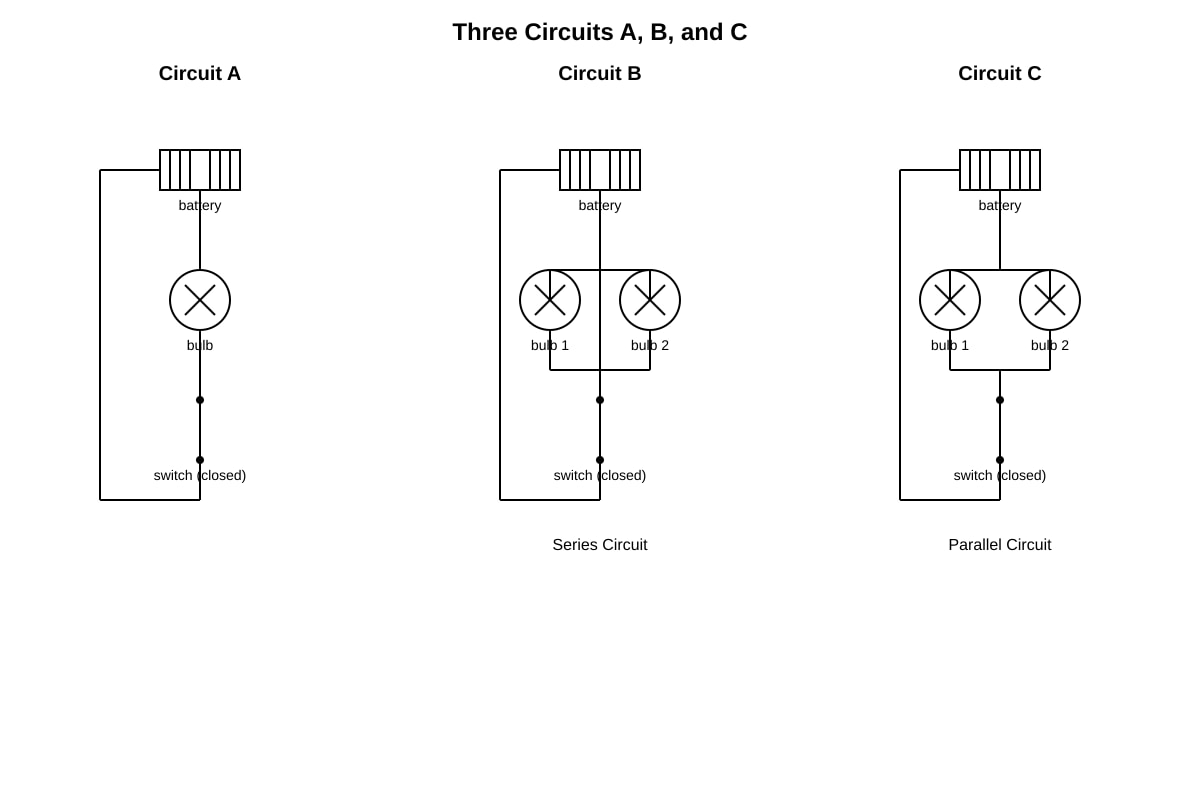
(a) Circuit A: Series circuit
Circuit B: Parallel circuit
(b) Circuit B (Parallel circuit). In a parallel circuit, each bulb receives the full voltage from the battery, so they shine at normal brightness. In a series circuit, the voltage is shared between the bulbs, so each bulb is dimmer.
(c) The other bulbs will remain lit. In a parallel circuit, each bulb is on a separate branch. Removing one bulb does not break the circuit for the others.
(d) Ammeter (connected in series with the circuit/component).
Question 24 [4 marks]
(a) Solid
(b) Liquid
(c) Gas
(d) Process X: Melting (or Fusion)
Process Y: Boiling (or Evaporation/Vaporisation)
Question 25 [4 marks]
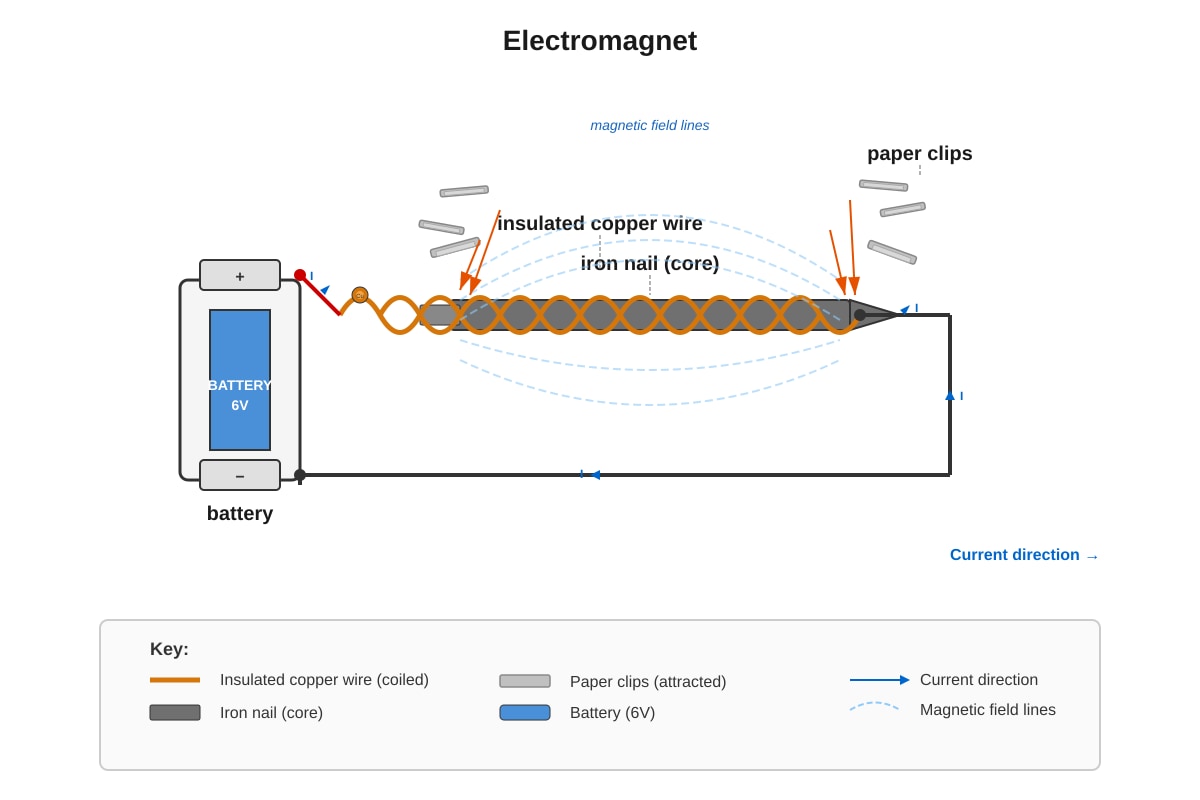
(a) Magnetic (or Made of magnetic material like iron/steel/nickel/cobalt)
(b) Increase the number of coils of wire around the nail (OR: Increase the current/voltage by adding more batteries; use a soft iron core).
(c) Bring the electromagnet near some steel paper clips/iron nails and see if they are attracted. (OR: Switch on the circuit and test if it can pick up magnetic materials.)
(d) Crane in a junkyard lifting scrap metal (OR: Electric bell, magnetic door lock, Maglev train, separating magnetic from non-magnetic materials).
Question 26 [4 marks]
(a) Light travels in straight lines. The opaque book blocks the light, preventing it from reaching the screen, so a shadow is formed.
(b) The shadow becomes larger. When the book is moved closer to the torch, it blocks more of the spreading light rays, casting a bigger shadow on the screen.
(c) Move the screen further away from the book (OR: Move the torch closer to the book).
(d) A shadow is dark/black and shows only the outline/shape of the object. A reflection shows the colours and details of the object and is formed on a smooth, shiny surface.
Question 27 [4 marks]
(a) Heat gain (The ice cream gains heat from the warmer surroundings.)
(b) Melting
(c) The temperature of the ice cream remains constant at 0°C during melting. (Heat gained is used to overcome forces between particles/change state, not increase temperature.)
(d) Use a cooler box/insulated container (OR: Wrap in newspaper/aluminium foil/towel; keep in a shaded/cool place; add ice packs).
Question 28 [4 marks]
(a) Water vapour in the surrounding air loses heat to the cold surface of the glass, condenses into tiny water droplets.
(b) There is more water vapour in the air in the bathroom (higher humidity) due to the hot shower. More water vapour condenses on the cooler mirror surface.
(c) Water cycle
(d) The water droplets on the grass (dew) gain heat from the Sun and evaporate into water vapour. (OR: The Sun heats the ground/grass, causing the dew to evaporate.)
Section C: Open-Ended Questions (28 marks)
Question 29 [4 marks]
(a) Cell wall - gives plant cell a fixed shape and provides support.
Chloroplasts - contain chlorophyll to trap light for photosynthesis.
Large central vacuole - stores water and cell sap, maintains turgidity.
(Any two, 1 mark each)
(b) Cell membrane - controls the movement of substances in and out of the cell / partially permeable.
(c) Root hair cell - has a long, narrow projection (root hair) that increases surface area for absorption of water and mineral salts from the soil.
(d) Red blood cell - has no nucleus (in mammals) to carry more oxygen; biconcave disc shape increases surface area for efficient diffusion of oxygen; contains haemoglobin that binds to oxygen for transport.
Question 30 [4 marks]
(a) Fertilisation is the fusion of the male gamete (sperm) and female gamete (egg) to form a zygote.
Pollination is the transfer of pollen grains from the anther to the stigma of a flower.
(b) Wind-pollinated flowers: Small, dull-coloured petals; no nectar/scent; large, feathery stigma hanging outside; long, dangling stamens; light, smooth pollen grains.
Insect-pollinated flowers: Large, brightly coloured petals; sweet nectar/scent; sticky stigma inside flower; short, stiff stamens; heavy, sticky/spiky pollen grains.
(Any two differences, 1 mark each)
(c) Sepal - protects the flower bud before it opens.
Petal - attracts pollinators (insects/birds) with bright colours/scent.
Stamen (Anther + Filament) - male reproductive part; anther produces pollen grains (male gametes).
Pistil/Carpel (Stigma + Style + Ovary) - female reproductive part; stigma receives pollen; ovary contains ovules (female gametes).
(Any two parts with correct functions, 1 mark each)
Question 31 [4 marks]
(a) The heart pumps deoxygenated blood to the lungs to pick up oxygen, then pumps oxygenated blood to the rest of the body. It acts as a double pump: right side → lungs; left side → body.
(b) Arteries: Thick, muscular, elastic walls to withstand high pressure; carry blood away from the heart (usually oxygenated).
Veins: Thinner walls, larger lumen, have valves to prevent backflow; carry blood towards the heart (usually deoxygenated) at low pressure.
Capillaries: Walls are one cell thick for exchange of substances; very narrow, form dense networks.
(Any two differences between any two types, 2 marks total)
(c) William Harvey discovered the circulation of blood - that blood flows in a continuous circuit from the heart to the body and back, pumped by the heart (not consumed and produced by the liver as previously believed).
Question 32 [4 marks]
(a) Producer - makes its own food through photosynthesis (traps light energy, converts to chemical energy); forms the base of the food chain/web.
(b) Energy is lost as heat during respiration/life processes at each trophic level (only ~10% transferred). Also, not all parts are eaten, and not all eaten is digested/absorbed.
(c) Decomposers (bacteria and fungi) break down dead organisms and waste, returning nutrients/mineral salts to the soil/environment for producers to reuse. They recycle nutrients in the ecosystem.
(d) Pyramid of numbers shows the number of individual organisms at each trophic level. Pyramid of biomass shows the total dry mass of organisms at each level. Pyramid of numbers can be inverted (e.g., one tree → many insects); pyramid of biomass is usually upright.
Question 33 [4 marks]
(a) Conduction - transfer of heat through a solid by vibration of particles (no movement of particles from one place to another).
Convection - transfer of heat in fluids (liquids/gases) by the movement of the fluid itself (hotter, less dense fluid rises; cooler, denser fluid sinks).
(b) Metals are good conductors of heat. The metal spoon conducts heat from the hot soup to the handle quickly, making it hot to touch.
(c) The heating element is placed at the bottom. It heats the water at the bottom → water expands, becomes less dense, rises → cooler water at top sinks → convection current forms, heating all water evenly.
(d) Vacuum flask - has a double-walled glass container with a vacuum between the walls (stops conduction and convection). Inner walls are silvered (reflects radiated heat back). Stopper/lid is made of plastic/cork (poor conductor). Outer casing provides insulation.
Question 34 [4 marks]
(a) The magnet attracts the steel paper clip. The magnetic force acts through the non-magnetic plastic ruler (magnetic force can pass through non-magnetic materials).
(b) Stroke the steel rod with a magnet in one direction repeatedly (using the same pole of the magnet each time). OR: Place the steel rod in a solenoid and pass direct current through it.
(c) Like poles repel, unlike poles attract. The north pole of the floating magnet repels the north pole of the fixed magnet, creating an upward magnetic force that balances the weight of the floating magnet.
(d) Maglev (Magnetic Levitation) train - uses repulsion between like poles (or attraction) to levitate the train above the track, reducing friction for high speed. (OR: Magnetic bearings, floating display platforms.)
Question 35 [4 marks]
(a) The solar panel converts light energy from the Sun into electrical energy.
(b) Electrical energy → Kinetic energy + Sound energy + Heat energy (in the motor/fan).
(c) The fan will slow down and stop. When the solar panel is covered, no light reaches it, so no electrical energy is produced to power the motor.
(d) Renewable energy source (Sunlight is inexhaustible). No pollution/greenhouse gases produced during operation. Low maintenance once installed. Can be installed on rooftops (no extra land needed). (Any two advantages)
End of Answer Key