AI Generated Exam Paper

Primary 5 Science Practice Paper 5

Free Kimi AI-generated P5 Science Practice Paper 5 with questions, answers, and syllabus-aligned practice for Singapore students preparing for exams.

These static practice materials are generated from the site's syllabus and paper-generation workflow, with source and model context shown so students and parents can evaluate the material before use.

Primary 5 Science AI Generated Generated by Kimi K2.6 Free Updated 2026-06-09

Questions

<!-- TuitionGoWhere generation metadata: stage=5-2; model=moonshotai/kimi-k2.6:free; model_label=Kimi K2.6 Free; generated=2026-06-09; Sources: Stage 4-0 LLM templates, syllabus context, and Stage 2 evidence where available. -->

TuitionGoWhere Practice Paper - Science Primary 5

TuitionGoWhere Practice Paper (AI)

Subject:Science
Level:Primary 5
Paper:Practice Paper - Diversity (Version 5 of 5)
Duration:1 hour 15 minutes
Total Marks:60
Name:___________________________
Class:___________________________
Date:___________________________

Instructions

  • Write your name, class, and date on this paper.
  • Read each question carefully before answering.
  • Write your answers in the spaces provided.
  • For questions requiring explanation, give your answer in complete sentences.
  • Use scientific terms where appropriate.
  • You may use a ruler and pencil for diagrams.
  • Check your work before handing in.

Section A: Multiple Choice (20 marks)

Answer all questions. Each question carries 1 mark.


1. Which of the following is NOT a characteristic of living things?

A. They can reproduce B. They can grow C. They can rust D. They can respond to changes


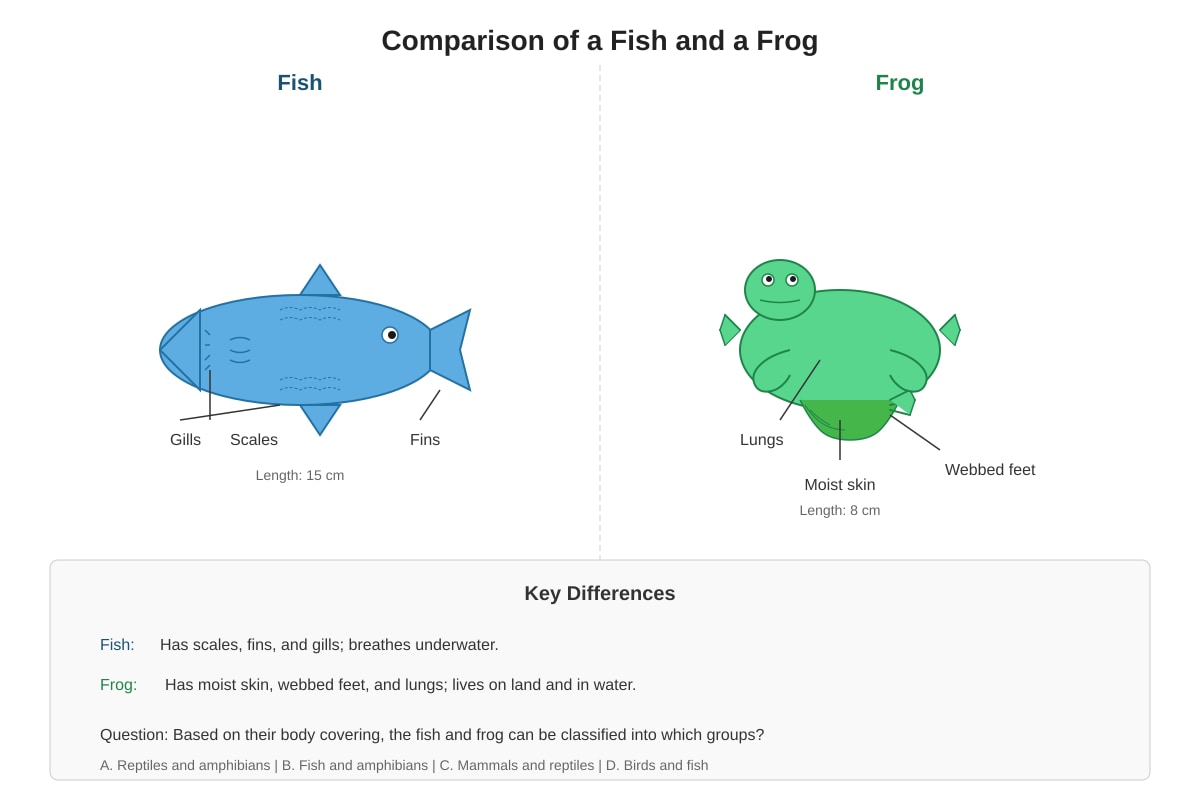
2. The diagram below shows two animals.

<image_placeholder> id: Q2-fig1 type: diagram linked_question: Q2 description: Side-by-side comparison of a fish and a frog labels: Fish (left) - scales, fins, gills; Frog (right) - moist skin, webbed feet, lungs values: Fish length 15 cm; Frog length 8 cm must_show: Key external features allowing identification of each animal group; both animals in clear profile view; labels pointing to distinguishing features </image_placeholder>

Based on their body covering, the fish and frog can be classified into which groups?

A. Reptiles and amphibians B. Fish and amphibians C. Mammals and reptiles D. Birds and fish


3. Which group of animals has hair or fur on their bodies?

A. Birds B. Fish C. Mammals D. Reptiles


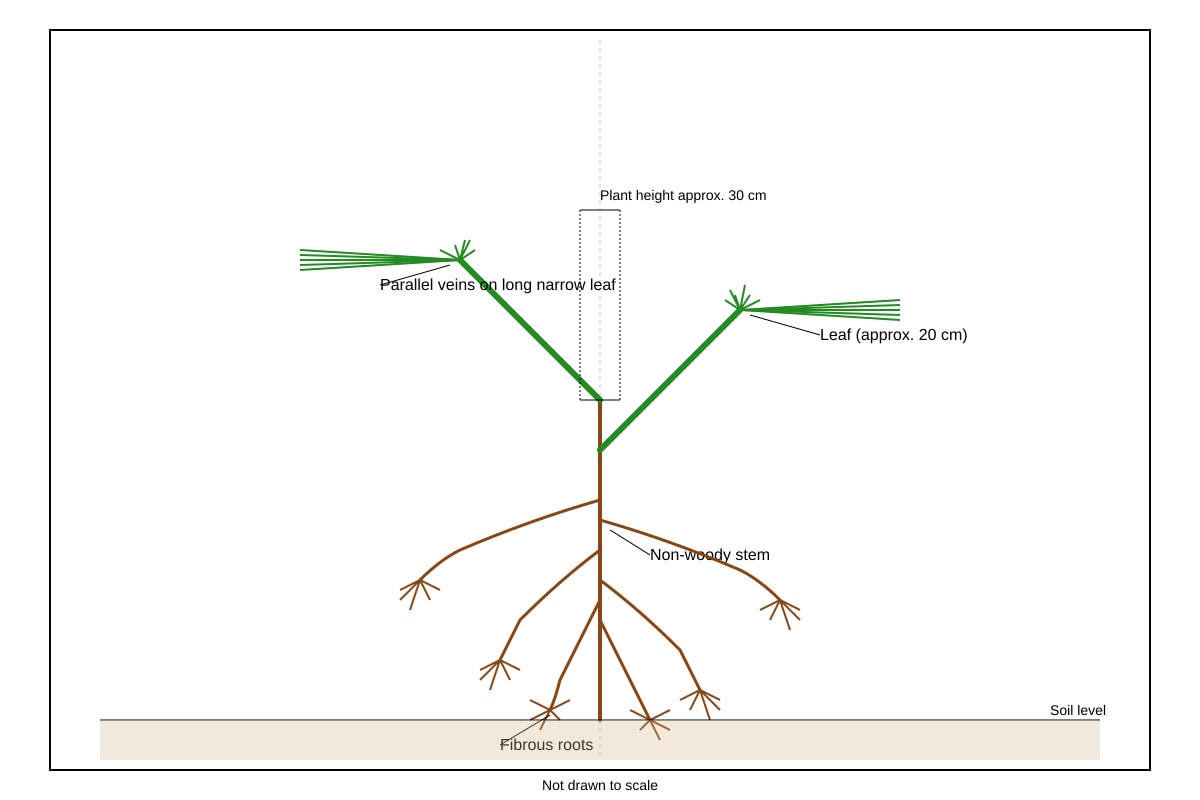
4. The plant shown below has fibrous roots and parallel leaf veins.

<image_placeholder> id: Q4-fig1 type: diagram linked_question: Q4 description: A grass-like plant with visible root system and leaf structure labels: Fibrous roots, parallel veins on long narrow leaf, non-woody stem values: Plant height approximately 30 cm; leaf length 20 cm must_show: Clear fibrous root spread; parallel venation pattern on leaf; absence of woody tissue; typical monocot plant morphology </image_placeholder>

This plant is most likely a:

A. Dicot B. Monocot C. Fern D. Moss


5. Which adaptation helps a cactus survive in a dry desert?

A. Broad leaves to catch more sunlight B. Shallow roots that spread wide C. Thick, waxy stem to store water D. Bright flowers to attract many insects


6. The table below shows characteristics of four organisms.

OrganismNumber of legsBody coveringHow it breathes
P6Hard outer shellThrough tiny holes along body
Q8No shell; moist skinThrough moist skin
R4ScalesThrough lungs
S2FeathersThrough lungs

Which organism is an insect?

A. P B. Q C. R D. S


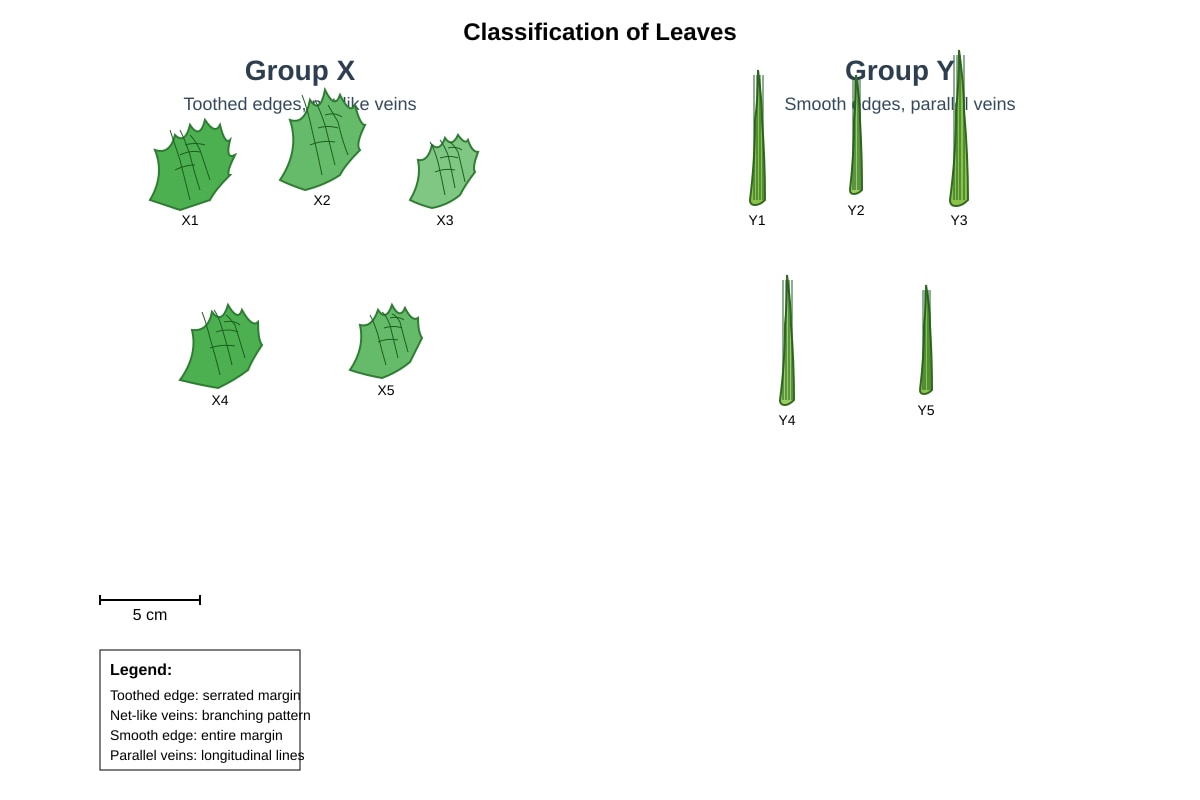
7. A student sorts some leaves into two groups. Group X has leaves with toothed edges and net-like veins. Group Y has leaves with smooth edges and parallel veins.

<image_placeholder> id: Q7-fig1 type: diagram linked_question: Q7 description: Two sets of leaves displayed in labelled groups labels: Group X - toothed edges, net-like veins; Group Y - smooth edges, parallel veins values: 5 leaves per group; leaf lengths 5-10 cm must_show: Clear edge patterns (toothed vs smooth); vein patterns visible (net-like vs parallel); two clearly labelled groups </image_placeholder>

Group X leaves most likely come from:

A. Grass plants B. Dicot plants C. Monocot plants D. Fern plants


8. Which of the following shows the correct flow of energy in a food chain?

A. Grass → Grasshopper → Frog → Snake B. Sun → Grass → Snake → Frog C. Snake → Frog → Grasshopper → Grass D. Grass → Frog → Grasshopper → Snake


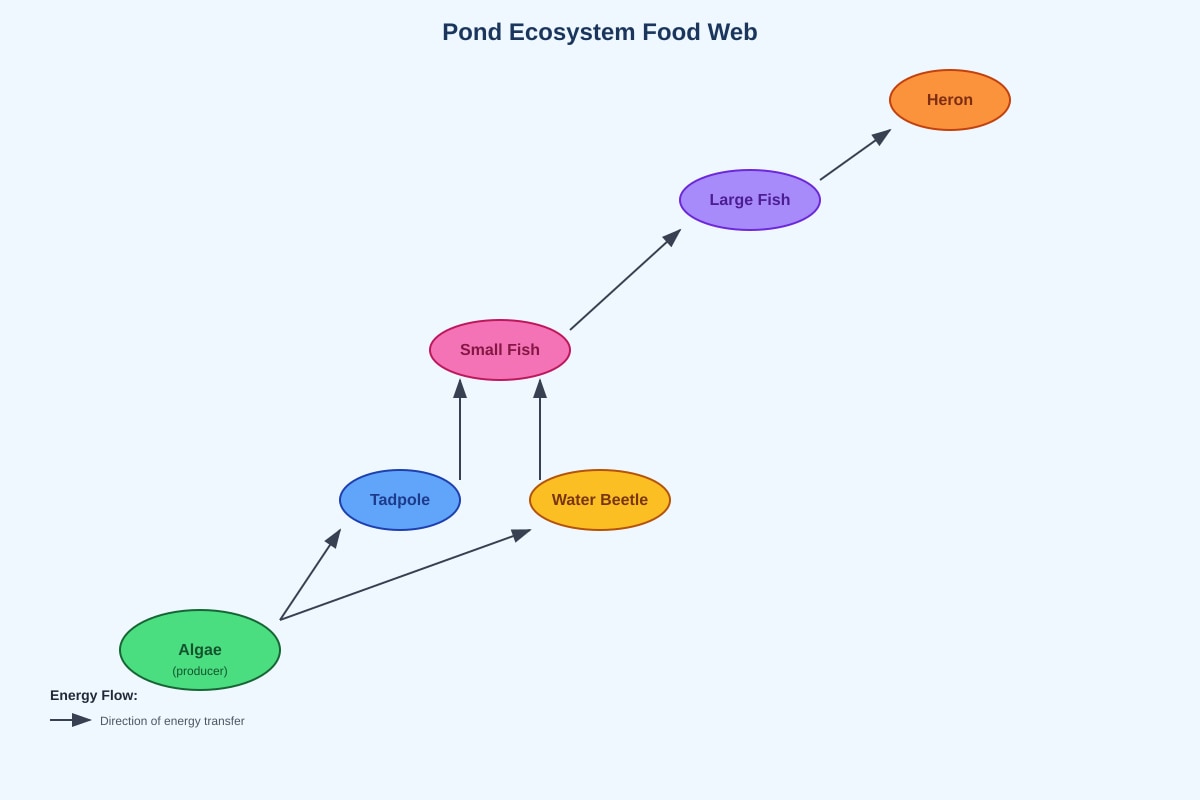
9. The diagram shows a food web in a pond.

<image_placeholder> id: Q9-fig1 type: diagram linked_question: Q9 description: Pond ecosystem food web showing producers and consumers labels: Algae (producer), Tadpole, Small fish, Large fish, Water beetle, Heron; arrows showing feeding directions values: 6 organisms shown; arrows indicate energy flow direction must_show: Algae at base as producer; multiple arrows from algae to primary consumers; tadpole and water beetle as herbivores; small fish as secondary consumer; large fish and heron as top consumers; clear arrow direction for energy flow </image_placeholder>

If all the small fish were removed from this pond, which would most likely happen?

A. The algae would decrease rapidly B. The large fish would have less food and may decrease C. The tadpole would become extinct D. The water beetle would start eating algae


10. Which of these is a producer in a food chain?

A. A lion that hunts zebras B. A mushroom growing on dead wood C. A grass plant making its own food D. A vulture eating dead animals


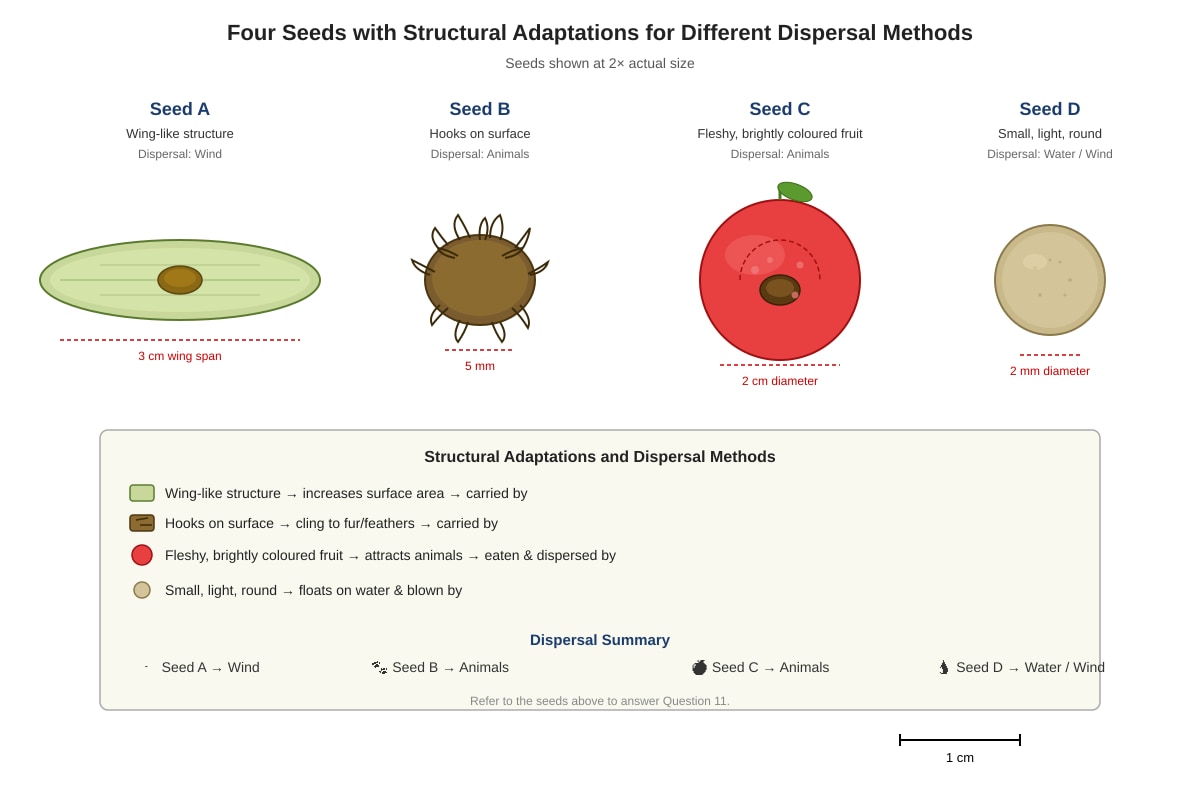
11. The seeds shown below are dispersed in different ways.

<image_placeholder> id: Q11-fig1 type: diagram linked_question: Q11 description: Four seed types with structural adaptations for different dispersal methods labels: Seed A - wing-like structure; Seed B - hooks on surface; Seed C - fleshy, brightly coloured fruit; Seed D - small, light, round values: Seeds shown at 2x actual size with scale bar; A 3 cm wing span; B 5 mm with hooks; C 2 cm diameter; D 2 mm diameter must_show: Clear structural adaptations for each dispersal method; wing for wind; hooks for animal attachment; fleshy fruit for animal eating; small size for water/wind; labels clearly identifying each feature </image_placeholder>

Seed B with hooks on its surface is dispersed by:

A. Wind B. Water C. Animals D. Splitting dry pods


12. A class found these organisms in the school garden: earthworm, spider, ant, snail, and millipede. How many of these are invertebrates?

A. 2 B. 3 C. 4 D. 5


13. Which cell part is found in plant cells but NOT in animal cells?

A. Nucleus B. Cell membrane C. Cytoplasm D. Cell wall


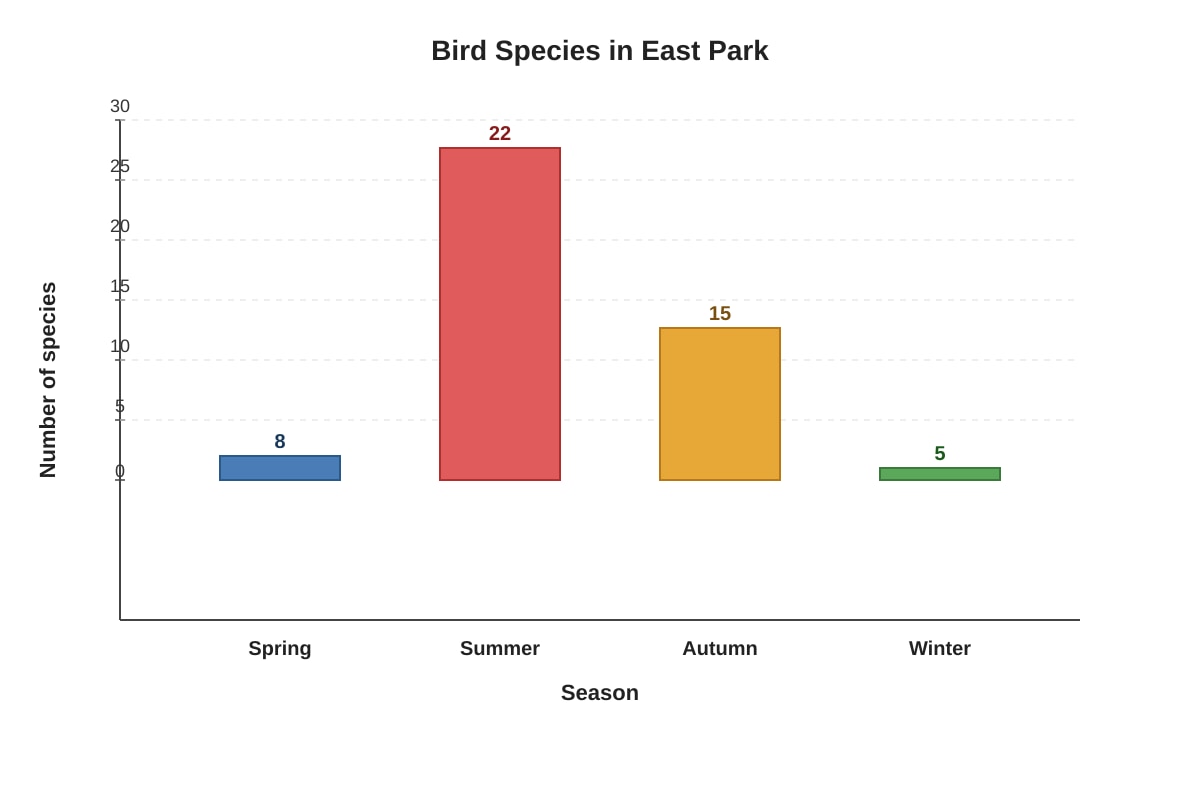
14. The graph below shows the number of different bird species counted in a park over four seasons.

<image_placeholder> id: Q14-fig1 type: graph linked_question: Q14 description: Bar graph showing bird species counts across four seasons labels: X-axis: Spring, Summer, Autumn, Winter; Y-axis: Number of species (0-30); Bars: Spring 8, Summer 22, Autumn 15, Winter 5 values: Spring: 8 species; Summer: 22 species; Autumn: 15 species; Winter: 5 species; Y-axis increments of 5 must_show: Clearly labelled axes with units; four bars of different heights; precise values readable from bar heights; title "Bird Species in East Park"; gridlines for reading values </image_placeholder>

Based on the graph, what can you conclude about bird diversity in this park?

A. Bird diversity is highest in winter when food is scarce B. Bird diversity is lowest in summer when it is too hot C. Bird diversity changes with seasons, being highest in summer D. Bird diversity stays the same throughout the year


15. Which sense organ does NOT match its function?

A. Eyes - detecting light and colours B. Ears - detecting chemicals in the air C. Nose - detecting smells D. Skin - detecting temperature


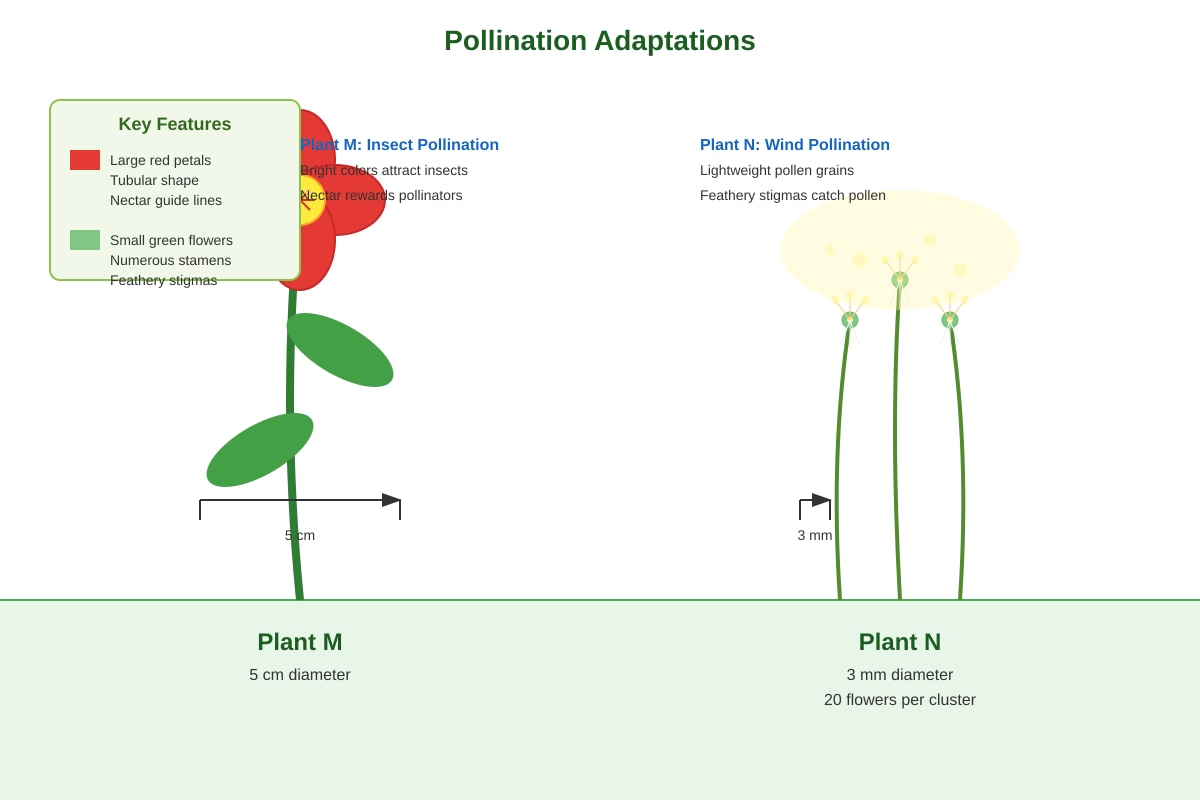
16. Two plants are compared. Plant M has flowers with bright petals and sweet nectar. Plant N produces fine powder that floats in air.

<image_placeholder> id: Q16-fig1 type: diagram linked_question: Q16 description: Two flowering plants showing different pollination adaptations labels: Plant M - large red petals, tubular shape, nectar guide lines; Plant N - small green flowers, numerous stamens with powdery pollen, feathery stigmas values: Plant M flower 5 cm diameter; Plant N flowers 3 mm diameter, clustered in groups of 20 must_show: Clear size difference; colour contrast (bright vs dull); structural features for insect vs wind pollination; nectar guides visible on Plant M; pollen dust cloud suggested around Plant N </image_placeholder>

How is pollen most likely transferred for each plant?

A. Plant M by insects, Plant N by wind B. Plant M by wind, Plant N by insects C. Both plants by insects D. Both plants by wind


17. A student makes a key to identify some animals. Which step in the key has a mistake?

  1. a. The animal has wings ................................................ go to 2 b. The animal does not have wings .......................... go to 3

  2. a. The animal has feathers .......................................... bird b. The animal does not have feathers ........................ insect

  3. a. The animal has moist skin ....................................... frog b. The animal has dry, scaly skin ................................ go to 4

  4. a. The animal has four legs ......................................... lizard b. The animal has no legs ........................................... snake

A. Step 1 - not all winged animals are birds or insects B. Step 2 - some insects have feathery wings C. Step 3 - frogs do not have moist skin D. Step 4 - lizards can have more than four legs


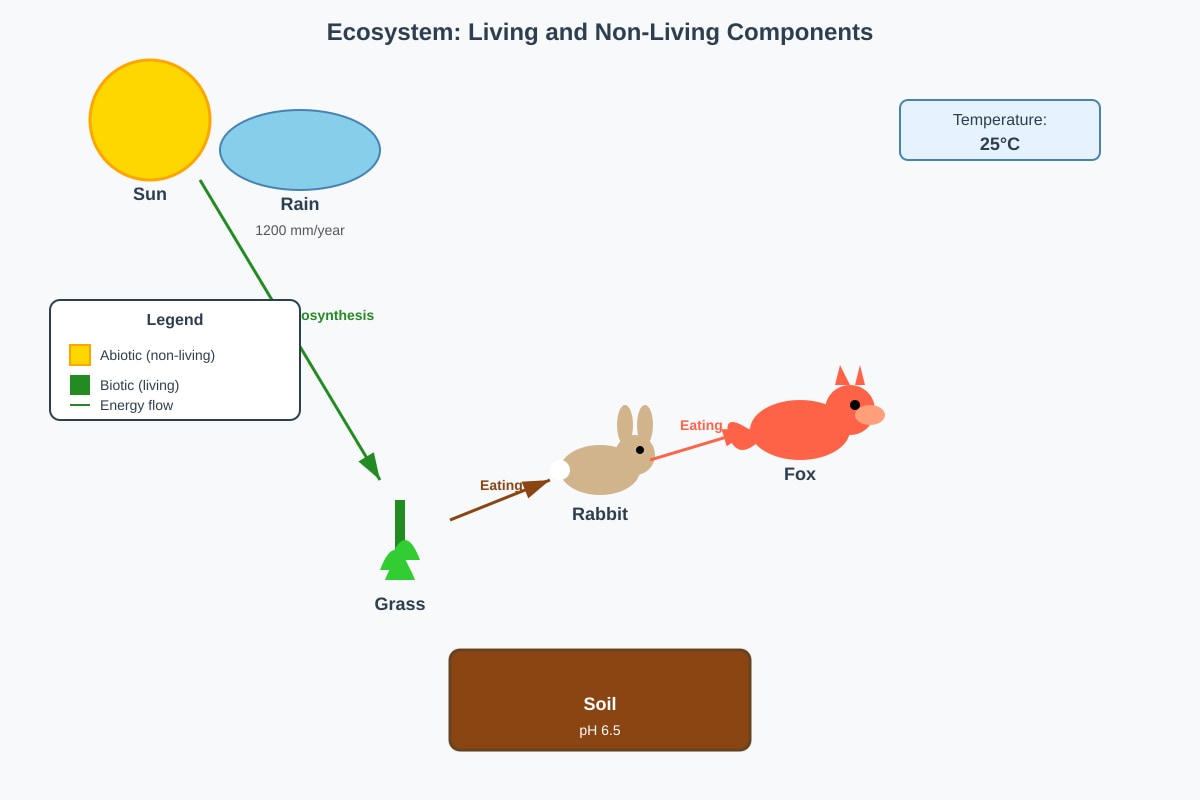
18. The diagram shows the interaction between living things and their environment.

<image_placeholder> id: Q18-fig1 type: diagram linked_question: Q18 description: Simple ecosystem showing abiotic and biotic components labels: Sun, Rain, Soil (abiotic); Grass, Rabbit, Fox (biotic); arrows showing relationships values: Temperature label 25°C; rainfall 1200 mm/year; soil pH 6.5 must_show: All abiotic factors with values; all biotic organisms; arrows from sun to grass (photosynthesis), from grass to rabbit (eating), from rabbit to fox (eating); proper distinction between living and non-living components </image_placeholder>

Which of these is an abiotic factor in this ecosystem?

A. The rabbit that eats grass B. The fox that hunts rabbits C. The sunlight that helps grass grow D. The grass that makes its own food


19. Why is biodiversity important for an ecosystem?

A. It makes the area look more beautiful for visitors B. It provides more tourism opportunities C. It ensures that organisms can depend on each other for survival D. It allows scientists to name more species


20. The table shows observations about a mystery organism.

FeatureObservation
Food sourcedead leaves and rotting wood
Body coveringhard outer skeleton
Number of legs14
Habitatdamp, dark places

To which group does this organism most likely belong?

A. Insect B. Arachnid C. Crustacean D. Myriapod (centipede/millipede)


Section B: Short Answer (24 marks)

Answer all questions. Write your answers in the spaces provided.


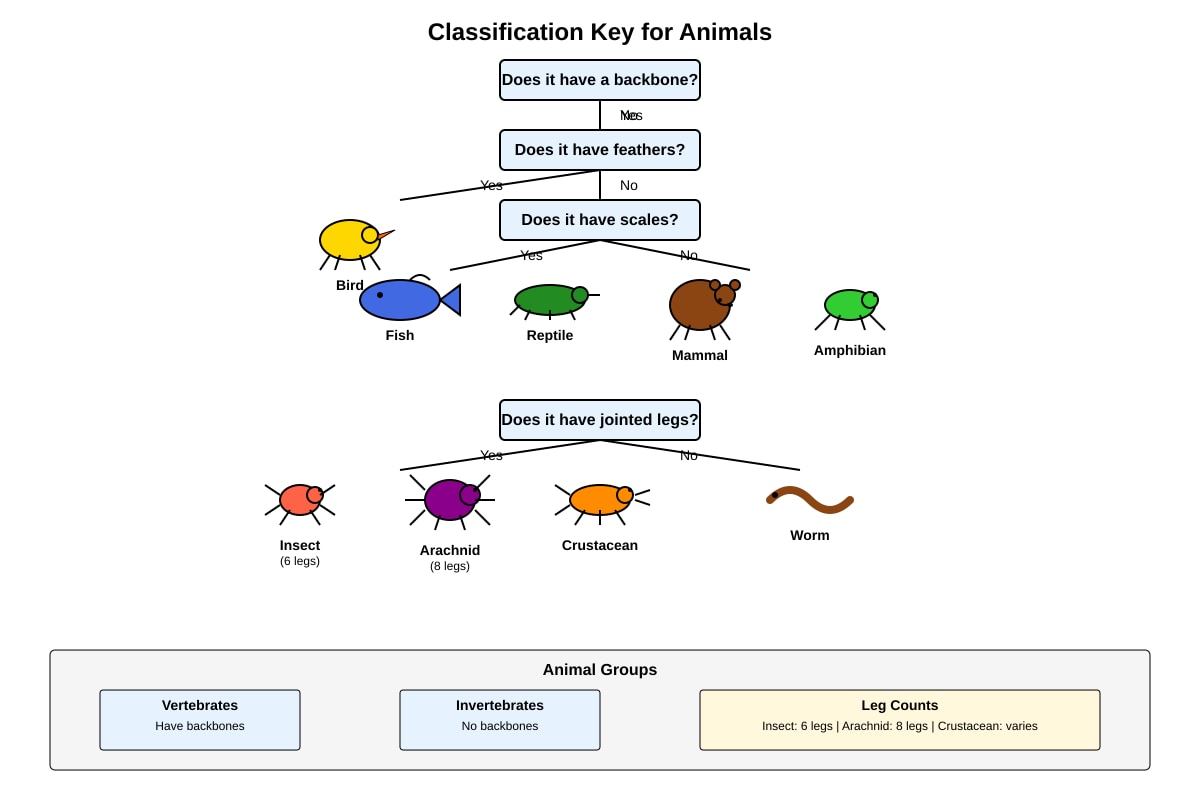
21. The diagram below shows a classification key for some common animals.

<image_placeholder> id: Q21-fig1 type: diagram linked_question: Q21 description: Dichotomous key branching diagram for animal classification labels: Start: "Does it have a backbone?"; Yes branch: Vertebrates → "Does it have feathers?" Yes: Bird, No: "Does it have scales?" Yes: Fish/Reptile, No: Mammal/Amphibian; No branch: Invertebrates → "Does it have jointed legs?" Yes: Insect/Arachnid/Crustacean, No: Worm values: 8 animal silhouettes at end points must_show: Clear branching structure with questions at each node; at least 6 distinct end categories; simple animal silhouettes; leg counts indicated for invertebrates (6 for insect, 8 for arachnid); all pathways clearly labelled </image_placeholder>

(a) Using the key, explain whether a butterfly is a vertebrate or invertebrate. [2]


(b) A student finds an animal with eight legs and no backbone. Use the key to trace the classification path and name the animal group. [2]


(c) Why do scientists use classification keys instead of just listing animal names? [2]


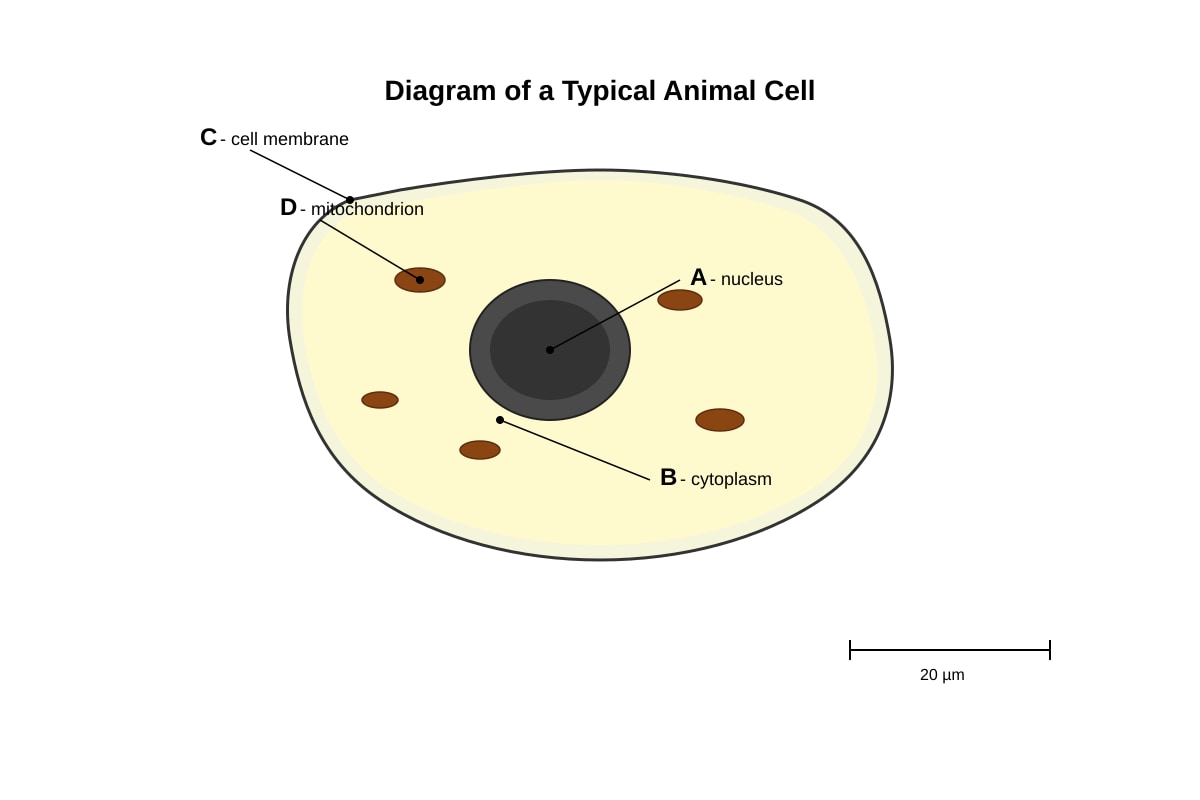
22. Study the diagram of the animal cell below.

<image_placeholder> id: Q22-fig1 type: diagram linked_question: Q22 description: Labelled diagram of a typical animal cell labels: A - nucleus, B - cytoplasm, C - cell membrane, D - mitochondrion; callout lines from each letter values: Cell diameter approximately 20 micrometres must_show: Irregular rounded shape; nucleus as prominent dark circle; cytoplasm filling cell; thin cell membrane boundary; small oval mitochondria scattered; clear letter labels A-D with leader lines </image_placeholder>

(a) Name the parts labelled A and B. [2]

A: ___________________________

B: ___________________________

(b) The nucleus is often called the "control centre" of the cell. Explain what this means. [2]


(c) State one difference between an animal cell shown here and a plant cell that you would see under a microscope. [1]


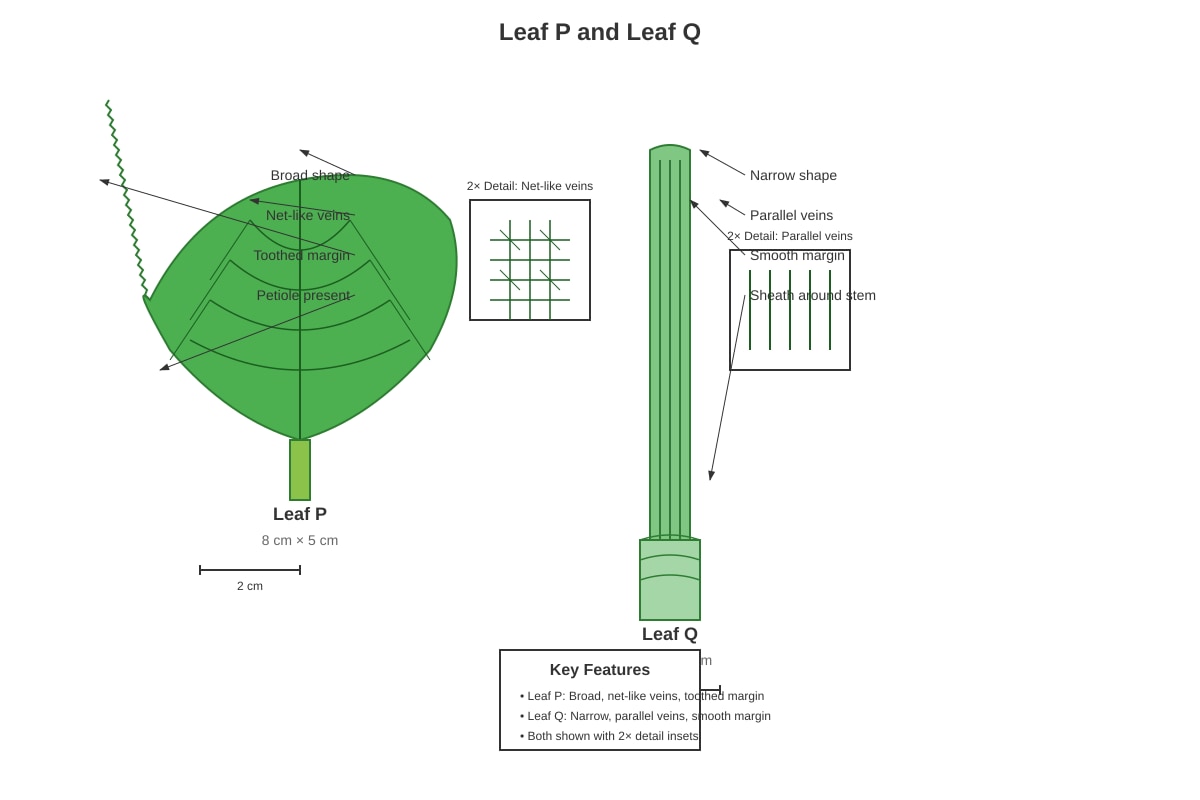
23. The diagram shows two leaves from different plants.

<image_placeholder> id: Q23-fig1 type: diagram linked_question: Q23 description: Two leaves side by side with detailed structural features labels: Leaf P - broad, net-like veins, toothed margin, petiole present; Leaf Q - narrow, parallel veins, smooth margin, sheath around stem values: Leaf P 8 cm long, 5 cm wide; Leaf Q 25 cm long, 1 cm wide; both with 2x detail insets showing vein patterns must_show: Clear contrast in shape, vein pattern, and margin; magnified insets of vein networks (net vs parallel); labels on all key features; size scale bar on each leaf </image_placeholder>

(a) Classify each leaf as monocot or dicot. Give one reason for each answer. [3]

Leaf P: _________________________________________________________

Reason: _________________________________________________________

Leaf Q: _________________________________________________________

Reason: _________________________________________________________

(b) A farmer wants to grow corn and beans. Using your knowledge of leaf types, advise which plant is the monocot and which is the dicot. [2]


(c) Explain why knowing whether a plant is a monocot or dicot can help a farmer decide how to cultivate it. [2]


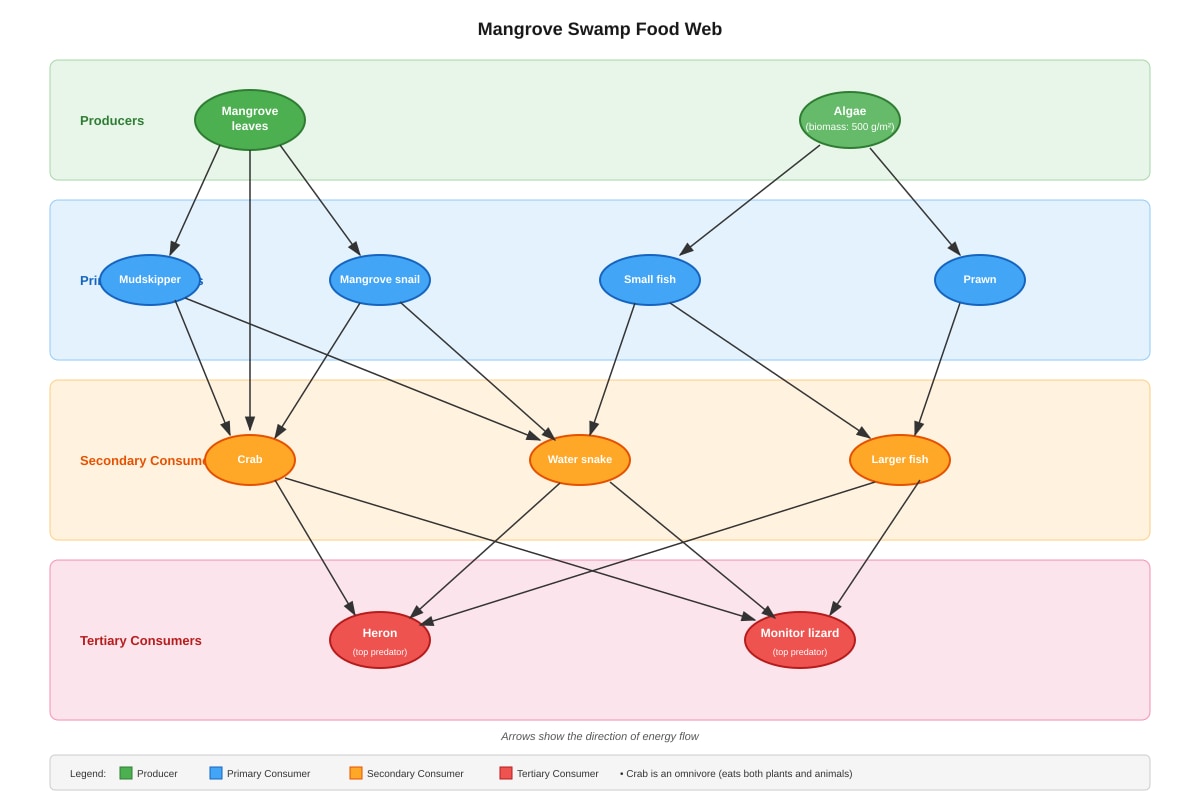
24. The food web below shows feeding relationships in a mangrove swamp.

<image_placeholder> id: Q24-fig1 type: diagram linked_question: Q24 description: Mangrove ecosystem food web with multiple interconnected food chains labels: Producers: Mangrove leaves, Algae; Primary consumers: Mudskipper, Mangrove snail, Small fish, Prawn; Secondary consumers: Crab, Water snake, Larger fish; Tertiary consumer: Heron, Monitor lizard; Arrows with energy flow direction values: 12 organisms shown; 18 arrows connecting them; mangrove leaf biomass 500 g/m² must_show: Clear producer level at bottom; multiple arrows from producers to herbivores; crab eating both snails and leaves (omnivore); heron at top with multiple prey; cross-connections between food chains forming web; no isolated chains </image_placeholder>

(a) Name one producer and one primary consumer from this food web. [2]

Producer: ___________________________

Primary consumer: ___________________________

(b) Explain what would happen to the water snake population if all the larger fish were removed by overfishing. [2]


(c) Draw a simple food chain with four organisms from this food web in the correct order. [2]


(d) Why is it better to describe this as a food web rather than a single food chain? [2]


25. A class conducted a survey of organisms in three different habitats: a grassy field, a pond, and a flower garden. Their results are shown below.

HabitatTypes of plantsTypes of animalsTotal different species
Grassy field81220
Pond152540
Flower garden5813

(a) Calculate the average number of species found across the three habitats. Show your working. [2]


(b) Which habitat has the highest biodiversity? Explain how you decided. [2]


(c) Suggest two reasons why the pond might have more species than the flower garden. [2]


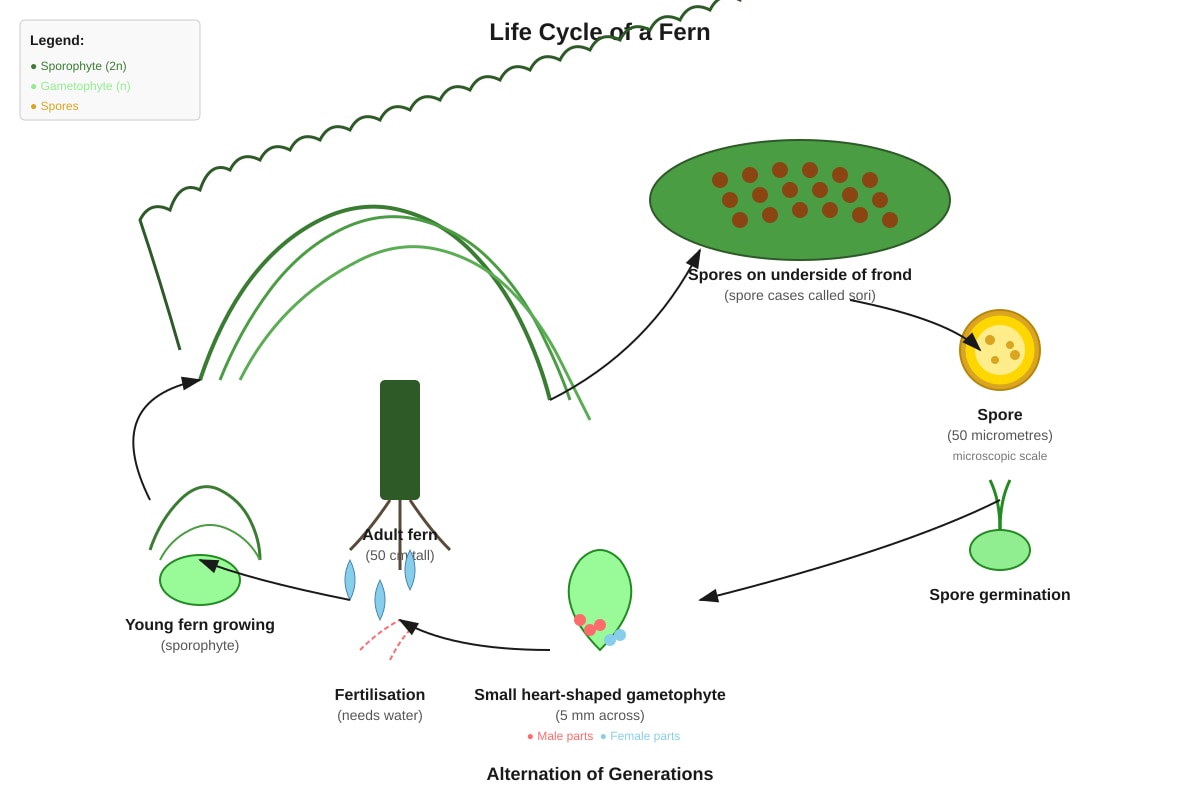
26. The diagram shows the life cycle of a fern.

<image_placeholder> id: Q26-fig1 type: diagram linked_question: Q26 description: Fern life cycle showing alternation of generations labels: Adult fern, Spores on underside of frond, Spore germination, Small heart-shaped gametophyte, Male and female parts on gametophyte, Fertilisation, Young fern growing values: Adult fern 50 cm tall; spores 50 micrometres; gametophyte 5 mm across must_show: Complete cycle with arrows; spore cases (sori) on frond undersides; microscopic scale for spore and gametophyte; water droplet indicating need for water in fertilisation; young sporophyte emerging from gametophyte; full cycle returning to adult fern </image_placeholder>

(a) Ferns do not produce seeds. How do they reproduce instead? [1]


(b) Explain why ferns usually grow in damp, shady places rather than in dry, sunny areas. [2]


(c) Compare fern reproduction with flowering plant reproduction. State one similarity and one difference. [3]

Similarity: _________________________________________________________


Difference: _________________________________________________________


Section C: Application and Synthesis (16 marks)

Answer all questions. Show your reasoning clearly.


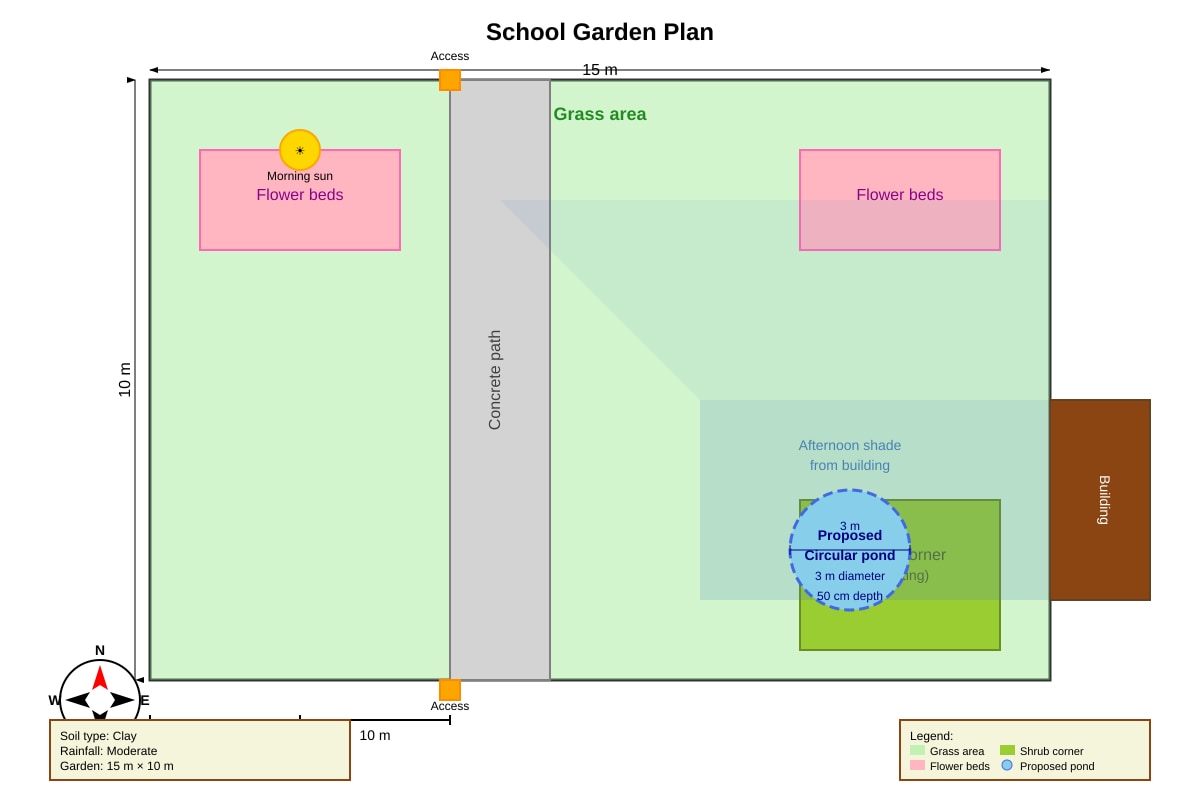
27. A student wants to build a small pond in the school garden to increase biodiversity.

<image_placeholder> id: Q27-fig1 type: diagram linked_question: Q27 description: School garden plan showing proposed pond location and existing features labels: Existing: Grass area, Flower beds, Shrub corner, Concrete path; Proposed: Circular pond 3 m diameter, near shrub corner; Sunlight: morning sun, afternoon shade from building values: Garden dimensions 15 m × 10 m; pond depth 50 cm; soil type: clay; rainfall: moderate must_show: Scale diagram with measurements; compass direction; shade pattern from building; existing vegetation; proposed pond with dimensions; access points </image_placeholder>

(a) The student chooses to place the pond near the shrub corner where it gets morning sun but afternoon shade. Explain why this location is better than:

  • placing it in full sun all day [2]
  • placing it in full shade all day [2]


(b) The student plans to add water plants, a few small fish, and some snails. Explain why adding these organisms in this order (plants first, then fish, then snails) is important for the pond ecosystem to succeed. [3]


(c) After one month, the student notices green slime covering the pond surface and the water smells bad. Identify one problem and suggest one solution. [2]


28. The passage below describes research into forests in Southeast Asia.

Scientists have been studying forests in Borneo for 20 years. Primary rainforest has more than 500 tree species per hectare. When this forest is cleared and replanted with only oil palm trees, the number of tree species drops to just 1. The number of animal species also falls by 80%. Scientists found that forests with more tree species recovered faster after droughts and fires. They also found that some animals, like hornbills, need large areas of diverse forest to find enough different fruits to feed their young throughout the year.

(a) Explain why replanting with only oil palm trees causes animal species to decrease by 80%. [2]


(b) Use evidence from the passage to explain why biodiversity helps forests survive environmental problems like droughts and fires. [2]


(c) Based on the passage, suggest one way to protect hornbill populations without completely stopping oil palm farming. [2]


29. Two students, Ali and Ben, disagree about how to classify fungi.

Ali: "Fungi should be in the plant kingdom because they grow in soil and do not move."

Ben: "Fungi should be in a separate kingdom because they cannot make their own food and they reproduce using spores."

(a) Give one way fungi are similar to plants and one way they are different from plants, based on the students' statements. [2]

Similar to plants: _________________________________________________________

Different from plants: _________________________________________________________

(b) Explain why the ability to make food is an important difference when classifying organisms. [2]


(c) Some scientists now classify slime moulds in a separate group from fungi, even though they look similar and both produce spores. Suggest what other differences scientists might have discovered to justify this separate classification. [2]


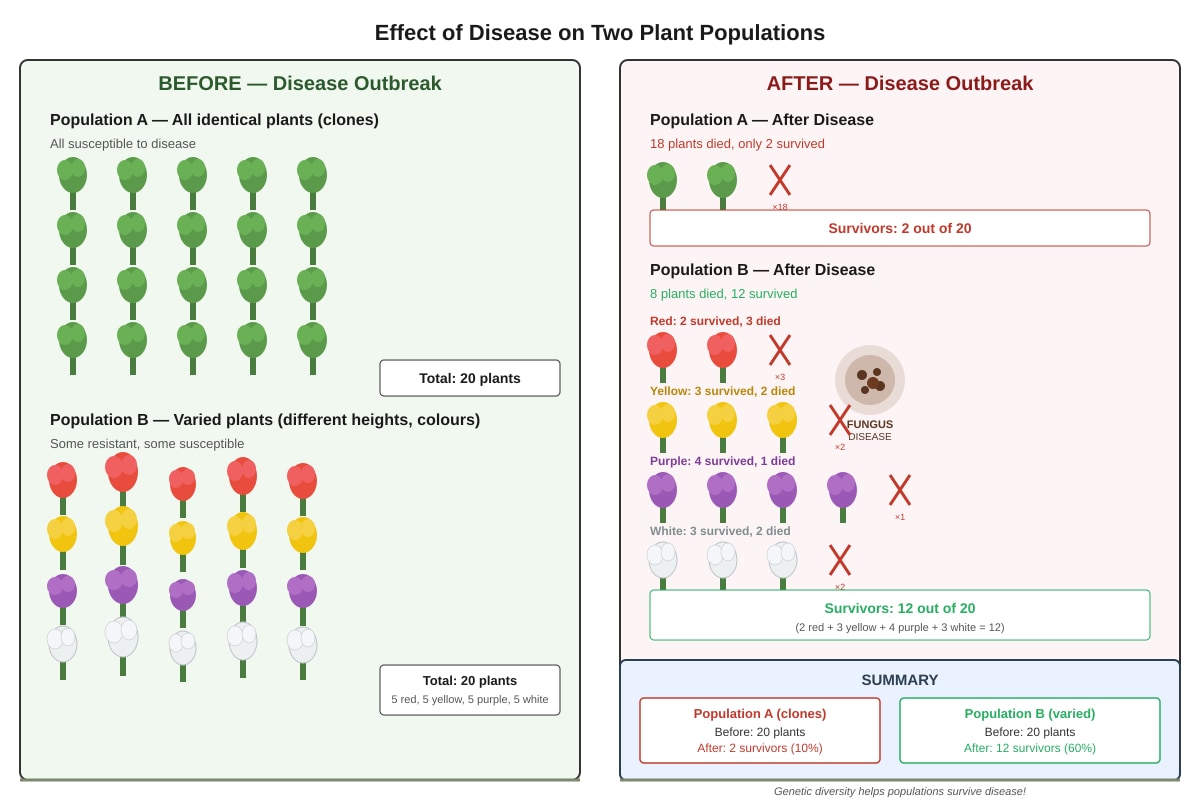
30. The diagram shows how genetic diversity helps a population survive disease.

<image_placeholder> id: Q30-fig1 type: diagram linked_question: Q30 description: Two populations of plants before and after disease outbreak labels: Population A - all identical plants (clones), all susceptible; Population B - varied plants (different heights, colours), some resistant, some susceptible; Before: 20 plants each; After disease: Population A 2 survivors, Population B 12 survivors values: Population A: 20 identical, 2 survive; Population B: varied colours (5 red, 5 yellow, 5 purple, 5 white), 3 red die, 2 yellow die, 1 purple die, 2 white die, 12 survive total must_show: Clear "Before" and "After" panels; identical vs varied appearance; disease symbol (fungus spots) on affected plants; numerical counts; survival totals </image_placeholder>

(a) Describe the difference between Population A and Population B before the disease. [1]


(b) Calculate the percentage survival rate for each population. Show your working. [2]

Population A: _________________________________________________________

Population B: _________________________________________________________

(c) Explain why Population B had more survivors, linking your answer to the concept of genetic diversity. [3]


END OF PAPER


Extra space for working


Answers

<!-- TuitionGoWhere generation metadata: stage=5-2; model=moonshotai/kimi-k2.6:free; model_label=Kimi K2.6 Free; generated=2026-06-09; Sources: Stage 4-0 LLM templates, syllabus context, and Stage 2 evidence where available. -->

TuitionGoWhere Practice Paper - Science Primary 5: Answer Key

Version 5 of 5 — Diversity


Section A: Multiple Choice (20 marks)

QuestionAnswerExplanation
1CRusting is a chemical change that happens to non-living things like iron. Living things show characteristics such as reproduction, growth, and response to stimuli. Rusting is not a life process.
2BFish have scales and use gills to breathe water; frogs have moist skin and lungs (as adults). These are key features of fish and amphibians respectively. The body covering (scales vs moist skin) is a primary classification feature.
3CMammals are the only group with hair or fur. Birds have feathers, fish have scales, reptiles have scales.
4BMonocots have fibrous root systems and parallel leaf veins. Dicots have tap roots and net-like veins. The diagram shows classic monocot characteristics.
5CCacti store water in thick, waxy stems. Broad leaves would lose too much water in deserts. Shallow roots spread wide but this alone doesn't store water.
6AInsects have 6 legs, hard outer shell (exoskeleton), and breathe through spiracles (tiny holes). Organism P matches all these features.
7BDicot plants have toothed or lobed leaf edges and net-like (reticulate) venation. Monocots typically have smooth edges and parallel veins.
8AEnergy flows from producer to consumer: grass (producer) → grasshopper (primary consumer) → frog (secondary consumer) → snake (tertiary consumer). Arrows must point from food to feeder.
9BLarge fish eat small fish. Without small fish, large fish lose their food source and would likely decrease. Tadpoles might increase (less predation), algae might decrease (more tadpole eating), but water beetles wouldn't change diet.
10CProducers make their own food through photosynthesis. Lions are consumers, mushrooms are decomposers, vultures are scavengers/decomposers.
11CHooks attach to animal fur or clothing, allowing seed dispersal by animals moving between locations. Wings indicate wind dispersal; fleshy fruit indicates animal eating; small round seeds indicate water or wind dispersal.
12DAll five (earthworm, spider, ant, snail, millipede) are invertebrates — they have no backbone. Earthworms and snails are soft-bodied invertebrates; spider, ant, and millipede are arthropods (invertebrates with jointed legs).
13DThe cell wall is found in plant cells but not animal cells. Nucleus, cell membrane, and cytoplasm are found in both. Plant cells also have chloroplasts and large vacuoles not found in animal cells.
14CThe graph shows clear seasonal variation: summer has 22 species (highest), winter has 5 (lowest). This shows diversity changes with seasons, peaking in summer — likely due to food availability and migration patterns.
15BEars detect sound (vibrations), not chemicals. The nose detects chemicals (smells). This is a common confusion — students may associate "air" with breathing but ears respond to pressure changes, not chemical composition.
16ABright petals and sweet nectar attract insects (insect pollination). Fine, light pollen that floats is adapted for wind pollination. Large colourful flowers are never wind-pollinated as they waste energy on unnecessary structures.
17AStep 2 incorrectly assumes all winged animals without feathers are insects. Bats are winged mammals, and some insects do have scale-covered wings that might appear feathery. The key misses bats entirely.
18CAbiotic factors are non-living: sunlight, rain, soil, temperature. The rabbit, fox, and grass are all biotic (living) components.
19CBiodiversity ensures interdependence — organisms rely on each other for food, shelter, and other needs. This ecosystem stability is the fundamental reason, not just appearance or human benefits.
20D14 legs identifies this as a myriapod (centipede or millipede). Insects have 6 legs, arachnids have 8, crustaceans typically have 10+ but include aquatic forms like crabs. The habitat (damp, dark) and food (detritus) further support myriapod classification.

Section B: Short Answer (24 marks)


21. Classification key (6 marks)

(a) [2 marks]

  • Answer: The butterfly is an invertebrate (1 mark). It does not have a backbone / has no internal skeleton / has an exoskeleton instead (1 mark).
  • Explanation: Invertebrates lack a vertebral column. Butterflies have a hard outer shell (exoskeleton) and jointed legs, placing them in the arthropod group of invertebrates.

(b) [2 marks]

  • Answer: Arachnid (1 mark). Path: No backbone → has jointed legs → count legs: 8 legs identifies arachnid (not 6-legged insect) (1 mark).
  • Explanation: The key branches first on backbone presence, then on jointed legs, then distinguishes insects (6 legs) from arachnids (8 legs) and crustaceans (variable, often aquatic).

(c) [2 marks]

  • Answer: Classification keys help identify unknown organisms by answering simple yes/no questions about observable features (1 mark). They organise information systematically so anyone can follow the steps to reach the correct identification without memorising all names (1 mark).
  • Explanation: Keys are diagnostic tools. They progressive narrow possibilities based on easily observable characteristics, making them practical for field identification and reducing errors from guesswork.

22. Animal cell (5 marks)

(a) [2 marks]

  • A: Nucleus (1 mark) — contains genetic material/DNA/chromosomes; controls cell activities
  • B: Cytoplasm (1 mark) — jelly-like substance where chemical reactions occur

(b) [2 marks]

  • Answer: The nucleus contains the cell's genetic material (DNA/chromosomes) (1 mark). It controls what the cell does by instructing which proteins to make and regulating cell division and other life processes (1 mark).
  • Explanation: Like a control centre or brain, the nucleus holds the "instructions" that determine cell structure and function. Without it, the cell cannot coordinate activities or reproduce properly.

(c) [1 mark]

  • Answer: Plant cells have a cell wall (rigid, gives shape) / chloroplasts (for photosynthesis) / large central vacuole — any one correct difference.
  • Explanation: The cell wall made of cellulose provides structural support. Chloroplasts contain chlorophyll for food production. The large vacuole stores water and maintains turgor pressure. Animal cells lack all three.

23. Leaf types (7 marks)

(a) [3 marks]

  • Leaf P: Dicot (1 mark). Reason: Net-like/reticulate veins AND/OR toothed margin AND/OR broad leaf with petiole (1 mark — any one feature).
  • Leaf Q: Monocot (1 mark). Reason: Parallel veins AND/OR smooth margin AND/OR narrow leaf with sheath (1 mark — any one feature).
  • Explanation: Dicots typically have broad leaves with net-like venation and petioles (leaf stalks). Monocots (grasses, lilies, orchids, palms) have narrow leaves with parallel veins and often lack true petioles, having sheaths instead.

(b) [2 marks]

  • Answer: Corn is the monocot (1 mark). Beans are dicots (1 mark).
  • Explanation: Corn (maize) is a grass family member — classic monocot with parallel veins. Beans are legumes — dicots with net-veined leaves and taproot systems. This distinction helps farmers understand growth patterns and nutrient needs.

(c) [2 marks]

  • Answer: Monocots and dicots have different root systems (fibrous vs tap root), different leaf venation, and different seed structures (one vs two seed leaves/cotyledons) (1 mark). This affects how they absorb water and nutrients, so farmers need different planting depths, spacing, and fertiliser approaches (1 mark).
  • Explanation: Dicots with tap roots access deeper water; monocots with fibrous roots stabilise soil but stay near surface. Understanding this guides irrigation and erosion control decisions.

24. Food web (8 marks)

(a) [2 marks]

  • Producer: Mangrove leaves / Algae (1 mark — either correct)
  • Primary consumer: Mudskipper / Mangrove snail / Small fish / Prawn (1 mark — any herbivore that eats producers)
  • Explanation: Producers make their own food via photosynthesis. Primary consumers are herbivores that eat producers directly.

(b) [2 marks]

  • Answer: Water snakes eat larger fish (as part of their diet) (1 mark). With fewer larger fish, water snakes would have less food, so their population would likely decrease due to starvation or reduced breeding success (1 mark).
  • Explanation: In food webs, removing one species affects predators dependent on it. Water snakes may have alternative prey (crabs), but larger fish removal would still reduce total food availability.

(c) [2 marks]

  • Answer: Any valid chain with 4 organisms in correct order, e.g.: Mangrove leaves → Mangrove snail → Crab → Heron (1 mark for correct sequence, 1 mark for all 4 organisms from the web with correct feeding relationships)
  • Explanation: Food chains show single pathways of energy flow. Each arrow points from food source to consumer. The chain must start with a producer and end with a top consumer, with correct feeding links between.

(d) [2 marks]

  • Answer: A food web shows interconnected food chains / multiple feeding relationships (1 mark). Organisms often eat more than one type of food and are eaten by multiple predators, so a web better represents real complexity than a single chain (1 mark).
  • Explanation: In this web, crabs eat both snails and leaves (omnivore). Heron eats multiple prey. If one food source fails, organisms can switch alternatives — stability impossible to show in a simple chain.

25. Habitat survey (6 marks)

(a) [2 marks]

  • Working: (20+40+13)÷3=73÷3=24.33...(20 + 40 + 13) \div 3 = 73 \div 3 = 24.33... (1 mark for correct addition and division setup)
  • Answer: 24 species (rounded to nearest whole number) or 24.3 species (1 mark — accept either if working shown)
  • Explanation: Average = total sum ÷ number of items. Always show working for calculation questions — marks awarded for method even if final answer has arithmetic error.

(b) [2 marks]

  • Answer: The pond has the highest biodiversity (1 mark). It has the greatest total number of different species (40) compared to grassy field (20) and flower garden (13) / highest combined plant and animal types (1 mark).
  • Explanation: Biodiversity is measured by species richness — the count of different species in an area. The pond has more plant types AND more animal types, giving the highest total.

(c) [2 marks]

  • Any two valid reasons (1 mark each):
    1. Ponds have both water and land habitats / edge effects, supporting species from both environments
    2. Water provides moisture and temperature stability for many organisms
    3. Ponds have more microhabitats (surface, middle, bottom, plants, mud) allowing specialisation
    4. Water supports more plant types (floating, submerged, emergent) which support more animal types
    5. Flower gardens are managed/monoculture, reducing natural variety
  • Explanation: Habitat complexity promotes biodiversity. Ponds offer vertical stratification and aquatic-terrestrial interface. Gardens often have weeding, pesticides, and limited plant selection reducing natural variation.

26. Fern life cycle (6 marks)

(a) [1 mark]

  • Answer: Ferns reproduce using spores (produced in spore cases/sori on frond undersides).
  • Explanation: Spores are single cells capable of growing into new organisms without fertilisation initially. This is asexual reproduction stage in the fern's life cycle.

(b) [2 marks]

  • Answer: Ferns need water for fertilisation — sperm must swim through water to reach the egg on the gametophyte (1 mark). Shady places prevent drying out of gametophytes and spore cases, which would kill the delicate reproductive structures (1 mark).
  • Explanation: Unlike seed plants, ferns have flagellated sperm requiring liquid water for transport. Their reproductive phase is vulnerable to desiccation. Damp shade maintains moisture; sunny dry conditions would be lethal.

(c) [3 marks]

  • Similarity: Both use sexual reproduction at some stage / both produce gametes (egg and sperm) / both have alternating generations with haploid and diploid stages (2 marks for clear, correct similarity with explanation; 1 mark if vague).
    • Detailed: Both ferns and flowering plants produce male and female gametes that fuse in fertilisation to form a new organism, ensuring genetic variation.
  • Difference: Flowering plants produce seeds enclosed in fruits; ferns produce spores not seeds / flowering plants have flowers for reproduction; ferns have no flowers / flowering plants can reproduce in drier conditions due to pollen; ferns need water for fertilisation (1 mark for any correct difference with explanation).
    • Detailed comparison: Flowering plants have double fertilisation forming embryo and endosperm within a seed, with pollen tubes delivering sperm without free water. Ferns have fre-swimming sperm and no seed protection for the embryo.

Section C: Application and Synthesis (16 marks)


27. School garden pond (7 marks)

(a) [4 marks total — 2 marks each location]

Full sun all day — why worse:

  • Too much sunlight causes excessive evaporation, lowering water levels (1 mark)
  • High temperatures and light promote algal blooms / excessive algae growth, depleting oxygen (1 mark)
  • OR: Some pond organisms (amphibians, certain plants) cannot tolerate extreme heat / need cooling shade

Full shade all day — why worse:

  • Insufficient light for photosynthesis, so aquatic plants cannot make enough food / oxygen (1 mark)
  • Water becomes too cold for many organisms, slowing metabolism and reducing biodiversity (1 mark)
  • OR: Limited plant growth reduces food and shelter for animals; decomposition slows

(b) [3 marks]

  • Plants first: Aquatic plants produce oxygen through photosynthesis and provide food base for the ecosystem (1 mark). Plants also absorb excess nutrients, stabilise water conditions, and provide shelter.
  • Then fish: Fish need established oxygen levels and some food source (plants/algae-eating) to survive; adding fish first would cause deaths from lack of oxygen and food (1 mark).
  • Then snails: Snails help clean up debris, eat algae, and recycle nutrients; adding them after fish ensures waste from fish is processed, maintaining water quality (1 mark).
  • Explanation: This sequence establishes the producer base before adding consumers, mimicking natural succession. Rushed stocking causes crashes from oxygen depletion, ammonia poisoning, and ecological imbalance.

(c) [2 marks]

  • Problem: Eutrophication / algal bloom / excessive algae growth due to too many nutrients (from fish food, waste, or fertiliser runoff) (1 mark)
  • Solution: Reduce feeding / add more water plants to absorb nutrients / introduce algae-eating organisms (snails, tadpoles) / partial water change / reduce fish number (1 mark — any sensible solution matching the identified problem)
  • Explanation: Green slime indicates cyanobacteria or algae overgrowth. The bad smell suggests anoxic (oxygen-depleted) conditions from bacterial decomposition. This typically results from nutrient overload and insufficient plant uptake.

28. Rainforest research (6 marks)

(a) [2 marks]

  • Answer: Oil palm monoculture provides only one type of food/plant (1 mark). Animals lose their diverse food sources, shelter types, and nesting sites; specialist species that depended on specific rainforest trees cannot survive (1 mark).
  • Explanation: Many rainforest animals are dietary specialists (frugivores, insectivores) or need specific habitat structures (canopy layers, tree holes). Converting 500 species to 1 eliminates ecological niches, causing population crashes or extirpation.

(b) [2 marks]

  • Answer: The passage states forests with more tree species recovered faster after droughts and fires (1 mark). With many species, some will survive any particular stress while others may be affected, so the ecosystem as a whole maintains function / "insurance effect" (1 mark).
  • Explanation: Biodiversity provides functional redundancy — if one species fails in drought, another with different water-use strategies may thrive. This portfolio effect stabilises ecosystem processes under environmental variation.

(c) [2 marks]

  • Answer: Maintain buffer zones / corridors of diverse forest connecting larger forest patches / retain some native tree species within oil palm areas / set aside a percentage of land as permanent forest reserve for hornbill foraging (1 mark for any concrete strategy, 1 mark for linking to hornbill needs from passage).
  • Explanation: Hornbills need large areas with year-round fruit diversity for chick-rearing. Small forest fragments or single-species plantations cannot support their movement and dietary needs. Agroforestry mixing palms with native fruit trees is one viable compromise.

29. Fungi classification (6 marks)

(a) [2 marks]

  • Similar to plants: Grow in soil / do not move from place to place / fixed in position (1 mark — any one feature Ali identified)
  • Different from plants: Cannot photosynthesise / make own food / must absorb nutrients from surroundings / reproduce by spores (1 mark — Ben's correct observation)
  • Explanation: The plant-fungi distinction historically confused early naturalists. Modern classification uses fundamental metabolic differences — autotrophy (self-feeding) vs heterotrophy — as primary kingdom separators.

(b) [2 marks]

  • Answer: Making food (photosynthesis) is the foundation of energy capture in ecosystems (1 mark). Organisms that cannot make food must obtain energy by consuming others, placing them in fundamentally different ecological and evolutionary groups — consumers/decomposers vs producers (1 mark).
  • Explanation: Photosynthesis converts light to chemical energy, creating organic matter from inorganic CO₂ and water. This biochemical pathway (or its absence) determines nutritional mode, which correlates with cell structure, ecological role, and evolutionary history — making it a reliable classification criterion.

(c) [2 marks]

  • Answer: Differences might include: cell structure (slime moulds lack chitinous cell walls, having temporary cellulose walls at some stages); life cycle (slime moulds have amoeboid stage, fungi do not); movement (slime moulds can crawl/aggregate, fungi are strictly non-motile); genetic/ribosomal RNA evidence showing different evolutionary lines (1 mark for any reasonable biological difference, 1 mark for explanation).
  • Explanation: Slime moulds were historically grouped with fungi due to convergent fruiting body morphology and spore production. Molecular phylogenetics revealed they belong in supergroup Amoebozoa, closer to animals than true fungi (Opisthokonta). Observable differences include their amoeboid feeding stage and lack of chitin in vegetative cells.

30. Genetic diversity (6 marks)

(a) [1 mark]

  • Answer: Population A had all identical plants (clones/genetically identical/monoculture); Population B had varied/different-looking plants (different heights, colours, genetic differences).

(b) [2 marks]

  • Population A: 2÷20×100%=10%2 \div 20 \times 100\% = \mathbf{10\%} (1 mark — working must show 2/20 and percentage calculation)
  • Population B: 12÷20×100%=60%12 \div 20 \times 100\% = \mathbf{60\%} (1 mark)

(c) [3 marks]

  • Explanation linking genetic diversity to survival:
    • Population B had genetic diversity — plants with different genes/characteristics (1 mark)
    • This meant some plants had natural resistance to the disease (different colours/traits linked to resistance genes) (1 mark)
    • When disease struck, resistant survived and reproduced; in Population A, with no variation, all were equally vulnerable — none had resistance, so nearly all died (1 mark)
  • Concept connection: Genetic diversity acts as "insurance" against diseases and environmental changes. Monocultures are efficient for farming but ecologically fragile. This principle underlies conservation genetics and crop breeding programs — maintaining seed banks and wild relatives preserves options for future challenges.

Mark Summary

SectionMarks
A: Multiple Choice20
B: Short Answer24
C: Application and Synthesis16
Total60

Common Errors to Watch:

  • Q7/Q23: Confusing monocot/dicot features — remember "monocot = one cotyledon, parallel veins, fibrous roots" and "dicot = two cotyledons, net veins, tap root"
  • Q9/Q24: Food web arrows point from food to feeder (energy direction), not from predator to prey
  • Q26: Ferns need water for fertilisation — a unique constraint among land plants
  • Q30b: Always show working for percentage calculations; marks awarded for method
  • Q29: Fungi are heterotrophs (like animals), not autotrophs (like plants) — a frequent misconception