TuitionGoWhere Practice Paper - Science Primary 5
TuitionGoWhere Practice Paper (AI)
Subject: Science
Level: Primary 5
Paper: Practice Paper — Topic Focus: Diversity (Version 5 of 5)
Duration: 45 minutes
Total Marks: 50
Name: ______________________
Class: ______________________
Date: ______________________
Note: This paper is AI-generated from the MOE Primary Science Syllabus (2023). It is not extracted from any past-year examination paper.
Instructions
- This paper has 3 sections and 20 questions. Attempt all questions.
- Section A: Questions 1–5 (Multiple-Choice, 10 marks). Circle the correct option.
- Section B: Questions 6–15 (Short Answer, 24 marks). Write your answers in the spaces provided.
- Section C: Questions 16–20 (Structured Questions, 16 marks). Answer in full sentences where asked.
- Marks for each question are shown in brackets ( ).
Section A: Multiple-Choice (Questions 1–5, 10 marks)
Question 1 (2 marks)
Which pair of animals are BOTH mammals?
A. Penguin and seahorse
B. Bat and dolphin
C. Bat and penguin
D. Seahorse and dolphin
Answer: ________________
Question 2 (2 marks)
Amir observed an animal beside a pond. It had smooth, moist skin. Its young swam in the water and breathed through gills. The adults hopped on land and breathed with lungs. To which animal group does it belong?
A. Fish
B. Amphibians
C. Reptiles
D. Mammals
Answer: ________________
Question 3 (2 marks)
Which organism is classified as a fungus?
A. Moss
B. Hydrilla
C. Bracket fungus growing on a tree trunk
D. Grass
Answer: ________________
Question 4 (2 marks)
Mei wants to make the canopy (top cover) of an umbrella. Which material is most suitable?
A. Tissue paper
B. Cotton wool
C. Thin plastic sheet
D. Cardboard
Answer: ________________
Question 5 (2 marks)
Use this key:
- Step 1: Does it have feathers? Yes → Eagle. No → go to Step 2.
- Step 2: Does it have dry scales and lay eggs on land? Yes → Snake. No → go to Step 3.
- Step 3: Does it have fur? Yes → Animal X. No → Animal Y.
An animal has fur, climbs trees, and its baby drinks its mother's milk. Which animal is X?
A. Eagle
B. Snake
C. Squirrel
D. Frog
Answer: ________________
Section B: Short Answer (Questions 6–15, 24 marks)
Question 6 (2 marks)
State one reason why scientists classify living things into groups.
Question 7 (2 marks)
Match each animal to its correct group. Write the group next to the animal. Groups: mammal, reptile, fish, bird.
| Animal | Group |
|---|
| Pangolin | ______________ |
| King cobra | ______________ |
| Seahorse | ______________ |
| Penguin | ______________ |
Question 8 (2 marks)
Use the key below to identify creature W.
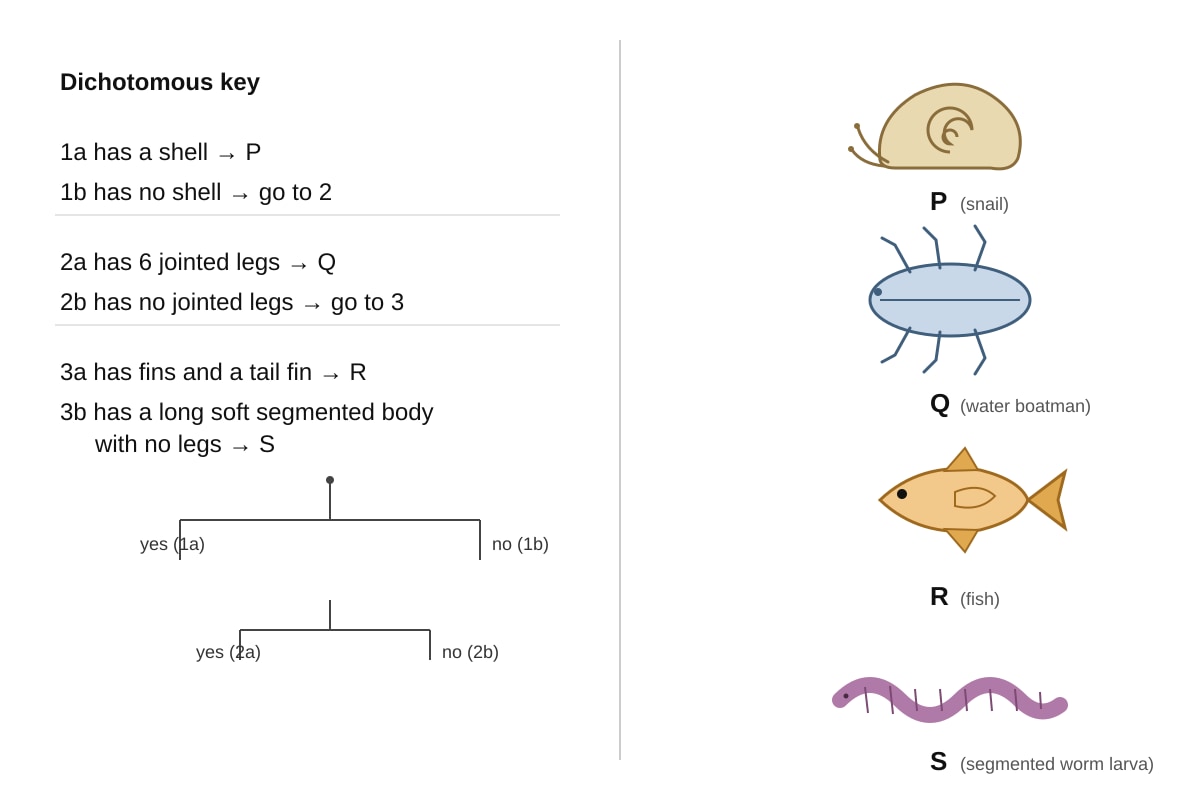
Generated diagram for Q8.
Creature W has no shell and has 6 jointed legs. Which creature (P, Q, R or S) is W? State one feature you used.
Creature W: ________ Feature used: __________________________________________
Question 9 (2 marks)
Compare a hibiscus plant and a fern. Write one similarity and one difference.
Similarity: ________________________________________________________________
Difference: ________________________________________________________________
Question 10 (2 marks)
Circle the living things in this list: cloud, moss, fire, yeast
Give one reason for one of your choices.
Question 11 (3 marks)
Complete the table with the missing information (i), (ii) and (iii).
| Animal group | Body covering | Breathing organ |
|---|
| Fish | (i) ____________ | Gills |
| Bird | Feathers | (ii) ____________ |
| Mammal | (iii) ____________ | Lungs |
Question 12 (2 marks)
A raincoat keeps a hiker dry in the rain. State two properties of the raincoat material that make it suitable.
Property 1: ________________________________________________________________
Property 2: ________________________________________________________________
Question 13 (3 marks)
Mei Ling tested three bag straps made of canvas, leather and nylon. She hung 100 g weights on each strip, one at a time, until the strip tore.
(a) State the variable she changed. (1 mark)
(b) State the variable she measured. (1 mark)
(c) State one variable she must keep the same for a
<stage5_exam_md>
TuitionGoWhere Practice Paper - Science Primary 5
TuitionGoWhere Practice Paper (AI)
Subject: Science
Level: Primary 5
Paper: Practice Paper — Topic Focus: Diversity (Version 5 of 5)
Duration: 45 minutes
Total Marks: 50
Name: ______________________
Class: ______________________
Date: ______________________
Note: This paper is AI-generated from the MOE Primary Science Syllabus (2023). It is not extracted from any past-year examination paper.
Instructions
- This paper has 3 sections and 20 questions. Attempt all questions.
- Section A: Questions 1–5 (Multiple-Choice, 10 marks). Circle the correct option.
- Section B: Questions 6–15 (Short Answer, 24 marks). Write your answers in the spaces provided.
- Section C: Questions 16–20 (Structured Questions, 16 marks). Answer in full sentences where asked.
- Marks for each question are shown in brackets ( ).
Section A: Multiple-Choice (Questions 1–5, 10 marks)
Question 1 (2 marks)
Which pair of animals are BOTH mammals?
A. Penguin and seahorse
B. Bat and dolphin
C. Bat and penguin
D. Seahorse and dolphin
Answer: ________________
Question 2 (2 marks)
Amir observed an animal beside a pond. It had smooth, moist skin. Its young swam in the water and breathed through gills. The adults hopped on land and breathed with lungs. To which animal group does it belong?
A. Fish
B. Amphibians
C. Reptiles
D. Mammals
Answer: ________________
Question 3 (2 marks)
Which organism is classified as a fungus?
A. Moss
B. Hydrilla
C. Bracket fungus growing on a tree trunk
D. Grass
Answer: ________________
Question 4 (2 marks)
Mei wants to make the canopy (top cover) of an umbrella. Which material is most suitable?
A. Tissue paper
B. Cotton wool
C. Thin plastic sheet
D. Cardboard
Answer: ________________
Question 5 (2 marks)
Use this key:
- Step 1: Does it have feathers? Yes → Eagle. No → go to Step 2.
- Step 2: Does it have dry scales and lay eggs on land? Yes → Snake. No → go to Step 3.
- Step 3: Does it have fur? Yes → Animal X. No → Animal Y.
An animal has fur, climbs trees, and its baby drinks its mother's milk. Which animal is X?
A. Eagle
B. Snake
C. Squirrel
D. Frog
Answer: ________________
Section B: Short Answer (Questions 6–15, 24 marks)
Question 6 (2 marks)
State one reason why scientists classify living things into groups.
Question 7 (2 marks)
Match each animal to its correct group. Write the group next to the animal. Groups: mammal, reptile, fish, bird.
| Animal | Group |
|---|
| Pangolin | ______________ |
| King cobra | ______________ |
| Seahorse | ______________ |
| Penguin | ______________ |
Question 8 (2 marks)
Use the key below to identify creature W.
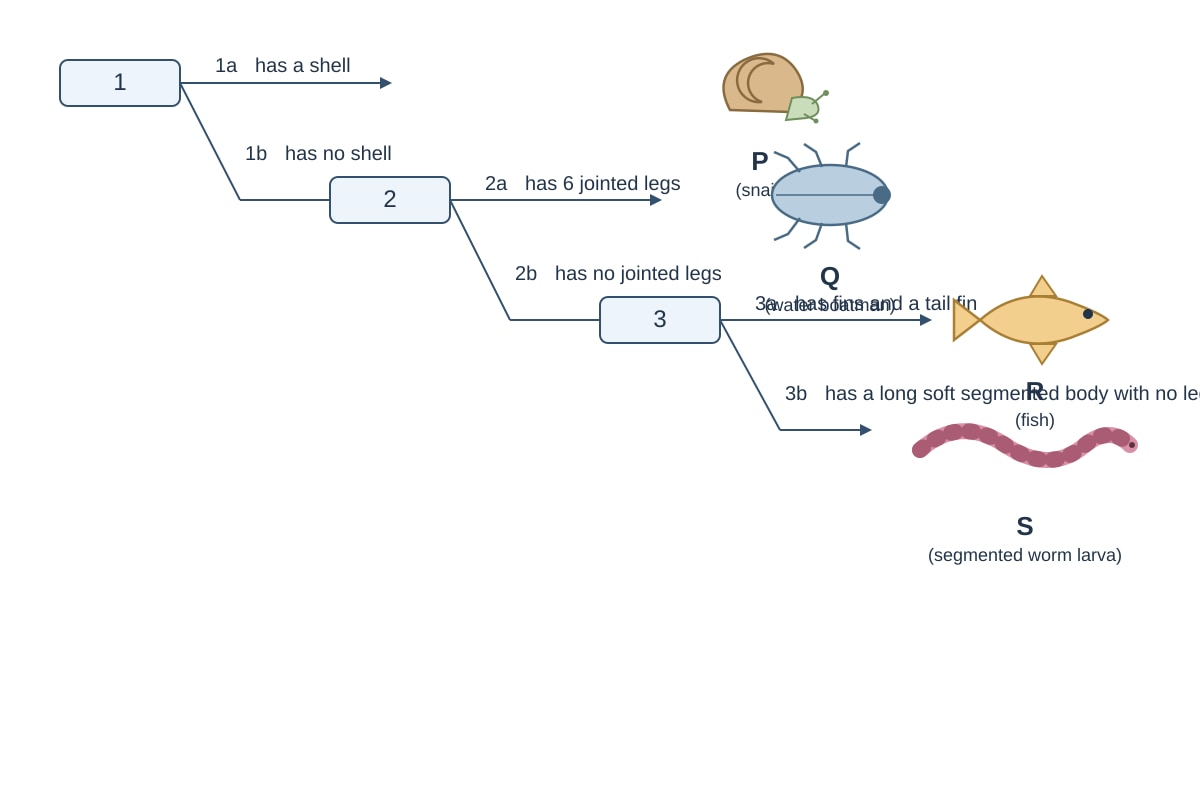
Generated diagram for Q8.
Creature W has no shell and has 6 jointed legs. Which creature (P, Q, R or S) is W? State one feature you used.
Creature W: ________ Feature used: __________________________________________
Question 9 (2 marks)
Compare a hibiscus plant and a fern. Write one similarity and one difference.
Similarity: ________________________________________________________________
Difference: ________________________________________________________________
Question 10 (2 marks)
Circle the living things in this list: cloud, moss, fire, yeast
Give one reason for one of your choices.
Question 11 (3 marks)
Complete the table with the missing information (i), (ii) and (iii).
| Animal group | Body covering | Breathing organ |
|---|
| Fish | (i) ____________ | Gills |
| Bird | Feathers | (ii) ____________ |
| Mammal | (iii) ____________ | Lungs |
Question 12 (2 marks)
A raincoat keeps a hiker dry in the rain. State two properties of the raincoat material that make it suitable.
Property 1: ________________________________________________________________
Property 2: ________________________________________________________________
Question 13 (3 marks)
Mei Ling tested three bag straps made of canvas, leather and nylon. She hung 100 g weights on each strip, one at a time, until the strip tore.
(a) State the variable she changed. (1 mark)
(b) State the variable she measured. (1 mark)
(c) State one variable she must keep the same for a fair test. (1 mark)
Question 14 (3 marks)
Jun Jie wants to make a window for a treehouse. Name the most suitable material and give two reasons for your choice.
Material: ______________________________________________________
Reason 1: ______________________________________________________
Reason 2: ______________________________________________________
Question 15 (3 marks)
Classify these plants into flowering and non-flowering: hibiscus, fern, orchid, moss
Flowering plants: ______________________________________________
Non-flowering plants: __________________________________________
State one difference between the two groups. (1 mark)
Section C: Structured Questions (Questions 16–20, 16 marks)
Question 16 (3 marks)
Ravi observed four animals: butterfly, chicken, cat and dog. Sort them into two groups based on how their young are born. Give a heading for each group.
Group 1 heading: ______________ Animals: ______________________
Group 2 heading: ______________ Animals: ______________________
Question 17 (4 marks)
Sarah tested four materials and recorded her results.
| Material | Flexible | Transparent | Waterproof |
|---|
| A | No | Yes | Yes |
| B | Yes | No | Yes |
| C | No | Yes | No |
| D | Yes | Yes | Yes |
(a) Which material is most suitable for a raincoat window that must let the wearer see through it? (1 mark)
(b) Give two reasons using the table. (2 marks)
(c) Which material is not waterproof? (1 mark)
Question 18 (3 marks)
Mould grows on a piece of bread left in a warm cupboard.
(a) To which group of living things does mould belong? (1 mark)
(b) State one similarity and one difference between mould and a green plant. (2 marks)
Similarity: __________________________________________________
Difference: __________________________________________________
Question 19 (3 marks)
Compare a fish and a frog (adult). Write one similarity and two differences in their characteristics.
Similarity: ________________________________________________________________
Difference 1: ______________________________________________________________
Difference 2: ______________________________________________________________
Question 20 (3 marks)
Sort these items into the correct groups: moss, wooden chair, robot, yeast, iron nail
| Was once alive | Never alive |
|---|
| ______________ | ______________ |
| ______________ | ______________ |
| ______________ | |
Explain why the wooden chair belongs in its group. (1 mark)
— End of Paper —