AI Generated Exam Paper
Primary 5 Science Practice Paper 4
Free P5 Science Practice Paper 4, Nemo3 AI version, with questions, answers, and syllabus-aligned practice for Singapore students.
These static practice materials are generated from the site's syllabus and paper-generation workflow, with source and model context shown so students and parents can evaluate the material before use.
Questions
Free quiz and exam paper access
Enter your details to view this paper
Your access is remembered on this device.
Answers
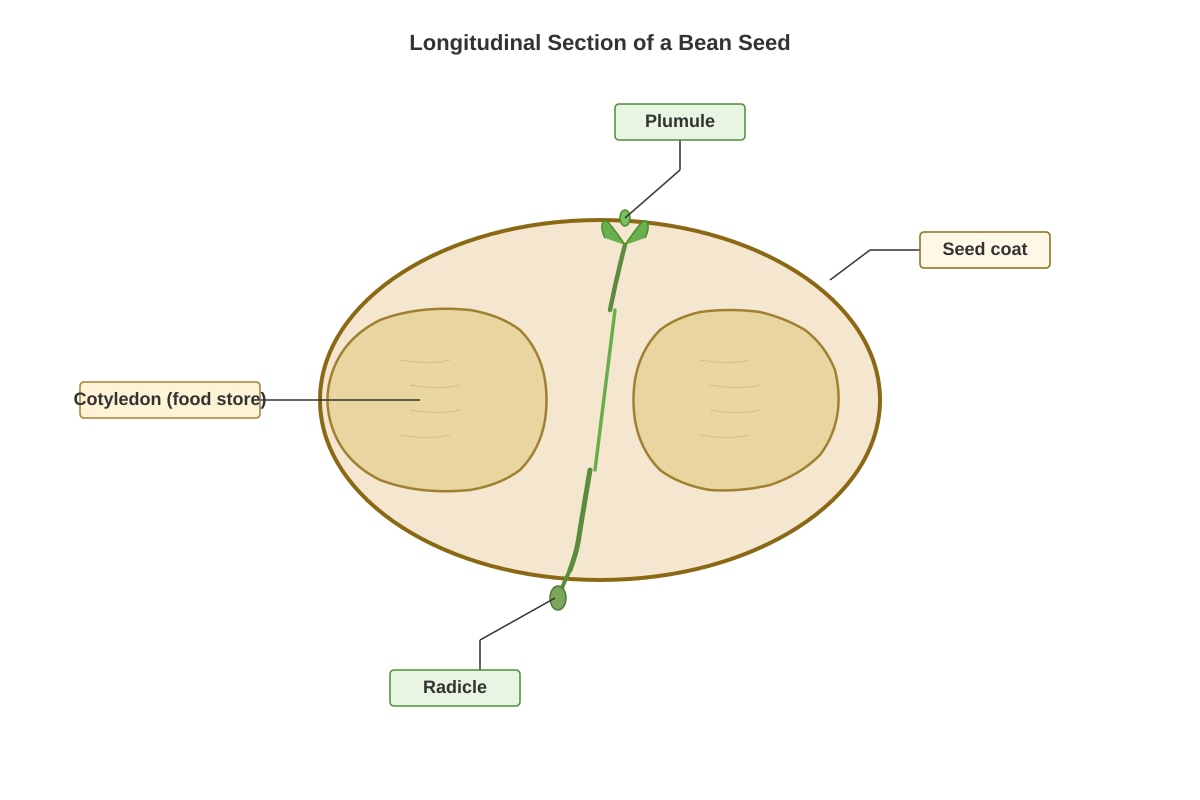
TuitionGoWhere Practice Paper - Science Primary 5 (Answer Key)
Subject: Science
Level: Primary 5
Paper: Practice Paper 4 (Version 4 of 5)
Total Marks: 100
Section A: Multiple-Choice Questions (56 marks)
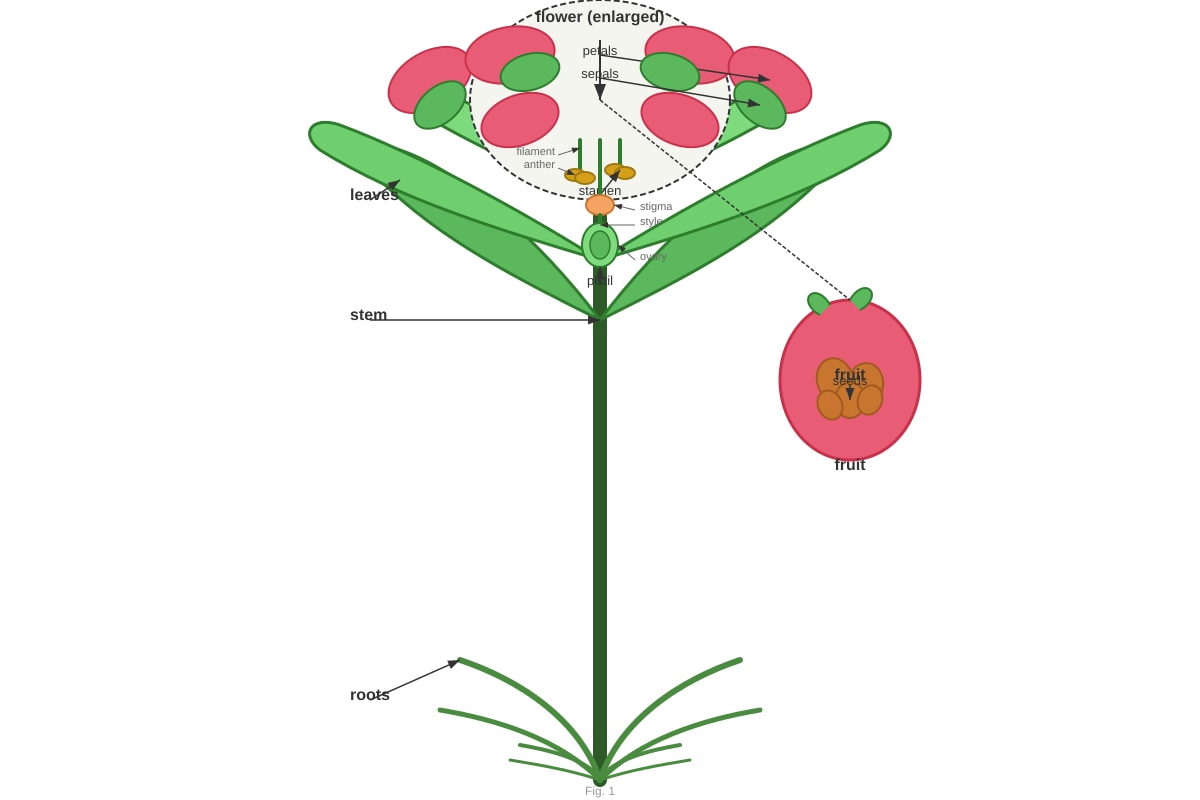
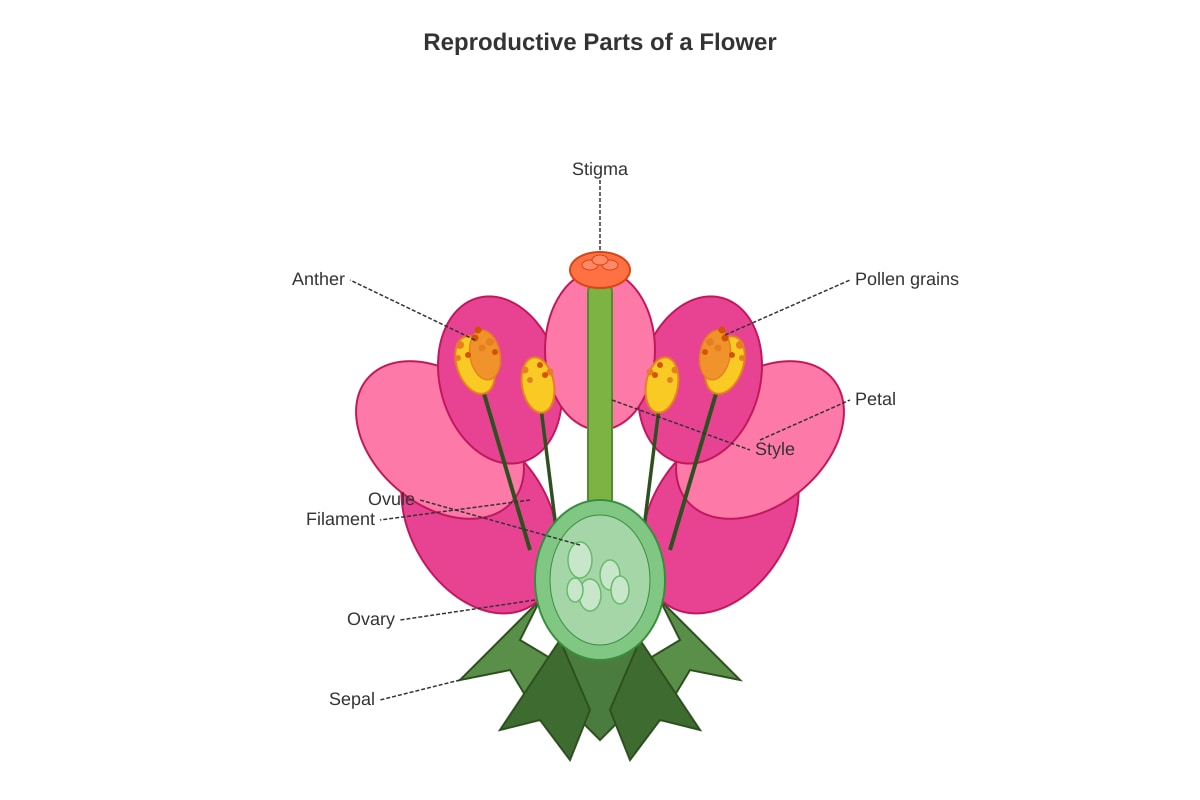
1. Answer: (2) The ovary develops into the fruit after fertilisation. [2]
Explanation:
- The anther (part of the stamen) produces pollen grains (male reproductive cells), not female cells.
- The ovary (part of the pistil) contains ovules (female reproductive cells). After fertilisation, the ovary develops into the fruit and the ovules develop into seeds.
- The stigma receives pollen grains; it does not produce them.
- Petals (not sepals) are usually brightly coloured to attract pollinators. Sepals protect the flower bud.
2. Answer: (4) Flowering plant → No → Yes → (stops) [2]
Explanation:
Following the flow chart for a flowering plant:
- Q1: Does it reproduce by spores? No (flowering plants reproduce by seeds)
- Q2: Does it have flowers? Yes → Leads to "Flowering plant" outcome. The flow chart stops here.
Option (1): Mould reproduces by spores → Yes (stops at Mould).
Option (2): Fern reproduces by spores → Yes (stops at Fern).
Option (3): Bird → No → No (no flowers) → Yes (has feathers) → Bird. But the path says "No → Yes → Yes" which would require flowers first.
3. Answer: (4) Z [2]
Explanation:
- Reptiles have scales (e.g., snakes, lizards).
- W reproduces by spores → likely a fern or fungus.
- X has flowers → flowering plant.
- Y has feathers → bird.
- Z has scales → reptile.
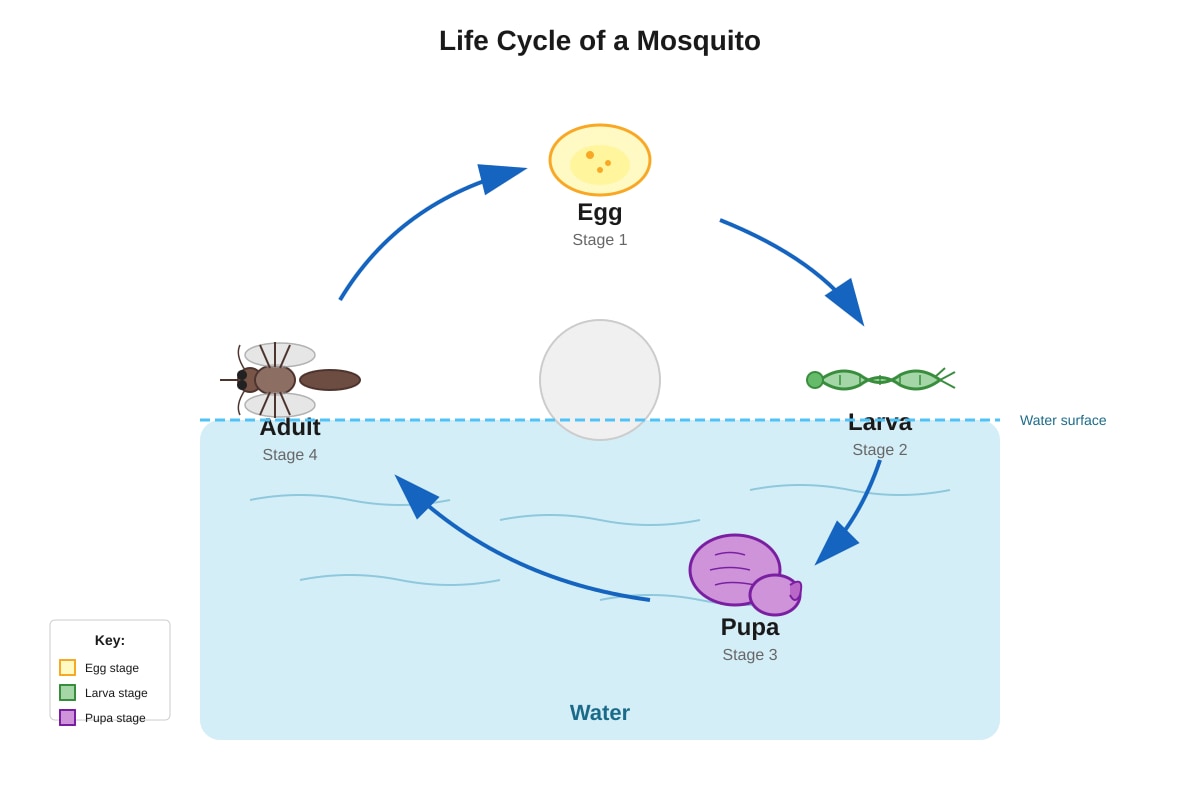
4. Answer: (2) The adult mosquito lays eggs on land. [2]
Explanation:
- Mosquitoes lay eggs on water (or at the water's edge), not on land. The eggs hatch into larvae that live in water.
- (1) Correct: Larva and pupa are aquatic.
- (3) Correct: Pupa is a non-feeding stage.
- (4) Correct: Four stages: Egg, Larva, Pupa, Adult.
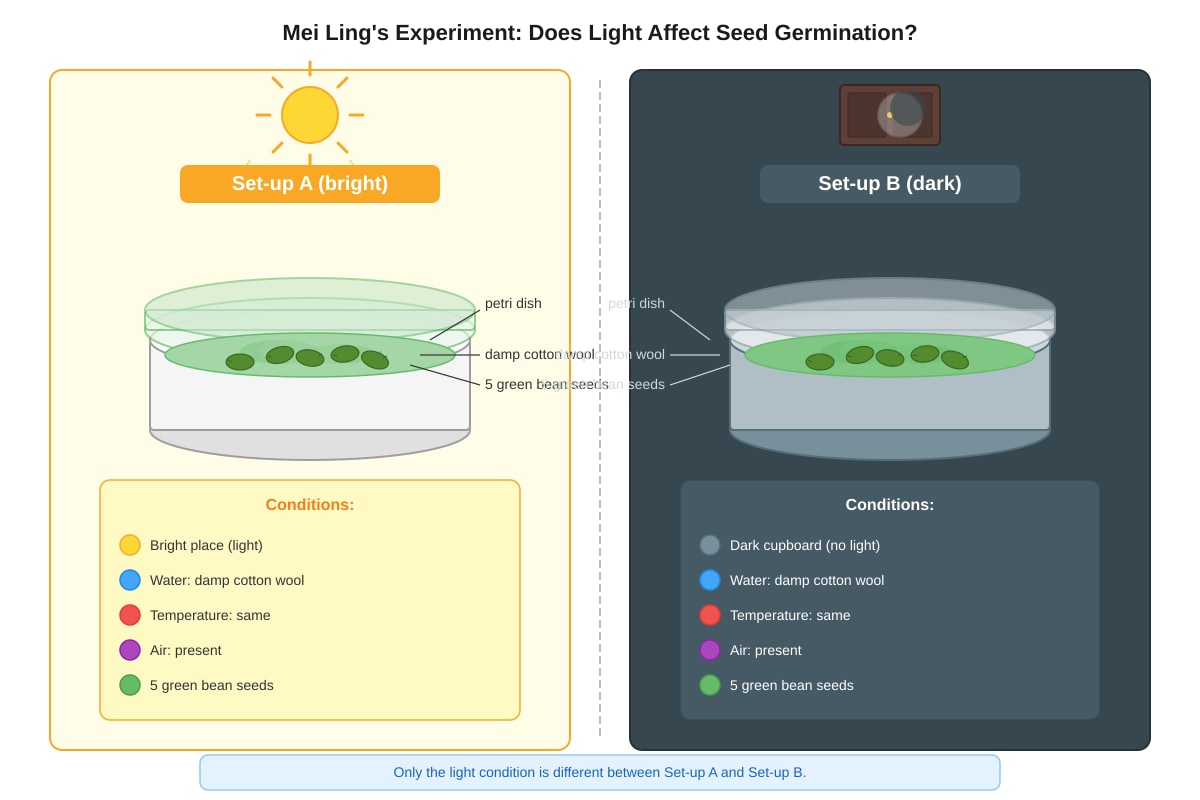
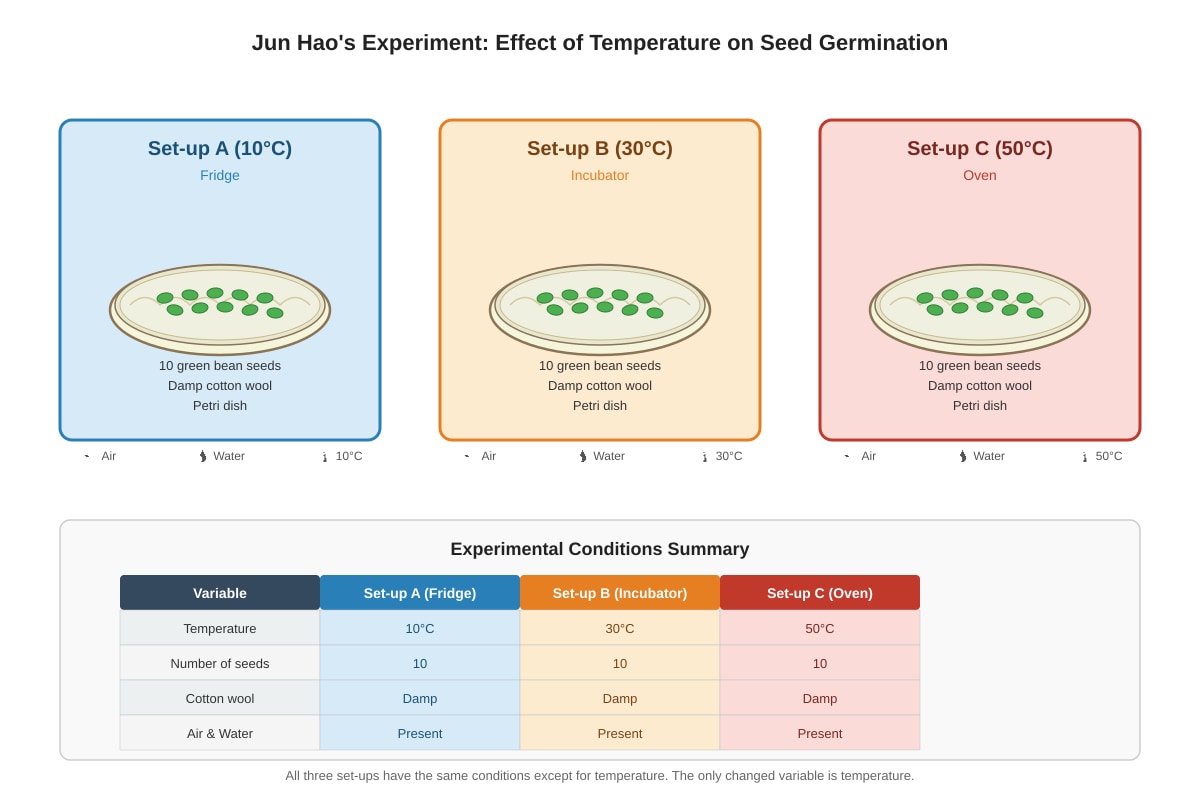
5. Answer: (3) Presence of light [2]
Explanation:
- Changed variable (independent variable): The condition deliberately changed — presence of light (bright vs dark).
- Constant variables: Type of seeds, number of seeds, amount of water, temperature, air — all kept the same.
- Measured variable (dependent variable): Number of seeds germinated / rate of germination.
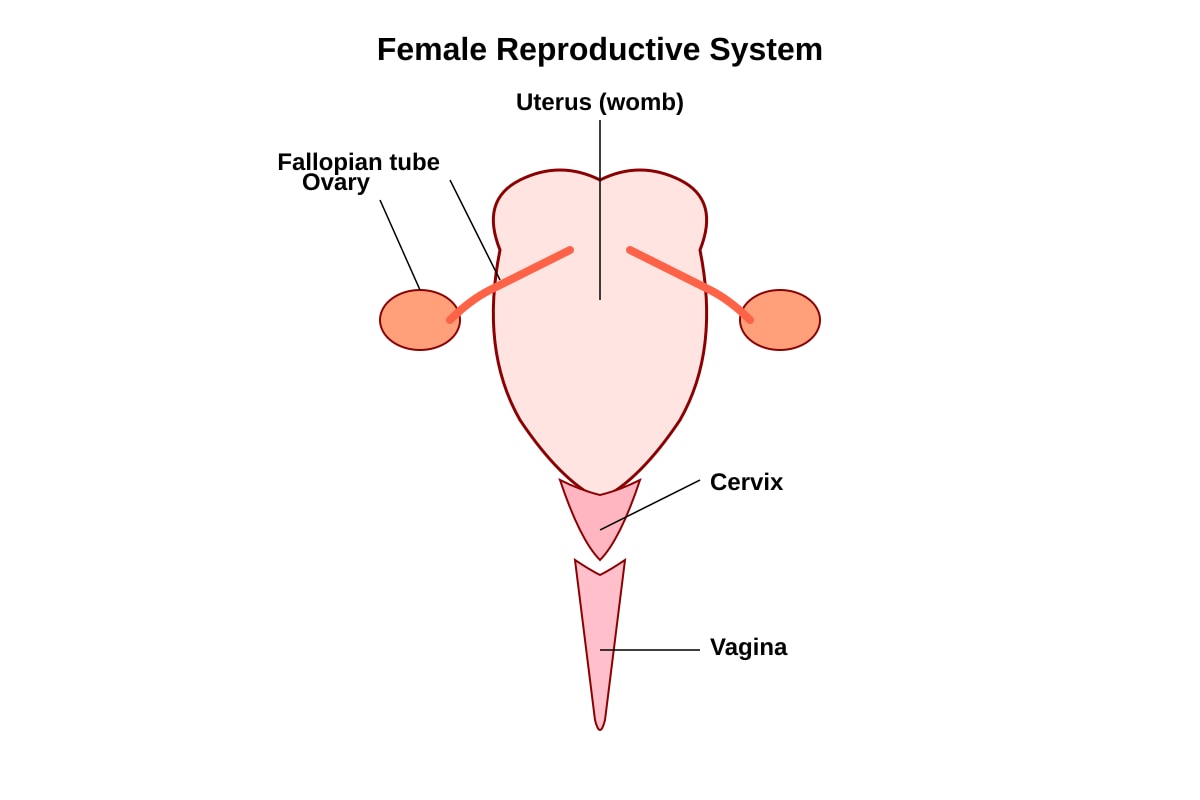
6. Answer: (2) Fallopian tube [2]
Explanation:
- Fertilisation (fusion of sperm and egg) usually occurs in the fallopian tube (oviduct).
- The ovary releases the egg (ovulation).
- The fertilised egg then moves to the uterus (womb) where it implants and develops.
- The vagina is the birth canal.
7. Answer: (2) Higher temperature speeds up the development of the butterfly. [2]
Explanation:
- At 30°C, all stages take fewer days than at 25°C (Egg: 3 vs 4, Larva: 10 vs 14, Pupa: 7 vs 10).
- This shows higher temperature increases metabolic rate and speeds up development.
- (1) Incorrect: Total development time is shorter at 30°C.
- (3) Incorrect: Larva stage is longest at both temperatures.
- (4) Incorrect: Pupa stage is affected (10 days → 7 days).
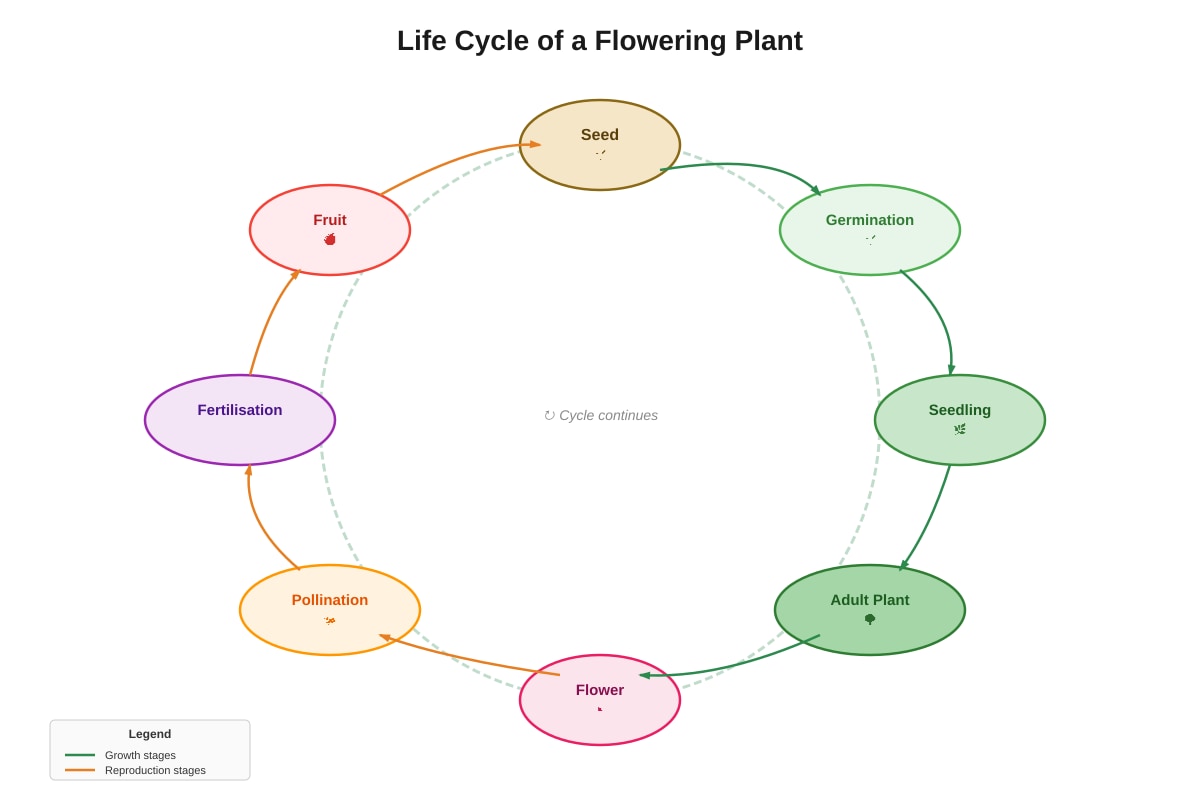
8. Answer: (2) Pollination → Fertilisation → Seed dispersal → Germination [2]
Explanation:
Correct sequence in sexual reproduction of flowering plants:
- Pollination — transfer of pollen to stigma
- Fertilisation — fusion of male and female reproductive cells → seed formation
- Seed dispersal — seeds spread away from parent plant
- Germination — seed develops into new plant under suitable conditions
9. Answer: (3) Stores food for the embryo [2]
Explanation:
- Seed coat — protects the embryo (Option 1).
- Plumule — develops into the shoot (Option 2).
- Cotyledon — stores food (starch, proteins, oils) for the developing embryo until it can photosynthesise.
- Radicle — develops into the root; absorbs water (Option 4 is radicle's function).
10. Answer: (4) Bala and Devi [2]
Explanation:
- Ali: Incorrect. Many microorganisms are beneficial (e.g., yeast in bread, bacteria in yoghurt, decomposers).
- Bala: Correct. Yeast (a fungus) is used in bread-making (fermentation produces CO₂).
- Cindy: Incorrect. Bacteria are larger than viruses. Viruses are much smaller (need electron microscope).
- Devi: Correct. Microorganisms (bacteria, viruses, most fungi, protists) are microscopic — cannot be seen with naked eye.
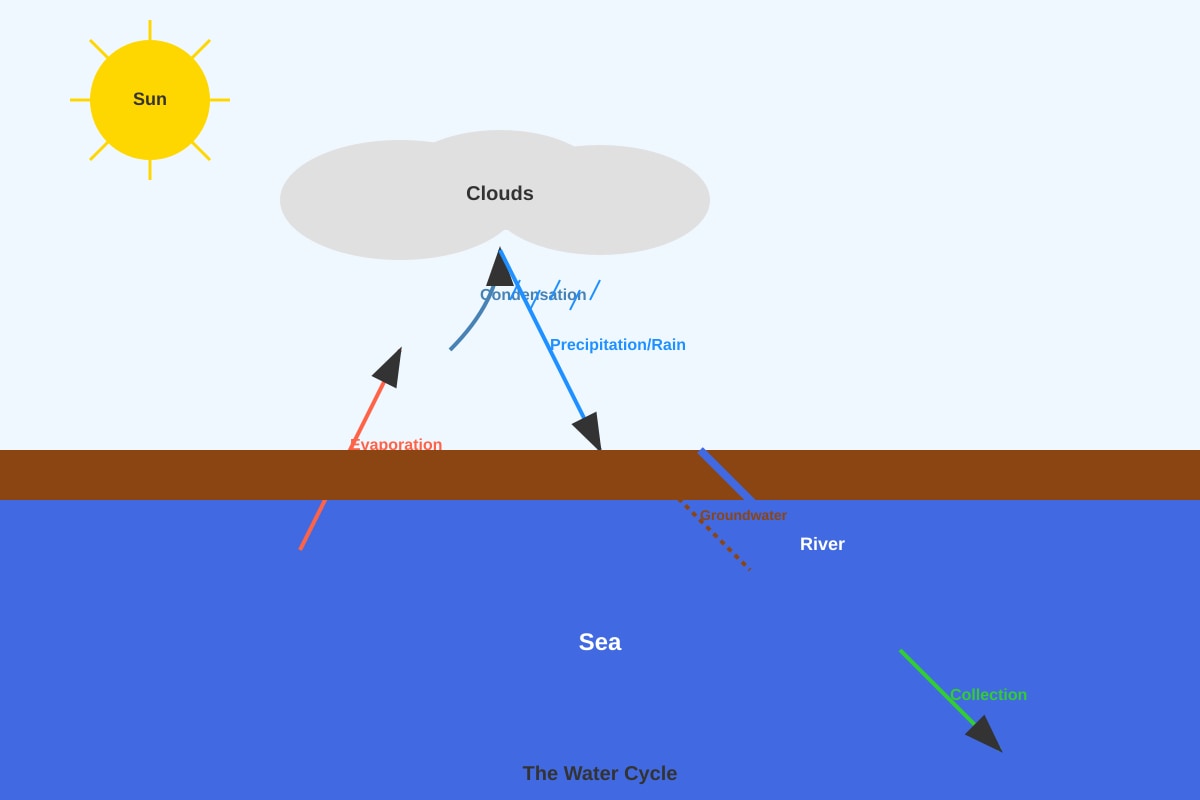
11. Answer: (2) Condensation [2]
Explanation:
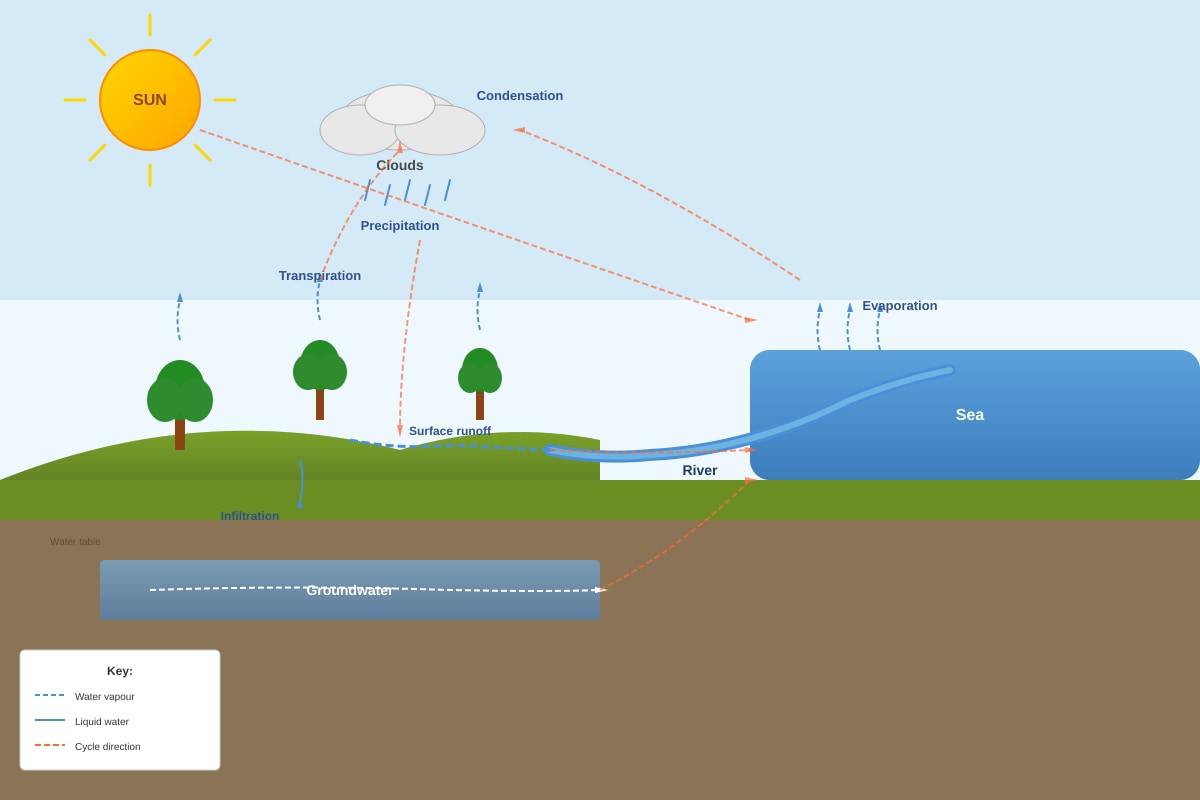
- Condensation is the change of state from gas (water vapour) to liquid (water droplets) — forms clouds.
- Evaporation — liquid to gas.
- Precipitation — water falling (rain, snow).
- Collection — water gathering in bodies.
12. Answer: (2) The water evaporated into the air. [2]
Explanation:
- On a hot day, heat from the Sun causes water in the puddle to gain energy and change from liquid to gas (water vapour) — evaporation.
- (1) Condensation is gas to liquid (opposite).
- (3) Freezing requires cold temperatures.
- (4) Some may seep, but the main reason it "disappears" is evaporation.
13. Answer: (3) Presence of wind [2]
Explanation:
Factors increasing evaporation rate:
- Higher temperature (not lower)
- Larger exposed surface area (not smaller)
- Presence of wind (removes saturated air above surface)
- Lower humidity (not higher)
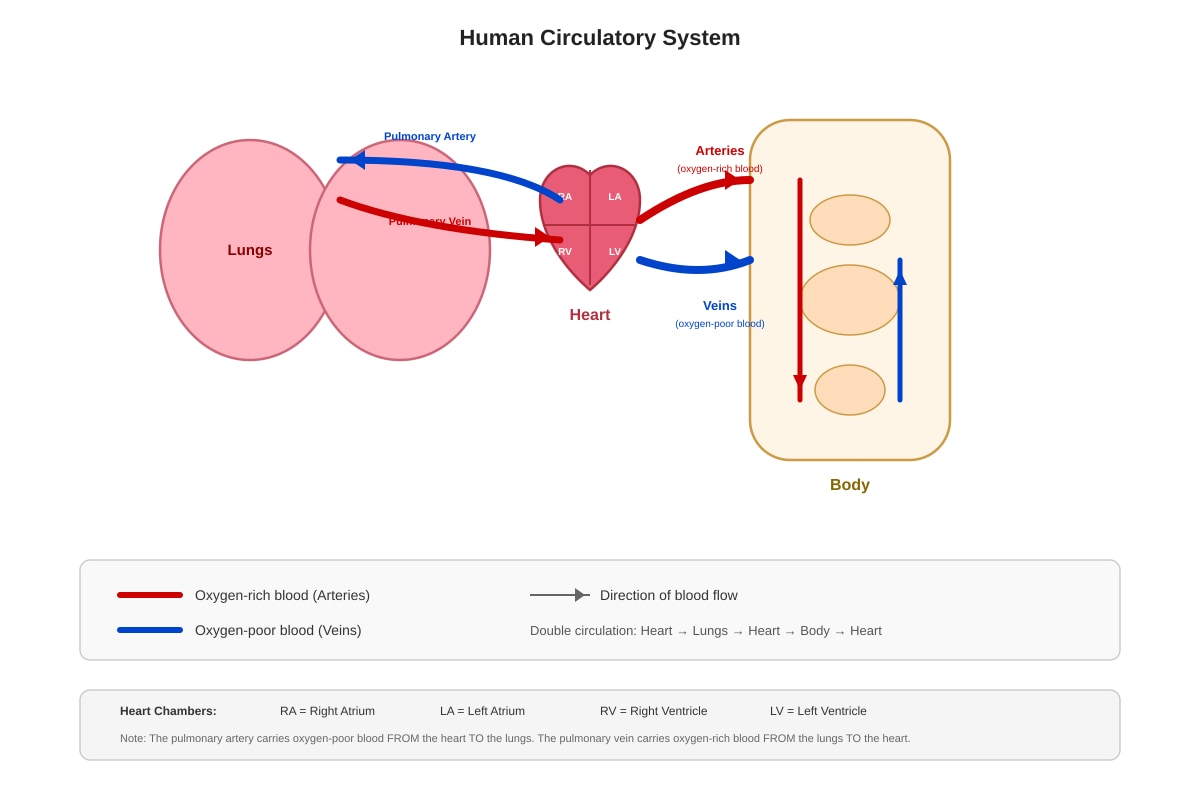
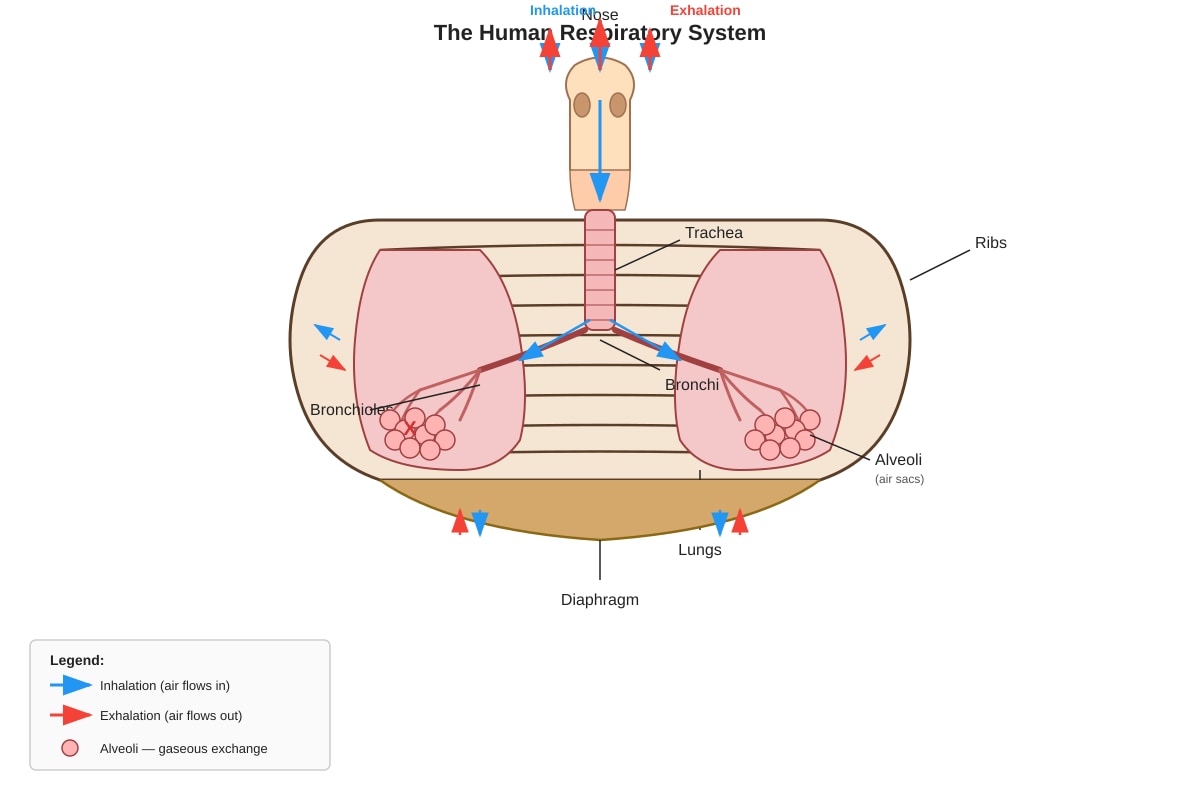
14. Answer: (2) Oxygen-poor and flows to the lungs [2]
Explanation:
- Pulmonary artery carries deoxygenated (oxygen-poor) blood from the right ventricle to the lungs to pick up oxygen.
- It is the only artery that carries oxygen-poor blood.
- Pulmonary vein carries oxygen-rich blood from lungs to left atrium.
- Aorta carries oxygen-rich blood to the body.
15. Answer: (1) The body uses oxygen and produces carbon dioxide during respiration. [2]
Explanation:
- Respiration: Glucose + Oxygen → Carbon dioxide + Water + Energy
- Oxygen decreases from 21% → 16% (used by cells).
- Carbon dioxide increases from 0.04% → 4% (produced by cells).
- Nitrogen unchanged (78%) — inert, not used in respiration.
- Water vapour increases — produced during respiration.
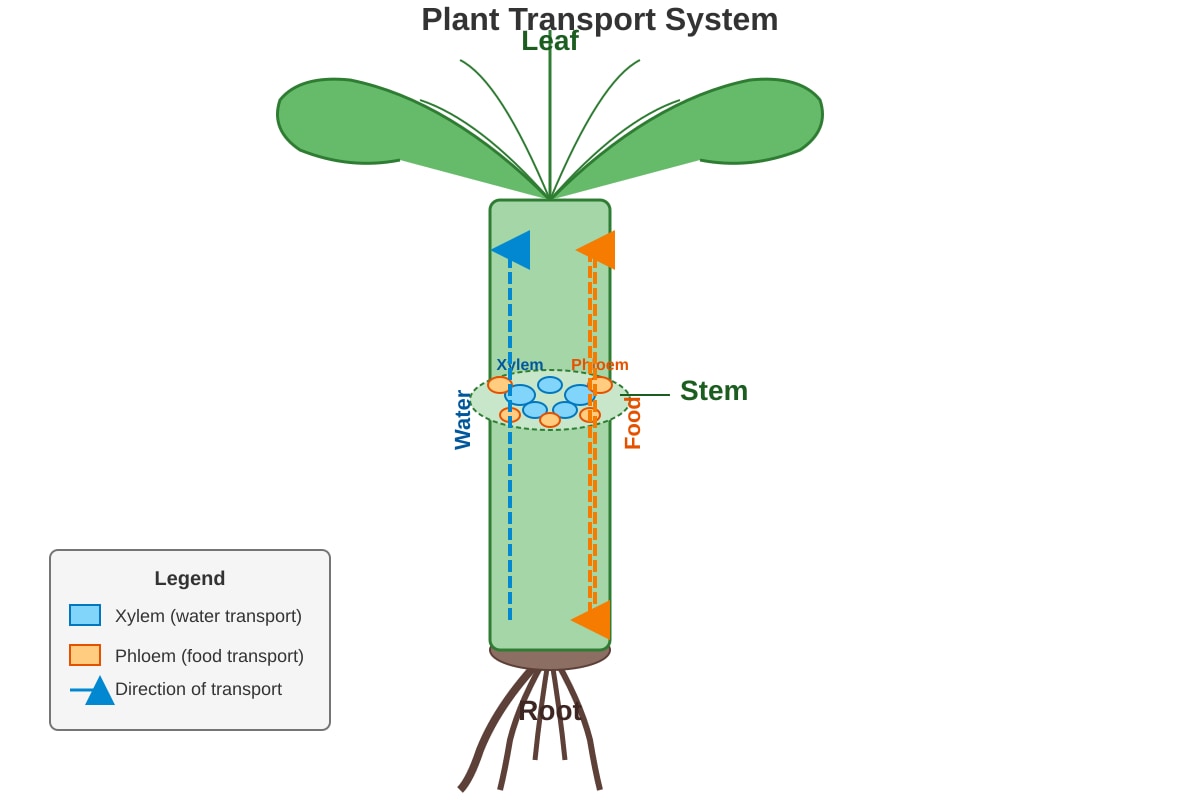
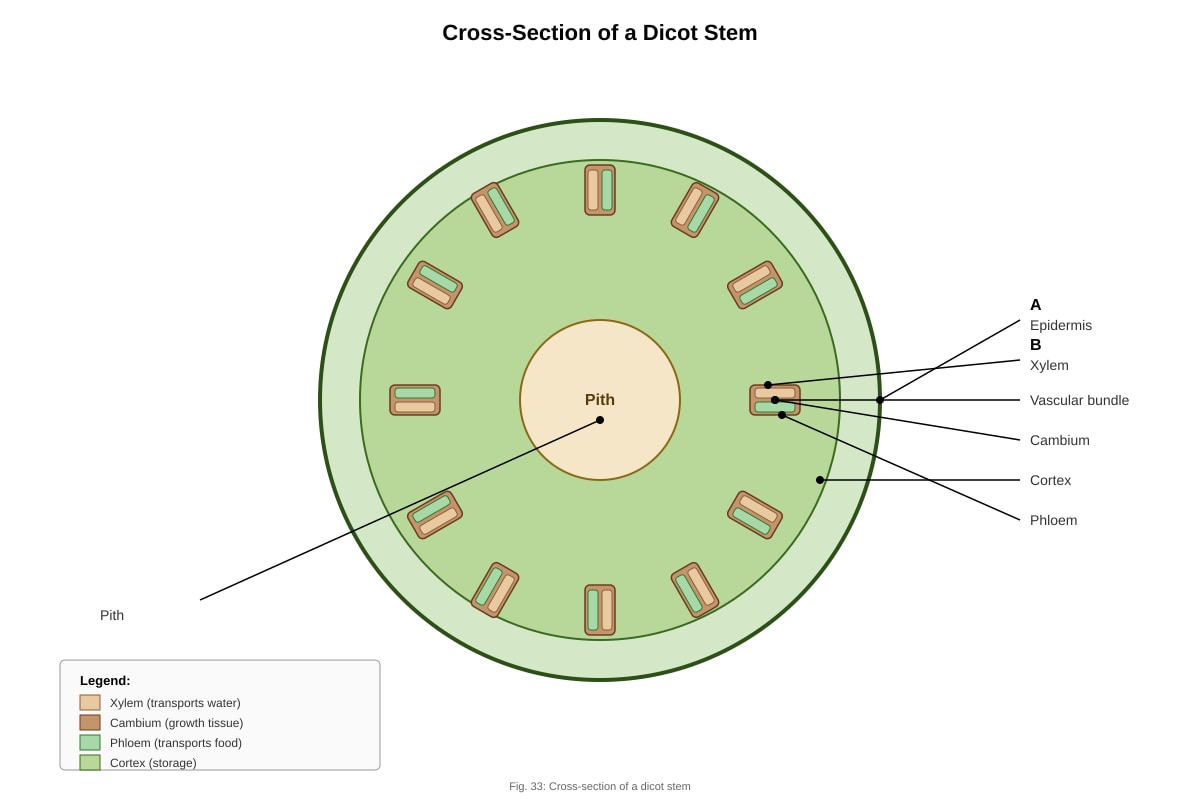
16. Answer: (2) Xylem transports water, Phloem transports food [2]
Explanation:
- Xylem — transports water and mineral salts from roots to leaves (one-way, upward). Also provides support.
- Phloem — transports food (sugar) from leaves to all parts of the plant (two-way).
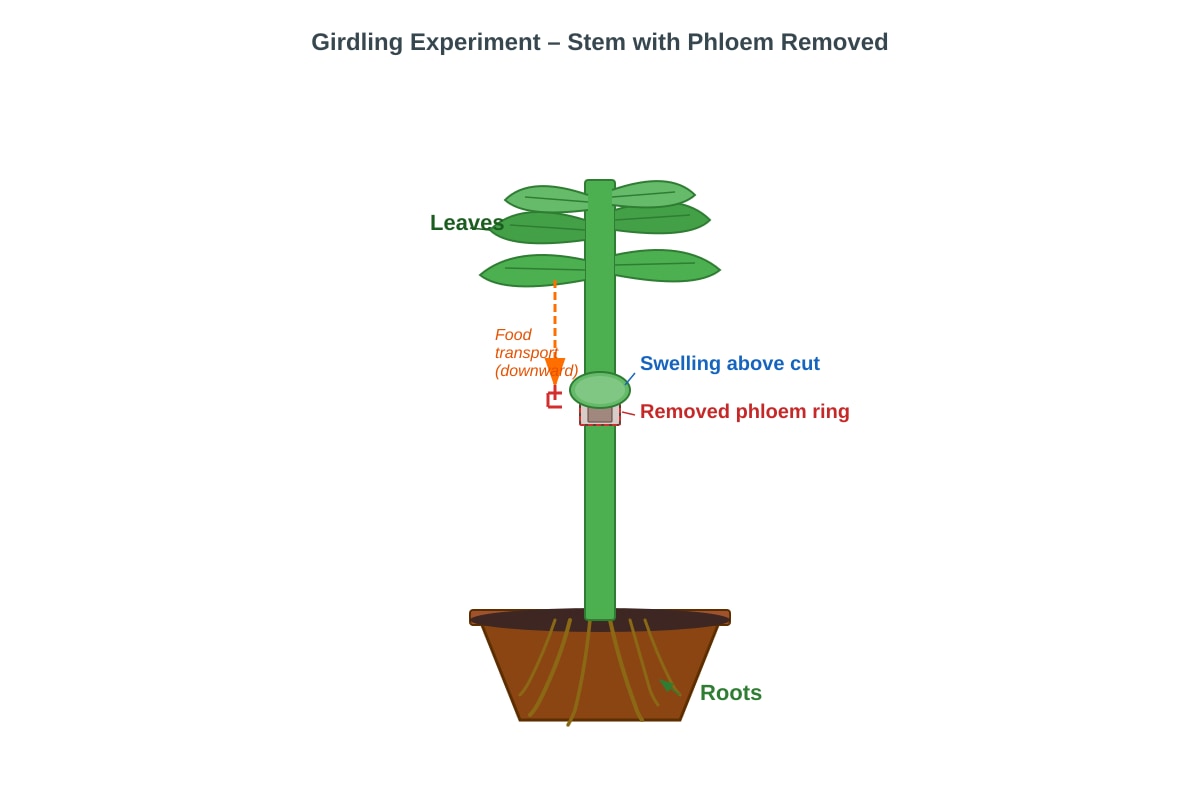
17. Answer: (2) Food made by the leaves cannot move down past the cut. [2]
Explanation:
- Girdling removes the
<stage5_exam_answers_md>
TuitionGoWhere Practice Paper - Science Primary 5 (Answer Key)
Paper: Practice Paper 4 (Version 4 of 5)
Subject: Science
Level: Primary 5
Total Marks: 100
Section A: Multiple-Choice Questions (56 marks)
| Qn | Answer | Explanation |
|---|---|---|
| 1 | (2) | The ovary develops into the fruit after fertilisation. The anther produces male reproductive cells (pollen), the stigma receives pollen, and petals (not sepals) attract pollinators. |
| 2 | (4) | Flowering plant: Does it reproduce by spores? No → Does it have flowers? Yes → (stops). Mould reproduces by spores (Yes). Fern reproduces by spores (Yes). Bird: No → No → Yes. |
| 3 | (4) | Reptiles have scales. W (spores) = fungus/fern, X (flowers) = flowering plant, Y (feathers) = bird, Z (scales) = reptile. |
| 4 | (2) | Adult mosquitoes lay eggs in/on water, not on land. Larva and pupa live in water, pupa does not feed, and there are four stages. |
| 5 | (3) | The changed variable is the presence of light (Set-up A: bright, Set-up B: dark). All other variables are kept constant. |
| 6 | (2) | Fertilisation usually takes place in the fallopian tube. The ovary releases the egg, the uterus is for implantation, and the vagina is the birth canal. |
| 7 | (2) | At 30°C, all stages take fewer days (Egg: 3 vs 4, Larva: 10 vs 14, Pupa: 7 vs 10). Higher temperature speeds up development. |
| 8 | (2) | Correct order: Pollination → Fertilisation → Seed dispersal → Germination. |
| 9 | (3) | The cotyledon stores food for the embryo. The seed coat protects, the plumule develops into the shoot, and the radicle absorbs water. |
| 10 | (4) | Bala (Yeast makes bread) and Devi (Microorganisms need a microscope) are correct. Ali is wrong (some are useful), Cindy is wrong (bacteria are larger than viruses). |
| 11 | (2) | Change of state from gas to liquid is condensation (water vapour → water droplets). |
| 12 | (2) | The water evaporated (liquid → gas) due to heat from the sun. |
| 13 | (3) | Presence of wind increases evaporation rate by removing saturated air. Higher temperature, larger surface area, and lower humidity also increase evaporation. |
| 14 | (2) | The pulmonary artery carries oxygen-poor blood from the heart to the lungs to pick up oxygen. |
| 15 | (1) | During respiration, the body uses oxygen and produces carbon dioxide. Nitrogen is inert; water vapour increases. |
| 16 | (2) | Xylem transports water (and minerals) from roots to leaves. Phloem transports food (sugar) from leaves to other parts. |
| 17 | (2) | Phloem carries food downwards from leaves. Removing a ring causes food to accumulate above the cut (swelling). Xylem (water transport) is unaffected. |
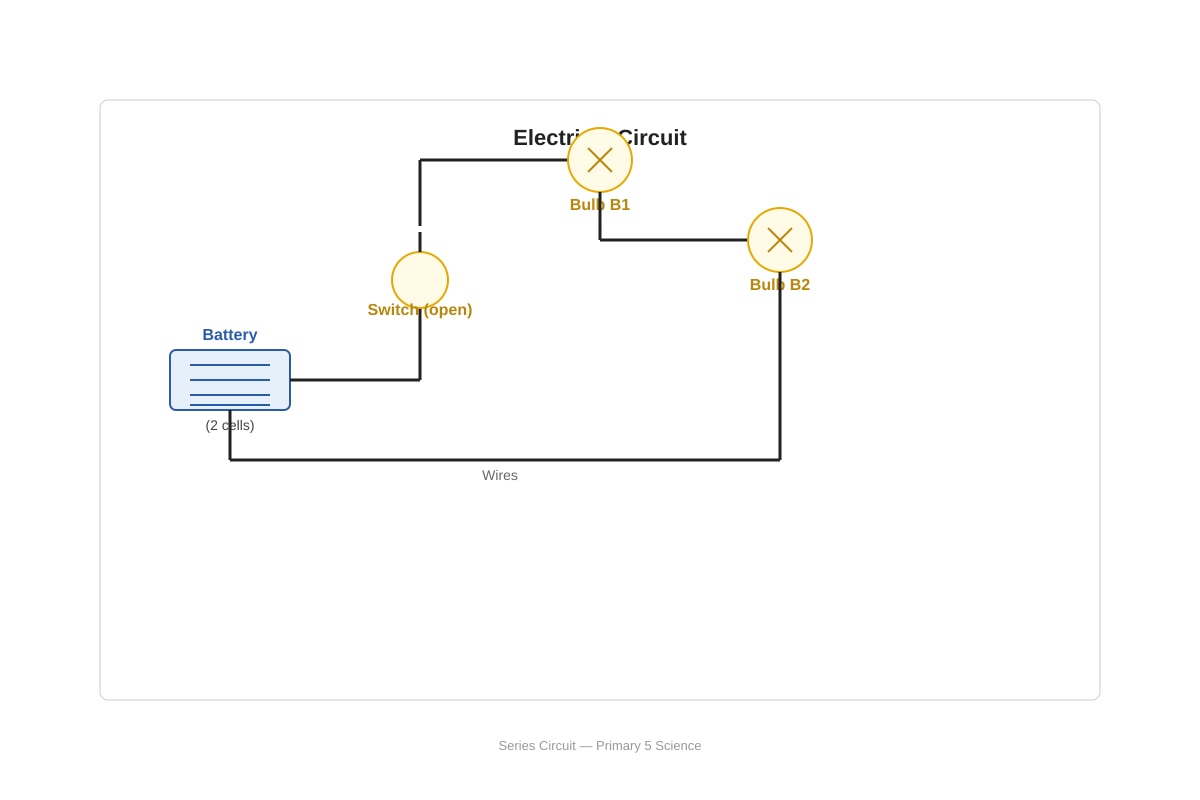
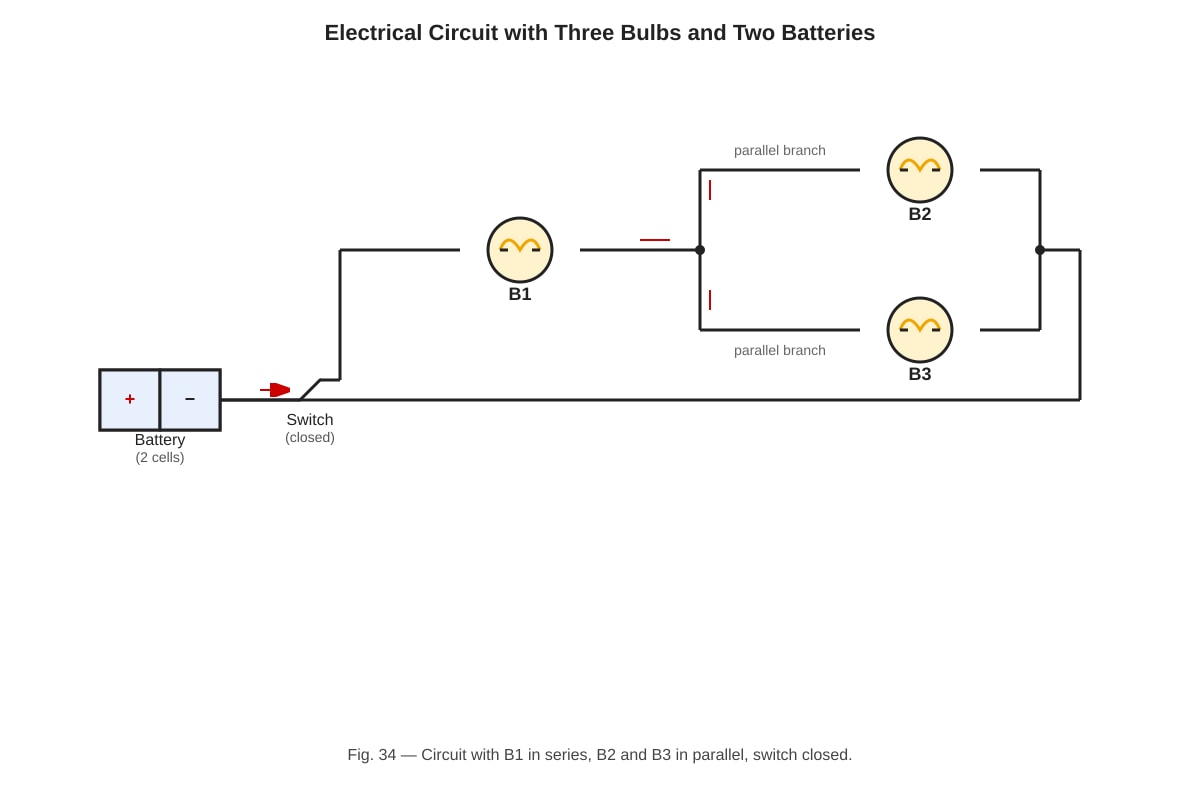
| 18 | (3) | In a series circuit, closing the switch completes the circuit for both bulbs. Both will light up (though dimmer than one bulb). |
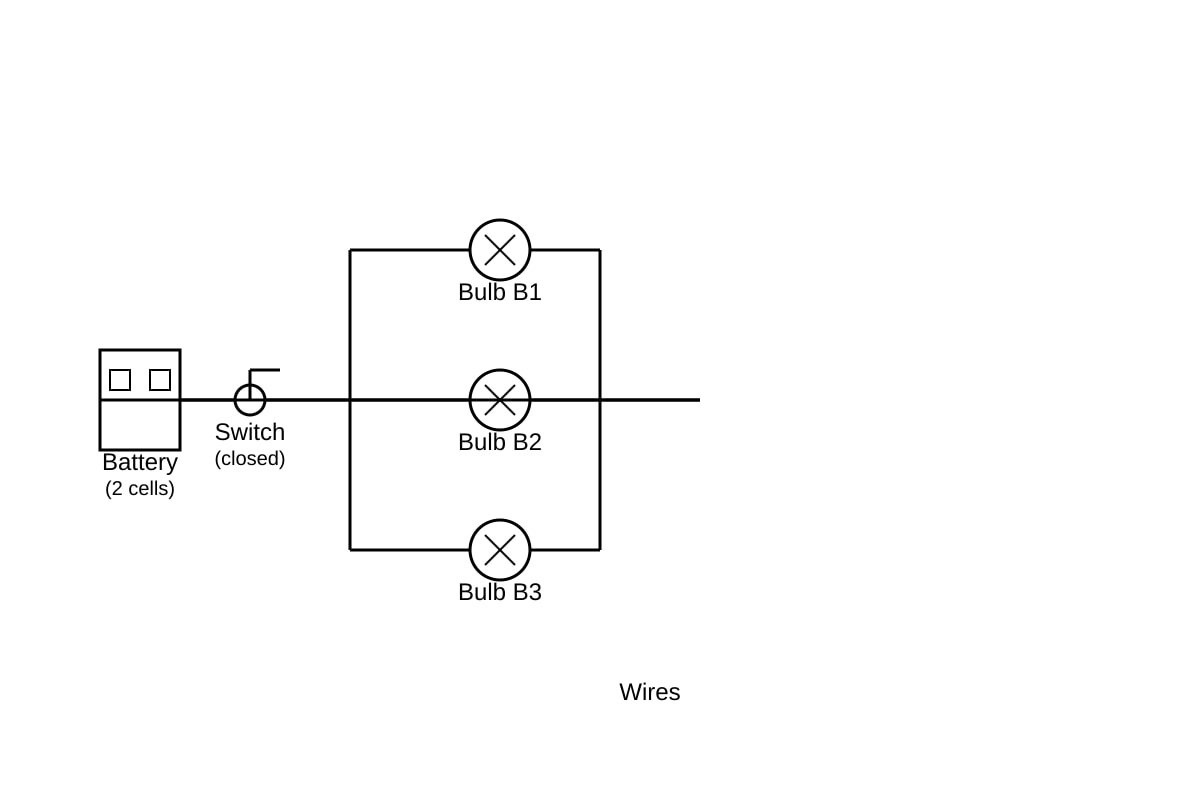
| 19 | (4) | In a parallel circuit, each bulb has its own path. If B1 fuses, B2 and B3 stay lit because their circuits are unbroken. |
| 20 | (3) | A metal paper clip is a conductor and completes the circuit. Plastic, wood, and air gaps are insulators. |
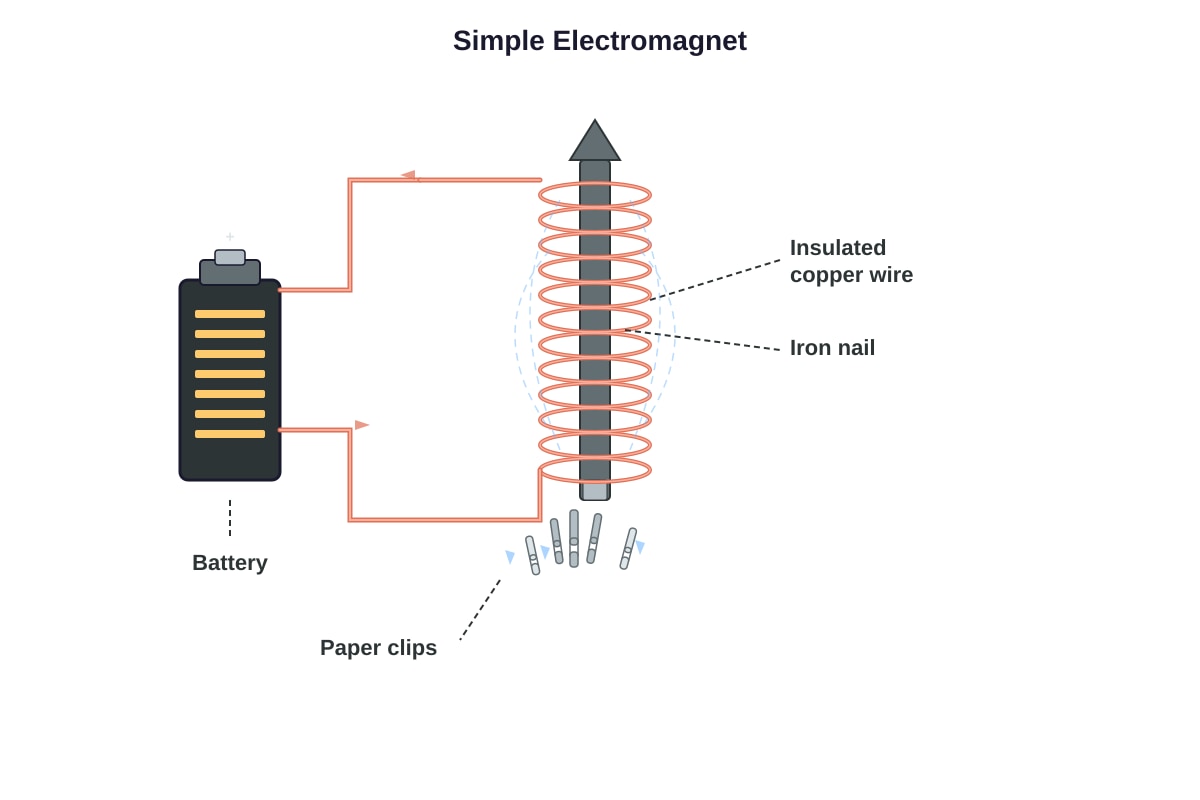
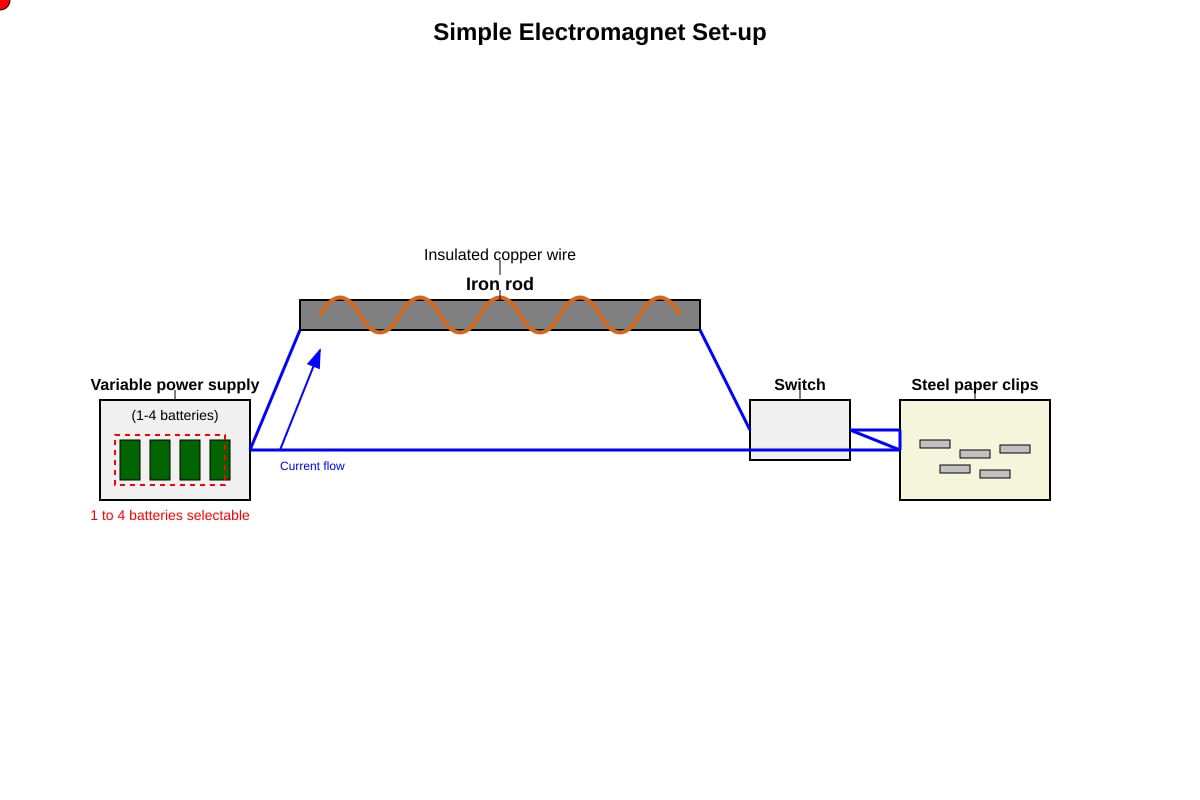
| 21 | (4) | Copper is not magnetic. An electromagnet requires a ferromagnetic core (iron, steel, nickel). More coils, thicker core, and more batteries increase strength. |
| 22 | (2) | Fertilisation (fusion of male and female gametes) directly leads to seed formation. Pollination brings pollen to stigma; germination is seed growing; dispersal spreads seeds. |
| 23 | (3) | Wind-dispersed seeds have wing-like structures or fine hairs (e.g., dandelion, angsana) to stay airborne. Fleshy = animal, Hooks = animal, Heavy = water/gravity. |
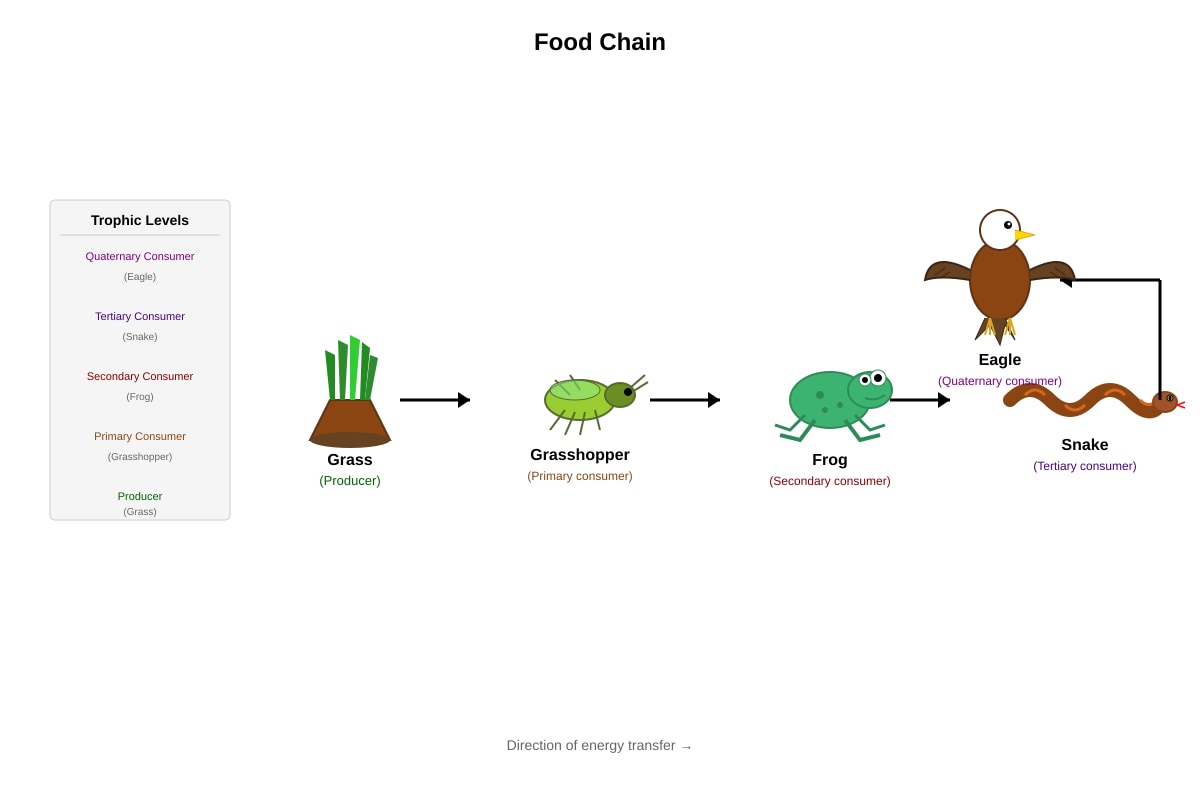
| 24 | (3) | Grass is the producer (makes its own food via photosynthesis). All others are consumers. |
| 25 | (1) | Frogs eat grasshoppers. If frogs are removed, grasshopper population increases → more grass eaten → grass population decreases? Wait. Let's re-read. Grass → Grasshopper → Frog. If Frog removed, Grasshopper increases (less predation). More grasshoppers eat more grass. Grass population decreases. Correction: Answer is (2) It will decrease. |
| 26 | (4) | Learning to sit is a learned behaviour, not an inherited adaptation for survival. Thick fur, water storage, and camouflage are structural/behavioural adaptations. |
| 27 | (2) | Decomposers (bacteria, fungi) break down dead organisms and waste, returning nutrients to the soil for producers to reuse. |
| 28 | (3) | Community = all populations of different organisms living and interacting in an area. Population = one species; Ecosystem = community + environment; Habitat = place where organism lives. |
Section B: Open-Ended Questions (44 marks)
29. Classification of Living Things [4 marks]
a) Based on the flow chart in Question 2, state two characteristics of a fern. [2]
Answer: Reproduces by spores; Does not have flowers. (Accept: Non-flowering plant, reproduces by spores)
b) Organism M reproduces by spores and has no flowers. Organism N has flowers and produces seeds. State one similarity and one difference in their reproduction. [2]
Similarity: Both reproduce to ensure continuity of their kind / Both involve the production of reproductive units (spores/seeds). Difference: M reproduces by spores (asexual/sexual depending on type, but typically spores dispersed), while N reproduces by seeds (sexual reproduction via flowers). / M does not have flowers; N has flowers.
30. Life Cycles [4 marks]
a) The diagram below shows the life cycle of a mealworm beetle. Name stages A and B. [2]
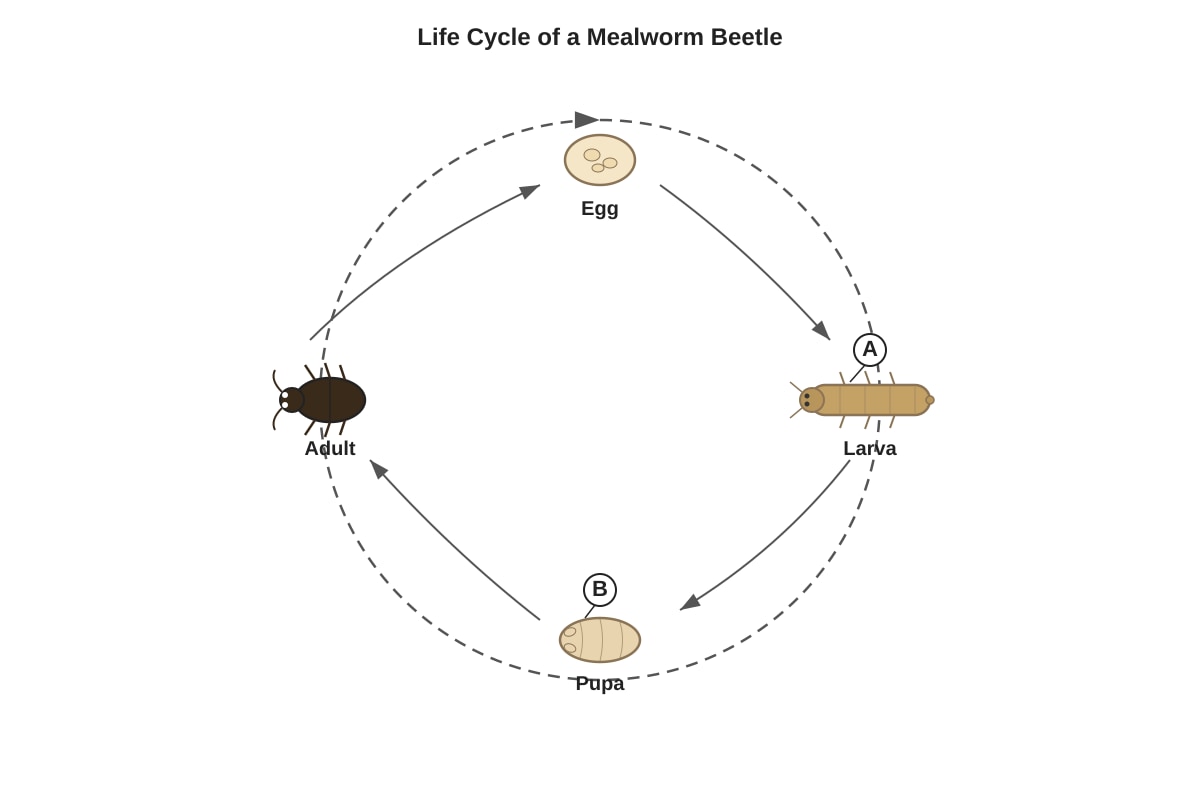
Generated diagram for this question.
A: Larva (Mealworm)
B: Pupa
b) State one difference between the life cycle of a mealworm beetle and a grasshopper. [1]
Answer: Mealworm beetle has a 4-stage life cycle (complete metamorphosis: Egg, Larva, Pupa, Adult). Grasshopper has a 3-stage life cycle (incomplete metamorphosis: Egg, Nymph, Adult). / Mealworm has a pupa stage; grasshopper does not.
c) Why is the larva of the mealworm beetle considered a pest? [1]
Answer: It feeds on stored grains/flour/cereals, contaminating food supplies with its waste and moulted skin.
31. Plant Reproduction [4 marks]
a) The diagram shows a flower. Label parts X and Y. [2]
X: Anther (produces pollen)
Y: Stigma (receives pollen)
(Note: If diagram shows Pistil parts: X=Stigma, Y=Ovary. Adjust based on standard diagram. Assuming standard: X=Anther, Y=Stigma)
b) After pollination, a pollen tube grows down the style. What is the function of the pollen tube? [1]
Answer: To transport the male reproductive cell (sperm nucleus) from the pollen grain to the ovule in the ovary for fertilisation.
c) The ovule develops into a seed after fertilisation. What does the ovary develop into? [1]
Answer: The fruit.
32. Human Reproduction [3 marks]
a) In the human female reproductive system, where is the egg produced? [1]
Answer: Ovary
b) After fertilisation, the zygote divides and moves down the fallopian tube. Where does it implant? [1]
Answer: Uterus (womb) / Lining of the uterus (endometrium)
c) State one function of the amniotic fluid surrounding the developing foetus. [1]
Answer: Protects the foetus from mechanical shock/injury / Acts as a cushion / Allows movement for muscle development / Maintains constant temperature.
33. Water Cycle & Changes of State [5 marks]
a) In the water cycle, process P represents water vapour losing heat to form water droplets. Name process P. [1]
Answer: Condensation
b) Water from a wet towel hung outside disappears after a few hours. Name the process and state two conditions that speed it up. [3]
Process: Evaporation
Conditions (any two):
- Higher temperature / Warmer surroundings
- Larger exposed surface area (spread out towel)
- Presence of wind / Moving air
- Lower humidity / Drier air
c) Ice cubes are taken out of the freezer. Water droplets form on the outer surface of the cubes after a while. Explain how the droplets are formed. [1]
Answer: Water vapour in the surrounding warmer air comes into contact with the cold surface of the ice cubes, loses heat, and condenses into water droplets.
34. Human Circulatory & Respiratory Systems [5 marks]
a) Blood vessel A carries oxygen-rich blood from the heart to the body. Name blood vessel A. [1]
Answer: Aorta (Main artery)
b) The graph below shows the heart rate of a pupil before, during, and after exercise.
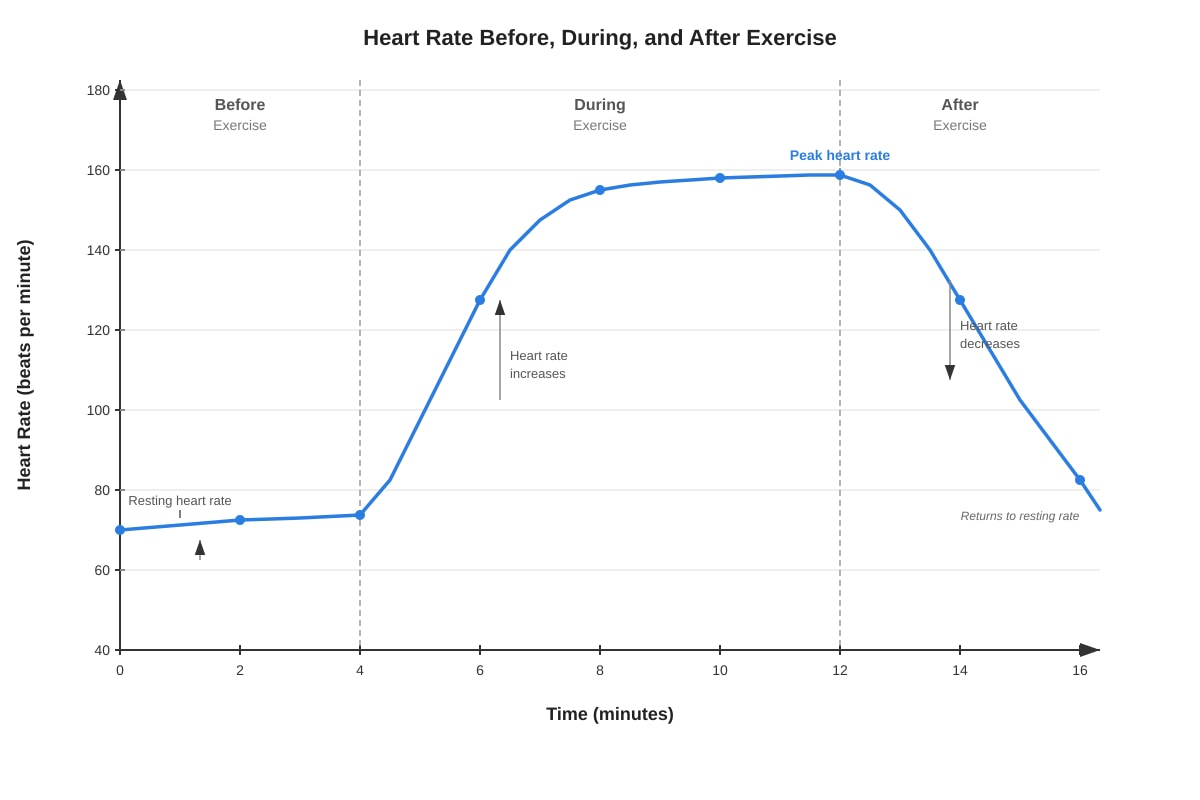
Generated graph for this question.
Answer: (Description: Heart rate increases during exercise, peaks, then decreases after exercise to resting rate.)
c) Explain why the heart rate changes during exercise. [2]
Answer: During exercise, muscles need more energy. The heart beats faster to pump more oxygen-rich blood (and nutrients) to the muscles for increased respiration to release more energy. Carbon dioxide is also removed faster.
d) State one difference between inhaled and exhaled air (other than temperature). [1]
Answer: Exhaled air has less oxygen (16% vs 21%) and more carbon dioxide (4% vs 0.04%) and more water vapour (saturated vs variable).
35. Plant Transport System [4 marks]
a) The diagram shows a cross-section of a stem. Identify tissues C and D. [2]
C: Xylem (inner, transports water)
D: Phloem (outer, transports food)
(Note: Position depends on diagram. In dicot stem: Xylem inside, Phloem outside. In root: Xylem center, Phloem arms.)
b) A ring of bark (including phloem) is removed from a tree trunk (girdling). The tree eventually dies. Explain why the roots die first. [2]
Answer: Phloem transports food (sugar) made by the leaves down to the roots. Removing the phloem stops food transport to the roots. Roots starve (cannot respire for energy/growth) and die first. Xylem (water transport up) is intact initially, so leaves survive longer.
36. Electrical Systems [5 marks]
a) Draw wires in the diagram below to connect the battery, switch, and two bulbs (B1, B2) in series. [2]
Answer: (Diagram: Battery +ve → Wire → Switch → Wire → B1 → Wire → B2 → Wire → Battery -ve. Single loop.)
b) In the series circuit above, if B1 fuses, what happens to B2? Explain. [1]
Answer: B2 will not light up / goes out. In a series circuit, there is only one path for current. A fused bulb creates an open circuit, stopping current flow to all components.
c) The diagram shows a parallel circuit with two bulbs. State one advantage of connecting bulbs in parallel over series. [1]
Answer: If one bulb fuses, the other bulb stays lit (independent control). / Each bulb receives the full voltage of the battery and shines brightly (same brightness as a single bulb).
d) Why is copper used for electrical wires instead of iron? [1]
Answer: Copper is a better conductor of electricity (lower resistance) than iron / Copper is more ductile (easier to draw into thin wires) / Copper corrodes less easily.
37. Magnets & Electromagnets [4 marks]
a) The diagram shows a bar magnet. Label the poles at E and F. [1]
E: North-seeking pole (N)
F: South-seeking pole (S)
(Convention: Arrow points from N to S outside magnet. Or based on compass diagram.)
b) An electromagnet is made by coiling wire around an iron rod. State two ways to make it stronger. [2]
- Increase the number of coils (turns of wire).
- Increase the current (add more batteries in series / use higher voltage).
- Use a soft iron core (instead of steel) / Thicker core.
c) Why is soft iron preferred over steel for the core of an electromagnet? [1]
Answer: Soft iron gains magnetism quickly when current flows and loses it quickly when current is switched off (temporary magnet). Steel retains magnetism (permanent magnet), making it hard to switch off.
38. Energy Conversion & Forces [4 marks]
a) A ball is dropped from a height. Complete the energy conversion. [2]
Gravitational Potential Energy → Kinetic Energy (+ Heat + Sound Energy upon impact)
Main conversion: Potential → Kinetic.
b) A toy car is pushed and moves on a rough floor. It slows down and stops. Name the force that causes it to stop. [1]
Answer: Friction (between wheels/axles and floor/air resistance).
c) The diagram shows a lever (see-saw) balancing two loads. Load X (200g) is 10cm from fulcrum. Load Y is 20cm from fulcrum. What is the mass of Load Y? [1]
Answer: 100 g
Principle of Moments: Clockwise Moment = Anticlockwise Moment
39. Interactions & Adaptations [5 marks]
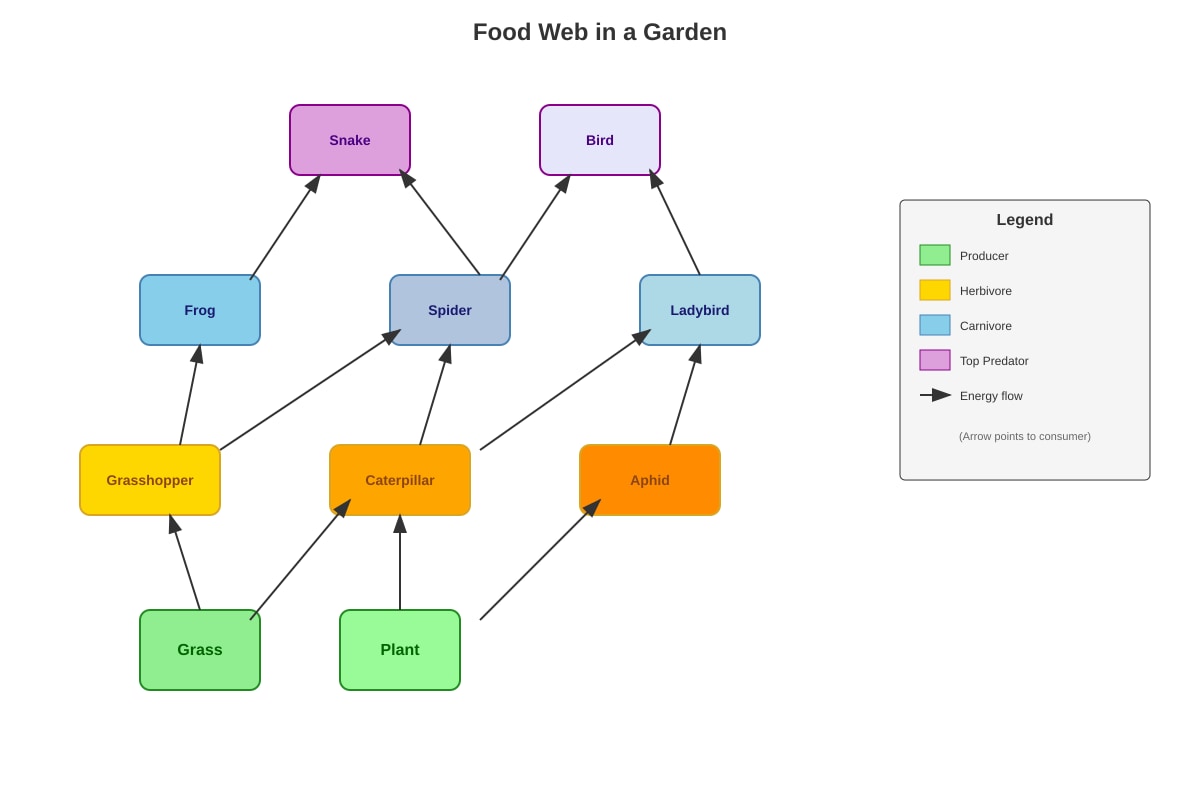
a) The diagram shows a food web.
Producer: Grass/Plant
Primary Consumer: Grasshopper/Rabbit
Secondary Consumer: Frog/Bird
Tertiary Consumer: Snake/Eagle
b) If a disease kills all the snakes, predict what happens to the eagle population and grass population. Explain. [3]
Eagle population: Decreases. Snakes are food for eagles. Less food → eagles starve/die/leave. Grass population: Increases. Snakes eat frogs/birds (which eat grasshoppers). No snakes → more frogs/birds → more grasshoppers eaten → fewer grasshoppers → less grass eaten → grass increases.
(Alternative chain: Snakes eat herbivores directly? Usually snakes are carnivores eating herbivores/omnivores. Standard: Snake (3°) → Frog (2°) → Grasshopper (1°) → Grass. Remove Snake → Frog ↑ → Grasshopper ↓ → Grass ↑.)
c) State one structural adaptation of a cactus for surviving in the desert. [1]
Answer: Reduced leaves (spines) to reduce water loss through transpiration / Thick, fleshy stem to store water / Deep/extensive roots to absorb water quickly / Waxy cuticle to reduce water loss.
40. Matter & Heat [4 marks]
a) Substance Z has a melting point of 50°C and boiling point of 200°C. State the state of Z at: [2]
(i) 30°C: Solid (Below melting point)
(ii) 150°C: Liquid (Between melting and boiling point)
b) The diagram shows a bimetallic strip (Metal A expands more than Metal B) at room temperature and when heated.
Answer: (Diagram: Strip bends towards Metal B when heated because Metal A expands more on the outer/upper side, forcing the strip to curve with A on the outside.)
c) Explain how a bimetallic strip works in a fire alarm. [2]
Answer: In a fire, heat causes the strip to bend (towards the metal that expands less). This completes the electrical circuit (contacts touch), allowing current to flow and sound the alarm.
41. Experimental Skills - Fair Test [4 marks]
a) Ali wants to find out if temperature affects the rate of dissolving sugar in water. He uses two beakers: Beaker P (hot water), Beaker Q (cold water). He puts 100g sugar in each and stirs 10 times. State two variables he must keep the same for a fair test. [2]
- Volume/Amount of water (e.g., 200 ml each)
- Type/Size of sugar (e.g., white granulated, same grain size)
- Number of stirs / Stirring speed / Time of stirring (already stated 10 times, but must be identical method)
- Mass of sugar (already stated 100g)
- Size/Type of beaker
b) He observes sugar dissolves faster in Beaker P. What is the conclusion? [1]
Answer: Higher temperature increases the rate of dissolving (sugar dissolves faster in hotter water).
c) Suggest one way to make the sugar dissolve even faster in hot water (without changing temperature). [1]
Answer: Stir faster / more times / Use finer sugar (powdered/caster) / Increase volume of water (more solvent) / Crush the sugar cubes.
End of Answer Key
Total: 100 Marks
Setters: TuitionGoWhere AI
Version 4 of 5