AI Generated Exam Paper
Primary 5 Science Practice Paper 4
Free P5 Science Practice Paper 4, HY3 AI version, with questions, answers, and syllabus-aligned practice for Singapore students.
These static practice materials are generated from the site's syllabus and paper-generation workflow, with source and model context shown so students and parents can evaluate the material before use.
Questions
Free quiz and exam paper access
Enter your details to view this paper
Your access is remembered on this device.
Answers
TuitionGoWhere Practice Paper - Science Primary 5 (Answer Key)
Version: 4 of 5
Topic: Diversity
Total Marks: 40
Section A Answers (10 marks)
1. B (1 mark)
Teaching note: Diversity means living things are different from one another. Different body features and habitats show this. A, C, D are false because they say all are same.
2. C (1 mark)
Teaching note: Feathers are physical characteristics. Grouping by feathers is grouping by observable body features.
3. B (1 mark)
Teaching note: Mushroom (fungi), fern (plant), fish (animal) are all living. Rock, cloud, water are non-living.
4. A (1 mark)
Teaching note: Roots and stems are plant parts used to group plants. Others are not scientific traits.
5. A (1 mark)
Teaching note: Movement type (fly/swim/walk) is a characteristic used to group animals.
6. C (1 mark)
Teaching note: Fungi are a separate group, not plants or animals.
7. B (1 mark)
Teaching note: Diversity = many different types of living things. A and C are wrong; D is not true.
8. A (1 mark)
Teaching note: Snail has shell, snake does not; both are animals but different features show diversity.
9. C (1 mark)
Teaching note: Plastic toy is non-living. Others are living.
10. B (1 mark)
Teaching note: Grouping helps study and understand living things.
Section B Answers (12 marks)
11. (2 marks)
Any two correct: body covering (feathers/fur/scales), number of legs, ability to fly, where they live, shape.
Marking: 1 mark per correct characteristic.
Teaching note: Physical characteristics are features we can see.
12. (2 marks)
Example: Plants make their own food using sunlight; animals cannot and must eat.
(Or: Plants do not move from place to place; animals can move.)
Marking: 1 mark for stating a plant trait, 1 mark for animal trait or contrast.
13. (2 marks)
Two from: mushroom, yeast, bacteria, algae, fern (if not counted as plant by some frameworks, but better use fungi/bacteria). Suggested: mushroom, bacteria.
Marking: 1 mark each.
14. (2 marks)
Both are plants because they have roots, stems, and make food using sunlight (1 mark). They live in different habitats (desert vs pond) showing diversity in where plants can survive (1 mark).
Teaching note: Same group but different environment = diversity.
15. (2 marks)
Any two: provides food, keeps air clean, balances nature, gives medicines, supports life.
Marking: 1 mark each.
16. (2 marks)
Yes, correct (1 mark). Insects are a group of animals with 6 legs and body parts (1 mark).
Common mistake: thinking insects are not animals.
Section C Answers (8 marks)
17. (2 marks)
Group 1: Plants (rose, mango, fern) — 1 mark
Group 2: Animals (cat, lizard, bee, fish) — 1 mark
(Mushroom separate but question asks two main groups; mushroom can be noted as fungi. If student puts fungi as third, accept but only 2 groups needed.)
18. (2 marks)
Plants share: they make their own food / have green parts / do not move about (1 mark).
Animals share: they move / eat other things / have eyes or legs (1 mark).
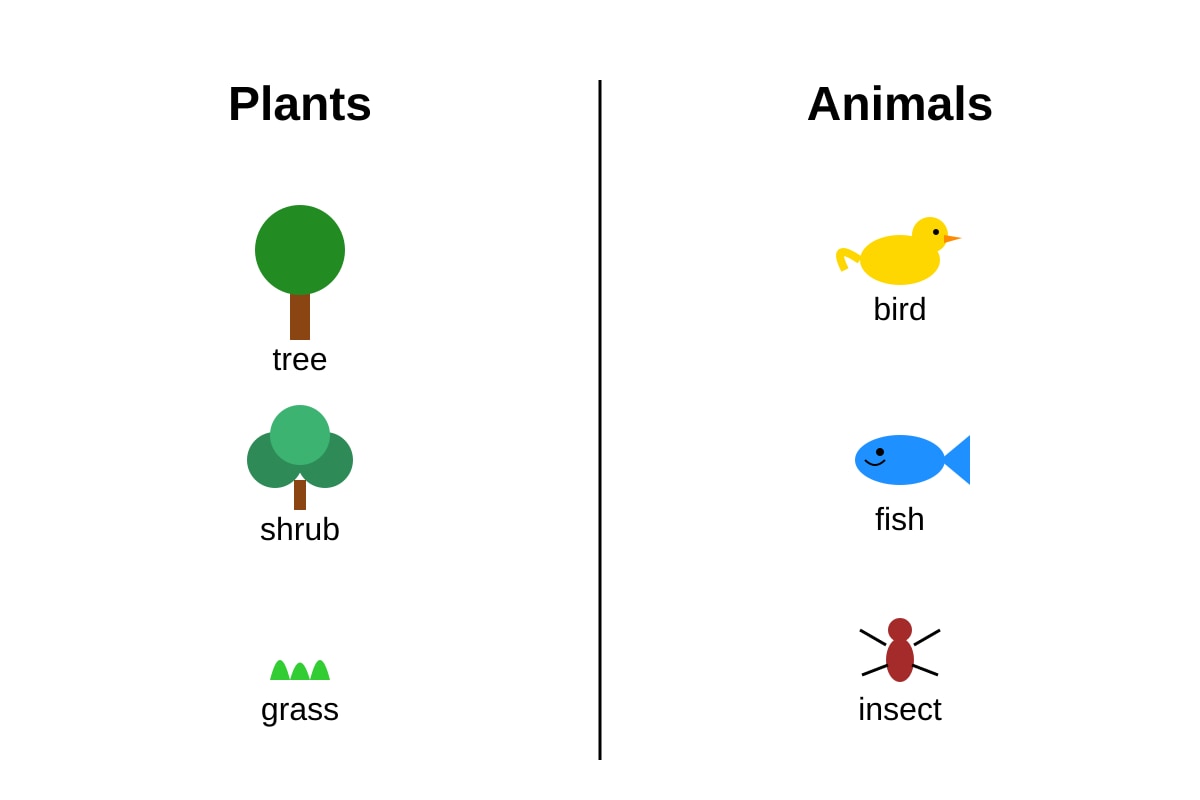
Image note: Diagram shows plant column and animal column; use visible examples.
19. (2 marks)
Frog – Animal – lives in water and land / has legs.
Pine tree – Plant – has needles not broad leaves.
Mushroom – Fungi – no leaves, grows on damp wood.
Marking: 1 mark for group + feature per row up to 2 marks total (0.5 each correct cell). Simplified: 2 marks for all three reasonably correct.
20. (2 marks)
Example: Check if it has chlorophyll/green colour (plant) or not and soft body (fungus) (1 mark). Or observe if it grows from spores (fungus) (1 mark).
Marking: 1 mark for test, 1 mark for reason.