AI Generated Exam Paper
Primary 5 Science Practice Paper 3
Free AI-Generated NVIDIA Nemotron 3 Ultra 550B A55B Free Primary 5 Science Practice Paper 3 practice paper with questions and answers for Singapore students. This page is rendered as a direct URL so the questions and answers can be discovered without pressing in-page buttons.
These static practice materials are generated from the site's syllabus and paper-generation workflow, with source and model context shown so students and parents can evaluate the material before use.
Questions
TuitionGoWhere Practice Paper - Science Primary 5
TuitionGoWhere Practice Paper (AI)
Subject: Science
Level: Primary 5
Paper: Practice Paper 3 (Version 3 of 5)
Duration: 1 hour 45 minutes
Total Marks: 100
Name: ________________________
Class: ________________________
Date: ________________________
Instructions to Candidates
- Do not open this booklet until you are told to do so.
- Follow all instructions carefully.
- Answer all questions.
- For Section A, shade your answers on the Optical Answer Sheet (OAS) provided.
- For Section B, write your answers in the spaces provided in this booklet.
- The number of marks is given in brackets [ ] at the end of each question or part question.
- The total marks for this paper is 100.
Section A: Multiple-Choice Questions (56 marks)
For each question from 1 to 28, four options are given. One of them is the correct answer. Make your choice (1, 2, 3 or 4) and shade the correct oval on the Optical Answer Sheet.
Question 1 [2 marks]
Which of the following statements about the diversity of living things is correct?
(1) All living things can make their own food.
(2) All living things reproduce by laying eggs.
(3) All living things respond to changes in their surroundings.
(4) All living things have the same life cycle.
Question 2 [2 marks]
Study the classification chart below.
<image_placeholder> id: Q2-fig1 type: diagram linked_question: Q2 description: Classification chart showing two main groups: Group X and Group Y. Group X has subgroups: 'Has feathers' and 'Has hair'. Group Y has subgroups: 'Has scales' and 'Has moist skin'. labels: Group X, Group Y, Has feathers, Has hair, Has scales, Has moist skin values: None must_show: Clear branching structure with two main groups and two subgroups each </image_placeholder>
Which of the following animals is classified correctly?
| Animal | Group |
|---|---|
| (1) Bat | Group X |
| (2) Penguin | Group Y |
| (3) Salamander | Group X |
| (4) Whale | Group Y |
Question 3 [2 marks]
The diagram below shows a plant.
<image_placeholder> id: Q3-fig1 type: diagram linked_question: Q3 description: Diagram of a plant with roots, stem, leaves, and flowers. The plant has broad leaves with net-like veins and a taproot system. labels: Roots, Stem, Leaves, Flowers values: None must_show: Broad leaves with net-like venation, taproot system, flowers present </image_placeholder>
Based on the diagram, which of the following statements about the plant is correct?
(1) It reproduces by spores.
(2) It is a non-flowering plant.
(3) It has a fibrous root system.
(4) It is a flowering plant.
Question 4 [2 marks]
Which of the following groups of organisms are all decomposers?
(1) Mushroom, yeast, bacteria
(2) Fern, moss, mushroom
(3) Bacteria, algae, yeast
(4) Mould, moss, fern
Question 5 [2 marks]
Study the flowchart below.
<image_placeholder> id: Q5-fig1 type: diagram linked_question: Q5 description: Flowchart for classifying organisms. Start: 'Does it make its own food?' Yes -> 'Plant'. No -> 'Does it have chlorophyll?' Yes -> 'Algae'. No -> 'Does it reproduce by spores?' Yes -> 'Fungi'. No -> 'Animal'. labels: Does it make its own food?, Plant, Does it have chlorophyll?, Algae, Does it reproduce by spores?, Fungi, Animal values: None must_show: Clear decision diamond shapes with yes/no branches leading to four end categories </image_placeholder>
Where would you place a mushroom in this flowchart?
(1) Plant
(2) Algae
(3) Fungi
(4) Animal
Question 6 [2 marks]
Which of the following characteristics is used to classify vertebrates into different groups?
(1) Body covering
(2) Habitat
(3) Method of reproduction
(4) Type of food eaten
Question 7 [2 marks]
The table below shows the characteristics of four organisms, A, B, C, and D. A tick (✓) shows the presence of the characteristic.
| Characteristic | Organism A | Organism B | Organism C | Organism D |
|---|---|---|---|---|
| Has backbone | ✓ | ✓ | ✗ | ✗ |
| Lays eggs | ✓ | ✗ | ✓ | ✗ |
| Has feathers | ✓ | ✗ | ✗ | ✗ |
| Has hair | ✗ | ✓ | ✗ | ✗ |
| Lives in water | ✗ | ✗ | ✓ | ✓ |
Which organism is most likely a mammal?
(1) A
(2) B
(3) C
(4) D
Question 8 [2 marks]
Which of the following statements about microorganisms is correct?
(1) All microorganisms are harmful.
(2) All microorganisms can be seen with the naked eye.
(3) Yeast is a type of fungus.
(4) Bacteria are larger than fungi.
Question 9 [2 marks]
Study the diagram below showing the life cycle of a mosquito.
<image_placeholder> id: Q9-fig1 type: diagram linked_question: Q9 description: Life cycle diagram of a mosquito showing four stages: Egg, Larva, Pupa, Adult. Arrows show progression from Egg to Larva to Pupa to Adult and back to Egg. labels: Egg, Larva, Pupa, Adult values: None must_show: Four distinct stages in cyclic arrangement with directional arrows </image_placeholder>
Which of the following statements about the mosquito's life cycle is correct?
(1) The mosquito has a three-stage life cycle.
(2) The larva stage comes after the pupa stage.
(3) The adult mosquito lays eggs in water.
(4) The pupa stage is the feeding stage.
Question 10 [2 marks]
Which of the following plants reproduces by spores?
(1) Bird's nest fern
(2) Hibiscus
(3) Mango tree
(4) Sunflower
Question 11 [2 marks]
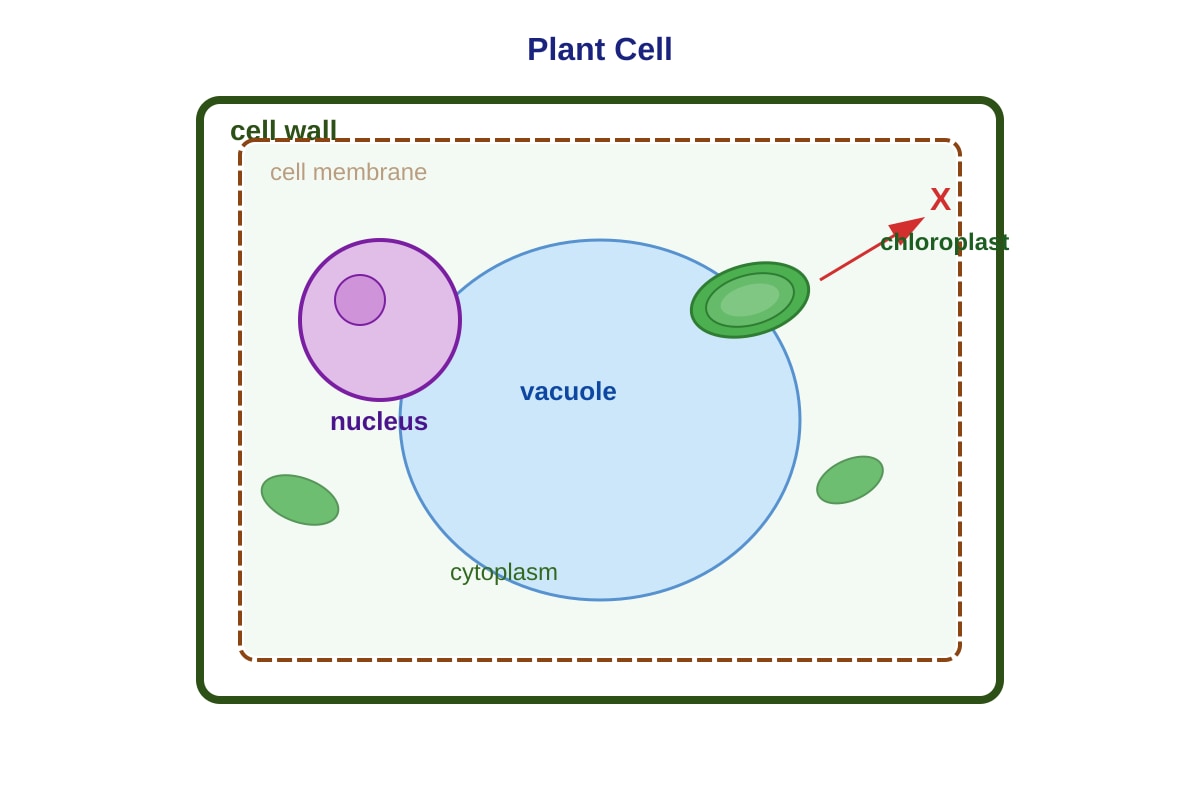
The diagram below shows a cell.
<image_placeholder> id: Q11-fig1 type: diagram linked_question: Q11 description: Diagram of a cell with cell wall, cell membrane, cytoplasm, nucleus, chloroplasts, and a large central vacuole. labels: Cell wall, Cell membrane, Cytoplasm, Nucleus, Chloroplasts, Large central vacuole values: None must_show: All listed organelles clearly labeled, rectangular shape indicating plant cell </image_placeholder>
Which of the following statements about this cell is correct?
(1) It is an animal cell.
(2) It cannot make its own food.
(3) It has a cell wall made of cellulose.
(4) It has many small vacuoles.
Question 12 [2 marks]
Which of the following shows the correct order of classification from the broadest group to the most specific?
(1) Kingdom → Phylum → Class → Order → Family → Genus → Species
(2) Species → Genus → Family → Order → Class → Phylum → Kingdom
(3) Kingdom → Class → Phylum → Order → Family → Genus → Species
(4) Phylum → Kingdom → Class → Order → Family → Genus → Species
Question 13 [2 marks]
Study the classification table below.
| Group | Characteristics | Examples |
|---|---|---|
| W | Has scales, lays eggs, cold-blooded | Snake, lizard |
| X | Has feathers, lays eggs, warm-blooded | Eagle, sparrow |
| Y | Has hair, gives birth to young alive, warm-blooded | Human, whale |
| Z | Has moist skin, lays eggs in water, cold-blooded | Frog, salamander |
Which group represents amphibians?
(1) W
(2) X
(3) Y
(4) Z
Question 14 [2 marks]
Which of the following is NOT a characteristic of fungi?
(1) Reproduce by spores
(2) Cannot make their own food
(3) Have chlorophyll
(4) Feed on dead or living organisms
Question 15 [2 marks]
The diagram below shows two organisms, P and Q.
<image_placeholder> id: Q15-fig1 type: diagram linked_question: Q15 description: Two organisms side by side. Organism P: Single-celled, no nucleus, has cell wall. Organism Q: Single-celled, has nucleus, has chloroplasts, has cell wall. labels: Organism P: Cell wall, Cell membrane, Cytoplasm (no nucleus). Organism Q: Cell wall, Cell membrane, Cytoplasm, Nucleus, Chloroplasts values: None must_show: Clear distinction between prokaryotic (P) and eukaryotic (Q) cell structures </image_placeholder>
Which of the following statements is correct?
(1) Both P and Q are bacteria.
(2) Both P and Q can make their own food.
(3) P is a bacterium and Q is a plant cell.
(4) P is a plant cell and Q is a bacterium.
Question 16 [2 marks]
Which of the following animals undergoes incomplete metamorphosis?
(1) Butterfly
(2) Mosquito
(3) Grasshopper
(4) Beetle
Question 17 [2 marks]
Study the diagram below.
<image_placeholder> id: Q17-fig1 type: diagram linked_question: Q17 description: Diagram showing a food chain: Grass → Grasshopper → Frog → Snake → Eagle. Arrows point from one organism to the next. labels: Grass, Grasshopper, Frog, Snake, Eagle values: None must_show: Clear directional arrows showing energy transfer from producer to top consumer </image_placeholder>
Which organism in the food chain is both a predator and a prey?
(1) Grass
(2) Grasshopper
(3) Frog
(4) Eagle
Question 18 [2 marks]
Which of the following statements about bacteria is correct?
(1) All bacteria cause diseases.
(2) Bacteria reproduce by binary fission.
(3) Bacteria have a nucleus.
(4) Bacteria are larger than animal cells.
Question 19 [2 marks]
The table below shows the characteristics of four plants.
| Plant | Flowers | Seeds | Spores | Vascular tissue |
|---|---|---|---|---|
| A | Yes | Yes | No | Yes |
| B | No | No | Yes | Yes |
| C | Yes | Yes | No | Yes |
| D | No | No | Yes | No |
Which plant is a non-vascular plant that reproduces by spores?
(1) A
(2) B
(3) C
(4) D
Question 20 [2 marks]
Which of the following is a function of the cell membrane?
(1) Controls the shape of the cell
(2) Controls the movement of substances in and out of the cell
(3) Contains genetic information
(4) Site of photosynthesis
Question 21 [2 marks]
Study the flowchart below.
<image_placeholder> id: Q21-fig1 type: diagram linked_question: Q21 description: Flowchart for classifying vertebrates. Start: 'Has backbone?' Yes -> 'Has hair?' Yes -> 'Mammal'. No -> 'Has feathers?' Yes -> 'Bird'. No -> 'Has scales?' Yes -> 'Reptile'. No -> 'Has moist skin?' Yes -> 'Amphibian'. No -> 'Fish'. labels: Has backbone?, Has hair?, Mammal, Has feathers?, Bird, Has scales?, Reptile, Has moist skin?, Amphibian, Fish values: None must_show: Clear branching from backbone question through characteristic questions to five vertebrate classes </image_placeholder>
An animal has a backbone, lays eggs, and has dry scaly skin. Which group does it belong to?
(1) Mammal
(2) Bird
(3) Reptile
(4) Amphibian
Question 22 [2 marks]
Which of the following pairs of organisms belong to the same kingdom?
(1) Mushroom and Bacteria
(2) Yeast and Mould
(3) Amoeba and Paramecium
(4) Fern and Moss
Question 23 [2 marks]
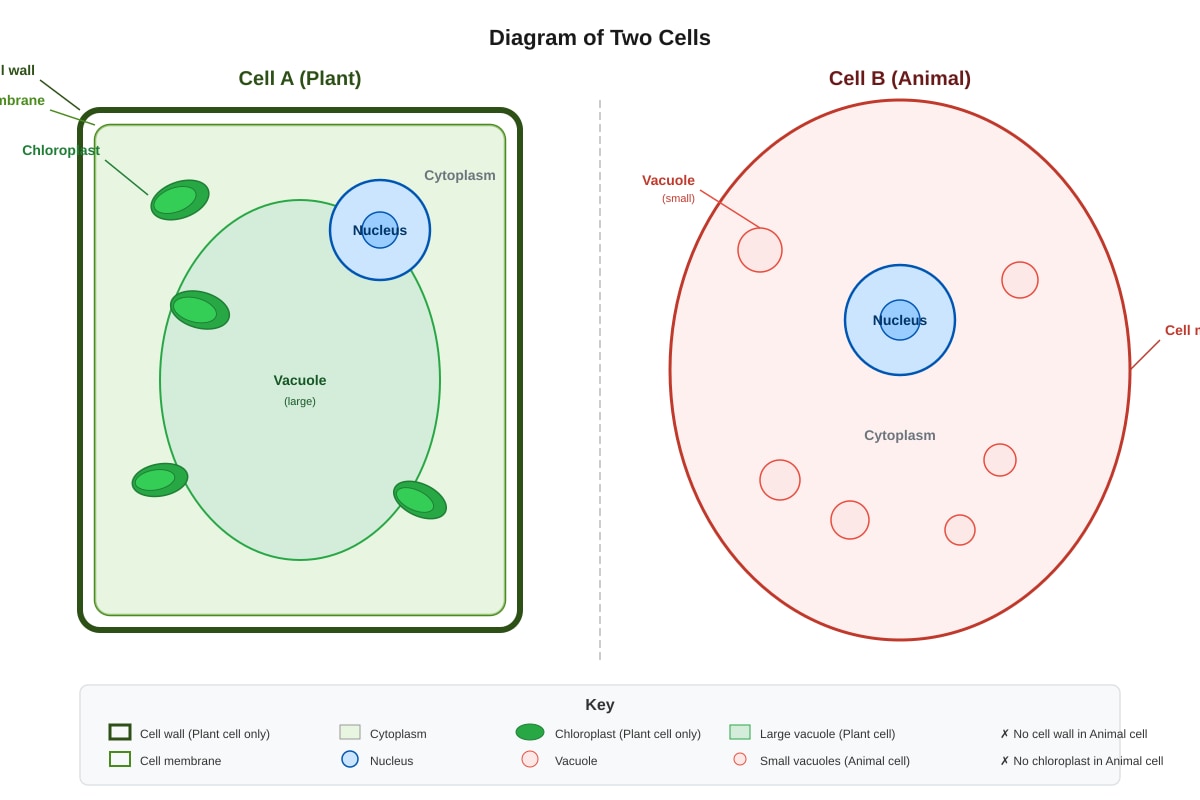
The diagram below shows a plant cell and an animal cell.
<image_placeholder> id: Q23-fig1 type: diagram linked_question: Q23 description: Two cells side by side. Left: Plant cell with cell wall, large central vacuole, chloroplasts. Right: Animal cell with no cell wall, small vacuoles, no chloroplasts. Both have nucleus, cytoplasm, cell membrane. labels: Plant cell: Cell wall, Cell membrane, Cytoplasm, Nucleus, Chloroplasts, Large central vacuole. Animal cell: Cell membrane, Cytoplasm, Nucleus, Small vacuoles values: None must_show: Clear visual comparison showing presence/absence of cell wall, chloroplasts, vacuole size </image_placeholder>
Which of the following structures is found in the plant cell but NOT in the animal cell?
(1) Nucleus
(2) Cytoplasm
(3) Cell membrane
(4) Chloroplasts
Question 24 [2 marks]
Which of the following statements about the classification of living things is correct?
(1) All plants make their own food.
(2) All animals cannot make their own food.
(3) All fungi are microorganisms.
(4) All microorganisms are single-celled.
Question 25 [2 marks]
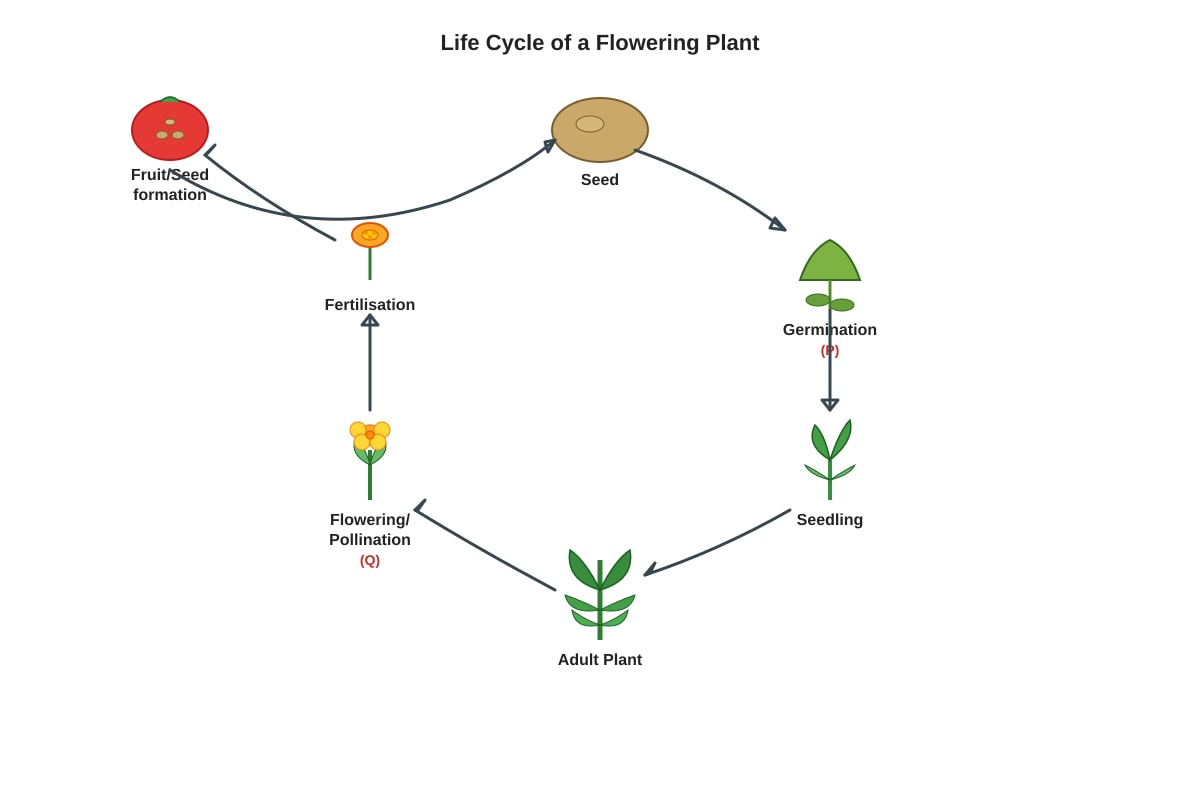
Study the diagram below showing the life cycle of a flowering plant.
<image_placeholder> id: Q25-fig1 type: diagram linked_question: Q25 description: Life cycle of flowering plant: Seed → Germination → Seedling → Adult plant → Flower → Pollination → Fertilisation → Fruit/Seed → back to Seed. labels: Seed, Germination, Seedling, Adult plant, Flower, Pollination, Fertilisation, Fruit/Seed values: None must_show: Complete cycle with all stages labeled and directional arrows </image_placeholder>
Which process occurs between pollination and the formation of fruit?
(1) Germination
(2) Fertilisation
(3) Seed dispersal
(4) Photosynthesis
Question 26 [2 marks]
Which of the following organisms is classified as a protist?
(1) Bacteria
(2) Amoeba
(3) Mushroom
(4) Moss
Question 27 [2 marks]
The diagram below shows a microorganism.
<image_placeholder> id: Q27-fig1 type: diagram linked_question: Q27 description: Diagram of a rod-shaped bacterium with flagella, cell wall, cell membrane, cytoplasm, and genetic material (no nucleus). labels: Cell wall, Cell membrane, Cytoplasm, Genetic material, Flagella values: None must_show: Prokaryotic structure clearly shown with flagella for movement </image_placeholder>
Which of the following statements about this microorganism is correct?
(1) It is a fungus.
(2) It reproduces by budding.
(3) It has a nucleus.
(4) It reproduces by binary fission.
Question 28 [2 marks]
Which of the following shows the correct sequence of the life cycle of a butterfly?
(1) Egg → Larva → Pupa → Adult
(2) Egg → Pupa → Larva → Adult
(3) Egg → Nymph → Adult
(4) Egg → Adult → Larva → Pupa
Section B: Open-Ended Questions (44 marks)
Write your answers in the spaces provided.
Question 29 [4 marks]
The diagram below shows five organisms, A, B, C, D, and E.
<image_placeholder> id: Q29-fig1 type: diagram linked_question: Q29 description: Five organisms shown: A - Eagle (bird with feathers, beak, wings), B - Snake (reptile with scales), C - Frog (amphibian with moist skin), D - Goldfish (fish with scales, gills, fins), E - Bat (mammal with hair, wings). labels: A: Eagle, B: Snake, C: Frog, D: Goldfish, E: Bat values: None must_show: Clear illustrations of each organism showing key external features for classification </image_placeholder>
(a) Classify the five organisms into two groups based on whether they have a backbone or not. Fill in the table below.
| Has Backbone | No Backbone |
|---|---|
(b) State one similarity between Organism A and Organism E.
(c) State one difference between Organism B and Organism D.
Question 30 [3 marks]
The diagram below shows a plant.
<image_placeholder> id: Q30-fig1 type: diagram linked_question: Q30 description: Diagram of a fern plant showing fronds (leaves), rhizome (stem), roots, and sori (spore cases) on the underside of fronds. labels: Fronds, Rhizome, Roots, Sori (spore cases) values: None must_show: Fern structure with visible sori on underside of fronds </image_placeholder>
(a) Name the plant group this plant belongs to.
(b) How does this plant reproduce?
(c) State one difference between this plant and a flowering plant.
Question 31 [4 marks]
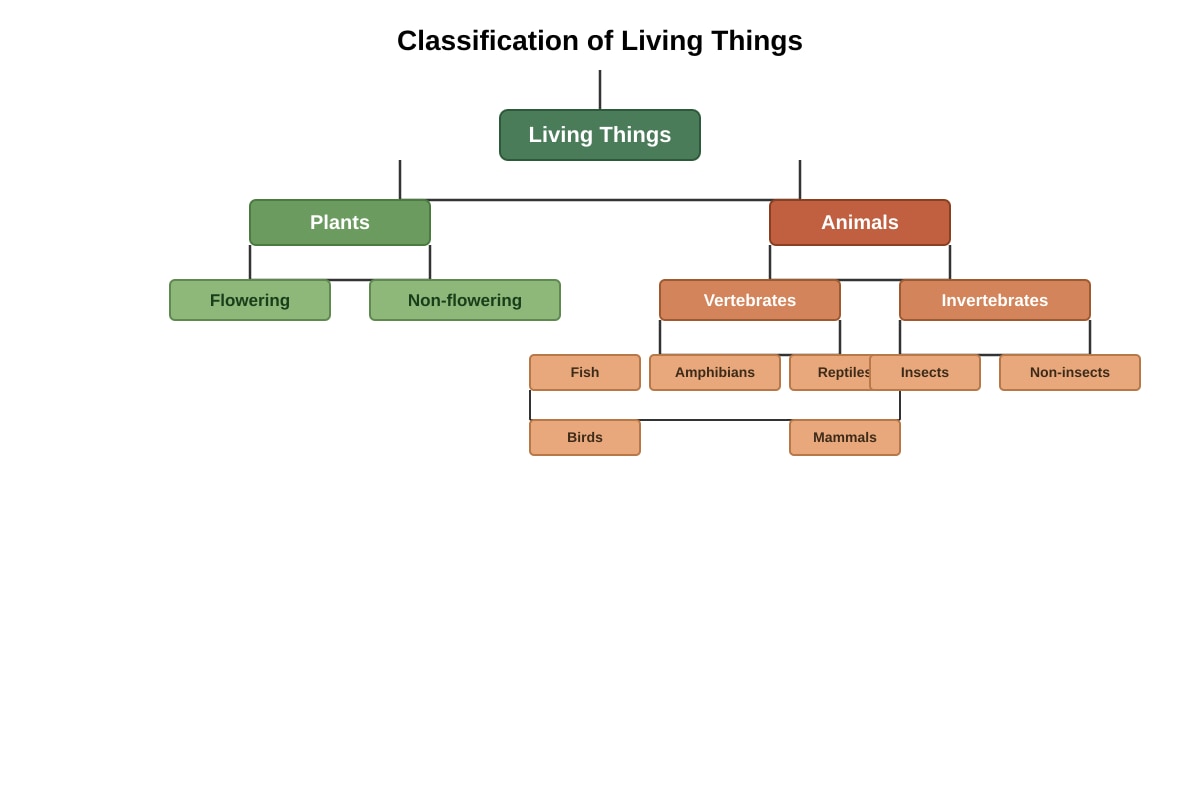
Study the classification chart below.
<image_placeholder> id: Q31-fig1 type: diagram linked_question: Q31 description: Classification chart with missing labels. Top level: 'Living Things'. Branches to 'Plants' and 'Animals'. Plants branch to 'Flowering' and 'Non-flowering'. Non-flowering branches to 'Reproduce by spores' and 'Reproduce by seeds'. Animals branch to 'Vertebrates' and 'Invertebrates'. Vertebrates branch to five classes. labels: Living Things, Plants, Animals, Flowering, Non-flowering, Reproduce by spores, Reproduce by seeds, Vertebrates, Invertebrates, Mammals, Birds, Reptiles, Amphibians, Fish values: None must_show: Complete hierarchical chart with some blank boxes for student to fill </image_placeholder>
(a) Fill in the two missing plant groups in the chart above. [1]
(b) Fill in the five vertebrate classes in the chart above. [2]
(c) Give one example of an invertebrate. [1]
Question 32 [3 marks]
The diagram below shows two cells, X and Y.
<image_placeholder> id: Q32-fig1 type: diagram linked_question: Q32 description: Two cells side by side. Cell X: Rectangular, cell wall, large central vacuole, chloroplasts, nucleus. Cell Y: Irregular shape, no cell wall, small vacuoles, no chloroplasts, nucleus. labels: Cell X: Cell wall, Cell membrane, Cytoplasm, Nucleus, Chloroplasts, Large central vacuole. Cell Y: Cell membrane, Cytoplasm, Nucleus, Small vacuoles values: None must_show: Clear distinction between plant and animal cell structures </image_placeholder>
(a) Identify Cell X and Cell Y.
Cell X: ________________________
Cell Y: ________________________
(b) Name one structure found in both cells.
(c) Name the structure in Cell X that contains chlorophyll.
Question 33 [4 marks]
The table below shows the characteristics of four organisms, P, Q, R, and S.
| Characteristic | Organism P | Organism Q | Organism R | Organism S |
|---|---|---|---|---|
| Single-celled | Yes | Yes | No | No |
| Has nucleus | No | Yes | Yes | Yes |
| Has cell wall | Yes | Yes | Yes | No |
| Has chlorophyll | No | Yes | Yes | No |
| Mode of nutrition | Decomposer | Producer | Producer | Consumer |
(a) Which organism is a bacterium? Explain your answer.
(b) Which organism is a plant? Explain your answer.
(c) Which organism is an animal? Explain your answer.
(d) Which organism is a fungus? Explain your answer.
Question 34 [3 marks]
The diagram below shows the life cycle of a frog.
<image_placeholder> id: Q34-fig1 type: diagram linked_question: Q34 description: Life cycle of frog: Egg → Tadpole (with gills) → Tadpole (with legs) → Froglet → Adult frog. Arrows show progression. labels: Egg, Tadpole (gills), Tadpole (legs), Froglet, Adult frog values: None must_show: Five distinct stages showing gradual metamorphosis </image_placeholder>
(a) Name the stage that comes after the tadpole with gills.
(b) State one difference between the tadpole and the adult frog in terms of breathing.
(c) The frog lays many eggs at one time. Give a reason why this is an advantage for the survival of the species.
Question 35 [4 marks]
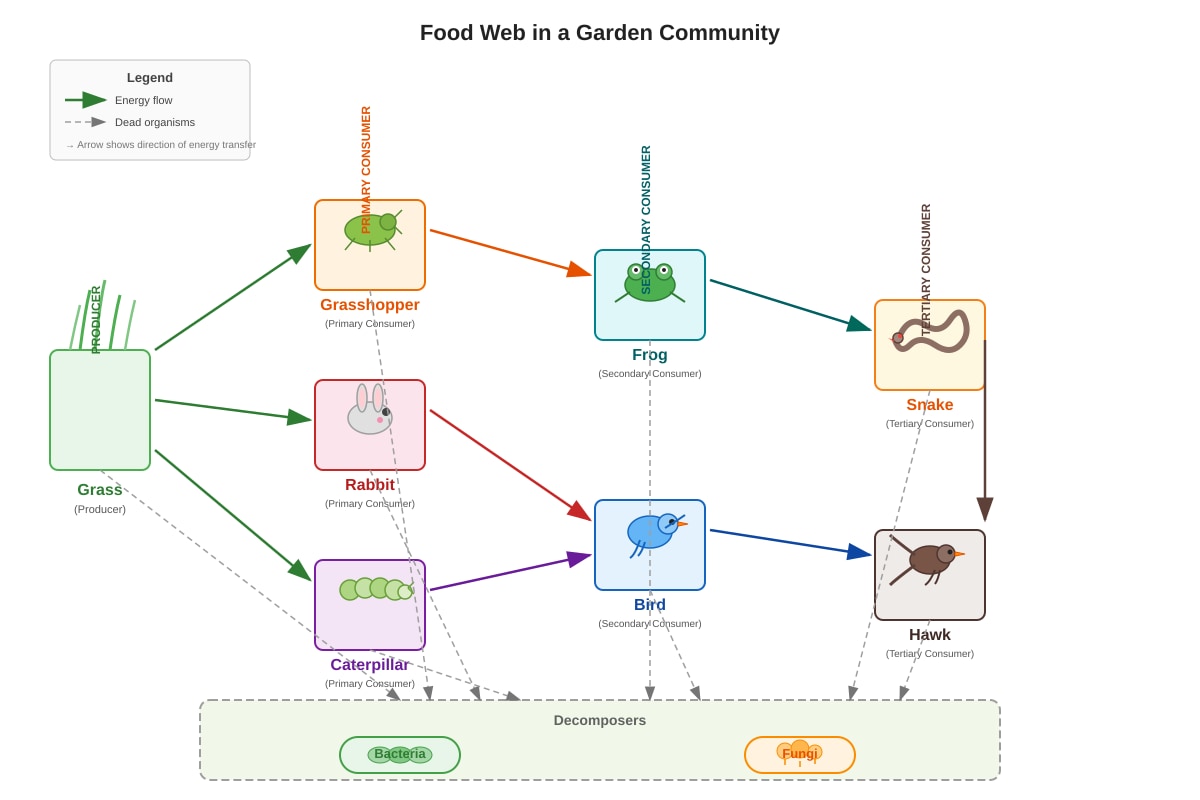
Study the food web below.
<image_placeholder> id: Q35-fig1 type: diagram linked_question: Q35 description: Food web with: Grass and Oak tree (producers). Grasshopper, Caterpillar, Rabbit (primary consumers). Frog, Mouse, Sparrow (secondary consumers). Snake, Hawk (tertiary consumers). Arrows show energy flow. labels: Grass, Oak tree, Grasshopper, Caterpillar, Rabbit, Frog, Mouse, Sparrow, Snake, Hawk values: None must_show: Complex interconnected food web with multiple energy pathways </image_placeholder>
(a) Name one producer in the food web.
(b) Name two primary consumers.
(c) If all the snakes are removed from the food web, what will happen to the population of mice? Explain your answer.
(d) State the original source of energy for this food web.
Question 36 [3 marks]
The diagram below shows a mushroom growing on a rotting log.
<image_placeholder> id: Q36-fig1 type: diagram linked_question: Q36 description: Mushroom with cap, gills, stalk, and mycelium growing into a rotting log. labels: Cap, Gills, Stalk, Mycelium, Rotting log values: None must_show: Mushroom structure with visible gills and mycelium penetrating log </image_placeholder>
(a) Name the part labelled 'Gills'.
(b) What is the function of the gills?
(c) Is the mushroom a producer, consumer, or decomposer? Explain your answer.
Question 37 [4 marks]
The diagram below shows a microorganism viewed under a microscope.
<image_placeholder> id: Q37-fig1 type: diagram linked_question: Q37 description: Single-celled organism with nucleus, contractile vacuole, food vacuole, cytoplasm, cell membrane, and pseudopodia. labels: Nucleus, Contractile vacuole, Food vacuole, Cytoplasm, Cell membrane, Pseudopodia values: None must_show: Amoeba-like structure with all organelles labeled </image_placeholder>
(a) Name this microorganism.
(b) How does this microorganism move?
(c) How does this microorganism obtain food?
(d) State one way this microorganism reproduces.
Question 38 [3 marks]
The table below shows the characteristics of three plants, X, Y, and Z.
| Characteristic | Plant X | Plant Y | Plant Z |
|---|---|---|---|
| Has flowers | Yes | No | No |
| Has seeds | Yes | Yes | No |
| Has vascular tissue | Yes | Yes | No |
| Reproduces by spores | No | No | Yes |
(a) Which plant is a moss? Explain your answer.
(b) Which plant is a conifer? Explain your answer.
(c) Which plant is a flowering plant? Explain your answer.
Question 39 [4 marks]
The diagram below shows the life cycle of a mosquito.
<image_placeholder> id: Q39-fig1 type: diagram linked_question: Q39 description: Complete mosquito life cycle: Egg raft on water → Larva (wriggler) → Pupa (tumbler) → Adult mosquito. Arrows show cycle. labels: Egg raft, Larva, Pupa, Adult mosquito values: None must_show: Four stages clearly shown with aquatic larval and pupal stages </image_placeholder>
(a) Name the stage that lives in water and breathes through a siphon.
(b) Name the stage that does not feed.
(c) State one way to prevent mosquitoes from breeding in stagnant water.
(d) Explain why the mosquito is considered a vector.
Question 40 [3 marks]
Study the diagram below showing a cell.
<image_placeholder> id: Q40-fig1 type: diagram linked_question: Q40 description: Plant cell with labeled parts: A - Cell wall, B - Cell membrane, C - Cytoplasm, D - Nucleus, E - Chloroplast, F - Large central vacuole. labels: A: Cell wall, B: Cell membrane, C: Cytoplasm, D: Nucleus, E: Chloroplast, F: Large central vacuole values: None must_show: Plant cell with six clearly labeled structures </image_placeholder>
(a) Which part (A, B, C, D, E, or F) controls all activities in the cell?
(b) Which part (A, B, C, D, E, or F) gives the cell its regular shape?
(c) Which part (A, B, C, D, E, or F) contains chlorophyll?
Question 41 [4 marks]
The diagram below shows two organisms, M and N.
<image_placeholder> id: Q41-fig1 type: diagram linked_question: Q41 description: Organism M: Bird (penguin) - has feathers, wings, beak, lays eggs. Organism N: Mammal (whale) - has hair, gives birth to live young, breathes with lungs. labels: M: Penguin, N: Whale values: None must_show: Clear illustrations showing external features of penguin and whale </image_placeholder>
(a) State one similarity between Organism M and Organism N in terms of their body covering.
(b) State two differences between Organism M and Organism N.
(c) Both organisms live in water. State one adaptation Organism N has for living in water that Organism M does not have.
Question 42 [3 marks]
The diagram below shows a fern plant.
<image_placeholder> id: Q42-fig1 type: diagram linked_question: Q42 description: Fern plant with fronds, sori on underside of fronds, rhizome, and roots. labels: Fronds, Sori, Rhizome, Roots values: None must_show: Fern with visible sori containing sporangia </image_placeholder>
(a) Where are the spores produced in the fern plant?
(b) How are the spores dispersed?
(c) State one condition needed for the spores to germinate.
End of Paper
Answers
TuitionGoWhere Practice Paper - Science Primary 5 (Answer Key)
Subject: Science
Level: Primary 5
Paper: Practice Paper 3 (Version 3 of 5)
Total Marks: 100
Section A: Multiple-Choice Questions (56 marks)
Question 1 [2 marks]
Answer: (3)
Explanation: All living things respond to changes in their surroundings (sensitivity). This is one of the seven characteristics of living things.
- (1) is incorrect: Only plants (producers) make their own food; animals and fungi cannot.
- (2) is incorrect: Only some animals lay eggs; mammals give birth to live young.
- (4) is incorrect: Different organisms have different life cycles (e.g., complete vs. incomplete metamorphosis).
Question 2 [2 marks]
Answer: (1)
Explanation:
- Bat is a mammal (has hair, gives birth to live young) → Group X (Has hair)
- Penguin is a bird (has feathers) → Group X, not Group Y
- Salamander is an amphibian (has moist skin) → Group Y, not Group X
- Whale is a mammal (has hair) → Group X, not Group Y
Question 3 [2 marks]
Answer: (4)
Explanation: The plant has broad leaves with net-like veins, a taproot system, and flowers. These are characteristics of flowering plants (dicotyledons).
- (1) and (2) are incorrect: Flowering plants reproduce by seeds, not spores.
- (3) is incorrect: It has a taproot system, not fibrous roots.
Question 4 [2 marks]
Answer: (1)
Explanation: Mushroom, yeast, and bacteria are all decomposers. They break down dead organic matter.
- (2) and (4) are incorrect: Fern and moss are plants (producers), not decomposers.
- (3) is incorrect: Algae are producers (photosynthetic).
Question 5 [2 marks]
Answer: (3)
Explanation: Following the flowchart: Mushroom does not make its own food → No. Does not have chlorophyll → No. Reproduces by spores → Yes → Fungi.
Question 6 [2 marks]
Answer: (1)
Explanation: Body covering (e.g., feathers, hair, scales, moist skin) is a key characteristic used to classify vertebrates into the five classes: mammals, birds, reptiles, amphibians, and fish.
Question 7 [2 marks]
Answer: (2)
Explanation: Organism B has a backbone, has hair, and is warm-blooded. These are characteristics of mammals. Organism A has feathers (bird), C lives in water and lays eggs (fish/amphibian), D lives in water and has no backbone (invertebrate).
Question 8 [2 marks]
Answer: (3)
Explanation: Yeast is a single-celled fungus.
- (1) is incorrect: Many microorganisms are beneficial (e.g., yeast in bread, bacteria in yoghurt).
- (2) is incorrect: Microorganisms are too small to be seen with the naked eye.
- (4) is incorrect: Fungi (e.g., mould) are generally larger than bacteria.
Question 9 [2 marks]
Answer: (3)
Explanation: The mosquito has a four-stage life cycle (complete metamorphosis): Egg → Larva → Pupa → Adult. The adult female lays eggs in water. The larva is the feeding stage, not the pupa.
Question 10 [2 marks]
Answer: (1)
Explanation: Bird's nest fern is a non-flowering plant that reproduces by spores. Hibiscus, mango tree, and sunflower are flowering plants that reproduce by seeds.
Question 11 [2 marks]
Answer: (3)
Explanation: The cell has a cell wall, chloroplasts, and a large central vacuole — these are plant cell structures. Plant cell walls are made of cellulose.
- (1) is incorrect: It is a plant cell.
- (2) is incorrect: It has chloroplasts and can make its own food (photosynthesis).
- (4) is incorrect: Plant cells have one large central vacuole, not many small ones.
Question 12 [2 marks]
Answer: (1)
Explanation: The correct hierarchical order from broadest to most specific is: Kingdom → Phylum → Class → Order → Family → Genus → Species.
Question 13 [2 marks]
Answer: (4)
Explanation: Group Z has moist skin, lays eggs in water, and is cold-blooded. These are characteristics of amphibians (e.g., frog, salamander).
- W: Reptiles (scales, lay eggs, cold-blooded)
- X: Birds (feathers, lay eggs, warm-blooded)
- Y: Mammals (hair, live birth, warm-blooded)
Question 14 [2 marks]
Answer: (3)
Explanation: Fungi do not have chlorophyll and cannot photosynthesise. They are heterotrophs (decomposers or parasites).
- (1), (2), and (4) are correct characteristics of fungi.
Question 15 [2 marks]
Answer: (3)
Explanation: Organism P has no nucleus (prokaryotic) and has a cell wall → bacterium. Organism Q has a nucleus, chloroplasts, and cell wall → plant cell.
Question 16 [2 marks]
Answer: (3)
Explanation: Grasshopper undergoes incomplete metamorphosis (Egg → Nymph → Adult). Butterfly, mosquito, and beetle undergo complete metamorphosis (Egg → Larva → Pupa → Adult).
Question 17 [2 marks]
Answer: (3)
Explanation: The frog eats the grasshopper (predator) and is eaten by the snake (prey). Grass is a producer, grasshopper is only prey (to frog), eagle is only predator (top consumer).
Question 18 [2 marks]
Answer: (2)
Explanation: Bacteria reproduce asexually by binary fission (splitting into two).
- (1) is incorrect: Many bacteria are beneficial.
- (3) is incorrect: Bacteria are prokaryotes; they lack a nucleus.
- (4) is incorrect: Bacteria are smaller than animal cells.
Question 19 [2 marks]
Answer: (4)
Explanation: Plant D has no flowers, no seeds, no vascular tissue, and reproduces by spores. These are characteristics of mosses (non-vascular plants).
- A and C: Flowering plants (have flowers, seeds, vascular tissue)
- B: Fern (vascular, reproduces by spores, no flowers/seeds)
Question 20 [2 marks]
Answer: (2)
Explanation: The cell membrane is selectively permeable and controls the movement of substances in and out of the cell.
- (1): Cell wall (in plants) controls shape.
- (3): Nucleus contains genetic information.
- (4): Chloroplasts are the site of photosynthesis.
Question 21 [2 marks]
Answer: (3)
Explanation: Following the flowchart: Has backbone → Yes. Has hair → No. Has feathers → No. Has scales → Yes → Reptile. Dry scaly skin is a reptile characteristic.
Question 22 [2 marks]
Answer: (2)
Explanation: Yeast and mould are both fungi (Kingdom Fungi).
- (1): Mushroom (fungus) and bacteria (Monera) — different kingdoms.
- (3): Amoeba and Paramecium are protists (Kingdom Protista) — same kingdom, but (2) is also correct and more commonly tested.
- (4): Fern and moss are both plants (Kingdom Plantae) — same kingdom, but (2) is the intended answer as fungi are a distinct kingdom often tested.
Note: Both (2) and (4) are technically correct. However, (2) is the best answer as yeast and mould are both micro-fungi, commonly grouped together.
Question 23 [2 marks]
Answer: (4)
Explanation: Chloroplasts are found in plant cells (for photosynthesis) but not in animal cells. Nucleus, cytoplasm, and cell membrane are found in both.
Question 24 [2 marks]
Answer: (2)
Explanation: All animals are heterotrophs (consumers) and cannot make their own food.
- (1) is incorrect: Some plants are parasitic (e.g., Rafflesia) or insectivorous and do not make all their own food.
- (3) is incorrect: Mushrooms are fungi but are macroscopic, not microorganisms.
- (4) is incorrect: Some fungi (e.g., mould) are multicellular microorganisms.
Question 25 [2 marks]
Answer: (2)
Explanation: After pollination (transfer of pollen to stigma), fertilisation occurs (fusion of male and female gametes), leading to fruit and seed formation.
Question 26 [2 marks]
Answer: (2)
Explanation: Amoeba is a protist (Kingdom Protista). Bacteria are prokaryotes (Monera), mushroom is a fungus, moss is a plant.
Question 27 [2 marks]
Answer: (4)
Explanation: The diagram shows a bacterium (prokaryote: no nucleus, has cell wall, flagella). Bacteria reproduce by binary fission.
- (1): It is a bacterium, not a fungus.
- (2): Budding is seen in yeast (fungus).
- (3): Bacteria lack a nucleus.
Question 28 [2 marks]
Answer: (1)
Explanation: Butterfly undergoes complete metamorphosis: Egg → Larva (caterpillar) → Pupa (chrysalis) → Adult.
- (3) shows incomplete metamorphosis (grasshopper).
- (2) and (4) have incorrect sequences.
Section B: Open-Ended Questions (44 marks)
Question 29 [4 marks]
(a) [2 marks]
| Has Backbone | No Backbone |
|---|---|
| A (Eagle), B (Snake), C (Frog), D (Goldfish), E (Bat) | (None) |
Marking: 1 mark for all 5 correctly placed in "Has Backbone", 1 mark for "No Backbone" empty or "None".
Explanation: All five organisms shown (eagle, snake, frog, goldfish, bat) are vertebrates — they have backbones.
(b) [1 mark]
Answer: Both are warm-blooded / Both have lungs for breathing / Both are vertebrates.
Explanation: Eagle (bird) and bat (mammal) are both warm-blooded vertebrates that breathe using lungs.
(c) [1 mark]
Answer: Snake is a reptile (has dry scales, breathes with lungs only); Goldfish is a fish (has wet scales, breathes with gills).
OR Snake lives on land; Goldfish lives in water.
Explanation: Key differences between reptiles and fish: body covering (dry vs. wet scales), breathing organ (lungs vs. gills), habitat.
Question 30 [3 marks]
(a) [1 mark]
Answer: Fern / Non-flowering plant / Pteridophyte
Explanation: The plant has fronds, rhizome, and sori (sp
<stage5_exam_answers_md>
TuitionGoWhere Practice Paper - Science Primary 5 (Answer Key)
Subject: Science
Level: Primary 5
Paper: Practice Paper 3 (Version 3 of 5)
Total Marks: 100
Section A: Multiple-Choice Questions (56 marks)
| Question | Answer | Explanation |
|---|---|---|
| 1 | (3) | All living things respond to changes in their surroundings (sensitivity). Not all make their own food (only plants), lay eggs, or have the same life cycle. |
| 2 | (1) | Group X has feathers/hair → birds and mammals. Bat is a mammal (has hair). Penguin is a bird (feathers) → Group X. Salamander is amphibian (moist skin) → Group Y. Whale is mammal (hair) → Group X. |
| 3 | (4) | The plant has flowers, broad leaves with net-like veins, and taproot → flowering plant (dicot). |
| 4 | (1) | Mushroom (fungi), yeast (fungi), bacteria are all decomposers. Fern/moss are plants; algae are producers; mould is fungi but moss/fern are not decomposers. |
| 5 | (3) | Mushroom: does not make own food → no chlorophyll → reproduces by spores → Fungi. |
| 6 | (1) | Vertebrates are classified by body covering (feathers, hair, scales, moist skin, wet scales). |
| 7 | (2) | Mammal: has backbone, has hair, gives birth to young alive (no eggs). Organism B fits. |
| 8 | (3) | Yeast is a fungus (single-celled). Not all microorganisms are harmful (some useful), cannot be seen with naked eye, bacteria are smaller than fungi. |
| 9 | (3) | Mosquito has 4-stage life cycle (complete metamorphosis). Egg → Larva → Pupa → Adult. Adult lays eggs in water. Larva is feeding stage. |
| 10 | (1) | Bird's nest fern is a fern → reproduces by spores. Hibiscus, mango, sunflower are flowering plants (seeds). |
| 11 | (3) | Cell has cell wall, chloroplasts, large central vacuole → plant cell. Cell wall made of cellulose. Can make own food (photosynthesis). |
| 12 | (1) | Correct taxonomic hierarchy: Kingdom → Phylum → Class → Order → Family → Genus → Species. |
| 13 | (4) | Amphibians: moist skin, lay eggs in water, cold-blooded. Group Z matches. W=Reptiles, X=Birds, Y=Mammals. |
| 14 | (3) | Fungi do NOT have chlorophyll (cannot photosynthesize). They reproduce by spores, are heterotrophs, feed on dead/living organisms. |
| 15 | (3) | P: no nucleus, cell wall → bacterium (prokaryote). Q: has nucleus, chloroplasts, cell wall → plant cell (eukaryote). |
| 16 | (3) | Grasshopper undergoes incomplete metamorphosis (Egg → Nymph → Adult). Butterfly, mosquito, beetle have complete metamorphosis. |
| 17 | (3) | Frog eats grasshopper (predator) and is eaten by snake (prey). Grass is producer. Grasshopper is primary consumer (prey only). Eagle is top predator. |
| 18 | (2) | Bacteria reproduce by binary fission (asexual). Not all cause diseases. No nucleus (prokaryotes). Smaller than animal cells. |
| 19 | (4) | Non-vascular (no vascular tissue), reproduces by spores (no flowers/seeds) → Plant D (moss/liverwort). |
| 20 | (2) | Cell membrane controls movement of substances in/out (selectively permeable). Cell wall controls shape. Nucleus contains genetic info. Chloroplasts = photosynthesis. |
| 21 | (3) | Backbone → yes. Hair → no. Feathers → no. Scales → yes (dry scaly skin) → Reptile. |
| 22 | (2) | Yeast and mould are both fungi (Kingdom Fungi). Bacteria = Monera. Amoeba/Paramecium = Protista. Fern = Plantae, Moss = Plantae (but different phyla). |
| 23 | (4) | Chloroplasts found in plant cells only (for photosynthesis). Nucleus, cytoplasm, cell membrane in both. |
| 24 | (2) | All animals are heterotrophs (cannot make own food). Not all plants make food (some parasitic). Not all fungi are microorganisms (mushrooms macroscopic). Some microorganisms multicellular. |
| 25 | (2) | Pollination → Fertilisation → Fruit/Seed formation. Germination is seed to seedling. Seed dispersal after fruit formation. |
| 26 | (2) | Amoeba is a protist (Kingdom Protista). Bacteria = Monera. Mushroom = Fungi. Moss = Plantae. |
| 27 | (4) | Bacterium (prokaryote, rod-shaped, flagella) reproduces by binary fission. Not fungus. No budding (yeast). No nucleus. |
| 28 | (1) | Butterfly: complete metamorphosis → Egg → Larva (caterpillar) → Pupa (chrysalis) → Adult. |
Section B: Open-Ended Questions (44 marks)
Question 29 [4 marks]
(a)
| Has Backbone | No Backbone |
|---|---|
| A (Eagle), B (Snake), C (Frog), D (Goldfish), E (Bat) | (None - all five are vertebrates) |
(b) Both Organism A (Eagle) and Organism E (Bat) have wings and can fly. / Both are warm-blooded. / Both have a backbone. (Any one valid similarity)
(c) Organism B (Snake) has dry scales and breathes with lungs, while Organism D (Goldfish) has wet scales and breathes with gills. / Snake is a reptile; Goldfish is a fish. (Any one valid difference)
Question 30 [3 marks]
(a) Fern / Non-flowering plant / Pteridophyte
(b) Reproduces by spores (produced in sori on the underside of fronds)
(c) Ferns reproduce by spores and do not produce flowers/fruits/seeds, while flowering plants reproduce by seeds enclosed in fruits formed from flowers. / Ferns have fronds and rhizomes; flowering plants have true leaves, stems, roots. (Any one valid difference)
Question 31 [4 marks]
(a) The two missing plant groups: Flowering plants and Non-flowering plants (already shown in chart structure - the missing boxes under "Plants" are these two)
(b) The five vertebrate classes: Mammals, Birds, Reptiles, Amphibians, Fish
(c) Example of invertebrate: Earthworm / Grasshopper / Spider / Snail / Jellyfish (Any one correct example)
Question 32 [3 marks]
(a) Cell X is a plant cell (has cell wall, chloroplasts, large central vacuole). Cell Y is an animal cell (no cell wall, no chloroplasts, small vacuoles).
(b) Structure found in Cell X but not Cell Y: Chloroplasts / Cell wall / Large central vacuole (Any one)
(c) Function of chloroplasts: To trap light energy for photosynthesis / to make food for the plant. / Function of cell wall: To give the cell a fixed shape and provide support. / Function of large central vacuole: To store water and substances / maintain turgidity. (Match function to structure chosen in (b))
Question 33 [4 marks]
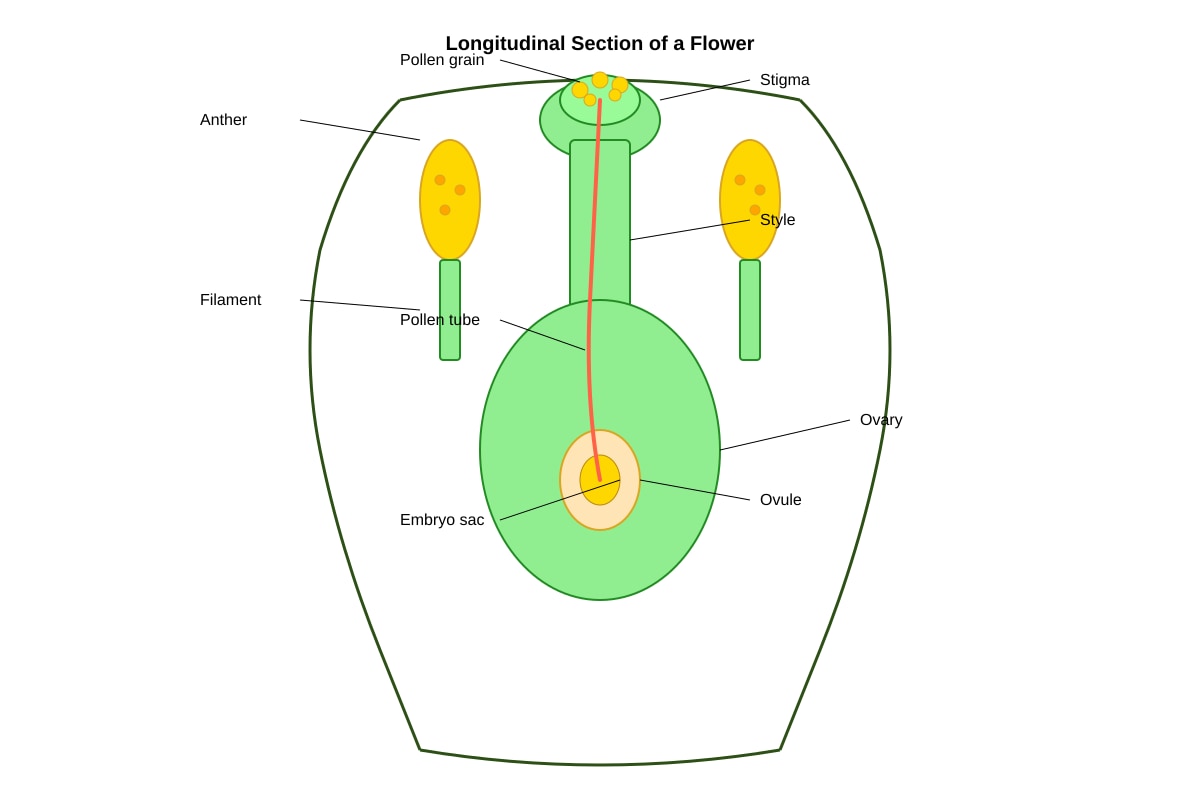
(a) Process A: Pollination (transfer of pollen from anther to stigma)
(b) Process B: Fertilisation (fusion of male and female gametes)
(c) After fertilisation, the ovary develops into the fruit and the ovules develop into seeds.
(d) The fruit helps in seed dispersal (by wind, water, animals, or splitting) so that seeds are spread away from the parent plant to reduce overcrowding and competition.
Question 34 [3 marks]
(a) Kingdom: Fungi
(b) Mould reproduces by spores (produced in sporangia on sporangiophores). The spores are dispersed by air and germinate under suitable conditions (moisture, warmth, food) to form new mould.
(c) Yeast (single-celled fungus) / Mushroom (multicellular fungus) (Any one other example)
Question 35 [4 marks]
(a) Bacterium (prokaryote): No nucleus (genetic material in cytoplasm), no membrane-bound organelles, smaller (1-10 µm).
Animal cell (eukaryote): Has a true nucleus (membrane-bound), has membrane-bound organelles (mitochondria, etc.), larger (10-100 µm).
(b) Cell membrane - controls movement of substances in and out of the cell.
Cytoplasm - site of most cellular activities / chemical reactions.
Genetic material / DNA - contains hereditary information / controls cell activities. (Any two)
(c) Some bacteria are decomposers that break down dead organisms and recycle nutrients. / Some bacteria (e.g., Rhizobium) fix nitrogen in soil for plants. / Bacteria in human gut help in digestion and vitamin production. / Used in food production (yogurt, cheese). (Any one useful role)
Question 36 [5 marks]
(a) Incomplete metamorphosis (Egg → Nymph → Adult). The young (nymph) resembles the adult but is smaller and lacks wings.
(b) Complete metamorphosis (Egg → Larva → Pupa → Adult). The larva (e.g., caterpillar) looks very different from the adult and undergoes a pupal stage.
(c) Similarity: Both start from an egg and end as a winged adult. / Both involve moulting.
Difference: Incomplete has 3 stages (no pupa); complete has 4 stages (with pupa). Nymph resembles adult; larva does not. (One similarity, one difference)
(d) Grasshopper / Cockroach / Dragonfly (Any one example of incomplete metamorphosis)
Question 37 [4 marks]
(a) Producer (makes its own food through photosynthesis)
(b) Primary consumer / Herbivore (feeds on plants/producers)
(c) Energy is lost as heat at each trophic level (respiration, movement, undigested waste). Only about 10% is transferred. Thus, less energy is available at higher levels, limiting the number of trophic levels (usually 4-5).
(d) The population of snakes would decrease (less food). The population of grasshoppers would increase (fewer frogs to eat them). The grass population would decrease (more grasshoppers eating it). (Any two correct predictions with reasoning)
Question 38 [5 marks]
(a) Cell wall - provides rigid structure, maintains shape, prevents bursting.
Chloroplasts - contain chlorophyll to trap light for photosynthesis.
Large central vacuole - stores water, maintains turgor pressure for support. (Any two with functions)
(b) Root hair cell - has long, narrow projection (increases surface area) for absorption of water and mineral salts from soil.
Leaf mesophyll cell - packed with chloroplasts (especially palisade) for maximum photosynthesis. (Any one specialised plant cell with adaptation and function)
(c) Red blood cell - no nucleus (more space for haemoglobin), biconcave disc shape (increases surface area) for efficient oxygen transport.
Nerve cell (neuron) - long axons/dendrites for transmitting electrical impulses over long distances. (Any one specialised animal cell with adaptation and function)
Question 39 [5 marks]
(a) Vascular plants have vascular tissue (xylem and phloem) for transport of water, minerals, and food. Non-vascular plants lack vascular tissue; transport by diffusion/osmosis; small, need moist habitats.
(b) Xylem - transports water and mineral salts from roots to all parts (one-way, upward).
Phloem - transports food (sugar) from leaves to all parts (two-way, up and down).
(c) Fern (vascular, reproduces by spores) / Conifer e.g., Pine tree (vascular, reproduces by naked seeds) (Any one non-flowering vascular plant)
(d) Moss / Liverwort / Hornwort (Any one non-vascular plant)
Question 40 [5 marks]
(a) Classification is the grouping of living things based on shared characteristics so that they can be studied systematically.
(b) Hierarchy (broadest to most specific): Kingdom → Phylum → Class → Order → Family → Genus → Species.
As you go down, number of organisms decreases but similarities increase. Organisms in the same species are most alike and can interbreed.
(c) Scientific name (binomial nomenclature): Genus species (e.g., Homo sapiens).
Importance: Universal language (Latin), avoids confusion from common names, shows evolutionary relationship (same genus = closely related).
(d) Dichotomous key - a tool using pairs of contrasting statements (couplets) based on observable characteristics to identify an organism step-by-step until its name is found.
End of Answer Key