AI Generated Exam Paper
Primary 5 Science Practice Paper 3
Free P5 Science Practice Paper 3, HY3 AI version, with questions, answers, and syllabus-aligned practice for Singapore students.
These static practice materials are generated from the site's syllabus and paper-generation workflow, with source and model context shown so students and parents can evaluate the material before use.
Questions
TuitionGoWhere Practice Paper - Science Primary 5
TuitionGoWhere Practice Paper (AI) — Version 3
Subject: Science
Level: Primary 5
Paper: Practice Paper (Topic: Diversity)
Duration: 45 minutes
Total Marks: 40
Name: ______________________
Class: _________
Date: ___________
Instructions:
- This practice paper has 20 questions on the topic of Diversity.
- Section A: 10 multiple-choice questions (1 mark each).
- Section B: 6 short-answer questions (2 marks each).
- Section C: 4 structured questions (total 8 marks).
- Write your answers clearly in the spaces provided.
- No past-year paper evidence was used; this is syllabus-first AI-generated practice.
Section A (10 marks)
Answer all questions. Each question carries 1 mark.
-
Which of the following is an example of a living thing that shows diversity in the way it reproduces? A) A rock
B) A flowering plant
C) A plastic toy
D) A drop of water -
Which group below shows the greatest diversity of living things? A) Only cats
B) Only tables
C) Birds, fish, insects, and mammals
D) Only chairs -
Diversity among living things means that they — A) are all exactly the same
B) have differences in features and ways of life
C) do not change
D) are all non-living -
Which of these is a non-living thing? A) Fern
B) Earthworm
C) Stone
D) Mosquito -
A student groups objects as living or non-living. Which object should be in the "living" group? A) Book
B) Snail
C) Pencil
D) Shoe -
Which characteristic shows that a mushroom is a living thing? A) It is made of metal
B) It grows and reproduces
C) It never changes
D) It is always cold -
Which of the following is NOT a reason scientists group living things? A) To study them easily
B) To show their diversity
C) To make them all the same
D) To understand their features -
Which pair shows diversity in habitat? A) Fish in water, cactus in desert
B) Two identical cups
C) Two stones
D) One book -
A bat and a bird both can fly. This shows — A) they are the same animal
B) diversity in how different animals adapt
C) they are non-living
D) they cannot reproduce -
Which statement is true about diversity of materials? A) All materials are living
B) Wood, metal, and plastic are different non-living materials
C) Only living things show diversity
D) Materials cannot be grouped
Section B (12 marks)
Answer all questions. Each question carries 2 marks.
- Name two ways in which living things show diversity.
- Explain why a tree and a dog are both living things but are different in diversity.
- List two non-living things found in a classroom and state one property of each.
- Some plants reproduce using seeds and others using spores. How does this show diversity in plants?
- Give one example of diversity among animals in the way they move.
- Why is it useful to group living and non-living things when studying science?
Section C (8 marks)
Answer all questions. Marks shown per question.
-
(a) State one difference between a living thing and a non-living thing. (1 mark)
(b) Give one example of each. (1 mark)
Living: ____________________ Non-living: ____________________ -
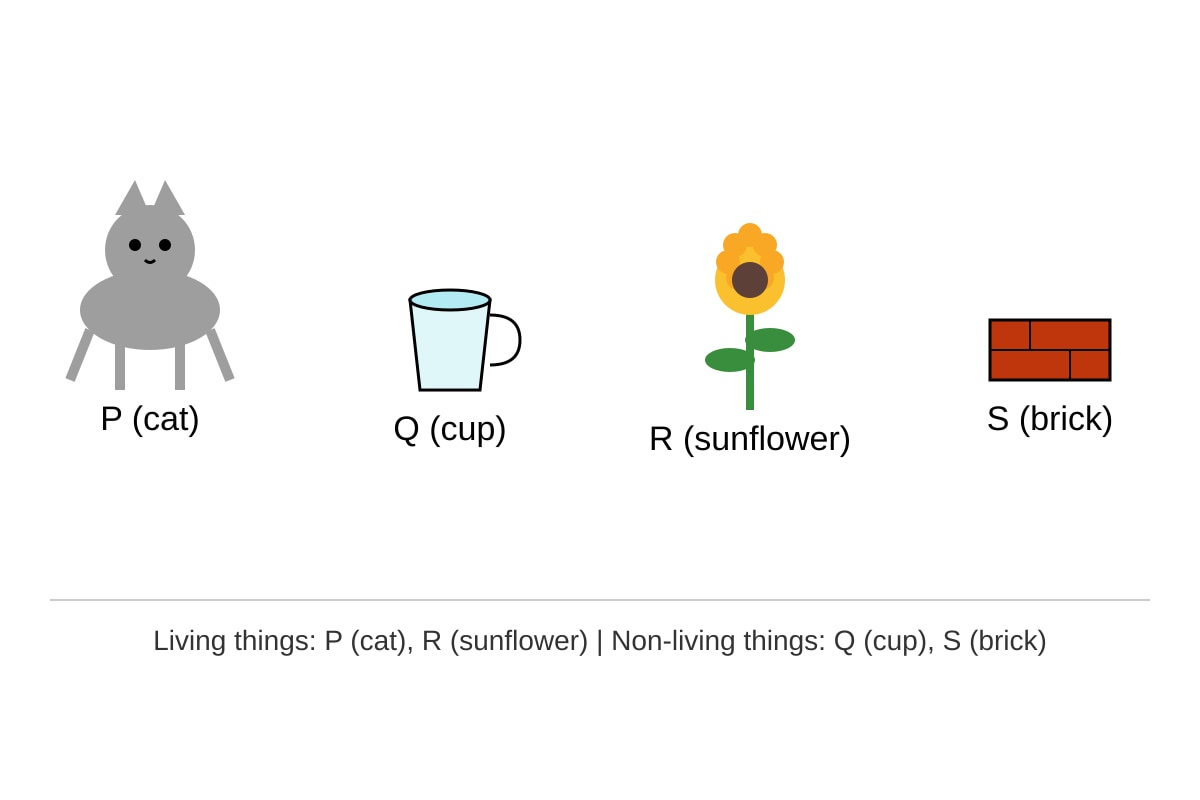
The picture below shows four objects. Two are living and two are non-living.
Image pending generation: figure for Q18.
(a) Circle the two living things. (1 mark)
(b) Explain how you identified them. (1 mark)
-
(a) What is meant by "diversity of living things"? (1 mark)
(b) Give two examples of diverse living things and one difference between them. (2 marks)
-
A student says: "All things in the world are either plants or animals."
(a) Is this statement correct? Explain. (1 mark)
(b) Name one group of living things that is not a plant or animal, and one non-living thing. (1 mark)
Living (not plant/animal): ____________________ Non-living: ____________________
End of Paper
Answers
TuitionGoWhere Practice Paper - Science Primary 5 (Answers)
Version: 3
Total Marks: 40
Section A Answers (1 mark each)
- B Flowering plant. Teaching note: Living things reproduce; a plant shows diversity in reproduction compared to non-living objects.
- C Birds, fish, insects, mammals — many different living groups = high diversity.
- B Differences in features/ways of life = diversity.
- C Stone is non-living; others are living.
- B Snail is living; others are non-living objects.
- B Grows/reproduces = living characteristic.
- C Grouping does not make them same; it shows diversity.
- A Different habitats show diversity.
- B Different animals adapting to fly shows diversity.
- B Wood, metal, plastic are diverse non-living materials.
Section B Answers (2 marks each)
- [2 marks] Any two: different shapes, sizes, habitats, food, reproduction methods.
Marking: 1 mark per correct way. - [2 marks] Both living (grow, reproduce, need air/food) but tree makes food using sunlight, dog moves to find food; shows diversity.
Marking: 1 mark both living, 1 mark difference. - [2 marks] e.g., desk (solid, hard), water (liquid, takes shape of container).
Marking: 1 mark per item + property. - [2 marks] Seeds and spores are different reproduction methods; shows plant diversity.
Marking: 1 mark methods, 1 mark link to diversity. - [2 marks] e.g., fish swim, birds fly, snakes slither.
Marking: 1 mark example, 1 mark movement stated. - [2 marks] Easier to study, see patterns, understand diversity.
Marking: 1 mark per valid reason.
Section C Answers
- (a) [1 mark] Living grows/changes/reproduces; non-living does not.
(b) [1 mark] Living: cat; Non-living: rock. - (a) [1 mark] P (cat) and R (sunflower).
(b) [1 mark] They are living because they grow/reproduce; Q and S are objects.
Image note: Figure shows labelled cat, cup, sunflower, brick. - (a) [1 mark] Living things have many different forms/features.
(b) [2 marks] e.g., frog (lives in water) and eagle (flies); difference = habitat/movement.
Marking: 1 mark examples, 1 mark difference. - (a) [1 mark] No; there are fungi, bacteria etc.
(b) [1 mark] Living: mushroom; Non-living: metal.
Total = 40 marks. Syllabus-first AI practice; not from past papers.
Free quiz and exam paper access
Enter your details to view this paper
Your access is remembered on this device.