AI Generated Exam Paper
Primary 5 Science Practice Paper 2
Free P5 Science Practice Paper 2, Nemo3 AI version, with questions, answers, and syllabus-aligned practice for Singapore students.
These static practice materials are generated from the site's syllabus and paper-generation workflow, with source and model context shown so students and parents can evaluate the material before use.
Questions
Free quiz and exam paper access
Enter your details to view this paper
Your access is remembered on this device.
Answers
TuitionGoWhere Practice Paper - Science Primary 5 (Answer Key)
Subject: Science
Level: Primary 5
Paper: Practice Paper 2 (Version 2 of 5)
Total Marks: 100
SECTION A: Multiple-Choice Questions (56 marks)
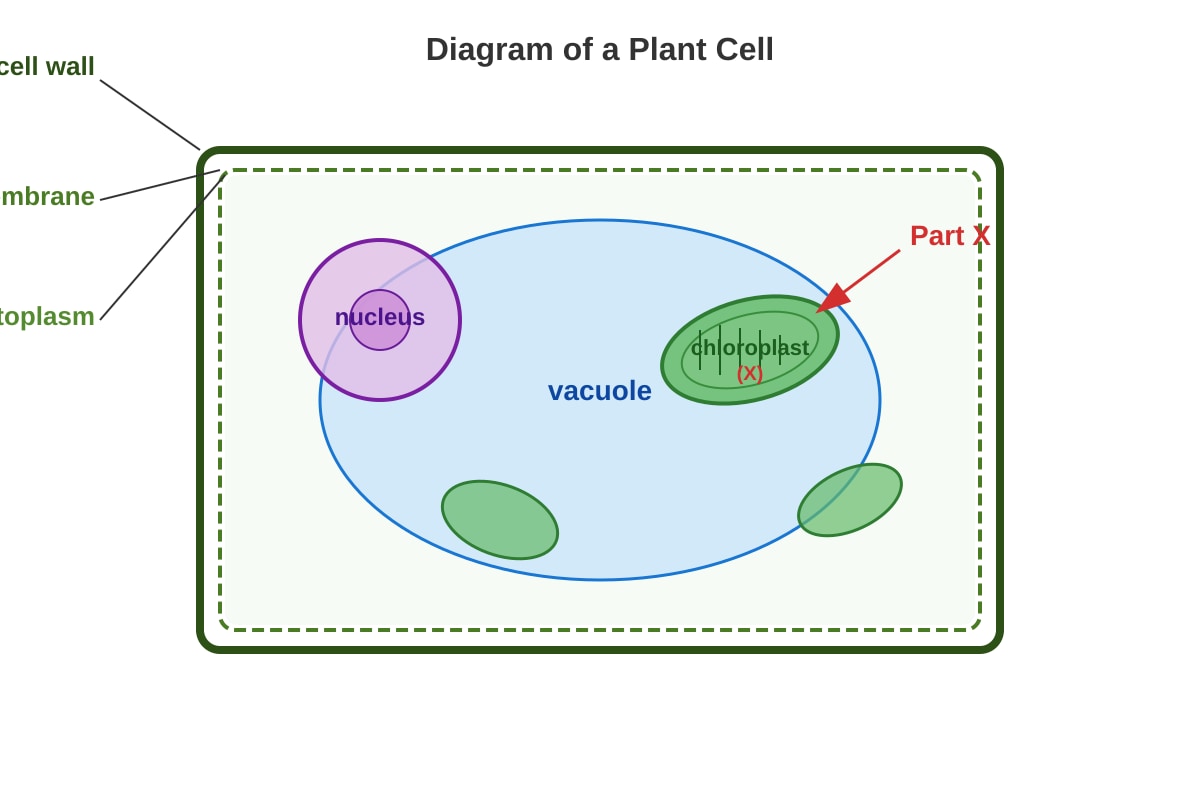
1. Answer: (3) Chloroplast [2]
Explanation: Chloroplasts contain chlorophyll, the green pigment that traps light energy for photosynthesis. The nucleus controls cell activities, cytoplasm is where most cell activities occur, and vacuole stores water and substances.
2. Answer: (2) It controls the movement of substances in and out of the cell. [2]
Explanation: The cell membrane is selectively permeable (not fully permeable), controlling what enters and leaves the cell. The cell wall gives the cell its regular shape (in plant cells), and photosynthesis occurs in chloroplasts.
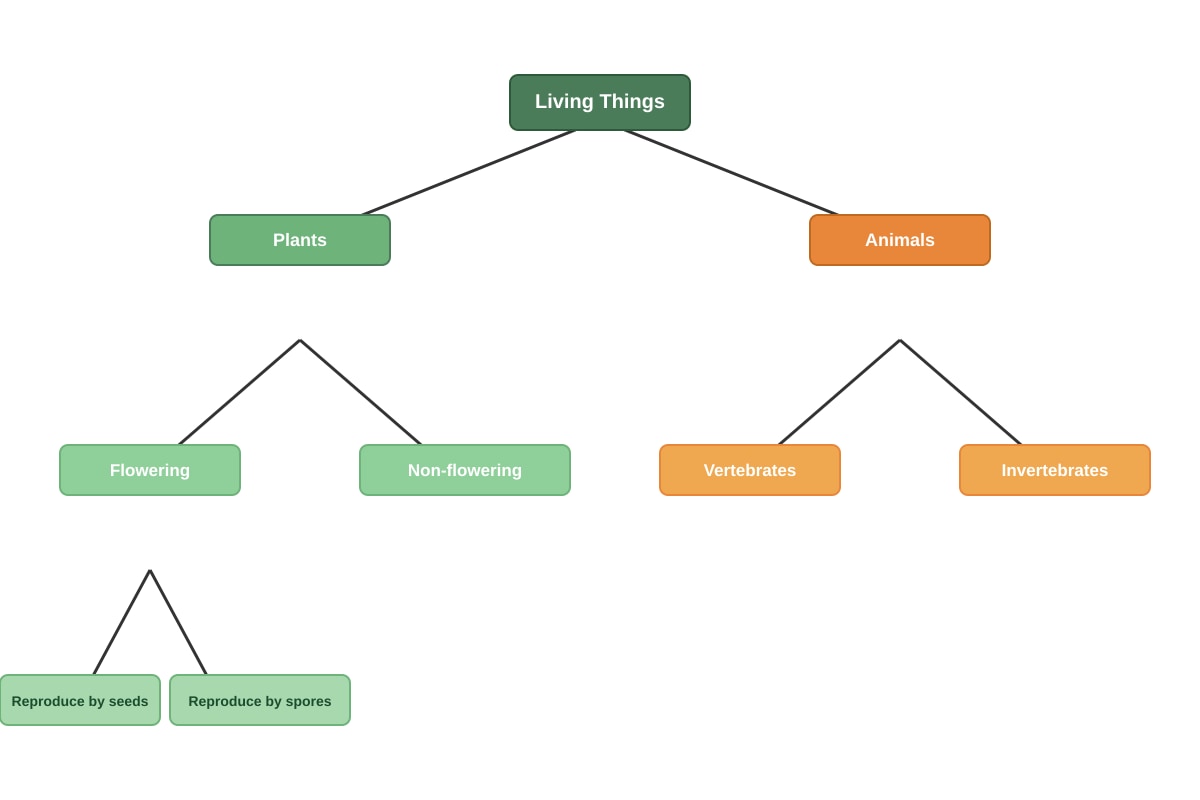
3. Answer: (2) Mushroom – Non-flowering plant, reproduces by spores [2]
Explanation: Mushrooms are fungi, not plants. They reproduce by spores but belong to the kingdom Fungi, not Plantae. Ferns and mosses are correctly classified as non-flowering plants that reproduce by spores. Hibiscus is correctly classified as a flowering plant reproducing by seeds.
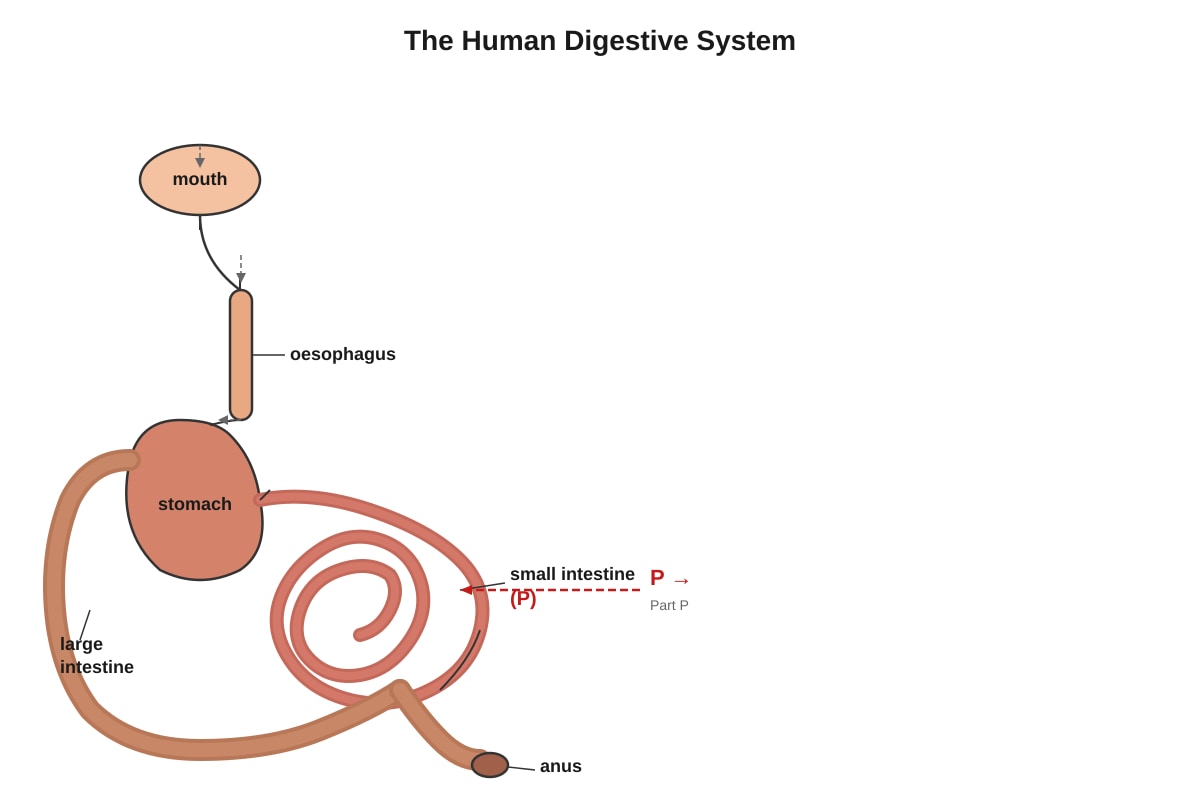
4. Answer: (2) Small intestine [2]
Explanation: The small intestine has villi (finger-like projections) that greatly increase surface area for absorption of digested food. The stomach mainly digests food, the large intestine absorbs water, and the oesophagus transports food.
5. Answer: (1) Nose → Trachea → Bronchi → Lungs → Alveoli [2]
Explanation: Air enters through the nose, passes down the trachea (windpipe), branches into the bronchi (one to each lung), further divides into bronchioles, and ends at the alveoli (air sacs) where gaseous exchange occurs.
6. Answer: (3) Nitrogen is used up during respiration. [2]
Explanation: Nitrogen is inert and is not used up or produced during respiration. The percentage remains 78% in both inhaled and exhaled air. Oxygen decreases (used in respiration), carbon dioxide increases (produced in respiration), and water vapour increases (exhaled air is saturated).
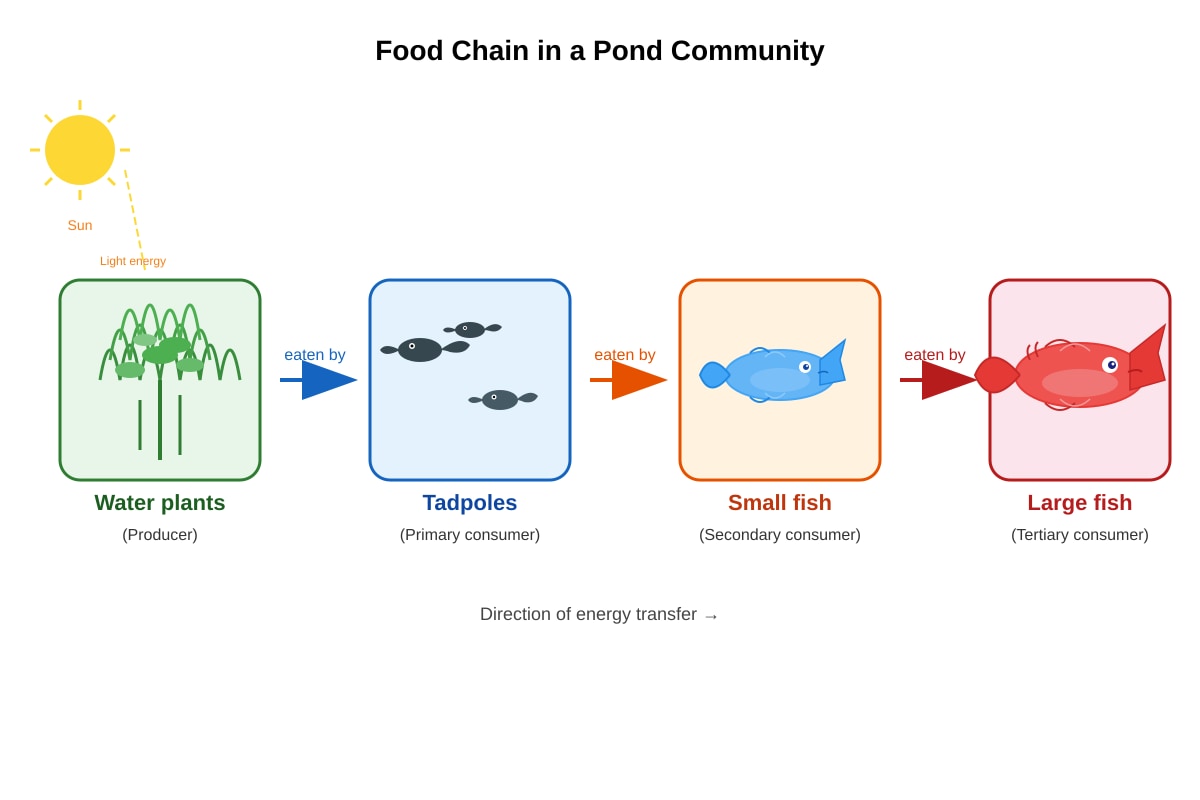
7. Answer: (1) Tadpoles: Decrease, Small fish: Decrease [2]
Explanation: Water plants are the producers/food source for tadpoles. If water plants decrease, tadpoles have less food → tadpole population decreases. Small fish eat tadpoles, so with fewer tadpoles, small fish have less food → small fish population also decreases.
8. Answer: (2) A polar bear having thick fur to keep warm. [2]
Explanation: Structural adaptations are physical features of an organism's body. Thick fur is a physical feature. Migration (1), colour change (3), and hibernation (4) are behavioural adaptations (actions/behaviours).
9. Answer: (2) Fertilisation [2]
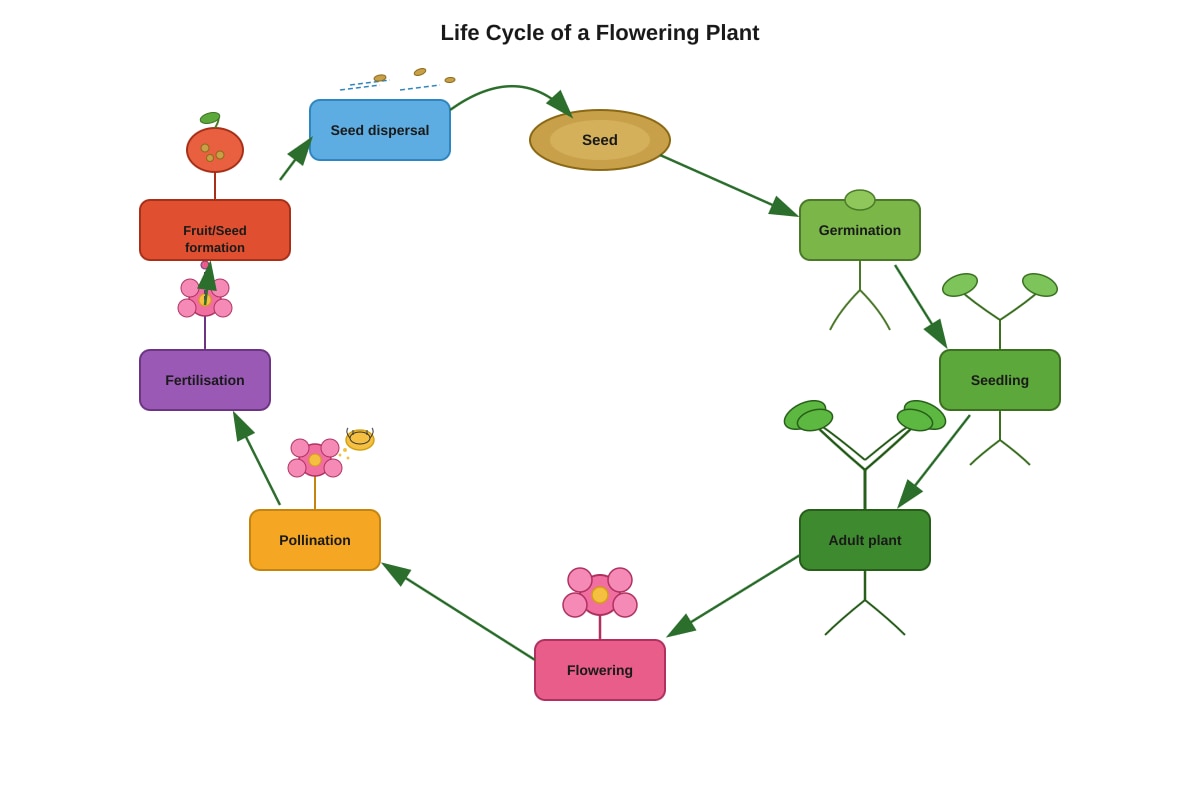
Explanation: In flowering plants: Pollination (transfer of pollen to stigma) → Fertilisation (fusion of male and female reproductive cells) → Seed/Fruit formation → Seed dispersal → Germination.
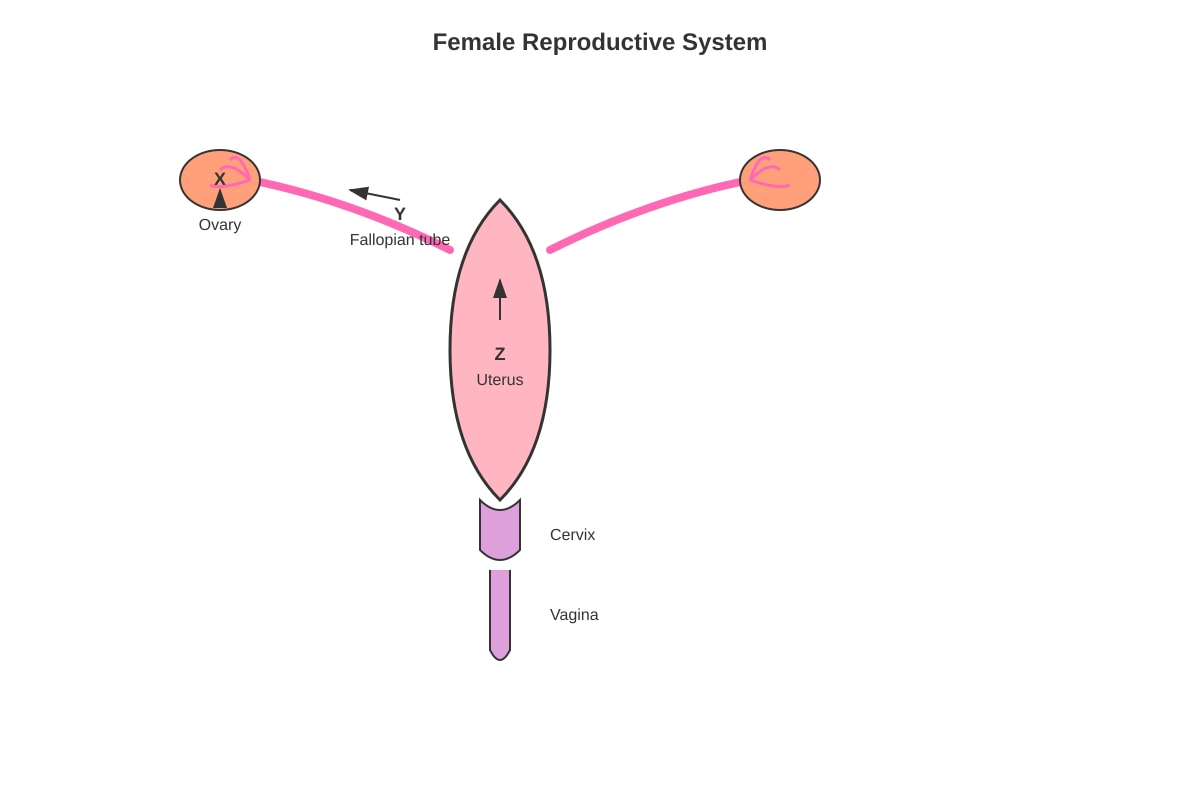
10. Answer: (2) Fallopian tube [2]
Explanation: Fertilisation in humans typically occurs in the fallopian tube (oviduct). The ovary releases the egg, the uterus is where the embryo implants and develops, and the vagina is the birth canal.
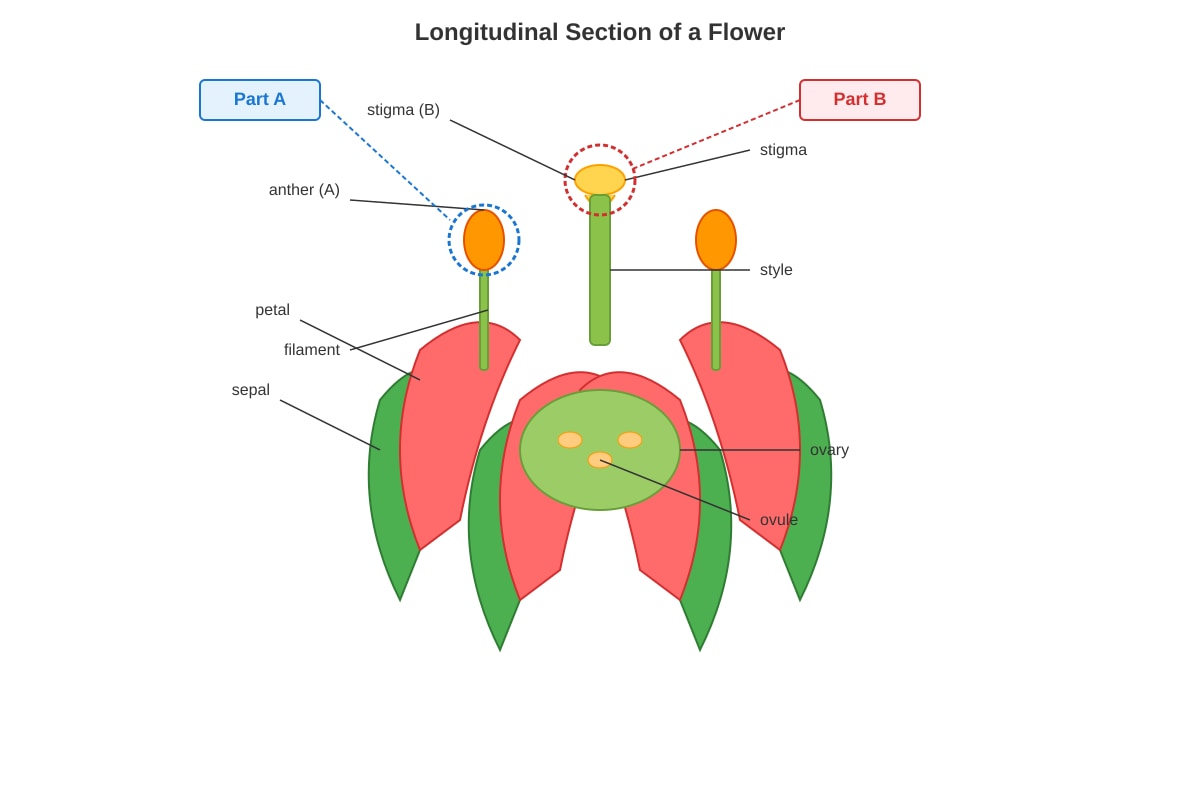
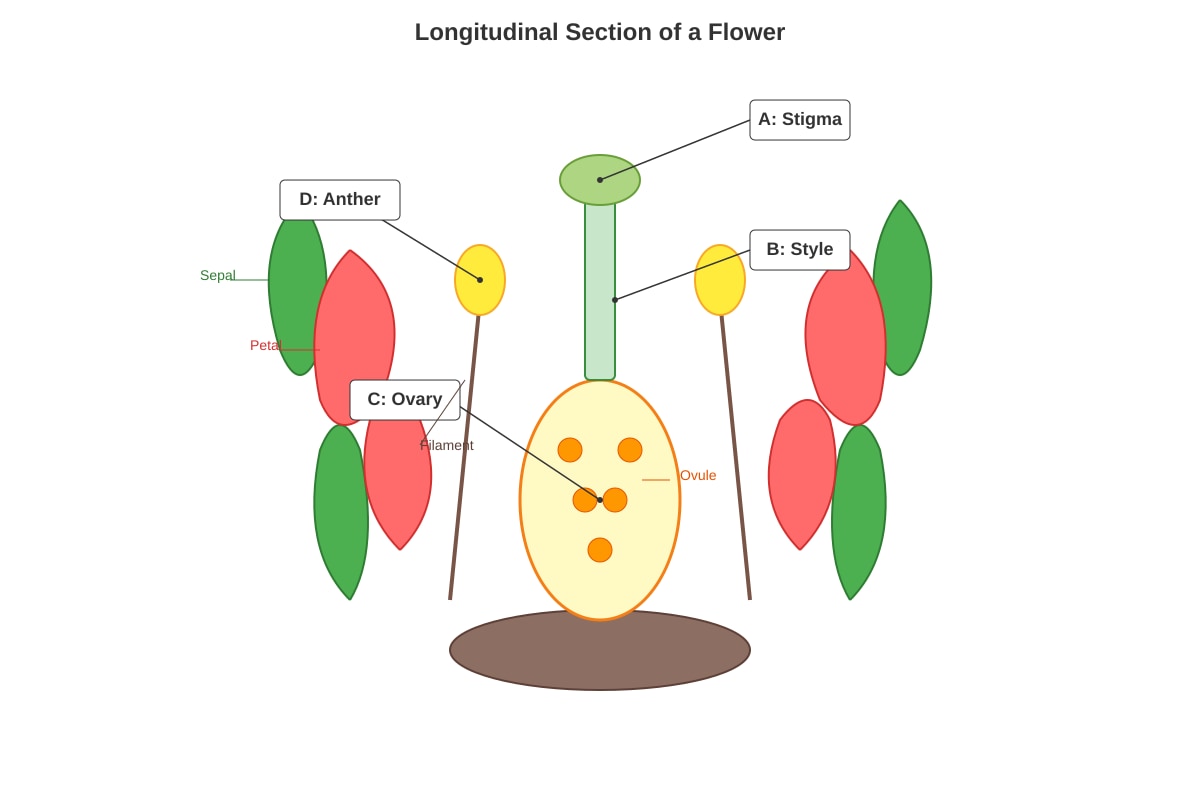
11. Answer: (1) A (Anther) [2]
Explanation: The anther is the male reproductive part of a flower that produces pollen grains (containing male reproductive cells). The stigma receives pollen, the ovary contains ovules (female reproductive cells), and the ovule develops into a seed after fertilisation.
12. Answer: (2) Seed dispersal prevents overcrowding and competition among young plants. [2]
Explanation: Seed dispersal spreads seeds away from the parent plant, reducing competition for light, water, nutrients, and space. Not all seeds are dispersed by wind (some by water, animals, splitting). Water-dispersed seeds have fibrous husks/air spaces, not wings. Animals disperse seeds by eating fruits and passing out undigested seeds, not digesting them completely.
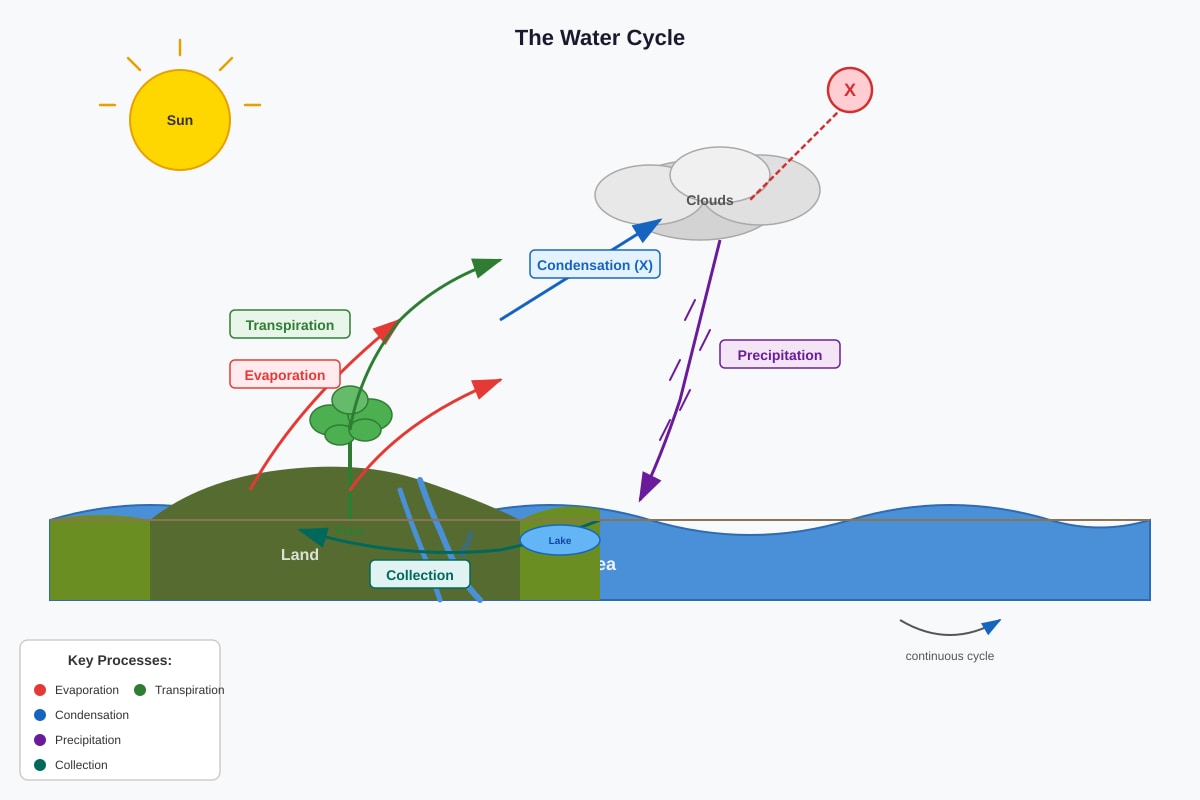
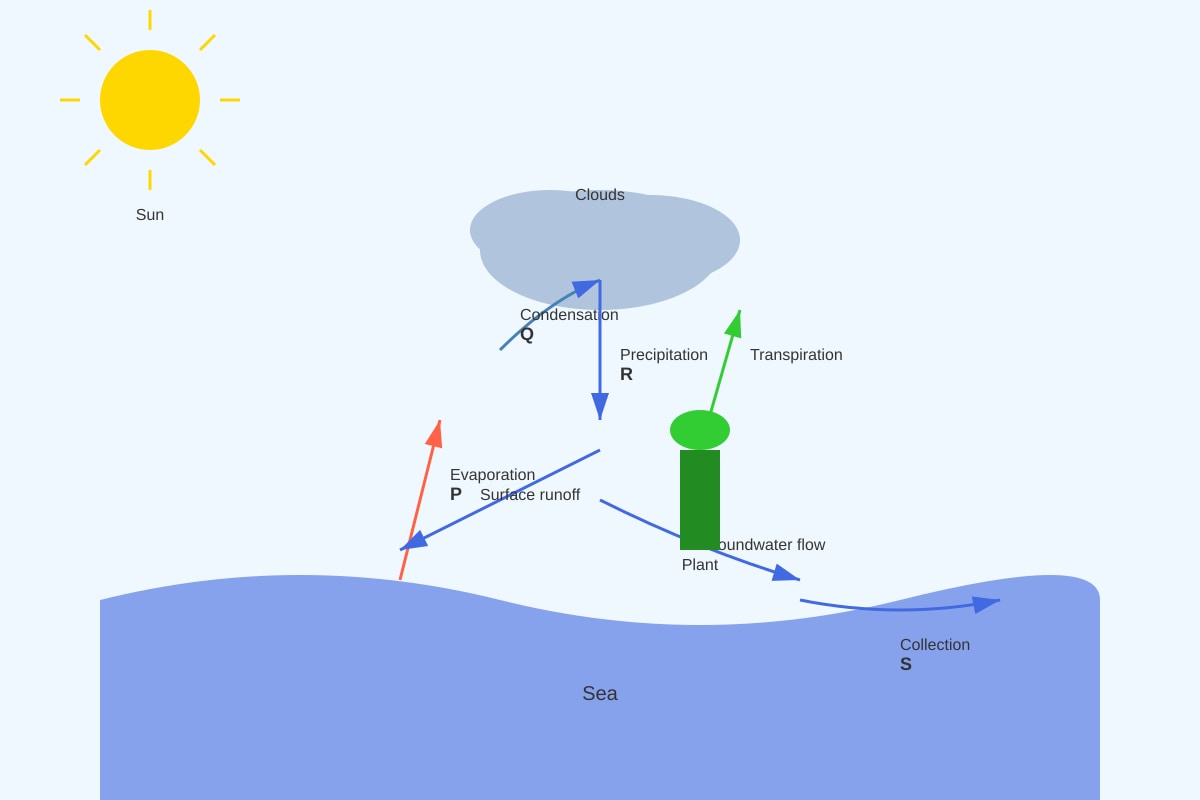
13. Answer: (2) Condensation [2]
Explanation: Condensation is the process where water vapour (gas) cools and changes into tiny water droplets (liquid), forming clouds. Evaporation is liquid to gas, precipitation is water falling from clouds, collection is water gathering in water bodies.
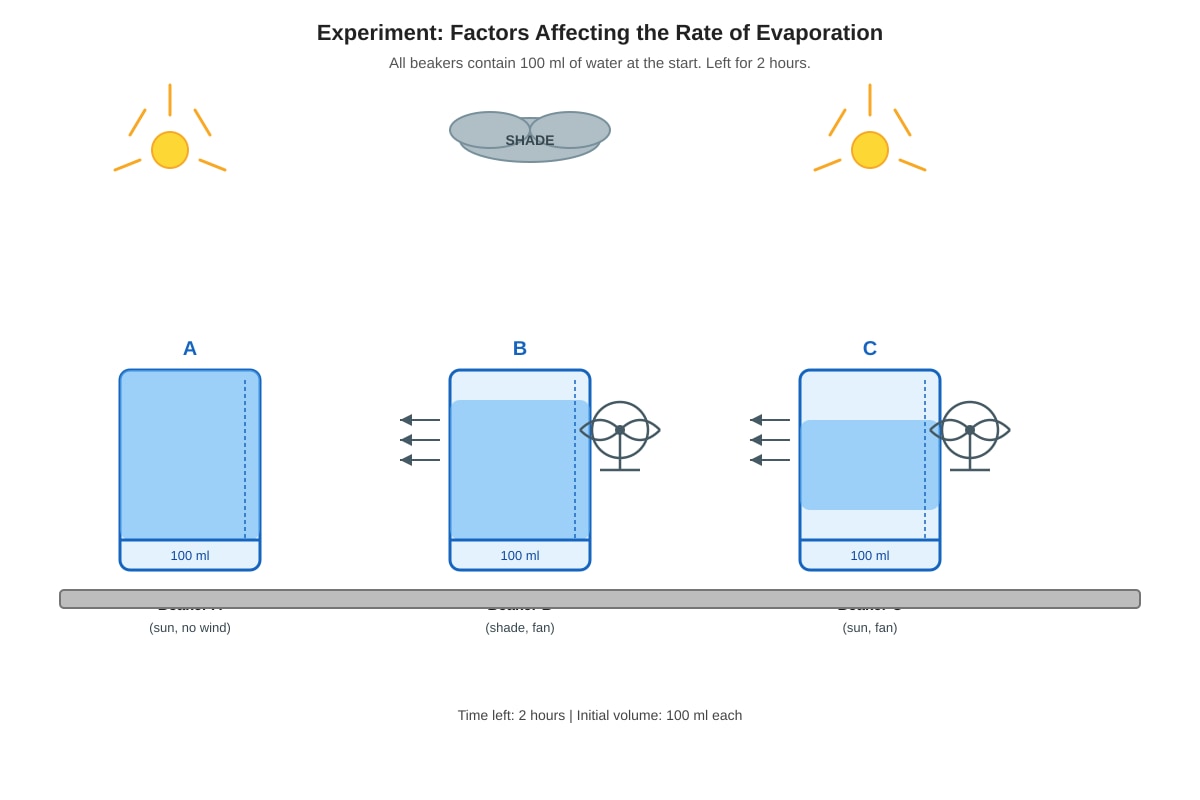
14. Answer: (4) Higher humidity [2]
Explanation: Higher humidity means more water vapour in the air, which slows down evaporation. Higher temperature, larger surface area, and wind all increase evaporation rate.
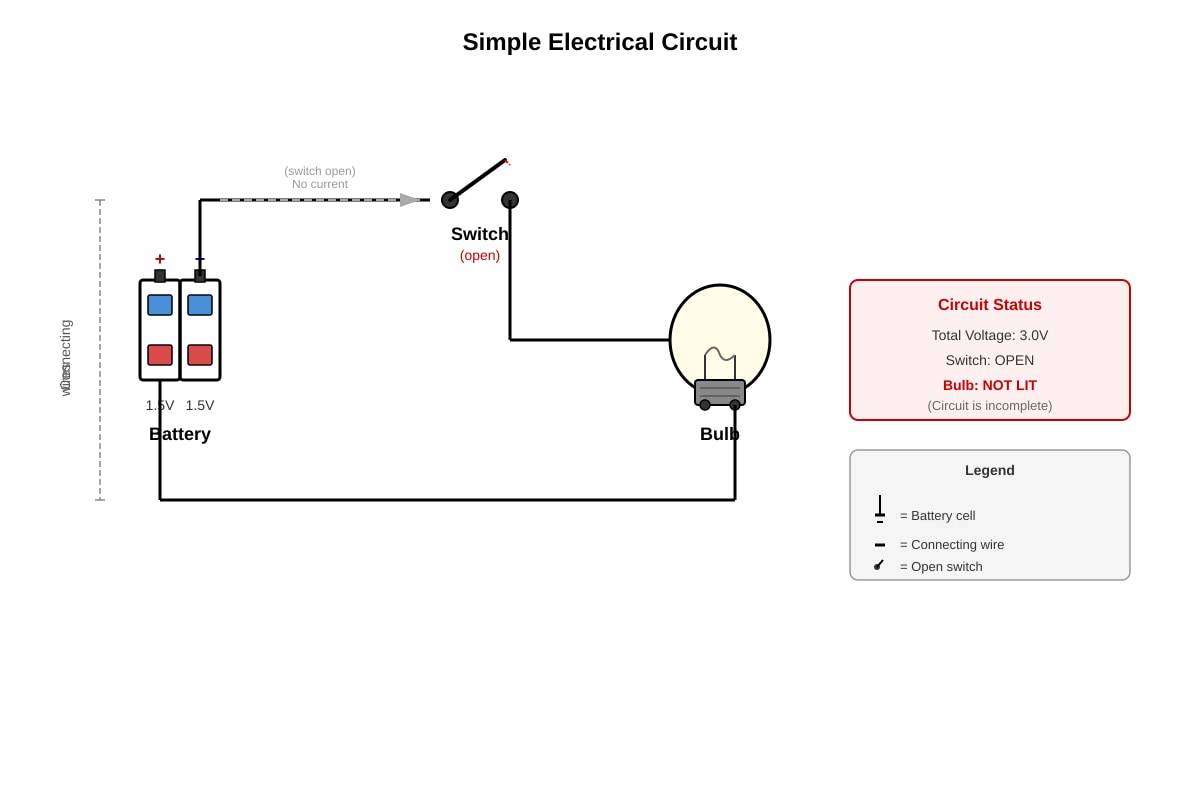
15. Answer: (3) The circuit is incomplete. [2]
Explanation: An open switch creates a gap in the circuit, making it incomplete. Electric current cannot flow through an incomplete circuit, so the bulb does not light up.
16. Answer: (3) A closed circuit with a battery, switch, bulb, and wires all connected properly. [2]
Explanation: A bulb lights up only in a closed (complete) circuit with an energy source (battery), a load (bulb), and conducting path (wires). Gaps, open switches, or missing bulbs create incomplete circuits.
17. Answer: (3) The other bulb does not light up. [2]
Explanation: In a series circuit, there is only one path for current. If one bulb fuses, the circuit is broken and current cannot flow, so all bulbs go out.
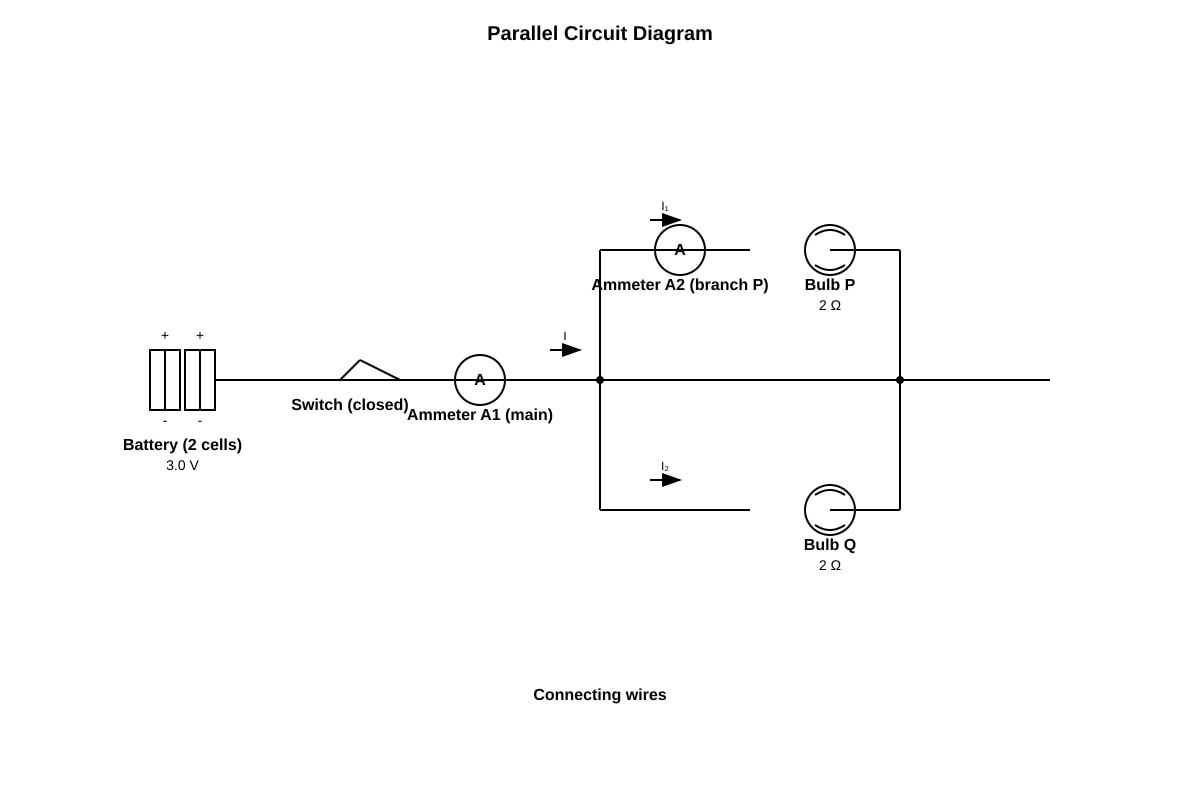
18. Answer: (2) If one bulb fuses, the other bulb still lights up. [2]
Explanation: In a parallel circuit, each bulb has its own path to the battery. If one bulb fuses, the other path remains complete, so the other bulb continues to light. This is why household lights are connected in parallel.
19. Answer: (3) Copper [2]
Explanation: Copper is a metal and a good conductor of electricity. Plastic, wood, and rubber are insulators (poor conductors).
20. Answer: (4) Using a wooden rod instead of an iron nail. [2]
Explanation: An
<stage5_exam_answers_md>
TuitionGoWhere Practice Paper - Science Primary 5 (Answer Key)
Paper: Practice Paper 2 (Version 2 of 5)
Total Marks: 100
SECTION A: Multiple-Choice Questions (56 marks)
| Question | Answer | Explanation |
|---|---|---|
| 1 | (3) Chloroplast | Chloroplasts contain chlorophyll which traps light energy for photosynthesis. |
| 2 | (2) It controls the movement of substances in and out of the cell. | The cell membrane is selectively permeable, controlling what enters and leaves the cell. |
| 3 | (2) Mushroom – Non-flowering plant, reproduces by spores | Mushrooms are fungi, not plants. They reproduce by spores but belong to a separate kingdom. |
| 4 | (2) Small intestine | The small intestine has villi that increase surface area for maximum absorption of digested food. |
| 5 | (1) Nose → Trachea → Bronchi → Lungs → Alveoli | Air travels from nose to trachea, then branches into bronchi, enters lungs, and reaches alveoli for gas exchange. |
| 6 | (3) Nitrogen is used up during respiration. | Nitrogen is inert and not used in respiration; its percentage remains constant at 78%. |
| 7 | (1) Decrease | Decrease |
| 8 | (2) A polar bear having thick fur to keep warm. | Structural adaptations are physical features. Thick fur is a structural adaptation; migration, colour change, and hibernation are behavioural. |
| 9 | (2) Fertilisation | After pollination (transfer of pollen to stigma), the pollen tube grows down the style for fertilisation to occur in the ovule. |
| 10 | (2) Fallopian tube | Fertilisation typically occurs in the fallopian tube where the sperm meets the egg. |
| 11 | (1) A (Anther) | The anther is the male reproductive part that produces pollen grains. |
| 12 | (2) Seed dispersal prevents overcrowding and competition among young plants. | Seed dispersal spreads seeds away from parent plant, reducing competition for light, water, and nutrients. |
| 13 | (2) Condensation | Condensation is the process where water vapour cools and changes into tiny water droplets (clouds). |
| 14 | (4) Higher humidity | Higher humidity slows evaporation as air is already saturated with water vapour. |
| 15 | (3) The circuit is incomplete. | An open switch creates a gap, preventing current from flowing in a complete loop. |
| 16 | (3) A closed circuit with a battery, switch, bulb, and wires all connected properly. | A complete closed circuit is needed for current to flow and light the bulb. |
| 17 | (3) The other bulb does not light up. | In a series circuit, there is only one path for current. If one bulb fuses, the circuit is broken. |
| 18 | (2) If one bulb fuses, the other bulb still lights up. | In parallel circuits, each bulb has its own path; if one fails, the other remains lit. |
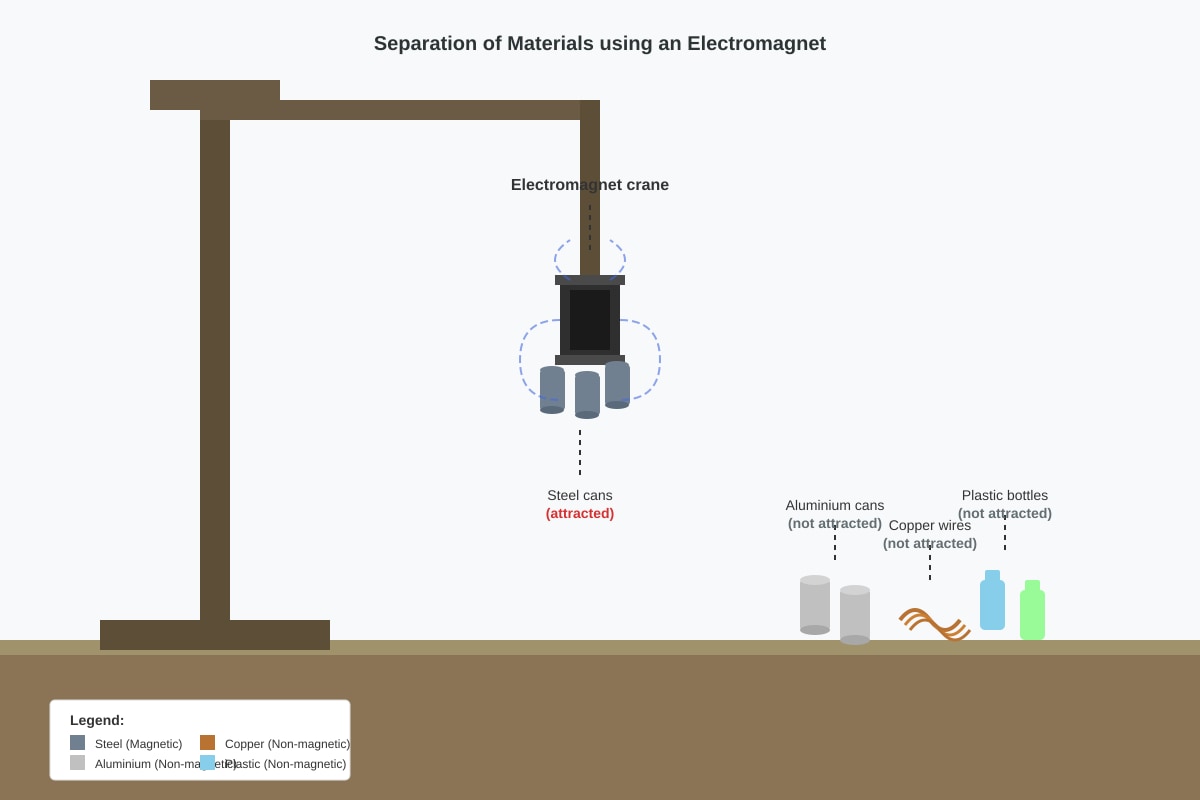
| 19 | (3) Copper | Copper is a metal and excellent conductor of electricity. Plastic, wood, and rubber are insulators. |
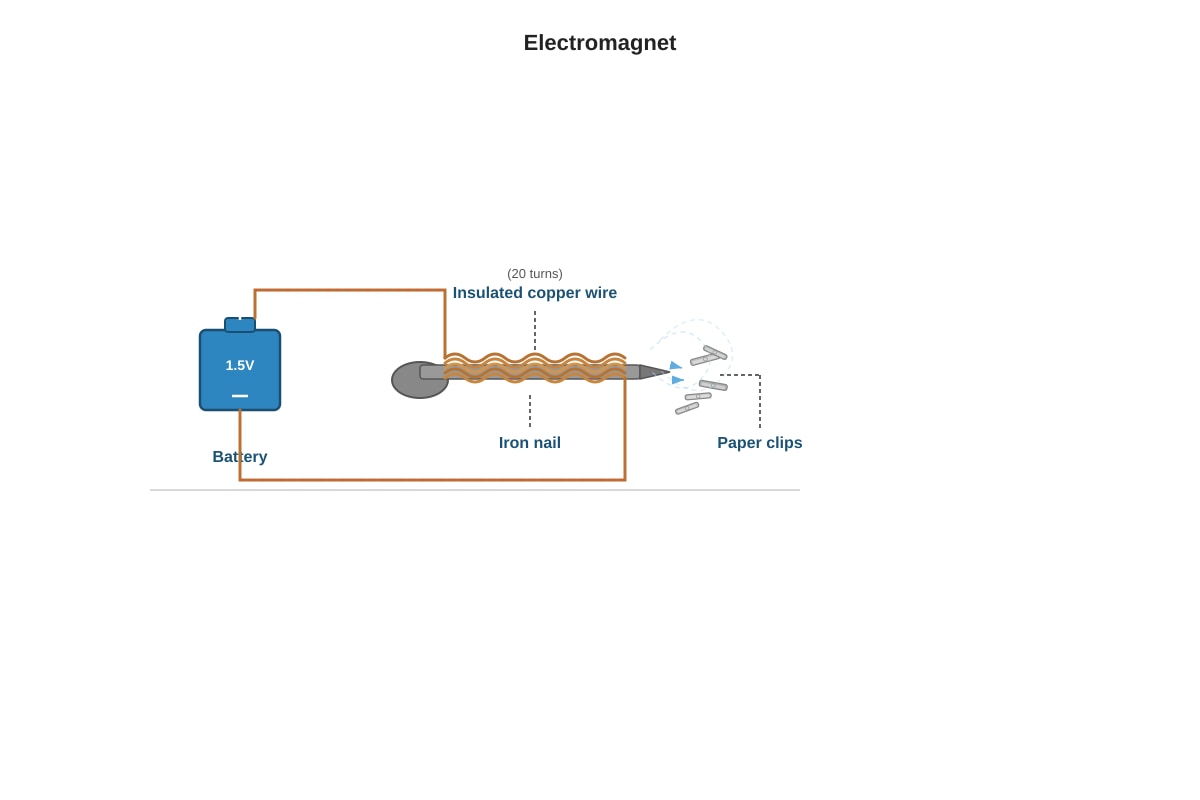
| 20 | (4) Using a wooden rod instead of an iron nail. | Wood is not magnetic; an iron core is needed to concentrate the magnetic field. |
| 21 | (3) Light | Light is a form of energy, not matter. It has no mass and does not occupy space. |
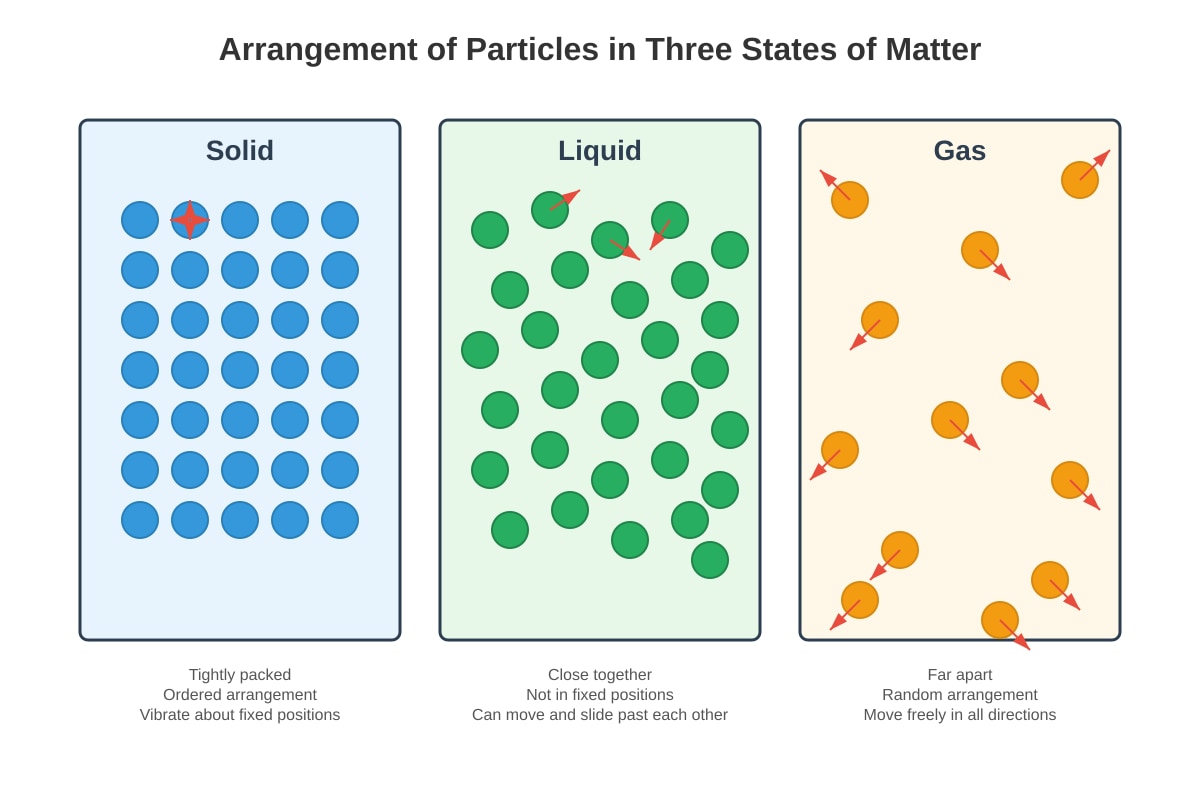
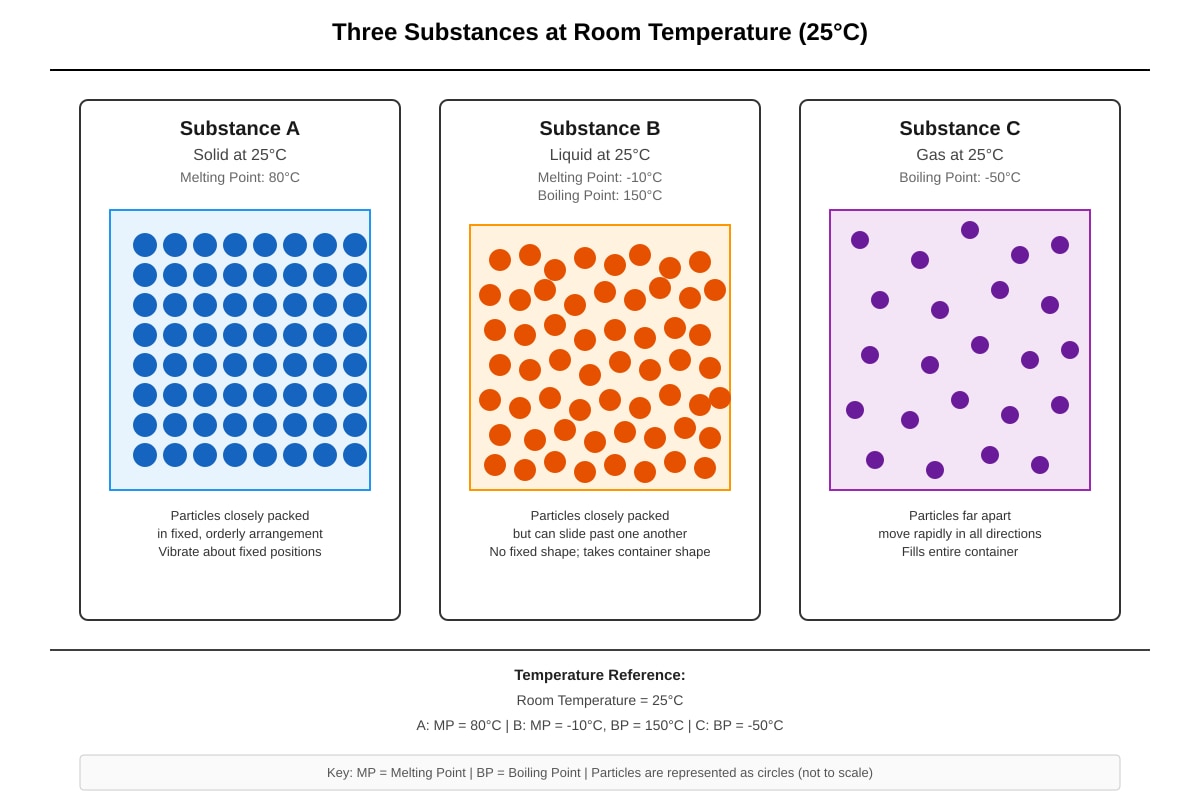
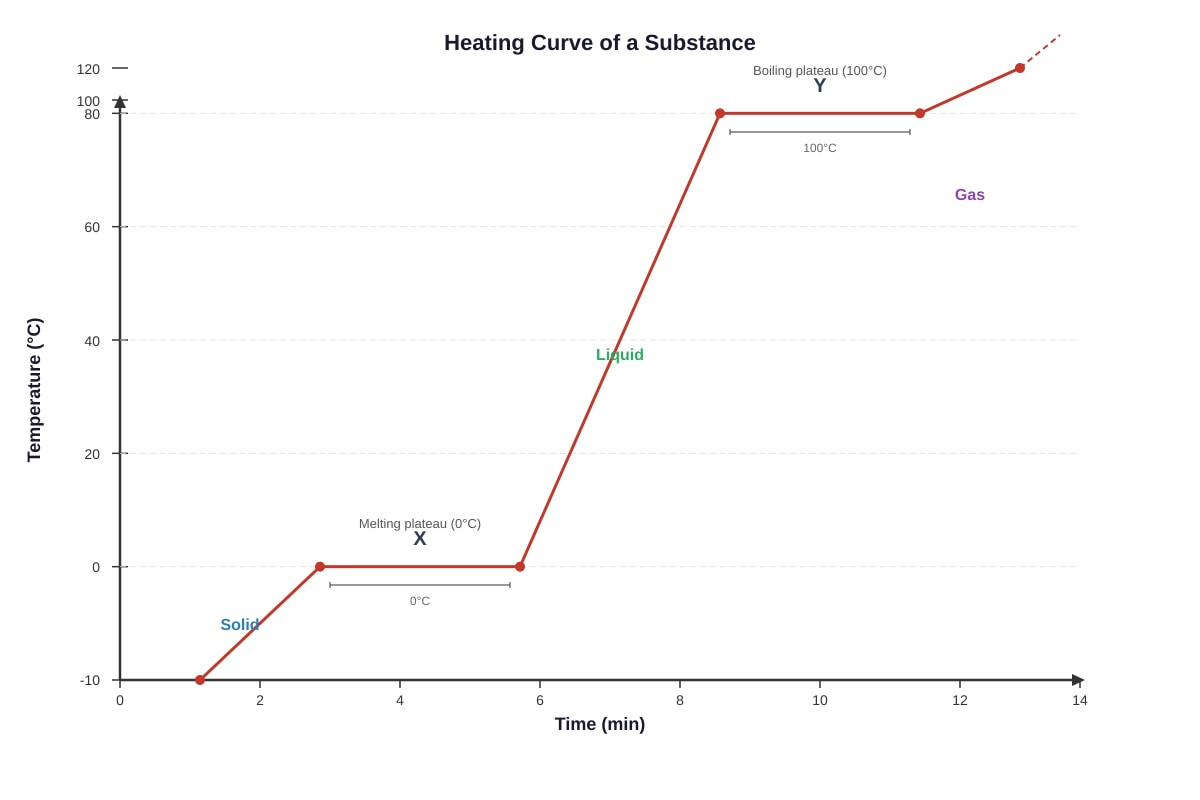
| 22 | (1) Solid | Solids have particles tightly packed in orderly arrangement, vibrating about fixed positions. |
| 23 | (2) The mass of the water is the same as the mass of the ice. | Mass is conserved during state changes; only arrangement and energy of particles change. |
| 24 | (3) A and B only | At 25°C: A (m.p. -10, b.p. 50) is liquid; B (m.p. 0, b.p. 100) is liquid; C (m.p. 50) is solid. |
| 25 | (3) Boiling | Boiling is the change from liquid to gas at boiling point. Evaporation also does this but at any temperature. |
| 26 | (2) Remains the same | Decreases |
| 27 | (1) Evaporation → Condensation → Precipitation → Collection | Water cycle starts with evaporation from sea, then condensation, precipitation, and collection back into sea. |
| 28 | (3) The metal ball expands. | Metals expand when heated due to increased kinetic energy of particles. Mass remains constant. |
SECTION B: Open-Ended Questions (44 marks)
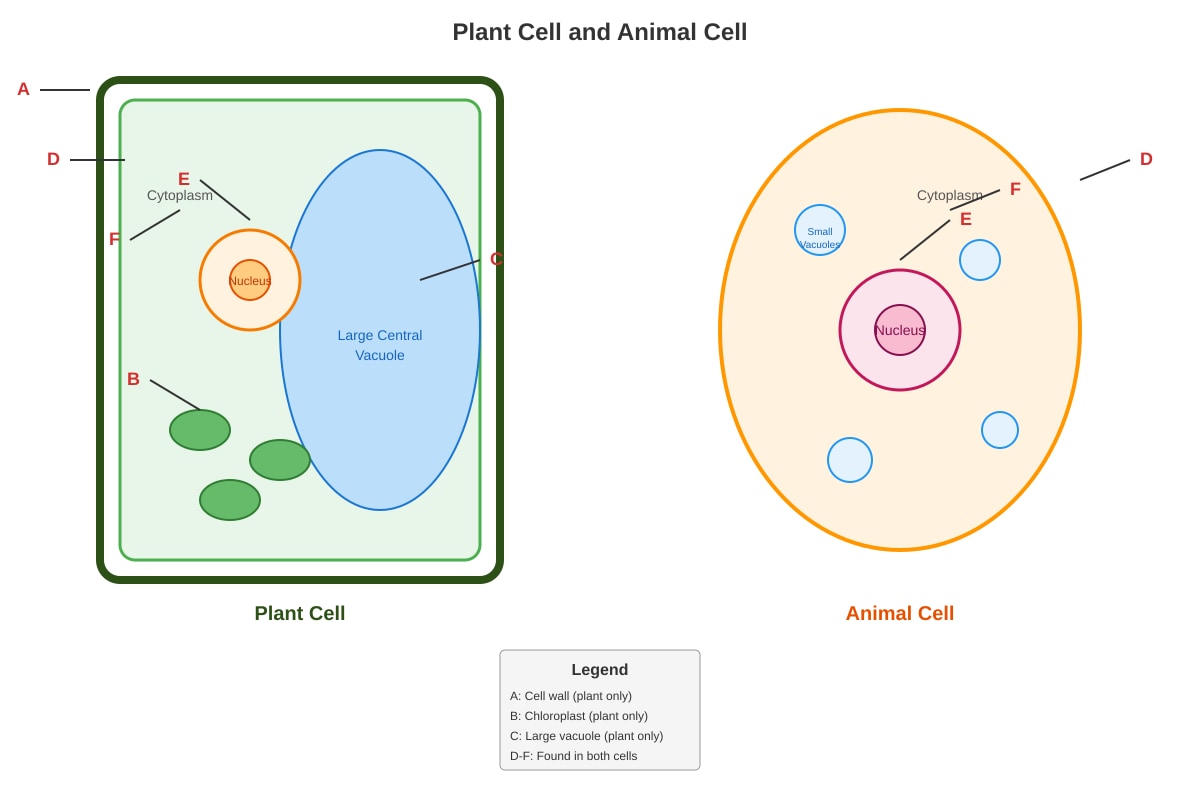
29. Plant and Animal Cells
(a) Identify the parts labelled A, B, and C in the plant cell. [3]
- A: Cell wall
- B: Chloroplast
- C: Large vacuole
(b) State one function of the part labelled B. [1]
- Contains chlorophyll to trap light energy for photosynthesis / Site of photosynthesis.
(c) State two differences between the plant cell and the animal cell shown. [2]
- Difference 1: Plant cell has a cell wall; animal cell does not have a cell wall.
- Difference 2: Plant cell has chloroplasts; animal cell does not have chloroplasts. (Acceptable alternatives: Plant cell has a large central vacuole; animal cell has small vacuoles or none. Plant cell has a regular/fixed shape; animal cell has an irregular shape.)
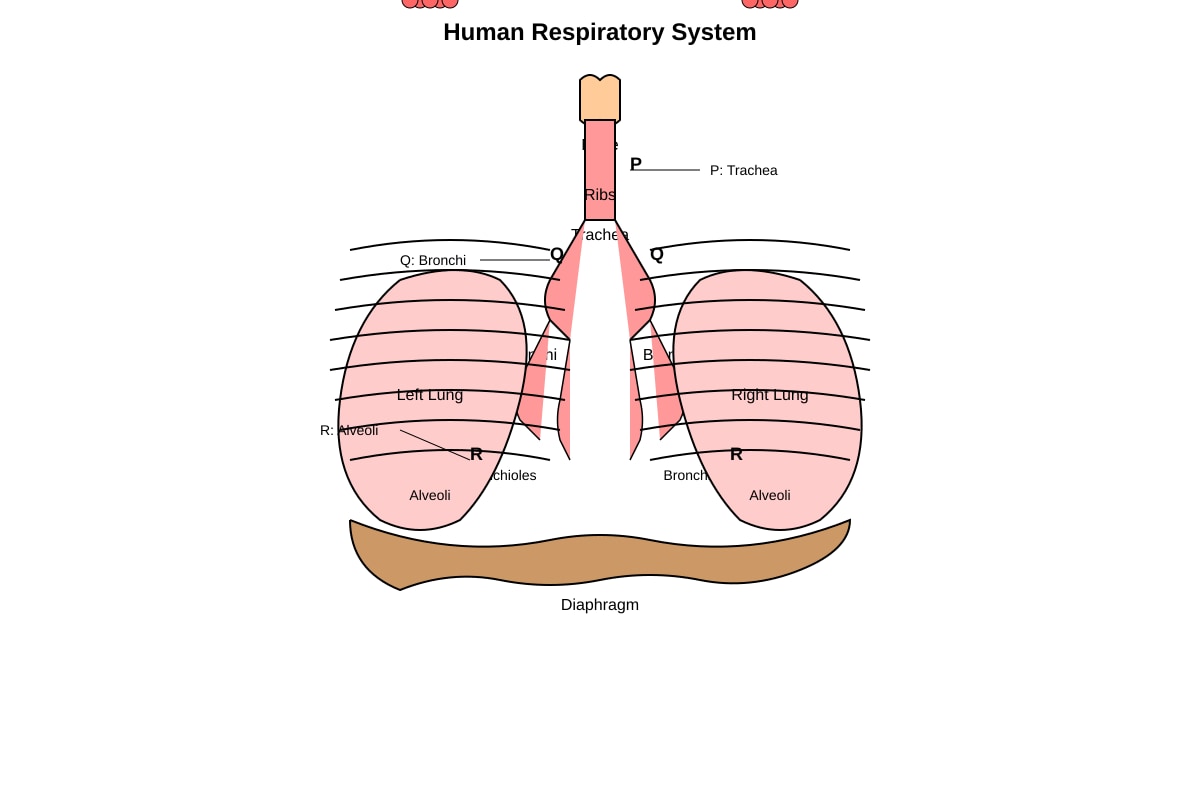
30. Human Respiratory System
(a) Name the parts labelled P, Q, and R. [3]
- P: Trachea (windpipe)
- Q: Bronchus / Bronchi (bronchial tubes)
- R: Alveoli (air sacs)
(b) State the function of part R. [1]
- Site of gaseous exchange where oxygen diffuses into the blood and carbon dioxide diffuses out of the blood.
(c) Explain how the structure of part R is adapted for its function. [2]
- The alveoli have thin walls (one cell thick) to allow rapid diffusion of gases.
- They have a large surface area (due to numerous alveoli) to maximise gas exchange.
- They are surrounded by a dense network of capillaries for efficient transport of gases.
- They are moist to dissolve gases for diffusion. (Any two valid points for 2 marks)
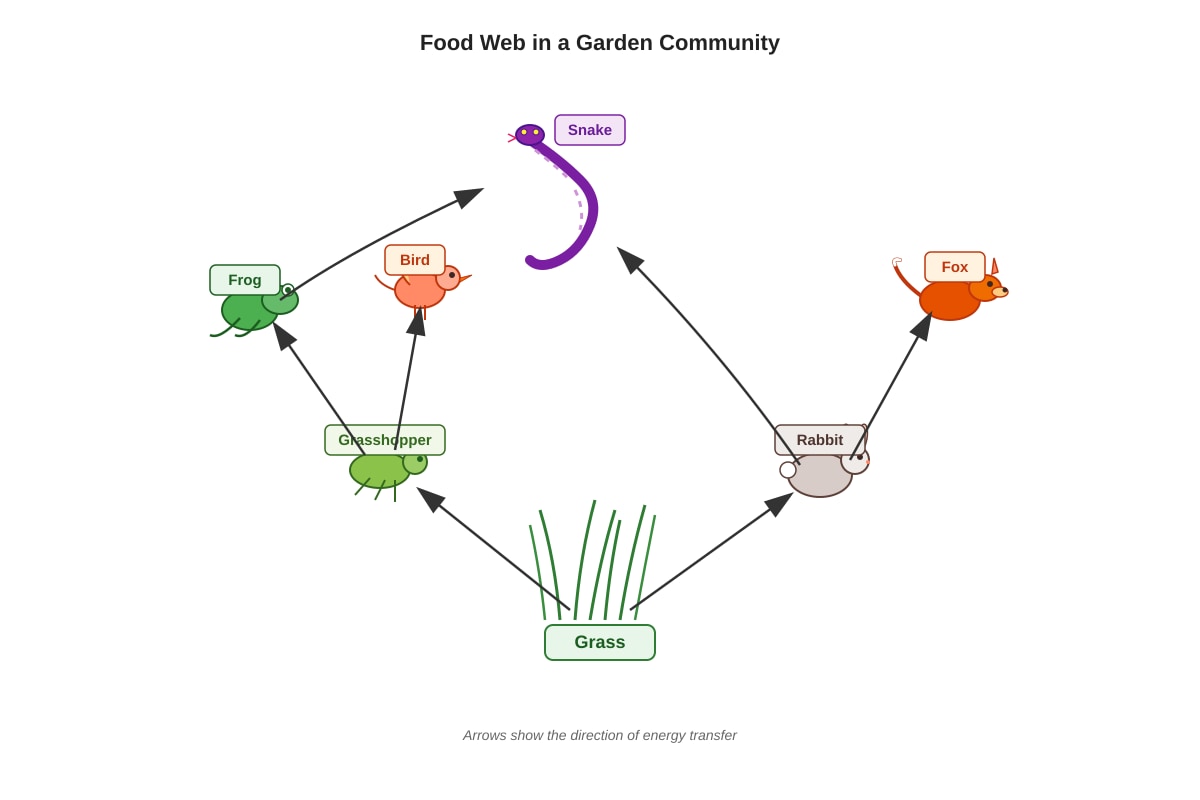
31. Food Web and Energy Flow
(a) Based on the food web, identify all the food chains that include the hawk. [2]
- Grass → Grasshopper → Frog → Snake → Hawk
- Grass → Grasshopper → Frog → Hawk
- Grass → Rabbit → Fox → Hawk
- Grass → Rabbit → Hawk
- Grass → Mouse → Snake → Hawk
- Grass → Mouse → Hawk
- Grass → Mouse → Fox → Hawk (Any 4 correct chains for 2 marks; 1 mark for 2-3 correct chains)
(b) If all the snakes are removed from the community, explain what will happen to the population of grasshoppers. [2]
- The population of grasshoppers will decrease.
- With no snakes, the frog population increases (less predation). More frogs eat more grasshoppers, causing the grasshopper population to decrease.
(c) The grass in the food web obtains energy from the Sun. Explain why the amount of energy transferred from the grass to the rabbit is less than the energy the grass obtains from the Sun. [2]
- Not all sunlight energy is absorbed by grass (some reflected, some wrong wavelength).
- Grass uses most energy for its own life processes (respiration, growth, reproduction) and loses it as heat.
- Only energy stored in the grass biomass (chemical energy) is transferred to the rabbit when eaten.
- Typically only about 10% of energy is transferred between trophic levels.
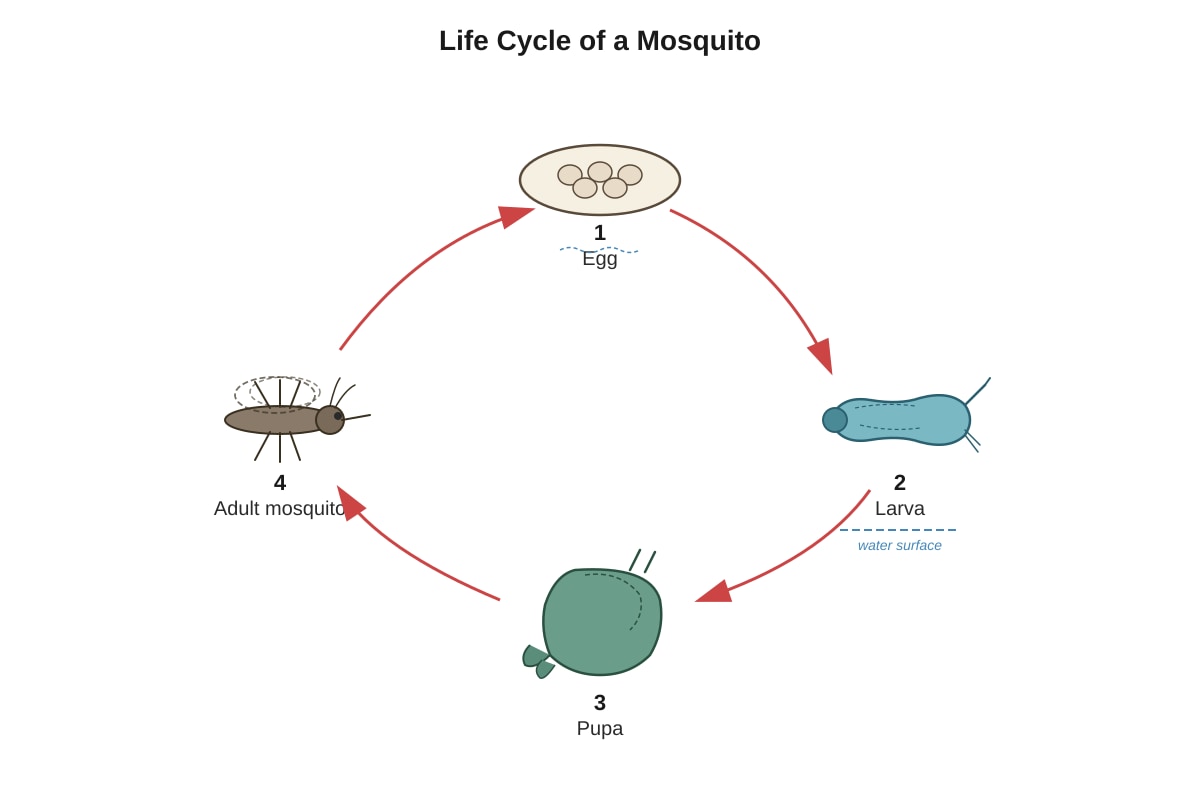
32. Life Cycle of a Mosquito
(a) Name the four stages in the life cycle of a mosquito. [2]
- Egg → Larva → Pupa → Adult
(b) At which stage does the mosquito cause harm to humans? [1]
- Adult stage (female mosquito bites to suck blood, transmitting diseases).
(c) State one way to prevent mosquitoes from breeding in stagnant water. [1]
- Remove/cover stagnant water containers / Add oil to water surface to prevent larvae breathing / Introduce fish that eat larvae / Use larvicide.
(d) The diagram below shows a mosquito larva. Explain how it breathes underwater. [2]
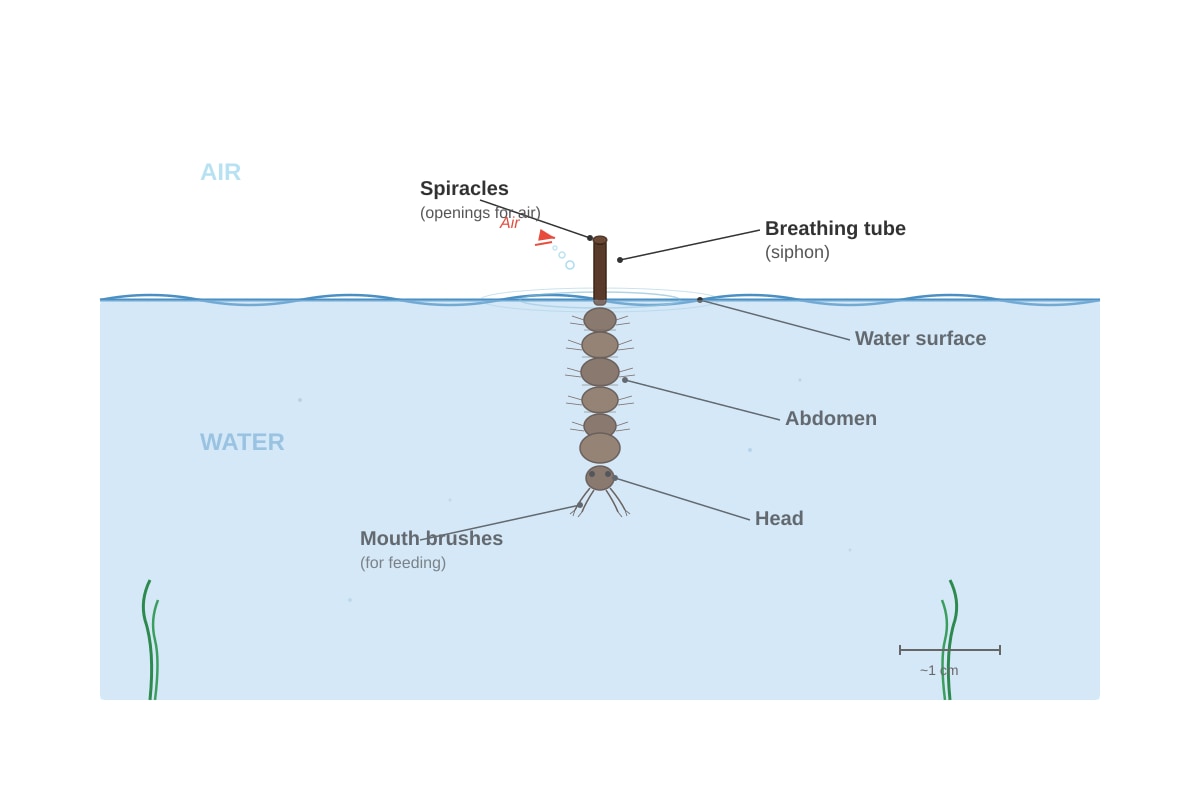
Generated diagram for this question.
- The larva has a breathing tube (siphon) at the end of its abdomen.
- It comes to the water surface and extends the tube above water to take in air.
- The tube has spiracles that open to take in oxygen from the air.
33. Water Cycle and Changes of State
(a) In the water cycle, name the process where water changes from liquid to gas. [1]
- Evaporation (or boiling, but evaporation occurs at all temperatures in water cycle).
(b) Explain why water vapour rises in the atmosphere. [1]
- Water vapour is less dense than the surrounding air (or: warm air carrying water vapour rises).
(c) The diagram shows a beaker of ice cubes left on a table. After some time, water droplets form on the outer surface of the beaker. Explain how these water droplets are formed. [2]
- Water vapour in the surrounding warm air comes into contact with the cold outer surface of the beaker.
- The water vapour loses heat to the cold surface and condenses into tiny water droplets.
(d) State one difference between boiling and evaporation. [1]
- Boiling occurs at a fixed temperature (100°C at sea level); evaporation occurs at any temperature.
- Boiling occurs throughout the liquid with bubbles; evaporation occurs only at the surface.
- Boiling is rapid; evaporation is slow.
- Boiling requires a heat source; evaporation uses ambient heat.
34. Electrical Circuits
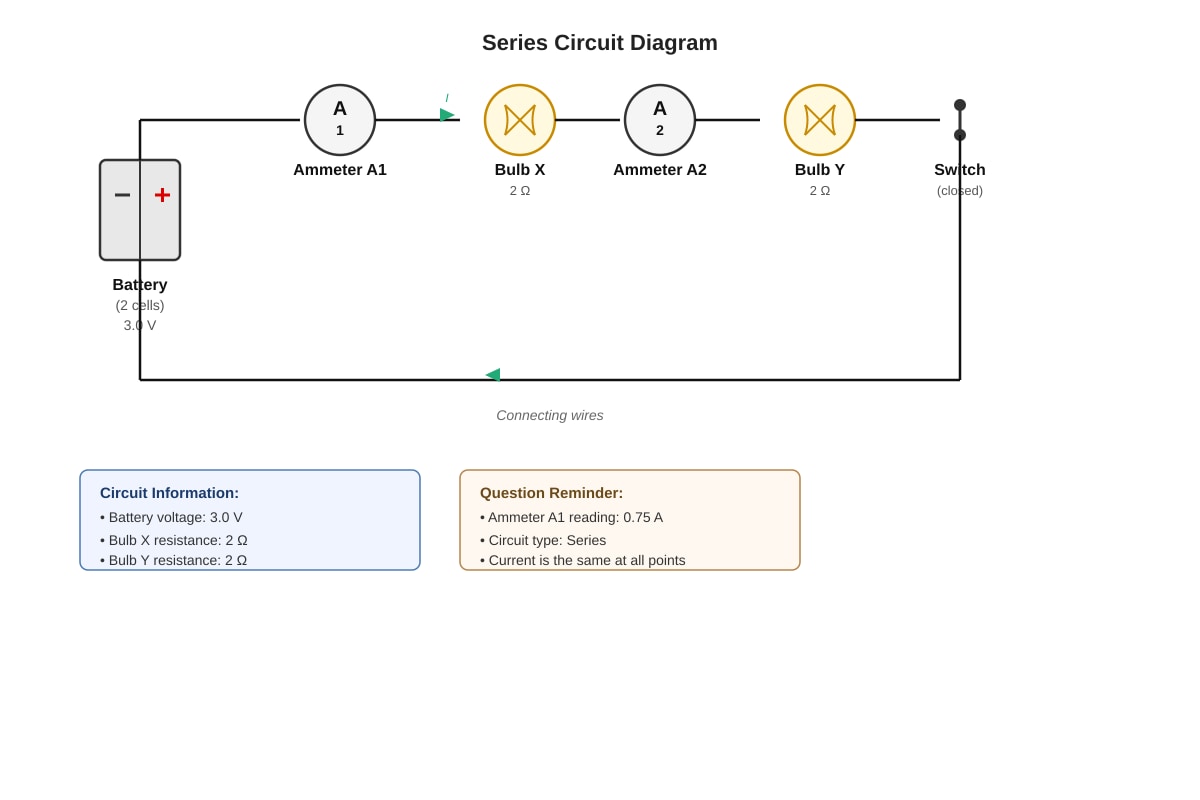
(a) Draw a circuit diagram using symbols to show two bulbs connected in series with a battery of two cells and a closed switch. [2]
  +| |-  +| |-
   |      |
  [Switch]---[Bulb]---[Bulb]---
   |      |      |      |
   -----------------------
(Standard symbols: Cell: long line + short line; Battery: two cells; Switch: closed (line connecting); Bulb: circle with cross; Wires: straight lines)
(b) In a series circuit, the current flowing through each component is the same. If the current measured at the battery is 0.5 A, what is the current passing through each bulb? [1]
- 0.5 A
(c) State one disadvantage of connecting bulbs in series. [1]
- If one bulb fuses, all bulbs go out (circuit broken).
- Bulbs are dimmer than in parallel (shared voltage).
- Cannot control bulbs independently.
(d) The diagram below shows a circuit with a battery, a switch, and three identical bulbs (B1, B2, B3). B2 and B3 are in parallel, and this combination is in series with B1. The switch is closed. [2]
Image pending generation: diagram for Q34d.
- (i) If B2 fuses, what happens to the brightness of B1 and B3?
- B1: Becomes dimmer (total resistance increases, total current decreases).
- B3: Remains the same brightness (voltage across parallel branch unchanged, current through B3 unchanged).
- (ii) Explain your answer for B3.
- B3 is in a separate parallel branch. When B2 fuses, the voltage across the parallel combination (and thus across B3) remains the same as the battery voltage minus voltage across B1. Since B3's resistance is unchanged, the current through B3 (I = V/R) remains the same, so its brightness is unchanged.
35. Magnets and Electromagnets
(a) State two properties of a magnet. [2]
- Attracts magnetic materials (iron, steel, nickel, cobalt).
- Has two poles (North and South).
- Like poles repel, unlike poles attract.
- Freely suspended magnet comes to rest in North-South direction. (Any two for 2 marks)
(b) The diagram shows a bar magnet. Draw the magnetic field lines around it. [2]
Image pending generation: diagram for Q35b.
- Drawing should show:
- Lines emerging from North pole, entering South pole.
- Arrows pointing from N to S outside the magnet.
- Lines closer together at poles (stronger field).
- Lines do not cross.
(c) An electromagnet is made by coiling wire around an iron nail and connecting it to a battery. State three ways to increase the strength of this electromagnet. [3]
- Increase the number of coils (turns of wire).
- Increase the current (use more batteries / higher voltage).
- Use a soft iron core (instead of steel or other materials).
- Wind coils more tightly / closer together. (Any three for 3 marks)
(d) State one advantage of an electromagnet over a permanent magnet. [1]
- The magnetism can be turned on and off (by switching current on/off).
- The strength can be adjusted (by changing current/coils).
- The polarity can be reversed (by reversing current direction).
36. Matter and Its Properties
(a) Define matter. [1]
- Anything that has mass and occupies space.
(b) The table below shows the properties of three substances X, Y, and Z at room temperature. [3]
| Substance | Has definite volume? | Has definite shape? | Can be compressed? |
|---|---|---|---|
| X | Yes | Yes | No |
| Y | Yes | No | No |
| Z | No | No | Yes |
- (i) Identify the state of matter for X, Y, and Z.
- X: Solid
- Y: Liquid
- Z: Gas
- (ii) Explain why substance Z can be compressed.
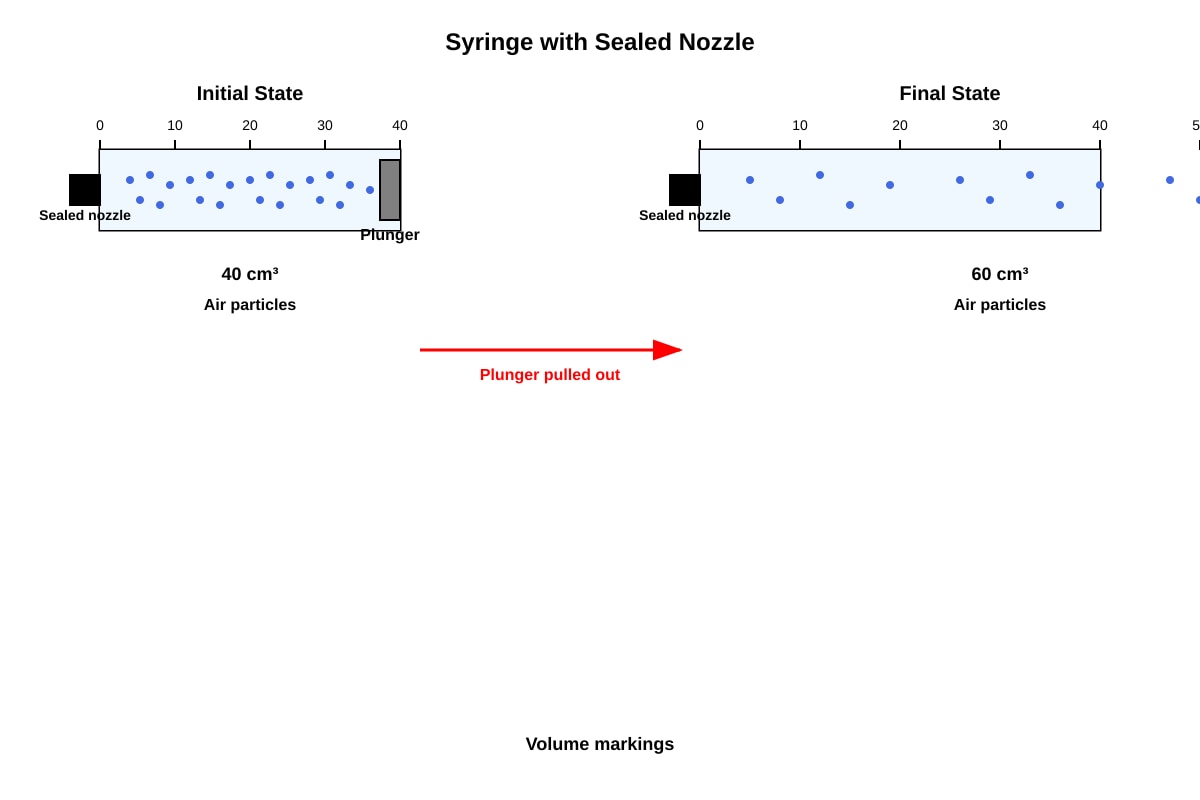
- Gas particles are far apart with large empty spaces between them, allowing them to be pushed closer together when pressure is applied.
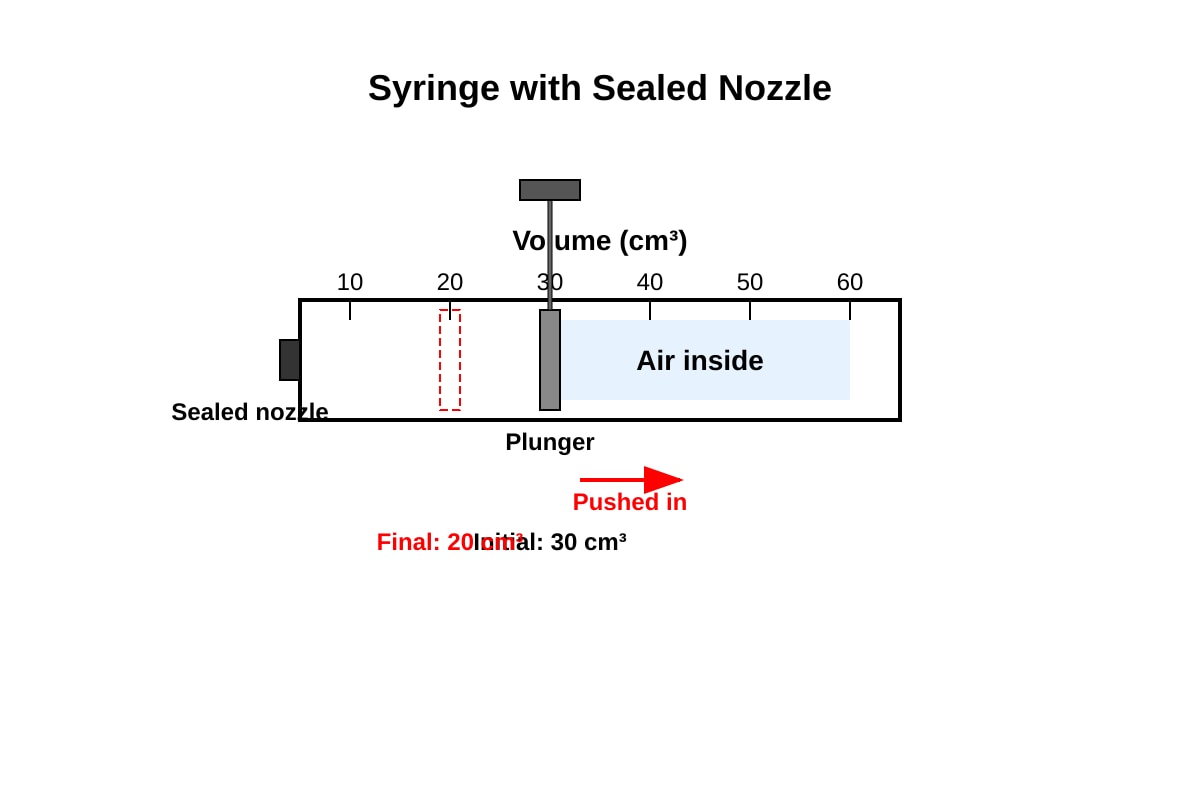
(c) A syringe contains 30 cm³ of air. The nozzle is sealed and the plunger is pushed in until the volume is 20 cm³. [2]
- (i) What is the new volume of the air?
- 20 cm³
- (ii) Has the mass of the air changed? Explain.
- No, the mass remains the same. The syringe is sealed so no air particles escape or enter; only the volume decreases as particles are pushed closer together.
(d) When water boils, bubbles are seen rising. What are these bubbles made of? [1]
- Water vapour (water in gaseous state) / Steam. (Not air or oxygen/hydrogen gas)
37. Heat and Temperature
(a) State the difference between heat and temperature. [2]
- Heat is a form of energy (measured in Joules) that flows from hotter to colder regions; it is the total kinetic energy of particles.
- Temperature is a measure of the degree of hotness (measured in °C); it indicates the average kinetic energy of particles.
(b) A metal spoon is placed in a cup of hot tea. The handle of the spoon becomes hot after a while. [2]
- (i) Name the process of heat transfer.
- Conduction
- (ii) Explain how heat is transferred in this process.
- Particles at the hot end gain kinetic energy and vibrate more vigorously.
- They collide with neighbouring particles, transferring kinetic energy along the spoon.
- Metals have free electrons that move quickly and transfer energy faster.
(c) The diagram shows a vacuum flask. Explain how the vacuum reduces heat loss. [2]
Image pending generation: diagram for Q37c.
- The vacuum has no particles (or very few).
- Heat transfer by conduction and convection requires a medium (particles).
- With no particles in the vacuum, conduction and convection cannot occur across the gap.
- (Note: Radiation is reduced by shiny silvered walls, not the vacuum itself.)
(d) Explain why a clinical thermometer has a kink (constriction) in the capillary tube. [1]
- The kink prevents the mercury/alcohol from flowing back into the bulb when the thermometer is removed from the mouth, allowing the temperature reading to be taken after removal.
38. Plant Reproduction
(a) The diagram shows a flower. Label the parts: stigma, style, ovary, anther, filament, petal, sepal. [3]
Image pending generation: diagram for Q38a.
- Labels (from top to bottom typically):
- Stigma (sticky top)
- Style (stalk)
- Ovary (swollen base containing ovules)
- Anther (pollen-producing top of stamen)
- Filament (stalk of stamen)
- Petal (coloured, attractive)
- Sepal (green, protective, outermost)
(b) Describe the process of fertilisation in flowering plants. [3]
- Pollen grain lands on the stigma (pollination).
- Pollen tube grows down the style into the ovary.
- Pollen tube enters the ovule through the micropyle.
- Male nucleus from pollen tube fuses with female nucleus (egg cell) in the ovule → fertilisation.
- Zygote forms, develops into embryo; ovule becomes seed; ovary becomes fruit.
(c) State two ways in which seeds can be dispersed. Give an example for each. [2]
| Dispersal Method | Example |
|---|---|
| Wind | Dandelion, Angsana, Shorea (winged/fuzzy seeds) |
| Water | Coconut, Lotus (fibrous husk/air spaces for floating) |
| Animal (external) | Love grass, Bidens (hooks/spines on fruit) |
| Animal (internal) | Papaya, Tomato, Mango (fleshy edible fruits) |
| Splitting/Explosive | Rubber tree, Balsam, Pea (pods split open) |
| (Any two methods with correct examples for 2 marks) |
(d) Why is seed dispersal important for plants? [1]
- Prevents overcrowding and competition among seedlings and parent plant for sunlight, water, nutrients, and space.
- Allows colonisation of new habitats.
MARKING SCHEME SUMMARY
- Section A: 28 questions × 2 marks = 56 marks
- Section B: 10 questions (Q29-Q38) = 44 marks
- Total: 100 marks
Suggested Mark Allocation for Section B:
| Question | Marks | Breakdown |
|---|---|---|
| 29 | 6 | (a) 3, (b) 1, (c) 2 |
| 30 | 6 | (a) 3, (b) 1, (c) 2 |
| 31 | 6 | (a) 2, (b) 2, (c) 2 |
| 32 | 6 | (a) 2, (b) 1, (c) 1, (d) 2 |
| 33 | 5 | (a) 1, (b) 1, (c) 2, (d) 1 |
| 34 | 6 | (a) 2, (b) 1, (c) 1, (d) 2 |
| 35 | 8 | (a) 2, (b) 2, (c) 3, (d) 1 |
| 36 | 7 | (a) 1, (b) 3, (c) 2, (d) 1 |
| 37 | 7 | (a) 2, (b) 2, (c) 2, (d) 1 |
| 38 | 9 | (a) 3, (b) 3, (c) 2, (d) 1 |
| Total | 44 |
End of Answer Key