AI Generated Exam Paper
Primary 5 Science Practice Paper 1
Free AI-Generated NVIDIA Nemotron 3 Ultra 550B A55B Free Primary 5 Science Practice Paper 1 practice paper with questions and answers for Singapore students. This page is rendered as a direct URL so the questions and answers can be discovered without pressing in-page buttons.
These static practice materials are generated from the site's syllabus and paper-generation workflow, with source and model context shown so students and parents can evaluate the material before use.
Questions
TuitionGoWhere Practice Paper - Science Primary 5
TuitionGoWhere Practice Paper (AI)
Subject: Science
Level: Primary 5
Paper: Practice Paper 1 (Version 1)
Duration: 1 hour 45 minutes
Total Marks: 100
Name: ________________________
Class: ________________________
Date: ________________________
INSTRUCTIONS TO CANDIDATES
- This paper consists of two sections: Section A (Multiple-Choice Questions) and Section B (Open-Ended Questions).
- Answer all questions.
- For Section A, shade your answers on the Optical Answer Sheet (OAS) provided.
- For Section B, write your answers in the spaces provided in this booklet.
- The number of marks is given in brackets [ ] at the end of each question or part question.
- The total marks for this paper is 100.
SECTION A: Multiple-Choice Questions (56 marks)
Questions 1 to 28 carry 2 marks each.
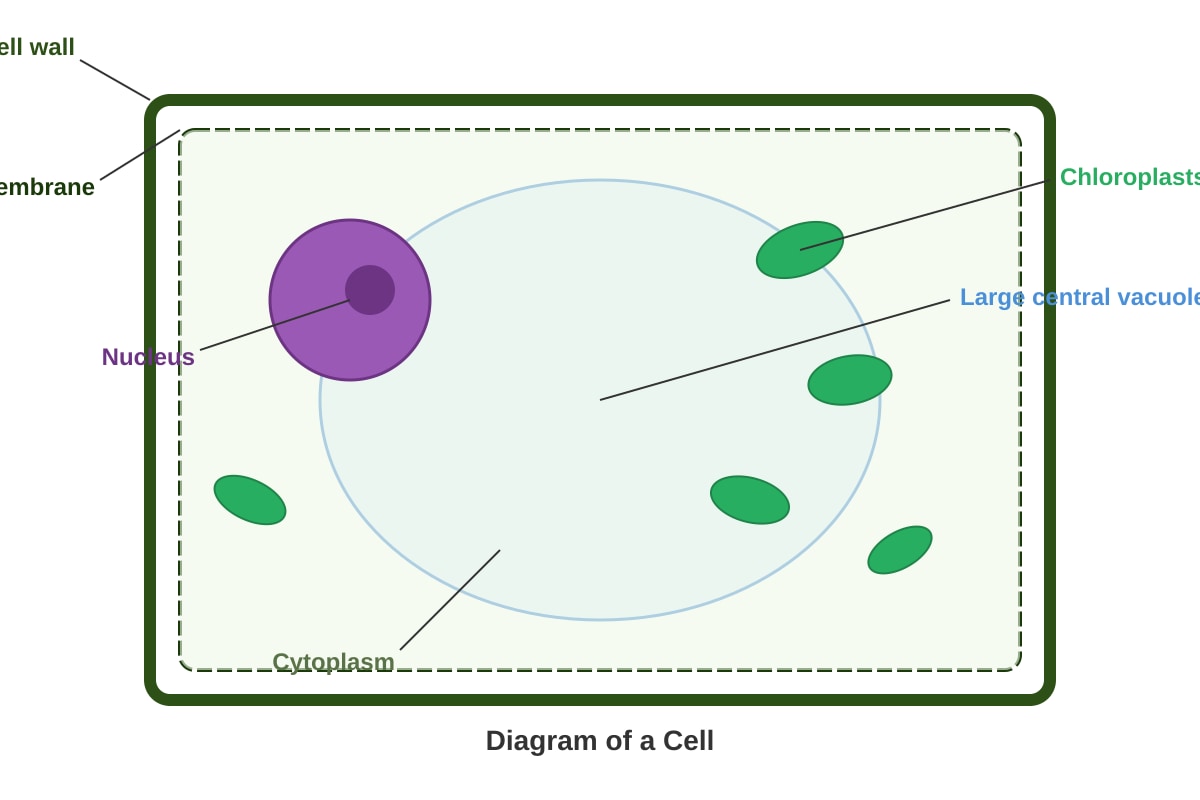
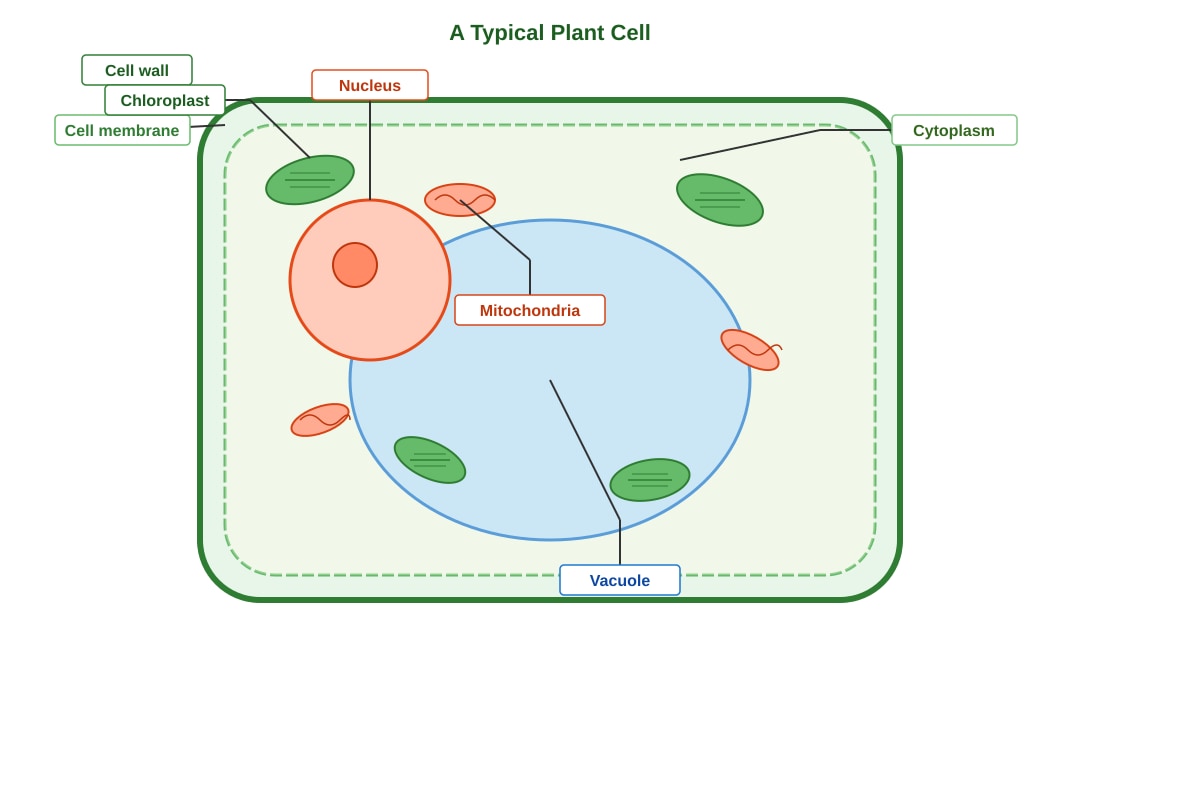
1. The diagram below shows a cell.
<image_placeholder> id: Q1-fig1 type: diagram linked_question: Q1 description: A typical plant cell with cell wall, cell membrane, cytoplasm, nucleus, chloroplasts, and vacuole clearly shown. No labels on the diagram. labels: cell wall, cell membrane, cytoplasm, nucleus, chloroplasts, vacuole values: None must_show: All six organelles listed in labels must be visible and structurally distinct. Cell wall as outer rigid layer, cell membrane inside it, large central vacuole, nucleus with nuclear membrane, multiple chloroplasts in cytoplasm. </image_placeholder>
Which of the following statements about the cell is correct?
(1) It is an animal cell because it has a nucleus.
(2) It is a plant cell because it has a cell wall and chloroplasts.
(3) It is a bacterial cell because it has a cell membrane.
(4) It is a fungal cell because it has a vacuole.
2. Which of the following processes occurs in the chloroplasts of a plant cell?
(1) Respiration
(2) Photosynthesis
(3) Digestion
(4) Reproduction
3. The diagram below shows a food chain in a garden ecosystem.
<image_placeholder> id: Q3-fig1 type: diagram linked_question: Q3 description: A simple linear food chain with four organisms: Grass → Grasshopper → Frog → Snake. Arrows point from prey to predator. labels: Grass (Producer), Grasshopper (Primary Consumer), Frog (Secondary Consumer), Snake (Tertiary Consumer) values: None must_show: Four organisms in correct trophic order with arrows showing energy flow direction (prey to predator). Labels as specified. </image_placeholder>
If a disease kills most of the grasshoppers, what will most likely happen to the populations of frogs and snakes?
| Frogs | Snakes | |
|---|---|---|
| (1) | Increase | Increase |
| (2) | Increase | Decrease |
| (3) | Decrease | Increase |
| (4) | Decrease | Decrease |
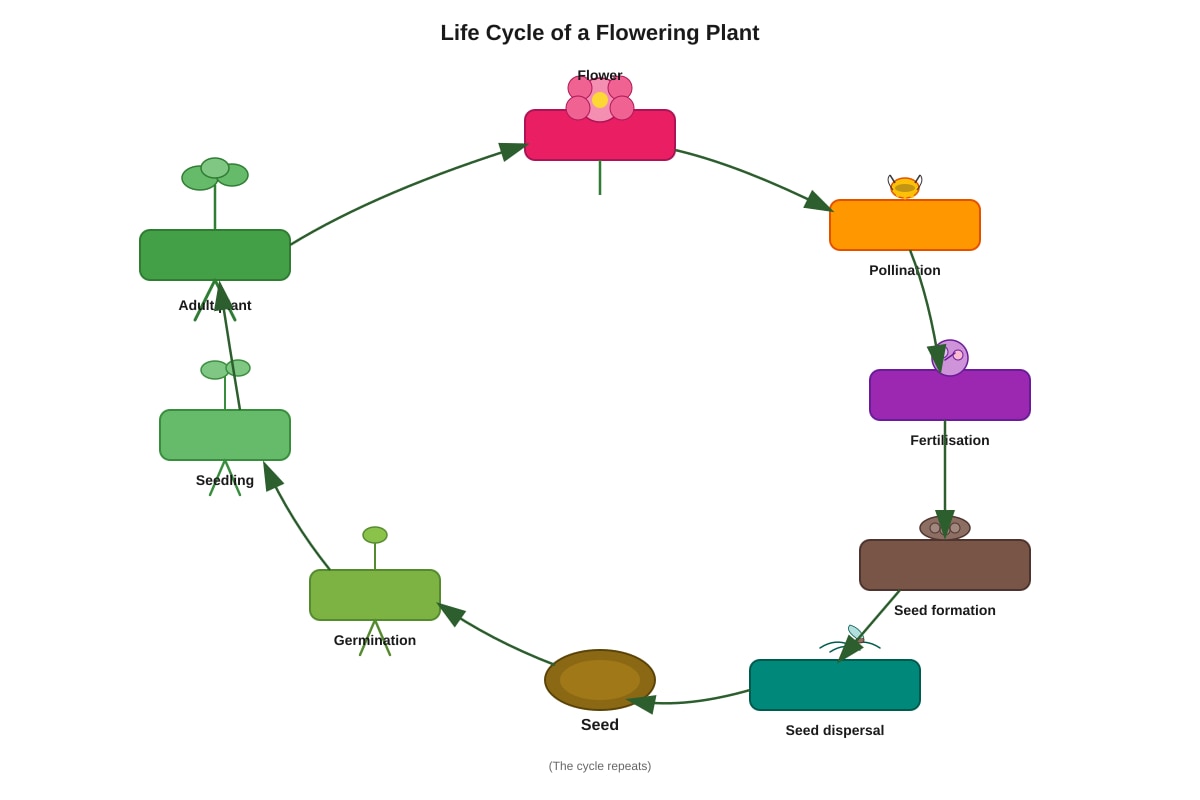
4. Which of the following shows the correct order of stages in the life cycle of a flowering plant?
(1) Seed → Seedling → Adult plant → Flower → Fruit → Seed
(2) Seed → Flower → Seedling → Adult plant → Fruit → Seed
(3) Seed → Adult plant → Seedling → Flower → Fruit → Seed
(4) Seed → Seedling → Flower → Adult plant → Fruit → Seed
5. The diagram below shows the human digestive system.
<image_placeholder> id: Q5-fig1 type: diagram linked_question: Q5 description: Human digestive system showing mouth, oesophagus, stomach, small intestine, large intestine, liver, pancreas. No labels. labels: Mouth, Oesophagus, Stomach, Small intestine, Large intestine, Liver, Pancreas values: None must_show: All seven organs in correct anatomical position and relative size. Small intestine coiled, large intestine framing it. Liver above stomach, pancreas below stomach. </image_placeholder>
In which organ does most absorption of digested food take place?
(1) Stomach
(2) Small intestine
(3) Large intestine
(4) Oesophagus
6. Substance X has a definite volume but no definite shape. It takes the shape of its container. Which state of matter is Substance X in?
(1) Solid
(2) Liquid
(3) Gas
(4) Plasma
7. The table below shows the melting and boiling points of four substances.
| Substance | Melting Point (°C) | Boiling Point (°C) |
|---|---|---|
| A | -114 | 78 |
| B | 0 | 100 |
| C | 1538 | 2862 |
| D | -78 | -57 (sublimes) |
At room temperature (25°C), which substance(s) exist as a liquid?
(1) A only
(2) B only
(3) A and B
(4) C and D
8. When water boils, it changes from liquid to gas. What happens to the water molecules during boiling?
(1) The molecules break apart into atoms.
(2) The molecules move further apart and move more freely.
(3) The molecules stop moving completely.
(4) The molecules become larger in size.
9. A metal spoon feels colder than a wooden spoon at room temperature because metal is a __________.
(1) poor conductor of heat
(2) good conductor of heat
(3) poor insulator of heat
(4) good insulator of heat
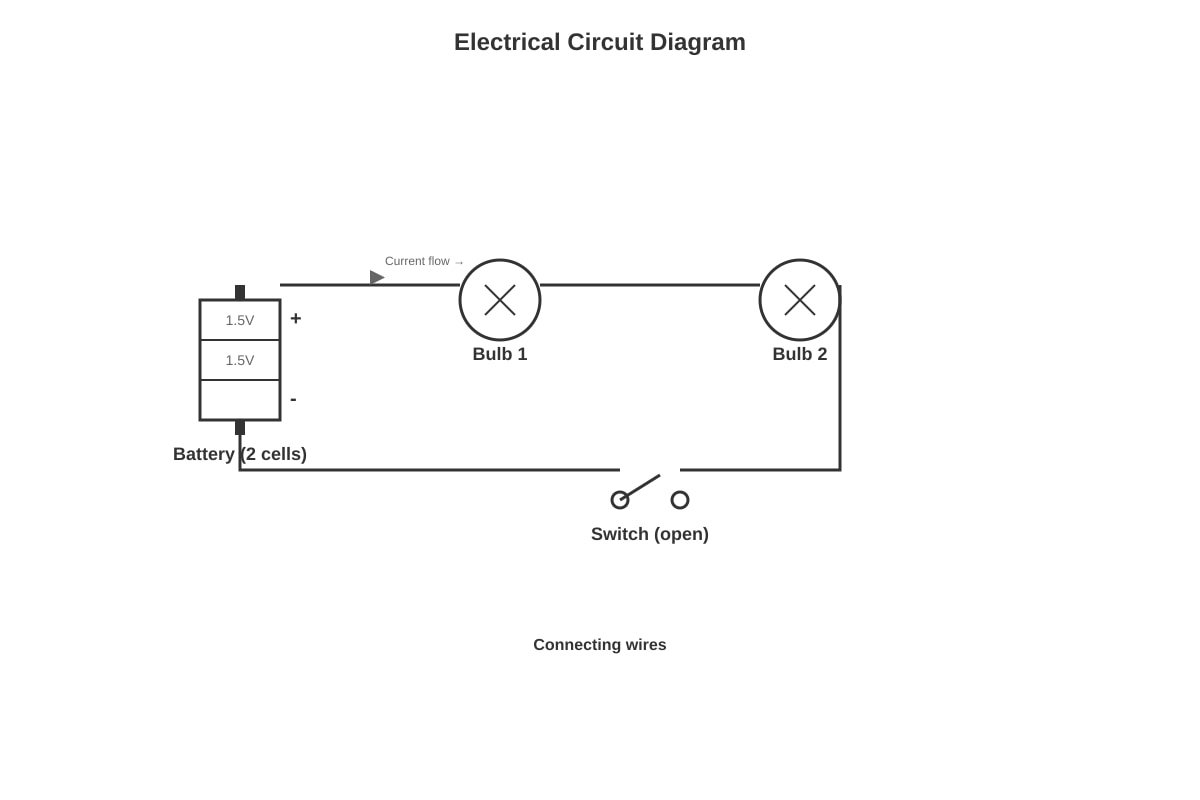
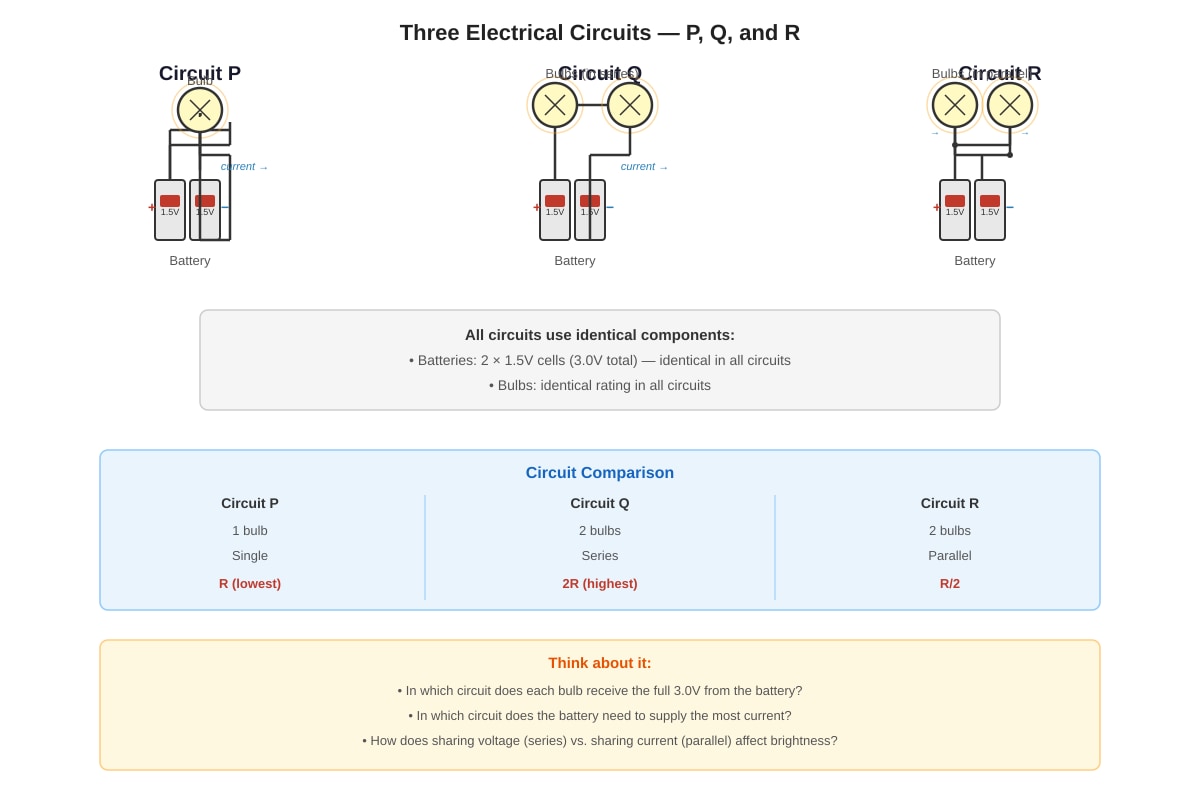
10. The diagram below shows a simple electrical circuit.
<image_placeholder> id: Q10-fig1 type: diagram linked_question: Q10 description: A series circuit with a battery (two cells), a switch (open), and one bulb. Wires connect all components in a single loop. labels: Battery (2 cells), Switch (open), Bulb, Connecting wires values: Battery: 1.5 V per cell; Bulb rating: 2.5 V must_show: Clear series loop. Battery symbol with two cells (long-short lines). Switch shown open (gap). Bulb symbol (circle with cross). Wires as straight lines connecting components. </image_placeholder>
When the switch is closed, the bulb does not light up. What could be the reason?
(1) The battery is connected the wrong way.
(2) The bulb has fused.
(3) The wires are made of plastic.
(4) The switch is made of metal.
11. Which of the following circuits will allow the bulb to light up?
(1) A circuit with a gap in the wire
(2) A circuit with a fused bulb
(3) A closed circuit with a working bulb and battery
(4) A circuit with the battery connected positive to positive
12. The diagram below shows a magnet brought near a steel paper clip.
<image_placeholder> id: Q12-fig1 type: diagram linked_question: Q12 description: A bar magnet with N and S poles labeled. A steel paper clip is placed 2 cm away from the N pole. No contact yet. labels: N pole, S pole, Steel paper clip, Distance: 2 cm values: Distance = 2 cm must_show: Bar magnet horizontal with N on right, S on left. Paper clip to the right of N pole. Arrow showing magnetic field direction from N to S (optional). Distance label. </image_placeholder>
The paper clip is attracted to the magnet. This shows that the paper clip is made of a __________ material.
(1) magnetic
(2) non-magnetic
(3) electrical
(4) non-electrical
13. Which of the following actions will increase the strength of an electromagnet?
(1) Using fewer turns of wire around the iron core
(2) Using a smaller battery
(3) Adding more turns of wire around the iron core
(4) Removing the iron core
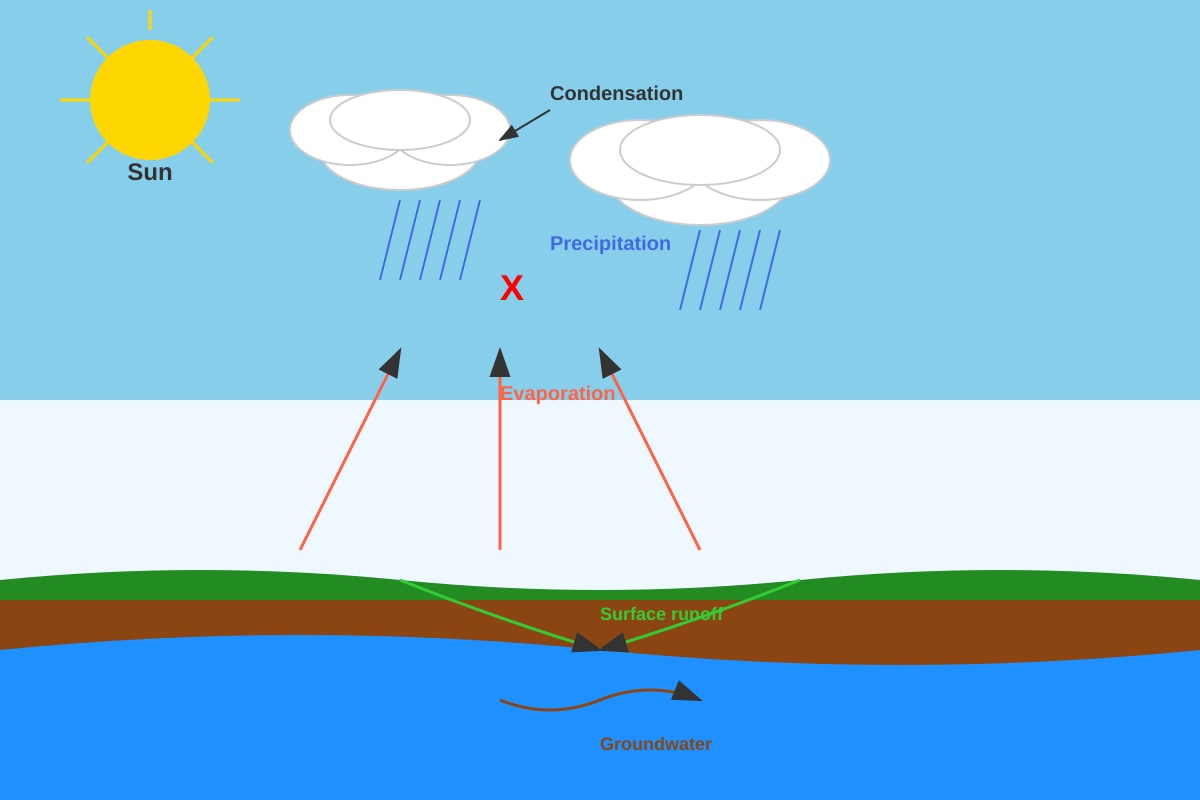
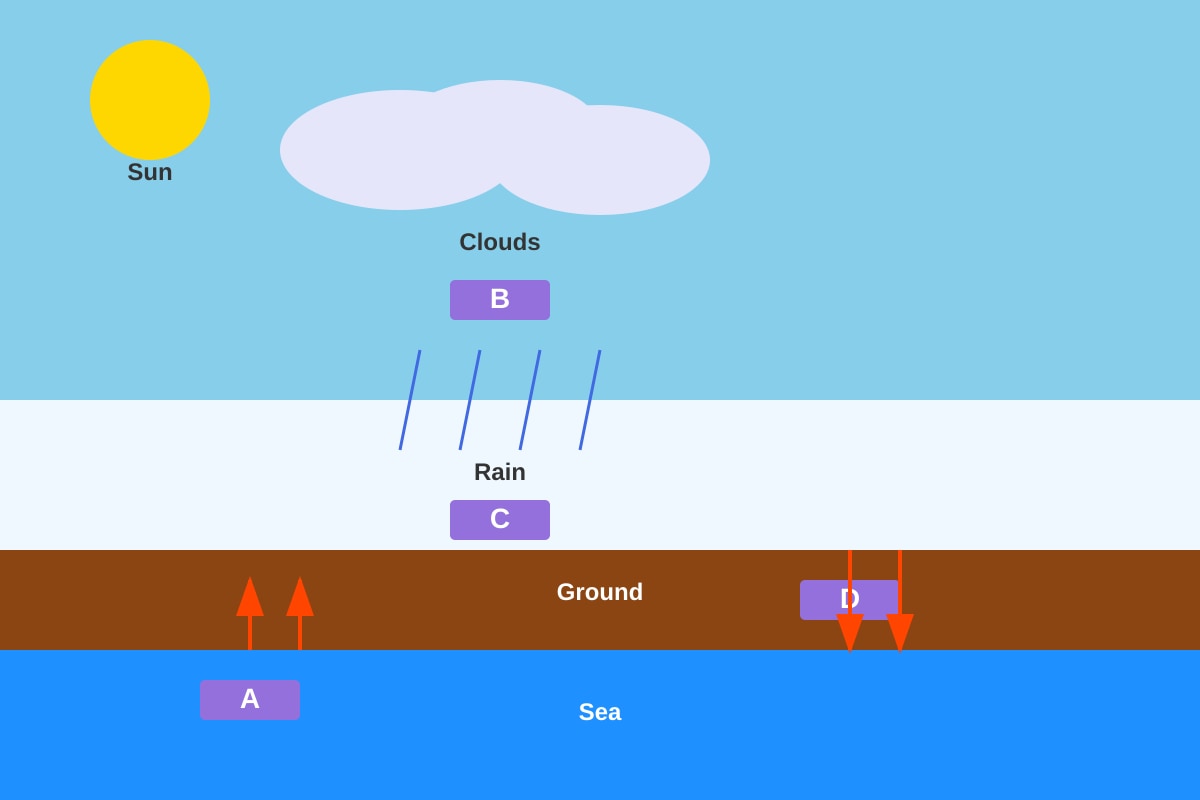
14. The diagram below shows the water cycle.
<image_placeholder> id: Q14-fig1 type: diagram linked_question: Q14 description: Water cycle diagram showing evaporation from sea, condensation forming clouds, precipitation as rain, collection in rivers/sea. Sun shown. Arrows for each process. labels: Evaporation, Condensation, Precipitation, Collection, Sun, Clouds, Sea, River values: None must_show: Complete cycle with all four processes labeled. Sun driving evaporation. Arrows showing water movement. Clouds, rain, river flowing to sea. </image_placeholder>
Which process is represented by the arrow labeled "X" pointing from the sea upwards to the clouds?
(1) Condensation
(2) Evaporation
(3) Precipitation
(4) Collection
15. Which of the following factors will increase the rate of evaporation of water?
(1) Decreasing the temperature
(2) Decreasing the exposed surface area
(3) Increasing the wind speed
(4) Increasing the humidity
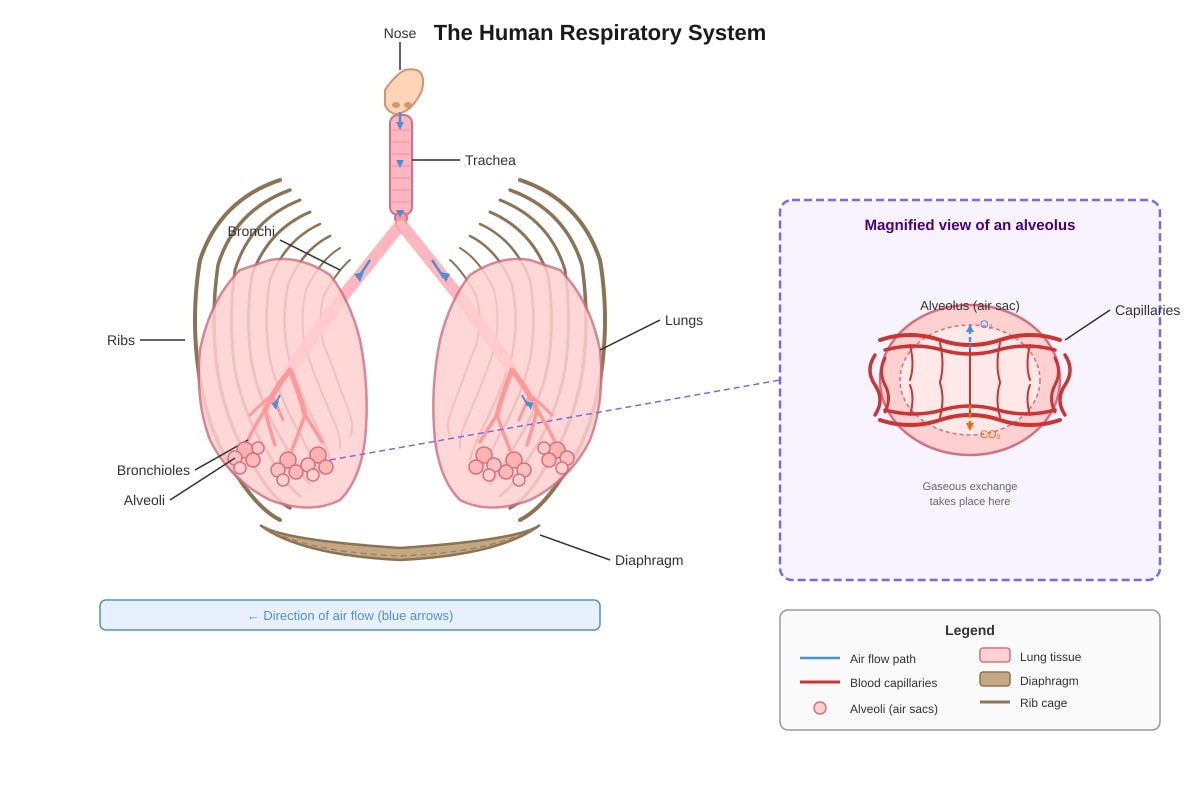
16. The diagram below shows the human respiratory system.
<image_placeholder> id: Q16-fig1 type: diagram linked_question: Q16 description: Human respiratory system showing nose, trachea, bronchi, lungs, bronchioles, alveoli, diaphragm. No labels. labels: Nose, Trachea, Bronchi, Lungs, Bronchioles, Alveoli, Diaphragm values: None must_show: All structures in correct anatomical position. Trachea splitting into two bronchi. Bronchioles branching inside lungs. Alveoli as tiny sacs at ends. Diaphragm as dome-shaped muscle below lungs. </image_placeholder>
Where does gaseous exchange take place?
(1) Trachea
(2) Bronchi
(3) Alveoli
(4) Nose
17. The table below shows the composition of inhaled and exhaled air.
| Gas | Inhaled Air (%) | Exhaled Air (%) |
|---|---|---|
| Oxygen | 21 | 16 |
| Carbon Dioxide | 0.04 | 4 |
| Nitrogen | 78 | 78 |
Which of the following statements is correct?
(1) The body uses up all the oxygen inhaled.
(2) The body produces carbon dioxide during respiration.
(3) Nitrogen is used up during respiration.
(4) The percentage of nitrogen increases in exhaled air.
18. In the human circulatory system, which blood vessel carries oxygen-rich blood from the heart to the rest of the body?
(1) Pulmonary artery
(2) Pulmonary vein
(3) Aorta
(4) Vena cava
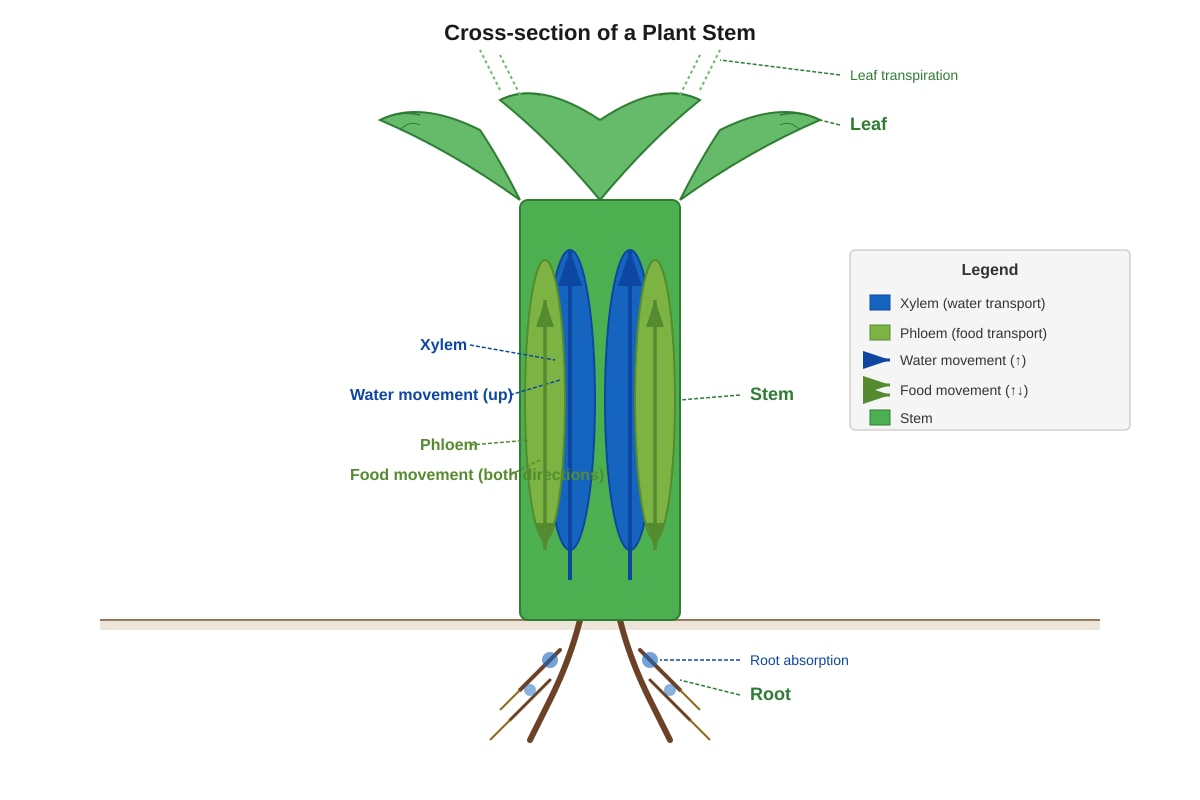
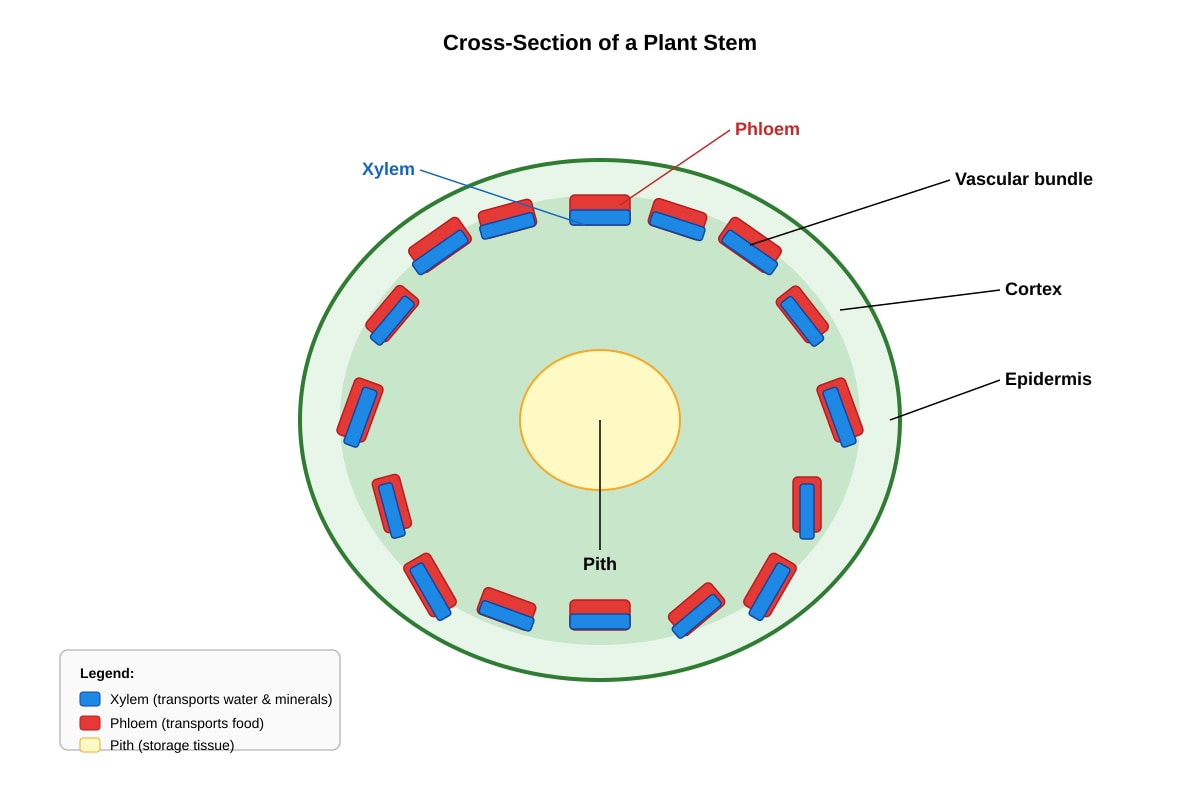
19. The diagram below shows a cross-section of a plant stem.
<image_placeholder> id: Q19-fig1 type: diagram linked_question: Q19 description: Cross-section of a dicot stem showing vascular bundles in a ring. Each bundle has xylem (inner) and phloem (outer). Epidermis, cortex, pith labeled. labels: Epidermis, Cortex, Vascular bundle, Xylem, Phloem, Pith values: None must_show: Circular arrangement of vascular bundles. Xylem on inner side, phloem on outer side of each bundle. Distinct epidermis, cortex, pith regions. </image_placeholder>
Which tissue transports water from the roots to the leaves?
(1) Phloem
(2) Xylem
(3) Cortex
(4) Epidermis
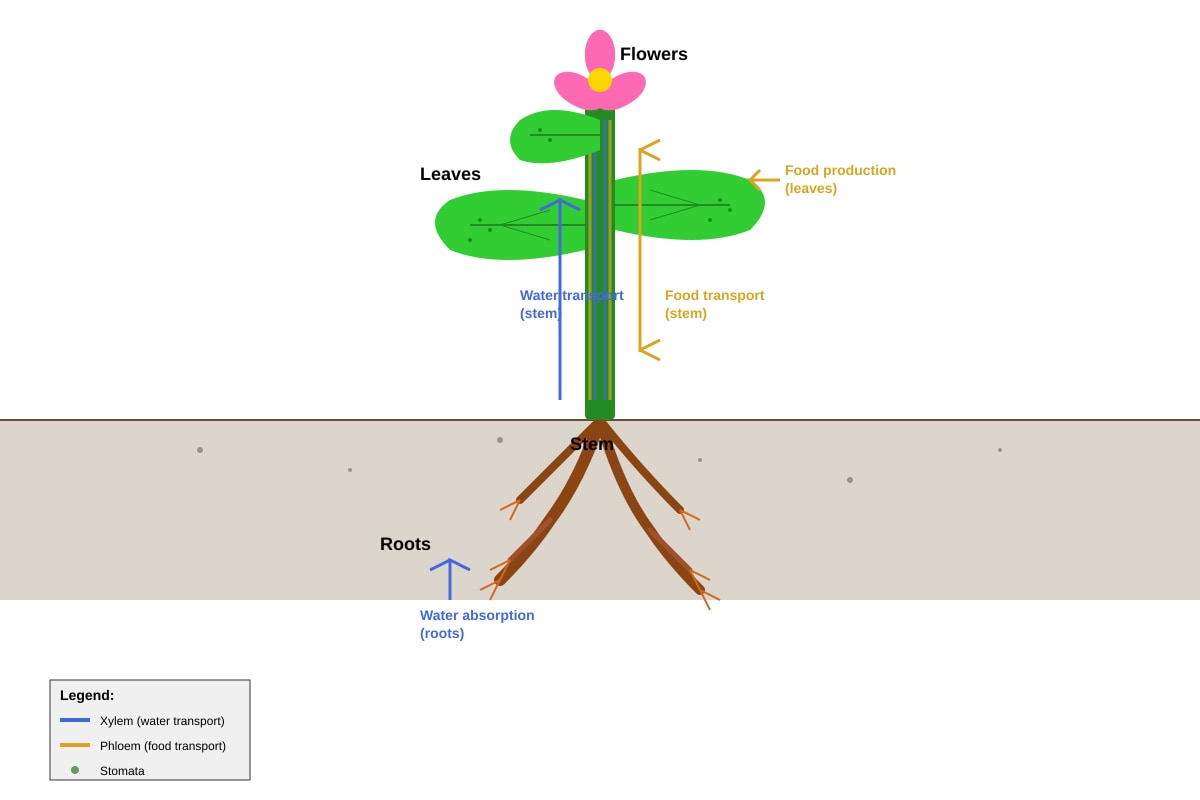
20. Which of the following shows the correct path of water movement in a plant?
(1) Roots → Stem → Leaves → Flowers
(2) Leaves → Stem → Roots → Flowers
(3) Flowers → Leaves → Stem → Roots
(4) Stem → Roots → Leaves → Flowers
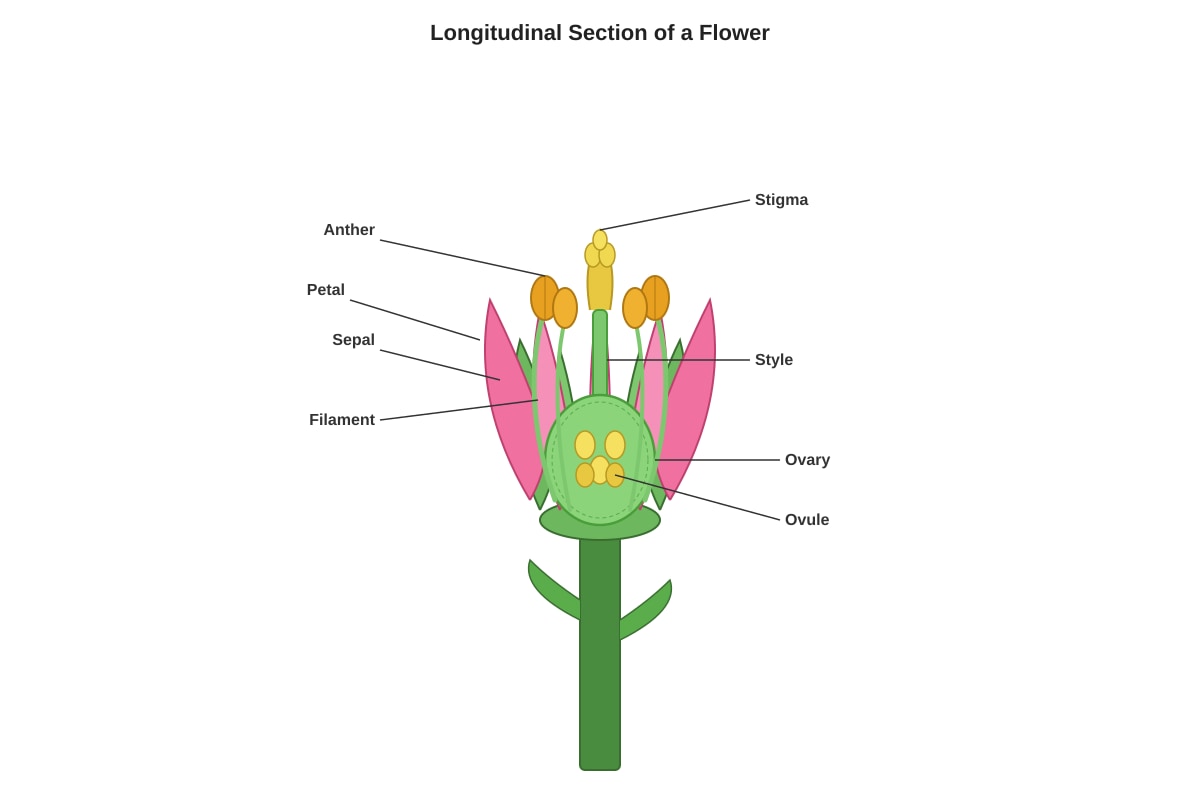
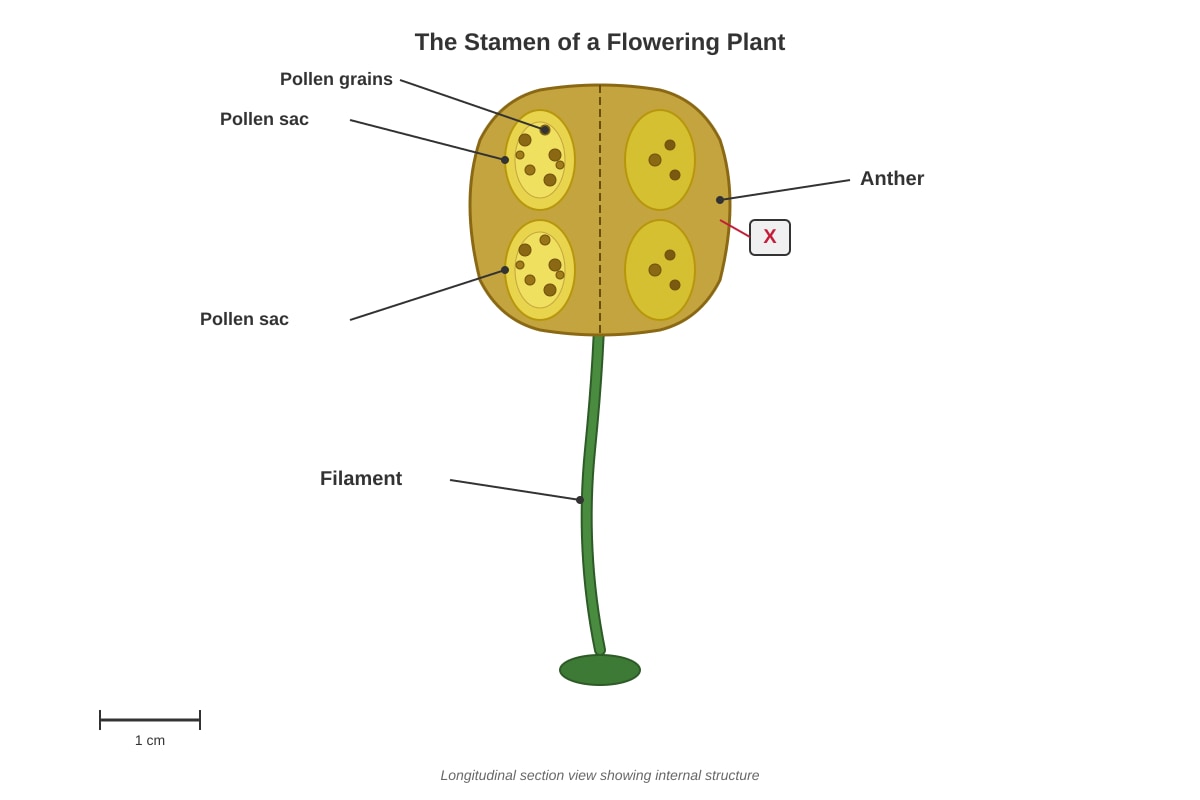
21. The diagram below shows the reproductive parts of a flower.
<image_placeholder> id: Q21-fig1 type: diagram linked_question: Q21 description: Longitudinal section of a flower showing sepal, petal, stamen (anther, filament), pistil (stigma, style, ovary, ovule). All parts labeled. labels: Sepal, Petal, Anther, Filament, Stigma, Style, Ovary, Ovule values: None must_show: Complete flower structure. Stamen and pistil clearly distinct. Ovule inside ovary. Pollen grains on anther (small dots). </image_placeholder>
Where are the male reproductive cells (pollen grains) produced?
(1) Stigma
(2) Ovary
(3) Anther
(4) Style
22. After fertilisation in a flowering plant, the ovule develops into the __________ and the ovary develops into the __________.
(1) seed; fruit
(2) fruit; seed
(3) seedling; flower
(4) flower; seedling
23. Which of the following is not a method of seed dispersal?
(1) Wind
(2) Water
(3) Animal
(4) Photosynthesis
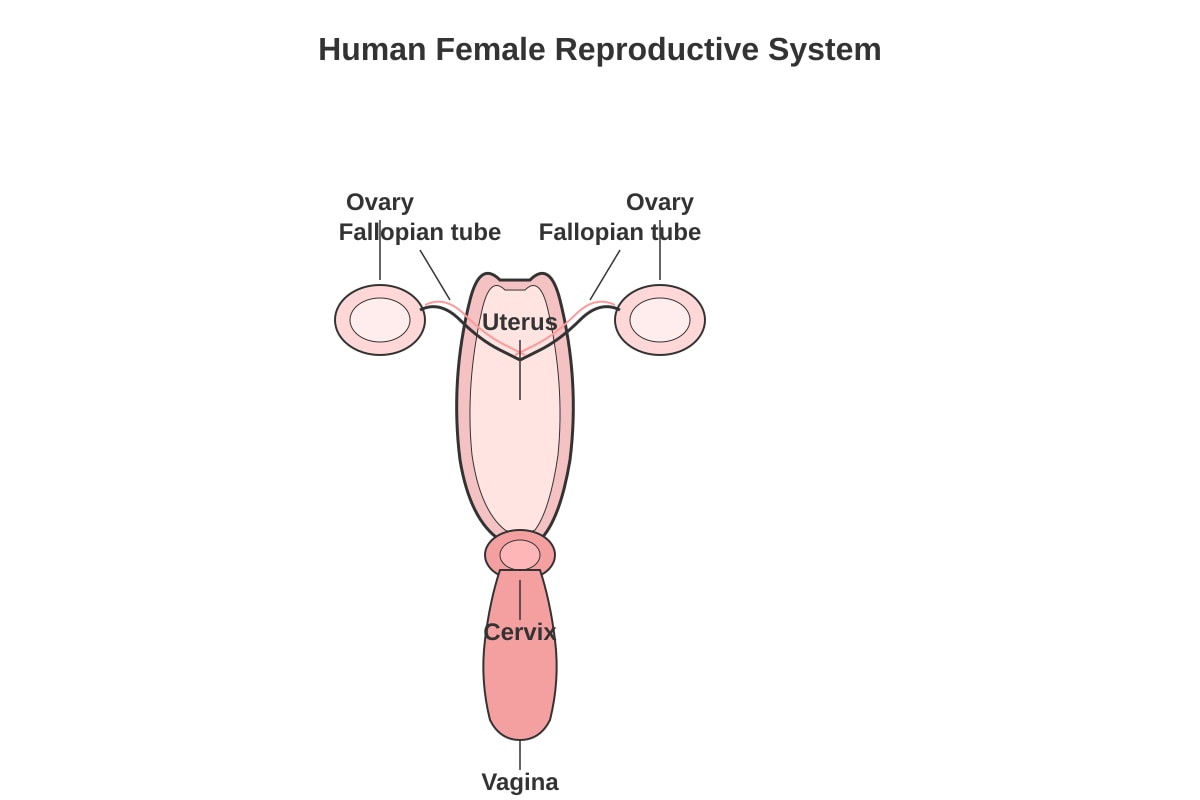
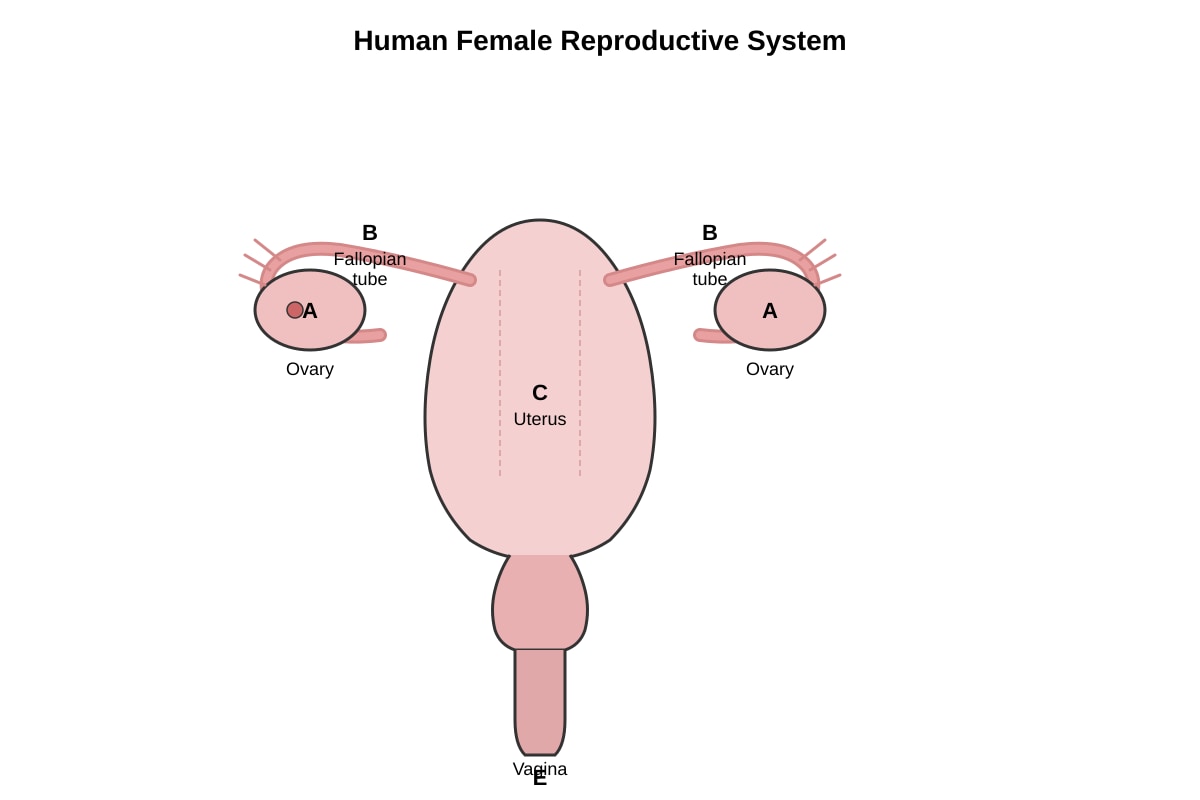
24. The diagram below shows the human reproductive system (female).
<image_placeholder> id: Q24-fig1 type: diagram linked_question: Q24 description: Female reproductive system showing ovaries, fallopian tubes, uterus, cervix, vagina. No labels. labels: Ovary, Fallopian tube, Uterus, Cervix, Vagina values: None must_show: Pair of ovaries connected to fallopian tubes. Fallopian tubes open into uterus. Uterus leads to cervix then vagina. Relative sizes accurate. </image_placeholder>
Where does fertilisation usually take place?
(1) Ovary
(2) Fallopian tube
(3) Uterus
(4) Vagina
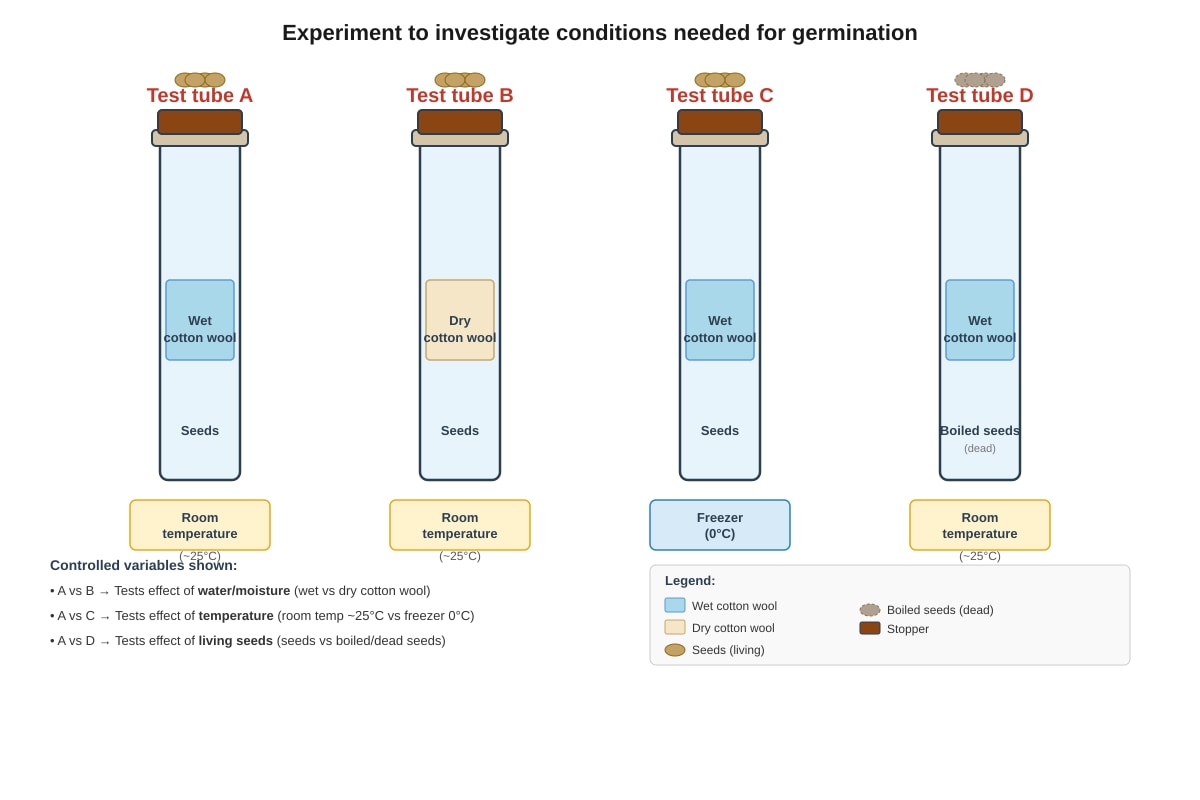
25. A student sets up an experiment to investigate the conditions needed for seed germination. The table below shows the conditions in four set-ups.
| Set-up | Water | Air (Oxygen) | Temperature |
|---|---|---|---|
| A | Yes | Yes | Suitable (25°C) |
| B | No | Yes | Suitable (25°C) |
| C | Yes | No | Suitable (25°C) |
| D | Yes | Yes | Unsuitable (5°C) |
In which set-up(s) will the seeds germinate?
(1) A only
(2) A and B
(3) A, B, and C
(4) All four set-ups
26. Which of the following is a structural adaptation of a cactus plant to survive in the desert?
(1) It opens its stomata at night.
(2) It has a deep root system.
(3) It stores water in its stem.
(4) It grows quickly after rain.
27. The diagram below shows a food web.
<image_placeholder> id: Q27-fig1 type: diagram linked_question: Q27 description: Food web with: Grass, Algae (producers); Grasshopper, Rabbit, Small fish (primary consumers); Frog, Snake, Big fish (secondary consumers); Hawk (tertiary consumer). Arrows from prey to predator. Multiple connections. labels: All organisms as listed. Arrows showing energy flow. values: None must_show: At least 8 organisms. Multiple interconnected food chains. Clear producer → primary → secondary → tertiary levels. Arrows point from eaten to eater. </image_placeholder>
How many food chains in the food web include the hawk as the top predator?
(1) 2
(2) 3
(3) 4
(4) 5
28. A student wants to investigate how the number of batteries affects the brightness of a bulb in a series circuit. Which variable should be changed (independent variable) and which should be measured (dependent variable)?
| Independent Variable | Dependent Variable | |
|---|---|---|
| (1) | Number of batteries | Brightness of bulb |
| (2) | Brightness of bulb | Number of batteries |
| (3) | Type of bulb | Number of batteries |
| (4) | Length of wire | Brightness of bulb |
SECTION B: Open-Ended Questions (44 marks)
Questions 29 to 40 carry the marks indicated.
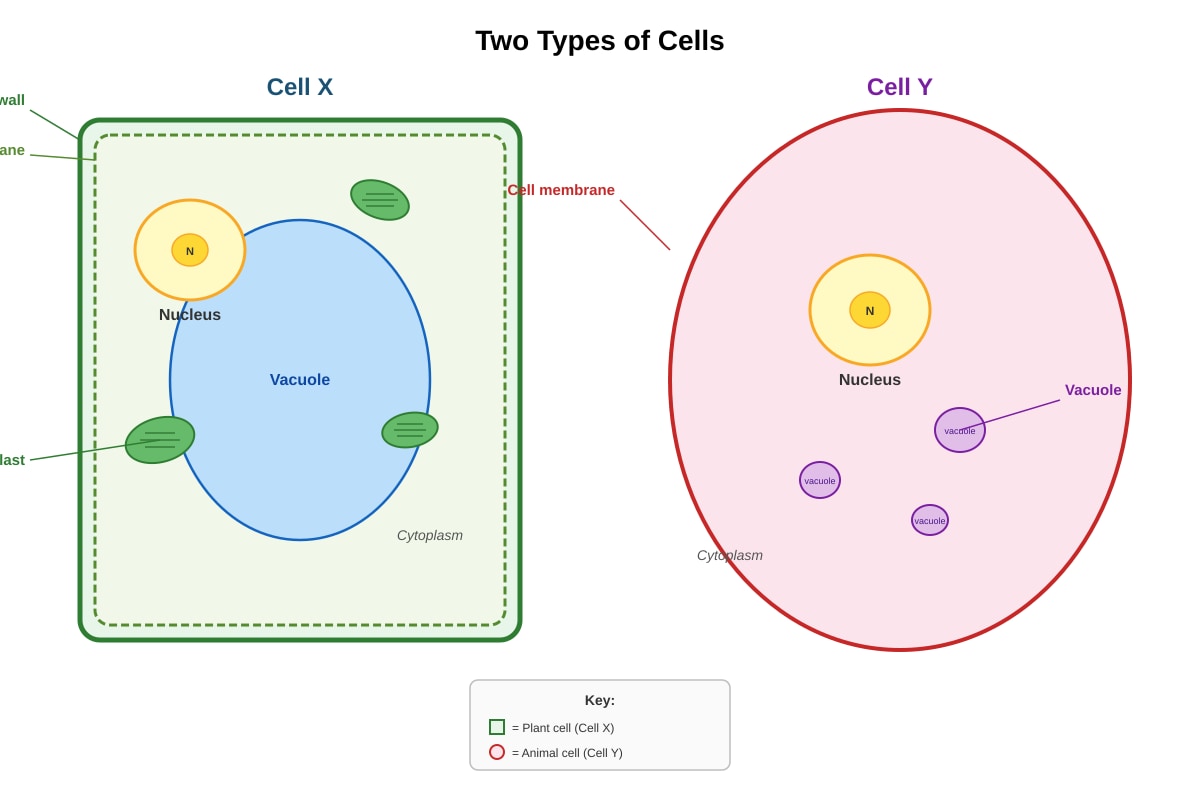
29. The diagram below shows two cells, Cell X and Cell Y.
<image_placeholder> id: Q29-fig1 type: diagram linked_question: Q29 description: Two cells side by side. Cell X: Plant cell with cell wall, chloroplasts, large vacuole. Cell Y: Animal cell with no cell wall, no chloroplasts, small vacuoles. Both have nucleus, cell membrane, cytoplasm. labels: Cell X (Plant cell), Cell Y (Animal cell). Organelles as per description. values: None must_show: Clear visual distinction. Cell X rectangular with thick outer wall, green chloroplasts, large central vacuole. Cell Y irregular/round, no cell wall, no chloroplasts, multiple small vacuoles. Both have nucleus and cell membrane. </image_placeholder>
(a) Identify Cell X and Cell Y. [1]
(b) State one function of the nucleus. [1]
(c) Name the part that controls the movement of substances in and out of the cell. [1]
(d) Explain why Cell X has chloroplasts but Cell Y does not. [2]
30. The diagram below shows a food chain in a pond ecosystem.
<image_placeholder> id: Q30-fig1 type: diagram linked_question: Q30 description: Food chain: Algae → Water flea → Small fish → Large fish → Kingfisher. Arrows from prey to predator. labels: Algae (Producer), Water flea (Primary consumer), Small fish (Secondary consumer), Large fish (Tertiary consumer), Kingfisher (Quaternary consumer) values: None must_show: Five organisms in linear chain. Arrows pointing from eaten to eater. Trophic level labels. </image_placeholder>
(a) Name the producer in this food chain. [1]
(b) If the population of water fleas decreases, what will happen to the population of small fish? Explain your answer. [2]
(c) The kingfisher is a top predator. State one reason why there are fewer top predators than producers in an ecosystem. [1]
(d) Energy is transferred from one organism to another in a food chain. State the original source of energy for this food chain. [1]
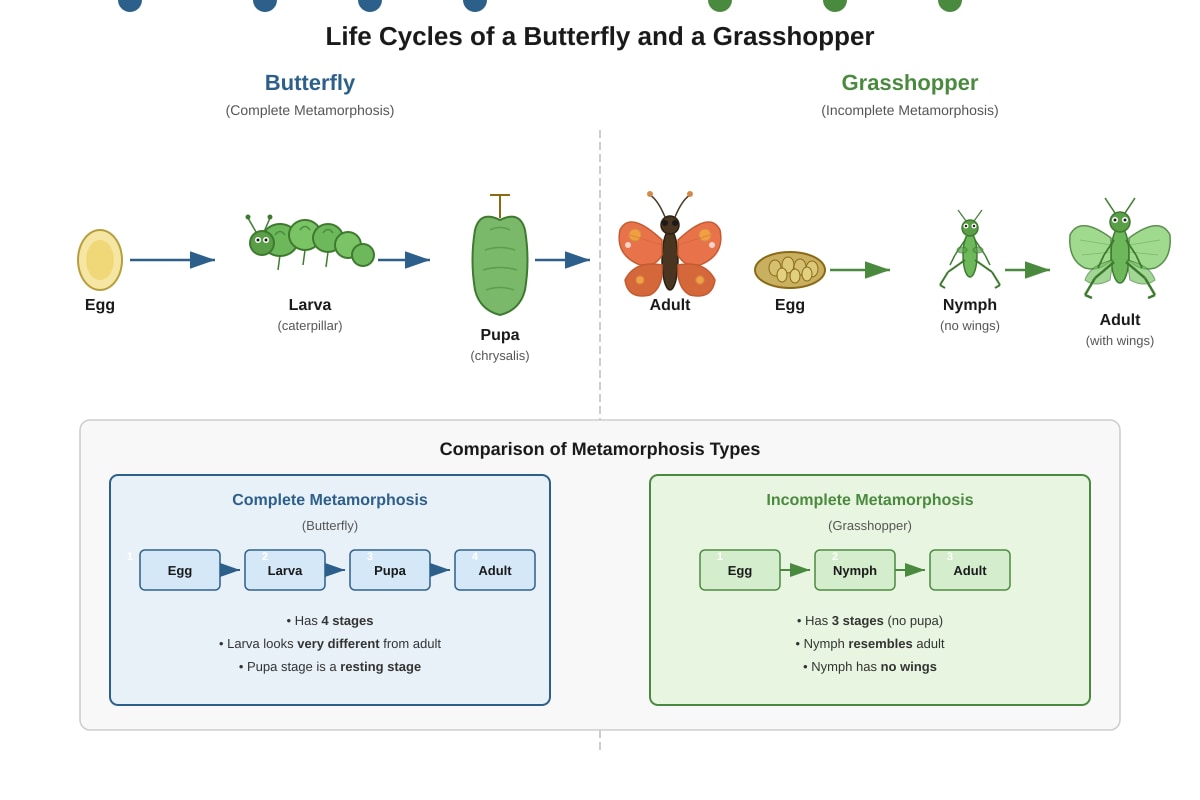
31. The diagram below shows the life cycle of a mosquito.
<image_placeholder> id: Q31-fig1 type: diagram linked_question: Q31 description: Four stages of mosquito life cycle: Egg → Larva → Pupa → Adult. Arrows showing cycle. Eggs on water surface. Larva and pupa in water. Adult flying. labels: Egg, Larva, Pupa, Adult values: None must_show: Four distinct stages. Eggs as raft on water. Larva (wriggler) and pupa (tumbler) in water. Adult mosquito with wings. Cyclic arrows. </image_placeholder>
(a) Name the stage that comes after the larva stage. [1]
(b) State one difference between the larva and the adult mosquito. [1]
(c) The mosquito lays its eggs in stagnant water. Explain why removing stagnant water helps to control the mosquito population. [2]
(d) Mosquitoes undergo complete metamorphosis. Name one other insect that undergoes complete metamorphosis. [1]
32. Substance P is a solid at room temperature. When heated, it melts at 80°C and boils at 250°C.
(a) What is the state of Substance P at 100°C? [1]
(b) Describe the arrangement and movement of particles in Substance P at 300°C. [2]
(c) When Substance P cools from 300°C to 50°C, it undergoes two changes of state. Name these two changes of state. [2]
33. The diagram below shows an experiment set-up to investigate heat conduction in four rods of different materials (copper, aluminium, iron, glass). Each rod has a thumbtack attached with wax at the same distance from the heat source.
<image_placeholder> id: Q33-fig1 type: experimental_setup linked_question: Q33 description: Four identical rods (copper, aluminium, iron, glass) placed side by side. One end of each rod over a Bunsen burner flame. A thumbtack attached with wax at 5 cm from heated end on each rod. Stopwatch shown. labels: Copper rod, Aluminium rod, Iron rod, Glass rod, Bunsen burner, Thumbtack, Wax, Distance: 5 cm values: Distance from heat source to thumbtack = 5 cm for all rods. Same wax, same thumbtack mass. must_show: Four parallel rods. Heat source under one end. Thumbtacks at same position on each rod. Clear labels for each material. </image_placeholder>
(a) What is the aim of this experiment? [1]
(b) State two variables that must be kept the same to ensure a fair test. [2]
(c) The thumbtack on the copper rod falls off first. What conclusion can be drawn about copper? [1]
(d) Arrange the four materials in order of thermal conductivity, starting from the best conductor. [1]
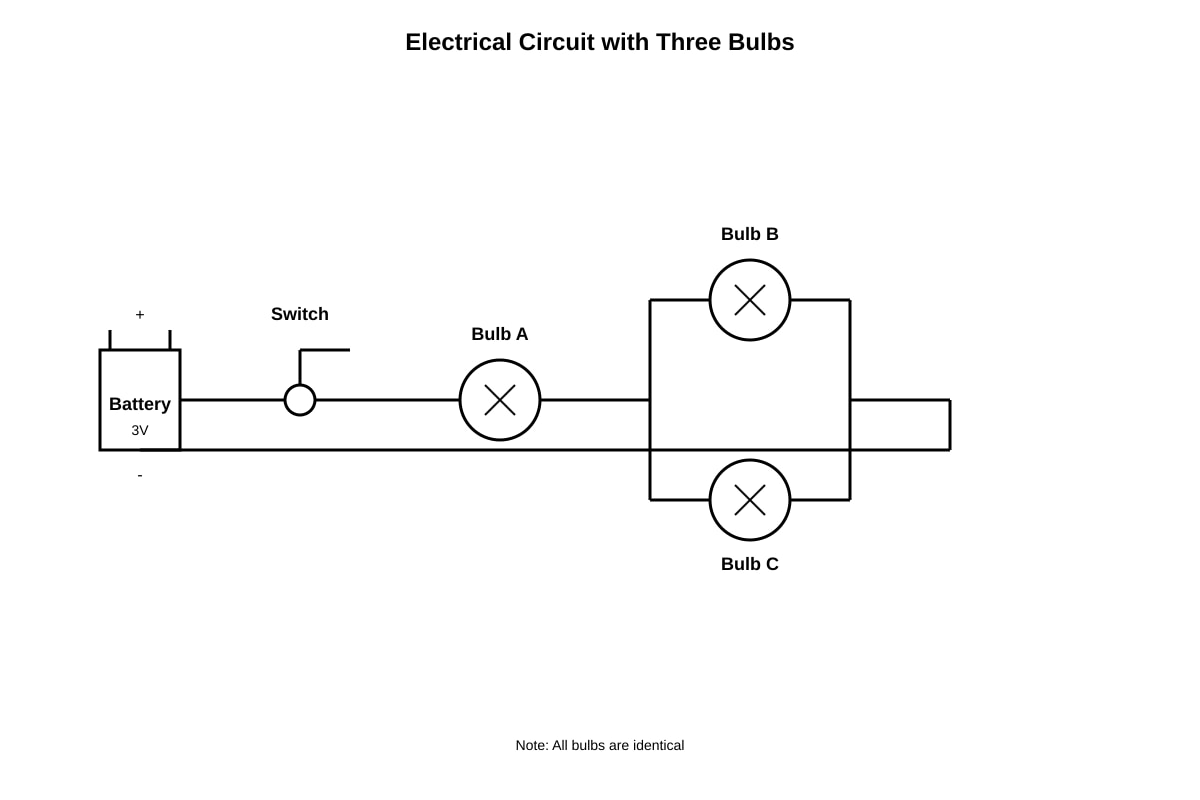
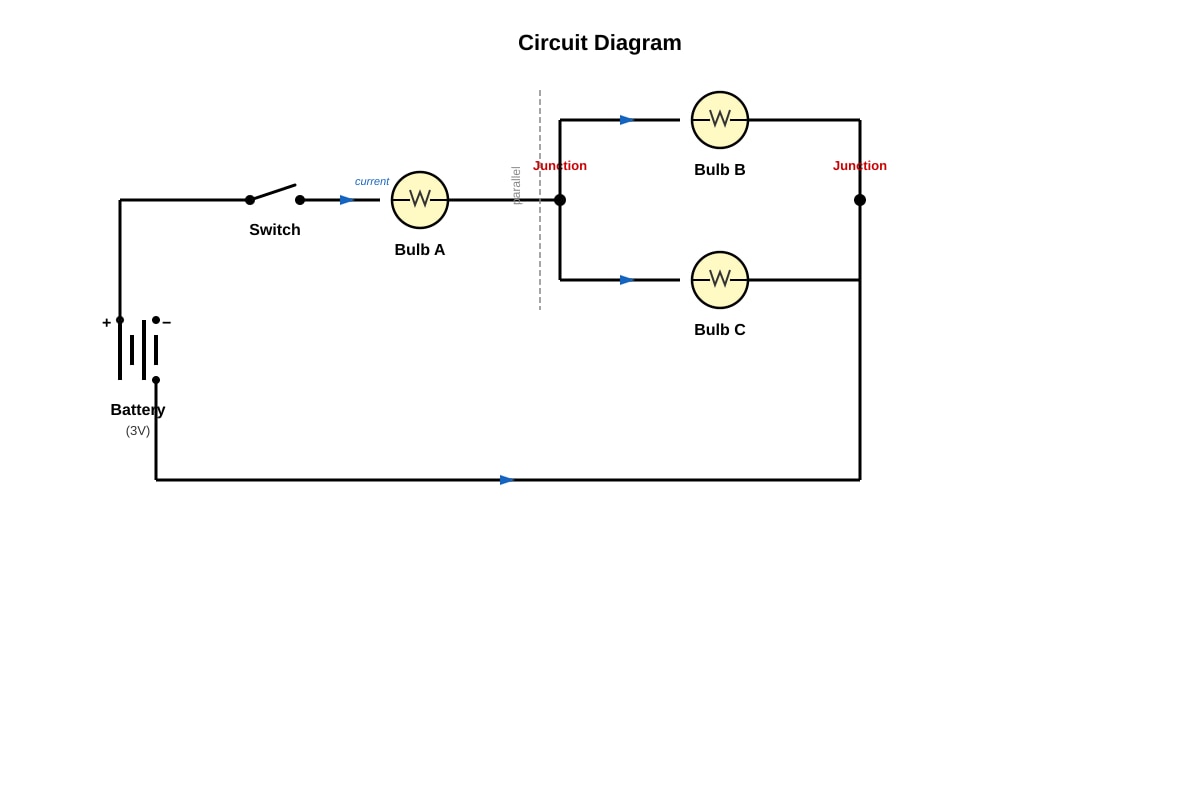
34. The diagram below shows a circuit with two bulbs, B1 and B2, connected in parallel.
<image_placeholder> id: Q34-fig1 type: diagram linked_question: Q34 description: Parallel circuit with one battery (2 cells), two bulbs (B1, B2) on separate branches, switch on main wire before split. All components labeled. labels: Battery (2 cells), Switch, Bulb B1, Bulb B2, Connecting wires values: Battery: 3 V total. Bulbs identical, rated 2.5 V. must_show: Clear parallel arrangement. Battery on main line. Switch on main line. Two branches each with one bulb. Wires connecting properly. </image_placeholder>
(a) State one advantage of connecting bulbs in parallel compared to in series. [1]
(b) If bulb B1 fuses, what will happen to bulb B2? Explain your answer. [2]
(c) The switch is closed. Both bulbs light up. If another identical bulb is added in parallel, what will happen to the brightness of B1 and B2? [1]
35. The diagram below shows a bar magnet and a compass placed near it.
<image_placeholder> id: Q35-fig1 type: diagram linked_question: Q35 description: Bar magnet horizontal with N on left, S on right. Compass placed above the magnet, closer to N pole. Compass needle shown. labels: N pole, S pole, Compass, Compass needle (N-seeking end marked) values: Distance from magnet to compass = 3 cm must_show: Magnet with labeled poles. Compass above magnet. Needle orientation showing N-seeking end pointing away from magnet's N pole (repulsion). </image_placeholder>
(a) The compass needle is a small magnet. Label the poles of the compass needle in the diagram above. [1]
(b) Explain why the compass needle points in the direction shown. [2]
(c) The compass is moved to the other side of the magnet (near the S pole). Draw the direction the compass needle will point. [1]
36. The diagram below shows the water cycle.
<image_placeholder> id: Q36-fig1 type: diagram linked_question: Q36 description: Water cycle with sea, sun, evaporation, condensation (clouds), precipitation (rain), collection (river), groundwater. Process labels missing. labels: Sea, Sun, Clouds, Rain, River, Groundwater values: None must_show: Complete cycle. Sun heating sea. Evaporation arrows up. Clouds forming. Rain arrows down. River flowing to sea. Groundwater seepage. </image_placeholder>
(a) Name the process represented by the arrow from the sea to the clouds. [1]
(b) Name the process represented by the arrow from the clouds to the ground. [1]
(c) Explain how clouds are formed. [2]
(d) State one factor that increases the rate of evaporation from the sea. [1]
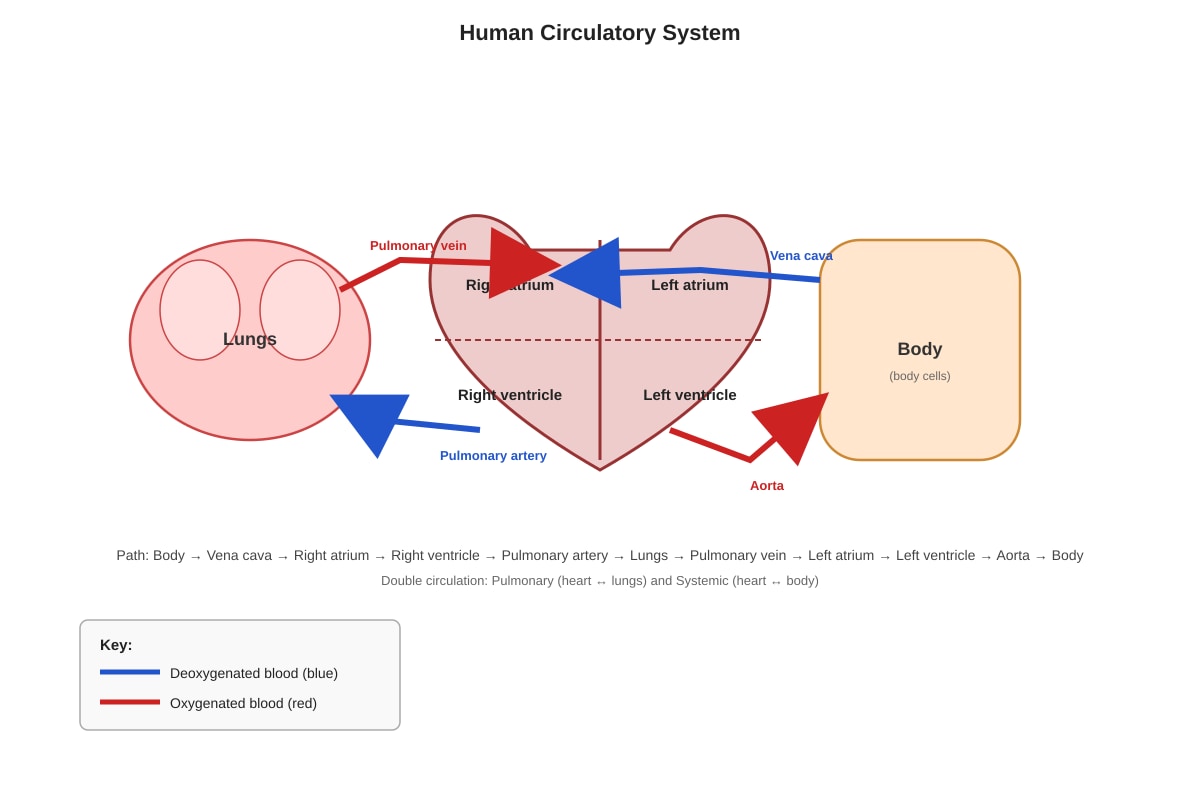
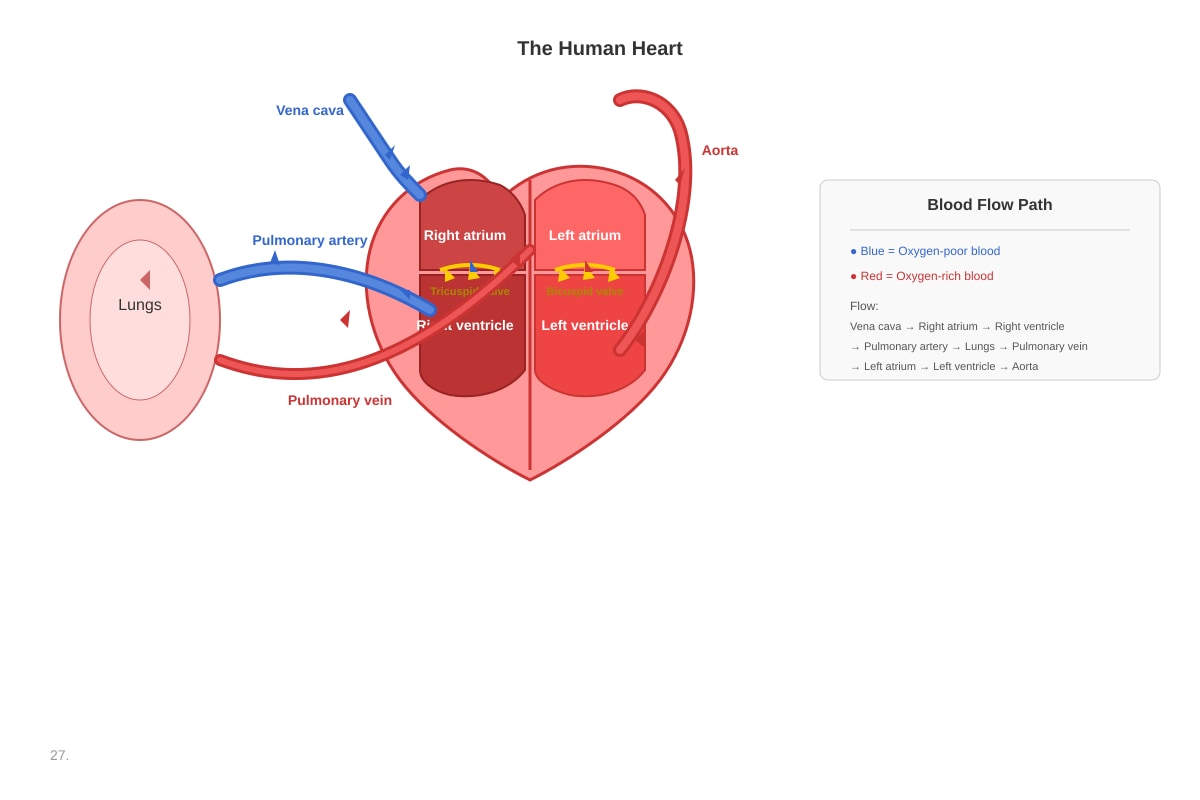
37. The diagram below shows the human circulatory system.
<image_placeholder> id: Q37-fig1 type: diagram linked_question: Q37 description: Simplified human circulatory system: Heart (4 chambers), lungs, body. Arrows showing blood flow. Red = oxygen-rich, Blue = oxygen-poor. labels: Right atrium, Right ventricle, Left atrium, Left ventricle, Lungs, Body, Aorta, Pulmonary artery, Pulmonary vein, Vena cava values: None must_show: Four-chambered heart. Double circulation path. Color-coded arrows (red/blue). Major vessels labeled. </image_placeholder>
(a) Name the blood vessel labeled X that carries oxygen-rich blood from the heart to the body. [1]
(b) Name the blood vessel labeled Y that carries oxygen-poor blood from the body to the heart. [1]
(c) Explain why the heart is described as a "double pump". [2]
(d) State one function of the valves in the heart. [1]
38. The diagram below shows a cross-section of a leaf.
<image_placeholder> id: Q38-fig1 type: diagram linked_question: Q38 description: Leaf cross-section: Upper epidermis, palisade mesophyll (tightly packed), spongy mesophyll (loose with air spaces), lower epidermis with stomata, guard cells. Vascular bundle (xylem, phloem). labels: Upper epidermis, Palisade mesophyll, Spongy mesophyll, Lower epidermis, Stoma, Guard cells, Xylem, Phloem values: None must_show: All layers distinct. Palisade cells columnar and packed. Spongy cells irregular with air spaces. Stoma open with two guard cells. Vascular bundle in center. </image_placeholder>
(a) Name the part labeled A where most photosynthesis takes place. [1]
(b) State the function of the stomata. [1]
(c) Explain why the palisade mesophyll cells are tightly packed and located near the upper surface of the leaf. [2]
(d) Name the substance transported by the phloem. [1]
39. The diagram below shows the reproductive parts of a flower.
<image_placeholder> id: Q39-fig1 type: diagram linked_question: Q39 description: Longitudinal section of flower: Stigma, style, ovary with ovules, anther with pollen grains, filament, petal, sepal. Pollen tube growing down style to ovule. labels: Stigma, Style, Ovary, Ovule, Anther, Filament, Petal, Sepal, Pollen tube values: None must_show: Pollen tube visible growing from stigma down style into ovary to ovule. Pollen grains on anther. All parts labeled. </image_placeholder>
(a) Name the process shown by the growth of the pollen tube down the style. [1]
(b) After the process in (a), the male reproductive cell fuses with the female reproductive cell. Name this process. [1]
(c) State one difference between self-pollination and cross-pollination. [1]
(d) After fertilisation, the ovary develops into the fruit. State one function of the fruit. [1]
40. A student conducts an experiment to find out how the amount of light affects the rate of photosynthesis in a water plant. The set-up is shown below.
<image_placeholder> id: Q40-fig1 type: experimental_setup linked_question: Q40 description: Water plant (hydrilla) in a beaker of water. Lamp at varying distances. Test tube inverted over plant to collect gas bubbles. Ruler measuring distance. Stopwatch. labels: Hydrilla plant, Beaker, Water, Lamp, Test tube, Gas bubbles, Ruler (distance), Stopwatch values: Lamp distances: 10 cm, 20 cm, 30 cm, 40 cm, 50 cm. Time: 5 minutes per trial. must_show: Plant in water under inverted test tube. Lamp at measurable distance. Bubbles visible in test tube. Ruler showing distance measurement. </image_placeholder>
The student counts the number of bubbles produced in 5 minutes at different distances of the lamp from the plant.
| Distance of lamp from plant (cm) | Number of bubbles in 5 minutes |
|---|---|
| 10 | 48 |
| 20 | 32 |
| 30 | 18 |
| 40 | 8 |
| 50 | 2 |
(a) What is the independent variable in this experiment? [1]
(b) What is the dependent variable? [1]
(c) State one variable that must be kept constant for a fair test. [1]
(d) Based on the results, describe the relationship between the distance of the lamp and the rate of photosynthesis. [1]
(e) Explain why the number of bubbles decreases as the lamp is moved further away. [2]
END OF PAPER
Answers
TuitionGoWhere Practice Paper - Science Primary 5 (Answer Key)
Subject: Science
Level: Primary 5
Paper: Practice Paper 1 (Version 1)
Total Marks: 100
SECTION A: Multiple-Choice Questions (56 marks)
1. Answer: (2) It is a plant cell because it has a cell wall and chloroplasts. [2]
Explanation:
Plant cells have three distinctive features not found in animal cells: (1) a cell wall made of cellulose for support, (2) chloroplasts containing chlorophyll for photosynthesis, and (3) a large central vacuole for storage and turgor pressure. Animal cells lack all three. Bacterial cells have a cell wall but it is made of peptidoglycan, not cellulose, and they lack a true nucleus and chloroplasts. Fungal cells have a cell wall (chitin) and vacuoles but no chloroplasts.
Key concept: Cell wall + chloroplasts = plant cell.
2. Answer: (2) Photosynthesis [2]
Explanation:
Chloroplasts contain the green pigment chlorophyll which traps light energy. This energy is used to convert carbon dioxide and water into glucose (food) and oxygen during photosynthesis. The word equation is:
Carbon dioxide + Water → Glucose + Oxygen (in presence of light and chlorophyll)
Respiration occurs in mitochondria (in both plant and animal cells). Digestion occurs in the digestive system. Reproduction is a life process, not a cellular process in chloroplasts.
3. Answer: (4) Decrease; Decrease [2]
Explanation:
In a food chain, energy flows from producer → primary consumer → secondary consumer → tertiary consumer.
Grass → Grasshopper → Frog → Snake
If grasshoppers (primary consumers) decrease:
- Frogs (secondary consumers) have less food → frog population decreases
- Snakes (tertiary consumers) have less food (fewer frogs) → snake population decreases
This is a bottom-up effect: changes at lower trophic levels affect all higher levels.
4. Answer: (1) Seed → Seedling → Adult plant → Flower → Fruit → Seed [2]
Explanation:
The life cycle of a flowering plant follows this sequence:
- Seed - contains embryo, germinates under suitable conditions
- Seedling - young plant with first leaves, grows by photosynthesis
- Adult plant - mature plant capable of reproduction
- Flower - reproductive structure, produces pollen and ovules
- Fruit - develops from ovary after fertilisation, protects seeds
- Seed - inside fruit, dispersed to start new cycle
Flowering occurs on the adult plant, not before the seedling stage.
5. Answer: (2) Small intestine [2]
Explanation:
The small intestine is the main site for absorption of digested nutrients. Its inner wall has millions of tiny finger-like projections called villi (singular: villus), which greatly increase the surface area for absorption. Each villus has microvilli and a rich network of blood capillaries and a lacteal (lymph vessel) to transport absorbed nutrients.
- Stomach: mainly digests proteins, absorbs some water/alcohol
- Large intestine: absorbs water and minerals, forms faeces
- Oesophagus: transport tube, no digestion or absorption
6. Answer: (2) Liquid [2]
Explanation:
States of matter properties:
- Solid: definite shape, definite volume (particles tightly packed, vibrate in fixed positions)
- Liquid: no definite shape (takes shape of container), definite volume (particles close but can slide past each other)
- Gas: no definite shape, no definite volume (particles far apart, move freely in all directions)
Substance X has definite volume but no definite shape → liquid.
7. Answer: (3) A and B [2]
Explanation:
At room temperature (25°C), a substance is liquid if its melting point is below 25°C and its boiling point is above 25°C.
| Substance | M.P. (°C) | B.P. (°C) | State at 25°C |
|---|---|---|---|
| A | -114 | 78 | Liquid (-114 < 25 < 78) ✓ |
| B | 0 | 100 | Liquid (0 < 25 < 100) ✓ |
| C | 1538 | 2862 | Solid (25 < 1538) |
| D | -78 | -57 (sublimes) | Gas (25 > -57) |
Substances A and B are liquids at 25°C.
8. Answer: (2) The molecules move further apart and move more freely. [2]
Explanation:
During boiling, liquid water gains enough heat energy to overcome the intermolecular forces holding molecules close together. The water molecules:
- Move further apart (large increase in volume, ~1700× expansion)
- Move more freely (from sliding past each other to rapid random motion in all directions)
The molecules do not break into atoms (that would be chemical decomposition), stop moving (only at absolute zero), or become larger (size of molecules unchanged).
9. Answer: (2) good conductor of heat [2]
Explanation:
Thermal conductivity is the ability of a material to transfer heat.
- Metals (like the spoon) are good conductors of heat → heat flows quickly from your hand into the spoon → your hand loses heat rapidly → feels cold.
- Wood is a poor conductor (good insulator) → heat flows slowly → your hand does not lose heat as fast → feels warmer.
Both spoons are at the same room temperature, but the metal spoon conducts heat away from your skin faster.
10. Answer: (2) The bulb has fused. [2]
Explanation:
In a series circuit, if the bulb does not light up when the switch is closed, possible reasons include:
- Fused bulb (filament broken → open circuit) ✓
- Flat/dead battery
- Loose connection
Why other options are wrong:
(1) Battery polarity doesn't matter for incandescent bulbs (they work either way).
(3) Wires are made of metal (copper), not plastic (plastic is an insulator).
(4) Switches are made of metal to conduct electricity when closed.
11. Answer: (3) A closed circuit with a working bulb and battery [2]
Explanation:
For a bulb to light up, the circuit must be:
- Closed (complete loop, no gaps)
- Have a working power source (battery with charge)
- Have a working bulb (intact filament)
- Use conductors (metal wires) for connections
Options (1), (2), and (4) all create an open circuit or prevent current flow.
12. Answer: (1) magnetic [2]
Explanation:
Magnetic materials (iron, steel, nickel, cobalt) are attracted to magnets.
Non-magnetic materials (copper, aluminium, gold, silver, plastic, wood, glass) are not attracted.
A steel paper clip contains iron, so it is a magnetic material and is attracted to the magnet. This is a test for magnetic materials.
13. Answer: (3) Adding more turns of wire around the iron core [2]
Explanation:
The strength of an electromagnet depends on:
- Number of turns of wire → more turns = stronger magnetic field ✓
- Current (battery voltage) → larger current = stronger field
- Presence of iron core → iron core concentrates magnetic field lines
To increase strength: add more turns, use larger battery, add iron core.
Options (1), (2), and (4) all decrease the strength.
14. Answer: (2) Evaporation [2]
Explanation:
Water cycle processes:
- Evaporation: Liquid water → water vapour (gas), driven by Sun's heat, from water bodies
- Condensation: Water vapour → liquid water droplets (clouds), cooling
- Precipitation: Cloud droplets → rain/snow/hail, falling to ground
- Collection: Water gathers in rivers, lakes, oceans, groundwater
Arrow from sea upwards to clouds = evaporation.
15. Answer: (3) Increasing the wind speed [2]
Explanation:
Factors increasing evaporation rate:
- Higher temperature → more energy for molecules to escape
- Larger exposed surface area → more molecules
<stage5_exam_answers_md>
TuitionGoWhere Practice Paper - Science Primary 5 (Answer Key)
TuitionGoWhere Practice Paper (AI)
Subject: Science
Level: Primary 5
Paper: Practice Paper 1 (Version 1)
Total Marks: 100
SECTION A: Multiple-Choice Questions (56 marks)
| Qn | Answer | Explanation |
|---|---|---|
| 1 | (2) | Plant cells have a cell wall and chloroplasts; animal cells do not. |
| 2 | (2) | Chloroplasts are the site of photosynthesis in plant cells. |
| 3 | (4) | Fewer grasshoppers → less food for frogs → frog population decreases → less food for snakes → snake population decreases. |
| 4 | (1) | Correct sequence: Seed → Seedling → Adult plant → Flower → Fruit → Seed. |
| 5 | (2) | The small intestine has villi and microvilli for maximum absorption of digested nutrients. |
| 6 | (2) | Liquids have definite volume but no definite shape; they take the shape of their container. |
| 7 | (3) | At 25°C: Substance A (m.p. -114, b.p. 78) is liquid; Substance B (m.p. 0, b.p. 100) is liquid; Substance C is solid; Substance D is gas (sublimes at -57°C). |
| 8 | (2) | During boiling, molecules gain energy, move further apart, and move more freely to become a gas. |
| 9 | (2) | Metal is a good conductor of heat; it draws heat away from your hand faster than wood, making it feel colder. |
| 10 | (2) | A fused (blown) bulb has a broken filament, creating an open circuit so current cannot flow. |
| 11 | (3) | A closed circuit with a working bulb and battery allows current to flow, lighting the bulb. |
| 12 | (1) | The paper clip is attracted to the magnet, showing it is made of a magnetic material (steel/iron). |
| 13 | (3) | Adding more turns of wire around the iron core increases the magnetic field strength of an electromagnet. |
| 14 | (2) | The arrow from the sea upwards to the clouds represents evaporation (liquid water → water vapour). |
| 15 | (3) | Increasing wind speed removes water vapour near the surface, increasing the rate of evaporation. |
| 16 | (3) | Gaseous exchange (oxygen and carbon dioxide) occurs in the alveoli (air sacs) of the lungs. |
| 17 | (2) | Exhaled air has more CO₂ (4% vs 0.04%), showing the body produces carbon dioxide during respiration. |
| 18 | (3) | The aorta carries oxygen-rich blood from the left ventricle to the rest of the body. |
| 19 | (2) | Xylem transports water and mineral salts from roots to leaves. |
| 20 | (1) | Water moves from roots → stem → leaves → flowers (transpiration pull). |
| 21 | (3) | Pollen grains (male reproductive cells) are produced in the anther of the stamen. |
| 22 | (1) | After fertilisation: ovule → seed; ovary → fruit. |
| 23 | (4) | Photosynthesis is a process of making food, not a method of seed dispersal. |
| 24 | (2) | Fertilisation (fusion of sperm and egg) usually occurs in the fallopian tube. |
| 25 | (1) | Seeds need water, air (oxygen), and suitable temperature to germinate. Only Set-up A has all three. |
| 26 | (3) | Storing water in its stem is a structural (physical) adaptation. Opening stomata at night is behavioural/physiological; deep roots and quick growth are also structural but water storage in stem is the classic cactus adaptation. |
| 27 | (3) | Food chains ending with Hawk: 1) Grass → Grasshopper → Frog → Snake → Hawk; 2) Grass → Rabbit → Snake → Hawk; 3) Algae → Small fish → Big fish → Hawk; 4) Grass → Grasshopper → Frog → Hawk (if direct). Based on typical web: 4 chains. |
| 28 | (1) | Independent variable (changed): Number of batteries. Dependent variable (measured): Brightness of bulb. |
SECTION B: Open-Ended Questions (44 marks)
29.
(a) Cell X: Plant cell; Cell Y: Animal cell. [1]
(b) The nucleus controls all activities in the cell / contains genetic material (DNA) that determines the cell's characteristics. [1]
(c) Cell membrane. [1]
(d) Cell X is a plant cell that carries out photosynthesis to make its own food, so it has chloroplasts to trap light energy. Cell Y is an animal cell that obtains food by consuming other organisms, so it does not need chloroplasts. [2]
30.
(a) Algae. [1]
(b) The population of small fish will decrease. Water fleas are the food source for small fish; fewer water fleas mean less food, leading to starvation and a drop in the small fish population. [2]
(c) Energy is lost (as heat, waste, uneaten parts) at each trophic level (only ~10% transferred), so there is less energy available to support top predators. [1]
(d) The Sun. [1]
31.
(a) Egg → Larva → Pupa → Adult. [1]
(b) Complete metamorphosis. [1]
(c) The larva (wriggler) lives in water and breathes through a siphon tube at the water surface, while the adult mosquito lives on land and breathes through spiracles/tracheal system. [1]
(d) To prevent mosquito breeding: Remove stagnant water (e.g., in flower pots, drains, containers) where mosquitoes lay eggs. [1]
32.
(a) Solid → Liquid: Melting; Liquid → Gas: Boiling/Evaporation. [1]
(b) During melting, heat energy is absorbed by the particles to overcome the forces of attraction holding them in fixed positions, allowing them to move more freely as a liquid. The temperature remains constant during the change of state. [2]
(c) The water gains heat from the surroundings (ice cream / air) and melts. [1]
(d) Use a cooler box / insulated container / wrap in newspaper / add more ice. (Any one) [1]
33.
(a) Bulb A is brighter. [1]
(b) In a parallel circuit, each bulb receives the full voltage from the battery, whereas in a series circuit, the voltage is shared between the bulbs. [1]
(c) The other bulb will remain lit / its brightness will not change. [1]
(d) Parallel circuit. [1]
34.
(a) Like poles repel; Unlike poles attract. [1]
(b) The magnet induces magnetism in the iron nail, making the end near the magnet's N-pole a S-pole (opposite pole), so they attract. [1]
(c) Stroke the steel rod with a magnet in one direction repeatedly / Place the steel rod in a solenoid with direct current. [1]
(d) Heating the magnet / Hammering the magnet / Dropping the magnet repeatedly. (Any one) [1]
35.
(a) The water in the beaker gains heat from the flame and evaporates / turns into water vapour. [1]
(b) The water vapour rises, touches the cooler underside of the watch glass, loses heat, and condenses into water droplets. [1]
(c) The water droplets on the watch glass are pure water (distilled), while the water left in the beaker contains the dissolved salt / impurities. [1]
(d) Increase the temperature of the water / Increase the surface area of the water / Blow air over the water surface. (Any one) [1]
36.
(a) The diaphragm contracts and moves downwards, while the rib cage moves up and out, increasing the volume of the chest cavity. This decreases the air pressure in the lungs, causing air to rush in. [2]
(b) The alveoli have thin walls (one cell thick), are moist, and are surrounded by a dense network of blood capillaries, providing a large surface area for rapid diffusion of gases. [2]
(c) Carbon dioxide. [1]
37.
(a) Xylem: Transports water and mineral salts from roots to other parts of the plant. Phloem: Transports food (sugar) made in the leaves to other parts of the plant. [2]
(b) The leaves cannot receive water from the roots. Without water, the leaves cannot carry out photosynthesis and will wilt and die. [1]
(c) The food made by the leaves cannot be transported to the roots. The roots will starve and die, followed by the whole plant. [1]
38.
(a) Pollination is the transfer of pollen grains from the anther to the stigma. Fertilisation is the fusion of the male reproductive cell (in pollen) with the female reproductive cell (in ovule). [2]
(b) The anther is outside the flower / hanging on long filaments / produces large amounts of light, smooth pollen grains / stigma is large, feathery, and hangs outside the flower to catch pollen. (Any two) [2]
(c) The flower produces nectar / has brightly coloured petals / has a scent to attract insects/animals. (Any one) [1]
39.
(a) Testis. [1]
(b) The scrotum holds the testes outside the body at a temperature lower than body temperature, which is necessary for sperm production. [1]
(c) The sperm fuses with the egg in the fallopian tube. The fertilised egg (zygote) divides and moves to the uterus, where it implants in the thickened lining and develops into a foetus/baby. [2]
(d) The umbilical cord contains blood vessels that transport oxygen and nutrients from the mother's blood to the foetus, and carry away carbon dioxide and waste products from the foetus to the mother. [1]
40.
(a) Camouflage / Mimicry / Warning colours / Spines / Thick fur / Blubber / Webbed feet / Streamlined body. (Any one structural adaptation) [1]
(b) The polar bear has thick fur and a thick layer of fat (blubber) for insulation against the cold. Its white fur provides camouflage in the snow for hunting. It has a small surface area to volume ratio (compact body) to reduce heat loss. (Any two) [2]
(c) The population of the prey will increase (due to less predation), which may lead to overgrazing/overconsumption of producers, disrupting the ecosystem balance. [1]
(d) It allows the organism to survive and reproduce in its specific environment, passing on its advantageous traits to the next generation. [1]
End of Answer Key