From Real Exams Exam Paper
Primary 5 Science Weighted Assessment 3 (Term 3) Paper 4
Free Exam-Derived Qwen3.7 Plus Primary 5 Science Weighted Assessment 3 (Term 3) Paper 4 practice paper with questions and answers for Singapore students. This page is rendered as a direct URL so the questions and answers can be discovered without pressing in-page buttons.
These static practice materials are generated from the site's syllabus and paper-generation workflow, with source and model context shown so students and parents can evaluate the material before use.
Questions
TuitionGoWhere Practice Paper - Science Primary 5
TuitionGoWhere Exam Practice (AI)
Subject: Science
Level: Primary 5
Paper: WA3 (Weighted Assessment 3) - Version 4 of 5
Topic Focus: Diversity (Adaptations, Classification, Interactions)
Duration: 1 hour 45 minutes
Total Marks: 56
Name: __________________________
Class: ___________
Date: __________________________
Instructions to Candidates
- This paper consists of two sections: Section A and Section B.
- Answer all questions.
- Write your answers in the spaces provided.
- For questions in Section A, choose the correct option and write the number (1, 2, 3, or 4) in the brackets provided.
- For questions in Section B, write your answers in the spaces provided.
Section A (28 marks)
Questions 1 to 14 carry 2 marks each. For each question, four options are given. One of them is the correct answer. Make your choice (1, 2, 3 or 4) and write your answer in the brackets provided.
1. The table below shows the characteristics of four different animals, P, Q, R, and S.
| Animal | Body Covering | Method of Reproduction |
|---|---|---|
| P | Scales | Lays eggs |
| Q | Moist skin | Lays eggs in water |
| R | Feathers | Lays eggs |
| S | Hair/Fur | Gives birth to young |
Which of the following statements is correct? (1) P is a reptile and R is a bird. (2) Q is an amphibian and S is a mammal. (3) P and R are both birds. (4) Q and S are both mammals.
( )
2. Study the classification chart below.
Living Things
|
+--- Group A: Have chlorophyll, make own food
|
+--- Group B: Do not have chlorophyll, cannot make own food
|
+--- Group X: Have 6 legs
|
+--- Group Y: Do not have 6 legs
Which of the following organisms is classified correctly? (1) Mushroom is in Group A. (2) Grasshopper is in Group Y. (3) Fern is in Group A. (4) Spider is in Group X.
( )
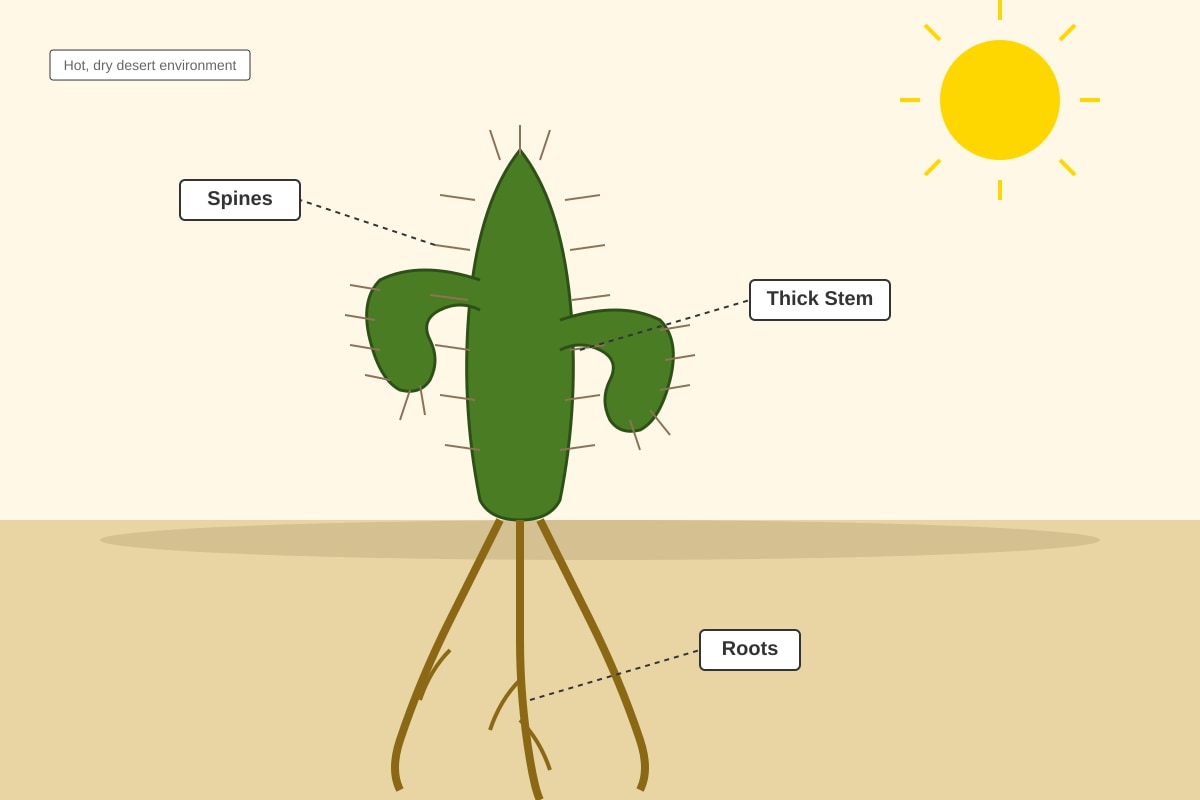
3. The diagram shows a plant growing in a hot and dry desert environment.
<image_placeholder> id: Q3-fig1 type: diagram linked_question: Q3 description: A cactus plant with thick, fleshy stem, spines instead of leaves, and deep roots. labels: Spines, Thick Stem, Roots must_show: The spines should be sharp and pointed. The stem should look swollen. </image_placeholder>
How do the spines help the plant survive in the desert? (1) They absorb more sunlight for photosynthesis. (2) They reduce water loss by reducing surface area. (3) They store water for dry periods. (4) They attract insects for pollination.
( )
4. Which of the following pairs of animals have the same method of locomotion? (1) Snake and Earthworm (2) Dolphin and Shark (3) Eagle and Bat (4) All of the above
( )
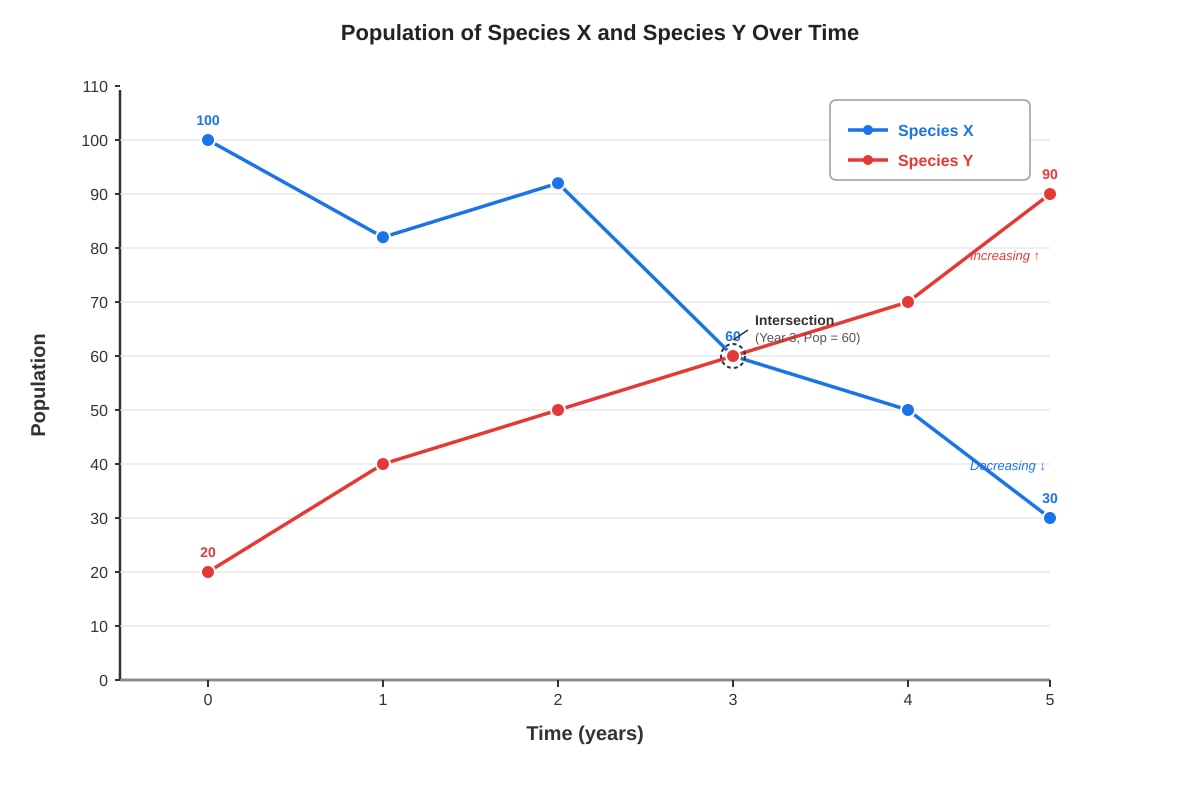
5. The graph shows the population of two species, X and Y, in a forest over 5 years.
<image_placeholder> id: Q5-fig1 type: graph linked_question: Q5 description: A line graph with Time (years) on x-axis (0 to 5) and Population on y-axis. Line X starts high and decreases. Line Y starts low and increases, crossing Line X at year 3. labels: Time (years), Population, Species X, Species Y values: At Year 0: X=100, Y=20. At Year 3: X=60, Y=60. At Year 5: X=30, Y=90. must_show: The intersection point at Year 3. The inverse relationship trend. </image_placeholder>
What is the most likely relationship between Species X and Species Y? (1) Species Y is a predator of Species X. (2) Species X and Y compete for the same food source. (3) Species X provides shelter for Species Y. (4) Species Y is a parasite living on Species X.
( )
6. Which of the following is not an adaptation of a polar bear to its cold environment? (1) Thick layer of fat under the skin. (2) White fur for camouflage. (3) Large ears to release heat. (4) Rough pads on feet for grip on ice.
( )
7. A student observed an organism in the garden. It had a hard outer covering, three pairs of jointed legs, and two antennae. It laid eggs. This organism is most likely a(n): (1) Arachnid (2) Insect (3) Crustacean (4) Myriapod
( )
8. Why do fish have gills instead of lungs? (1) Gills allow them to breathe dissolved oxygen in water. (2) Gills help them swim faster. (3) Lungs are too heavy for fish. (4) Gills prevent water from entering the body.
( )
9. Look at the food chain below: Grass Grasshopper Frog Snake Eagle
If the population of frogs decreases significantly due to disease, what will happen to the population of grasshoppers and snakes in the short term?
| Grasshoppers | Snakes | |
|---|---|---|
| (1) | Increase | Decrease |
| (2) | Decrease | Increase |
| (3) | Increase | Increase |
| (4) | Decrease | Decrease |
( )
10. Which of the following statements about fungi is true? (1) They are plants because they do not move. (2) They make their own food using sunlight. (3) They obtain nutrients by breaking down dead organic matter. (4) They have roots, stems, and leaves.
( )
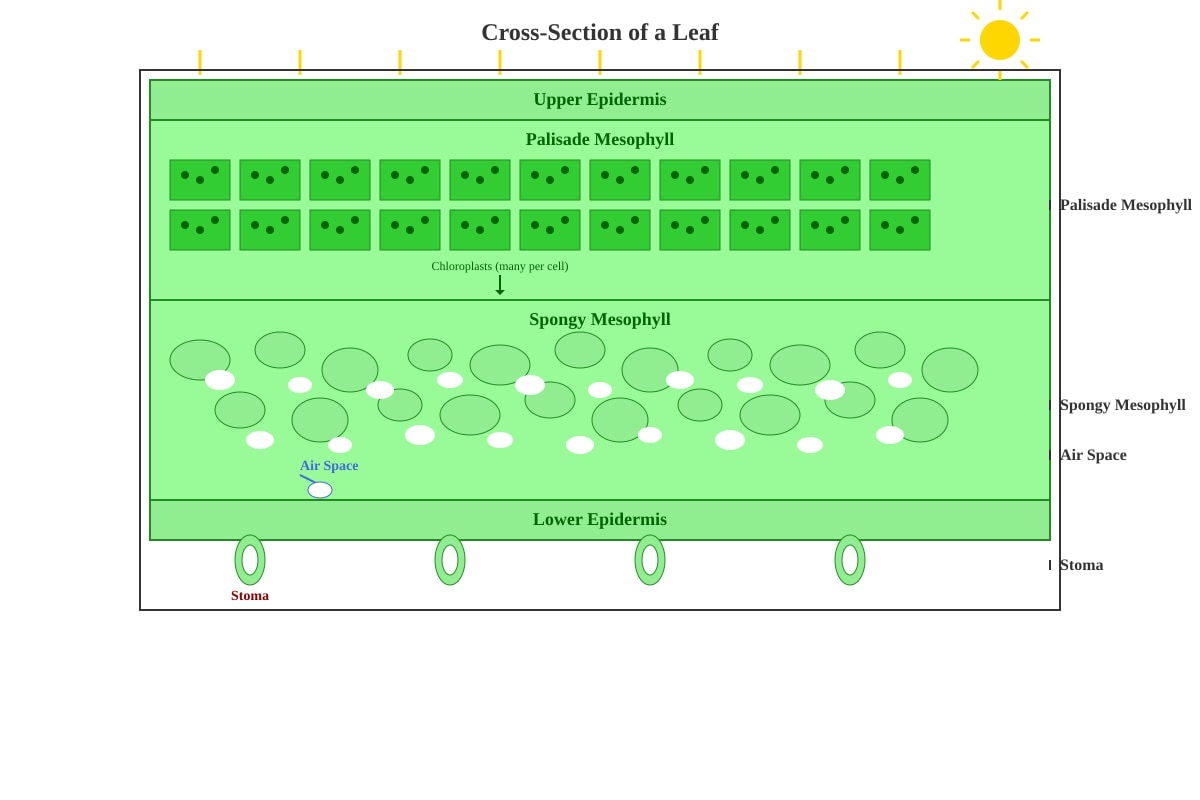
11. The diagram shows the cross-section of a leaf.
<image_placeholder> id: Q11-fig1 type: diagram linked_question: Q11 description: Cross section of a leaf showing upper epidermis, palisade mesophyll (tightly packed cells), spongy mesophyll (loose cells with air spaces), and lower epidermis with stomata. labels: Palisade Mesophyll, Spongy Mesophyll, Stoma, Air Space must_show: Palisade cells containing many chloroplasts. Stoma opening at the bottom. </image_placeholder>
Which part is mainly responsible for trapping sunlight for photosynthesis? (1) Upper Epidermis (2) Palisade Mesophyll (3) Spongy Mesophyll (4) Stoma
( )
12. Which of the following adaptations helps a camel survive in the desert? (1) Long eyelashes to keep out sand. (2) Humps that store water. (3) Thin skin to release heat. (4) Webbed feet to walk on sand.
( )
13. In a pond ecosystem, algae are the producers. Tadpoles eat algae. Fish eat tadpoles. Herons eat fish. If a large amount of pesticide kills most of the algae, which organism will be affected first? (1) Heron (2) Fish (3) Tadpole (4) Algae
( )
14. Which of the following groups contains only flowering plants? (1) Fern, Moss, Rose (2) Sunflower, Orchid, Hibiscus (3) Pine tree, Fern, Grass (4) Mushroom, Yeast, Bread mould
( )
Section B (28 marks)
Answer all questions. Write your answers in the spaces provided.
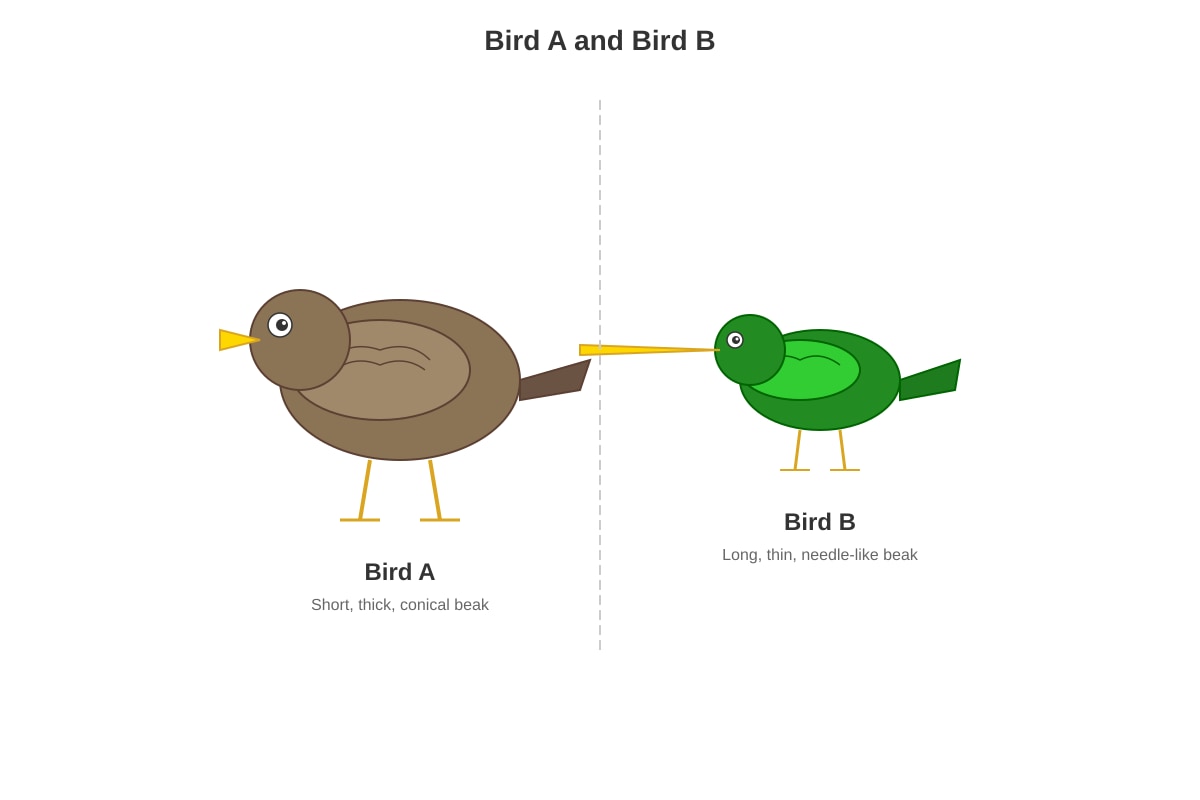
15. Study the diagram of two different birds, Bird A and Bird B.
<image_placeholder> id: Q15-fig1 type: diagram linked_question: Q15 description: Bird A has a short, thick, conical beak. Bird B has a long, thin, needle-like beak. Both are drawn in profile. labels: Bird A, Bird B must_show: Distinct difference in beak shape. Bird A looks like a finch/sparrow. Bird B looks like a hummingbird/sunbird. </image_placeholder>
(a) Based on the beak shape, suggest the type of food each bird eats. [2] Bird A: _______________________________________________________ Bird B: _______________________________________________________
(b) Explain how the beak of Bird B is adapted to its diet. [2]
16. The table below shows the characteristics of three organisms, J, K, and L.
| Organism | Has Chlorophyll? | Reproduces by Spores? | Has Vascular Tissue? |
|---|---|---|---|
| J | Yes | Yes | No |
| K | Yes | Yes | Yes |
| L | Yes | No | Yes |
(a) Identify the group of plants to which Organism J belongs. [1]
(b) Organism K is a fern. How does its method of reproduction differ from Organism L? [2]
(c) Why do mosses (like Organism J) usually grow in damp and shady places? [2]
17. A group of students investigated the effect of light intensity on the rate of photosynthesis of a water plant. They counted the number of bubbles produced in one minute at different distances from a lamp.
| Distance from Lamp (cm) | Number of Bubbles per Minute |
|---|---|
| 10 | 45 |
| 20 | 30 |
| 30 | 15 |
| 40 | 5 |
| 50 | 1 |
(a) What is the relationship between the distance from the lamp and the number of bubbles produced? [1]
(b) Explain why the number of bubbles changes as the distance increases. [2]
(c) Name the gas collected in the bubbles. [1]
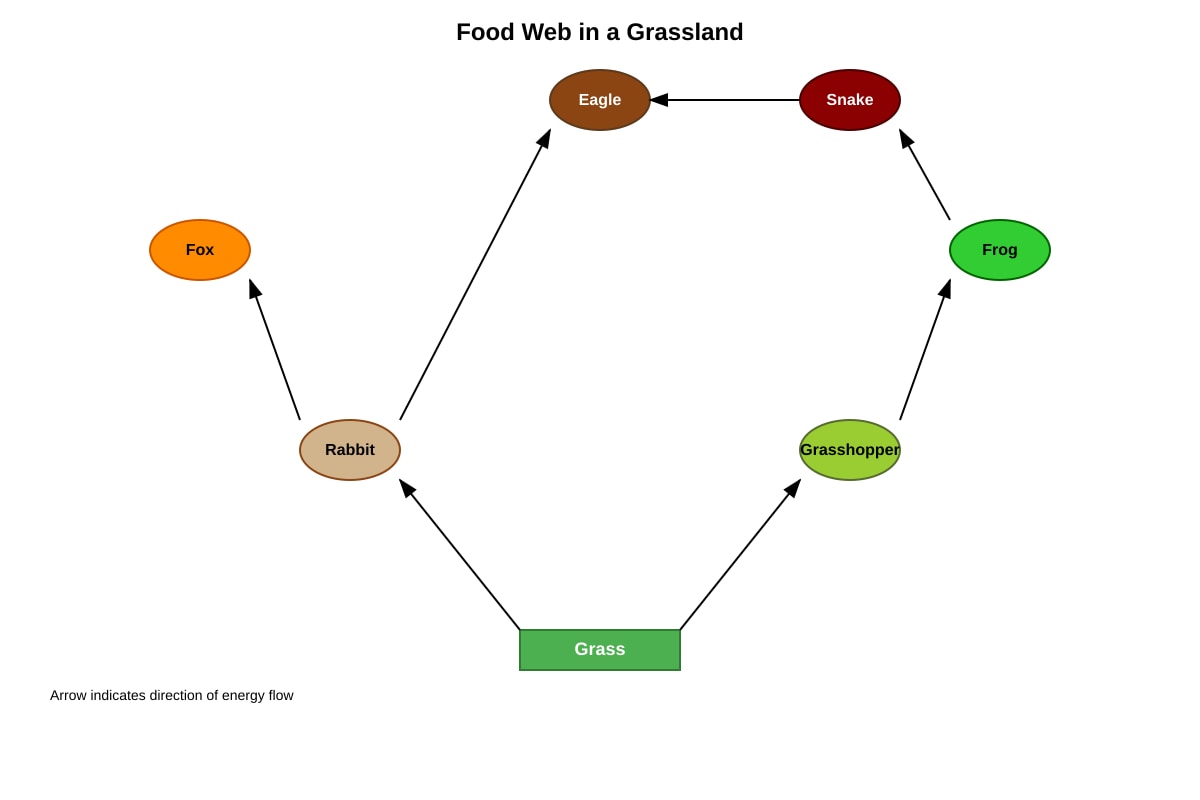
18. The diagram shows a simple food web in a grassland.
<image_placeholder> id: Q18-fig1 type: diagram linked_question: Q18 description: Food web with Grass at bottom. Arrows point from Grass to Rabbit and Grasshopper. Arrow from Rabbit to Fox. Arrow from Grasshopper to Frog. Arrow from Frog to Snake. Arrow from Snake to Eagle. Arrow from Rabbit to Eagle. labels: Grass, Rabbit, Grasshopper, Fox, Frog, Snake, Eagle must_show: Clear arrows indicating energy flow. </image_placeholder>
(a) Name one organism in the food web that is both a primary consumer and a secondary consumer. [1]
(Note: If none, explain why based on the diagram provided. In this specific web, Rabbit is primary, Grasshopper is primary. Frog is secondary. Snake is tertiary. Eagle is secondary/tertiary. Wait, let's adjust the question to be answerable. Let's ask for a secondary consumer.)
Correction for clarity in exam: Name one secondary consumer in the food web. [1]
(b) If all the frogs die due to pollution, explain the effect on the population of snakes. [2]
(c) Why is the sun important to this food web? [2]
19. Read the passage below.
"The Mangrove tree grows in coastal areas where the soil is salty and muddy. The roots of the Mangrove tree are often exposed above the mud. These specialized roots, called pneumatophores, have small pores that allow air to enter."
(a) Why do Mangrove trees need specialized roots like pneumatophores? [2]
(b) Suggest one other adaptation of Mangrove leaves to reduce water loss in the salty environment. [1]
20. Classify the following organisms into the correct groups: Mammal, Bird, Reptile, Amphibian, Fish.
- Dolphin
- Penguin
- Crocodile
- Toad
- Goldfish
(a) Complete the table. [5]
| Organism | Group |
|---|---|
| Dolphin | |
| Penguin | |
| Crocodile | |
| Toad | |
| Goldfish |
(b) Why is a Penguin classified as a bird and not a mammal, even though it cannot fly? [2]
End of Paper
Answers
TuitionGoWhere Practice Paper - Science Primary 5
Answer Key & Marking Scheme
Paper: WA3 - Version 4
Topic: Diversity
Section A (28 marks)
1. (2)
- Reasoning:
- P (Scales, Eggs) = Reptile.
- Q (Moist skin, Eggs in water) = Amphibian.
- R (Feathers, Eggs) = Bird.
- S (Hair, Live birth) = Mammal.
- Option (2) correctly identifies Q as Amphibian and S as Mammal.
2. (3)
- Reasoning:
- Group A: Plants (Chlorophyll). Fern is a plant. Correct.
- Group B: Non-plants. Mushroom is a fungus (Group B). Option (1) is wrong.
- Group X: 6 legs (Insects). Grasshopper has 6 legs, so it is in X, not Y. Option (2) is wrong.
- Group Y: Not 6 legs. Spider has 8 legs, so it is in Y, not X. Option (4) is wrong.
3. (2)
- Reasoning: Spines are modified leaves. Leaves have stomata which lose water. By reducing leaves to spines, the surface area for water loss is minimized. The thick stem stores water (not the spines).
4. (4)
- Reasoning:
- Snake and Earthworm both move by contracting muscles against the ground (slithering/crawling).
- Dolphin and Shark both swim using fins/tails.
- Eagle and Bat both fly using wings.
- Therefore, all pairs share the same method of locomotion.
5. (1)
- Reasoning: As Population Y increases, Population X decreases. This suggests Y is eating X (Predator-Prey) or competing. However, in typical primary science graphs, if one rises as the other falls drastically, it often indicates predation or competition. Given the options, if Y were a predator, X (prey) would decrease. If they competed, both might suffer, but one might outcompete the other. Option (1) is the most standard interpretation of such inverse curves in this context (Predator Y increases, Prey X decreases). Note: In some contexts, competition is also valid, but predation is a stronger direct link for "one goes up, one goes down" in simple models.
6. (3)
- Reasoning: Large ears are an adaptation for hot environments (like elephants or fennec foxes) to release heat. Polar bears have small ears to reduce heat loss.
7. (2)
- Reasoning: 6 legs = Insect. Arachnids have 8 legs. Crustaceans have more than 6 (usually 10+). Myriapods have many legs.
8. (1)
- Reasoning: Fish live in water. Water contains dissolved oxygen. Gills are specialized to extract dissolved oxygen from water. Lungs extract oxygen from air.
9. (1)
- Reasoning:
- Frogs eat Grasshoppers. If Frogs decrease, fewer Grasshoppers are eaten Grasshopper population Increases.
- Snakes eat Frogs. If Frogs decrease, Snakes have less food Snake population Decreases.
10. (3)
- Reasoning: Fungi are not plants (no chlorophyll). They are saprophytes/decomposers that obtain nutrients from dead organic matter.
11. (2)
- Reasoning: The Palisade Mesophyll layer contains the highest concentration of chloroplasts and is located near the upper surface to trap maximum sunlight.
12. (1)
- Reasoning: Long eyelashes protect eyes from sandstorms. Humps store fat (not water). Thin skin would lose water. Webbed feet are for swimming.
13. (3)
- Reasoning: Algae are the producers. Tadpoles eat algae directly. If algae die, Tadpoles lose their food source immediately. Fish and Herons are further up the chain and will be affected later.
14. (2)
- Reasoning:
- (1) Fern and Moss are non-flowering.
- (2) Sunflower, Orchid, Hibiscus are all flowering plants.
- (3) Pine is a conifer (non-flowering seed plant), Fern is non-flowering.
- (4) These are fungi.
Section B (28 marks)
15. (a) [2 marks]
- Bird A: Seeds / Nuts / Hard-shelled food. [1]
- Bird B: Nectar / Insects from deep flowers. [1]
(b) [2 marks]
- The long, thin beak allows Bird B to reach deep into flowers to access nectar [1] which other birds with short beaks cannot reach. [1]
16. (a) [1 mark]
- Moss (or Bryophyte).
(b) [2 marks]
- Organism K (Fern) reproduces by spores [1], while Organism L (Flowering plant) reproduces by seeds/flowers. [1]
(c) [2 marks]
- Mosses do not have true vascular tissue (roots/stems) to transport water efficiently [1]. They absorb water directly through their surface, so they need a damp environment to prevent drying out. [1]
- Alternative: Their sperm needs water to swim to the egg for fertilization.
17. (a) [1 mark]
- As the distance from the lamp increases, the number of bubbles produced decreases.
(b) [2 marks]
- Increasing the distance reduces the light intensity reaching the plant [1]. Since light is needed for photosynthesis, a lower light intensity results in a slower rate of photosynthesis, producing fewer oxygen bubbles. [1]
(c) [1 mark]
- Oxygen.
18. (a) [1 mark]
- Frog OR Snake OR Eagle.
- Note: Grasshopper is Primary. Frog eats Grasshopper (Secondary). Snake eats Frog (Tertiary). Eagle eats Snake (Quaternary) or Rabbit (Secondary).
- Accept Frog, Snake, or Eagle. (Most straightforward is Frog).
(b) [2 marks]
- The population of snakes will decrease [1] because frogs are their food source. With fewer frogs, snakes will have less food and may starve or move away. [1]
(c) [2 marks]
- The sun provides light energy [1] which is needed by the grass (producers) to perform photosynthesis and make food. This energy is then passed through the food web. [1]
19. (a) [2 marks]
- The muddy soil in mangroves has very little air/oxygen [1]. The pneumatophores stick out of the mud to absorb oxygen from the air for respiration. [1]
(b) [1 mark]
- Thick, waxy cuticle on leaves OR Small leaf surface area.
20. (a) [5 marks]
- Dolphin: Mammal [1]
- Penguin: Bird [1]
- Crocodile: Reptile [1]
- Toad: Amphibian [1]
- Goldfish: Fish [1]
(b) [2 marks]
- Penguins have feathers [1] and lay eggs with hard shells [1]. Mammals have hair/fur and give birth to live young (mostly).
- Note: Accept "Has wings" or "Has a beak" as secondary characteristics, but Feathers/Eggs are the primary classifiers.