From Real Exams Exam Paper

Primary 5 Science Weighted Assessment 3 (Term 3) Paper 1

Free Exam-Derived Qwen3.7 Plus Primary 5 Science Weighted Assessment 3 (Term 3) Paper 1 practice paper with questions and answers for Singapore students. This page is rendered as a direct URL so the questions and answers can be discovered without pressing in-page buttons.

These static practice materials are generated from the site's syllabus and paper-generation workflow, with source and model context shown so students and parents can evaluate the material before use.

Primary 5 Science From Real Exams Generated by Qwen3.7 Plus Updated 2026-06-04

Questions

<!-- TuitionGoWhere generation metadata: stage=3-1; model=qwen/qwen3.7-plus; model_label=Qwen3.7 Plus; generated=2026-06-04; Sources: Stage 2-1 real exam-derived templates and Stage 2-2 exam-enriched syllabus. -->

TuitionGoWhere Exam Practice (AI)

Subject: Science
Level: Primary 5
Paper: WA3 (Version 1 of 5)
Duration: 1 hour 45 minutes
Total Marks: 100
Name: __________________________
Class: ___________
Date: ________________

Instructions to Candidates:

  1. Write your name, class, and date in the spaces provided.
  2. Answer all questions.
  3. Write your answers in the spaces provided in this booklet.
  4. For questions which require working, show your working clearly.
  5. The number of marks is given in brackets [ ] at the end of each question or part question.

Section A (28 marks)

For each question from 1 to 14, four options are given. One of them is the correct answer. Make your choice (1, 2, 3 or 4) and write your answer in the brackets provided.

1. Which of the following statements about cells is correct? (1) All cells have a cell wall. (2) The nucleus controls the activities of the cell. (3) Plant cells do not have a cell membrane. (4) Animal cells contain chloroplasts for photosynthesis. Answer: ( ______ ) [1]

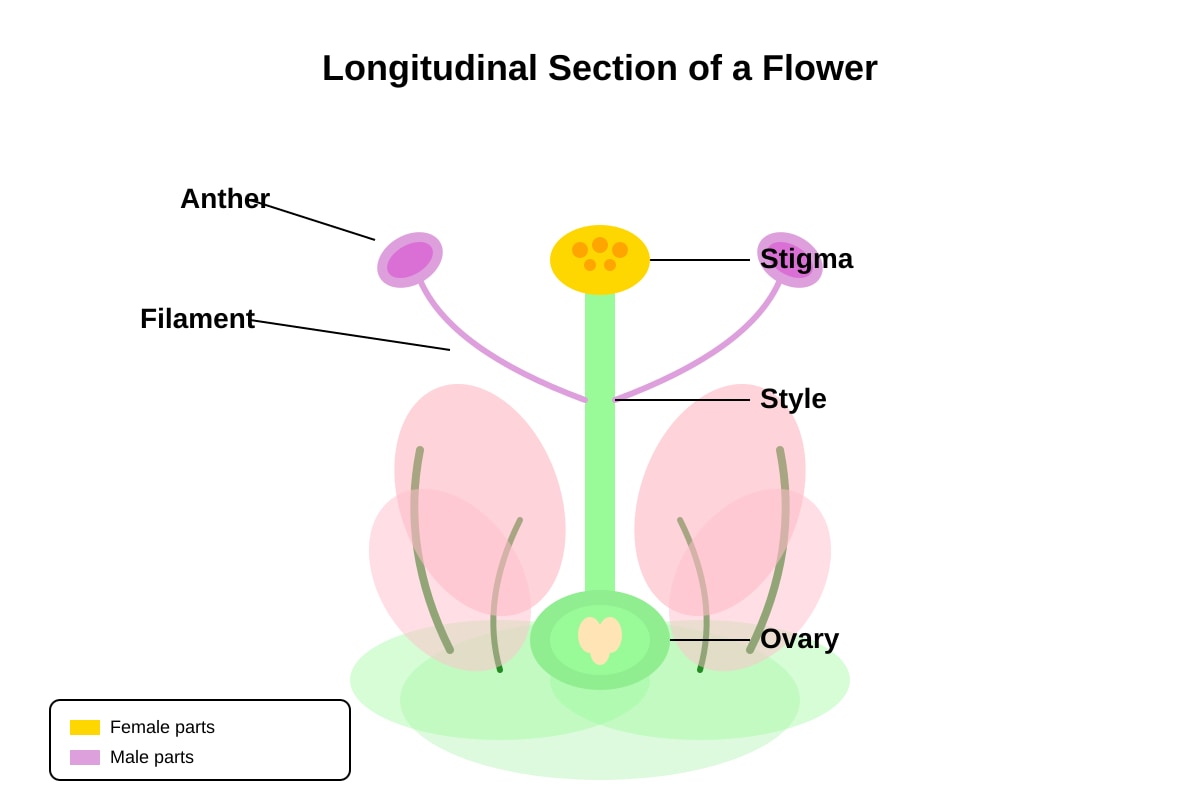
2. The diagram below shows the reproductive parts of a flower. <image_placeholder> id: Q2-fig1 type: diagram linked_question: Q2 description: A longitudinal section of a flower showing the stigma, style, ovary, anther, and filament. The stigma is at the top, connected to the ovary by the style. The anther and filament are beside the style. labels: Stigma, Style, Ovary, Anther, Filament must_show: Clear distinction between male parts (anther/filament) and female parts (stigma/style/ovary). </image_placeholder> Which part produces the male reproductive cells? (1) Stigma (2) Anther (3) Ovary (4) Style Answer: ( ______ ) [1]

3. Which of the following is the correct sequence of events in the reproduction of a flowering plant? (1) Pollination → Fertilisation → Seed Dispersal → Germination (2) Fertilisation → Pollination → Germination → Seed Dispersal (3) Pollination → Germination → Fertilisation → Seed Dispersal (4) Seed Dispersal → Pollination → Fertilisation → Germination Answer: ( ______ ) [1]

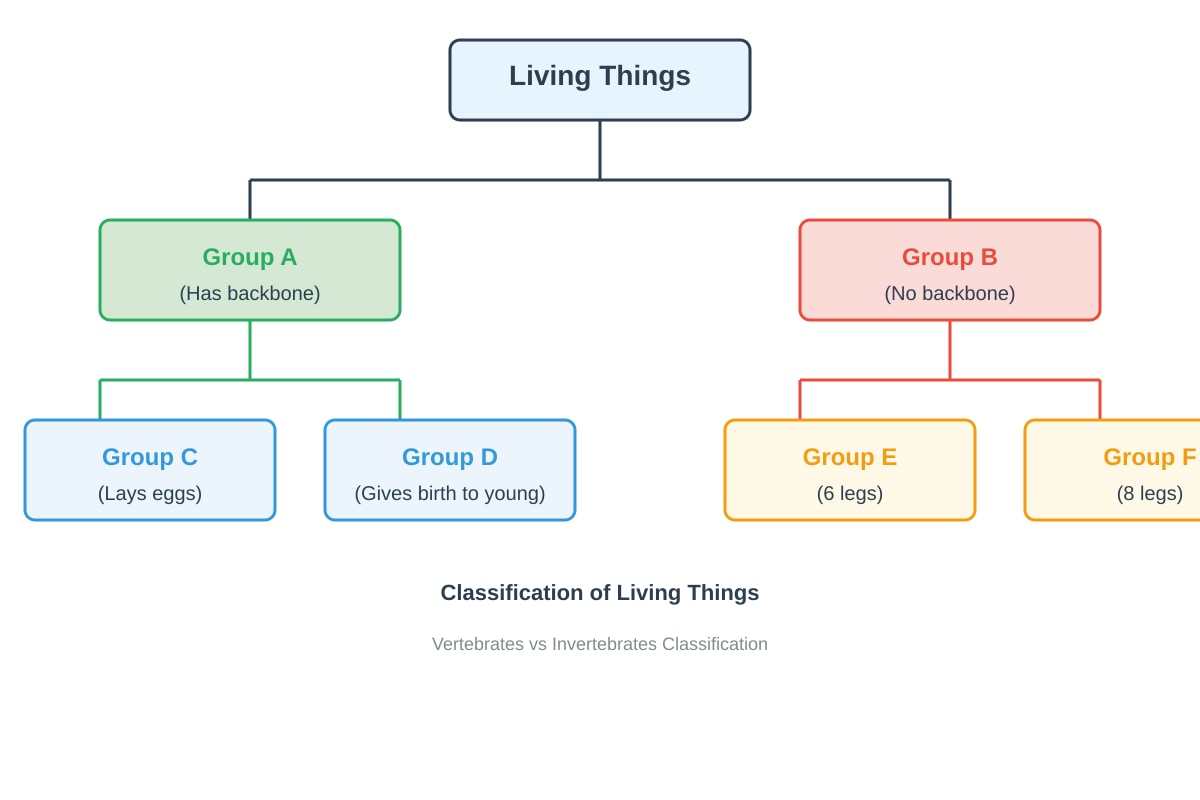
4. Study the classification chart below. <image_placeholder> id: Q4-fig1 type: chart linked_question: Q4 description: A simple branching classification chart. Top box: Living Things. Branches to: Group A (Has backbone) and Group B (No backbone). Group A branches to: Group C (Lays eggs) and Group D (Gives birth to young). Group B branches to: Group E (6 legs) and Group F (8 legs). labels: Group A, Group B, Group C, Group D, Group E, Group F must_show: Clear hierarchy showing vertebrates vs invertebrates, and further subgroups. </image_placeholder> Which of the following animals belongs to Group D? (1) Eagle (2) Frog (3) Cat (4) Spider Answer: ( ______ ) [1]

5. Why is sexual reproduction important for living things? (1) It allows organisms to grow larger. (2) It ensures the continuity of the species. (3) It helps plants make their own food. (4) It allows animals to move from place to place. Answer: ( ______ ) [1]

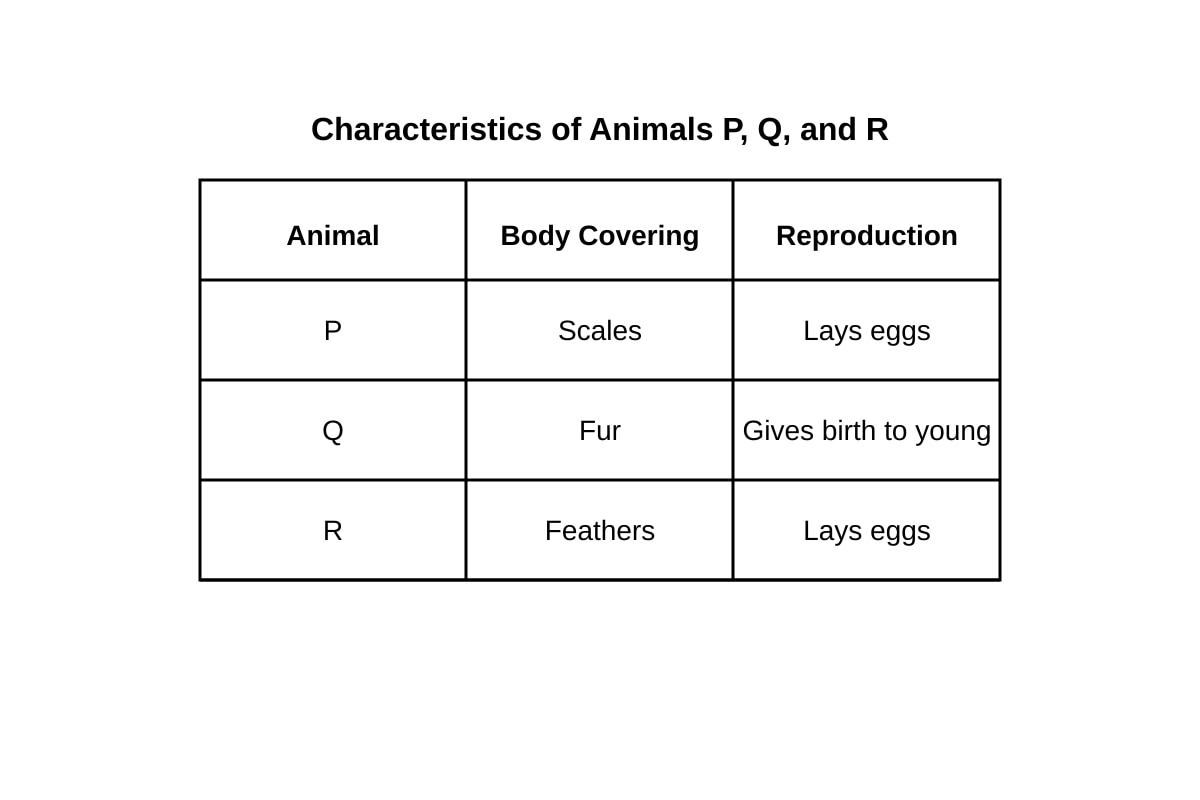
6. The table below shows the characteristics of three animals, P, Q, and R. <image_placeholder> id: Q6-fig1 type: table linked_question: Q6 description: A table with columns: Animal, Body Covering, Reproduction. Row 1: P, Scales, Lays eggs. Row 2: Q, Fur, Gives birth to young. Row 3: R, Feathers, Lays eggs. labels: Animal, Body Covering, Reproduction, P, Q, R values: P: Scales, Lays eggs; Q: Fur, Gives birth; R: Feathers, Lays eggs must_show: Clear text for body covering and reproduction method. </image_placeholder> Which of the following statements is true? (1) P is a mammal. (2) Q is a bird. (3) R is a reptile. (4) P and R lay eggs. Answer: ( ______ ) [1]

7. In humans, where does fertilisation take place? (1) Ovary (2) Uterus (3) Oviduct (4) Vagina Answer: ( ______ ) [1]

8. Which of the following is not a method of seed dispersal? (1) By wind (2) By water (3) By animals (4) By photosynthesis Answer: ( ______ ) [1]

9. A fruit has the following characteristics:

  • It is light and has wing-like structures.
  • It is dry when mature. How is this fruit most likely dispersed? (1) By water (2) By wind (3) By animals (4) By splitting action Answer: ( ______ ) [1]

10. Which of the following statements about spores is correct? (1) Spores are produced by flowering plants. (2) Spores are larger than seeds. (3) Spores are produced by ferns and mosses. (4) Spores need to be fertilised before they can grow. Answer: ( ______ ) [1]

11. Look at the diagram of the human reproductive system below. <image_placeholder> id: Q11-fig1 type: diagram linked_question: Q11 description: A simplified diagram of the female reproductive system. Labels point to Ovary, Oviduct, Uterus, and Vagina. labels: Ovary, Oviduct, Uterus, Vagina must_show: Correct anatomical positioning. </image_placeholder> Which part releases the egg? (1) Oviduct (2) Ovary (3) Uterus (4) Vagina Answer: ( ______ ) [1]

12. Why do plants need to disperse their seeds away from the parent plant? (1) To avoid overcrowding and competition for resources. (2) To help the seeds grow faster. (3) To attract more animals to the plant. (4) To ensure the seeds get more sunlight. Answer: ( ______ ) [1]

13. Which of the following animals undergoes metamorphosis? (1) Cat (2) Chicken (3) Butterfly (4) Dog Answer: ( ______ ) [1]

14. What is the function of the seed coat? (1) To provide food for the young plant. (2) To protect the embryo inside the seed. (3) To attract animals for dispersal. (4) To help the seed float in water. Answer: ( ______ ) [1]


Section B (44 marks)

Answer all questions in the spaces provided.

15. The diagram below shows the life cycle of a flowering plant. <image_placeholder> id: Q15-fig1 type: diagram linked_question: Q15 description: A circular life cycle diagram with four stages: Seed, Seedling, Mature Plant, Flower/Fruit. Arrows connect them in order. labels: Seed, Seedling, Mature Plant, Flower/Fruit must_show: Clear arrows indicating the cycle direction. </image_placeholder>

(a) Name the process represented by arrow A (from Flower/Fruit to Seed). [1]


(b) State two conditions necessary for seed germination. [2]


(c) Why is the seedling stage important for the plant? [1]


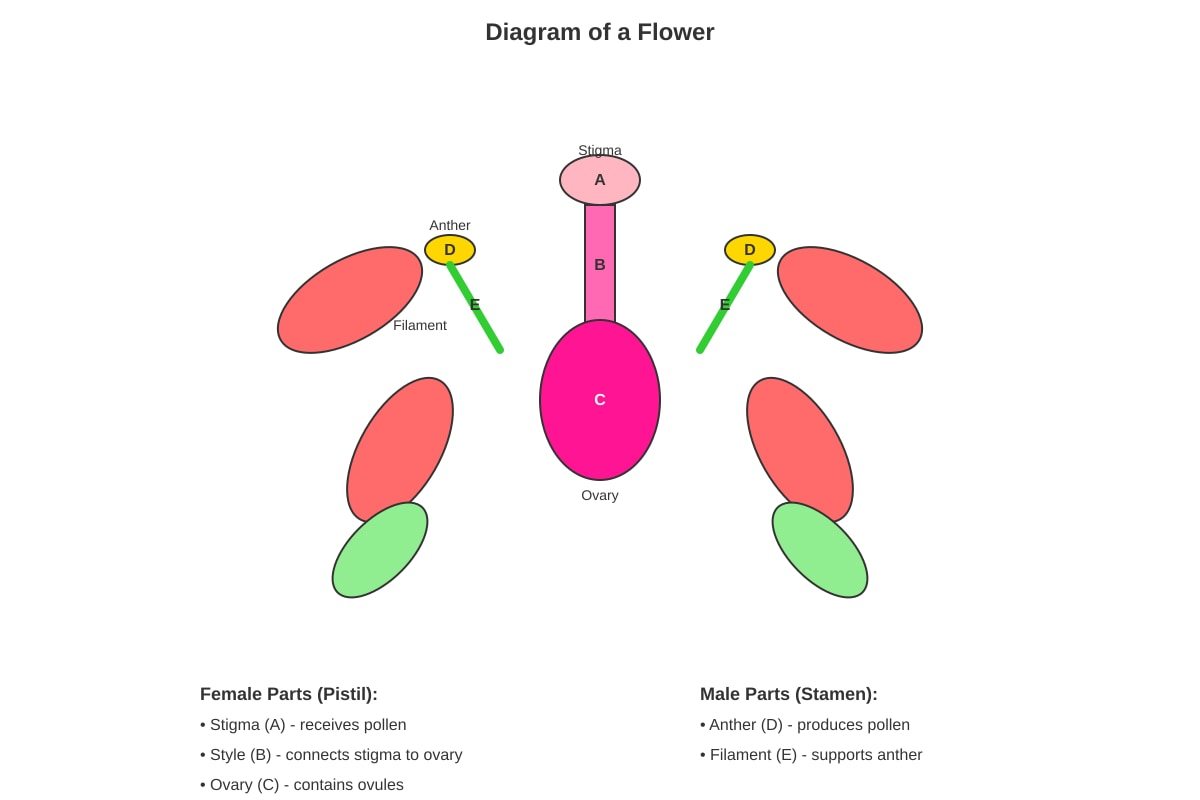
16. Study the diagram of the flower below. <image_placeholder> id: Q16-fig1 type: diagram linked_question: Q16 description: A flower with labels A (Stigma), B (Style), C (Ovary), D (Anther), E (Filament). labels: A: Stigma, B: Style, C: Ovary, D: Anther, E: Filament must_show: Clear labels for male and female parts. </image_placeholder>

(a) Identify the parts labelled D and E. [2] D: _________________________________________________________________________ E: _________________________________________________________________________

(b) Explain the difference between pollination and fertilisation. [2]


(c) After fertilisation, what does part C develop into? [1]


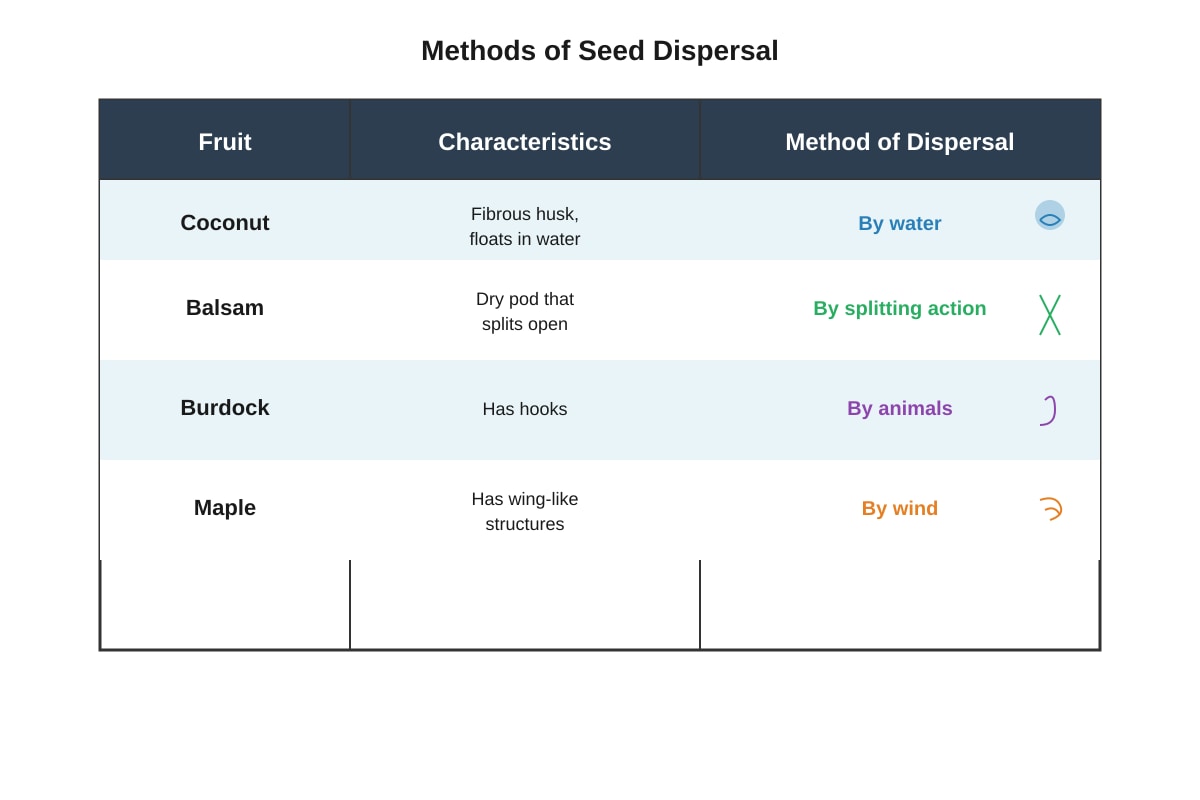
17. The table below shows the methods of seed dispersal for four different fruits. <image_placeholder> id: Q17-fig1 type: table linked_question: Q17 description: A table with columns: Fruit, Characteristics, Method of Dispersal. Row 1: Coconut, Fibrous husk, floats in water, By water. Row 2: Balsam, Dry pod that splits open, By splitting action. Row 3: Burdock, Has hooks, By animals. Row 4: Maple, Has wing-like structures, By wind. labels: Fruit, Characteristics, Method of Dispersal values: Coconut: Fibrous husk, floats; Balsam: Dry pod, splits; Burdock: Hooks; Maple: Wings must_show: Clear association between characteristics and dispersal method. </image_placeholder>

(a) Why is the fibrous husk of the coconut useful for its dispersal? [1]


(b) How do the hooks on the burdock fruit help in dispersal? [1]


(c) If a plant grows in a dense forest with little wind, which method of dispersal would be most effective for its seeds? Explain your answer. [2]


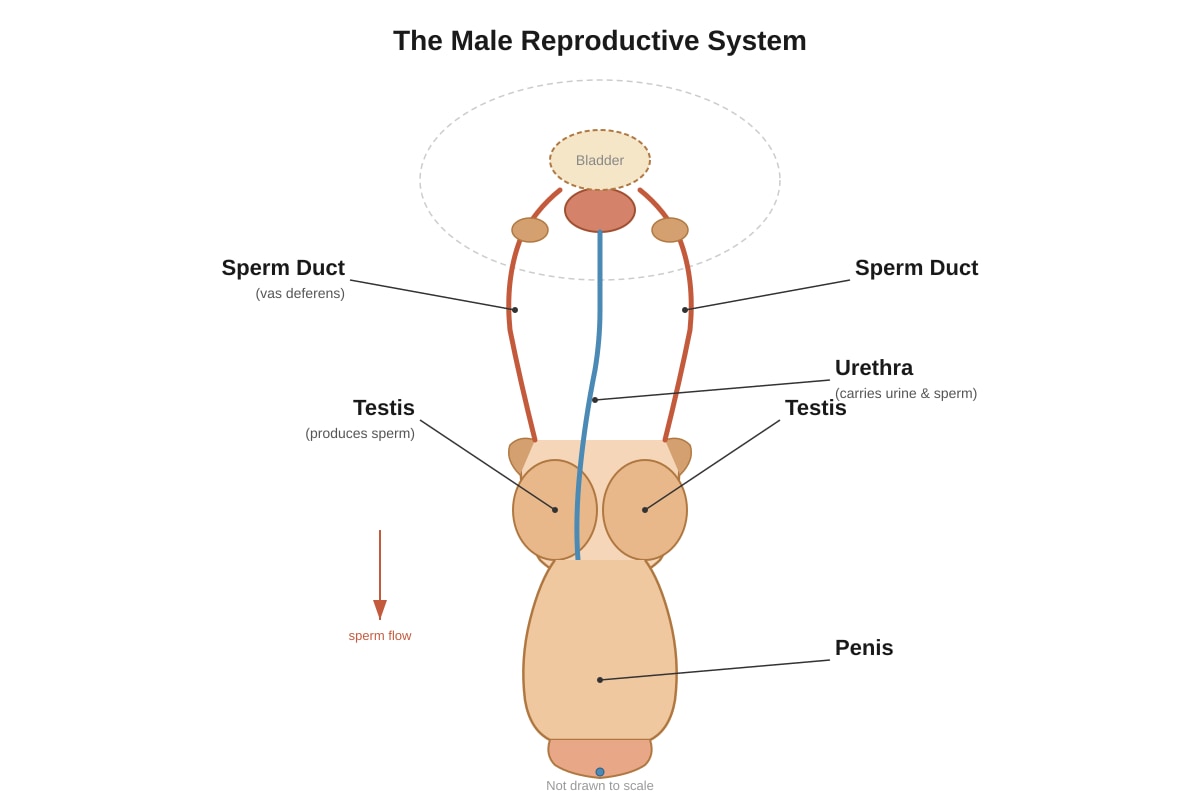
18. The diagram below shows the human reproductive system. <image_placeholder> id: Q18-fig1 type: diagram linked_question: Q18 description: A diagram of the male reproductive system. Labels point to Testis, Sperm Duct, Urethra, and Penis. labels: Testis, Sperm Duct, Urethra, Penis must_show: Correct anatomical positioning. </image_placeholder>

(a) Name the part that produces sperm. [1]


(b) What is the function of the sperm duct? [1]


(c) Why are testes located outside the body in a sac called the scrotum? [1]


19. Jane conducted an experiment to find out if light is necessary for seed germination. She set up two pots, A and B. <image_placeholder> id: Q19-fig1 type: diagram linked_question: Q19 description: Two pots. Pot A is in a dark cupboard. Pot B is on a windowsill with sunlight. Both pots have soil and 5 bean seeds. Both are watered equally. labels: Pot A (Dark), Pot B (Light) must_show: Clear distinction in lighting conditions. </image_placeholder>

(a) What is the variable changed in this experiment? [1]


(b) Name two variables that must be kept constant. [2]


(c) After 5 days, seeds in both pots germinated. What conclusion can Jane make? [1]


(d) Why did Jane use 5 seeds in each pot instead of just 1? [1]


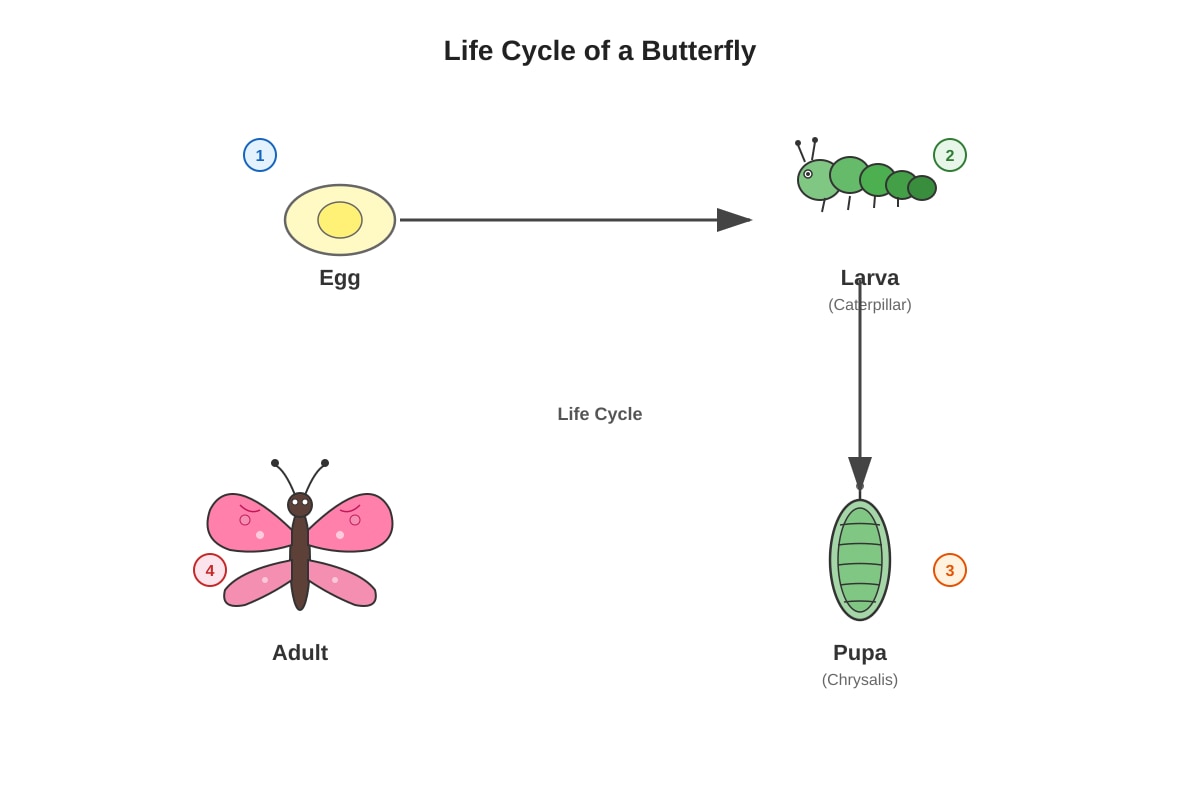
20. The diagram below shows the life cycle of a butterfly. <image_placeholder> id: Q20-fig1 type: diagram linked_question: Q20 description: A four-stage life cycle: Egg, Larva (Caterpillar), Pupa (Chrysalis), Adult Butterfly. Arrows connect them in a circle. labels: Egg, Larva, Pupa, Adult must_show: Distinct shapes for each stage. </image_placeholder>

(a) Name the stage where the butterfly feeds the most. [1]


(b) What happens during the pupal stage? [1]


(c) How is the life cycle of a butterfly different from that of a chicken? [2]


Section C (28 marks)

Answer all questions in the spaces provided.

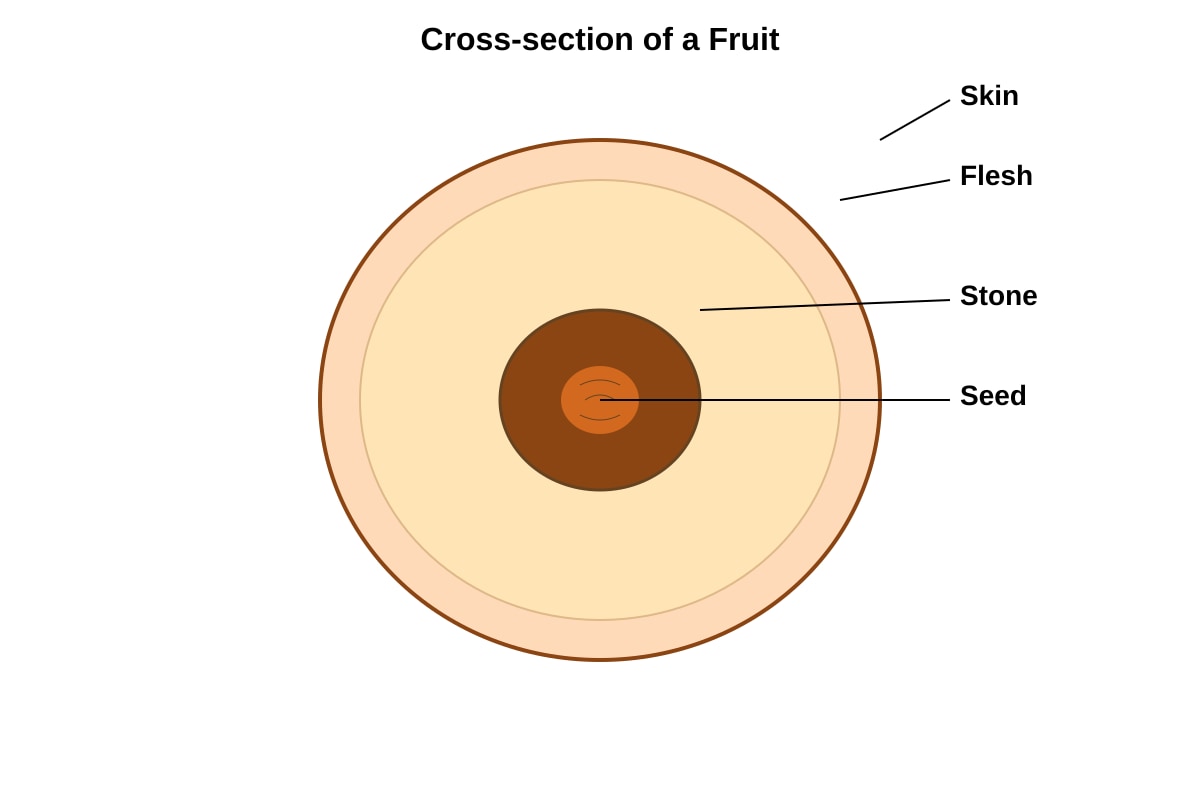
21. The diagram below shows a cross-section of a fruit. <image_placeholder> id: Q21-fig1 type: diagram linked_question: Q21 description: A cross-section of a peach or similar fruit. Labels point to Skin, Flesh, Seed, and Stone (hard inner layer). labels: Skin, Flesh, Seed, Stone must_show: Clear layers of the fruit. </image_placeholder>

(a) Which part of the flower develops into the flesh of the fruit? [1]


(b) Why is the flesh of the fruit often sweet and juicy? [2]


(c) If the seeds of this fruit are eaten by animals, how are they dispersed? Explain the process. [2]


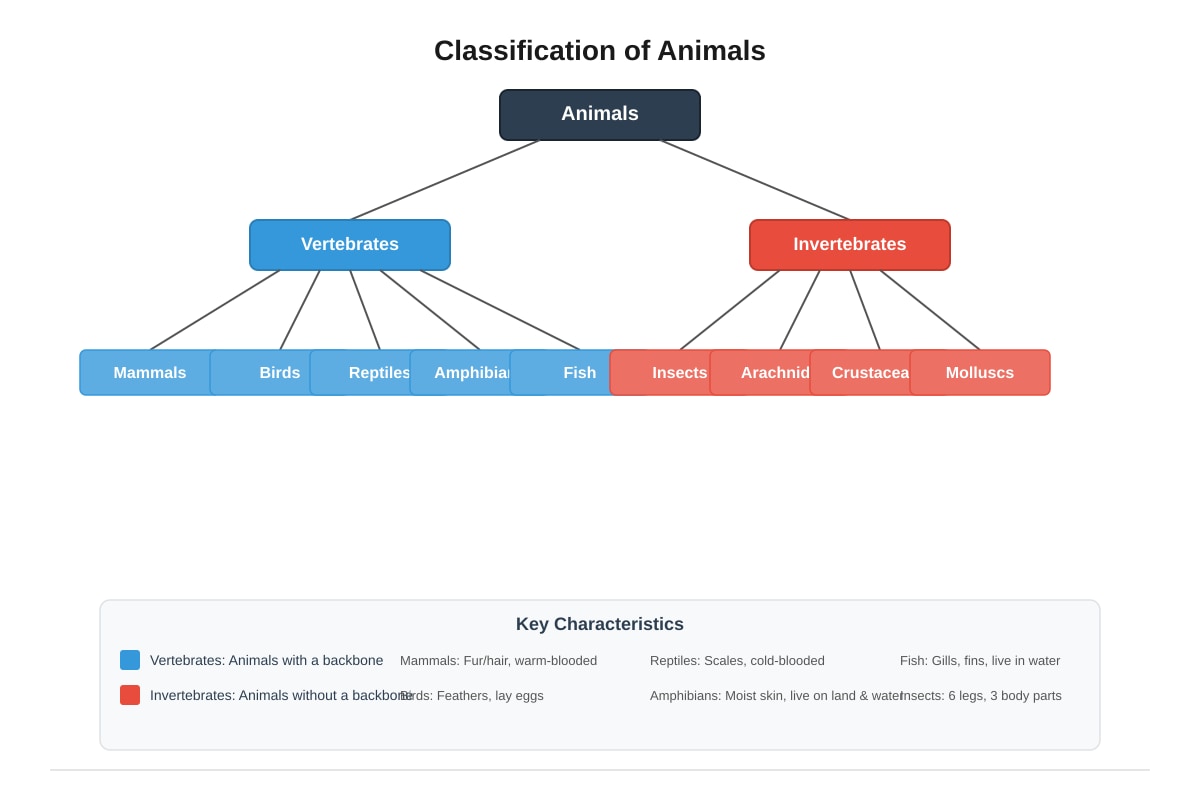
22. Study the classification chart below. <image_placeholder> id: Q22-fig1 type: chart linked_question: Q22 description: A chart classifying animals. Top: Animals. Branches to: Vertebrates and Invertebrates. Vertebrates branch to: Mammals, Birds, Reptiles, Amphibians, Fish. Invertebrates branch to: Insects, Arachnids, Crustaceans, Molluscs. labels: Vertebrates, Invertebrates, Mammals, Birds, Reptiles, Amphibians, Fish, Insects, Arachnids must_show: Clear hierarchical structure. </image_placeholder>

(a) Place the following animals into the correct groups: Dolphin, Spider, Salmon, Frog. [4]

  • Dolphin: _________________________
  • Spider: _________________________
  • Salmon: _________________________
  • Frog: _________________________

(b) State one similarity between birds and mammals. [1]


(c) State one difference between reptiles and amphibians. [1]


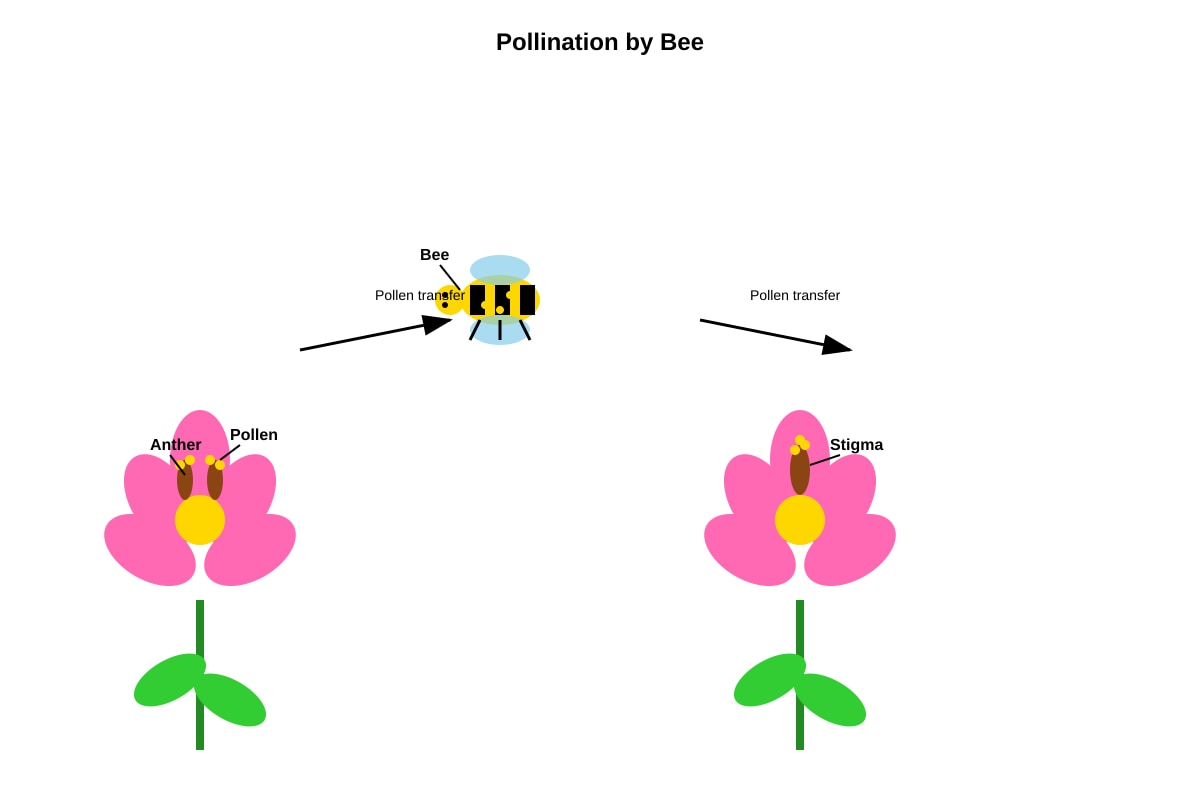
23. The diagram below shows the process of pollination. <image_placeholder> id: Q23-fig1 type: diagram linked_question: Q23 description: A bee landing on a flower. Pollen grains are shown sticking to the bee's body and being transferred to the stigma of another flower. labels: Bee, Pollen, Stigma, Anther must_show: Transfer of pollen from anther to stigma via bee. </image_placeholder>

(a) Name the agent of pollination shown in the diagram. [1]


(b) Describe two characteristics of flowers that are pollinated by this agent. [2]


(c) Why is cross-pollination generally better than self-pollination for plants? [2]


24. Read the passage below and answer the questions.

"The Rafflesia is a unique plant found in the rainforests of Southeast Asia. It does not have leaves, stems, or roots. It produces the largest flower in the world, which can grow up to 1 meter in diameter. The flower smells like rotting meat to attract flies for pollination. After pollination, it produces fruits containing thousands of tiny seeds."

(a) Why does the Rafflesia flower smell like rotting meat? [1]


(b) Since the Rafflesia has no leaves, how does it obtain nutrients? (Hint: It is a parasitic plant). [2]


(c) Suggest a method of dispersal for the Rafflesia seeds and explain why. [2]


End of Paper

Answers

<!-- TuitionGoWhere generation metadata: stage=3-1; model=qwen/qwen3.7-plus; model_label=Qwen3.7 Plus; generated=2026-06-04; Sources: Stage 2-1 real exam-derived templates and Stage 2-2 exam-enriched syllabus. -->

TuitionGoWhere Exam Practice (AI) - Answer Key

Subject: Science
Level: Primary 5
Paper: WA3 (Version 1 of 5)


Section A (28 marks)

1. (2)
Reasoning: The nucleus contains genetic material and controls cell activities. Not all cells have cell walls (animal cells don't), plant cells have cell membranes, and animal cells do not have chloroplasts.

2. (2)
Reasoning: The anther produces pollen grains, which contain the male reproductive cells. The stigma receives pollen, the ovary contains ovules (female cells), and the style connects stigma to ovary.

3. (1)
Reasoning: The correct sequence is Pollination (transfer of pollen) → Fertilisation (fusion of gametes) → Seed Dispersal (spreading seeds) → Germination (seed grows into new plant).

4. (3)
Reasoning: Group D is Vertebrates (Has backbone) that Give birth to young. This describes mammals. Cat is a mammal. Eagle (Bird, lays eggs), Frog (Amphibian, lays eggs), Spider (Invertebrate).

5. (2)
Reasoning: Sexual reproduction creates offspring with genetic variation, ensuring the species can adapt and continue even if conditions change. It does not directly cause growth, food production, or movement.

6. (4)
Reasoning: P (Scales, Lays eggs) is likely a reptile or fish. Q (Fur, Gives birth) is a mammal. R (Feathers, Lays eggs) is a bird. Therefore, P and R both lay eggs.

7. (3)
Reasoning: Fertilisation in humans occurs in the oviduct (fallopian tube) where the sperm meets the egg. The ovary releases the egg, the uterus is where the baby develops, and the vagina is the birth canal.

8. (4)
Reasoning: Photosynthesis is the process of making food, not dispersing seeds. Wind, water, and animals are common dispersal agents.

9. (2)
Reasoning: Light weight and wing-like structures are adaptations for wind dispersal, allowing the fruit/seed to be carried by air currents.

10. (3)
Reasoning: Ferns and mosses reproduce via spores. Flowering plants use seeds. Spores are generally smaller than seeds and do not require fertilisation in the same way (they are single cells that grow into gametophytes).

11. (2)
Reasoning: The ovary produces and releases eggs. The oviduct transports the egg, the uterus is for development, and the vagina is the birth canal.

12. (1)
Reasoning: Dispersal reduces competition for water, nutrients, sunlight, and space between the parent plant and its offspring.

13. (3)
Reasoning: Butterflies undergo complete metamorphosis (Egg → Larva → Pupa → Adult). Cats, chickens, and dogs do not undergo metamorphosis; their young resemble adults.

14. (2)
Reasoning: The seed coat is a tough outer layer that protects the delicate embryo and food store inside the seed from damage and drying out.


Section B (44 marks)

15. (a) Seed Dispersal [1]
(b) Any two: Water, Air (Oxygen), Warmth (Suitable Temperature) [2]
Note: Light is NOT required for germination.
(c) It is the stage where the seedling establishes roots and begins photosynthesis to become independent. [1]

16. (a) D: Anther [1], E: Filament [1]
(b) Pollination is the transfer of pollen from anther to stigma. Fertilisation is the fusion of the male reproductive cell (from pollen) with the female reproductive cell (in ovule). [2]
(c) Fruit [1]
Note: The ovary develops into the fruit, and the ovules develop into seeds.

17. (a) The fibrous husk traps air, making the coconut buoyant so it can float in water. [1]
(b) The hooks attach to the fur or feathers of passing animals, carrying the seeds away. [1]
(c) By animals. [1] In a dense forest with little wind, wind dispersal is ineffective. Animals can move through the forest and carry seeds away. [1]

18. (a) Testis [1]
(b) To transport sperm from the testis to the urethra. [1]
(c) To keep the testes at a temperature slightly lower than body temperature, which is necessary for sperm production. [1]

19. (a) Presence of light (or Light conditions) [1]
(b) Any two: Amount of water, Type of seeds, Amount of soil, Temperature. [2]
(c) Light is not necessary for seed germination. [1]
(d) To ensure the results are reliable and not due to chance (e.g., if one seed was defective). [1]

20. (a) Larva (Caterpillar) [1]
Reasoning: The larva feeds excessively to store energy for metamorphosis.
(b) The larva transforms into an adult butterfly inside the pupa. [1]
(c) A butterfly undergoes metamorphosis (4 stages: egg, larva, pupa, adult), while a chicken does not (young chick resembles adult). [2]


Section C (28 marks)

21. (a) Ovary wall [1]
Note: The ovary develops into the fruit, and the ovary wall becomes the flesh/pericarp.
(b) To attract animals to eat the fruit. [1] The animals then disperse the seeds found inside. [1]
(c) By animals. [1] Animals eat the fruit and pass the seeds out in their droppings elsewhere, or the seeds stick to their fur. [1]

22. (a)

  • Dolphin: Mammal [1]
  • Spider: Arachnid (or Invertebrate) [1]
  • Salmon: Fish [1]
  • Frog: Amphibian [1]
    (b) Both are warm-blooded (or both have lungs / both give birth to live young - Note: Monotremes are exceptions but generally accepted at P5 level that mammals give birth, birds lay eggs, so 'warm-blooded' is safer). [1]
    Correction for P5 Level: Both have backbones (Vertebrates). [1]
    (c) Reptiles have dry, scaly skin and lay eggs on land. Amphibians have moist, smooth skin and lay eggs in water. [1]

23. (a) Insect (Bee) [1]
(b) Any two: Brightly colored petals, Sweet scent, Nectar production, Sticky pollen. [2]
(c) Cross-pollination introduces genetic variation, making the offspring stronger and more resistant to diseases/environmental changes. [2]

24. (a) To attract flies, which act as the pollinators. [1]
(b) It attaches itself to a host plant and absorbs nutrients and water from the host's tissues. [2]
Note: It cannot photosynthesize as it has no leaves/chlorophyll.
(c) By animals. [1] The fruits are likely eaten by animals, and the tiny seeds pass through their digestive system and are deposited in droppings. [1]
Alternative: By wind, if the seeds are very light and dust-like, but animal dispersal is more common for fleshy fruits. Given the context of "fruits", animal dispersal is the primary inference.