From Real Exams Exam Paper

Primary 5 Science Weighted Assessment 2 (Term 3) Paper 4

Free Exam-Derived Qwen3.7 Plus Primary 5 Science Weighted Assessment 2 (Term 3) Paper 4 practice paper with questions and answers for Singapore students. This page is rendered as a direct URL so the questions and answers can be discovered without pressing in-page buttons.

These static practice materials are generated from the site's syllabus and paper-generation workflow, with source and model context shown so students and parents can evaluate the material before use.

Primary 5 Science From Real Exams Generated by Qwen3.7 Plus Updated 2026-06-04

Questions

<!-- TuitionGoWhere generation metadata: stage=3-1; model=qwen/qwen3.7-plus; model_label=Qwen3.7 Plus; generated=2026-06-04; Sources: Stage 2-1 real exam-derived templates and Stage 2-2 exam-enriched syllabus. -->

TuitionGoWhere Exam Practice (AI) - Science Primary 5

School: TuitionGoWhere Secondary School (AI)
Subject: Science
Level: Primary 5
Paper: WA2 (Version 4 of 5)
Duration: 1 hour 45 minutes
Total Marks: 60
Name: __________________________
Class: __________
Date: __________

Instructions to Candidates:

  1. Write your name, class, and date in the spaces provided.
  2. Answer all questions.
  3. Write your answers in the spaces provided in this booklet.
  4. For questions requiring explanations, use complete sentences and scientific terms.

Section A (20 marks)

For each question from 1 to 20, four options are given. One of them is the correct answer. Make your choice (1, 2, 3 or 4) and write it in the bracket provided. Each question carries 1 mark.

  1. Which of the following statements about cells is correct? (1) All cells have a cell wall. (2) The nucleus controls the activities of the cell. (3) Chloroplasts are found in all plant cells. (4) Animal cells are larger than plant cells. ( )

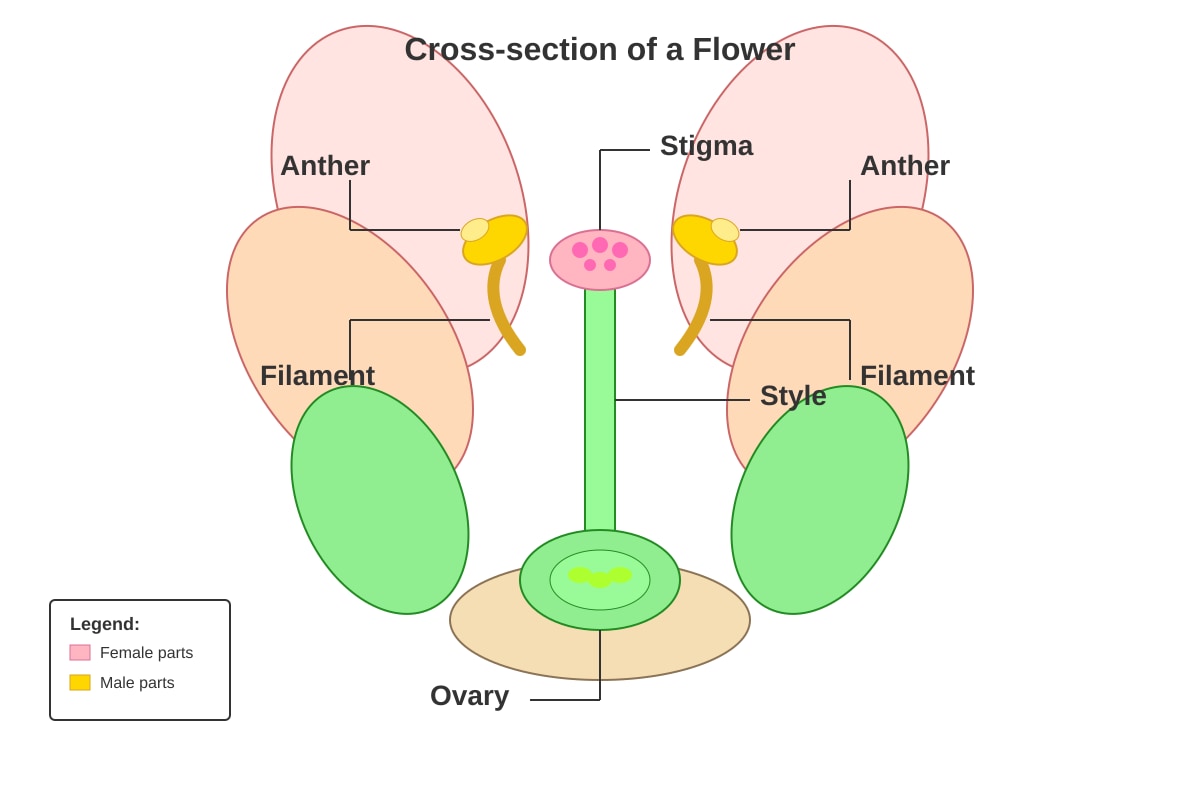
  2. The diagram below shows the reproductive parts of a flower. <image_placeholder> id: Q2-fig1 type: diagram linked_question: Q2 description: A cross-section of a flower showing the Stigma, Style, Ovary, Anther, and Filament. The Stigma is at the top, connected to the Ovary by the Style. The Anther is on a Filament, positioned near the Stigma but not touching it. labels: Stigma, Style, Ovary, Anther, Filament must_show: Clear distinction between male parts (Anther/Filament) and female parts (Stigma/Style/Ovary). </image_placeholder> Which part produces the male reproductive cells? (1) Stigma (2) Anther (3) Ovary (4) Style ( )

  3. What is the correct sequence of events in the reproduction of a flowering plant? (1) Pollination → Fertilisation → Seed Dispersal → Germination (2) Fertilisation → Pollination → Germination → Seed Dispersal (3) Pollination → Germination → Fertilisation → Seed Dispersal (4) Seed Dispersal → Pollination → Fertilisation → Germination ( )

  4. Which of the following is a characteristic of wind-dispersed seeds? (1) They have juicy and sweet flesh. (2) They have hooks or sticky surfaces. (3) They are light and have wing-like structures. (4) They have a hard and waterproof outer coat. ( )

  5. In humans, where does fertilisation take place? (1) Ovary (2) Uterus (3) Oviduct (4) Vagina ( )

  6. Which of the following pairs is incorrectly matched? (1) Ovary : Produces eggs (2) Testis : Produces sperm (3) Uterus : Site of fertilisation (4) Sperm duct : Transports sperm ( )

  7. Why is reproduction important for living things? (1) To help them grow bigger. (2) To ensure the continuity of their kind. (3) To provide energy for daily activities. (4) To remove waste products from the body. ( )

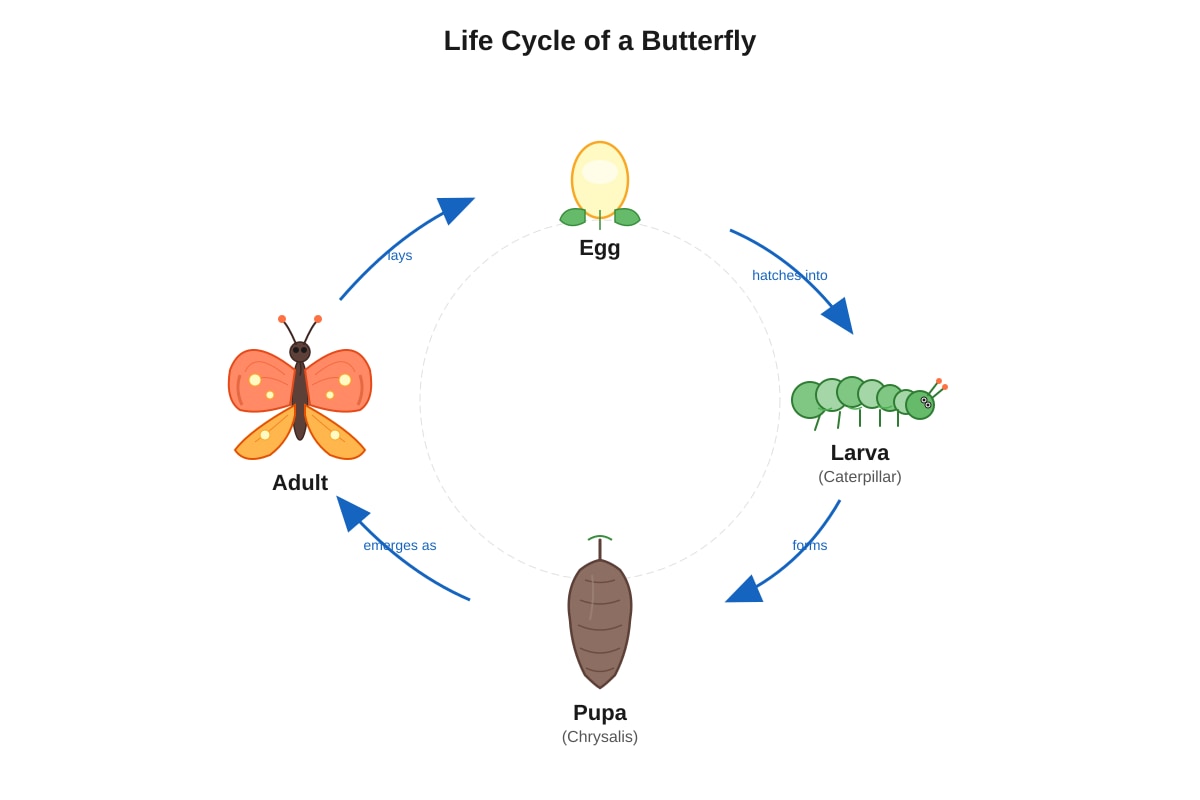
  8. The diagram below shows the life cycle of a butterfly. <image_placeholder> id: Q8-fig1 type: diagram linked_question: Q8 description: A circular life cycle diagram with four stages: Egg, Larva (Caterpillar), Pupa (Chrysalis), and Adult Butterfly. Arrows connect them in order. labels: Egg, Larva, Pupa, Adult must_show: The distinct difference in appearance between the Larva and the Adult. </image_placeholder> Which stage of the butterfly feeds on plant leaves? (1) Egg (2) Larva (3) Pupa (4) Adult ( )

  9. Which of the following animals reproduces by laying eggs? (1) Cat (2) Dog (3) Chicken (4) Human ( )

  10. What is the function of the seed coat? (1) To provide food for the developing embryo. (2) To protect the embryo from damage and drying out. (3) To attract animals for seed dispersal. (4) To absorb water for germination. ( )

  11. Which condition is not necessary for seed germination? (1) Water (2) Air (Oxygen) (3) Suitable temperature (4) Sunlight ( )

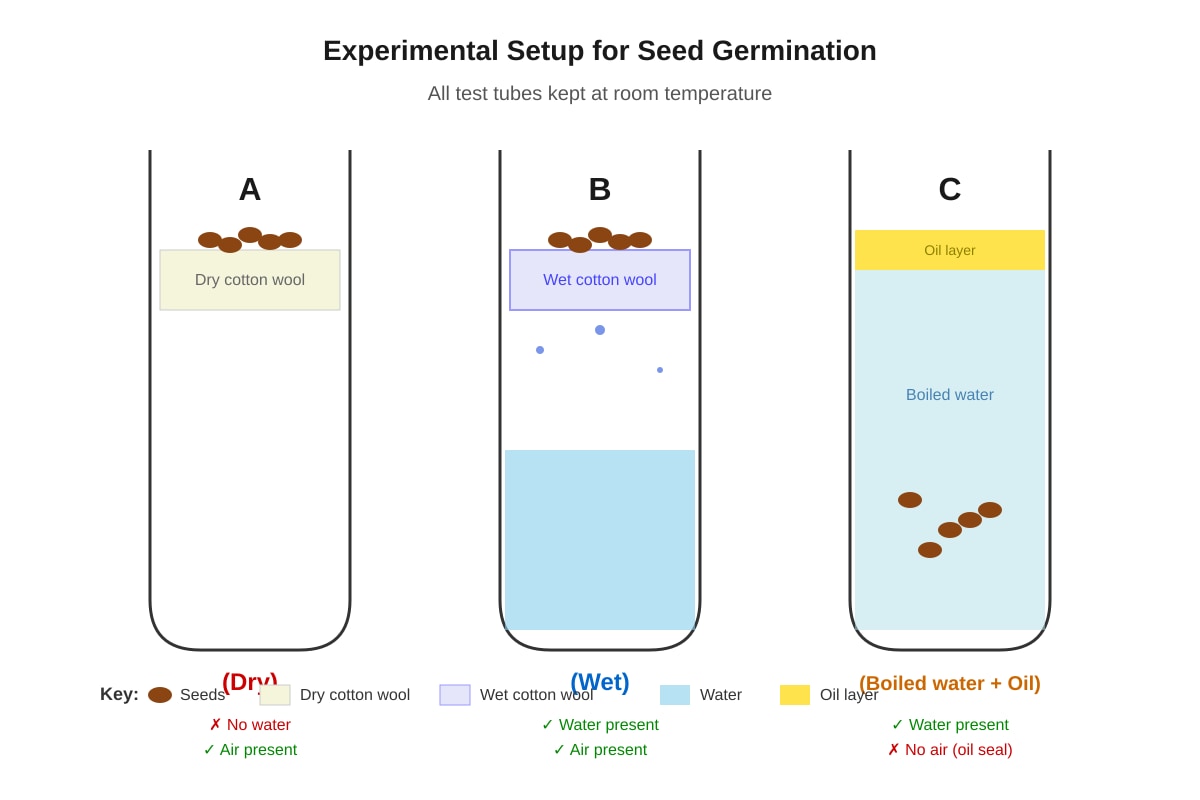
  12. The diagram below shows an experimental setup to study seed germination. <image_placeholder> id: Q12-fig1 type: diagram linked_question: Q12 description: Three test tubes labeled A, B, and C. Tube A has dry cotton wool and seeds. Tube B has wet cotton wool and seeds. Tube C has seeds submerged in boiled water covered with a layer of oil. All are at room temperature. labels: A (Dry), B (Wet), C (Boiled water + Oil) must_show: Tube B is the only one with both water and air access. Tube C lacks air. Tube A lacks water. </image_placeholder> In which test tube will the seeds germinate? (1) A only (2) B only (3) C only (4) A and B ( )

  13. Which of the following is a method of asexual reproduction in plants? (1) Pollination (2) Fertilisation (3) Spore formation (4) Seed dispersal ( )

  14. Ferns reproduce using spores. Where are the spores usually found? (1) On the roots (2) On the underside of the leaves (3) Inside the flowers (4) On the stem ( )

  15. Which of the following statements about sexual reproduction is true? (1) It involves only one parent. (2) The offspring are identical to the parent. (3) It involves the fusion of male and female reproductive cells. (4) It is faster than asexual reproduction. ( )

  16. What is the role of the petals in a flower? (1) To produce pollen. (2) To protect the flower bud. (3) To attract pollinators like insects. (4) To hold the stigma in position. ( )

  17. Which of the following fruits is dispersed by animals? (1) Coconut (2) Balsam (3) Strawberry (4) Maple ( )

  18. Why do plants disperse their seeds away from the parent plant? (1) To reduce competition for water, sunlight, and nutrients. (2) To attract more insects. (3) To make the parent plant look better. (4) To increase the weight of the parent plant. ( )

  19. In the human reproductive system, what happens to the egg if it is not fertilised? (1) It develops into a baby. (2) It is absorbed by the body. (3) It is released from the body during menstruation. (4) It turns into a sperm. ( )

  20. Which of the following is a similarity between the reproduction of flowering plants and humans? (1) Both involve the fusion of male and female reproductive cells. (2) Both produce seeds. (3) Both have external fertilisation. (4) Both offspring look exactly like the parents. ( )


Section B (40 marks)

Answer all questions. Write your answers in the spaces provided.

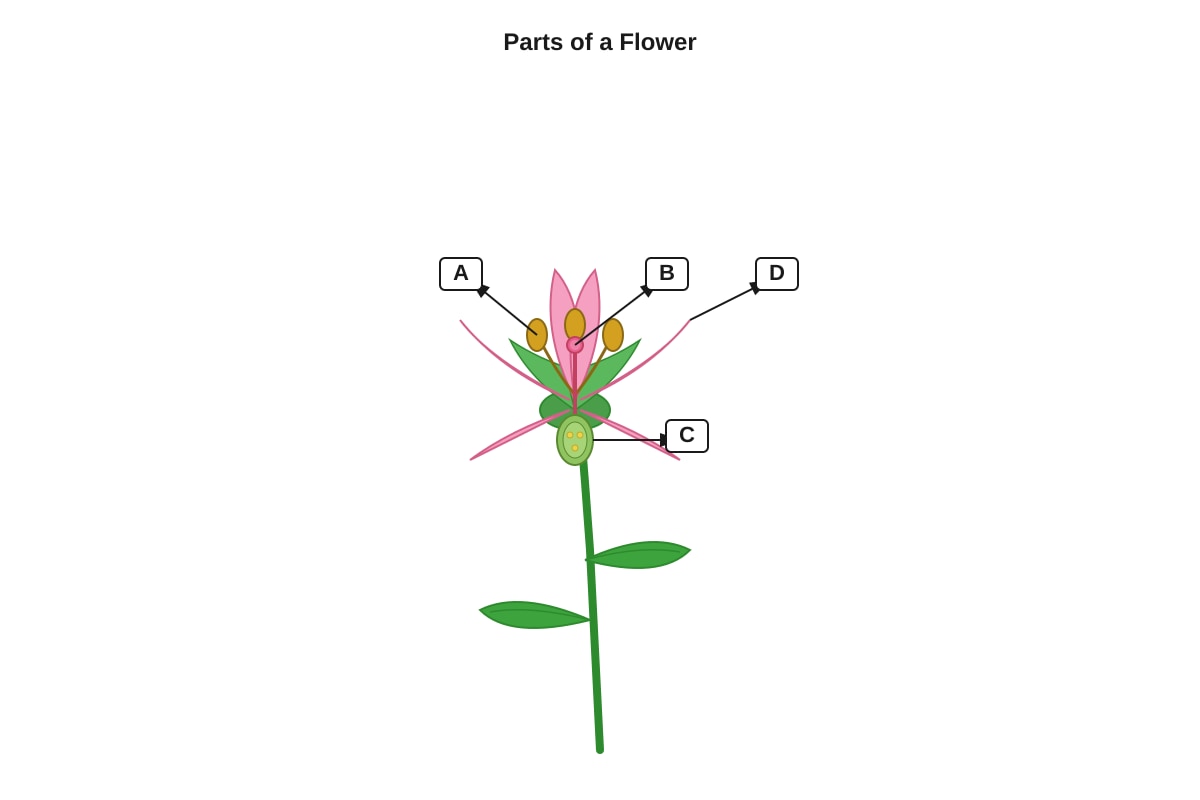
  1. The diagram below shows the parts of a flower. <image_placeholder> id: Q21-fig1 type: diagram linked_question: Q21 description: A detailed diagram of a flower with labels A, B, C, and D. A points to the Anther, B points to the Stigma, C points to the Ovary, and D points to the Petal. labels: A, B, C, D must_show: A is male part, B and C are female parts. </image_placeholder>

    (a) Identify parts A and B. [2] A: __________________________ B: __________________________

    (b) State the function of part C. [1]


    (c) Explain why part D is often brightly coloured. [1]


  2. Study the flowchart below which shows the process of reproduction in a flowering plant.

    Pollination → Process X → Formation of Fruit and Seeds → Seed Dispersal → Germination

    (a) Name Process X. [1]


    (b) Describe what happens during Process X. [2]


    (c) After germination, what does the seed develop into? [1]


  3. The table below shows the characteristics of three different fruits, P, Q, and R.

    FruitCharacteristics
    PLight, has wing-like structures
    QHas hooks on its surface
    RJuicy, sweet, and brightly coloured

    (a) State the method of dispersal for each fruit. [3] Fruit P: __________________________ Fruit Q: __________________________ Fruit R: __________________________

    (b) Explain how the characteristics of Fruit Q help in its dispersal. [2]


  4. The diagram below shows the human female reproductive system. <image_placeholder> id: Q24-fig1 type: diagram linked_question: Q24 description: Diagram of female reproductive system with labels X, Y, and Z. X points to the Ovary, Y points to the Oviduct, and Z points to the Uterus. labels: X, Y, Z must_show: X produces eggs, Y is the site of fertilisation, Z is where the baby grows. </image_placeholder>

    (a) Name parts X and Z. [2] X: __________________________ Z: __________________________

    (b) In which part does fertilisation usually take place? Write the letter. [1]


    (c) Explain the function of part Z. [2]


  5. John conducted an experiment to find out if water is necessary for seed germination. He set up two cups, A and B, as shown below. <image_placeholder> id: Q25-fig1 type: diagram linked_question: Q25 description: Cup A contains dry cotton wool and 5 bean seeds. Cup B contains wet cotton wool and 5 bean seeds. Both are placed on a windowsill at room temperature. labels: Cup A (Dry), Cup B (Wet) must_show: The only difference is the presence of water. </image_placeholder>

    (a) What is the aim of this experiment? [1]


    (b) State one variable that must be kept constant in this experiment. [1]


    (c) Predict which cup the seeds will germinate in. Explain your answer. [2]


    (d) Why did John use 5 seeds instead of just 1 seed in each cup? [1]


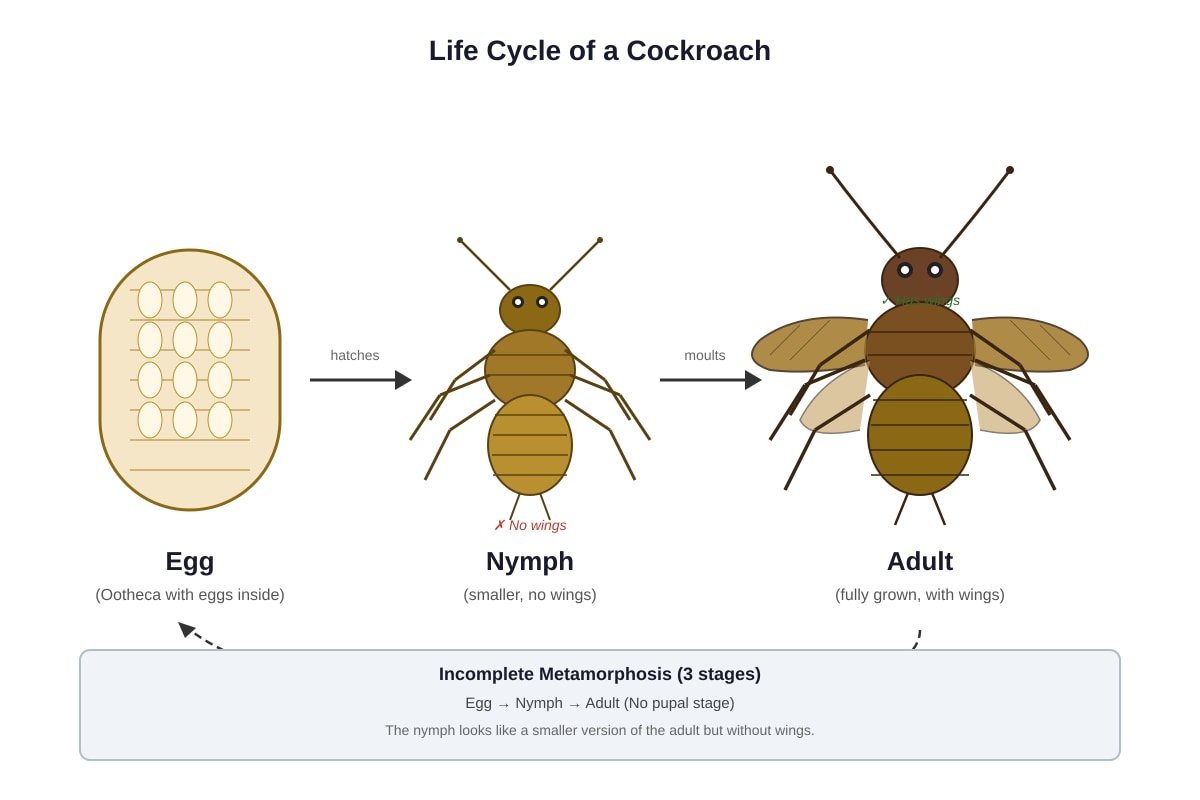
  6. The diagram below shows the life cycle of a cockroach. <image_placeholder> id: Q26-fig1 type: diagram linked_question: Q26 description: A three-stage life cycle: Egg → Nymph → Adult. The Nymph looks like a smaller version of the Adult but without wings. labels: Egg, Nymph, Adult must_show: Incomplete metamorphosis (no pupal stage). </image_placeholder>

    (a) How many stages are there in the life cycle of a cockroach? [1]


    (b) State one difference between the nymph and the adult cockroach. [1]


    (c) Does the cockroach undergo metamorphosis? Explain your answer. [2]


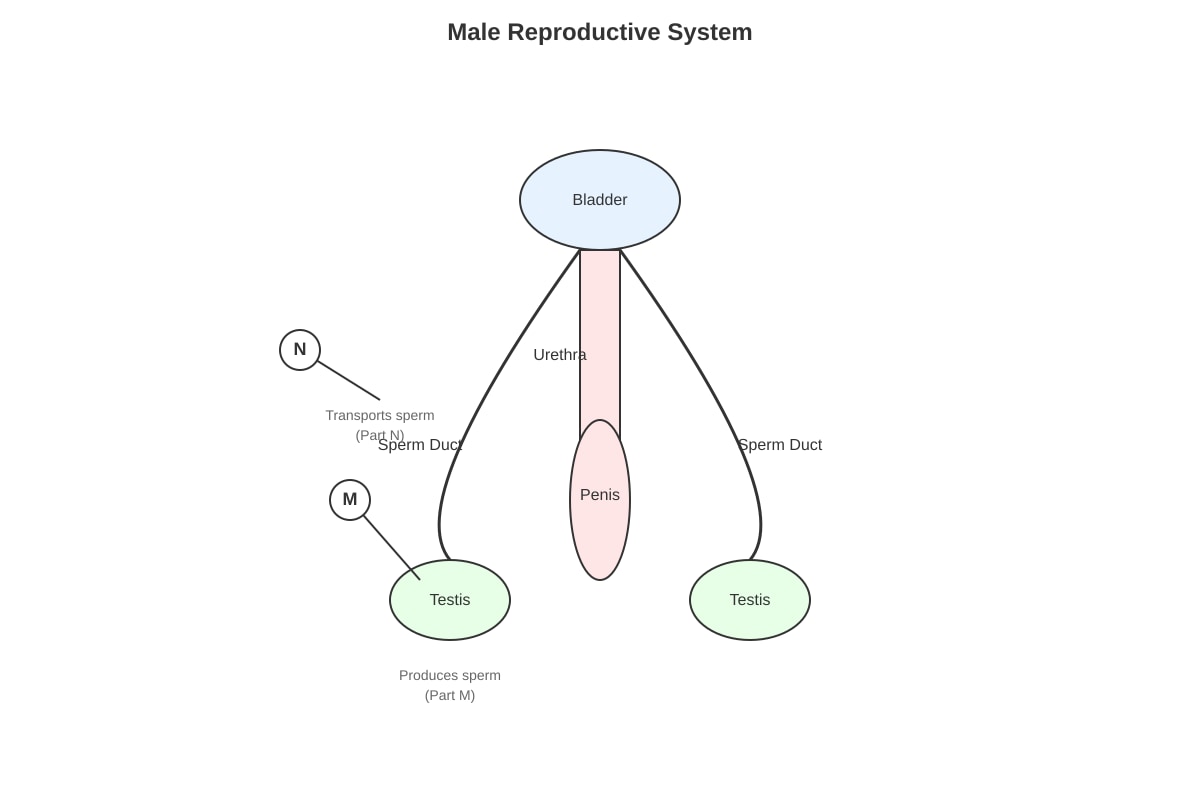
  7. Study the diagram below showing the male reproductive system. <image_placeholder> id: Q27-fig1 type: diagram linked_question: Q27 description: Diagram of male reproductive system. Label M points to the Testis, Label N points to the Sperm Duct. labels: M, N must_show: M produces sperm, N transports sperm. </image_placeholder>

    (a) Name parts M and N. [2] M: __________________________ N: __________________________

    (b) What is produced by part M? [1]


    (c) Why are the testes located outside the body in the scrotum? [1]


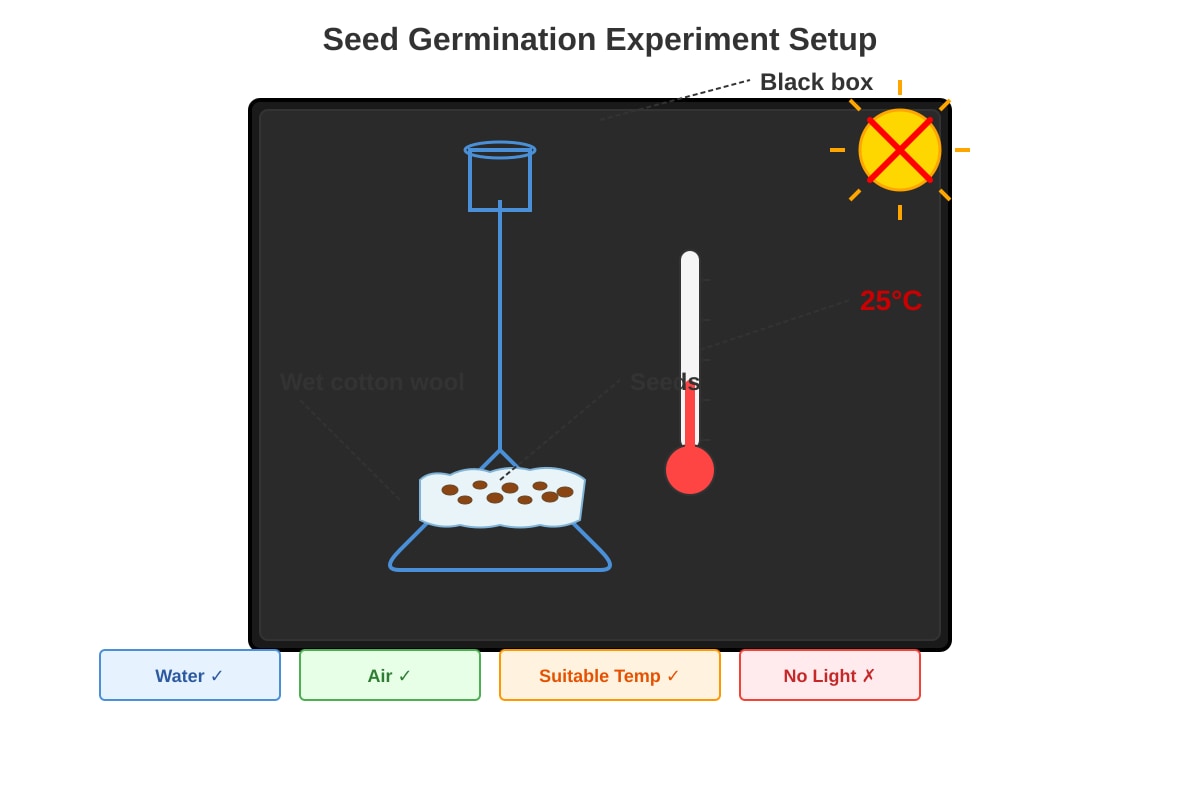
  8. The diagram below shows a setup used to investigate seed germination. <image_placeholder> id: Q28-fig1 type: diagram linked_question: Q28 description: A conical flask with seeds on wet cotton wool. The flask is placed inside a black box to block light. A thermometer shows the temperature is 25°C. labels: Wet cotton wool, Seeds, Black box, 25°C must_show: Conditions are Water, Air, Suitable Temp, but No Light. </image_placeholder>

    (a) The seeds in the setup germinated. What does this tell you about the need for sunlight in seed germination? [1]


    (b) List the three conditions necessary for seed germination. [3]


  9. Explain the difference between pollination and fertilisation. [2]


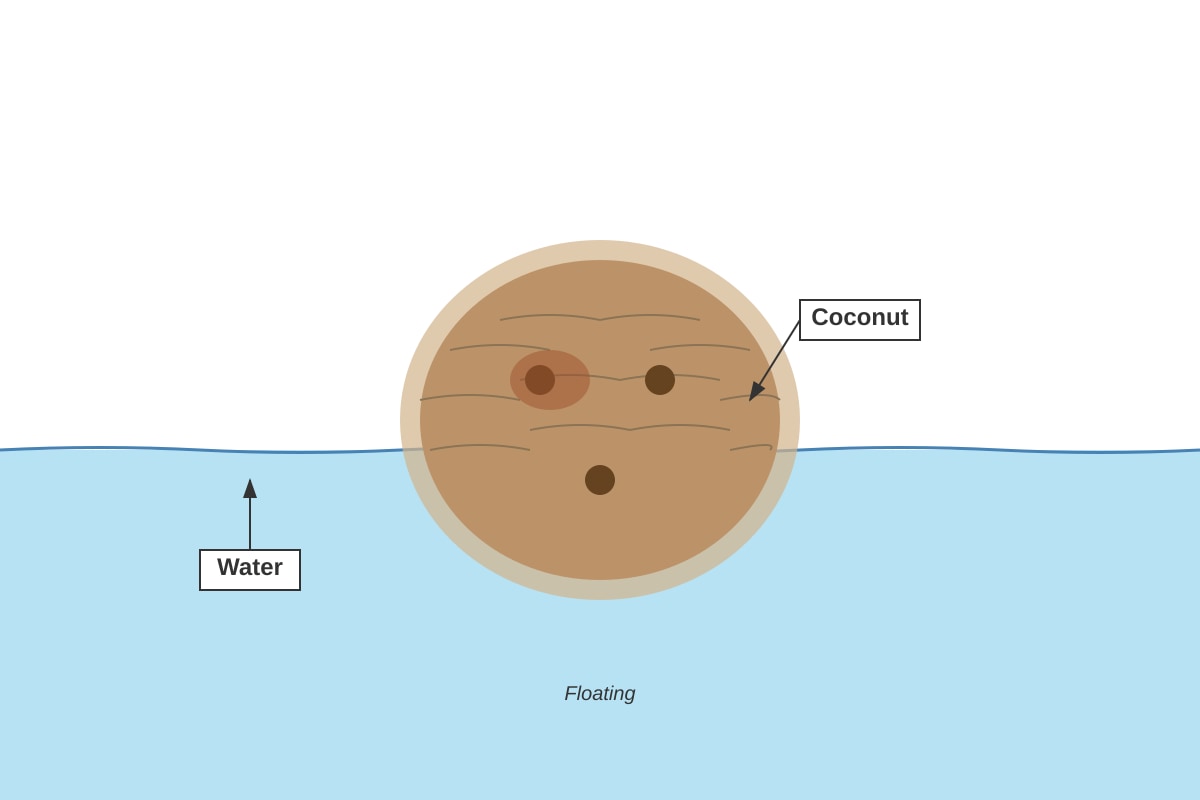
  10. The diagram below shows a fruit with a hard, waterproof outer coat. <image_placeholder> id: Q30-fig1 type: diagram linked_question: Q30 description: A coconut floating in water. It has a fibrous, buoyant outer layer. labels: Coconut, Water must_show: The fruit is floating. </image_placeholder>

    (a) How is this fruit dispersed? [1]


    (b) Explain how the features of this fruit help it to be dispersed by this method. [2]


    (c) Why is it important for the seed inside to have a hard coat? [1]


End of Paper

Answers

<!-- TuitionGoWhere generation metadata: stage=3-1; model=qwen/qwen3.7-plus; model_label=Qwen3.7 Plus; generated=2026-06-04; Sources: Stage 2-1 real exam-derived templates and Stage 2-2 exam-enriched syllabus. -->

Answer Key - Science Primary 5 (WA2 Version 4)

Section A (20 marks)

  1. (2) The nucleus contains genetic material and controls cell activities. (1) is wrong because animal cells lack cell walls. (3) is wrong because root cells lack chloroplasts. (4) is not a general rule.
  2. (2) The anther produces pollen grains, which contain the male reproductive cells.
  3. (1) The correct sequence is Pollination (transfer of pollen), Fertilisation (fusion of cells), Seed Dispersal (spreading seeds), and Germination (growth of new plant).
  4. (3) Wind-dispersed seeds are light and often have wings or hairs to catch the wind.
  5. (3) Fertilisation in humans occurs in the oviduct (fallopian tube).
  6. (3) The uterus is where the baby develops, not where fertilisation occurs. Fertilisation happens in the oviduct.
  7. (2) Reproduction ensures that the species continues to exist and does not become extinct.
  8. (2) The larva (caterpillar) is the feeding stage of the butterfly life cycle.
  9. (3) Chickens are birds and lay eggs. Cats, dogs, and humans give birth to live young.
  10. (2) The seed coat protects the delicate embryo inside from physical damage and prevents it from drying out.
  11. (4) Sunlight is not required for germination. Seeds can germinate in the dark (underground). Water, air, and suitable temperature are essential.
  12. (2) Tube B has water (wet cotton) and air (not submerged). Tube A lacks water. Tube C lacks air (boiled water removes dissolved air, oil prevents air from entering).
  13. (3) Spore formation is a form of asexual reproduction (e.g., in ferns and mosses). Pollination and fertilisation are part of sexual reproduction.
  14. (2) Ferns produce spores in spore sacs usually found on the underside of their fronds (leaves).
  15. (3) Sexual reproduction involves two parents and the fusion of male and female gametes.
  16. (3) Brightly coloured petals attract insects and other animals for pollination.
  17. (3) Strawberries are eaten by animals, and the seeds are passed out in droppings. Coconut is water-dispersed. Balsam is explosive. Maple is wind-dispersed.
  18. (1) Dispersal reduces overcrowding and competition for resources like water, nutrients, and sunlight between the parent and offspring.
  19. (3) If the egg is not fertilised, the lining of the uterus breaks down and is released along with the egg during menstruation.
  20. (1) Both flowering plants and humans reproduce sexually, involving the fusion of male and female reproductive cells.

Section B (40 marks)

(a) A: Anther [1], B: Stigma [1] (b) To protect the ovules / To develop into a fruit after fertilisation. [1] (c) To attract insects/pollinators for pollination. [1]

(a) Fertilisation [1] (b) The male reproductive cell (from pollen) fuses with the female reproductive cell (egg) in the ovary. [2] (1 mark for mentioning fusion, 1 mark for male/female cells) (c) A new plant / A seedling. [1]

(a) Fruit P: Wind [1], Fruit Q: Animals [1], Fruit R: Animals [1] (b) The hooks attach to the fur of animals or clothing of humans. [1] This allows the fruit to be carried away from the parent plant. [1]

(a) X: Ovary [1], Z: Uterus [1] (b) Y [1] (c) It is where the fertilised egg implants and develops into a baby. [1] It provides nourishment and protection to the developing baby. [1]

(a) To find out if water is necessary for seed germination. [1] (b) Temperature / Type of seeds / Amount of air / Light. [1] (Any one) (c) Cup B. [1] Because seeds need water to germinate, and Cup B provides water while Cup A does not. [1] (d) To make the results more reliable / To avoid errors due to a damaged or non-viable seed. [1]

(a) 3 [1] (b) The nymph does not have wings / The nymph is smaller than the adult. [1] (c) Yes. [1] Because the young (nymph) looks different from the adult (in terms of size and wings) and goes through changes to become an adult. [1] (Note: Some syllabi define metamorphosis strictly as having a pupal stage, but generally, incomplete metamorphosis is still metamorphosis. If the syllabus strictly requires 4 stages for "metamorphosis", the answer might be No, but typically P5 accepts incomplete metamorphosis as metamorphosis. However, to be safe with standard P5 definitions: "No, it undergoes incomplete metamorphosis" or "Yes, it changes form." Let's stick to the standard: It undergoes incomplete metamorphosis. The question asks "Does it undergo metamorphosis?". Answer: Yes. Explanation: It changes from a nymph to an adult.) Correction for P5 Standard: Often P5 distinguishes between "Metamorphosis" (4 stages) and "No Metamorphosis" (3 stages, young look like adults). If the school follows the strict 4-stage definition for the word "Metamorphosis" in exams: Alternative Answer: No. [1] The young (nymph) looks like the adult and there is no pupal stage. [1] (Note: Check specific school preference. Most MOE-aligned materials accept "Incomplete Metamorphosis". I will provide the "No" answer as it is a common distinction in P5 exams between 3-stage and 4-stage cycles.) Revised Answer for 26(c): No. [1] The nymph resembles the adult and there is no pupal stage. [1]

(a) M: Testis [1], N: Sperm Duct [1] (b) Sperm / Male reproductive cells. [1] (c) To keep the temperature lower than body temperature, which is suitable for sperm production. [1]

(a) Sunlight is not necessary for seed germination. [1] (b) 1. Water [1], 2. Air (Oxygen) [1], 3. Suitable temperature [1]

Pollination is the transfer of pollen grains from the anther to the stigma. [1] Fertilisation is the fusion of the male reproductive cell with the female reproductive cell. [1]

(a) Water. [1] (b) It has a fibrous, buoyant outer layer that traps air, allowing it to float on water. [1] This allows it to be carried by water currents to new locations. [1] (c) To protect the seed from salt water damage and physical damage while floating. [1]