From Real Exams Exam Paper

Primary 5 Science Weighted Assessment 2 (Term 3) Paper 2

Free Exam-Derived Qwen3.7 Plus Primary 5 Science Weighted Assessment 2 (Term 3) Paper 2 practice paper with questions and answers for Singapore students. This page is rendered as a direct URL so the questions and answers can be discovered without pressing in-page buttons.

These static practice materials are generated from the site's syllabus and paper-generation workflow, with source and model context shown so students and parents can evaluate the material before use.

Primary 5 Science From Real Exams Generated by Qwen3.7 Plus Updated 2026-06-04

Questions

<!-- TuitionGoWhere generation metadata: stage=3-1; model=qwen/qwen3.7-plus; model_label=Qwen3.7 Plus; generated=2026-06-04; Sources: Stage 2-1 real exam-derived templates and Stage 2-2 exam-enriched syllabus. -->

TuitionGoWhere Practice Paper - Science Primary 5

TuitionGoWhere Exam Practice (AI)

Subject: Science
Level: Primary 5
Paper: WA2 (Version 2 of 5)
Duration: 1 hour 45 minutes
Total Marks: 56
Name: __________________________
Class: __________
Date: __________________________

Instructions to Candidates:

  1. This paper consists of two sections: Section A and Section B.
  2. Answer all questions.
  3. Write your answers in the spaces provided.
  4. For questions in Section A, choose the correct answer (1, 2, 3 or 4) and write the number in the brackets provided.
  5. The use of calculators is not allowed.

Section A (28 marks)

For each question from 1 to 28, four options are given. One of them is the correct answer. Make your choice (1, 2, 3 or 4) and write the number in the brackets provided. Each question carries 1 mark.

1. Which of the following statements about cells is correct? (1) All cells have a cell wall. (2) The nucleus controls the activities of the cell. (3) Chloroplasts are found in all plant and animal cells. (4) Cells are the smallest unit of non-living things. [____]

2. The diagram below shows the reproductive parts of a flower. <image_placeholder> id: Q2-fig1 type: diagram linked_question: Q2 description: A cross-section of a flower showing the stigma, style, ovary, anther, and filament. The stigma is at the top of the style, leading down to the ovary which contains ovules. The anther is on a filament, positioned to the side. labels: Stigma, Style, Ovary, Anther, Filament must_show: Clear distinction between male parts (anther/filament) and female parts (stigma/style/ovary). </image_placeholder> Which part produces the male reproductive cells? (1) Stigma (2) Anther (3) Ovary (4) Style [____]

3. Which of the following is a characteristic of sexual reproduction in plants? (1) It involves only one parent. (2) The offspring are identical to the parent. (3) It involves the fusion of male and female reproductive cells. (4) It occurs only in non-flowering plants. [____]

4. Study the flowchart below. Pollen grains \rightarrow Process X \rightarrow Fertilisation \rightarrow Process Y \rightarrow New Plant What are Process X and Process Y? (1) X: Germination, Y: Pollination (2) X: Pollination, Y: Seed Dispersal (3) X: Pollination, Y: Germination (4) X: Fertilisation, Y: Growth [____]

5. Which of the following seeds is most likely dispersed by water? (1) A seed with hooks (2) A seed with a hard, waterproof coat and air spaces (3) A seed with wing-like structures (4) A seed inside a juicy fruit [____]

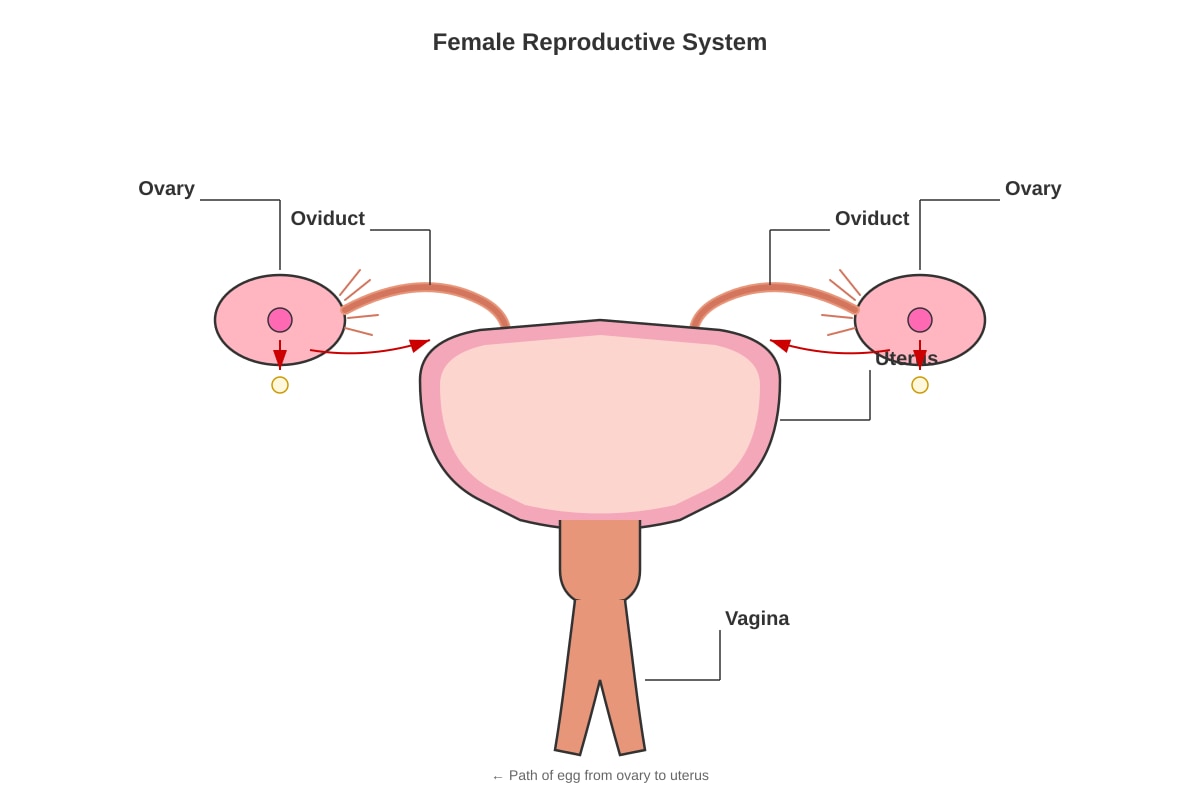
6. The diagram shows the human reproductive system. <image_placeholder> id: Q6-fig1 type: diagram linked_question: Q6 description: A simplified diagram of the female reproductive system. Labels point to the Ovary, Oviduct (Fallopian tube), Uterus (Womb), and Cervix/Vagina. labels: Ovary, Oviduct, Uterus, Vagina must_show: The path from ovary to uterus. </image_placeholder> Where does fertilisation usually take place? (1) Ovary (2) Oviduct (3) Uterus (4) Vagina [____]

7. Which of the following is NOT a condition needed for seed germination? (1) Water (2) Warmth (3) Air (Oxygen) (4) Sunlight [____]

8. Why do plants disperse their seeds away from the parent plant? (1) To attract more pollinators (2) To reduce overcrowding and competition for resources (3) To ensure the seeds get more sunlight immediately (4) To help the seeds grow faster [____]

9. Which of the following animals reproduces by laying eggs? (1) Cat (2) Dog (3) Chicken (4) Human [____]

10. In humans, which organ produces sperm? (1) Penis (2) Testes (3) Urethra (4) Prostate gland [____]

11. Which of the following is a similarity between reproduction in flowering plants and humans? (1) Both involve the fusion of male and female reproductive cells. (2) Both take place in the same organ. (3) Both produce seeds. (4) Both require wind for fertilisation. [____]

12. The table below shows the characteristics of three fruits, P, Q, and R.

FruitCharacteristic
PLight and has wing-like structures
QBrightly coloured and juicy
RHas hooks or spines

Which method of seed dispersal corresponds to Fruit Q? (1) Wind (2) Water (3) Animals (Internal) (4) Animals (External) [____]

13. What happens to the ovary after fertilisation in a flowering plant? (1) It falls off immediately. (2) It develops into a fruit. (3) It develops into a seed. (4) It turns into a flower petal. [____]

14. Which of the following statements about the life cycle of a flowering plant is correct? (1) Seed \rightarrow Young Plant \rightarrow Adult Plant \rightarrow Flower \rightarrow Fruit/Seed (2) Flower \rightarrow Seed \rightarrow Young Plant \rightarrow Adult Plant (3) Seed \rightarrow Flower \rightarrow Fruit \rightarrow Young Plant (4) Adult Plant \rightarrow Seed \rightarrow Flower \rightarrow Fruit [____]

15. Why is biodiversity important in an ecosystem? (1) It ensures that only the strongest species survive. (2) It makes the ecosystem more stable and resilient to changes. (3) It reduces the number of food chains. (4) It allows humans to build more houses. [____]

16. Which of the following is an example of a habitat? (1) A pond (2) A fish (3) A tree (4) A rock [____]

17. Organisms are classified into groups based on their similarities. Which of the following is a basis for classification? (1) Colour of the organism (2) Size of the organism (3) Presence or absence of a backbone (4) Where the organism lives [____]

18. Which of the following groups contains only mammals? (1) Whale, Dolphin, Bat (2) Shark, Whale, Seal (3) Penguin, Ostrich, Chicken (4) Frog, Toad, Newt [____]

19. What is the basic unit of classification in biology? (1) Kingdom (2) Phylum (3) Species (4) Class [____]

20. Which of the following statements about fungi is correct? (1) They can make their own food through photosynthesis. (2) They have chlorophyll. (3) They obtain nutrients from dead or decaying organic matter. (4) They are classified as plants. [____]


Section B (28 marks)

Answer all questions. Write your answers in the spaces provided. The number of marks available for each question or part is indicated in brackets.

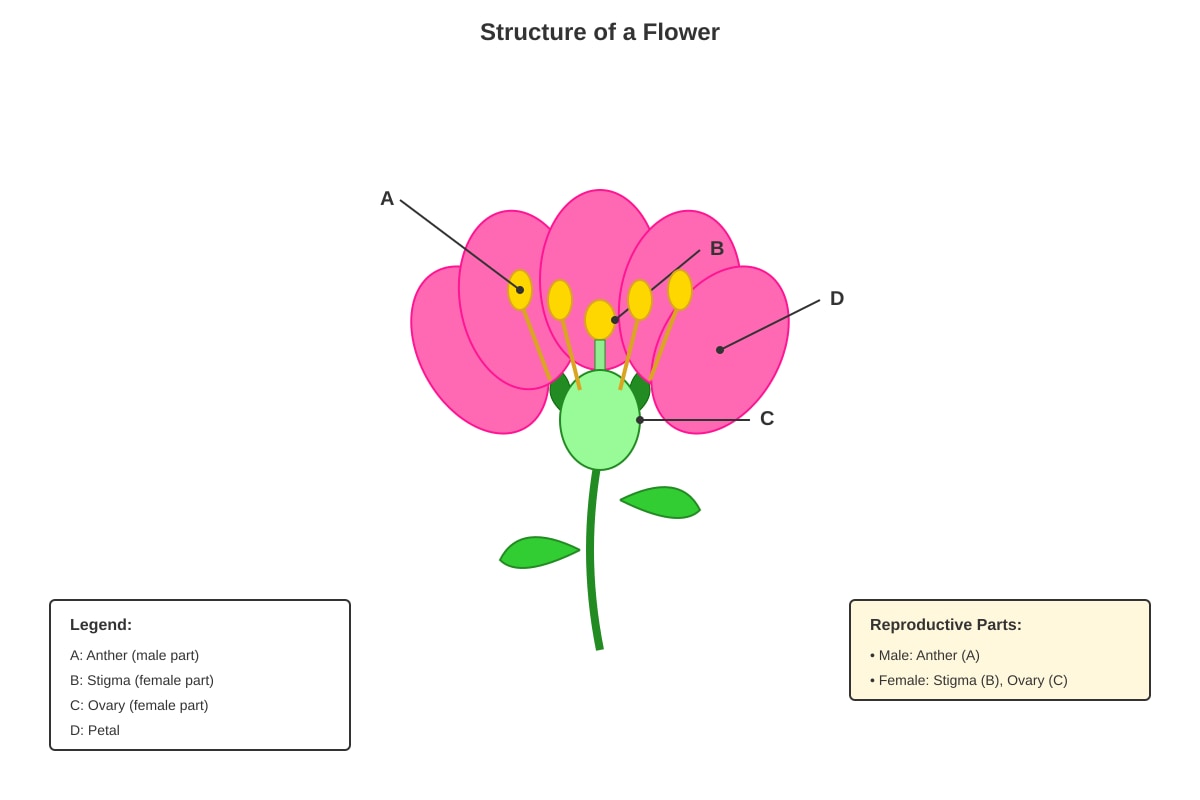
21. The diagram below shows the structure of a flower. <image_placeholder> id: Q21-fig1 type: diagram linked_question: Q21 description: A detailed diagram of a flower with labels A, B, C, and D. A points to the Anther, B points to the Stigma, C points to the Ovary, and D points to the Petal. labels: A: Anther, B: Stigma, C: Ovary, D: Petal must_show: Clear labels for male and female reproductive parts. </image_placeholder>

(a) Identify parts A and B. [2] Part A: __________________________ Part B: __________________________

(b) State the function of Part C. [1]


(c) Explain why Part D is often brightly coloured. [1]


22. John conducted an experiment to find out if sunlight is needed for seed germination. He set up two pots, A and B, as shown below. <image_placeholder> id: Q22-fig1 type: diagram linked_question: Q22 description: Two pots with soil and seeds. Pot A is placed in a sunny window. Pot B is placed in a dark cupboard. Both pots have equal amounts of water and soil. labels: Pot A: Sunlight, Water, Soil; Pot B: No Sunlight, Water, Soil must_show: Contrast in light conditions. </image_placeholder>

(a) What is the independent variable in this experiment? [1]


(b) State two variables that must be kept constant. [2]


(c) After one week, seeds in both Pot A and Pot B germinated. What conclusion can John make about sunlight and seed germination? [1]


(d) Why did John use more than one seed in each pot? [1]


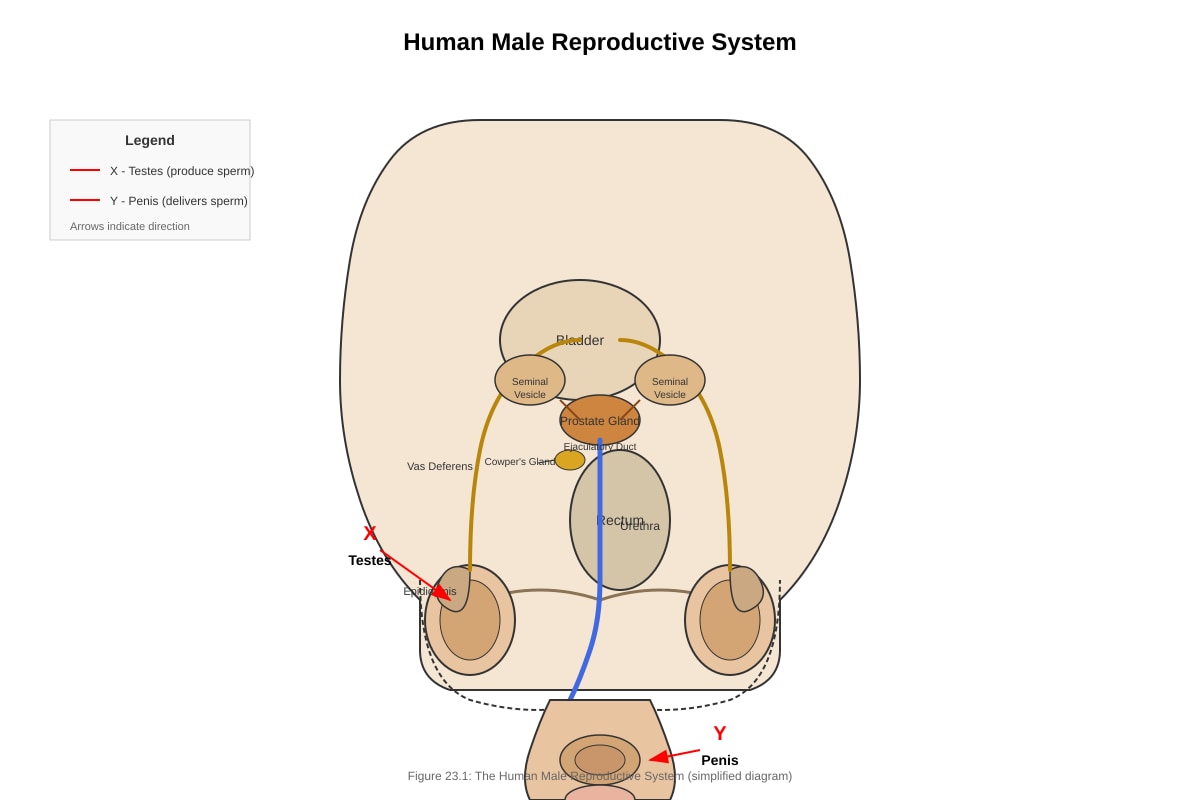
23. The diagram below shows the human reproductive system. <image_placeholder> id: Q23-fig1 type: diagram linked_question: Q23 description: Diagram of the male reproductive system. Label X points to the Testes, Label Y points to the Penis/Urethra area. labels: X: Testes, Y: Penis must_show: Internal and external structures. </image_placeholder>

(a) Name the part labelled X. [1]


(b) What is produced by part X? [1]


(c) Explain the importance of fertilisation in humans. [2]


24. Study the life cycle of a bean plant below. Stage A: Seed \rightarrow Stage B: Seedling \rightarrow Stage C: Adult Plant with Flowers \rightarrow Stage D: Fruit with Seeds

(a) Which stage represents the result of successful pollination and fertilisation? [1]


(b) Describe how the seeds in Stage D are dispersed if the fruit is dry and splits open suddenly. [1]


(c) Why is it important for the seedling (Stage B) to have leaves? [1]


25. The table below shows the characteristics of four different seeds.

SeedMassSurface Feature
WLightSmooth
XHeavyHooks
YLightWing-like
ZMediumJuicy Flesh

(a) Which seed is most likely dispersed by wind? Give a reason for your answer. [2] Seed: __________ Reason: _________________________________________________________________________

(b) Which seed is most likely dispersed by animals externally? Give a reason for your answer. [2] Seed: __________ Reason: _________________________________________________________________________

26. Classify the following animals into two groups based on one observable characteristic. Animals: Eagle, Goldfish, Cat, Shark, Sparrow, Guppy

(a) State the characteristic used for classification. [1]


(b) Group the animals. [2] Group 1: __________________________ Group 2: __________________________

27. Biodiversity refers to the variety of living things in an ecosystem.

(a) Give one reason why maintaining biodiversity is important for humans. [1]


(b) Human activities can threaten biodiversity. State one human activity that harms biodiversity and explain how it affects the ecosystem. [2] Activity: __________________________ Explanation: _________________________________________________________________________


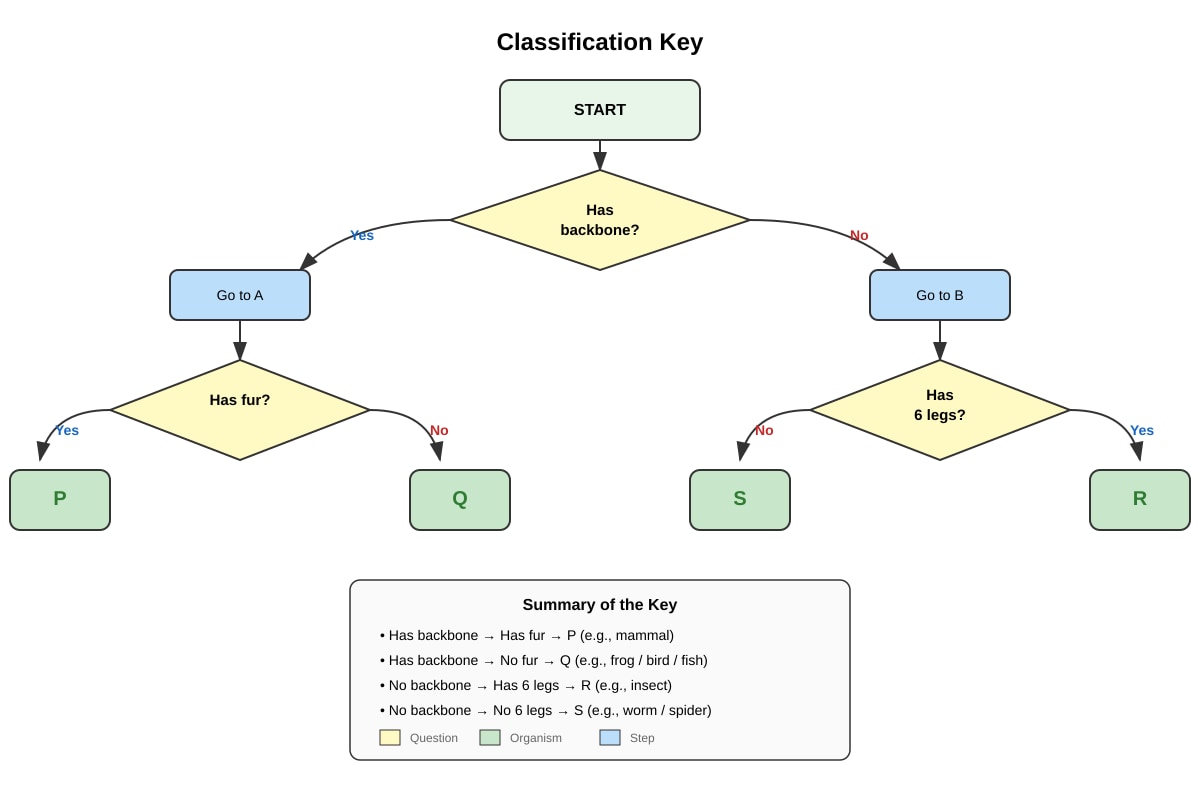
28. The diagram below shows a classification key for four organisms: P, Q, R, and S. <image_placeholder> id: Q28-fig1 type: chart linked_question: Q28 description: A simple branching key. Start: Has backbone? Yes -> Go to A. No -> Go to B. A: Has fur? Yes -> P. No -> Q. B: Has 6 legs? Yes -> R. No -> S. labels: P, Q, R, S must_show: The logical flow of the key. </image_placeholder>

(a) Organism P has a backbone and fur. What type of animal is P likely to be? [1]


(b) Organism R has no backbone and 6 legs. What type of animal is R likely to be? [1]


(c) If Organism Q is a frog, does it fit the key? Explain your answer. [2]


Answers

<!-- TuitionGoWhere generation metadata: stage=3-1; model=qwen/qwen3.7-plus; model_label=Qwen3.7 Plus; generated=2026-06-04; Sources: Stage 2-1 real exam-derived templates and Stage 2-2 exam-enriched syllabus. -->

TuitionGoWhere Practice Paper - Science Primary 5 (WA2 Version 2)

Answer Key and Marking Scheme

Section A (28 marks)

Each correct answer carries 1 mark.

  1. (2) The nucleus contains genetic material and controls cell activities. Cell walls are only in plants/fungi/bacteria. Chloroplasts are only in plant cells. Cells are the basic unit of living things.
  2. (2) The anther produces pollen grains, which contain the male reproductive cells.
  3. (3) Sexual reproduction involves the fusion of male (sperm/pollen) and female (egg/ovule) reproductive cells.
  4. (3) Pollination is the transfer of pollen to the stigma. After fertilisation, the seed develops and eventually germinates to form a new plant.
  5. (2) Seeds dispersed by water are usually light, have air spaces for buoyancy, and have a waterproof coat to prevent rotting.
  6. (2) Fertilisation in humans typically occurs in the oviduct (fallopian tube), where the sperm meets the egg.
  7. (4) Sunlight is NOT needed for germination. Seeds germinate underground where there is no light. They need water, warmth, and oxygen.
  8. (2) Dispersal reduces competition between the parent plant and offspring for water, nutrients, sunlight, and space.
  9. (3) Chickens are birds and lay eggs. Cats, dogs, and humans are mammals that give birth to live young.
  10. (2) The testes produce sperm and male sex hormones.
  11. (1) Both flowering plants and humans reproduce sexually, involving the fusion of male and female gametes.
  12. (3) Juicy, brightly coloured fruits attract animals to eat them. The seeds pass through the digestive tract and are excreted elsewhere (internal dispersal).
  13. (2) After fertilisation, the ovary swells and develops into a fruit, which protects the seeds.
  14. (1) The correct sequence is Seed \rightarrow Young Plant \rightarrow Adult Plant \rightarrow Flower \rightarrow Fruit/Seed.
  15. (2) High biodiversity makes an ecosystem more stable because if one species declines, others can fill its role, preventing ecosystem collapse.
  16. (1) A habitat is the natural home or environment of an organism. A pond is a habitat; a fish is an organism.
  17. (3) Classification is based on structural characteristics, such as the presence of a backbone (vertebrates vs invertebrates), not colour or size which can vary.
  18. (1) Whales, dolphins, and bats are all mammals (they have fur/hair, give birth to live young, and produce milk). Sharks are fish; penguins are birds; frogs are amphibians.
  19. (3) Species is the most specific and basic unit of classification.
  20. (3) Fungi are heterotrophs; they cannot photosynthesise as they lack chlorophyll. They absorb nutrients from dead or decaying matter.

Section B (28 marks)

21. (a) Part A: Anther [1] Part B: Stigma [1] (b) Function of Part C (Ovary): To protect the ovules / To develop into a fruit after fertilisation. [1] Teaching Note: Accept "contains ovules" or "becomes the fruit". (c) Reason for bright colours: To attract insects/animals for pollination. [1]

22. (a) Independent variable: Presence of sunlight / Light conditions. [1] (b) Constant variables (Any 2): Amount of water, Type of soil, Number of seeds, Type of seeds, Size of pot. [2] Teaching Note: Must be specific. "Environment" is too vague. (c) Conclusion: Sunlight is NOT needed for seed germination. [1] Teaching Note: Since both germinated, the lack of light in B did not stop the process. (d) Reason for multiple seeds: To ensure the results are reliable / To avoid errors due to a defective seed. [1]

23. (a) Part X: Testes [1] (b) Produced by X: Sperm [1] (c) Importance of fertilisation: It combines the genetic material from the father and mother. This ensures the offspring has characteristics from both parents and ensures the continuity of the species. [2] Marking: 1 mark for "fusion of sperm and egg" or "combining genetic material", 1 mark for "continuity of species" or "formation of a new individual".

24. (a) Stage: Stage D (Fruit with Seeds) [1] Teaching Note: Fertilisation leads to seed formation, which is contained in the fruit. (b) Dispersal method: Explosive action / Splitting open. [1] (c) Importance of leaves: To trap sunlight for photosynthesis to make food for the young plant. [1]

25. (a) Seed: Y [1] Reason: It is light and has wing-like structures which help it to be carried by the wind. [1] (b) Seed: X [1] Reason: It has hooks which can attach to the fur of animals for external dispersal. [1]

26. (a) Characteristic: Presence of a backbone / Vertebrate vs Invertebrate OR Method of reproduction (Lays eggs vs Gives birth) OR Body covering (Scales vs Fur/Feathers). [1] Note: The most common P5 classification is Vertebrate/Invertebrate or by Class (Mammal, Bird, Fish). Let's assume Vertebrate/Invertebrate is not the best fit as all listed are vertebrates. Let's use Method of Respiration or Habitat. Correction: All listed (Eagle, Goldfish, Cat, Shark, Sparrow, Guppy) are vertebrates. Better characteristic: Type of covering or Reproduction. Let's use: Reproduction (Lays eggs vs Gives birth to live young). (b) Group 1 (Lays eggs): Eagle, Goldfish, Shark, Sparrow, Guppy [1] Group 2 (Gives birth): Cat [1] Alternative Valid Answer: Characteristic: Habitat (Water vs Land/Air) Group 1 (Water): Goldfish, Shark, Guppy Group 2 (Land/Air): Eagle, Cat, Sparrow

27. (a) Reason: Provides sources for medicine / food / raw materials. OR Maintains ecosystem balance. [1] (b) Activity: Deforestation / Pollution / Overhunting. [1] Explanation: Deforestation destroys the habitat of animals, causing them to lose their home and food source, which may lead to extinction. [1] Marking: 1 mark for activity, 1 mark for clear explanation linking to loss of biodiversity.

28. (a) Type of animal: Mammal [1] Teaching Note: Fur is a key characteristic of mammals. (b) Type of animal: Insect [1] Teaching Note: 6 legs is a key characteristic of insects. (c) Answer: No. [1] Explanation: A frog is an amphibian. It has a backbone, so it goes to path A. However, it does not have fur, so it would be classified as Q in this key. But frogs do not have fur, so if Q is defined as "No fur" under "Has backbone", it fits structurally. Wait, the question asks if it fits the key logic. Re-evaluation: The key says: Has Backbone? Yes -> A. Has Fur? Yes -> P. No -> Q. A frog has a backbone (Yes). A frog does not have fur (No). So it ends up at Q. The question asks: "If Organism Q is a frog, does it fit the key?" Answer: Yes, it fits the path. Correction: The question asks if it fits the classification. Let's look at the key again. Start: Backbone? Yes -> Has Fur? Yes -> P (Mammal) No -> Q (Non-fur vertebrate, e.g., Bird, Reptile, Amphibian, Fish) So, a frog fits into category Q. However, usually these questions ask if the key distinguishes it well or if the description matches. Let's assume the question implies: "Is the classification correct?" Answer: Yes. [1] Explanation: A frog has a backbone but does not have fur. Therefore, it follows the path to Q. [1] Alternative Interpretation: If the question implies Q is only birds, then no. But Q is just a label. Let's stick to the logic: Yes, because a frog has a backbone and no fur.