From Real Exams Exam Paper

Primary 5 Science Weighted Assessment 2 (Term 3) Paper 1

Free Exam-Derived Qwen3.7 Plus Primary 5 Science Weighted Assessment 2 (Term 3) Paper 1 practice paper with questions and answers for Singapore students. This page is rendered as a direct URL so the questions and answers can be discovered without pressing in-page buttons.

These static practice materials are generated from the site's syllabus and paper-generation workflow, with source and model context shown so students and parents can evaluate the material before use.

Primary 5 Science From Real Exams Generated by Qwen3.7 Plus Updated 2026-06-04

Questions

<!-- TuitionGoWhere generation metadata: stage=3-1; model=qwen/qwen3.7-plus; model_label=Qwen3.7 Plus; generated=2026-06-04; Sources: Stage 2-1 real exam-derived templates and Stage 2-2 exam-enriched syllabus. -->

TuitionGoWhere Exam Practice (AI) - Science Primary 5

School: TuitionGoWhere Exam Practice (AI)
Subject: Science
Level: Primary 5
Paper: WA2 (Practice Paper) - Version 1
Duration: 1 hour 45 minutes
Total Marks: 56

Name: __________________________
Class: ___________
Date: __________________________


Instructions to Candidates:

  1. This paper consists of two sections: Section A and Section B.
  2. Answer all questions.
  3. Write your answers in the spaces provided in this booklet.
  4. For questions in Section B, you need to give explanations in complete sentences where necessary.

Section A (28 marks)

Questions 1 to 14 carry 2 marks each. For each question, four options are given. One of them is the correct answer. Make your choice (1, 2, 3 or 4) and write your answer in the bracket provided.

1. Which of the following statements about cells is correct? (1) All cells have a cell wall. (2) The nucleus controls the activities of the cell. (3) Plant cells do not have a cell membrane. (4) Animal cells contain chloroplasts for photosynthesis.

( )

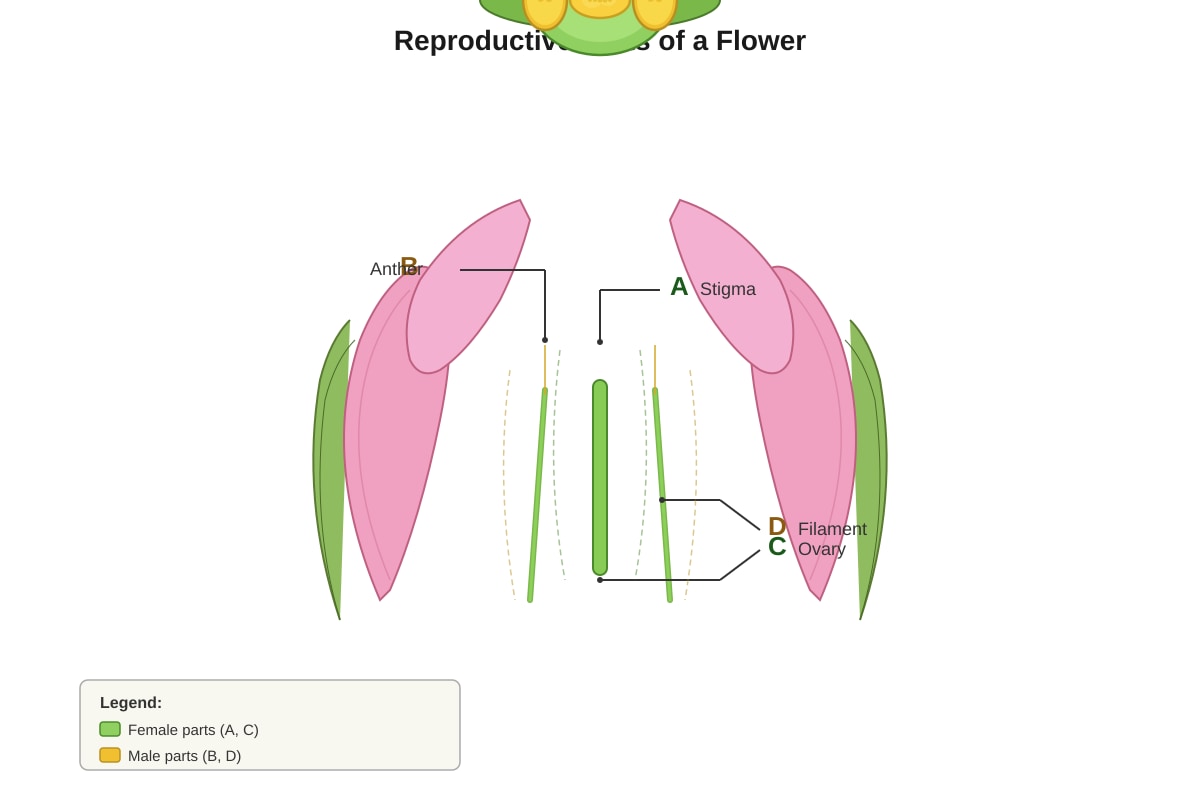
2. The diagram below shows the reproductive parts of a flower.

<image_placeholder> id: Q2-fig1 type: diagram linked_question: Q2 description: A cross-section of a flower showing four labelled parts. Part A is the stigma (top of female part), Part B is the anther (top of male part), Part C is the ovary (base of female part), Part D is the filament (stalk of male part). labels: A, B, C, D must_show: Clear distinction between male parts (B, D) and female parts (A, C). </image_placeholder>

Which parts are involved in the transfer of pollen during pollination? (1) A and B (2) A and D (3) B and C (4) C and D

( )

3. Which of the following is a characteristic of sexual reproduction in humans? (1) Offspring are identical to the parents. (2) It involves only one parent. (3) It involves the fusion of sperm and egg. (4) New individuals grow from a part of the parent’s body.

( )

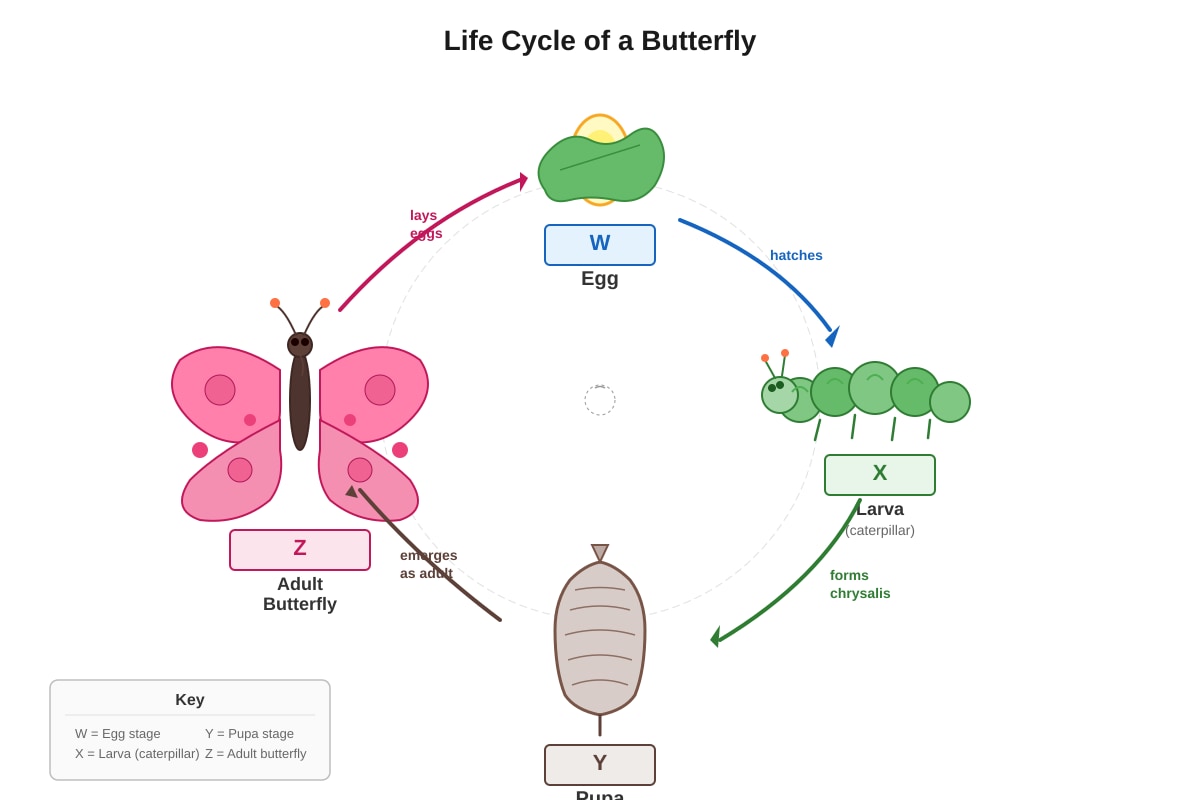
4. Study the life cycle of a butterfly below.

<image_placeholder> id: Q4-fig1 type: diagram linked_question: Q4 description: A circular life cycle diagram with four stages. Stage W is Egg, Stage X is Larva (caterpillar), Stage Y is Pupa, Stage Z is Adult Butterfly. Arrows show the direction W -> X -> Y -> Z -> W. labels: W, X, Y, Z must_show: Distinct shapes for egg, caterpillar, pupa, and butterfly. </image_placeholder>

During which stage does the butterfly feed the most to store energy for reproduction? (1) W (2) X (3) Y (4) Z

( )

5. Which of the following plants reproduces by spores? (1) Rose (2) Fern (3) Mango (4) Hibiscus

( )

6. The table below shows the characteristics of two fruits, P and Q.

FruitCharacteristics
PLight, has wing-like structures
QFibrous, waterproof skin

How are fruits P and Q most likely dispersed? (1) P: By wind; Q: By water (2) P: By animals; Q: By wind (3) P: By water; Q: By splitting action (4) P: By splitting action; Q: By animals

( )

7. Why is seed dispersal important for plants? (1) To ensure seeds germinate quickly. (2) To reduce overcrowding and competition for resources. (3) To attract more animals to the parent plant. (4) To increase the number of flowers on the parent plant.

( )

8. Which of the following sequences correctly shows the process of sexual reproduction in flowering plants? (1) Pollination → Fertilisation → Seed Dispersal → Germination (2) Fertilisation → Pollination → Germination → Seed Dispersal (3) Germination → Pollination → Fertilisation → Seed Dispersal (4) Seed Dispersal → Germination → Pollination → Fertilisation

( )

9. In humans, where does fertilisation usually take place? (1) Ovary (2) Uterus (3) Oviduct (4) Vagina

( )

10. Which of the following is not a condition required for seed germination? (1) Water (2) Air (Oxygen) (3) Suitable temperature (4) Sunlight

( )

11. A student set up an experiment to test the conditions for germination. He placed seeds in four different test tubes.

<image_placeholder> id: Q11-fig1 type: diagram linked_question: Q11 description: Four test tubes labeled A, B, C, D. Tube A: Seeds in dry cotton wool (no water). Tube B: Seeds in wet cotton wool, tube open to air. Tube C: Seeds completely submerged in boiled water (no air) with a layer of oil on top. Tube D: Seeds in wet cotton wool inside a closed fridge (low temperature). labels: A, B, C, D values: Tube B is at room temperature. must_show: Clear difference in water level, air exposure, and temperature context. </image_placeholder>

In which test tube will the seeds most likely germinate? (1) A (2) B (3) C (4) D

( )

12. Which of the following statements about asexual reproduction is true? (1) It produces genetically different offspring. (2) It involves the fusion of male and female reproductive cells. (3) It is faster than sexual reproduction. (4) It requires two parents.

( )

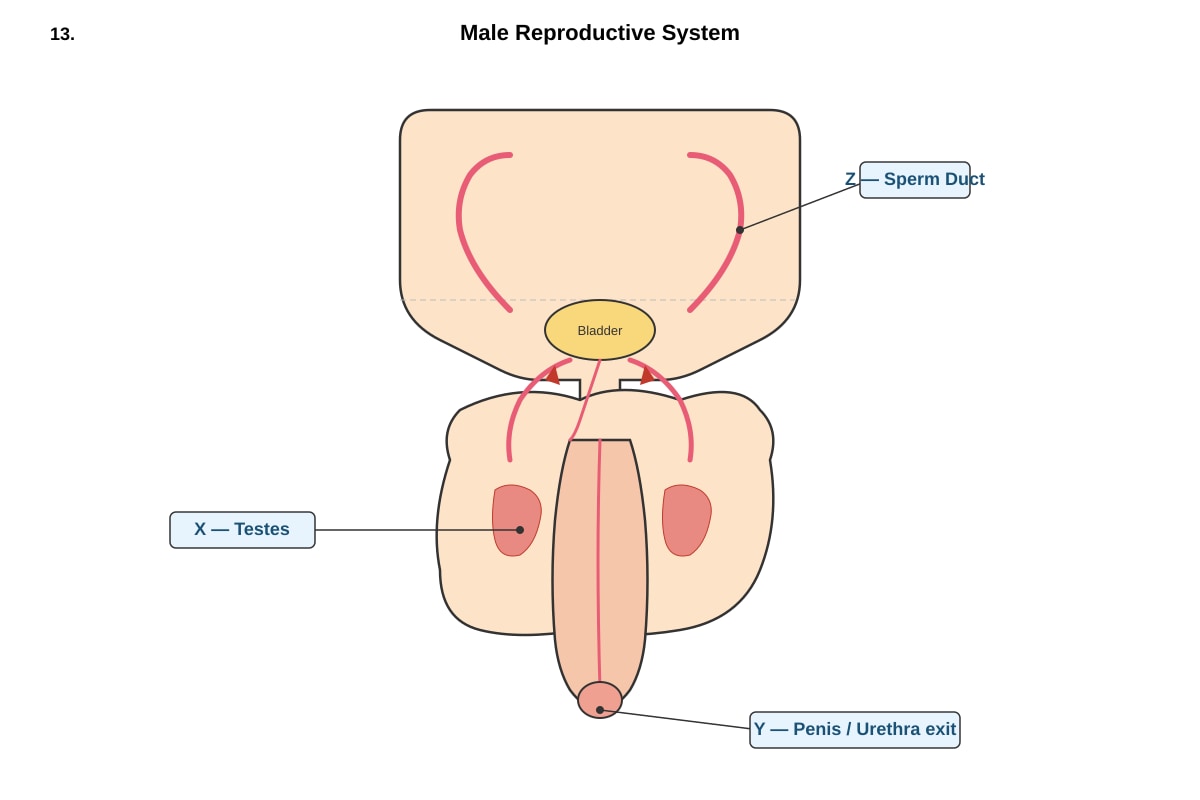
13. The diagram below shows the male reproductive system.

<image_placeholder> id: Q13-fig1 type: diagram linked_question: Q13 description: Diagram of male reproductive system. Label X points to the Testes. Label Y points to the Penis/Urethra exit. Label Z points to the Sperm Duct. labels: X, Y, Z must_show: Anatomical correctness suitable for Primary 5 level. </image_placeholder>

What is the function of part X? (1) To produce sperm (2) To transport sperm (3) To release urine and sperm (4) To provide nutrients to the sperm

( )

14. Which of the following animals undergoes a three-stage life cycle? (1) Frog (2) Cockroach (3) Butterfly (4) Mosquito

( )


Section B (28 marks)

Answer all questions in the spaces provided. The number of marks available for each question or part-question is given in brackets [ ].

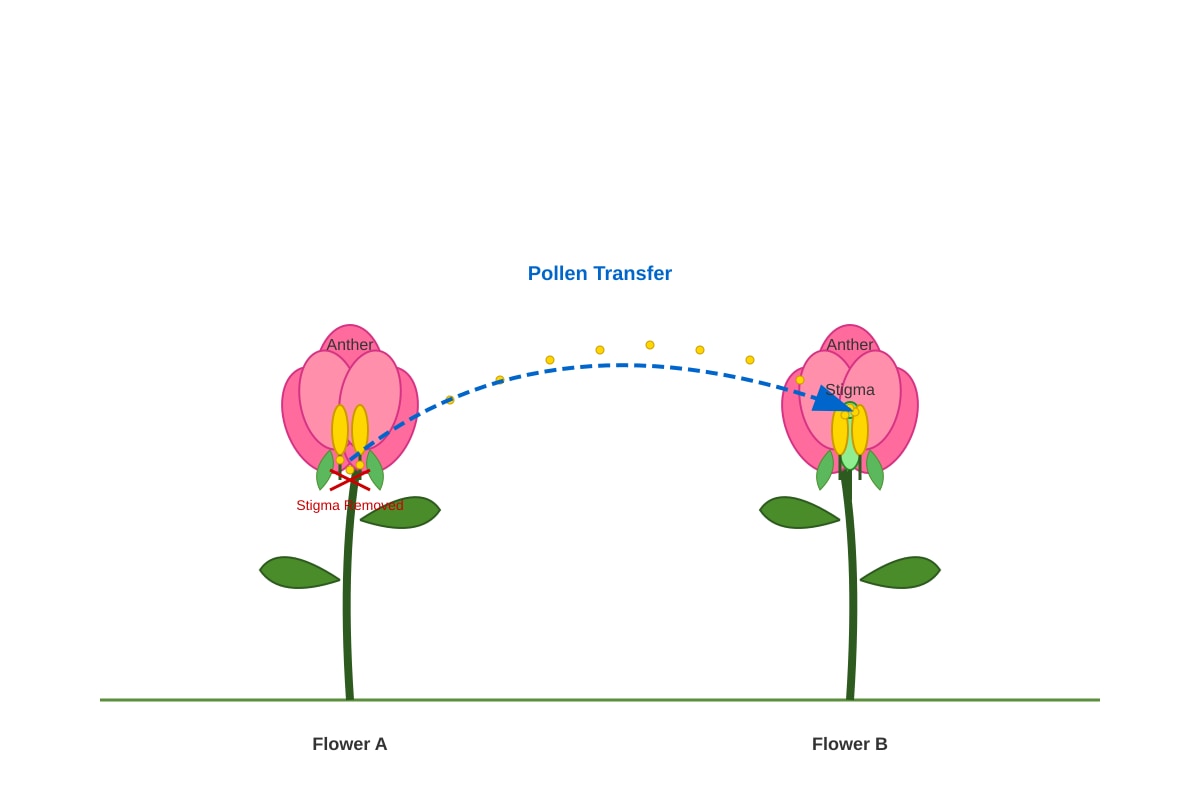
15. The diagram below shows a flower and its reproductive parts.

<image_placeholder> id: Q15-fig1 type: diagram linked_question: Q15 description: A flower with the stigma removed. The anther is intact. An arrow shows pollen falling from the anther onto the stigma of a different flower. labels: None required, visual context only. must_show: Pollen moving from one flower to another. </image_placeholder>

(a) Name the process shown in the diagram. [1]


(b) Explain why this process is important for the formation of seeds. [2]


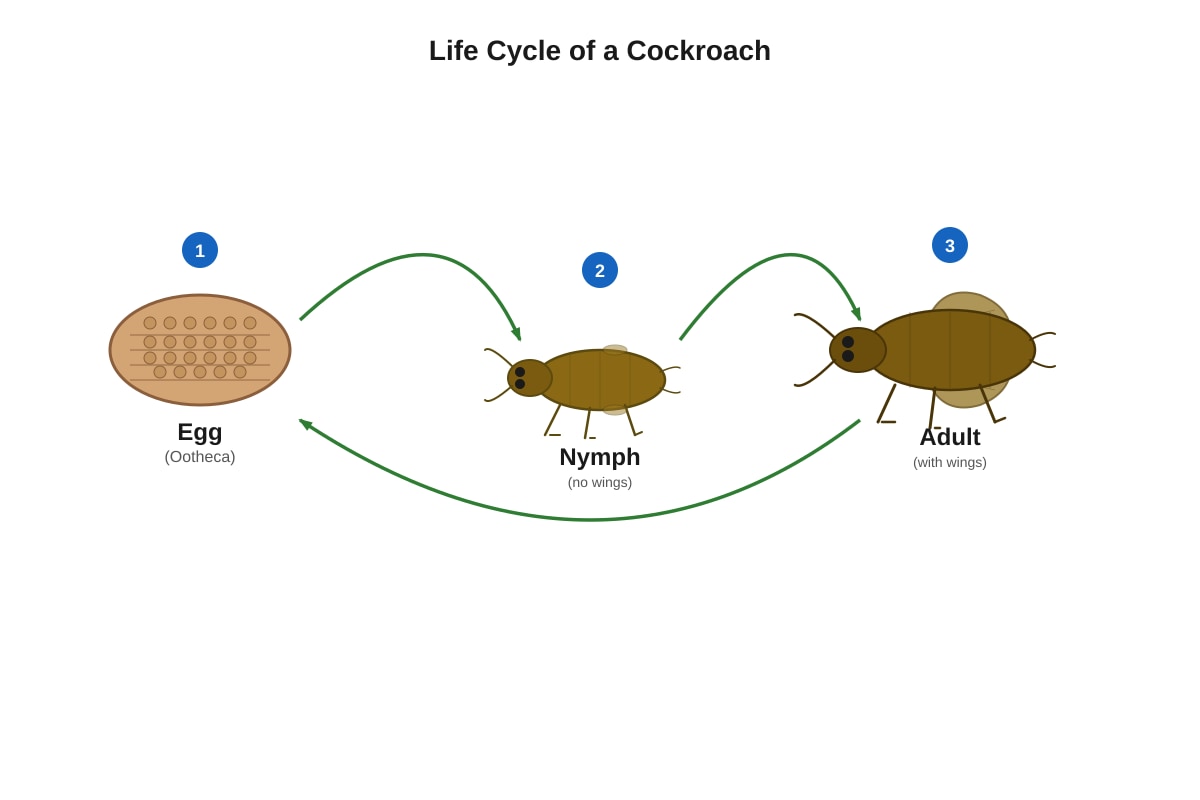
16. Study the life cycle of a cockroach below.

<image_placeholder> id: Q16-fig1 type: diagram linked_question: Q16 description: Three stages: Egg case (ootheca), Nymph (small cockroach, no wings), Adult (large cockroach, with wings). Arrows connect them in a cycle. labels: Egg, Nymph, Adult must_show: Nymph looks like a smaller version of the adult. </image_placeholder>

(a) How many stages are there in the life cycle of a cockroach? [1]


(b) State one similarity between the nymph and the adult cockroach. [1]


(c) Why does the nymph need to moult? [1]


17. Jane conducted an experiment to find out if sunlight is needed for seed germination. She set up two pots, A and B, with the same type of seeds and soil.

  • Pot A: Placed in a sunny spot. Watered daily.
  • Pot B: Placed in a dark cupboard. Watered daily.

After one week, seeds in both pots germinated.

(a) Was Jane’s hypothesis that "sunlight is needed for germination" supported by the results? Explain your answer. [2]


(b) Why did the seedlings in Pot B look yellow and weak after two weeks, while those in Pot A were green and healthy? [2]


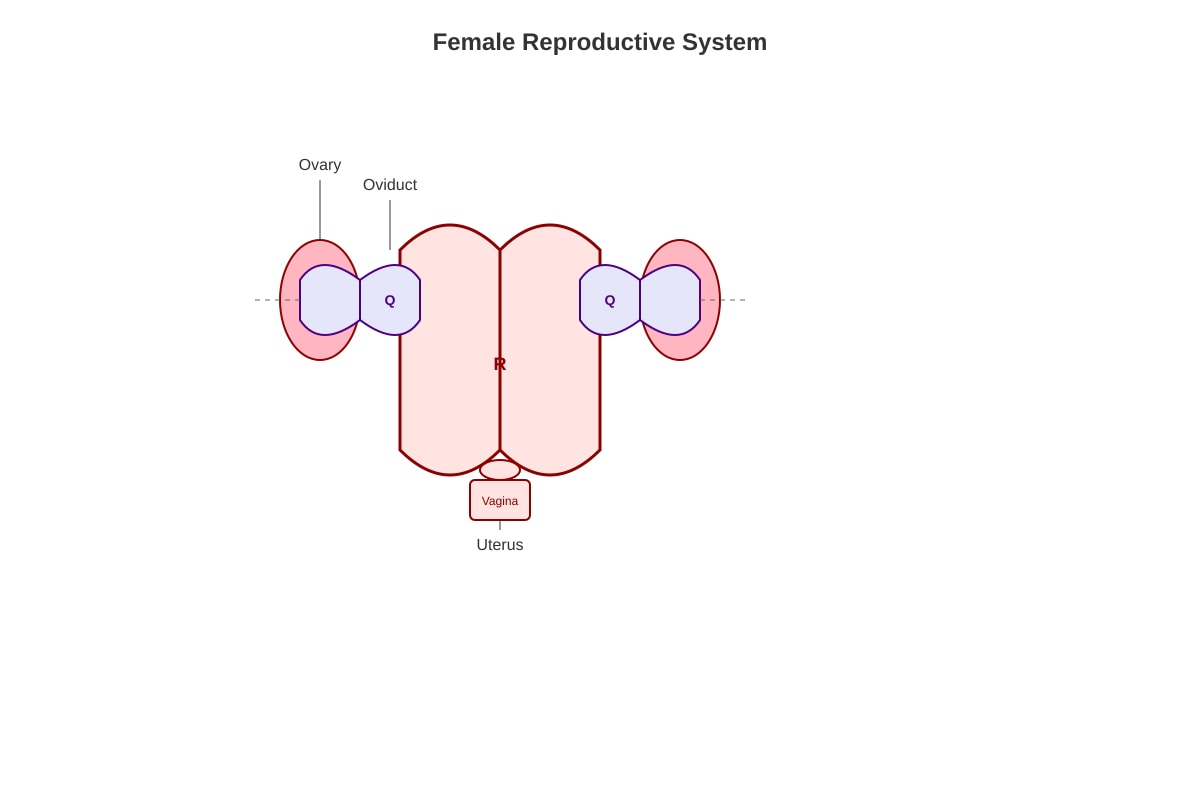
18. The diagram below shows the female reproductive system.

<image_placeholder> id: Q18-fig1 type: diagram linked_question: Q18 description: Female reproductive system. Label P is Ovary. Label Q is Oviduct. Label R is Uterus. labels: P, Q, R must_show: Clear connection between ovary, oviduct, and uterus. </image_placeholder>

(a) Where are eggs produced? [1]


(b) If part Q is blocked, explain why a woman may not be able to get pregnant. [2]


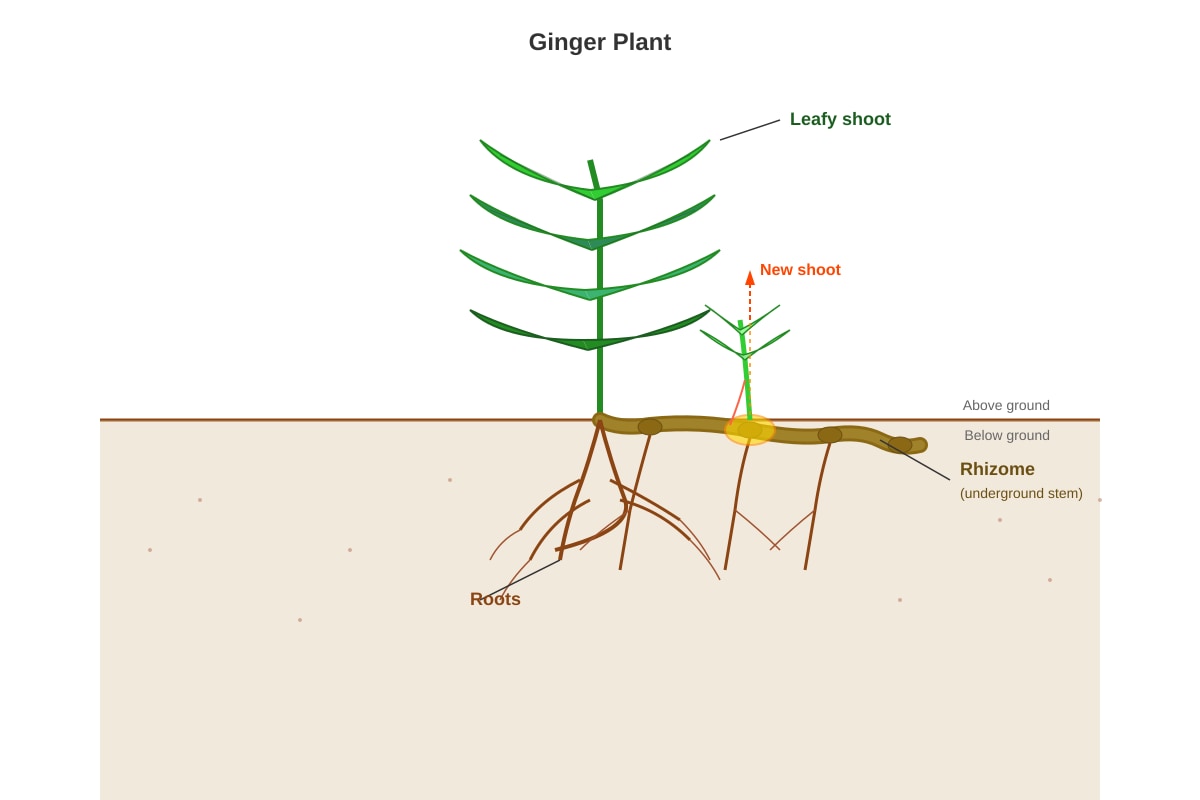
19. Some plants reproduce using underground stems. The diagram below shows a ginger plant.

<image_placeholder> id: Q19-fig1 type: diagram linked_question: Q19 description: A ginger plant showing the leafy shoot above ground and the rhizome (underground stem) below ground with roots. A section of the rhizome is highlighted as a "new shoot" emerging. labels: Leafy shoot, Rhizome (underground stem), Roots must_show: The new shoot growing from the rhizome, not from a seed. </image_placeholder>

(a) Is this sexual or asexual reproduction? [1]


(b) Give one advantage of this method of reproduction for the farmer. [1]


20. The table below shows the dispersal method of three fruits.

FruitDispersal Method
XBy Wind
YBy Animals
ZBy Splitting Action

(a) Describe one characteristic of Fruit X that helps it to be dispersed by wind. [1]


(b) Fruit Y has hooks on its surface. How does this help in its dispersal? [2]


(c) Why is it important for Fruit Z to disperse its seeds away from the parent plant? [2]


End of Paper

Answers

<!-- TuitionGoWhere generation metadata: stage=3-1; model=qwen/qwen3.7-plus; model_label=Qwen3.7 Plus; generated=2026-06-04; Sources: Stage 2-1 real exam-derived templates and Stage 2-2 exam-enriched syllabus. -->

Answer Key - Science Primary 5 WA2 Practice Paper (Version 1)

Section A (28 marks)

1. (2)

  • Reasoning: The nucleus contains genetic material and controls cell activities. Not all cells have cell walls (animal cells don't). Plant cells have cell membranes. Animal cells do not have chloroplasts.

2. (1)

  • Reasoning: Pollination is the transfer of pollen from the anther (male part, B) to the stigma (female part, A).

3. (3)

  • Reasoning: Sexual reproduction involves two parents and the fusion of male (sperm) and female (egg) reproductive cells. Offspring are not identical to parents.

4. (2)

  • Reasoning: Stage X is the larva (caterpillar). This is the feeding stage where it eats leaves to store energy for metamorphosis into the pupa and adult. The adult (Z) mainly feeds on nectar for energy for flight/reproduction, but the bulk of growth happens in the larval stage.

5. (2)

  • Reasoning: Ferns reproduce by spores. Roses, mangoes, and hibiscus are flowering plants that reproduce by seeds.

6. (1)

  • Reasoning: Fruit P is light with wings, adapted for wind dispersal. Fruit Q is fibrous and waterproof, adapted for water dispersal (e.g., coconut).

7. (2)

  • Reasoning: Seed dispersal reduces overcrowding, which minimizes competition for water, sunlight, and nutrients among the parent plant and its offspring.

8. (1)

  • Reasoning: The correct sequence is Pollination (transfer of pollen) → Fertilisation (fusion of cells) → Seed Dispersal (spreading seeds) → Germination (growth of new plant).

9. (3)

  • Reasoning: Fertilisation in humans typically occurs in the oviduct (fallopian tube). The ovary produces eggs, the uterus is where the baby develops.

10. (4)

  • Reasoning: Seeds need water, air (oxygen), and suitable temperature to germinate. Sunlight is not required for germination (though it is needed for photosynthesis after the seedling emerges).

11. (2)

  • Reasoning: Tube B has water, air, and suitable temperature (room temp). Tube A lacks water. Tube C lacks air. Tube D has low temperature.

12. (3)

  • Reasoning: Asexual reproduction is generally faster and requires only one parent. Offspring are genetically identical. It does not involve fusion of cells.

13. (1)

  • Reasoning: Part X is the testes. Their function is to produce sperm and male hormones.

14. (2)

  • Reasoning: Cockroaches have a 3-stage life cycle: Egg → Nymph → Adult. Frogs, butterflies, and mosquitoes have 4-stage life cycles (including a larval stage that looks different from the adult).

Section B (28 marks)

15. (a) Cross-pollination [1]

  • Note: Accept "Pollination" but "Cross-pollination" is more precise given the diagram shows two different flowers.

(b) Explanation:

  • Pollination leads to fertilisation. [1]
  • Fertilisation is the fusion of the male reproductive cell (from pollen) and the female reproductive cell (in the ovule), which is necessary for the ovule to develop into a seed. [1]

16. (a) 3 stages [1]

(b) Similarity:

  • Both have six legs. [1]
  • OR Both have similar body shape/structure.
  • OR Both have antennae.

(c) Reason for moulting:

  • The nymph has a hard outer skeleton (exoskeleton) that does not grow. [1]
  • It must shed the old skin to allow its body to grow larger.

17. (a) No, the hypothesis was not supported. [1]

  • Explanation: The seeds in Pot B (darkness) germinated just like the seeds in Pot A (sunlight). This shows that sunlight is not a necessary condition for germination. [1]

(b) Explanation:

  • Sunlight is needed for photosynthesis. [1]
  • Without sunlight, the seedlings in Pot B could not make chlorophyll (which makes them green) or food, so they remained yellow and weak. [1]

18. (a) Ovary (Part P) [1]

(b) Explanation:

  • Part Q is the oviduct. [1]
  • If it is blocked, the sperm cannot swim up to meet the egg, or the fertilised egg cannot travel to the uterus. Therefore, fertilisation cannot occur. [1]

19. (a) Asexual reproduction [1]

(b) Advantage:

  • The new plants are genetically identical to the parent, so desirable traits (e.g., taste, size) are preserved. [1]
  • OR It is faster than growing from seeds.
  • OR It does not depend on pollinators or weather conditions for seed production.

20. (a) Characteristic of Fruit X:

  • It is light / has a large surface area / has wing-like structures / has hair-like structures. [1]
  • Any one valid adaptation for wind dispersal.

(b) Explanation for Fruit Y:

  • The hooks allow the fruit to attach to the fur of animals or clothing of humans. [1]
  • The animal carries the fruit away from the parent plant and drops it elsewhere, aiding dispersal. [1]

(c) Importance of dispersal for Fruit Z:

  • To reduce competition for resources (water, sunlight, nutrients, space) between the parent plant and the offspring. [1]
  • To prevent overcrowding which can lead to the spread of diseases. [1]