From Real Exams Exam Paper
Primary 5 Science Weighted Assessment 1 (Term 1) Paper 5
Free Exam-Derived Qwen3.7 Plus Primary 5 Science Weighted Assessment 1 (Term 1) Paper 5 practice paper with questions and answers for Singapore students. This page is rendered as a direct URL so the questions and answers can be discovered without pressing in-page buttons.
These static practice materials are generated from the site's syllabus and paper-generation workflow, with source and model context shown so students and parents can evaluate the material before use.
Questions
TuitionGoWhere Practice Paper - Science Primary 5
TuitionGoWhere Exam Practice (AI)
Subject: Science
Level: Primary 5
Paper: WA1 (Weighted Assessment 1) - Version 5
Topic Focus: Diversity (Cells, Classification, Adaptations)
Duration: 1 hour 45 minutes
Total Marks: 56
Name: __________________________
Class: __________
Date: __________________________
Score: ______ / 56
Instructions to Candidates
- This paper consists of two sections: Section A and Section B.
- Answer all questions.
- Write your answers in the spaces provided.
- For questions in Section A, choose the correct answer and write its number (1, 2, 3 or 4) in the brackets provided.
- The use of calculators is not allowed.
Section A (28 marks)
For each question from 1 to 14, four options are given. One of them is the correct answer. Make your choice (1, 2, 3 or 4) and write your answer in the brackets provided. Each question carries 2 marks.
1. Which of the following statements about cells is correct? (1) All cells have a cell wall. (2) Animal cells contain chloroplasts to make food. (3) The nucleus controls the activities of the cell. (4) Cells are the smallest unit of non-living things.
[ ]
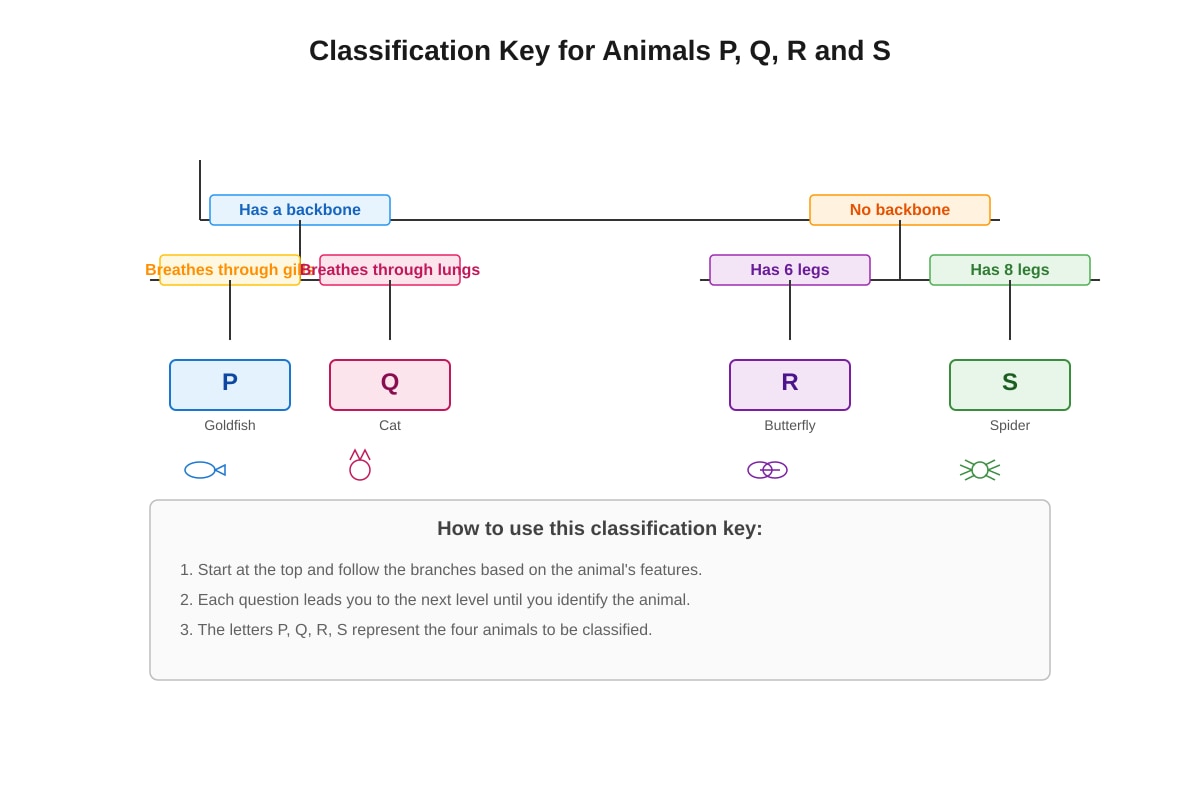
2. The diagram below shows the classification of four animals P, Q, R, and S.
<image_placeholder> id: Q2-classification type: diagram linked_question: Q2 description: A branching classification key diagram.
- Top level splits into "Has Backbone" and "No Backbone".
- "Has Backbone" splits into "Lays Eggs" (leads to P) and "Gives Birth to Young" (leads to Q).
- "No Backbone" splits into "Has 6 legs" (leads to R) and "Has more than 6 legs" (leads to S). labels: P, Q, R, S must_show: Clear branching structure with the criteria listed above. </image_placeholder>
Which of the following correctly identifies animal Q? (1) Butterfly (2) Goldfish (3) Cat (4) Spider
[ ]
3. Study the characteristics of the organism below.
- It is a microorganism.
- It can make its own food using sunlight.
- It is found in ponds.
Which organism fits this description? (1) Bacteria (2) Fungi (3) Algae (4) Virus
[ ]
4. Why do cacti have spines instead of broad leaves? (1) To attract insects for pollination. (2) To reduce water loss through transpiration. (3) To protect the plant from strong winds. (4) To increase the surface area for photosynthesis.
[ ]
5. Which of the following groups consists only of mammals? (1) Whale, Bat, Dolphin (2) Penguin, Ostrich, Kiwi (3) Shark, Ray, Eel (4) Frog, Toad, Salamander
[ ]
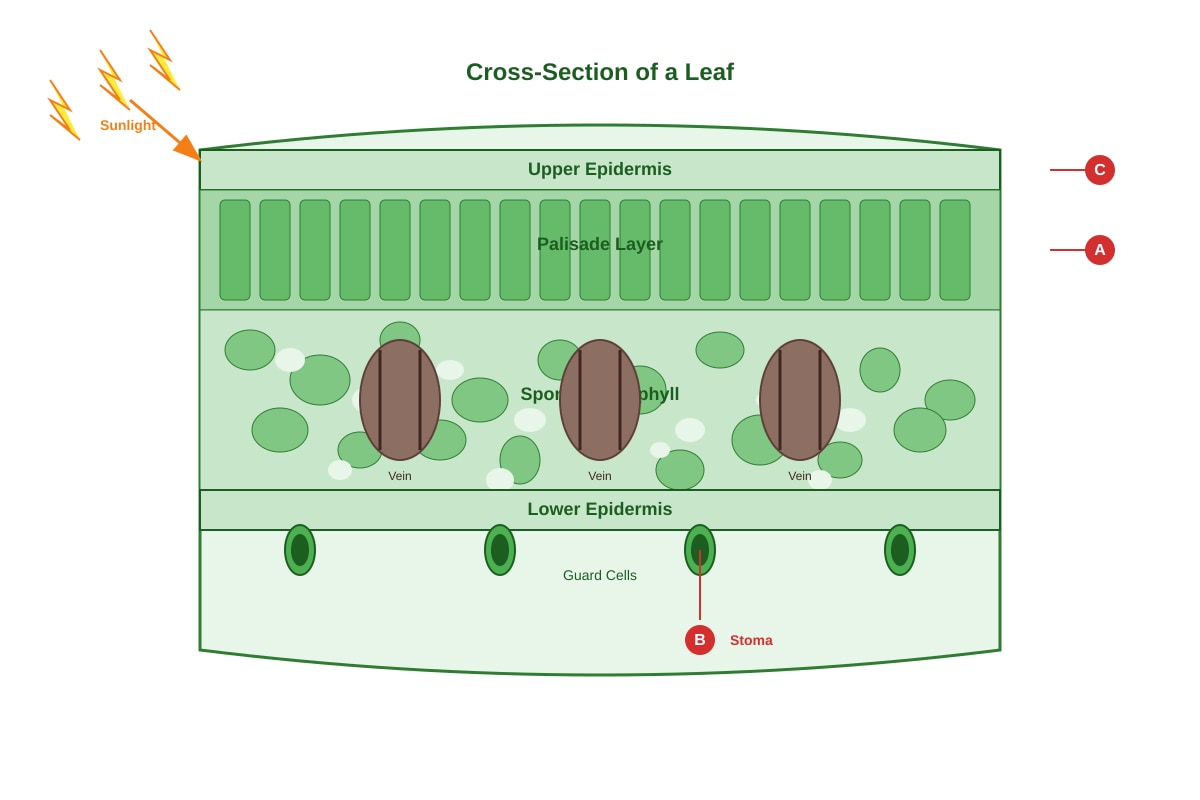
6. The diagram shows a cross-section of a leaf.
<image_placeholder> id: Q6-leaf type: diagram linked_question: Q6 description: A cross-section of a leaf showing upper epidermis, palisade layer, spongy mesophyll, and lower epidermis with stomata. labels: A (points to Palisade Layer), B (points to Stoma), C (points to Upper Epidermis) must_show: Distinct layers. Label A points to the tightly packed cells near the top. Label B points to the pore at the bottom. </image_placeholder>
Which part is mainly responsible for trapping sunlight for photosynthesis? (1) A (2) B (3) C (4) The veins
[ ]
7. Which of the following is a characteristic of fungi? (1) They have chlorophyll. (2) They reproduce by laying eggs. (3) They feed on dead and decaying matter. (4) They have roots, stems, and leaves.
[ ]
8. Look at the classification chart below.
| Group | Characteristics | Example |
|---|---|---|
| X | Has scales, lays eggs, breathes with gills | Goldfish |
| Y | Has scales, lays eggs, breathes with lungs | Lizard |
| Z | Has hair/fur, gives birth, breathes with lungs | ? |
Which animal can be placed in Group Z? (1) Crocodile (2) Platypus (3) Seal (4) Penguin
[ ]
9. Why are viruses not considered living things by some scientists? (1) They are too small to be seen. (2) They cannot reproduce on their own outside a host. (3) They do not have a nucleus. (4) They cause diseases.
[ ]
10. Which adaptation helps a polar bear survive in the Arctic? (1) Thin skin to release heat. (2) White fur for camouflage in snow. (3) Large ears to hear prey. (4) Webbed feet for climbing trees.
[ ]
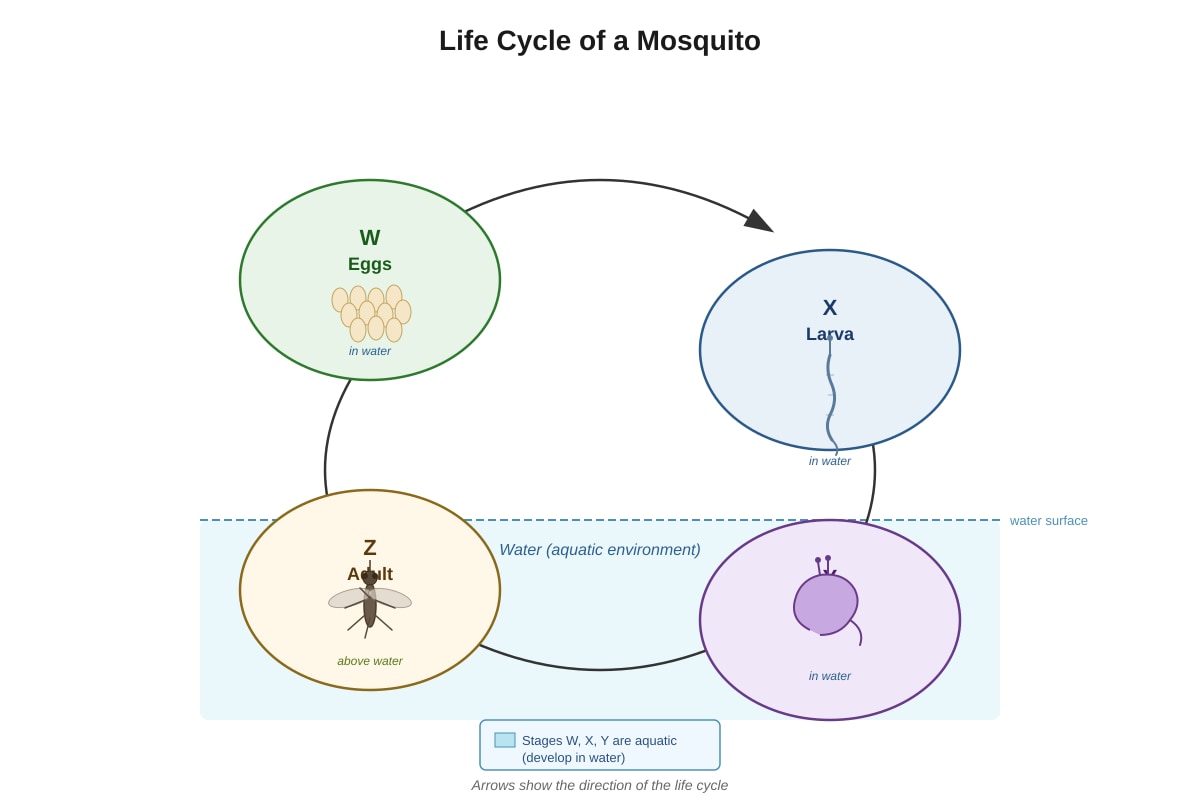
11. The diagram shows the life cycle of a mosquito.
<image_placeholder> id: Q11-mosquito type: diagram linked_question: Q11 description: A circular life cycle diagram with 4 stages.
- Eggs (on water surface)
- Larva (in water)
- Pupa (in water)
- Adult Mosquito (flying) Arrows connect them in order. labels: W (Eggs), X (Larva), Y (Pupa), Z (Adult) must_show: The aquatic nature of stages W, X, and Y. </image_placeholder>
At which stage does the mosquito breathe air through a siphon tube while hanging from the water surface? (1) W (2) X (3) Y (4) Z
[ ]
12. Which of the following statements about bacteria is true? (1) All bacteria are harmful to humans. (2) Bacteria are multicellular organisms. (3) Some bacteria are used to make yogurt and cheese. (4) Bacteria reproduce by laying eggs.
[ ]
13. A student observed an organism under a microscope. It had a cell wall, a nucleus, but no chloroplasts. It was growing on a piece of bread. What is the organism? (1) A plant cell (2) An animal cell (3) A fungus (e.g., Mould) (4) A bacterium
[ ]
14. Which of the following best explains why biodiversity is important? (1) It ensures that only the strongest animals survive. (2) It allows humans to hunt animals for fun. (3) It maintains the balance of the ecosystem and provides resources. (4) It makes the environment look colorful.
[ ]
Section B (28 marks)
Answer all questions in the spaces provided. The number of marks available is shown in brackets [ ] at the end of each question or part-question.
15. The diagram below shows two types of cells, Cell A and Cell B.
<image_placeholder> id: Q15-cells type: diagram linked_question: Q15 description: Two cell diagrams side-by-side. Cell A: Irregular shape, has a nucleus, cytoplasm, cell membrane. No cell wall, no chloroplasts. (Animal Cell) Cell B: Regular rectangular shape, has a nucleus, cytoplasm, cell membrane, thick cell wall, large vacuole, chloroplasts. (Plant Cell) labels: Cell A, Cell B must_show: Clear distinction between the rigid plant cell and flexible animal cell. </image_placeholder>
(a) Identify Cell A and Cell B. [2] Cell A: __________________________ Cell B: __________________________
(b) State one function of the part labelled X in Cell B (the thick outer layer). [1]
(c) Why is Cell B green in color while Cell A is not? [1]
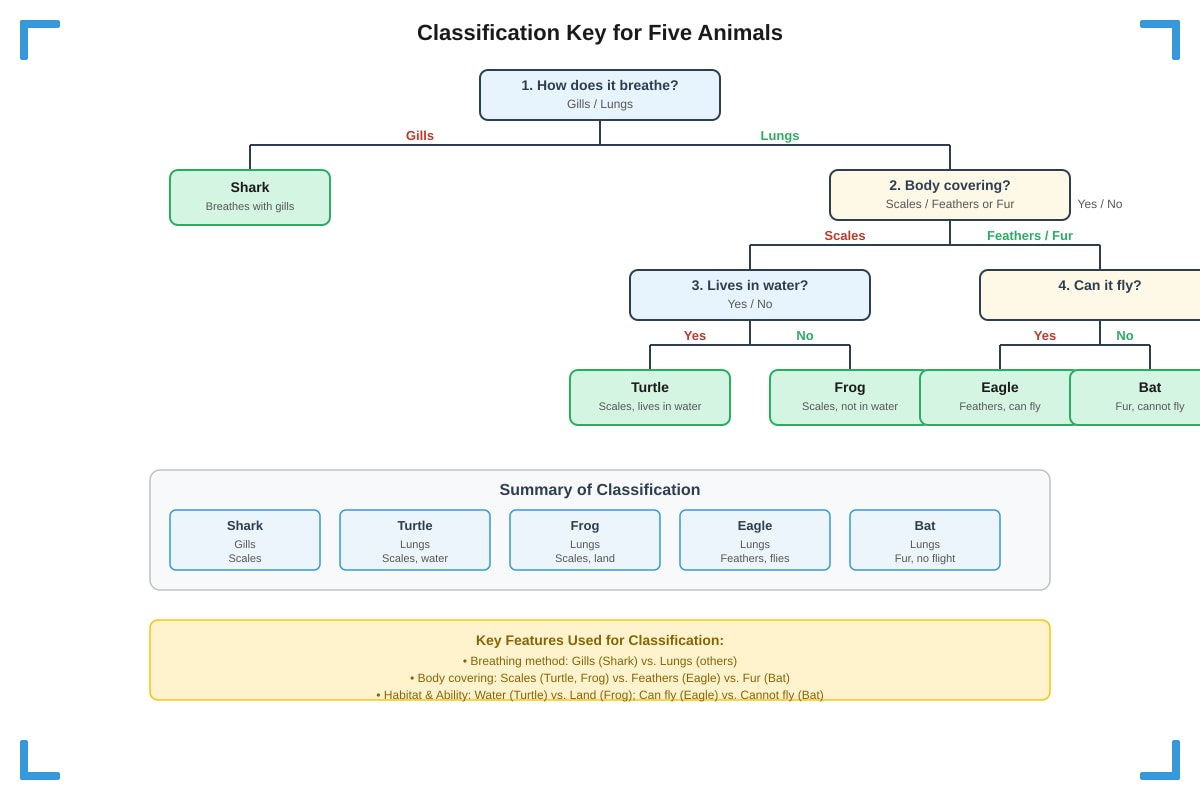
16. Study the classification key below for five different animals: Eagle, Frog, Shark, Bat, and Turtle.
<image_placeholder> id: Q16-key type: diagram linked_question: Q16 description: A dichotomous key. 1a. Lives in water all its life -> Go to 2 1b. Lives on land or in air -> Go to 3 2a. Has gills -> Shark 2b. Has lungs -> Turtle (Note: Turtles breathe air but spend much time in water, but for P5 simplification, let's adjust key to be clearer). Correction for P5 Level Clarity: 1a. Has backbone -> Go to 2 1b. No backbone -> Insect (Not in list) 2a. Lays eggs -> Go to 3 2b. Gives birth to young -> Bat 3a. Breathes with gills -> Shark 3b. Breathes with lungs -> Go to 4 4a. Has feathers -> Eagle 4b. Has smooth moist skin -> Frog 4c. Has hard shell -> Turtle labels: N/A must_show: The logical flow leading to the 5 animals. </image_placeholder>
(a) Based on the key above, which animal breathes with gills? [1]
(b) Explain why the Bat is classified separately from the Eagle, even though both can fly. [2]
(c) A new animal 'Z' is discovered. It has a backbone, lays eggs, and has dry scaly skin. Where would it fit in the key above? (State the characteristic it shares with an existing group). [1]
17. Microorganisms are everywhere. Some are useful, while others are harmful.
(a) Name one useful microorganism and state how it is useful to humans. [2] Microorganism: __________________________ Use: ___________________________________________________________________
(b) Bread left in a warm, damp place often develops mould. (i) What type of microorganism is mould? [1]
(ii) Suggest one way to prevent bread from becoming mouldy quickly. [1]
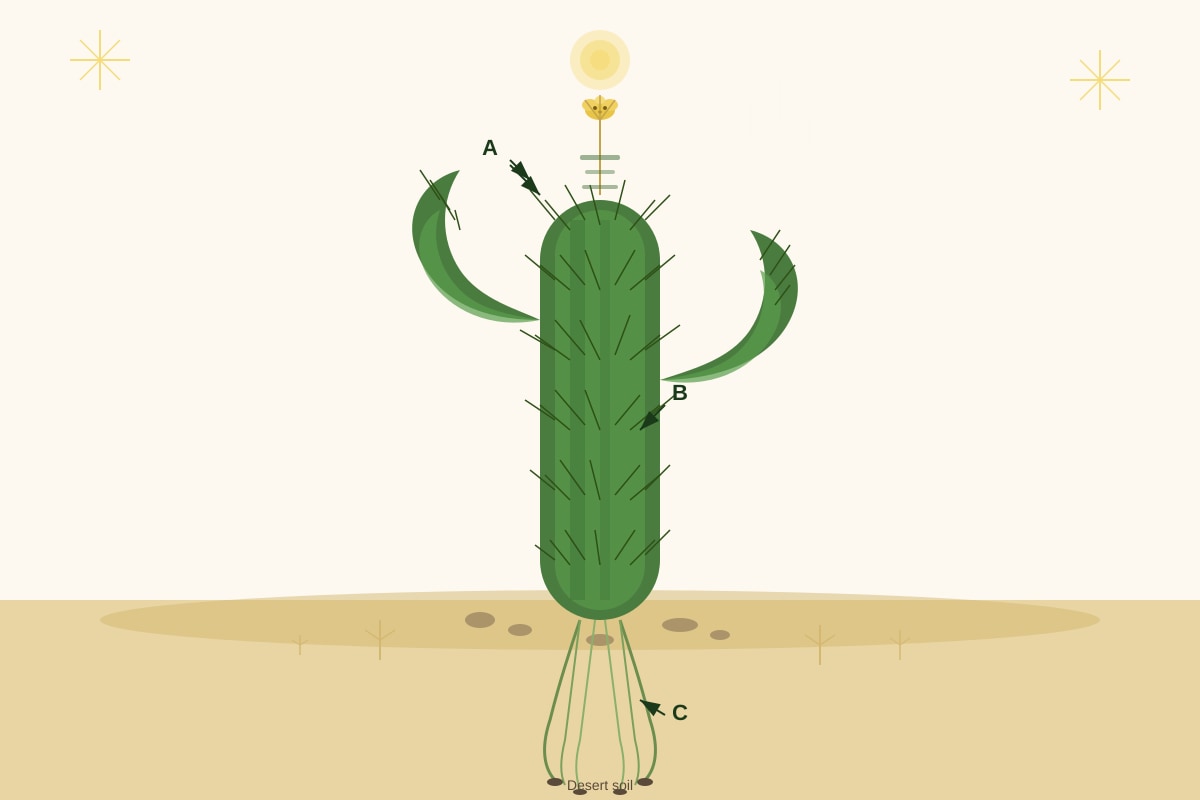
18. The diagram shows a cactus plant living in a desert.
<image_placeholder> id: Q18-cactus type: diagram linked_question: Q18 description: A cactus plant. Features to highlight: Thick fleshy stem, spines instead of leaves, extensive shallow root system. labels: A (Spines), B (Stem), C (Roots) must_show: The thick stem and spines clearly. </image_placeholder>
(a) What is the function of part A (spines)? [1]
(b) How does part B (stem) help the cactus survive in the desert? [2]
(c) Why do cacti have extensive shallow roots? [1]
19. Diversity in Plants
The table below shows three plants: Fern, Moss, and Rose.
| Plant | Has Flowers? | Has Vascular Tissue (Transport tubes)? | Reproduces by |
|---|---|---|---|
| Fern | No | Yes | Spores |
| Moss | No | No | Spores |
| Rose | Yes | Yes | Seeds |
(a) Which plant is a flowering plant? [1]
(b) Why can the Fern grow taller than the Moss? [2]
(c) Both Ferns and Mosses do not produce seeds. How do they ensure their kind continues? [1]
20. Adaptation and Survival
A group of students investigated how the shape of a bird's beak affects its ability to eat different types of food. They used tools to represent beaks:
- Tweezers (Thin, pointed beak)
- Spoon (Broad, flat beak)
- Pliers (Strong, crushing beak)
They tried to pick up:
- Small seeds from a narrow tube.
- Water from a shallow dish.
- Hard nuts.
(a) Which tool (beak type) would be most effective for picking up small seeds from a narrow tube? [1]
(b) Explain why a duck has a broad, flat beak like a spoon. [2]
(c) If a bird with a thin, pointed beak moved to an environment where only hard nuts were available, what would likely happen to the bird population over time? [2]
*** End of Paper ***
Answers
TuitionGoWhere Practice Paper - Science Primary 5 (Answer Key)
Topic Focus: Diversity (Cells, Classification, Adaptations) Version: 5
Section A (28 marks)
Each correct answer carries 2 marks.
- (3) The nucleus controls the activities of the cell.
- Note: (1) is incorrect because animal cells do not have cell walls. (2) is incorrect because animal cells do not have chloroplasts. (4) is incorrect because cells are the basic unit of living things.
- (3) Cat.
- Reasoning: Q has a backbone and gives birth to young. This is a characteristic of mammals. Cats are mammals. Butterflies and Spiders have no backbone. Goldfish lay eggs.
- (3) Algae.
- Reasoning: Algae are simple plant-like organisms found in water that contain chlorophyll and can photosynthesize. Bacteria and Fungi generally do not photosynthesize (with rare exceptions not covered at P5). Viruses are non-living.
- (2) To reduce water loss through transpiration.
- Reasoning: Broad leaves have many stomata which lose water. Spines have a very small surface area, minimizing water loss in hot, dry deserts.
- (1) Whale, Bat, Dolphin.
- Reasoning: All three are mammals (give birth, breathe with lungs, have hair/fur at some stage). Penguins are birds. Sharks are fish. Frogs are amphibians.
- (1) A (Palisade Layer).
- Reasoning: The palisade layer contains many chloroplasts and is located near the top of the leaf to trap maximum sunlight.
- (3) They feed on dead and decaying matter.
- Reasoning: Fungi are saprophytes. They do not have chlorophyll (1), do not lay eggs (2), and do not have true roots/stems/leaves (4).
- (3) Seal.
- Reasoning: Group Z describes mammals (hair/fur, gives birth, lungs). Seals are mammals. Crocodiles are reptiles. Platypus lays eggs (monotreme). Penguins are birds.
- (2) They cannot reproduce on their own outside a host.
- Reasoning: This is the key reason viruses are often considered on the border of living/non-living. They need a host cell to replicate.
- (2) White fur for camouflage in snow.
- Reasoning: Camouflage helps them hide from prey and predators. Thin skin (1) would cause heat loss. Large ears (3) would cause heat loss. Webbed feet (4) are for swimming, not climbing trees.
- (2) X (Larva).
- Reasoning: Mosquito larvae (wrigglers) live in water and breathe air through a siphon tube at the surface. Pupae (tumblers) also breathe but do not feed; however, the siphon is most distinctly associated with the larval stage in primary science contexts. Correction: Both Larva and Pupa breathe via siphon/tubes, but Larva is the active feeding stage often depicted with the siphon. In P5, Larva is the standard answer for "wriggler" breathing.
- (3) Some bacteria are used to make yogurt and cheese.
- Reasoning: Lactobacillus is a useful bacterium. Not all bacteria are harmful (1). Bacteria are unicellular (2). Bacteria reproduce by cell division, not eggs (4).
- (3) A fungus (e.g., Mould).
- Reasoning: Fungi have cell walls and nuclei (eukaryotic) but no chloroplasts (cannot photosynthesize). Plants have chloroplasts. Animals have no cell walls. Bacteria have no nucleus (prokaryotic).
- (3) It maintains the balance of the ecosystem and provides resources.
- Reasoning: Biodiversity ensures ecosystem stability, resilience, and provides food/medicine.
Section B (28 marks)
15. Cells (a) Cell A: Animal Cell [1] Cell B: Plant Cell [1] (b) Function of X (Cell Wall): To give the plant cell a regular shape and provide support/protection. [1] (c) Cell B is green because it contains chloroplasts which have chlorophyll. Cell A does not have chloroplasts. [1]
16. Classification (a) Shark [1] (b) Bat is a mammal while Eagle is a bird. [1] * Elaboration: Bats give birth to young and have fur/hair, whereas Eagles lay eggs and have feathers. [1] (c) It would fit with the Turtle (or Reptiles). It shares the characteristic of having dry scaly skin and laying eggs. [1]
17. Microorganisms (a) Accept any valid pair: * Microorganism: Yeast / Lactobacillus [1] * Use: To make bread rise / To make yogurt/cheese [1] * Alternative: Bacteria in gut help digestion. (b) (i) Fungi [1] (ii) Keep it in the refrigerator / Keep it in a dry place / Seal it in an airtight container. [1] * Reasoning: Mould needs warmth and moisture to grow. Removing these conditions slows growth.
18. Cactus Adaptation (a) Function of A (Spines): To reduce water loss (by reducing surface area) AND to protect the plant from animals eating it. [1] * Note: Either reason is acceptable, but water loss is the primary physiological adaptation linked to leaf modification. (b) Function of B (Stem): It is thick and fleshy to store water. [1] It is also green to carry out photosynthesis (since there are no leaves). [1] (c) Extensive shallow roots allow the cactus to absorb rainwater quickly from a large area before it evaporates. [1]
19. Diversity in Plants (a) Rose [1] (b) Ferns have vascular tissue (transport tubes) which transport water and nutrients to all parts of the plant and provide structural support. [1] Mosses lack vascular tissue, so they cannot grow tall as they cannot transport water efficiently against gravity. [1] (c) They reproduce by spores. [1]
20. Adaptation and Survival (a) Tweezers [1] (b) A duck's broad, flat beak acts like a sieve/strainer. [1] It allows the duck to filter small organisms and plants from the water while letting the water drain out. [1] (c) The bird population would decrease or die out. [1] * Reasoning: The thin beak is not adapted to crack hard nuts. The birds would struggle to get food, leading to starvation and inability to reproduce. [1] * Alternative acceptable answer: Over a very long time, birds with slightly stronger beaks might survive (natural selection), but in the context of P5 "what happens to the population," decline/extinction is the immediate consequence of poor adaptation.
Marking Notes for Teachers/Parents:
- Q15: Ensure students distinguish between cell wall (plant only) and cell membrane (both).
- Q16: Emphasize that classification is based on observable characteristics, not just habitat.
- Q18: Accept "store water" for the stem. Do not accept "store food" as the primary adaptation for survival in drought (though stems do store some energy, water storage is the key xerophytic adaptation).
- Q20: For part (c), look for the link between beak shape, food source, and survival.