From Real Exams Exam Paper
Primary 5 Science Weighted Assessment 1 (Term 1) Paper 1
Free P5 Science WA1 Paper 1, Exam version, with questions, answers, and syllabus-aligned practice for Singapore students.
These static practice materials are generated from the site's syllabus and paper-generation workflow, with source and model context shown so students and parents can evaluate the material before use.
Questions
Free quiz and exam paper access
Enter your details to view this paper
Your access is remembered on this device.
Answers
TUITIONGOWHERE SINGAPORE
2026 WEIGHTED ASSESSMENT 1 - ANSWER KEY
SCIENCE
PRIMARY 5
Section A: Multiple Choice Questions (20 marks)
Each question carries 2 marks.
1. Which statement about cells is correct? (1) Only plants have cells (2) Cells are visible to the naked eye (3) Cells are the basic unit of life ✓ (4) Animal cells are larger than plant cells
Answer: (3)
Explanation: Cells are indeed the basic structural and functional units of all living things.
2. The green substance in plant cells that captures sunlight is called: (1) Cytoplasm (2) Chlorophyll ✓ (3) Nucleus (4) Cell wall
Answer: (2)
Explanation: Chlorophyll is the green pigment in chloroplasts that absorbs light energy for photosynthesis.
3. Which part of a plant cell controls all activities? (1) Cell membrane (2) Chloroplast (3) Cell wall (4) Nucleus ✓
Answer: (4)
Explanation: The nucleus contains genetic material and controls all cellular activities.
4. In the human reproductive system, eggs are produced by the: (1) Womb (2) Ovaries ✓ (3) Fallopian tubes (4) Kidneys
Answer: (2)
Explanation: The ovaries are the female reproductive organs that produce and release eggs.
5. Fertilisation in humans occurs when: (1) An egg is released from the ovary (2) A sperm cell fuses with an egg cell ✓ (3) The baby is born (4) The embryo grows in the womb
Answer: (2)
Explanation: Fertilisation is specifically the fusion of male and female reproductive cells.
6. Which organ produces sperm in males? (1) Liver (2) Heart (3) Testes ✓ (4) Lungs
Answer: (3)
Explanation: The testes are the male reproductive organs that produce sperm.
7. Human reproduction is an example of: (1) Asexual reproduction (2) Sexual reproduction ✓ (3) Budding (4) Binary fission
Answer: (2)
Explanation: Human reproduction requires both male and female reproductive cells, making it sexual reproduction.
8. After fertilisation, the embryo develops in the: (1) Ovary (2) Fallopian tube (3) Womb (uterus) ✓ (4) Stomach
Answer: (3)
Explanation: The womb (uterus) is where the fertilised egg implants and develops.
9. The respiratory system in humans helps to: (1) Digest food (2) Transport blood (3) Take in oxygen and remove carbon dioxide ✓ (4) Produce reproductive cells
Answer: (3)
Explanation: The main function of the respiratory system is gas exchange - taking in oxygen and removing carbon dioxide.
10. Which system transports nutrients around the human body? (1) Respiratory system (2) Digestive system (3) Circulatory system ✓ (4) Nervous system
Answer: (3)
Explanation: The circulatory system (heart, blood, blood vessels) transports nutrients, oxygen, and waste products around the body.
Section B: Short Answer Questions (20 marks)
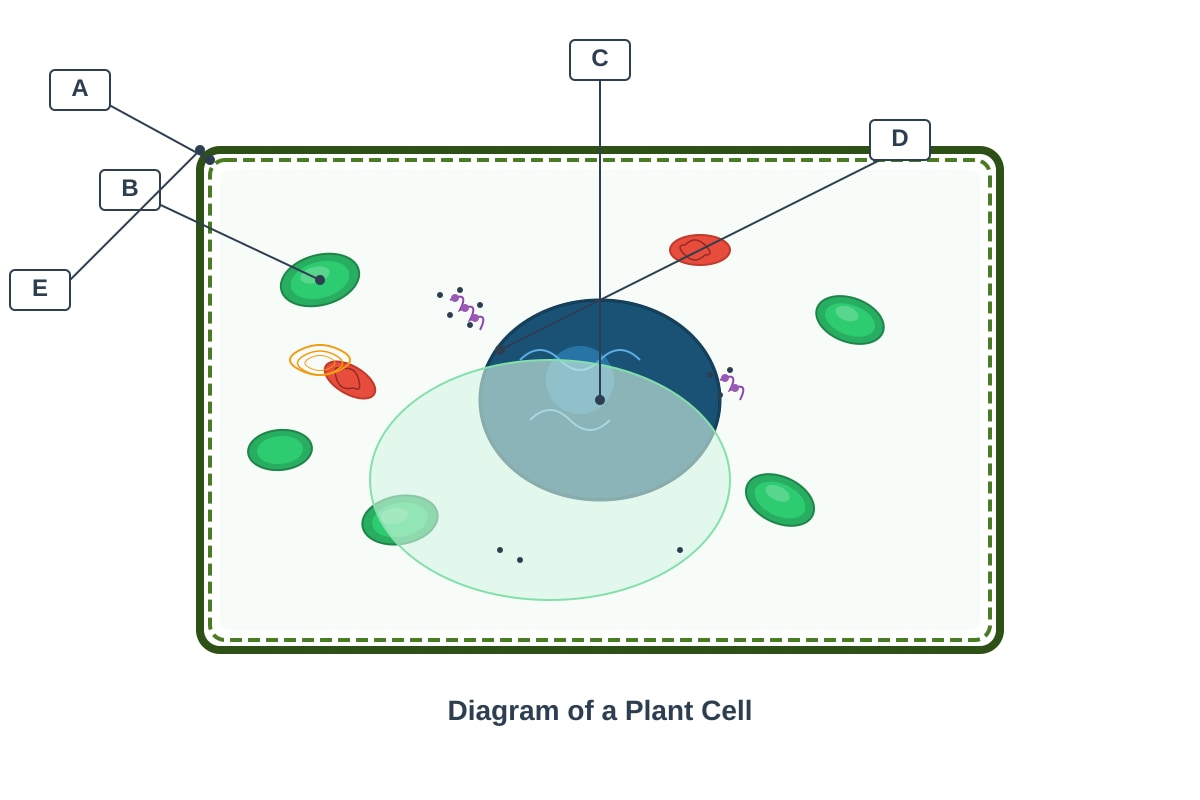
11. Study the diagram of a plant cell below. (4 marks)
| Label | Name of Part | Function |
|---|---|---|
| A | Cell membrane (0.5 marks) | Controls what enters and leaves the cell (0.5 marks) |
| B | Chloroplasts (0.5 marks) | Make food through photosynthesis (0.5 marks) |
| C | Nucleus (0.5 marks) | Controls cell activities (0.5 marks) |
| D | Cytoplasm (0.5 marks) | Holds cell parts in place / where chemical reactions occur (0.5 marks) |
Note: Accept "Cell wall" for E if referenced instead of A
12. Compare plant cells and animal cells by completing the table below. (4 marks)
| Structure | Present in Plant Cell? | Present in Animal Cell? |
|---|---|---|
| Cell membrane | Yes (1 mark) | Yes (1 mark) |
| Cell wall | Yes (1 mark) | No (1 mark) |
| Nucleus | Yes | Yes |
| Chloroplasts | Yes | No |
13. State THREE differences between plant cells and animal cells. (3 marks)
Difference 1: Plant cells have cell walls, animal cells do not (1 mark) Difference 2: Plant cells have chloroplasts, animal cells do not (1 mark) Difference 3: Plant cells are usually rectangular/square shaped, animal cells are usually round (1 mark)
Other acceptable answers: Plant cells have large vacuoles, animal cells have small vacuoles; Plant cells can make their own food, animal cells cannot
14. Explain the process of human reproduction by completing the passage below. (4 marks)
In humans, the male reproductive cells called sperm (0.5 marks) are produced by the testes (0.5 marks). The female reproductive cells called eggs/ova (0.5 marks) are produced by the ovaries (0.5 marks). When these two types of cells fuse together, this process is called fertilisation (1 mark). The fertilised egg then develops in the womb/uterus (1 mark).
15. Name the THREE main parts of the respiratory system and state their functions. (3 marks)
Part 1: Nose (0.5 marks) Function: Filters and warms air / Takes in air (0.5 marks) Part 2: Windpipe/Trachea (0.5 marks) Function: Carries air to and from lungs (0.5 marks) Part 3: Lungs (0.5 marks) Function: Gas exchange / Take in oxygen, remove carbon dioxide (0.5 marks)
16. Give TWO reasons why reproduction is important for living things. (2 marks)
Reason 1: To ensure species survival / continuity of species (1 mark) Reason 2: To produce offspring / next generation (1 mark)
Other acceptable answers: To replace organisms that die; To maintain population; To pass on characteristics
Section C: Structured Questions (10 marks)
17. A scientist wants to study the differences between onion cells and human cheek cells.
a) Name ONE tool the scientist must use to observe these cells clearly. (1 mark)
Microscope (1 mark)
b) State ONE structure that will be present in onion cells but NOT in cheek cells. (1 mark)
Cell wall or Chloroplasts (1 mark)
Note: Onion cells typically don't have chloroplasts as they're from the bulb, so "cell wall" is the better answer
c) Explain why onion cells have this structure but cheek cells do not. (2 marks)
Onion cells are plant cells and need cell walls for support and protection (1 mark), while cheek cells are animal cells that only need flexible cell membranes for movement. (1 mark)
18. Study the information about different animals and their reproduction:
a) Which animal has the longest pregnancy period? (1 mark)
Elephants (1 mark)
b) Suggest why larger animals tend to have longer pregnancy periods. (2 marks)
Larger animals need more time for their babies to grow bigger before birth (1 mark), and they need more complex body systems to develop fully. (1 mark)
Alternative: Larger brains and organs need more time to develop
c) Explain one advantage of having a longer pregnancy period for the development of offspring. (2 marks)
Longer pregnancy allows for better brain development and more advanced abilities (1 mark), which improves the baby's chances of survival after birth. (1 mark)
19. The diagram below shows the human circulatory system.
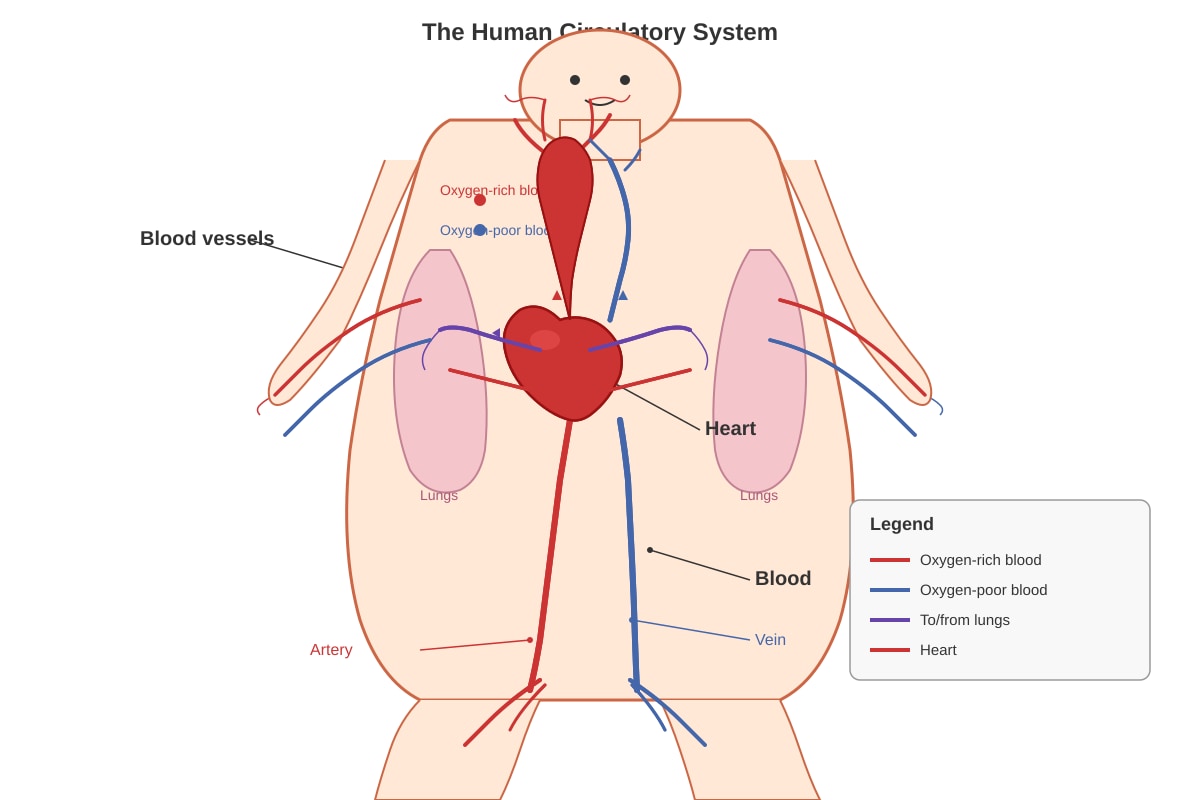
Generated diagram for this question.
a) What is the main function of the circulatory system? (1 mark)
To transport blood/nutrients/oxygen around the body (1 mark)
b) Name the THREE main parts of the circulatory system shown in the diagram.
Part 1: Heart Part 2: Blood Part 3: Blood vessels
Accept: arteries, veins, capillaries for blood vessels
Marking Scheme Summary
Total marks: 50
Grade Boundaries:
- A: 45-50 marks (90-100%)
- B: 40-44 marks (80-89%)
- C: 35-39 marks (70-79%)
- D: 30-34 marks (60-69%)
- Below 30 marks: Requires additional support
Topics Assessed:
- Cells and their structures (40% of marks)
- Human reproductive system (30% of marks)
- Human body systems (30% of marks)
Skills Assessed:
- Knowledge recall (50%)
- Understanding and explanation (30%)
- Application and analysis (20%)