From Real Exams Exam Paper
Primary 5 Science Semestral Assessment 2 (End of Year) Paper 5
Free P5 Science SA2 Paper 5, Kimi2.6 Exam version, with questions, answers, and syllabus-aligned practice for Singapore students.
These static practice materials are generated from the site's syllabus and paper-generation workflow, with source and model context shown so students and parents can evaluate the material before use.
Questions
Free quiz and exam paper access
Enter your details to view this paper
Your access is remembered on this device.
Answers
Primary 5 Science Quiz - Diversity: Answer Key
Total Marks: 40
Section A: Multiple Choice (8 marks)
1. B (Grass, rose, hibiscus) (1 mark)
Teaching note: Flowering plants produce flowers and seeds. Grass, rose, and hibiscus all produce flowers. Ferns and mosses are non-flowering plants. Mushrooms and mould are fungi, not plants.
Common mistake: Students sometimes think grass doesn't flower because the flowers are small and not showy. Grass actually does produce flowers, though they are often wind-pollinated and inconspicuous.
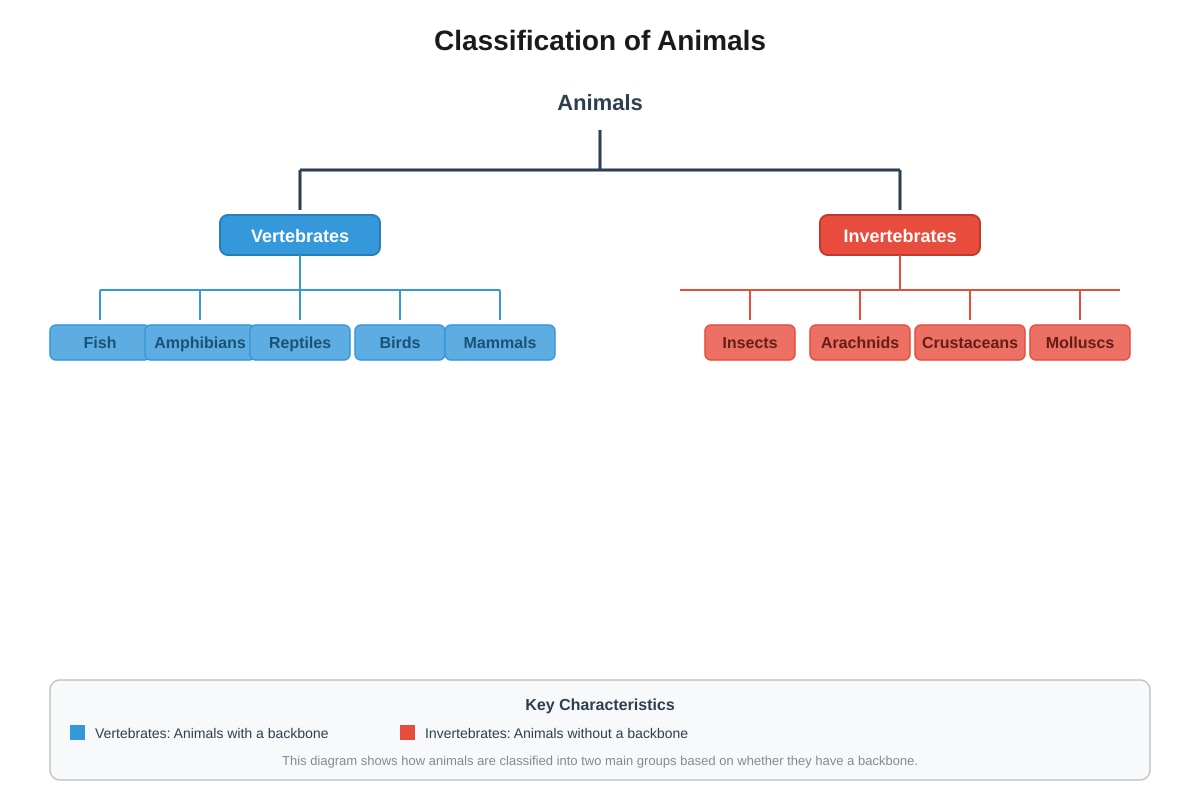
2. C (Spider – arachnid) (1 mark)
Teaching note: Spiders belong to the group arachnids, which have eight legs and two body parts. Butterflies are insects, frogs are amphibians, and octopuses are molluscs.
From the diagram (Q2-fig1): The classification tree shows Vertebrates branching to Fish, Amphibians, Reptiles, Birds, Mammals; and Invertebrates branching to Insects, Arachnids, Crustaceans, Molluscs. Spiders sit on the arachnid branch.
3. B (Insects) (1 mark)
Teaching note: The key characteristics given are: no backbone (invertebrate), six legs, hard outer covering (exoskeleton). These are the defining features of insects. Crustaceans typically have more than six legs (e.g., 10 or more), arachnids have eight legs, and molluscs have soft bodies without hard outer coverings.
4. A (They have hair or fur) (1 mark)
Teaching note: Having hair or fur is unique to mammals. Birds and reptiles also breathe through lungs (B is not unique). Some mammals don't lay eggs (platypus and echidna do, but most don't), and not all mammals have four legs (whales, dolphins have flippers; bats have wings).
5. C (R) (1 mark)
Teaching note: Birds are vertebrates (have backbone), have feathers, and typically live on land or fly. Organism R matches: backbone ✓, lives in water ✗ (birds don't live in water, though some swim), has feathers ✓. The "lives in water" column showing ✗ for R fits with birds being land/air dwellers.
P is a fish (backbone, water, scales, no feathers). Q has no backbone and lives in water – could be a jellyfish or similar invertebrate. S has no backbone and no feathers – many possibilities like insects or molluscs.
6. B (Fern) (1 mark)
Teaching note: Ferns are non-flowering plants that reproduce using spores. Coconut trees, sunflowers, and balsam plants are all flowering plants that produce seeds.
7. C (P, Q, and S only) (1 mark)
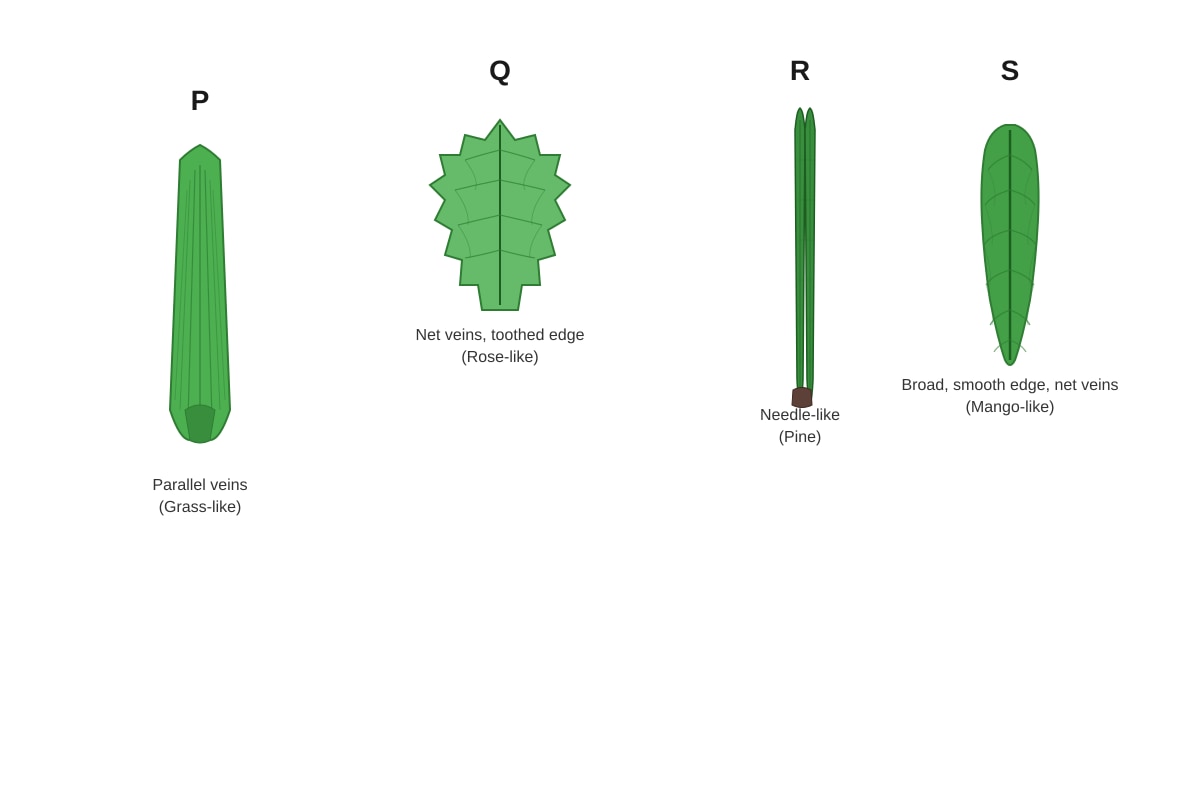
Teaching note: From Q7-fig1: P has parallel veins (monocot flowering plant like grass), Q has net-like veins with toothed edge (dicot flowering plant like rose), R has needle-like leaves (pine – a gymnosperm, non-flowering), S has broad smooth edge with net veins (dicot flowering plant like mango).
Common mistake: Students often think all plants with broad leaves are flowering plants, but conifers like pine have needle-like leaves and are non-flowering. Also, flowering plants can have parallel veins (monocots) or net-like veins (dicots).
From the image (Q7-fig1): P shows parallel veins typical of monocots; Q shows net-veined dicot with toothed margin; R shows needle-like pine needles; S shows broad net-veined leaf with smooth margin. P, Q, and S are flowering plants; R is non-flowering.
8. B (They are too small to be seen with the unaided eye) (1 mark)
Teaching note: Microorganisms are defined by their size – they are too small to see without a microscope. Not all microorganisms live in water (A is wrong). Not all are harmful – many bacteria and fungi are beneficial (C is wrong). Fungi cannot make their own food; they decompose organic matter (D is wrong). Some bacteria can make their own food through photosynthesis or chemosynthesis, but this is not true for all microorganisms.
Section B: Fill in the Blanks (8 marks)
9. (2 marks – 0.5 mark each)
Butterfly: Insect
Shark: Fish
Bat: Mammal
Earthworm: Invertebrate (accept: annelid/segmented worm)
Teaching note:
- Insects have six legs, three body parts (head, thorax, abdomen), and one pair of antennae.
- Fish are vertebrates with fins and gills that live in water.
- Mammals are vertebrates with hair/fur that feed their young with milk; bats are the only mammals capable of true flight.
- Earthworms are invertebrates (no backbone) with segmented bodies.
Common mistake: Students often classify bats as birds because they fly. Emphasise that bats have hair, give birth to live young, and feed them milk – all mammal characteristics.
10. (2 marks)
(a) Any two correct examples: Rose, hibiscus, grass, sunflower, mango tree, orchid, balsam, etc. (1 mark)
(b) Any two correct examples: Fern, moss, mushroom, mould, yeast, algae, lichen, etc. (1 mark)
Teaching note: Flowering plants produce flowers and seeds. Non-flowering plants include ferns (spores), mosses (spores), fungi (not true plants but often grouped here), algae, and lichens. Accept any reasonable correct examples.
11. (2 marks)
(a) Chlorophyll (1 mark)
(b) Fungi obtain their food by decomposing dead organic matter / absorbing nutrients from decaying material (1 mark)
Teaching note: Chlorophyll is the green pigment in plant cells that captures light energy for photosynthesis. Fungi are decomposers (saprotrophs) – they secrete digestive enzymes onto dead matter and absorb the nutrients. They cannot photosynthesise because they lack chlorophyll.
Common mistake: Students sometimes say fungi "eat" their food. More precisely, they absorb nutrients after external digestion.
12. (2 marks)
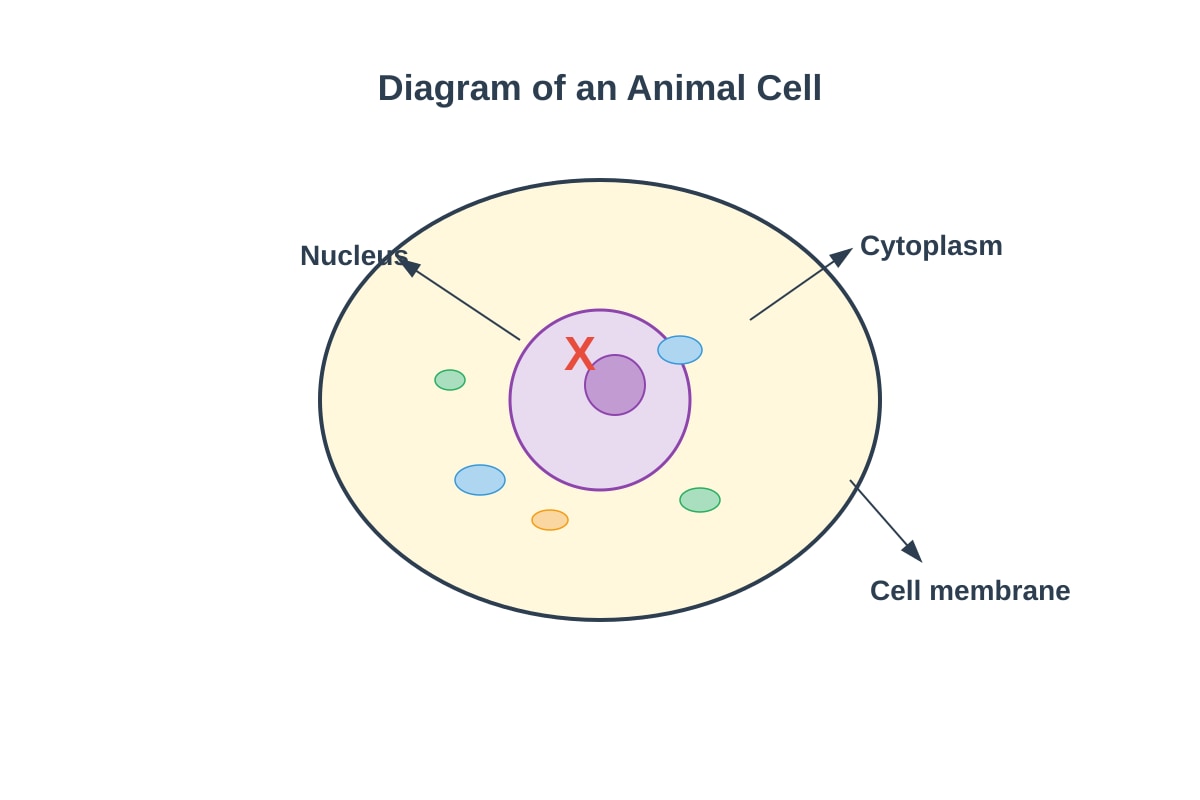
(a) Nucleus (1 mark)
(b) Any one correct difference:
- Plant cells have a cell wall, animal cells do not
- Plant cells have chloroplasts, animal cells do not
- Plant cells have a large central vacuole, animal cells have small or no vacuole
- Plant cells are usually more regular/rectangular in shape, animal cells are more rounded (1 mark)
Teaching note: From Q12-fig1, the labelled part X that controls cell activities is the nucleus. The nucleus contains genetic material (DNA) and directs all cell activities.
From the image (Q12-fig1): The diagram shows nucleus in center, cell membrane as boundary, cytoplasm as filling. The nucleus is clearly indicated as the control center.
Section C: Matching and Classification (8 marks)
13. (2 marks – 0.5 mark each)
| Column A | Answer | Column B |
|---|---|---|
| Fern | [A] | (given) |
| Mushroom | C | B. Flowering plant that produces seeds in fruits |
| Grass | B | C. Fungus that decomposes dead matter |
| Yeast | D | D. Microorganism used in bread-making |
Teaching note:
- Mushrooms are fungi that decompose dead organisms, returning nutrients to the soil.
- Grass is a flowering plant (produces small wind-pollinated flowers and seeds).
- Yeast is a single-celled fungus used in bread-making; it produces carbon dioxide gas that makes bread rise.
14. (2 marks)
(a) Ant and Spider (1 mark)
(b) A spider is not an insect because it has eight legs (not six) / it has two body parts (not three) / it does not have antennae (1 mark)
Teaching note: From the table, invertebrates (no backbone) are ant and spider. Insects must have: six legs, three body parts (head, thorax, abdomen), and usually one pair of antennae. Spiders have eight legs, two body parts (cephalothorax and abdomen), and no antennae – these are arachnid characteristics.
15. (2 marks)
(a) Reptile (1 mark)
(b) Arachnid (1 mark)
Teaching note: From Q15-fig1 classification key:
- Snake: has backbone (1a) → no feathers (2b) → has scales (3a) → lives on land (4b) → Reptile
- Eight legs, no backbone: at branch 5, 5b says "Has eight legs → Arachnid"
Working through the key:
1a. Has backbone → go to 2
2b. No feathers → go to 3
3a. Has scales → go to 4
4b. Lives on land → Reptile ✓
For the eight-legged creature:
1b. No backbone → go to 5
5b. Has eight legs → Arachnid ✓
16. (2 marks)
(a) Any two: type of flower, type of fruit, type of seed, type of leaf/vein pattern, number of seed leaves (cotyledons), stem structure (1 mark)
(b) Fungi grow well on decaying matter because they are decomposers / decaying matter provides nutrients / they absorb nutrients from dead organic material (1 mark)
Teaching note: Flowering plants (angiosperms) can be classified as monocots (one seed leaf, parallel veins, fibrous roots, flower parts in multiples of 3) or dicots (two seed leaves, net-like veins, tap root, flower parts in multiples of 4 or 5). Other characteristics include leaf shape, flower color, and fruit type.
Section D: Application and Reasoning (16 marks)
17. (4 marks)
(a) Plant. Evidence: It is green (contains chlorophyll for photosynthesis), cannot move (plants are fixed in place), has leaves and roots (typical plant structures), produces flowers (reproductive structure of flowering plants). (2 marks)
Marking breakdown: Identification as plant (1 mark); at least two supporting evidence points from the observations (1 mark).
Teaching note: The key features that identify this as a plant are: green colour (chlorophyll), immobility, presence of leaves and roots for photosynthesis and absorption, and flower production. Animals can move, do not have roots, and do not produce flowers.
(b) Flowering plant. Reason: It produces flowers with bright yellow petals / its seeds are found inside a fleshy fruit. (1 mark)
Teaching note: The presence of flowers and fruits containing seeds are definitive characteristics of flowering plants (angiosperms).
(c) Animal dispersal. The fleshy fruit is colourful and tasty, attracting animals to eat it. The seeds pass through the animal's digestive system and are deposited elsewhere with droppings that act as fertiliser. (1 mark)
Alternative answers: Water dispersal – if fruit has fibrous husk or air spaces; Wind dispersal – if seeds are small and light (less likely given "fleshy fruit" description).
Teaching note: Fleshy, brightly coloured fruits typically indicate animal dispersal. The fruit attracts animals, and the seeds are protected from digestion by hard coats. This is mutualistic – the plant gets dispersal, the animal gets food.
18. (4 marks)
(a) Any two valid reasons: (2 marks)
- Both have hair or fur (dolphins have very fine hair around snout when young; bats have visible fur)
- Both feed their young with milk from mammary glands
- Both are warm-blooded (maintain constant body temperature)
- Both give birth to live young (most mammals; dolphins definitely, most bats do)
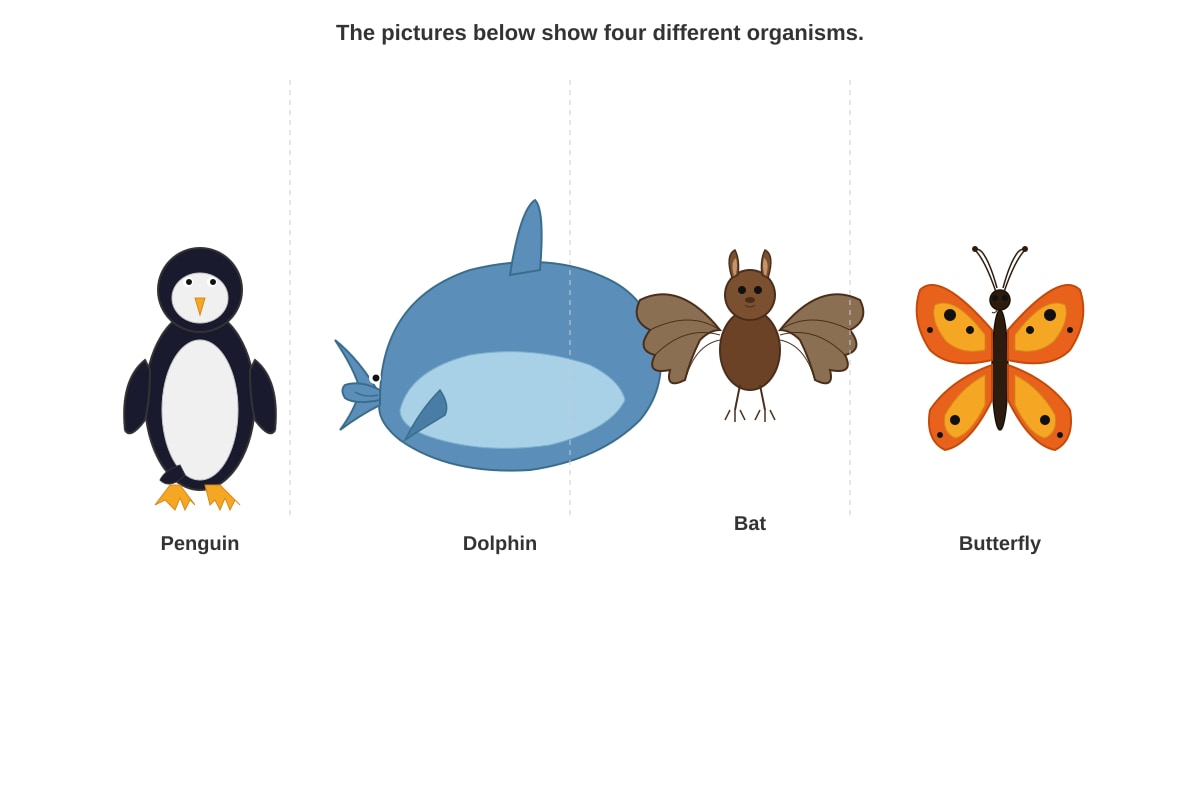
Teaching note: From Q18-fig1, despite differences in appearance and habitat, dolphins and bats share mammal characteristics. The most definitive mammal features are hair/fur and milk production. Dolphins appear hairless but are born with whisker-like hairs; bats clearly have fur.
(b) Penguin is a bird because it has feathers / it lays eggs / it has a beak / it is warm-blooded (any one valid reason with explanation). Most marks awarded for: It has feathers, which is the defining characteristic of birds. Flight is not a requirement for being a bird – ostriches, emus, and kiwis also cannot fly. (1 mark)
Teaching note: Feathers are unique to birds. While penguins cannot fly, they use their flippers to "fly" through water. The inability to fly does not disqualify an animal from being a bird.
(c) Any two insect characteristics: six legs, three body parts (head, thorax, abdomen), one pair of antennae, two pairs of wings (though some insects have one pair or none) (1 mark)
Teaching note: Butterflies have: six legs, three body parts, two pairs of wings (often colourful and scaled), and one pair of antennae that are club-shaped at the ends.
19. (4 marks)
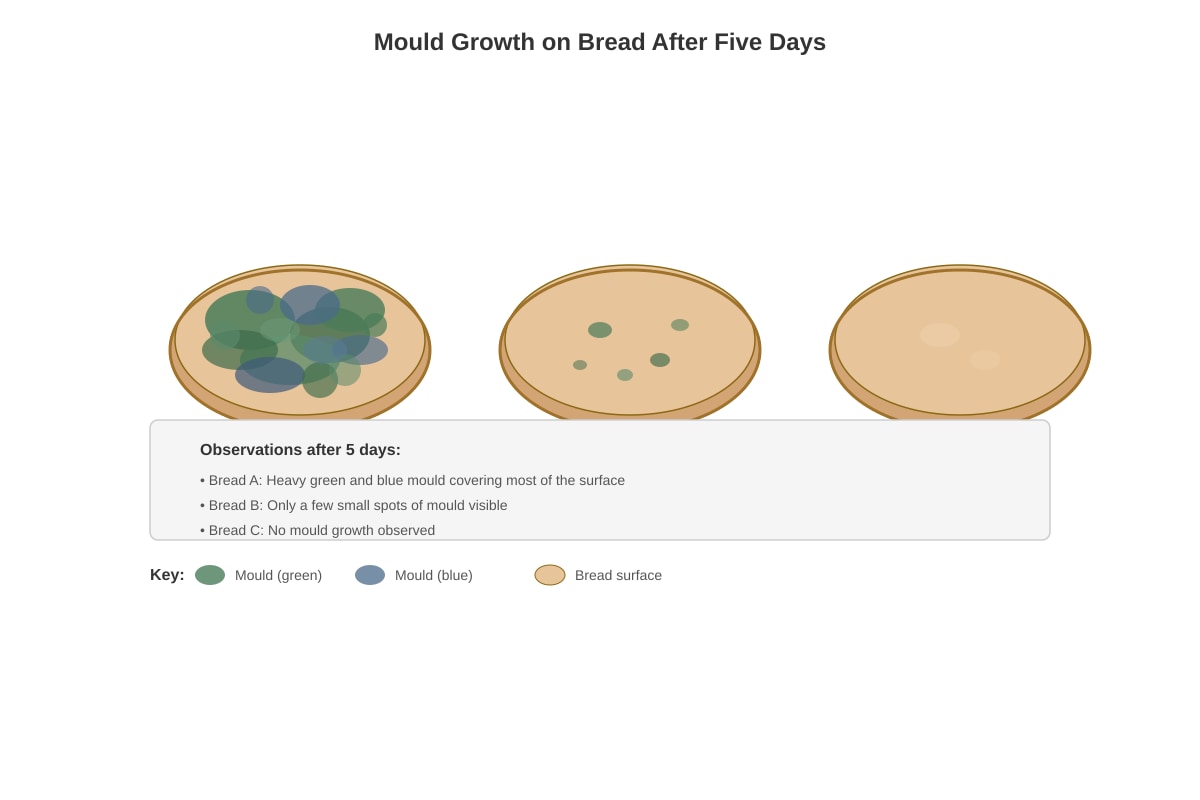
(a) Bread A (1 mark)
Teaching note: From Q19-fig1, Bread A shows heavy mould coverage (green/blue), Bread B shows small spots, Bread C shows none.
(b) Any two: warmth/temperature, moisture/water (1 mark)
Teaching note: Bread A (warm + moist) had most mould. Bread B (cold + moist) had some mould. Bread C (warm + dry) had no mould. Comparing A and C: moisture is needed (warm alone not enough). Comparing A and B: warmth speeds growth.
(c) Bread C had no mould because there was no moisture/water. Microorganisms like fungi need water to grow and reproduce. Even though it was warm, without moisture the spores could not germinate and grow. (1 mark)
Teaching note: This demonstrates that both warmth and moisture are needed together. Warmth alone (Bread C) is insufficient.
(d) Any valid fair test measure with explanation: (1 mark)
Examples:
- Use same type and size of bread – so that the amount of nutrients available is the same
- Leave all breads for same amount of time (5 days) – so that time is not a variable affecting results
- Place same number/area of bread – to ensure equal surface area for mould to grow
Teaching note: A fair test changes only one variable (the independent variable) and keeps all others constant. This ensures that any observed differences are due to the changed variable, not other factors.
20. (4 marks)
(a) Biodiversity means the variety of different living things/plants and animals/species in a habitat or place. From the passage, Singapore has over 2,000 plant species, 400+ bird species, and 200+ coral species despite its small size. (1 mark)
(b) Habitat loss causes species to become rare or extinct because: (2 marks)
- When forests/habitats are cleared, animals and plants lose their homes/shelter
- They lose their food sources that existed in those habitats
- They may not be able to find mates to reproduce, reducing their population
- If the population becomes too small, the species may die out completely (extinction)
Marking breakdown: Each valid point explaining the link between habitat loss and population decline (1 mark each, max 2 marks).
Teaching note: The passage specifically mentions the Singapore freshwater crab and cream-coloured giant squirrel as examples. Habitat loss is the primary threat to biodiversity worldwide.
(c) Created nature reserves and parks / set up protected areas (0.5 marks)
(d) Any valid suggestion not in passage: (0.5 marks)
Examples:
- Reduce pollution to keep habitats healthy
- Plant more trees and create green corridors to connect fragmented habitats
- Educate the public about the importance of biodiversity
- Support conservation organisations through donations or volunteering
- Avoid buying products from endangered species
Answer Key Summary
| Question | Marks | Key Concept |
|---|---|---|
| 1 | 1 | Flowering vs non-flowering plants |
| 2 | 1 | Animal classification (vertebrate groups) |
| 3 | 1 | Insect characteristics |
| 4 | 1 | Mammal characteristics |
| 5 | 1 | Interpreting data tables (bird characteristics) |
| 6 | 1 | Non-flowering plants (spores) |
| 7 | 1 | Plant classification from leaves/veins |
| 8 | 1 | Microorganism definition |
| 9 | 2 | Animal classification groups |
| 10 | 2 | Examples of plant types |
| 11 | 2 | Fungi vs plants (nutrition) |
| 12 | 2 | Cell structure |
| 13 | 2 | Matching organisms to types |
| 14 | 2 | Invertebrate identification; insect vs arachnid |
| 15 | 2 | Using classification keys |
| 16 | 2 | Plant classification criteria; fungi nutrition |
| 17 | 4 | Applying plant characteristics; seed dispersal |
| 18 | 4 | Mammal/bird/insect characteristics; functional anatomy |
| 19 | 4 | Experimental design; conditions for microorganism growth |
| 20 | 4 | Reading comprehension; biodiversity and conservation |
| Total | 40 |
Time estimate: 40 minutes allows approximately 1 minute per mark, with 5 minutes review time for a well-prepared P5 student.