From Real Exams Exam Paper
Primary 5 Science Semestral Assessment 2 (End of Year) Paper 5
Free P5 Science SA2 Paper 5, HY3 Exam version, with questions, answers, and syllabus-aligned practice for Singapore students.
These static practice materials are generated from the site's syllabus and paper-generation workflow, with source and model context shown so students and parents can evaluate the material before use.
Questions
TuitionGoWhere Exam Practice (AI) – SA2 Practice Paper
TuitionGoWhere Exam Practice (AI)
Subject: Science
Level: Primary 5
Paper: SA2 Practice Paper (Version 5 of 5)
Duration: 60 minutes
Total Marks: 60
Name: ________________________
Class: ________
Date: ____________
Instructions:
- This paper contains 20 questions on the topic of Diversity.
- Section A: 10 multiple-choice questions (1 mark each).
- Section B: 6 short-answer questions (2 marks each).
- Section C: 4 structured questions (total 28 marks).
- Answer all questions in the spaces provided.
- Use a pencil to draw any required diagrams.
Section A (10 marks)
Choose the correct answer for each question.
1. Which of the following is a correct example of diversity among living things?
A) All plants have the same leaf shape
B) Some animals breathe with lungs, others with gills
C) Every insect has exactly six legs of the same size
D) All fish live only in freshwater
2. A student groups objects as living or non-living. Which object below is non-living?
A) Mushroom
B) Fern
C) Plastic toy
D) Earthworm
3. Which characteristic shows that a butterfly is a living thing?
A) It is colourful
B) It can fly in the air
C) It grows and reproduces
D) It has wings
4. Plants and animals are both living things. Which of the following do they both need to survive?
A) Soil
B) Sunlight
C) Water
D) Oxygen from air only
5. Which group contains only non-living things?
A) Rock, water, air
B) Dog, cat, bird
C) Tree, flower, grass
D) Bee, ant, spider
6. A child sees a bat and a sparrow. Both can fly. This shows diversity in —
A) colour
B) movement method
C) size only
D) habitat only
7. Which statement about diversity is true?
A) Diversity means all things are exactly the same
B) Diversity means there are differences among living and non-living things
C) Only animals show diversity
D) Plants do not show diversity
8. Which of these is a living thing that can make its own food?
A) Lion
B) Rose plant
C) Stone
D) Cloud
9. Fungi such as yeast are classified as —
A) non-living
B) plants
C) living things
D) minerals
10. Why is it useful to study diversity?
A) To count the number of legs on every insect
B) To understand the different forms of life and how they survive
C) To prove that all animals look the same
D) To avoid learning about plants
Section B (12 marks)
Answer each question in the space provided.
11. Name two differences between a living thing and a non-living thing. (2 marks)
12. Give one example of a plant and one example of an animal that show diversity in their body covering. (2 marks)
13. State one way in which birds and fish are different in their breathing structures. (2 marks)
14. List two non-living things found in a garden. (2 marks)
15. Explain why a car is non-living although it can move. (2 marks)
16. Name one group of living things that is neither a plant nor an animal. (2 marks)
Section C (28 marks)
17. A student collected the following items from a park: a snail, a leaf, a stone, a spider, a puddle of water, and a mushroom.
(a) Group them into living and non-living. (3 marks)
(b) Give one reason why the mushroom is placed in its group. (1 mark)
(c) State one diversity feature you can observe between the snail and the spider. (1 mark)
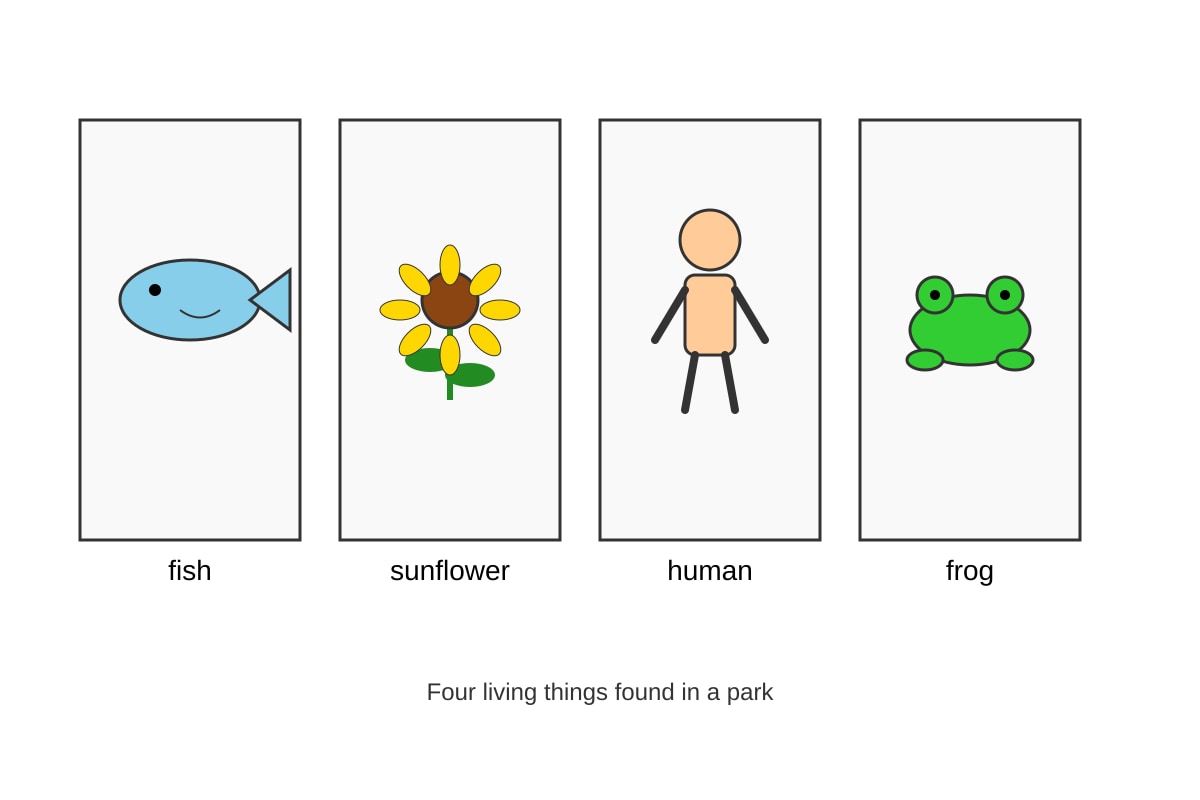
18. The diagram below shows four living things: a fish, a sunflower, a human, and a frog.
Image pending generation: diagram for Q18.
(a) Which two of these are animals? (1 mark)
(b) Which one is a plant? (1 mark)
(c) Give one diversity difference between the human and the fish in how they breathe. (2 marks)
(d) Explain why the sunflower is a living thing. (2 marks)
19. Read the table below about three objects.
| Object | Moves | Reproduces | Needs food |
|---|---|---|---|
| A | No | No | No |
| B | Yes | Yes | Yes |
| C | Yes (only when pushed) | No | No |
| (a) Which object is living? Give a reason. (2 marks) | |||
| (b) Which object is non-living but can move? (1 mark) | |||
| (c) State one diversity characteristic of living things shown by B. (1 mark) |
20. A teacher asked students to find diversity in a pond.
(a) Name two living things and two non-living things in a pond. (4 marks)
(b) Describe one way the living things in the pond are different from each other. (2 marks)
(c) Why should we protect diversity in the pond? (2 marks)
Answers
TuitionGoWhere Exam Practice (AI) – SA2 Practice Paper Answer Key (Version 5)
Subject: Science
Level: Primary 5
Paper: SA2 Practice Paper
Total Marks: 60
Section A (10 marks)
-
B — Some animals breathe with lungs, others with gills. (1m)
Teaching note: Diversity means differences. Breathing structures vary among animals. -
C — Plastic toy. (1m)
Teaching note: Plastic toy does not grow, reproduce, or need food. -
C — It grows and reproduces. (1m)
Teaching note: Growth and reproduction are key signs of life. -
C — Water. (1m)
Teaching note: Both plants and animals need water; not all need soil or only oxygen. -
A — Rock, water, air. (1m)
Teaching note: All three are non-living. -
B — Movement method. (1m)
Teaching note: Flying is a type of movement showing diversity. -
B — Diversity means there are differences among living and non-living things. (1m)
-
B — Rose plant. (1m)
Teaching note: Plants make food by photosynthesis. -
C — Living things. (1m)
Teaching note: Fungi are living but not plants/animals. -
B — To understand the different forms of life and how they survive. (1m)
Section B (12 marks)
-
(2m) Any two: living things grow / reproduce / need food / respond; non-living do not.
Marking: 1m per correct difference. -
(2m) Example: bird (feathers) and fish (scales). (1m each)
-
(2m) Birds breathe with lungs / fish breathe with gills. (2m)
-
(2m) Any two: stone, water, soil, air. (1m each)
-
(2m) A car moves because of engine/fuel, not because it is alive; it does not grow or reproduce. (2m)
-
(2m) Fungi (e.g., mushroom/yeast). (2m)
Section C (28 marks)
-
(a) Living: snail, spider, mushroom. Non-living: leaf (dead part, but commonly accepted as non-living once detached), stone, water. (3m: 1m per 2 correct placements, max 3)
(b) Mushroom is living because it grows and reproduces. (1m)
(c) Snail has shell, spider has 8 legs. (1m) -
(a) Fish and human (or frog). (1m)
(b) Sunflower. (1m)
(c) Human uses lungs, fish uses gills. (2m)
(d) It grows, reproduces, needs sunlight. (2m) -
(a) B; it reproduces and needs food. (2m)
(b) C. (1m)
(c) B can move by itself / reproduce. (1m) -
(a) Living: fish, plant; non-living: water, stone. (4m: 1m each)
(b) Fish has gills, plant makes food. (2m)
(c) To keep balance and life forms safe. (2m)
Free quiz and exam paper access
Enter your details to view this paper
Your access is remembered on this device.