From Real Exams Exam Paper
Primary 5 Science Semestral Assessment 2 (End of Year) Paper 4
Free Exam-Derived Qwen3.7 Plus Primary 5 Science Semestral Assessment 2 (End of Year) Paper 4 practice paper with questions and answers for Singapore students. This page is rendered as a direct URL so the questions and answers can be discovered without pressing in-page buttons.
These static practice materials are generated from the site's syllabus and paper-generation workflow, with source and model context shown so students and parents can evaluate the material before use.
Questions
TuitionGoWhere Practice Paper - Science Primary 5
TuitionGoWhere Exam Practice (AI)
Subject: Science
Level: Primary 5
Paper: SA2 Practice Paper (Version 4 of 5)
Topic Focus: Diversity (Adaptations, Classification, Interactions)
Duration: 1 hour 45 minutes
Total Marks: 56
Name: __________________________
Class: __________
Date: __________
Instructions to Candidates:
- This paper consists of two sections: Section A and Section B.
- Answer all questions.
- Write your answers in the spaces provided.
- For questions in Section A, write the number (1, 2, 3 or 4) of your answer in the brackets provided.
- The number of marks available for each question or part question is shown in brackets [ ] at the end of the question or part question.
Section A (28 marks)
For each question from 1 to 14, four options are given. One of them is the correct answer. Make your choice (1, 2, 3 or 4) and write your answer in the brackets provided. Each question carries 2 marks.
1. The table below shows the characteristics of four different animals.
| Animal | Body Covering | Method of Reproduction |
|---|---|---|
| P | Scales | Lays eggs |
| Q | Feathers | Lays eggs |
| R | Hair/Fur | Gives birth to young |
| S | Moist skin | Lays eggs in water |
Which animal is most likely to be a mammal? ( )
2. Study the classification chart below.
Living Things
├── Group A: Can make their own food
└── Group B: Cannot make their own food
├── Group X: Has 6 legs
└── Group Y: Has more than 6 legs or no legs
Which of the following organisms belongs to Group X? (1) Spider (2) Ant (3) Earthworm (4) Centipede ( )
3. A student observed a plant growing in a desert. The plant had thick, fleshy stems and its leaves were modified into spines.
What is the primary function of the thick, fleshy stems? (1) To attract insects for pollination (2) To store water for dry periods (3) To protect the plant from herbivores (4) To increase the surface area for photosynthesis ( )
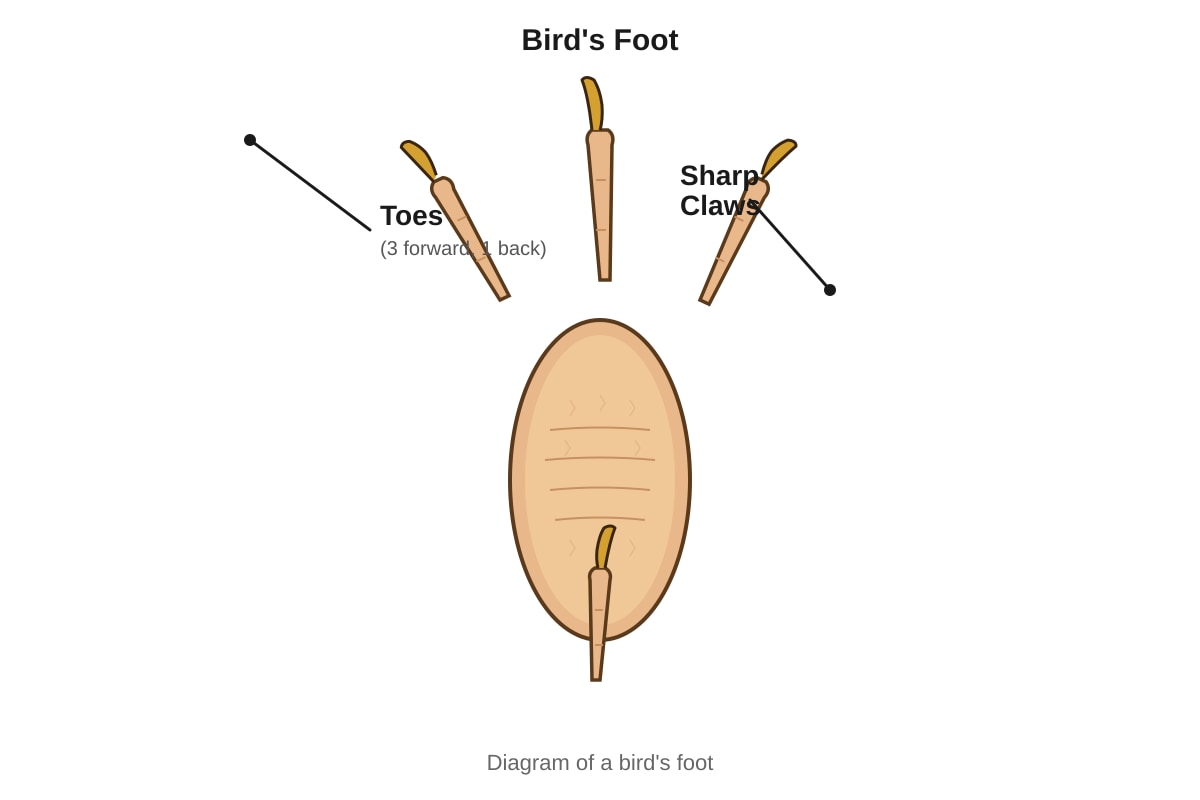
4. The diagram below shows the foot of a bird.
<image_placeholder> id: Q4-fig1 type: diagram linked_question: Q4 description: A drawing of a bird's foot with three toes pointing forward and one toe pointing backward. The toes have sharp, curved claws. labels: Toes, Sharp Claws must_show: The arrangement of toes (3 forward, 1 back) and the sharpness of the claws. </image_placeholder>
This foot structure is best adapted for: (1) Swimming in water (2) Perching on tree branches (3) Scratching the ground for food (4) Wading in shallow mud ( )
5. Which of the following statements about fungi is correct? (1) Fungi are plants because they have roots. (2) Fungi can make their own food using sunlight. (3) Fungi obtain nutrients by breaking down dead organic matter. (4) Fungi reproduce by producing seeds inside fruits. ( )
6. Two plants, Plant A and Plant B, are of the same species. Plant A is grown in a sunny garden, while Plant B is grown in a dark cupboard for two weeks.
What difference is most likely to be observed between Plant A and Plant B? (1) Plant B will have thicker stems than Plant A. (2) Plant A will have yellow leaves, while Plant B will have green leaves. (3) Plant A will be green and healthy, while Plant B will be pale and weak. (4) Plant B will produce more flowers than Plant A. ( )
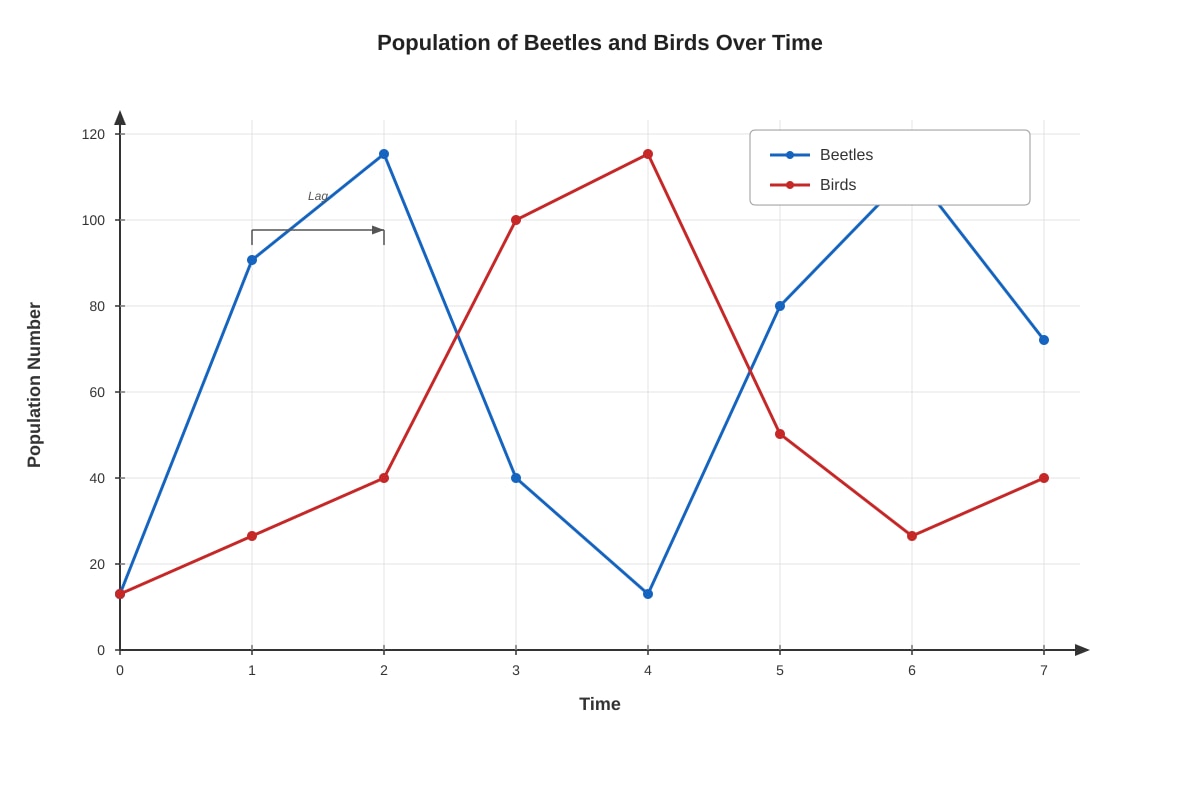
7. The graph below shows the population of beetles and birds in a forest over a period of time.
<image_placeholder> id: Q7-fig1 type: graph linked_question: Q7 description: A line graph with Time on the x-axis and Population Number on the y-axis. There are two lines. Line 1 (Beetles) rises sharply, then Line 2 (Birds) rises shortly after. As Line 2 rises, Line 1 falls. Then Line 2 falls, and Line 1 rises again. labels: Time, Population Number, Beetles, Birds values: Cyclical pattern showing predator-prey relationship. must_show: The lag between the rise in beetle population and the rise in bird population. </image_placeholder>
What can be concluded from the graph? (1) Birds eat beetles. (2) Beetles eat birds. (3) Birds and beetles compete for the same food. (4) The population of birds is not affected by the population of beetles. ( )
8. Which of the following groups contains only microorganisms? (1) Bacteria, Virus, Fungi (2) Bacteria, Algae, Moss (3) Virus, Mushroom, Yeast (4) Bacteria, Protozoa, Fern ( )
9. A farmer wants to increase the yield of his corn crop. He notices that some corn plants are taller and produce more kernels than others. He selects seeds only from the tallest plants with the most kernels to plant for the next season.
This practice is known as: (1) Natural selection (2) Selective breeding (3) Genetic engineering (4) Cross-pollination ( )
10. Study the food chain below:
Leaf → Caterpillar → Bird → Snake
If a disease kills most of the caterpillars, what is the immediate effect on the other organisms? (1) The number of leaves will decrease. (2) The number of birds will decrease. (3) The number of snakes will increase. (4) The number of birds will increase. ( )
11. Which of the following adaptations helps a cactus survive in a hot and dry environment? (1) Broad leaves to capture more sunlight. (2) Shallow and widespread roots to absorb rain water quickly. (3) Thin skin to allow easy water loss. (4) Large surface area to volume ratio for cooling. ( )
12. The diagram shows a simple key used to identify four different leaves.
1a. Leaf edge is smooth ............ Go to 2
1b. Leaf edge is jagged ............ Leaf P
2a. Leaf shape is heart-shaped .... Leaf Q
2b. Leaf shape is oval ............ Go to 3
3a. Leaf has parallel veins ....... Leaf R
3b. Leaf has net-like veins ....... Leaf S
A leaf has a jagged edge and net-like veins. Which leaf is it? (1) Leaf P (2) Leaf Q (3) Leaf R (4) Leaf S ( )
13. Why are decomposers important in an ecosystem? (1) They produce oxygen for animals to breathe. (2) They provide food for predators. (3) They recycle nutrients back into the soil. (4) They control the population of herbivores. ( )
14. Which of the following statements about variation is true? (1) All members of the same species look exactly the same. (2) Variation only occurs in animals, not in plants. (3) Variation allows some individuals to survive better in changing environments. (4) Variation is caused only by the environment, not by genetics. ( )
Section B (28 marks)
Answer all questions in the spaces provided. The number of marks available for each question or part question is shown in brackets [ ].
15. The table below shows the characteristics of three animals, A, B, and C.
| Animal | Body Temperature | Body Covering | Young Feeding |
|---|---|---|---|
| A | Constant | Feathers | N/A (Lays eggs) |
| B | Varies with environment | Scales | N/A (Lays eggs) |
| C | Constant | Hair | Milk from mother |
(a) Identify the class of vertebrates for Animal A and Animal C. [2] Animal A: __________________________ Animal C: __________________________
(b) Animal B is a reptile. State one other characteristic of reptiles not shown in the table. [1]
(c) Explain why Animal C needs to maintain a constant body temperature. [2]
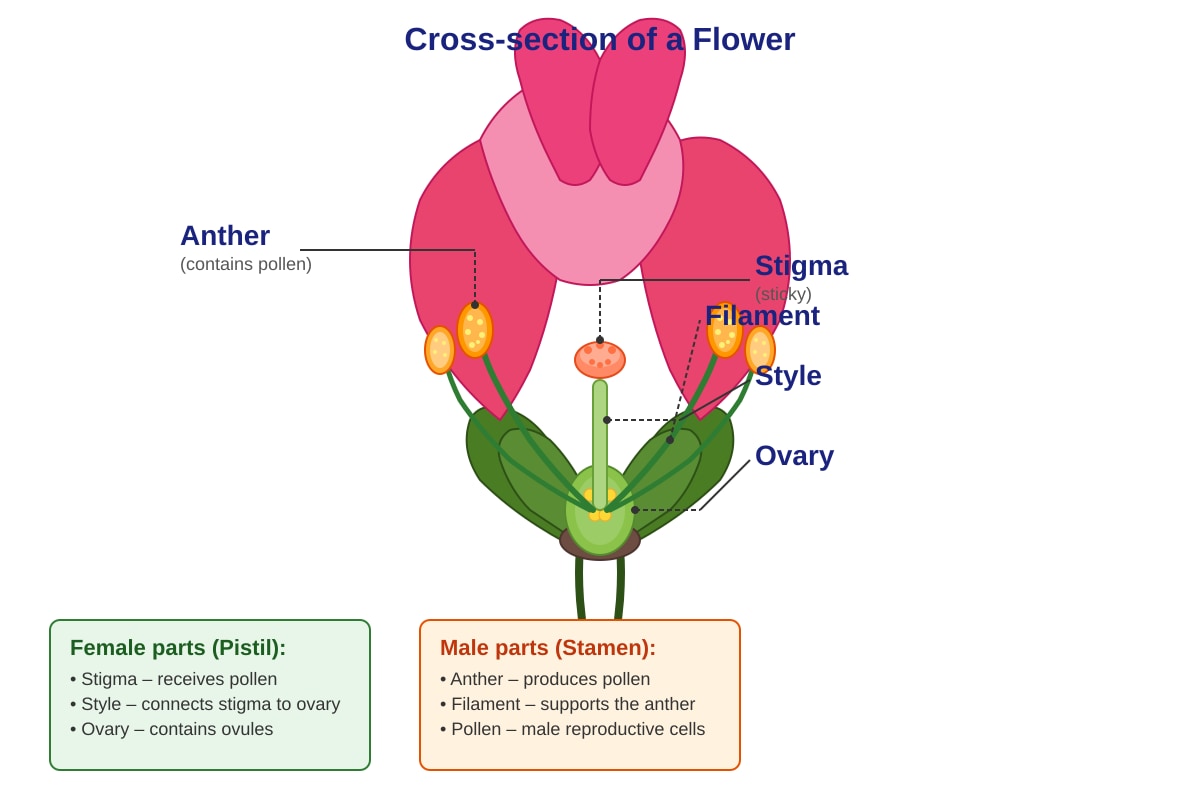
16. Study the diagram of a flower below.
<image_placeholder> id: Q16-fig1 type: diagram linked_question: Q16 description: A cross-section of a typical flower. Labels point to the Stigma, Style, Ovary, Anther, and Filament. The Stigma is sticky. The Anther contains pollen. labels: Stigma, Style, Ovary, Anther, Filament must_show: The relative positions of the male and female reproductive parts. </image_placeholder>
(a) Which part labeled in the diagram is responsible for producing pollen? [1]
(b) Describe the process of pollination. [2]
(c) After fertilization, what does the ovary develop into? [1]
17. A group of students investigated how the surface area of leaves affects the rate of water loss. They used three leaves from the same plant:
- Leaf X: Whole leaf
- Leaf Y: Half of the leaf removed
- Leaf Z: All leaf blade removed, only the stalk remains
They coated the cut edges with wax to prevent water loss from the cuts. They measured the mass of each leaf at the start and after 24 hours.
(a) State the independent variable in this experiment. [1]
(b) Why did the students coat the cut edges with wax? [1]
(c) Predict which leaf (X, Y, or Z) will have the greatest loss in mass. Explain your answer. [2] Leaf: __________________________ Explanation: _________________________________________________________________
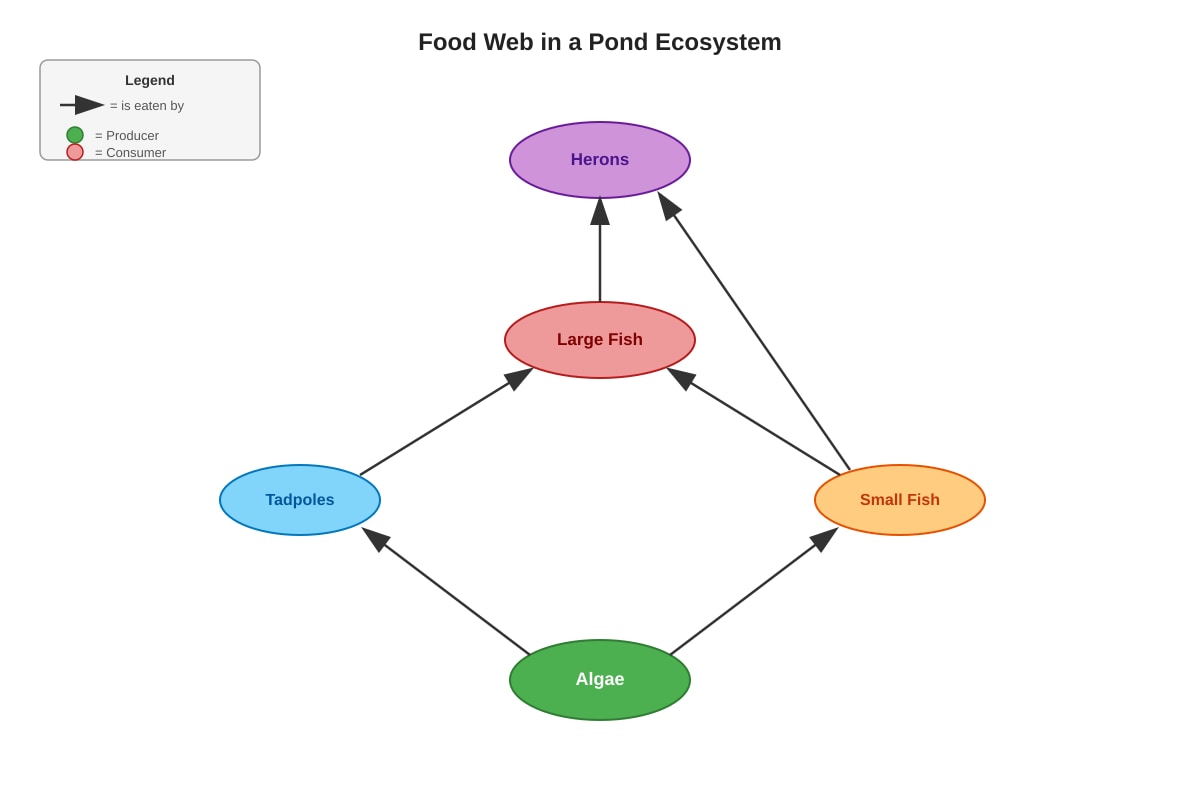
18. The diagram below shows a food web in a pond ecosystem.
<image_placeholder> id: Q18-fig1 type: diagram linked_question: Q18 description: A food web diagram. Algae is eaten by Tadpoles and Small Fish. Tadpoles are eaten by Large Fish. Small Fish are eaten by Large Fish and Herons. Large Fish are eaten by Herons. labels: Algae, Tadpoles, Small Fish, Large Fish, Herons arrows: Show energy flow from prey to predator. must_show: Multiple connections showing a web, not just a chain. </image_placeholder>
(a) Name one producer in this food web. [1]
(b) If the population of Small Fish decreases significantly due to pollution, explain how this might affect the population of Herons. [2]
(c) Why are there usually fewer Herons than Algae in this ecosystem? [2]
19. Read the passage below and answer the questions.
The Polar Bear lives in the Arctic, where it is very cold and snowy. It has a thick layer of fat under its skin and dense fur. Its fur appears white, which helps it blend in with the snow. It has large, wide paws with rough pads.
(a) How does the white fur help the Polar Bear survive? [1]
(b) Explain how the large, wide paws help the Polar Bear move on snow. [2]
(c) The Polar Bear is a carnivore. What type of teeth would you expect it to have, and why? [2] Teeth type: __________________________ Reason: _________________________________________________________________
20. Scientists discovered a new organism in a deep cave where there is no sunlight. The organism is multicellular, has cell walls, and obtains nutrients by absorbing decaying matter from the cave floor. It reproduces using spores.
(a) Is this organism a plant, animal, or fungus? Give a reason for your answer. [2] Type: __________________________ Reason: _________________________________________________________________
(b) Why can this organism not be a plant? [1]
(c) Suggest one way this organism contributes to the cave ecosystem. [1]
*** End of Paper ***
Answers
TuitionGoWhere Practice Paper - Science Primary 5 (Answer Key)
Topic Focus: Diversity (Adaptations, Classification, Interactions)
Version: 4 of 5
Section A (28 marks)
1. (3)
- Reasoning: Mammals are characterized by having hair or fur and giving birth to live young (with few exceptions like the platypus, but at P5 level, giving birth is the key discriminator against birds/reptiles/fish). Animal R has hair/fur and gives birth.
- Common Mistake: Choosing P (scales/eggs) which is a reptile or fish.
2. (2)
- Reasoning: Group X has 6 legs. Insects have 6 legs. An ant is an insect.
- Spider: 8 legs (Arachnid).
- Earthworm: No legs (Annelid).
- Centipede: Many legs (Myriapod).
- Concept: Classification of invertebrates based on leg count.
3. (2)
- Reasoning: In desert plants (xerophytes), thick fleshy stems are adapted to store water. Spines reduce surface area to minimize water loss and protect against herbivores.
- Concept: Adaptation to dry environments.
4. (2)
- Reasoning: The diagram shows a perching foot (anisodactyl arrangement: 3 toes forward, 1 back) with sharp claws for gripping. This is typical of birds that sit on branches.
- Swimming feet are webbed.
- Scratching feet have strong, thick toes (like chickens).
- Wading feet have long toes to distribute weight on mud.
- Concept: Structural adaptation for locomotion/perching.
5. (3)
- Reasoning: Fungi are not plants; they cannot photosynthesize (no chlorophyll). They are saprophytes, obtaining nutrients by secreting enzymes to break down dead organic matter externally and then absorbing it.
- Common Mistake: Thinking fungi are plants because they don't move.
6. (3)
- Reasoning: Photosynthesis requires light to produce chlorophyll (green pigment) and food. Without light, Plant B cannot make chlorophyll, leading to pale (etiolated) and weak growth. Plant A has light, so it remains green and healthy.
- Concept: Conditions for photosynthesis and plant health.
7. (1)
- Reasoning: The graph shows a classic predator-prey cycle. The prey (beetles) population increases, providing more food for predators (birds), so the bird population increases. As birds eat more beetles, the beetle population drops, leading to a subsequent drop in the bird population due to lack of food.
- Concept: Interdependence in ecosystems.
8. (1)
- Reasoning:
- Bacteria, Virus, and Fungi (like yeast/mold) are microorganisms (mostly microscopic, though some fungi are visible, their basic unit is microscopic). Note: At P5, Fungi like mushrooms are often treated separately, but Yeast/Mold are microorganisms. However, looking at the options:
- (2) Moss is a plant.
- (3) Mushroom is a macro-fungus (visible), but Virus/Bacteria are micro. Wait, let's look closer. Standard P5 classification: Microorganisms include Bacteria, Fungi (Yeast/Mold), Protozoa, Algae (some), Viruses.
- Let's re-evaluate Option 1 vs 3. Option 1 has "Fungi". Option 3 has "Mushroom". Mushrooms are fungi. But usually, "Microorganisms" refers to those needing a microscope. Yeast is a microorganism. Mushroom is not.
- Let's look at Option 1 again: Bacteria, Virus, Fungi. Some fungi are microscopic (yeast).
- Let's look at Option 4: Fern is a plant.
- Let's look at Option 2: Moss is a plant.
- Between 1 and 3: Option 1 is the best fit if we consider "Fungi" to include microscopic forms like yeast/mold which are standard examples of microorganisms in P5. Option 3 lists "Mushroom" which is clearly visible. Therefore, (1) is the intended answer as it lists groups that contain microorganisms, whereas Mushroom is a specific macroscopic fruiting body. Correction: In many P5 contexts, "Fungi" is a kingdom, but "Microorganisms" is a functional group. Bacteria and Viruses are definitely micro. Yeast (a fungus) is a micro. So (1) is correct.
9. (2)
- Reasoning: Selecting specific individuals with desirable traits to breed is selective breeding (artificial selection). Natural selection happens without human intervention.
- Concept: Human impact on diversity/breeding.
10. (2)
- Reasoning: If caterpillars (food for birds) decrease, birds will have less food. Their population will decrease due to starvation or reduced reproduction.
- Concept: Food chain dynamics.
11. (2)
- Reasoning: Desert plants need to maximize water absorption when it rarely rains. Shallow, widespread roots catch surface rain quickly.
- (1) Broad leaves increase water loss.
- (3) Thin skin increases water loss.
- (4) Large SA:Vol ratio increases water loss.
- Concept: Adaptation for water conservation and absorption.
12. (1)
- Reasoning: Follow the key:
- Edge jagged? Yes -> Leaf P.
- The key stops at Leaf P for jagged edges. The vein type is irrelevant once Leaf P is identified.
- Concept: Using a dichotomous key.
13. (3)
- Reasoning: Decomposers break down dead organisms and waste, releasing nutrients (minerals) back into the soil for plants to use. This recycles nutrients.
- Concept: Role of decomposers.
14. (3)
- Reasoning: Variation provides a range of traits. In a changing environment, some traits may be advantageous, allowing those individuals to survive and reproduce (natural selection).
- Concept: Importance of variation.
Section B (28 marks)
15. (a) Animal A: Bird [1] Animal C: Mammal [1] * Note: Birds have feathers and lay eggs. Mammals have hair and give birth/feed milk.
(b) They breathe using lungs. OR They have dry, scaly skin. OR They are cold-blooded (body temperature varies). [1] * Note: Any valid reptile characteristic not already listed (scales/eggs/temp variation is in table, so "breathes with lungs" is a safe addition, or "cold-blooded" is implied by "varies with environment" but explicitly stating it is good). The table says "Varies with environment", so stating "Cold-blooded" is a valid interpretation/name for that trait. Better answer: They breathe with lungs.
(c) To ensure their body enzymes work efficiently. [1] Enzymes control chemical reactions in the body (like digestion/respiration) and work best at a specific temperature. [1] * Teaching Note: Mammals are endotherms. Maintaining constant temperature ensures metabolic processes remain stable regardless of external weather.
16. (a) Anther [1] * Note: The anther produces pollen.
(b) Pollination is the transfer of pollen grains from the anther to the stigma. [2] * Marking: 1 mark for "from anther", 1 mark for "to stigma". Must mention both parts.
(c) Fruit [1] * Note: The ovary becomes the fruit; the ovules inside become the seeds.
17. (a) Surface area of the leaf (or Size of the leaf). [1]
(b) To prevent water loss from the cut surfaces. [1] * Reasoning: This ensures that any change in mass is due to water loss from the leaf surface (transpiration) only, making it a fair test.
(c) Leaf: X [1] Explanation: Leaf X has the largest surface area. [1] More stomata are present on a larger surface area, leading to a higher rate of transpiration (water loss). [1] * Teaching Note: Transpiration occurs mainly through stomata on the leaf surface. More surface area = more stomata = more water loss.
18. (a) Algae [1]
(b) The population of Herons will decrease. [1] Because Small Fish are a food source for Herons. With fewer Small Fish, Herons have less food. [1] * Note: Even though Herons also eat Large Fish, the direct loss of one food source impacts the total available energy/food supply.
(c) Energy is lost at each trophic level (as heat/waste/movement). [1] Therefore, less energy is available to support organisms at higher trophic levels, resulting in fewer individuals. [1] * Teaching Note: This is the "Pyramid of Numbers/Energy" concept. Only ~10% of energy is passed on.
19. (a) It provides camouflage. [1] This helps the Polar Bear hide from its prey (or predators, though they are apex) while hunting in the snow. [1] * Note: The question asks how it helps survive. Camouflage aids hunting success.
(b) The large surface area of the paws distributes the bear's weight over a larger area. [1] This reduces the pressure on the snow, preventing the bear from sinking. [1] * Concept: Pressure = Force / Area. Larger area = Lower pressure.
(c) Teeth type: Canines (or Sharp teeth). [1] Reason: To tear flesh/meat. [1] * Note: Carnivores need sharp canines for killing and tearing.
20. (a) Type: Fungus [1] Reason: It has cell walls, reproduces by spores, and obtains nutrients by absorbing decaying matter (cannot make its own food). [1] * Note: Plants make their own food. Animals do not have cell walls. Fungi fit all criteria.
(b) It cannot perform photosynthesis because there is no sunlight in the cave. [1] * Alternative: It does not have chlorophyll.
(c) It acts as a decomposer, breaking down dead matter and recycling nutrients in the cave ecosystem. [1]