From Real Exams Exam Paper
Primary 5 Science Semestral Assessment 2 (End of Year) Paper 4
Free P5 Science SA2 Paper 4, LongCat Exam version, with questions, answers, and syllabus-aligned practice for Singapore students.
These static practice materials are generated from the site's syllabus and paper-generation workflow, with source and model context shown so students and parents can evaluate the material before use.
Questions
Free quiz and exam paper access
Enter your details to view this paper
Your access is remembered on this device.
Answers
TuitionGoWhere Practice Paper - Science Primary 5
SA2 (Version 4 of 5) — Answer Key
Section A: Multiple Choice (10 marks)
| Qn | Answer | Marks | Notes |
|---|---|---|---|
| 1 | (B) Number of legs | 1 | Classification is based on observable structural characteristics. Number of legs is a valid taxonomic trait. Colour, diet, and habitat are less reliable for classification. |
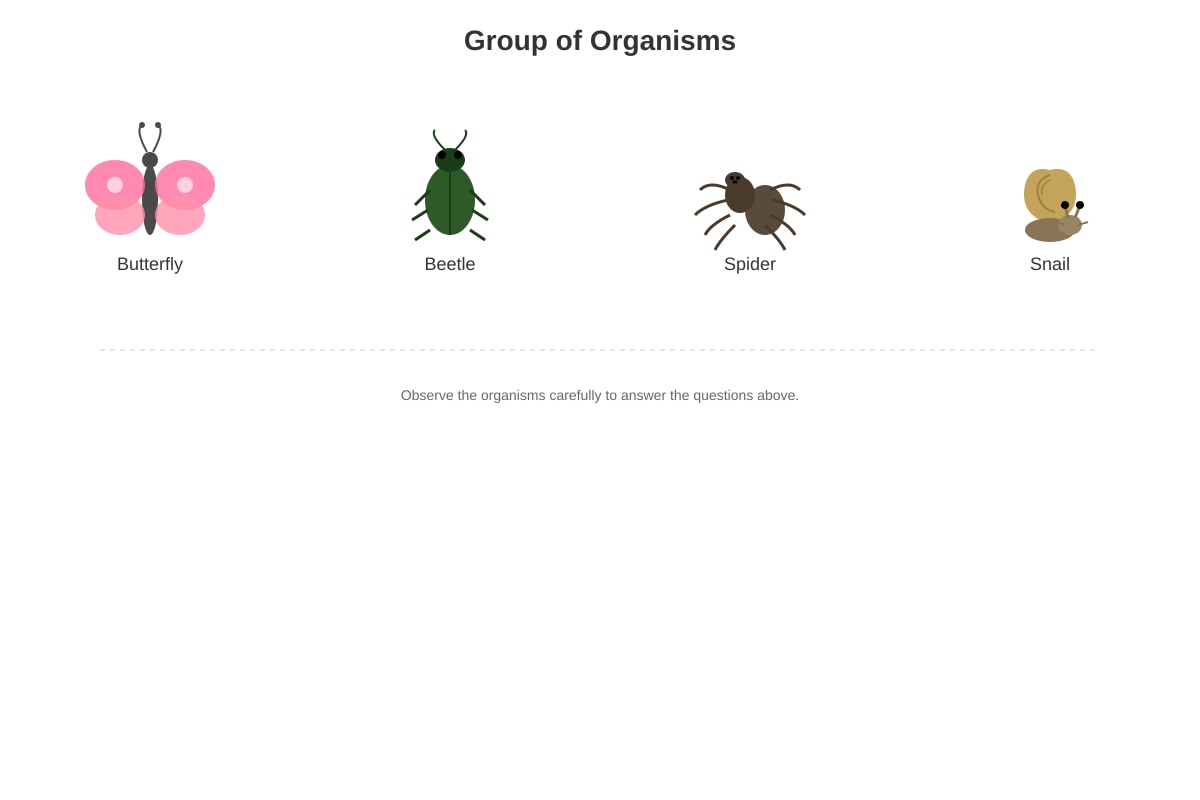
| 2 | (B) Whether they have six legs | 1 | Butterfly and beetle have six legs (insects); spider has eight legs (arachnid); snail has no legs (mollusc). This is the most scientifically valid grouping characteristic. |
| 3 | (D) River | 1 | A river is non-living. Mushroom (fungus), moss (plant), and coral (animal) are all living things. Common mistake: students may think coral is non-living because it is hard and rock-like. |
| 4 | (C) They all have feathers | 1 | Bat is a mammal (has fur, not feathers). Penguin and ostrice are birds. All three are warm-blooded, but the shared characteristic among the birds is feathers. The best answer is (C) as it is a defining trait of birds. |
| 5 | (C) Sunflower | 1 | Sunflower is a flowering plant (angiosperm). Fern and moss reproduce by spores. Pine tree is a gymnosperm (has cones, not flowers). |
| 6 | (B) To group organisms based on shared characteristics for easier study | 1 | The main purpose of classification is to organise the diversity of life into meaningful groups for identification and study. |
| 7 | (B) Fern | 1 | Ferns reproduce by spores. Rose, mango tree, and orchid are flowering plants that reproduce by seeds. |
| 8 | (D) Whether they breathe with gills or lungs | 1 | Fish breathe with gills; dolphins breathe with lungs. This is a fundamental difference showing they belong to different classes (fish vs. mammal). Body shape is a superficial similarity due to convergent evolution. |
| 9 | (C) They feed their young with milk | 1 | This is a defining characteristic of mammals. Scales → reptiles/fish; lay eggs → reptiles/birds/monotremes; feathers → birds. |
| 10 | (C) R | 1 | Insects have no backbone, have legs, and have wings. R matches: no backbone, yes legs, yes wings. P is a mammal/reptile (backbone + legs, no wings). Q is a bird (backbone + legs + wings). S could be a worm or snake (no backbone, no legs, no wings). |
Section B: Short Answer (20 marks)
11. [2 marks]
Answer:
- Whether they breathe with gills or lungs.
- Whether they have scales or skin/fur.
- Whether they are cold-blooded or warm-blooded.
- Whether they lay eggs or give birth to live young.
Marking scheme: 1 mark for each valid characteristic, max 2 marks. Accept any two scientifically valid distinguishing characteristics.
Common mistake: Students may state "lives in water" — this is a habitat characteristic, not a structural/biological classification trait. Do not award marks for habitat-based answers.
12. [3 marks]
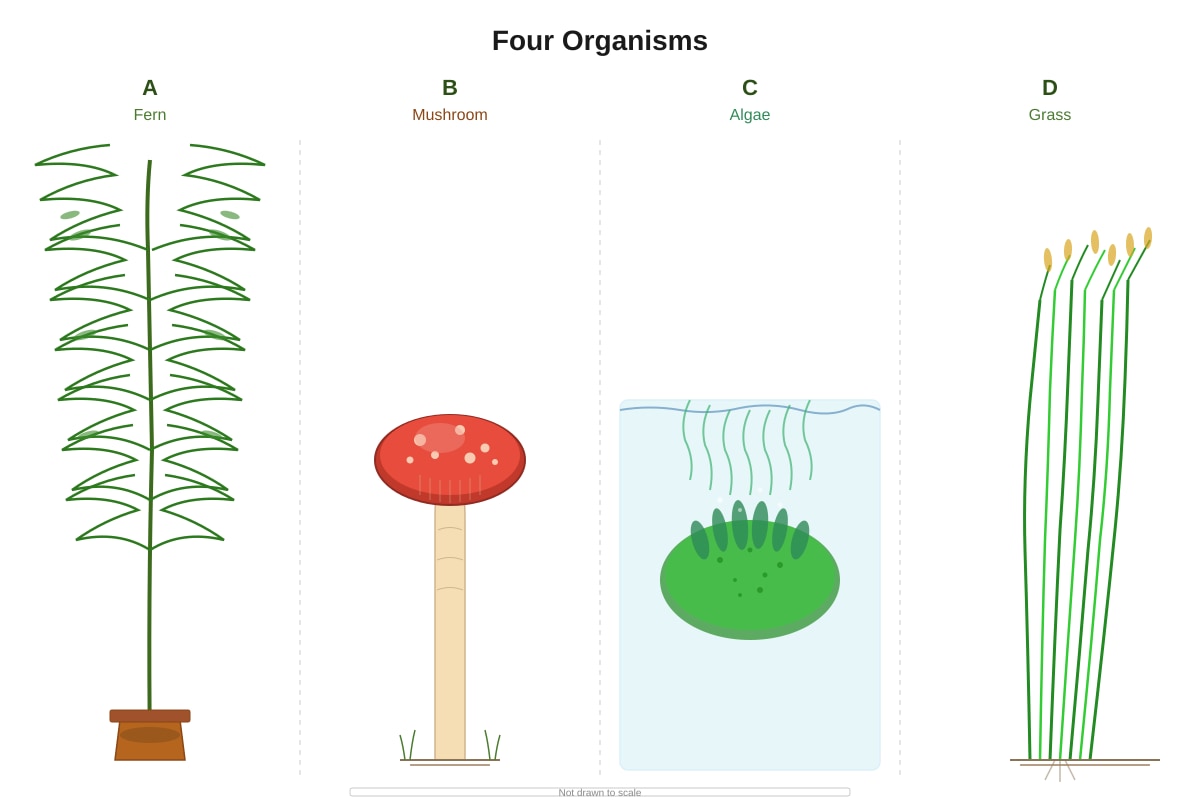
(a) A (Fern) [1 mark]
(b) B (Mushroom) [1 mark] — It is a fungus and does not have chlorophyll / cannot make its own food by photosynthesis / does not have true roots, stems, and leaves. [1 mark]
Marking scheme: Award 1 mark for correctly identifying organism B. Award 1 mark for a valid reason (must relate to it being a fungus, not a plant).
13. [2 marks]
(a) Mollusc / Gastropod [1 mark]
(b) Any one of the following: [1 mark]
- Whether it has a single shell or two shells (bivalve)
- Whether it has tentacles/eyes on stalks
- Whether it has a muscular foot
- The shape of the shell (spiral, flat, etc.)
- Whether it lives in water or on land
Marking scheme: 1 mark for correct group. 1 mark for any valid observable characteristic that aids further classification.
14. [4 marks]
(a) Plant X [1 mark] — It has roots but no flowers or seeds, which means it is a non-flowering plant that likely reproduces by spores (like a fern). [1 mark]
(b) Plant Y [1 mark] — It has no flowers, no seeds, and no roots, which means it is a simple plant-like organism such as an alga that does not have true plant structures. [1 mark]
Marking scheme: 1 mark for correct identification + 1 mark for valid explanation for each part.
15. [3 marks]
(i) Bird [1 mark]
(ii) Insect [1 mark]
(iii) Mollusc [1 mark]
Marking scheme: 1 mark each. Follow the key step by step. Common mistake: students may confuse arachnid and insect — remind them that insects have 6 legs, arachnids have 8.
Section C: Structured / Application (20 marks)
16. [5 marks]
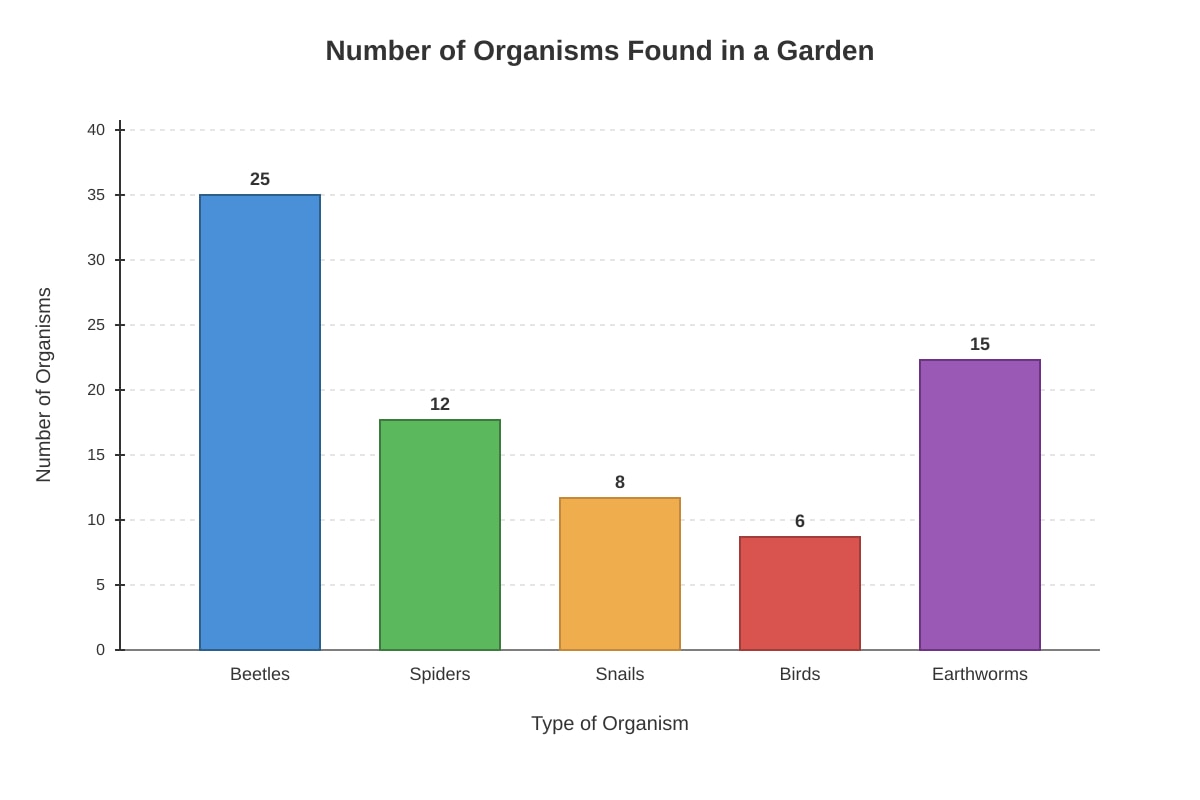
(a) Beetles [1 mark]
(b) 25 − 8 = 17 [2 marks]
Working: Number of beetles − Number of snails = 25 − 8 = 17
Marking scheme: 1 mark for correct subtraction, 1 mark for correct answer with unit (or number).
(c) [2 marks]
| With Backbone | Without Backbone |
|---|---|
| Birds | Beetles |
| Spiders | |
| Snails | |
| Earthworms |
Marking scheme: 1 mark for correctly placing Birds in "With Backbone". 1 mark for correctly placing all four invertebrates in "Without Backbone". Deduct ½ mark for each error.
17. [6 marks]
(a) 2 (Frog and Eagle) [1 mark]
(b) Grasshopper [1 mark]
- Reason 1: It has no backbone (it is an invertebrate). [1 mark]
- Reason 2: It has six legs and wings, which are characteristics of insects. [1 mark]
Note: Caterpillar also has no backbone and legs, but it does not have wings and has more than 6 legs (prolegs), so it is a larva. Award marks for grasshopper with valid reasons.
(c) Yes [1 mark] — The caterpillar and butterfly are the same organism at different stages of its life cycle (metamorphosis). They share the same genetic material and belong to the same species/group (insect — butterfly is an adult insect). [1 mark]
Marking scheme: 1 mark for "Yes", 1 mark for explanation referencing life cycle / same organism / same species.
18. [6 marks]
(a) [4 marks — 1 mark each]
- P: Reptile — Dry scaly skin, lays eggs on land, breathes through lungs.
- Q: Amphibian — Moist smooth skin, breathes through gills (young) and lungs (adult), lays eggs in water.
- R: Bird — Feathers, lays eggs on land, breathes through lungs.
- S: Mammal — Fur, gives birth to live young, breathes through lungs.
(b) Animal P (Reptile) [1 mark] — Both Animal R (bird) and Animal P (reptile) lay eggs on land and breathe through lungs. Birds and reptiles share a more recent common ancestor than birds and mammals/amphibians. Both are also cold-blooded (reptile) or share egg-laying traits. [1 mark]
Note: Accept any reasonable explanation that references shared characteristics between birds and reptiles (e.g., both lay eggs on land, both have scales/feathers which are related structures).
19. [4 marks]
(a) Any one of the following: [1 mark]
- Whether they have feathers or not
- Whether they have fur/hair or not
- Whether they lay eggs or give birth to live young
- Whether they are warm-blooded or cold-blooded
- Whether they have scales or moist skin
(b) Sample key using "Has feathers / Does not have feathers": [3 marks]
1a — Has feathers ............................ Bird
1b — Does not have feathers ................. Go to 2

2a — Has fur/hair ........................... Mammal
2b — Does not have fur/hair ................. Go to 3

3a — Has dry, scaly skin ................... Lizard (Reptile)
3b — Has moist skin ......................... Go to 4

4a — Lives in water (young), lays eggs in water ... Frog (Amphibian)
4b — Lives in water, has fins ................ Fish
Marking scheme: Award 1 mark for a logical first division. Award 1 mark for correct second-level split. Award 1 mark for correctly sorting all five organisms. Accept any valid key structure.
Common mistake: Students may create a key that does not account for all five organisms. Check that every organism can be identified using the key.
20. [5 marks]
(a) Any three of the following: [3 marks — 1 mark each]
- Whether the organism has a backbone or not
- Whether it has legs and how many
- Whether it has wings or not
- Whether it has feathers, fur, scales, or moist skin
- Whether it has roots, stems, and leaves (for plants)
- Whether it can make its own food (producer) or not
- Whether it has flowers/seeds or reproduces by spores
(b) Any two of the following: [2 marks — 1 mark each]
- It helps scientists organise and make sense of the huge variety of living things.
- It makes it easier to identify and name new or unknown organisms.
- It helps scientists understand the relationships between different organisms.
- It allows scientists to study and compare organisms more systematically.
- It helps in conservation efforts by identifying which species are related or endangered.
Marking scheme: 1 mark per valid reason, max 2 marks. Answers must go beyond "it is easier" — require a scientific justification.
Summary of Marks
| Section | Marks |
|---|---|
| A: Multiple Choice (Q1–10) | 10 |
| B: Short Answer (Q11–15) | 20 |
| C: Structured / Application (Q16–20) | 20 |
| Total | 50 |
Common Mistakes & Marking Notes
-
Habitat vs. structural traits: Students frequently use where an organism lives rather than its physical/biological characteristics for classification. Remind students that classification is based on observable structural and biological features.
-
Coral confusion: Many students classify coral as non-living or as a plant. Coral is a living animal (cnidarian).
-
Dolphin vs. fish: Students often group dolphins with fish because both live in water. Emphasise that dolphins breathe with lungs, are warm-blooded, and give birth to live young — all mammalian traits.
-
Butterfly life cycle: Students may think caterpillar and butterfly are different organisms. Reinforce the concept of complete metamorphosis.
-
Classification keys: Students often create keys that are not mutually exclusive or that do not cover all organisms. Practice with dichotomous keys is essential.
-
Non-examples: When asked for a "non-living" or "non-plant" example, students sometimes give an organism from a different kingdom without realising it. Encourage careful reading of the question.