From Real Exams Exam Paper
Primary 5 Science Semestral Assessment 2 (End of Year) Paper 4
Free Exam-Derived NVIDIA Nemotron 3 Ultra 550B A55B Free Primary 5 Science Semestral Assessment 2 (End of Year) Paper 4 practice paper with questions and answers for Singapore students. This page is rendered as a direct URL so the questions and answers can be discovered without pressing in-page buttons.
These static practice materials are generated from the site's syllabus and paper-generation workflow, with source and model context shown so students and parents can evaluate the material before use.
Questions
TuitionGoWhere Practice Paper - Science Primary 5
TuitionGoWhere Exam Practice (AI)
Subject: Science
Level: Primary 5
Paper: SA2 (Version 4)
Duration: 1 h 45 min
Total Marks: 100
Name: ___________________________
Class: Primary 5 _______
Date: _______________
Instructions to Candidates
- Do not open this booklet until you are told to do so.
- Follow all instructions carefully.
- Answer all questions.
- For Section A, shade your answers on the Optical Answer Sheet (OAS) provided.
- For Section B, write your answers in the spaces provided in this booklet.
- The number of marks is given in brackets [ ] at the end of each question or part question.
- The total marks for this paper is 100.
Section A: Multiple-Choice Questions (56 marks)
For each question from 1 to 28, four options are given. One of them is the correct answer. Make your choice (1, 2, 3 or 4) and shade the correct oval on the OAS.
1. Which of the following statements about living things is correct? [2]
(1) All living things can make their own food.
(2) All living things reproduce by laying eggs.
(3) All living things respond to changes around them.
(4) All living things need sunlight to survive.
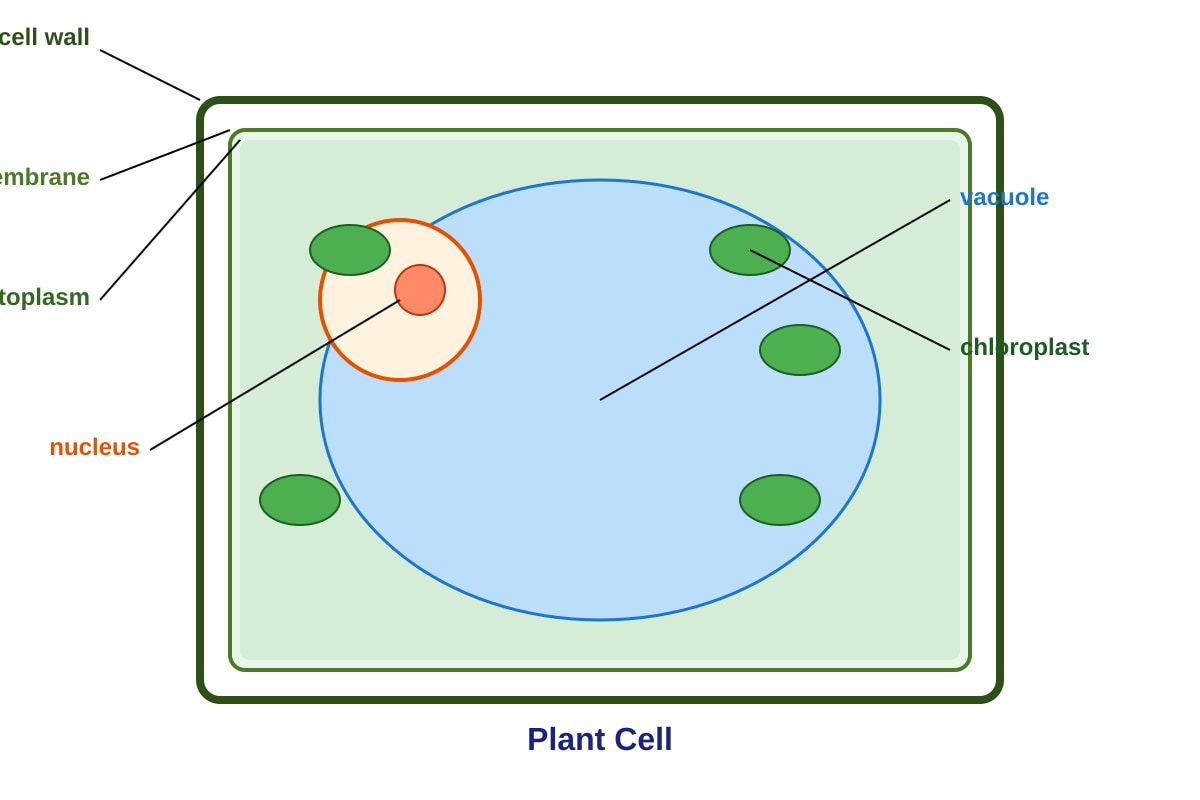
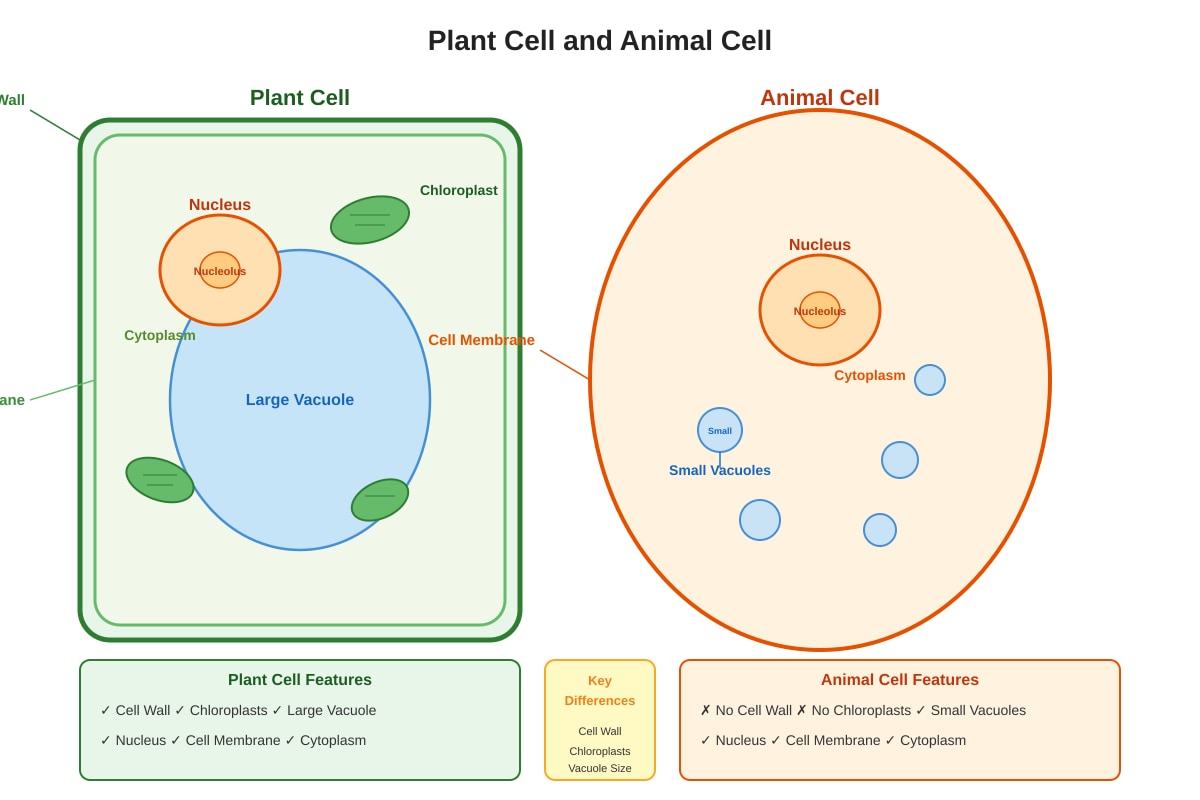
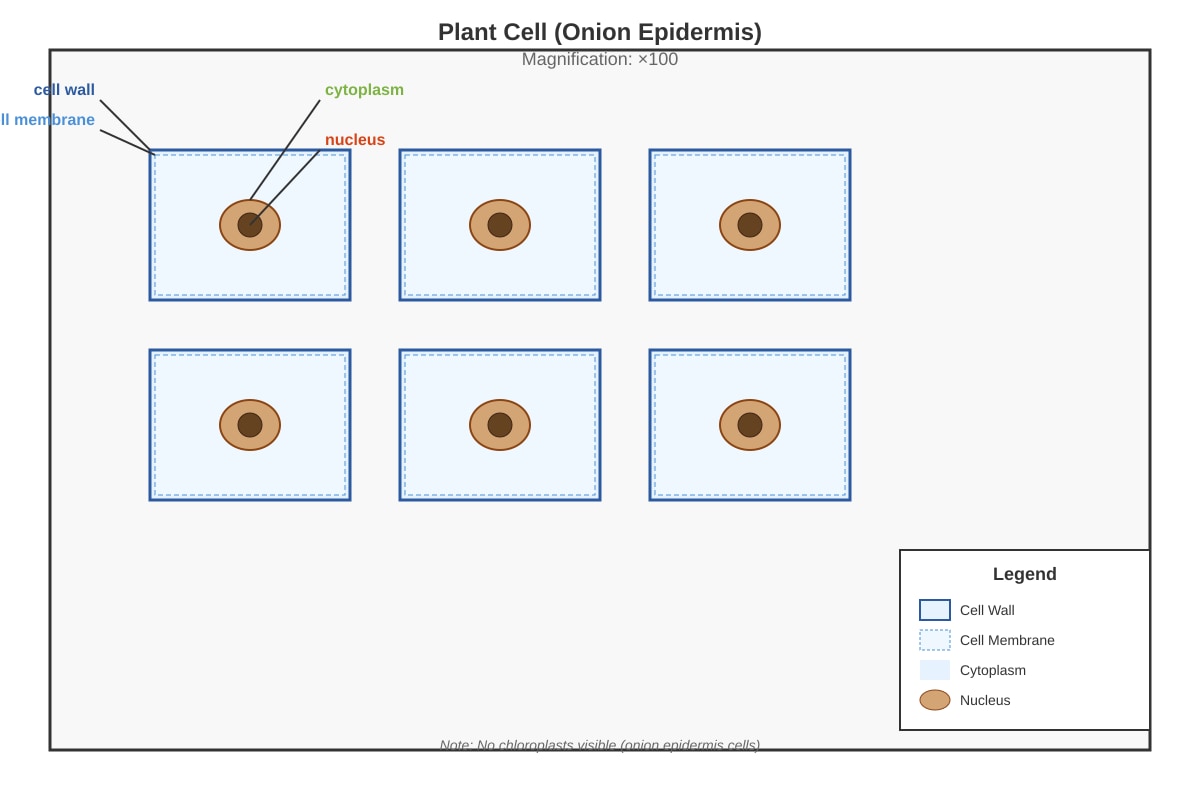
2. The diagram below shows a cell.
<image_placeholder>
id: Q2-fig1
type: diagram
linked_question: Q2
description: A typical plant cell with labelled parts: cell wall, cell membrane, cytoplasm, nucleus, chloroplast, vacuole.
labels: Cell wall, Cell membrane, Cytoplasm, Nucleus, Chloroplast, Vacuole
values: None
must_show: Clear labels for all six parts; cell wall outermost, chloroplasts in cytoplasm, large central vacuole.
</image_placeholder>
Which part controls all activities in the cell? [2]
(1) Cell wall
(2) Nucleus
(3) Cytoplasm
(4) Vacuole
3. Study the classification chart below.
Living Things
├── Group X
│ ├── Mushroom
│ ├── Yeast
│ └── Mould
└── Group Y
├── Rose plant
├── Grass
└── Fern
Which of the following correctly identifies Group X and Group Y? [2]
(1) Group X: Fungi; Group Y: Non-flowering plants
(2) Group X: Bacteria; Group Y: Flowering plants
(3) Group X: Fungi; Group Y: Flowering plants
(4) Group X: Non-flowering plants; Group Y: Fungi
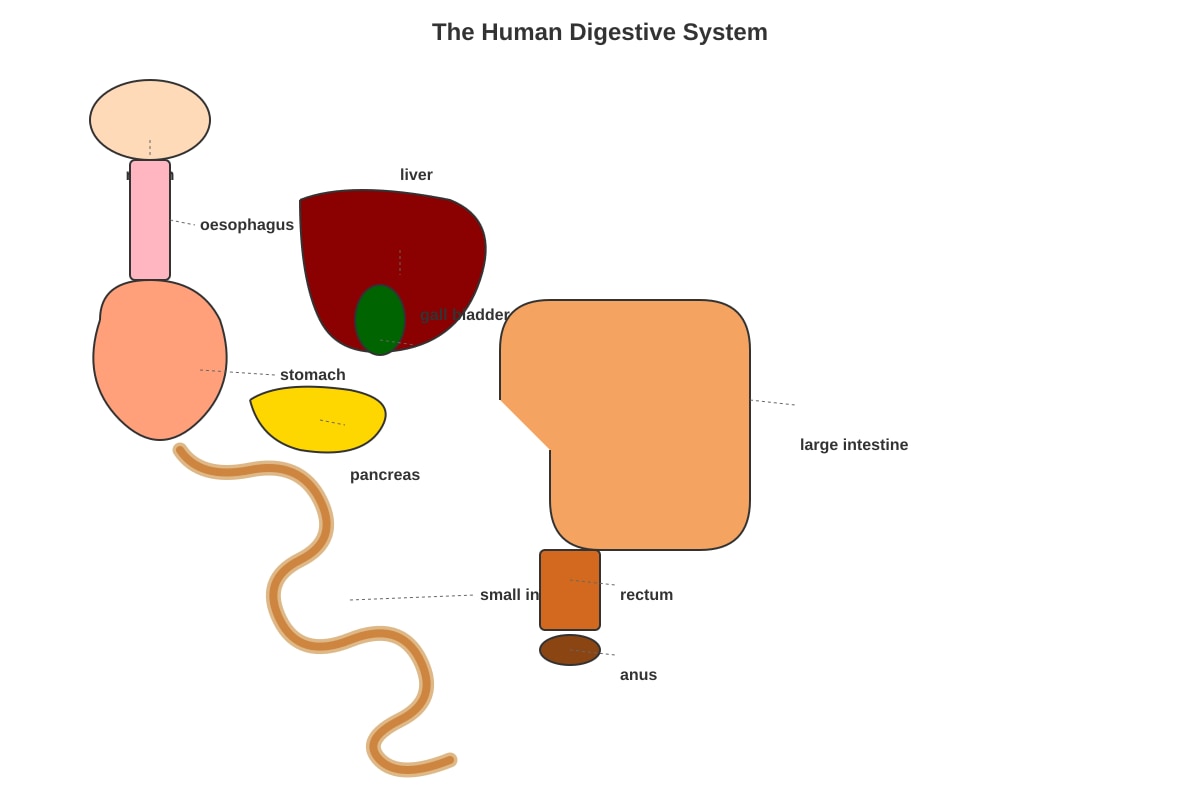
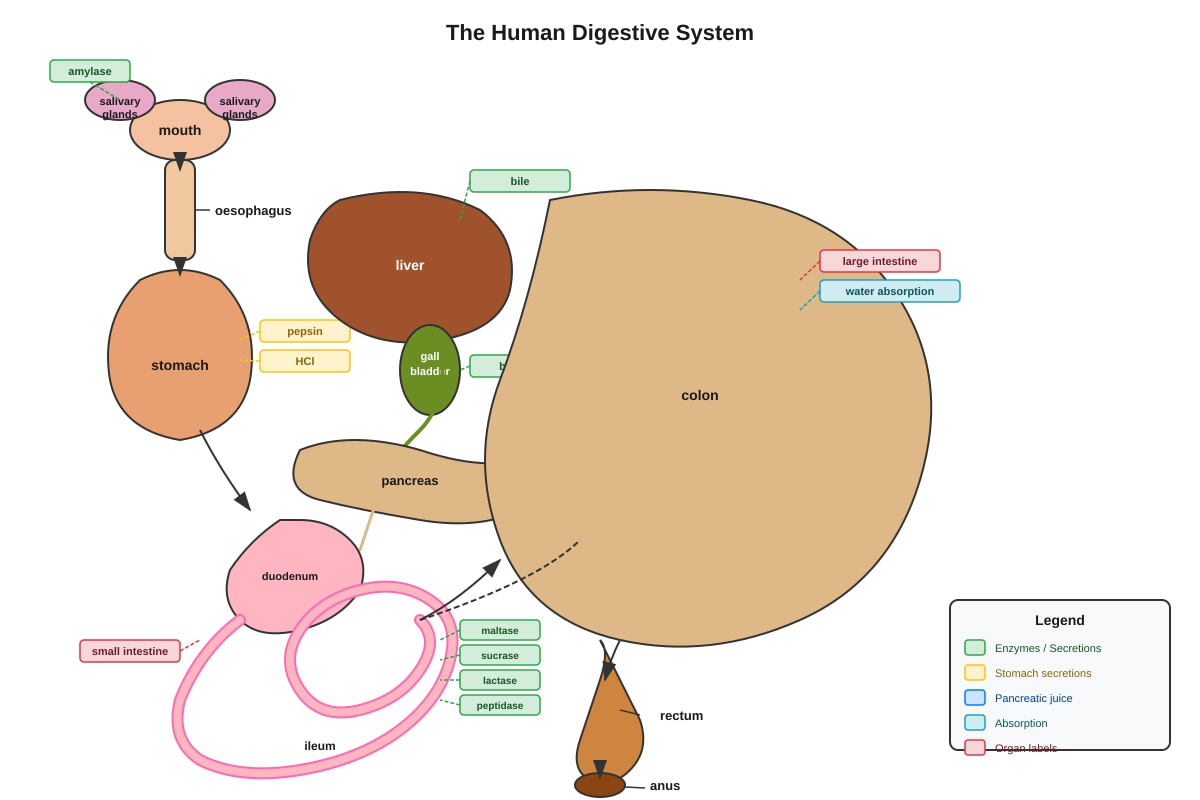
4. The diagram below shows the human digestive system.
<image_placeholder>
id: Q4-fig1
type: diagram
linked_question: Q4
description: Human digestive system with organs labelled A, B, C, D, E.
labels: A: Mouth, B: Oesophagus, C: Stomach, D: Small intestine, E: Large intestine
values: None
must_show: Clear labels A to E on respective organs; stomach shown as J-shaped pouch; small intestine coiled; large intestine framing small intestine.
</image_placeholder>
In which organ does most absorption of digested food take place? [2]
(1) A
(2) C
(3) D
(4) E
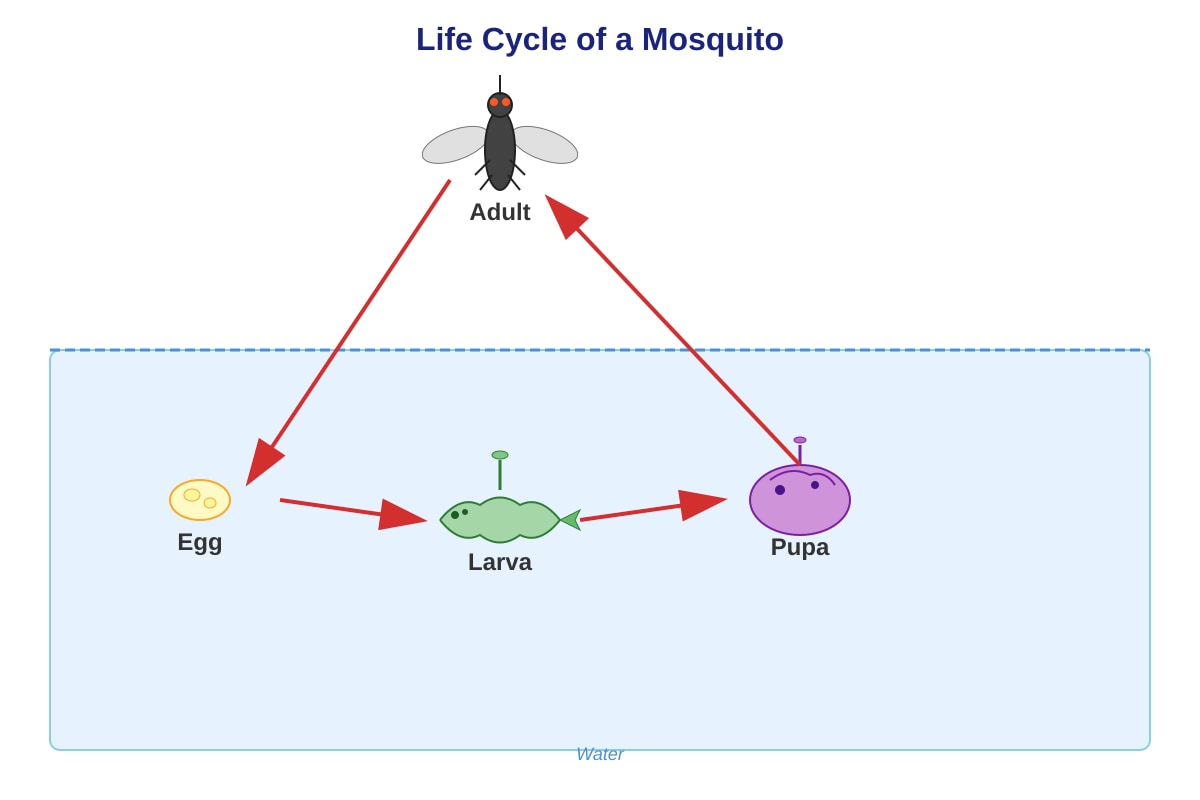
5. Which of the following shows the correct order of the stages in the life cycle of a mosquito? [2]
(1) Egg → Larva → Pupa → Adult
(2) Egg → Nymph → Larva → Adult
(3) Egg → Pupa → Larva → Adult
(4) Egg → Nymph → Pupa → Adult
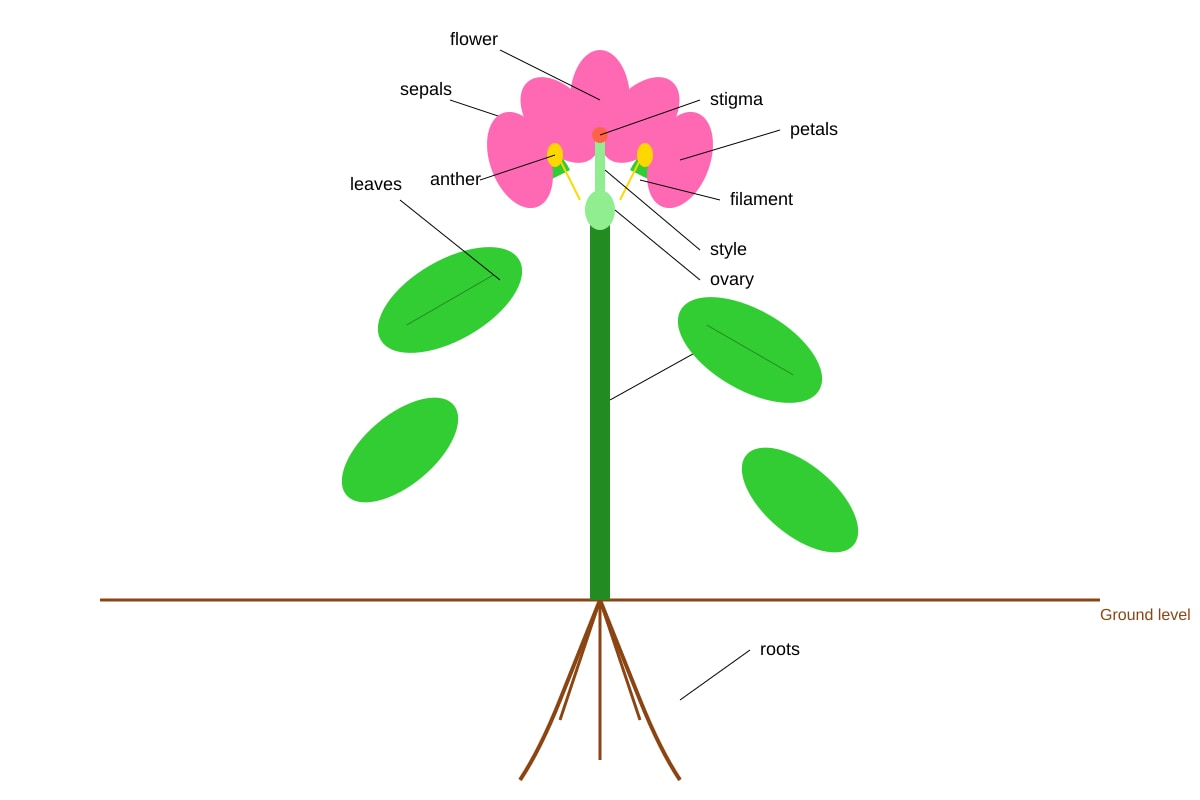
6. The diagram below shows a flowering plant.
<image_placeholder>
id: Q6-fig1
type: diagram
linked_question: Q6
description: Flowering plant with parts labelled P, Q, R, S.
labels: P: Roots, Q: Stem, R: Leaf, S: Flower
values: None
must_show: Roots underground, stem upright, leaves on stem, flower at top; labels P, Q, R, S clearly placed.
</image_placeholder>
Which part produces pollen grains? [2]
(1) P
(2) Q
(3) R
(4) S
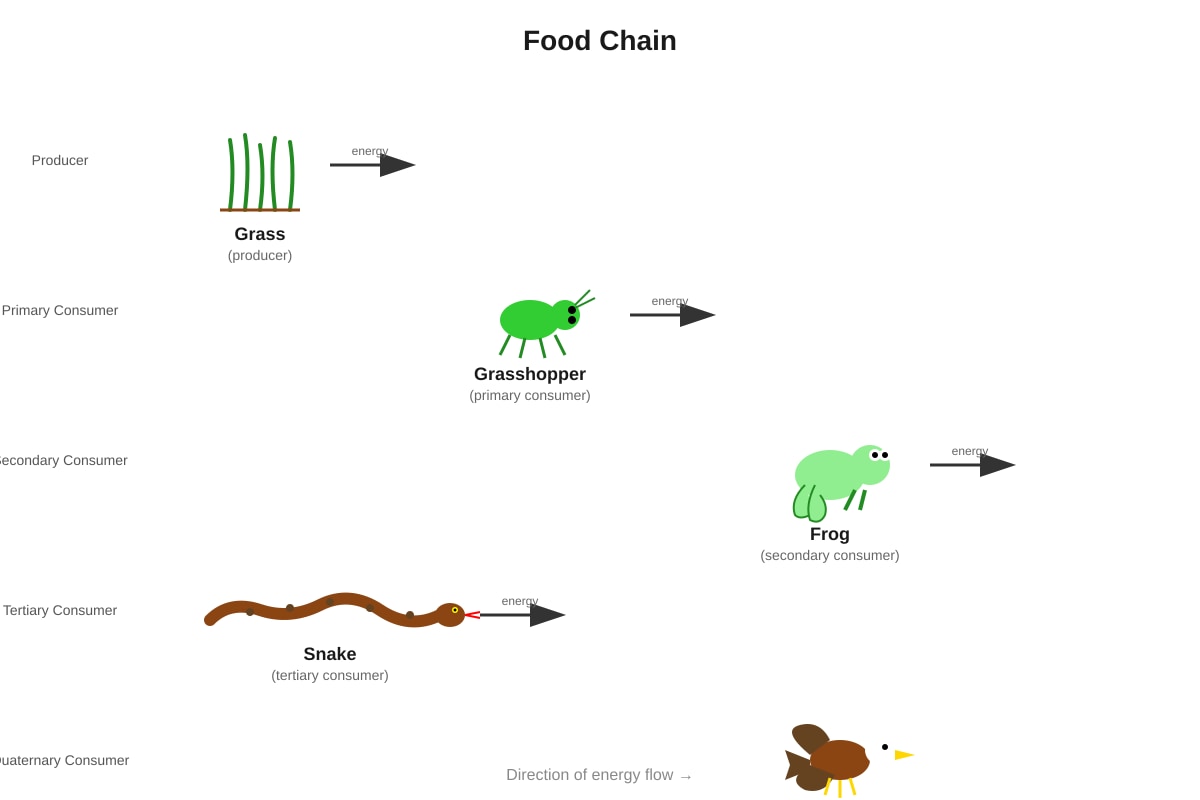
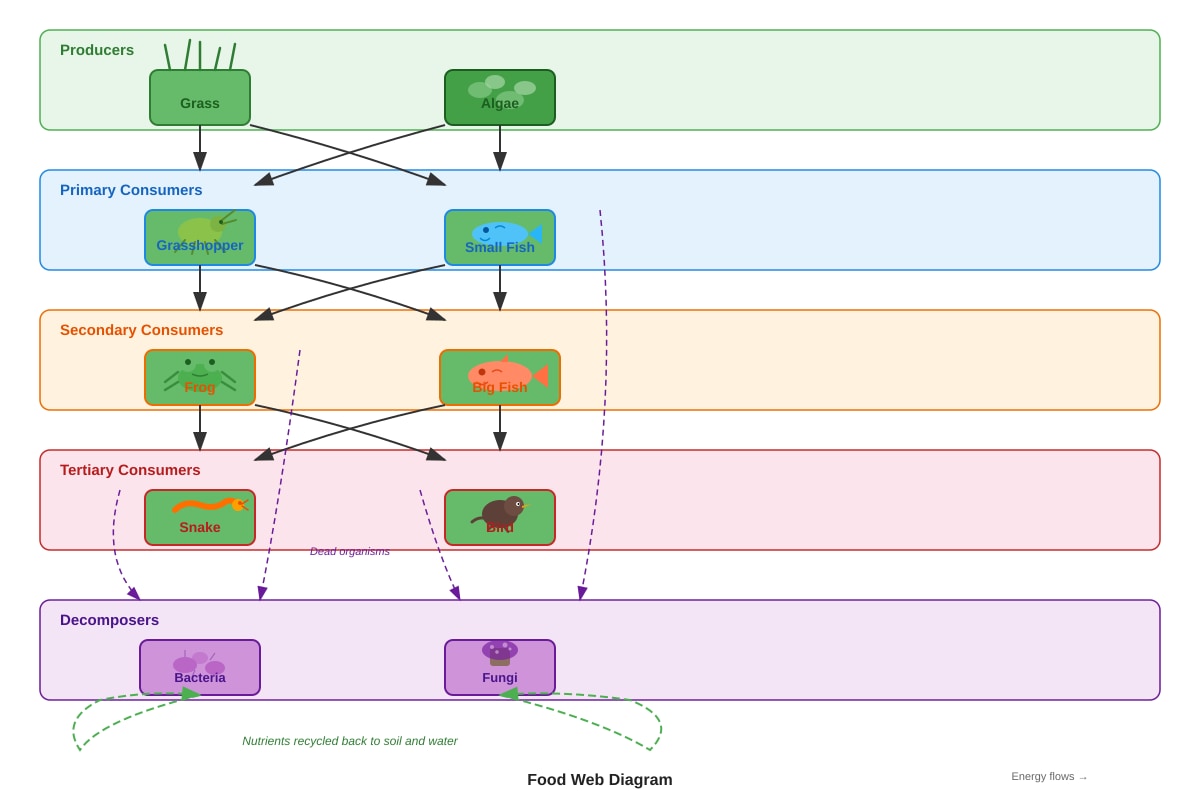
7. Study the food chain below.
Plant → Grasshopper → Frog → Snake → Eagle
If the population of grasshoppers decreases, what will most likely happen to the population of frogs and snakes? [2]
(1) Both populations will increase.
(2) Both populations will decrease.
(3) Frog population will increase; snake population will decrease.
(4) Frog population will decrease; snake population will increase.
8. Which of the following is a structural adaptation of a cactus to survive in the desert? [2]
(1) It has deep roots to absorb water.
(2) It stores water in its stem.
(3) It opens its stomata at night.
(4) It sheds its leaves during dry season.
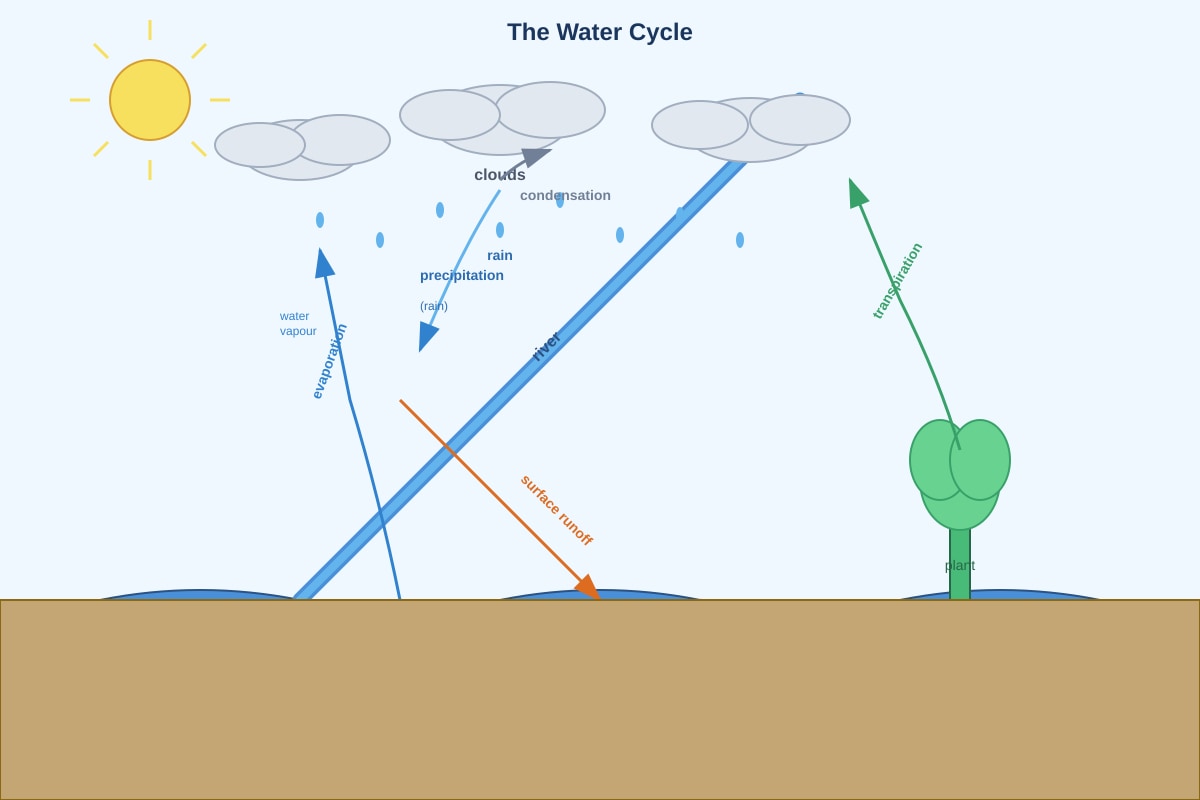
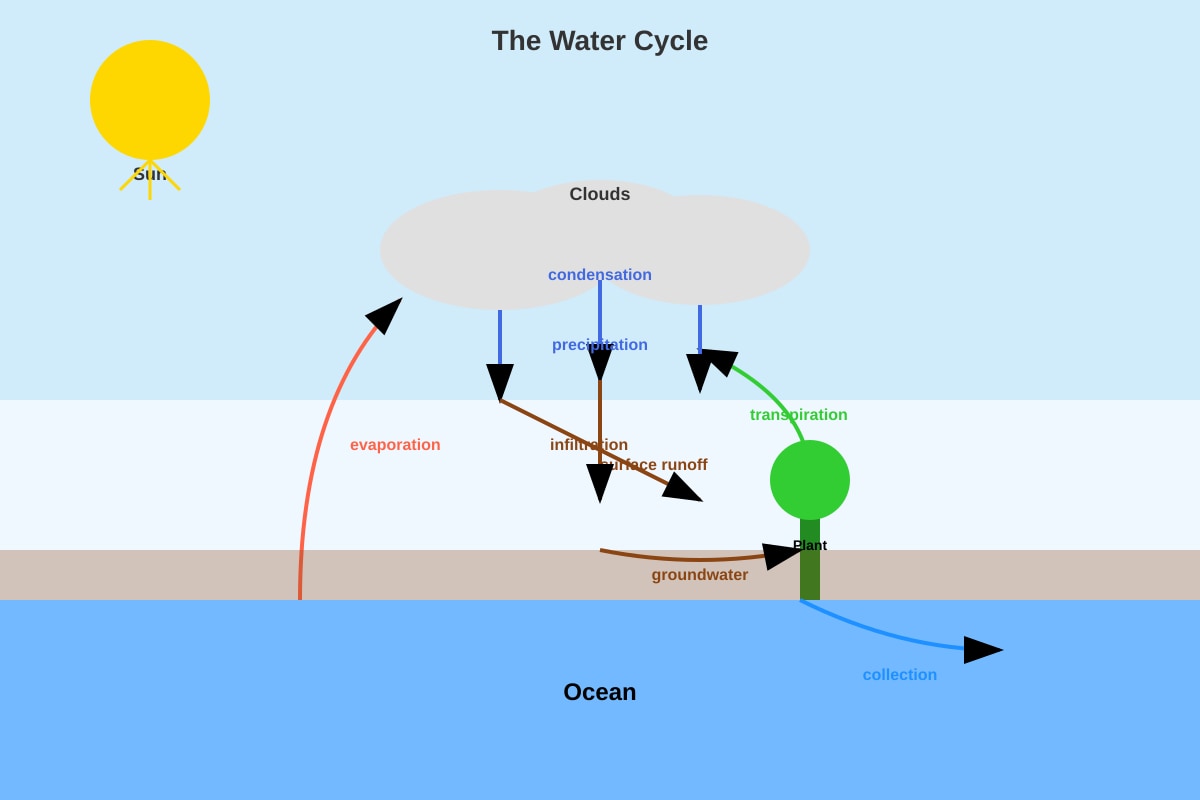
9. The diagram below shows the water cycle.
<image_placeholder>
id: Q9-fig1
type: diagram
linked_question: Q9
description: Water cycle diagram with processes labelled W, X, Y, Z.
labels: W: Evaporation, X: Condensation, Y: Precipitation, Z: Collection
values: None
must_show: Sun, water bodies, clouds, rain, arrows showing cycle; labels W, X, Y, Z at correct processes.
</image_placeholder>
Which process represents condensation? [2]
(1) W
(2) X
(3) Y
(4) Z
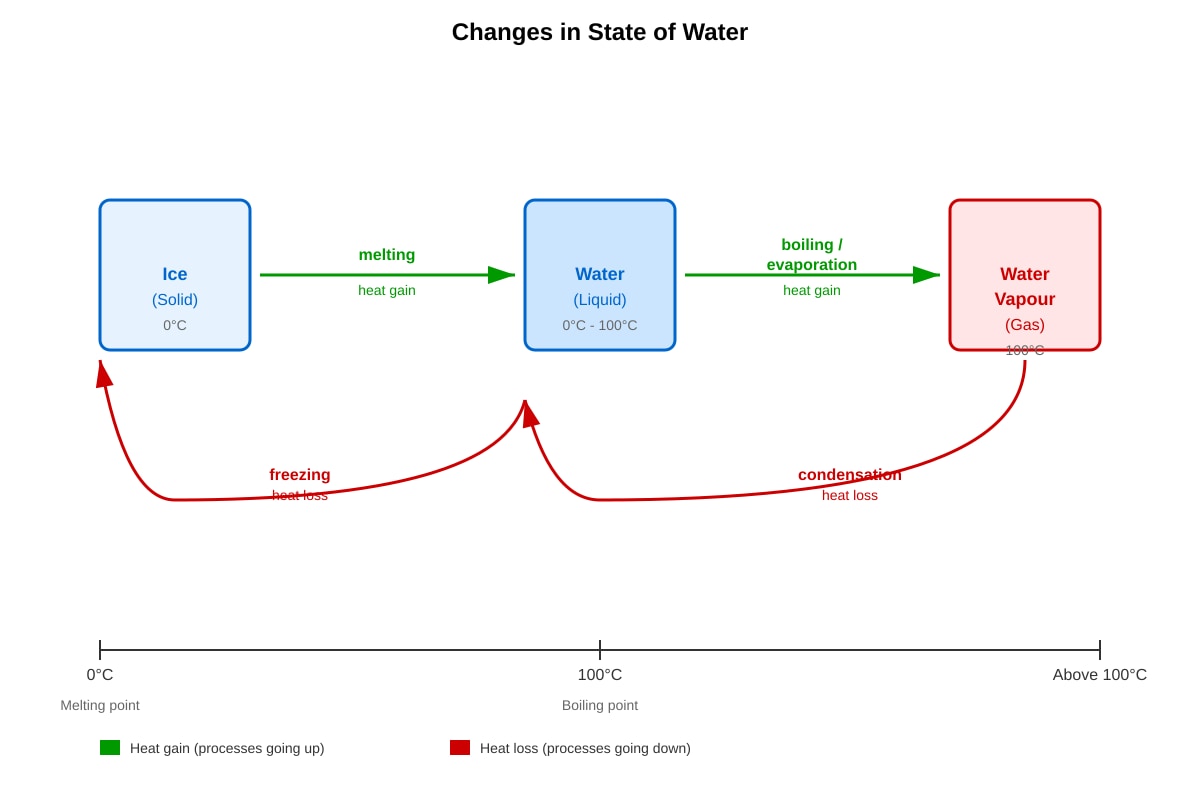
10. Matter exists in three states. Which of the following statements about the three states of matter is correct? [2]
(1) Solids have a fixed volume but no fixed shape.
(2) Liquids have a fixed shape but no fixed volume.
(3) Gases have neither a fixed shape nor a fixed volume.
(4) All states of matter can be compressed easily.
11. The table below shows the properties of four substances, A, B, C and D, at room temperature.
| Substance | Fixed Shape | Fixed Volume | Can be Compressed |
|---|---|---|---|
| A | Yes | Yes | No |
| B | No | Yes | No |
| C | No | No | Yes |
| D | Yes | Yes | Yes |
Which substance is a gas at room temperature? [2]
(1) A
(2) B
(3) C
(4) D
12. When water boils, it changes from liquid to gas. What happens to the arrangement and movement of water particles during boiling? [2]
(1) Particles become closer and move slower.
(2) Particles become closer and move faster.
(3) Particles move further apart and move slower.
(4) Particles move further apart and move faster.
13. A metal spoon feels colder than a wooden spoon at room temperature because ______. [2]
(1) metal is a better conductor of heat than wood
(2) metal is a poorer conductor of heat than wood
(3) metal absorbs more heat from the surroundings than wood
(4) metal has a lower temperature than wood
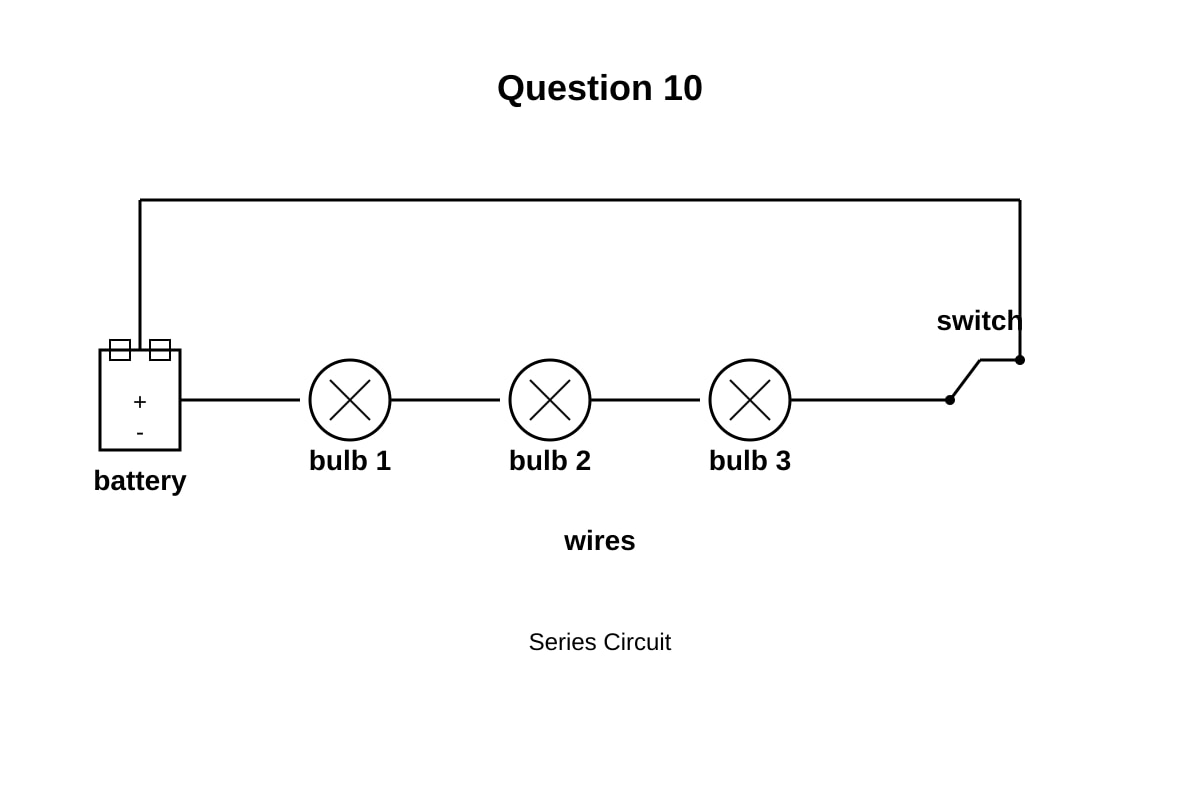
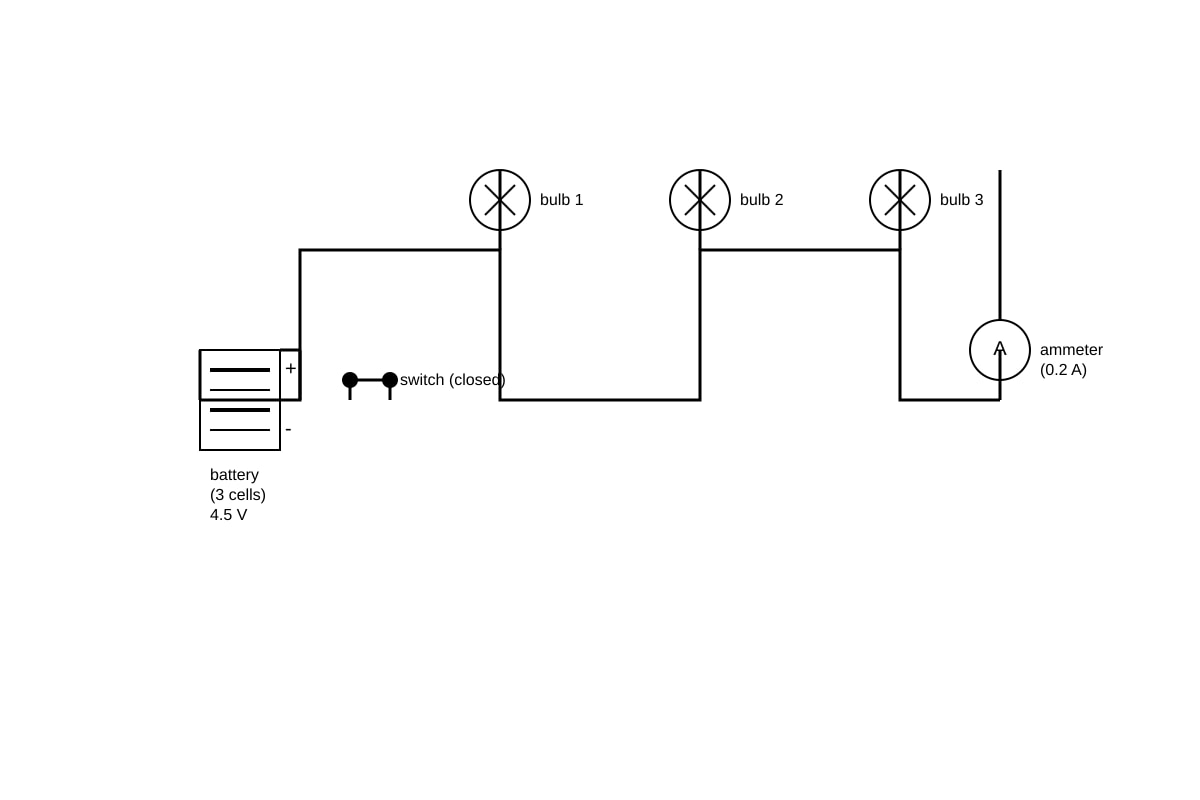
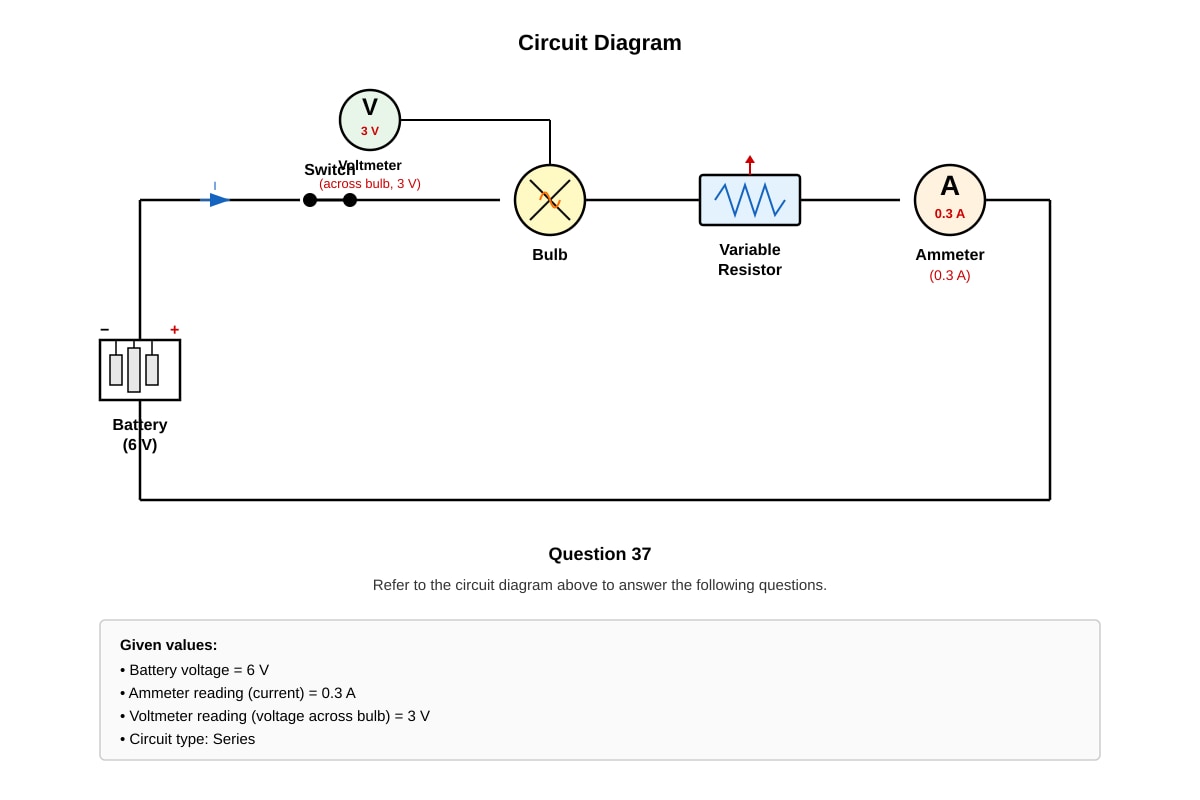
14. The diagram below shows a simple circuit.
<image_placeholder>
id: Q14-fig1
type: diagram
linked_question: Q14
description: Simple circuit with a battery, switch, and one bulb connected in series. Switch is open.
labels: Battery, Switch (open), Bulb
values: None
must_show: Standard circuit symbols; open switch clearly shown; single loop.
</image_placeholder>
What will happen to the bulb when the switch is closed? [2]
(1) The bulb will light up.
(2) The bulb will not light up.
(3) The bulb will light up briefly then go off.
(4) The bulb will become brighter.
15. Which of the following circuits will allow the bulb to light up? [2]
(1) A circuit with a broken filament in the bulb.
(2) A circuit with the switch open.
(3) A circuit with the battery connected correctly and a closed switch.
(4) A circuit with the battery connected in reverse polarity.
16. In a series circuit with two identical bulbs and one battery, what happens if one bulb fuses? [2]
(1) The other bulb lights up more brightly.
(2) The other bulb continues to light up with the same brightness.
(3) The other bulb goes off.
(4) The other bulb becomes dimmer.
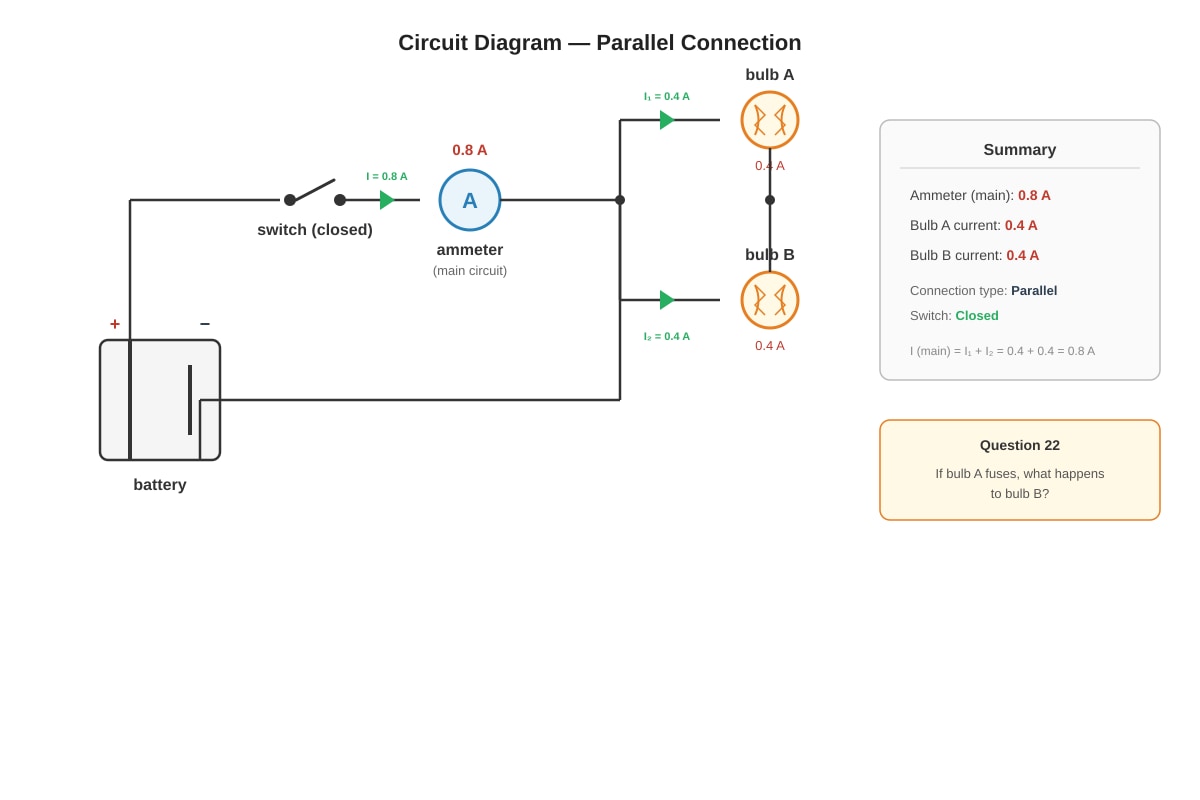
17. The diagram below shows a parallel circuit with two bulbs.
<image_placeholder>
id: Q17-fig1
type: diagram
linked_question: Q17
description: Parallel circuit with a battery and two bulbs on separate branches. Both switches closed.
labels: Battery, Bulb 1, Bulb 2
values: None
must_show: Two distinct branches from battery; each branch has a bulb; standard symbols.
</image_placeholder>
If Bulb 1 fuses, what happens to Bulb 2? [2]
(1) It goes off.
(2) It lights up more brightly.
(3) It continues to light up with the same brightness.
(4) It becomes dimmer.
18. Which of the following is a source of light? [2]
(1) Moon
(2) Mirror
(3) Sun
(4) White paper
19. Light travels in a ______. [2]
(1) curved line
(2) straight line
(3) zigzag line
(4) circular path
20. The diagram below shows a ray of light hitting a plane mirror.
<image_placeholder>
id: Q20-fig1
type: diagram
linked_question: Q20
description: Ray diagram showing incident ray, normal, reflected ray, and angle of incidence (30°) and angle of reflection (30°).
labels: Incident ray, Reflected ray, Normal, Angle of incidence (30°), Angle of reflection (30°)
values: Angle of incidence = 30°, Angle of reflection = 30°
must_show: Plane mirror vertical; normal perpendicular; incident and reflected rays at equal angles on opposite sides of normal; angles labelled 30°.
</image_placeholder>
What is the angle of reflection if the angle of incidence is 30°? [2]
(1) 30°
(2) 60°
(3) 90°
(4) 120°
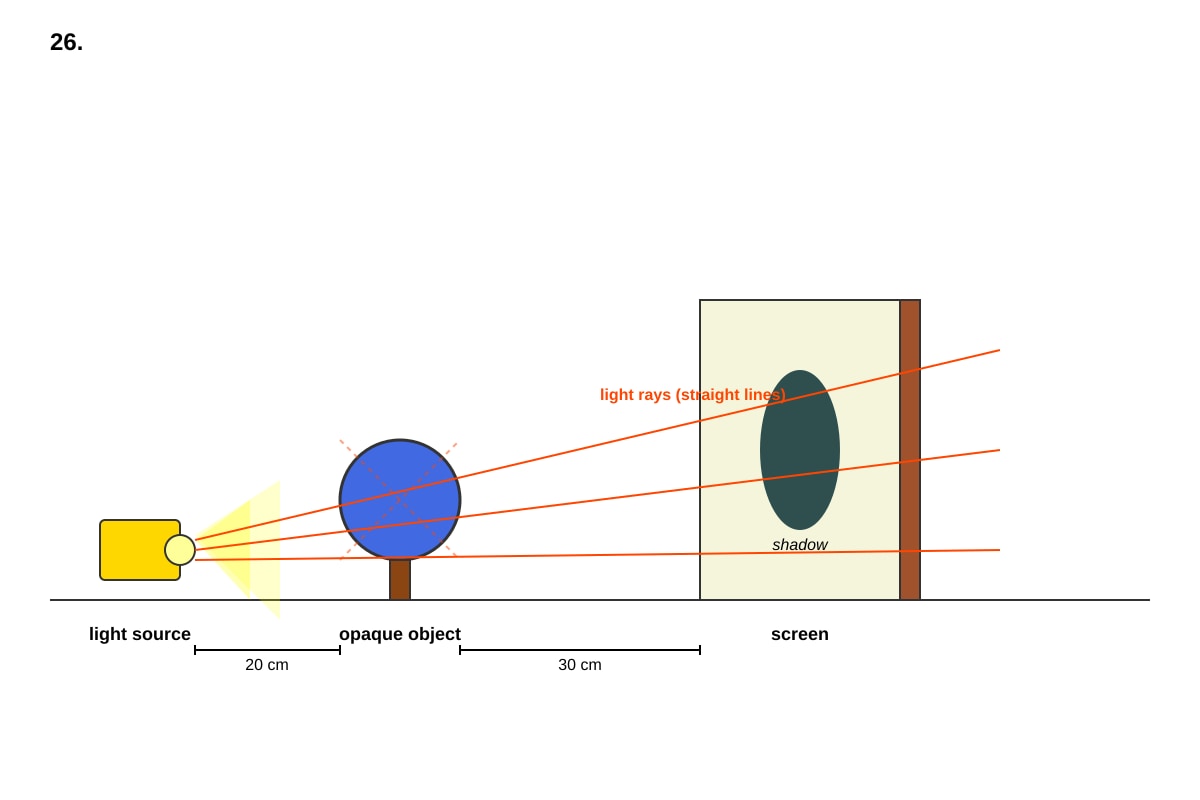
21. A shadow is formed when ______. [2]
(1) light passes through a transparent object
(2) light is reflected by a shiny surface
(3) light is blocked by an opaque object
(4) light passes through a translucent object
22. Which of the following forces is a non-contact force? [2]
(1) Friction
(2) Magnetic force
(3) Push
(4) Pull
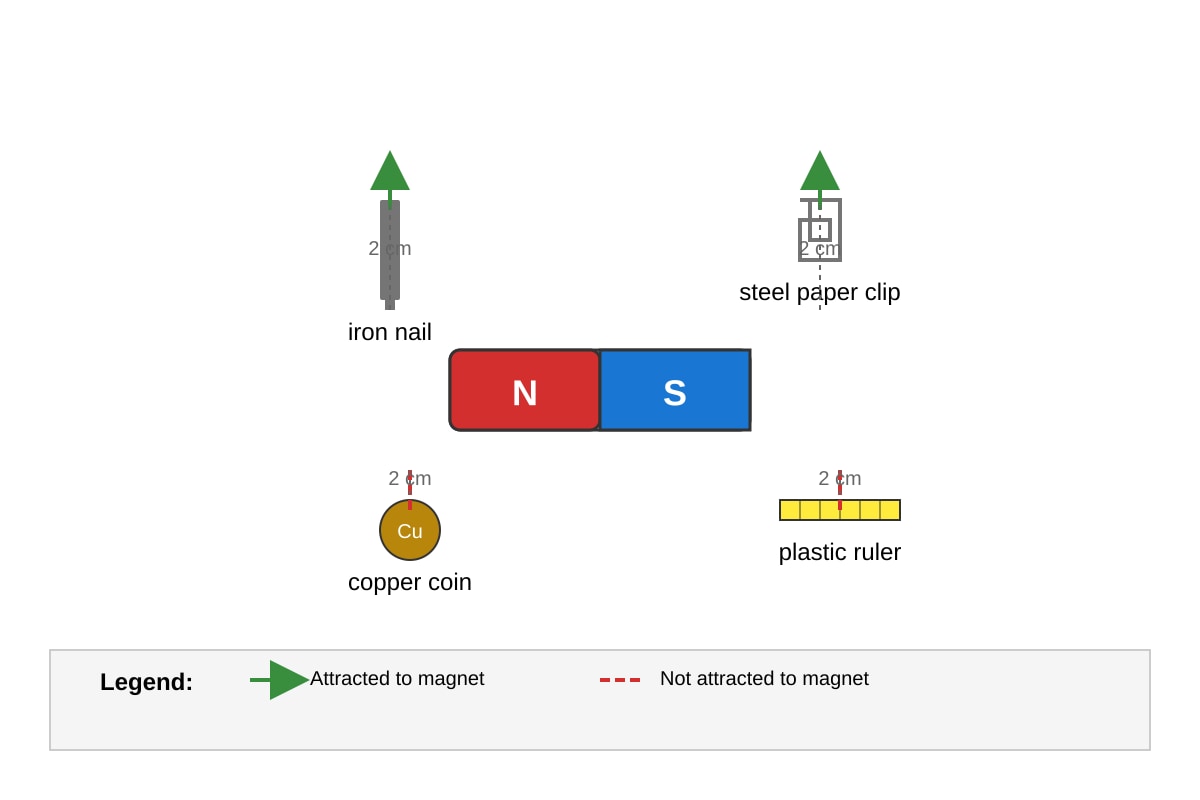
23. The diagram below shows a magnet attracting a steel paper clip.
<image_placeholder>
id: Q23-fig1
type: diagram
linked_question: Q23
description: Bar magnet with N and S poles; steel paper clip attracted to N pole.
labels: N pole, S pole, Steel paper clip
values: None
must_show: Bar magnet labelled N and S; paper clip touching N pole; magnetic field lines optional but not required.
</image_placeholder>
Which of the following statements is true? [2]
(1) The paper clip becomes a permanent magnet.
(2) The paper clip becomes a temporary magnet.
(3) The magnet loses its magnetism.
(4) The paper clip repels the magnet.
24. A spring balance is used to measure ______. [2]
(1) mass
(2) weight
(3) volume
(4) density
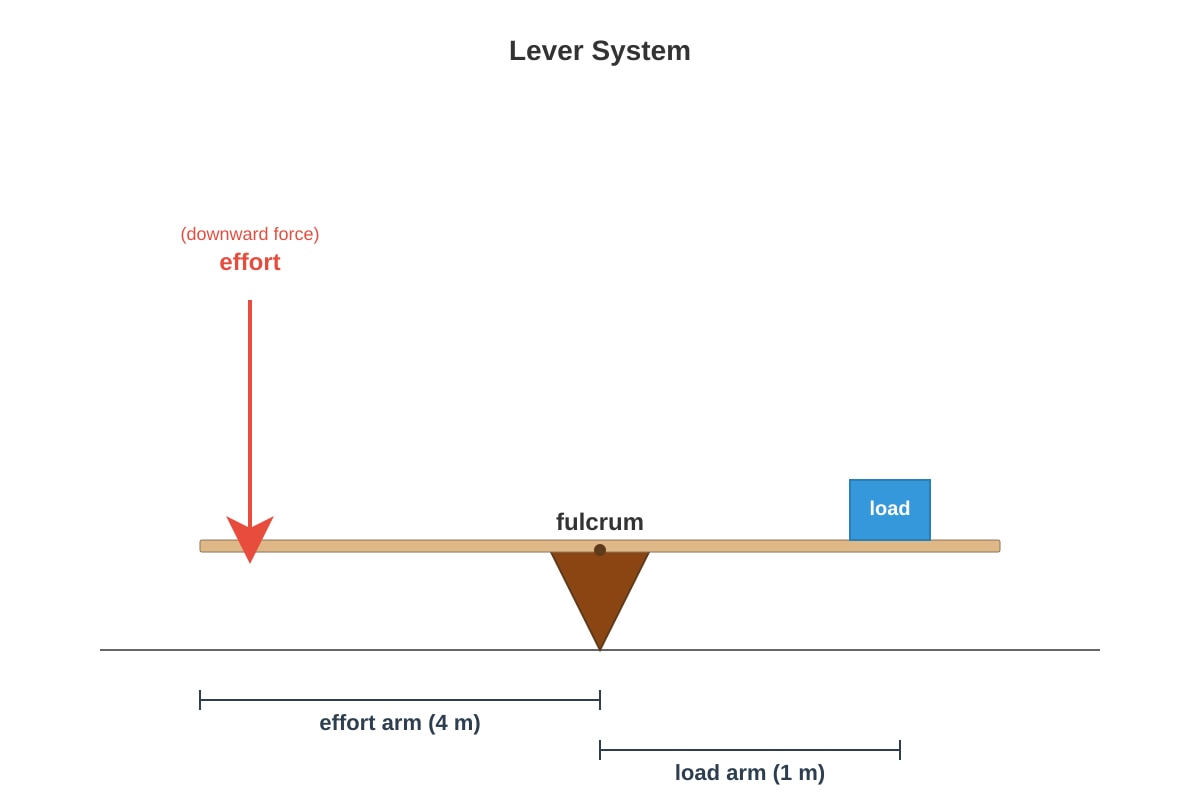
25. The diagram below shows a lever system.
<image_placeholder>
id: Q25-fig1
type: diagram
linked_question: Q25
description: First-class lever with fulcrum in middle, effort on left, load on right. Effort arm = 40 cm, load arm = 10 cm.
labels: Fulcrum, Effort, Load, Effort arm (40 cm), Load arm (10 cm)
values: Effort arm = 40 cm, Load arm = 10 cm
must_show: Lever bar horizontal; fulcrum triangle at centre; effort arrow down on left; load arrow down on right; distances labelled.
</image_placeholder>
If the load is 20 N, what is the minimum effort needed to lift the load? [2]
(1) 5 N
(2) 10 N
(3) 20 N
(4) 80 N
26. Which of the following energy conversions takes place in a battery-powered torch when it is switched on? [2]
(1) Electrical energy → Light energy + Heat energy
(2) Chemical energy → Electrical energy → Light energy + Heat energy
(3) Light energy → Electrical energy → Chemical energy
(4) Heat energy → Electrical energy → Light energy
27. The diagram below shows a roller coaster at different positions.
<image_placeholder>
id: Q27-fig1
type: diagram
linked_question: Q27
description: Roller coaster track with positions A (highest), B (lowest), C (medium height). Car at position A.
labels: Position A (highest), Position B (lowest), Position C (medium)
values: Height at A = 50 m, Height at B = 0 m, Height at C = 20 m
must_show: Track with three labelled positions; heights indicated; car at A.
</image_placeholder>
At which position does the roller coaster car have the most gravitational potential energy? [2]
(1) Position A
(2) Position B
(3) Position C
(4) Same at all positions
28. Which of the following shows the correct energy conversion when a ball is thrown upwards? [2]
(1) Kinetic energy → Gravitational potential energy
(2) Gravitational potential energy → Kinetic energy
(3) Chemical energy → Kinetic energy
(4) Heat energy → Kinetic energy
Section B: Open-Ended Questions (44 marks)
Write your answers in the spaces provided.
29. The diagram below shows two cells, Cell X and Cell Y.
<image_placeholder>
id: Q29-fig1
type: diagram
linked_question: Q29
description: Two cells side by side. Cell X: has cell wall, chloroplasts, large vacuole. Cell Y: no cell wall, no chloroplasts, small vacuoles.
labels: Cell X, Cell Y; parts labelled in each: cell membrane, cytoplasm, nucleus, (cell wall, chloroplast, vacuole for X)
values: None
must_show: Clear visual distinction: Cell X rectangular with cell wall, chloroplasts, large vacuole; Cell Y irregular, no cell wall, no chloroplasts, small vacuoles.
</image_placeholder>
(a) Identify Cell X and Cell Y. [1]
Cell X: ___________________________
Cell Y: ___________________________
(b) State one function of the chloroplast. [1]
(c) Explain why Cell Y does not have a cell wall. [1]
30. The diagram below shows the human respiratory system.
<image_placeholder>
id: Q30-fig1
type: diagram
linked_question: Q30
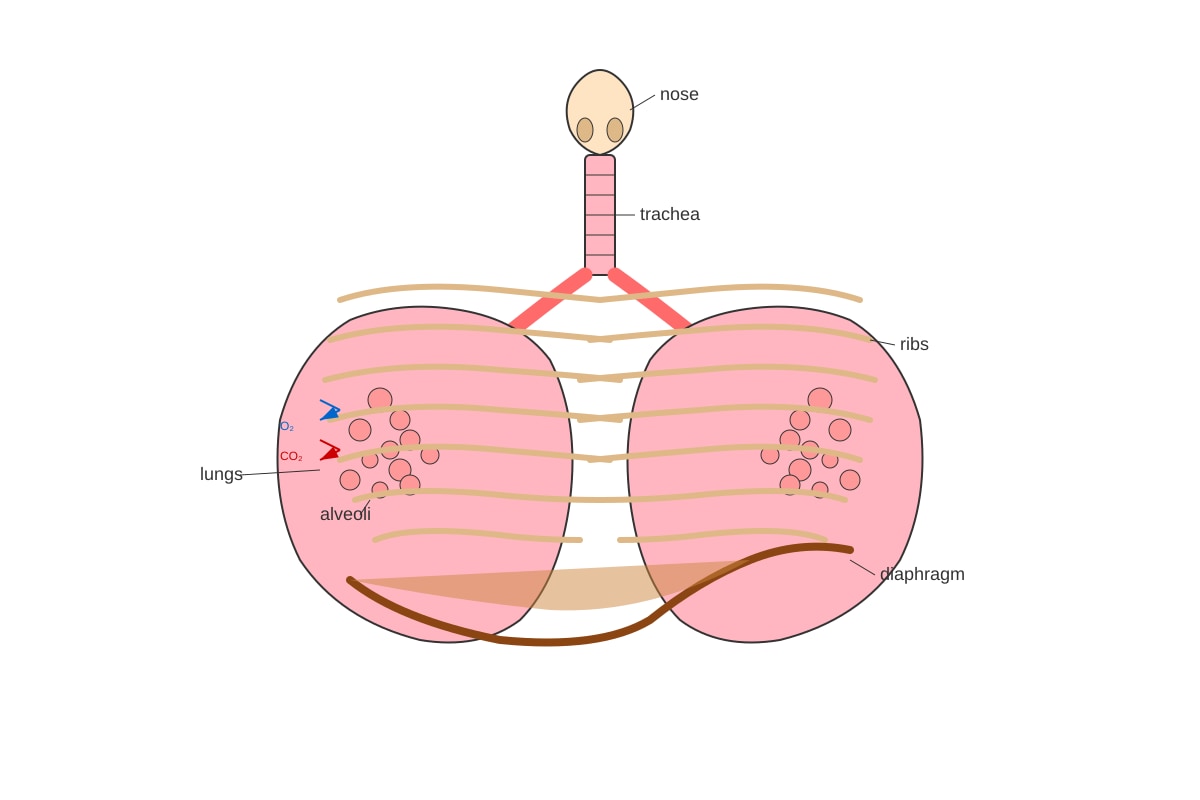
description: Human respiratory system with parts labelled A, B, C, D.
labels: A: Nose, B: Trachea, C: Bronchus, D: Air sac (alveolus)
values: None
must_show: Nose, trachea, bronchi branching, air sacs at ends; labels A, B, C, D.
</image_placeholder>
(a) Name the part where gaseous exchange takes place. [1]
(b) Describe how oxygen moves from the air sac into the blood. [2]
(c) State one difference between inhaled and exhaled air. [1]
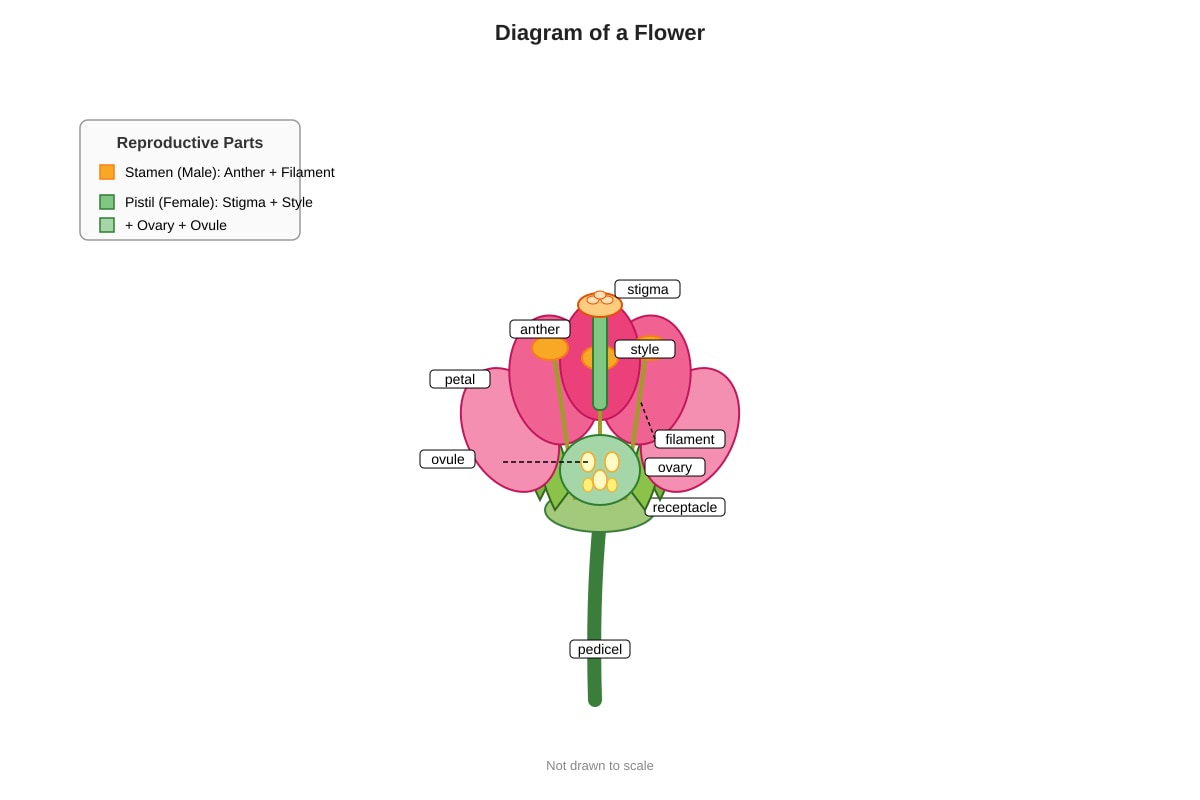
31. The diagram below shows a flower.
<image_placeholder>
id: Q31-fig1
type: diagram
linked_question: Q31
description: Longitudinal section of a flower with parts labelled P, Q, R, S.
labels: P: Stigma, Q: Style, R: Ovary, S: Anther
values: None
must_show: Stigma at top, style below, ovary at base with ovules inside, anther on filament; labels P, Q, R, S.
</image_placeholder>
(a) Name the part that produces pollen grains. [1]
(b) After pollination, a pollen tube grows down the style. State the function of the pollen tube. [1]
(c) The ovary develops into a fruit after fertilisation. What does the ovule develop into? [1]
32. Study the food web below.
Hawk
/ \
Snake Frog
| / \
Grasshopper Beetle
/ \ /
Grass Plant Plant
(a) How many food chains are there in this food web? [1]
(b) Which organism is both a prey and a predator? [1]
(c) If all the grasshoppers are removed, explain what will happen to the population of frogs. [2]
33. The table below shows the boiling and melting points of four substances, W, X, Y and Z.
| Substance | Melting Point (°C) | Boiling Point (°C) |
|---|---|---|
| W | -114 | 78 |
| X | 0 | 100 |
| Y | 1538 | 2862 |
| Z | -78 | -33 |
(a) Which substance is a gas at room temperature (25°C)? [1]
(b) Which substance is water? [1]
(c) Substance W is ethanol. At 50°C, what is the state of ethanol? Explain your answer. [2]
34. The diagram below shows an experiment on heat conduction.
<image_placeholder>
id: Q34-fig1
type: experimental_setup
linked_question: Q34
description: Four rods (copper, iron, glass, wood) of same length and thickness, each with a thumbtack attached with wax at the far end. One end of each rod heated equally.
labels: Copper rod, Iron rod, Glass rod, Wooden rod; Thumbtack; Wax; Heat source
values: All rods same dimensions; same heat applied
must_show: Four parallel rods; heat source at left end; thumbtacks at right ends held by wax; labels for each material.
</image_placeholder>
(a) In which rod will the thumbtack drop first? [1]
(b) Explain your answer in (a). [1]
(c) State one variable that must be kept the same for a fair test. [1]
35. The diagram below shows a circuit with two bulbs, B1 and B2, and two switches, S1 and S2.
<image_placeholder>
id: Q35-fig1
type: diagram
linked_question: Q35
description: Circuit with battery, two bulbs in parallel, each with its own switch (S1 for B1, S2 for B2). Main switch before parallel branches.
labels: Battery, Main switch, S1, S2, B1, B2
values: None
must_show: Battery; main switch closed; two parallel branches; each branch has a switch and bulb; standard symbols.
</image_placeholder>
The table below shows the state of the switches and the bulbs.
| Main Switch | S1 | S2 | B1 | B2 |
|---|---|---|---|---|
| Closed | Open | Closed | ? | ? |
(a) Complete the table by writing "On" or "Off" for B1 and B2. [2]
B1: ___________
B2: ___________
(b) What is the advantage of connecting bulbs in parallel in household lighting? [1]
36. The diagram below shows a ray of light passing through a rectangular glass block.
<image_placeholder>
id: Q36-fig1
type: diagram
linked_question: Q36
description: Rectangular glass block; incident ray enters top surface at an angle, refracts towards normal, travels through block, exits bottom surface parallel to incident ray but displaced.
labels: Incident ray, Refracted ray, Emergent ray, Normal, Glass block, Air
values: Angle of incidence = 40°
must_show: Rectangular block; incident ray at 40° to normal; refracted ray bending towards normal; emergent ray parallel to incident ray; normals at both surfaces.
</image_placeholder>
(a) Name the phenomenon that occurs when light passes from air into glass. [1]
(b) The angle of incidence is 40°. Is the angle of refraction greater than, smaller than, or equal to 40°? [1]
(c) Explain why the emergent ray is parallel to the incident ray. [1]
37. The diagram below shows a magnet being stroked along an iron nail using the stroking method.
<image_placeholder>
id: Q37-fig1
type: diagram
linked_question: Q37
description: Bar magnet stroked along iron nail from centre to end, repeated several times in same direction.
labels: Bar magnet (N-S), Iron nail, Direction of stroke
values: None
must_show: Magnet with N and S labelled; nail horizontal; arrow showing stroke direction from centre to right end; repeated strokes indicated.
</image_placeholder>
(a) After stroking, which end of the nail becomes the North pole? [1]
(b) State one way to increase the strength of the magnetised nail. [1]
(c) How can you demagnetise the nail? [1]
38. The diagram below shows a pulley system used to lift a load.
<image_placeholder>
id: Q38-fig1
type: diagram
linked_question: Q38
description: Single fixed pulley with effort pulling down to lift load up. Load = 50 N.
labels: Fixed pulley, Effort (downward), Load (50 N, upward)
values: Load = 50 N
must_show: Single fixed pulley; rope over pulley; load hanging on right; effort pulling down on left; load labelled 50 N.
</image_placeholder>
(a) What is the minimum effort needed to lift the 50 N load using this single fixed pulley? [1]
(b) State the advantage of using a single fixed pulley. [1]
(c) If a movable pulley is added to form a block and tackle system with two supporting ropes, what is the new minimum effort needed to lift the same 50 N load? [1]
39. The diagram below shows a pendulum swinging from position A to B to C.
<image_placeholder>
id: Q39-fig1
type: diagram
linked_question: Q39
description: Pendulum at three positions: A (highest left), B (lowest centre), C (highest right). Bob at A.
labels: Position A, Position B, Position C
values: Height of A and C = 20 cm above B; mass of bob = 100 g
must_show: Pendulum string fixed at top; three positions marked; heights indicated; bob at A.
</image_placeholder>
(a) At which position does the pendulum bob have the maximum kinetic energy? [1]
(b) At which position does the pendulum bob have the maximum gravitational potential energy? [1]
(c) Explain why the pendulum eventually stops swinging. [2]
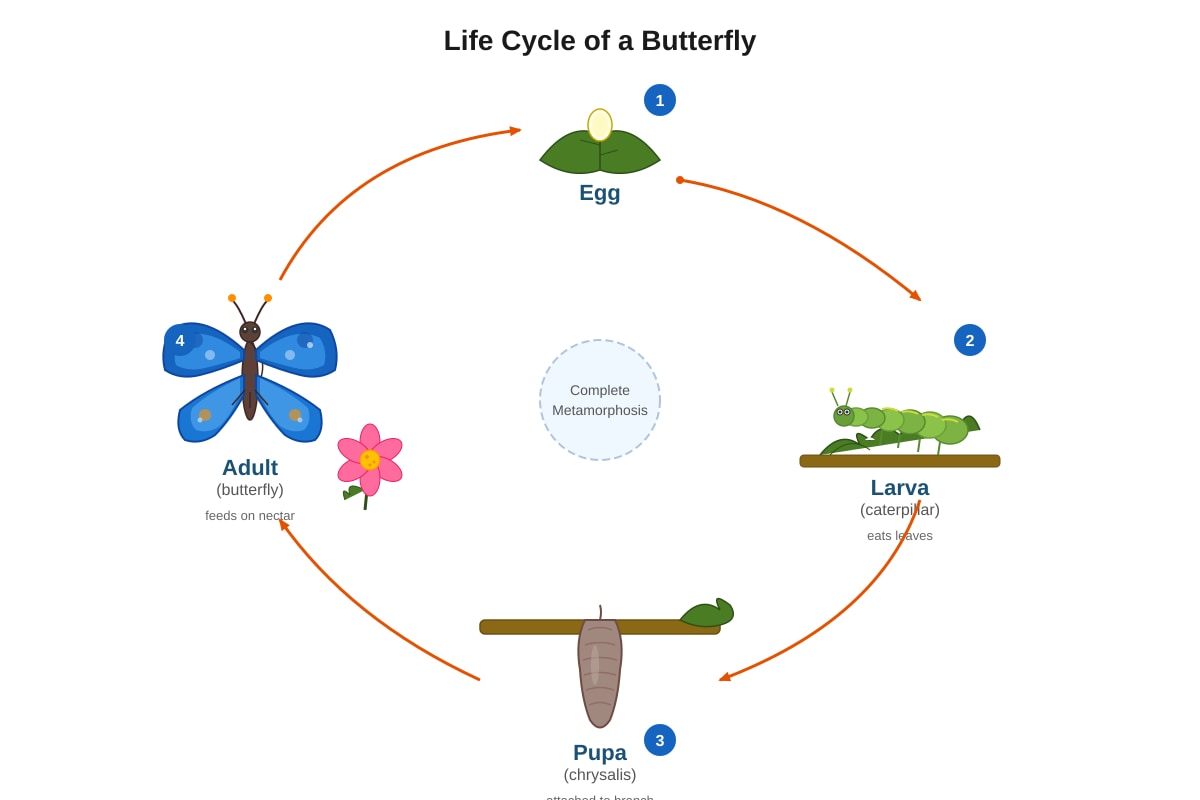
40. The diagram below shows the life cycle of a butterfly.
<image_placeholder>
id: Q40-fig1
type: diagram
linked_question: Q40
description: Four-stage life cycle: Egg → Larva (caterpillar) → Pupa (chrysalis) → Adult (butterfly). Arrows showing cycle.
labels: Egg, Larva, Pupa, Adult
values: None
must_show: Four distinct stages in circular arrangement; arrows clockwise; each stage labelled and illustrated.
</image_placeholder>
(a) Name the stage where the organism feeds actively and grows rapidly. [1]
(b) State one difference between the larva and the adult butterfly. [1]
(c) The butterfly lays many eggs at a time. Explain why this is important for the survival of the species. [2]
End of Paper
Answers
TuitionGoWhere Practice Paper - Science Primary 5 (SA2 Version 4) - Answer Key
Subject: Science
Level: Primary 5
Paper: SA2 (Version 4)
Total Marks: 100
Section A: Multiple-Choice Questions (56 marks)
1. Answer: (3)
Explanation: All living things respond to changes in their environment (sensitivity). Not all living things make their own food (only producers do), not all reproduce by laying eggs (mammals give birth), and not all need sunlight (decomposers and deep-sea organisms do not).
Marks: 2
2. Answer: (2)
Explanation: The nucleus contains genetic material (DNA) and controls all cellular activities. The cell wall provides support, cytoplasm is where chemical reactions occur, and the vacuole stores substances.
Marks: 2
3. Answer: (3)
Explanation: Mushroom, yeast, and mould are fungi (Group X). Rose plant, grass, and fern are plants; rose and grass are flowering plants, fern is non-flowering. The only option that correctly identifies Group X as Fungi is (3).
Marks: 2
4. Answer: (3)
Explanation: The small intestine (D) is where most absorption of digested food occurs. Its inner wall has villi that increase surface area for absorption. The stomach (C) mainly digests proteins; the large intestine (E) absorbs water.
Marks: 2
5. Answer: (1)
Explanation: Mosquitoes undergo complete metamorphosis: Egg → Larva → Pupa → Adult. Nymph stage is found in incomplete metamorphosis (e.g., grasshopper).
Marks: 2
6. Answer: (4)
Explanation: Pollen grains are produced in the anther, which is part of the flower (S). Roots absorb water, stem transports substances, leaves make food.
Marks: 2
7. Answer: (2)
Explanation: Grasshoppers are the food source for frogs. Fewer grasshoppers → less food for frogs → frog population decreases. Snakes eat frogs, so with fewer frogs, snake population also decreases.
Marks: 2
8. Answer: (2)
Explanation: Storing water in its stem is a structural (physical) adaptation. Deep roots (1) is also structural but storing water in stem is the classic cactus adaptation. Opening stomata at night (3) is a behavioural/physiological adaptation. Shedding leaves (4) is a response, not a permanent structural feature of cacti (they have spines instead of leaves).
Marks: 2
9. Answer: (2)
Explanation: Condensation is the process where water vapour cools and changes into liquid water droplets (clouds). X shows this process in the water cycle diagram.
Marks: 2
10. Answer: (3)
Explanation: Gases have neither fixed shape nor fixed volume; they expand to fill their container. Solids have both fixed shape and volume. Liquids have fixed volume but no fixed shape. Only gases can be compressed easily.
Marks: 2
11. Answer: (3)
Explanation: Substance C has no fixed shape, no fixed volume, and can be compressed — properties of a gas. A is a solid, B is a liquid, D has contradictory properties (fixed shape and volume but compressible — not possible for normal matter).
Marks: 2
12. Answer: (4)
Explanation: During boiling, particles gain energy, move faster, and overcome intermolecular forces, moving further apart to become a gas.
Marks: 2
13. Answer: (1)
Explanation: Metal conducts heat away from your hand faster than wood, making it feel colder. Both are at room temperature.
Marks: 2
14. Answer: (1)
Explanation: Closing the switch completes the circuit, allowing current to flow and the bulb to light up.
Marks: 2
15. Answer: (3)
Explanation: A complete circuit with a working battery, closed switch, and intact filament allows current to flow. Broken filament, open switch, or reverse polarity (for a simple bulb) would not work.
Marks: 2
16. Answer: (3)
Explanation: In a series circuit, there is only one path for current. If one bulb fuses, the circuit is broken and current stops flowing, so the other bulb goes off.
Marks: 2
17. Answer: (3)
Explanation: In a parallel circuit, each bulb has its own path. If Bulb 1 fuses, the circuit for Bulb 2 is unaffected, so it continues with the same brightness.
Marks: 2
18. Answer: (3)
Explanation: The Sun produces its own light. The Moon reflects sunlight, a mirror reflects light, and white paper reflects light.
Marks: 2
19. Answer: (2)
Explanation: Light travels in straight lines (rectilinear propagation). This is why shadows are formed.
Marks: 2
20. Answer: (1)
Explanation: Law of reflection: angle of incidence = angle of reflection. If incidence is 30°, reflection is 30°.
Marks: 2
21. Answer: (3)
Explanation: Shadows form when light is blocked by an opaque object. Transparent objects let light through, translucent objects let some light through, shiny surfaces reflect light.
Marks: 2
22. Answer: (2)
Explanation: Magnetic force can act at a distance without contact. Friction, push, and pull are contact forces.
Marks: 2
23. Answer: (2)
Explanation: The steel paper clip becomes a temporary magnet (induced magnetism) when attracted to a magnet. It loses magnetism when removed. It does not become permanent, the magnet does not lose magnetism, and it attracts (not repels).
Marks: 2
24. Answer: (2)
Explanation: A spring balance measures weight (force due to gravity), not mass. It works by Hooke's law: extension proportional to force.
Marks: 2
25. Answer: (1)
Explanation: For a lever: Effort × Effort arm = Load × Load arm. Effort × 40 cm = 20 N × 10 cm. Effort = 200/40 = 5 N.
Marks: 2
26. Answer: (2)
Explanation: Battery stores chemical energy → converted to electrical energy in circuit → bulb converts to light and heat energy.
Marks: 2
27. Answer: (1)
Explanation: Gravitational potential energy = mgh. Highest position (A, 50 m) has the most GPE.
Marks: 2
28. Answer: (1)
Explanation: As the ball rises, kinetic energy decreases and is converted to gravitational potential energy.
Marks: 2
Section B: Open-Ended Questions (44 marks)
29.
(a) Cell X: Plant cell
Cell Y: Animal cell
[1 mark for both correct]
(b) Chloroplast contains chlorophyll which traps light energy for photosynthesis.
[1 mark]
(c) Animal cells do not have a cell wall; only plant cells, fungi, and bacteria have cell walls.
[1 mark]
30.
(a) Air sac (alveolus) / Part D
[1 mark]
(b) Oxygen diffuses from the air sac (high concentration) through the thin, moist walls of the air sac and capillary into the blood (low concentration).
[2 marks: 1 for diffusion, 1 for concentration gradient + thin/moist walls]
(c) Inhaled air has more oxygen and less carbon dioxide; exhaled air has less oxygen and more carbon dioxide. (Accept: Inhaled air is cooler/drier; exhaled air is warmer/moister.)
[1 mark]
31.
(a) Anther / Part S
[1 mark]
(b) The pollen tube grows down the style to the ovary to transport the male reproductive cell (sperm) to the ovule for fertilisation.
[1 mark]
(c) The ovule develops into a seed.
[1 mark]
32.
(a) 6 food chains
Chains:
- Grass → Grasshopper → Frog → Snake → Hawk
- Grass → Grasshopper → Frog → Hawk
- Grass → Beetle → Frog → Snake → Hawk
- Grass → Beetle → Frog → Hawk
- Plant → Grasshopper → Frog → Snake → Hawk
- Plant → Grasshopper → Frog → Hawk
(Also Plant → Beetle → Frog → Snake → Hawk and Plant → Beetle → Frog → Hawk = 8 total? Wait, let's recount carefully.)
Actually: Producers: Grass, Plant (2). Primary consumers: Grasshopper, Beetle (2). Secondary: Frog (1). Tertiary: Snake (1). Quaternary: Hawk (1).
Chains from Grass: Grass→Grasshopper→Frog→Snake→Hawk, Grass→Grasshopper→Frog→Hawk, Grass→Beetle→Frog→Snake→Hawk, Grass→Beetle→Frog→Hawk = 4.
Chains from Plant: Plant→Grasshopper→Frog→Snake→Hawk, Plant→Grasshopper→Frog→Hawk, Plant→Beetle→Frog→Snake→Hawk, Plant→Beetle→Frog→Hawk = 4.
Total = 8 food chains.
Correction: 8 food chains.
[1 mark for correct count with valid reasoning]
(b) Frog (eats grasshopper/beetle, eaten by snake/hawk)
[1 mark]
(c) Frogs eat grasshoppers and beetles. If grasshoppers are removed, frogs lose one food source. They may eat more beetles, but overall food decreases, so frog population will likely decrease.
[2 marks: 1 for identifying grasshopper as frog's prey, 1 for explaining population decrease due to less food]
33.
(a) Substance Z (Boiling point -33°C < 25°C, so gas at room temperature)
[1 mark]
(b) Substance X (Melting point 0°C, boiling point 100°C — properties of water)
[1 mark]
(c) At 50°C, ethanol is a liquid.
Explanation: Ethanol's melting point is -114°C and boiling point is 78°C. At 50°C, the temperature is between its melting and boiling points, so it exists as a liquid.
[2 marks: 1 for correct state, 1 for correct explanation using MP and BP]
34.
(a) Copper rod
[1 mark]
(b) Copper is the best conductor of heat among the four materials. Heat travels fastest through copper, melting the wax first and causing the thumbtack to drop first.
[1 mark]
(c) Length and thickness of rods / Amount of heat applied / Initial temperature of rods / Distance of thumbtack from heat source (any one)
[1 mark]
35.
(a) B1: Off (S1 is open, so circuit for B1 is incomplete)
B2: On (S2 is closed, main switch closed, circuit for B2 is complete
<stage3_exam_answers_md>
TuitionGoWhere Practice Paper - Science Primary 5 (Answer Key)
TuitionGoWhere Exam Practice (AI)
Subject: Science
Level: Primary 5
Paper: SA2 (Version 4) إن إن إن إن إن إن إن إن إن إن إن إن إن إن إن إن إن إن إن إن إن إن إن إن إن إن إن إن إن إن إن إن إن إن إن إن إن إن إن إن إن إن إن إن إن إن إن إن
إن إن إن إن إن إن إن إن إن إن إن إن إن إن إن إن إن إن إن إن إن إن إن إن إن إن إن إن إن إن إن إن إن إن إن إن إن إن إن إن إن إن إن إن إن إن إن إن
Section A: Multiple-Choice Questions (56 marks)
| Question | Answer | Explanation |
|---|---|---|
| 1 | (3) | All living things respond to changes around them (sensitivity). Not all make their own food (only plants), reproduce by laying eggs, or need sunlight (animals don't). |
| 2 | (2) | The nucleus controls all activities in the cell. |
| 3 | (3) | Group X: Mushroom, Yeast, Mould are Fungi. Group Y: Rose plant, Grass, Fern are Flowering plants (Rose, Grass) and Non-flowering (Fern) — but "Flowering plants" is the best fit for Group Y as a group containing flowering plants. |
| 4 | (3) | Most absorption of digested food takes place in the small intestine (D). |
| 5 | (1) | Mosquito life cycle: Egg → Larva → Pupa → Adult (complete metamorphosis). |
| 6 | (4) | Pollen grains are produced in the anther (part of the flower, labelled S). |
| 5 | (2) | If grasshoppers decrease, frogs (predator) have less food → frog population decreases. Snakes eat frogs → less food for snakes → snake population decreases. |
| 8 | (2) | Cacti store water in their stems (structural adaptation). Deep roots and night-opening stomata are also adaptations, but water storage in stem is a key structural feature. |
| 9 | (2) | Condensation is the process where water vapour becomes liquid (cloud formation) — labelled X. |
| 10 | (3) | Gases have neither fixed shape nor fixed volume. |
| 11 | (3) | Substance C: No fixed shape, no fixed volume, can be compressed → Gas. |
| 11 | (4) | During boiling, particles gain energy, move faster and move further apart (liquid → gas). |
| 13 | (1) | Metal conducts heat away from hand faster than wood → feels colder. |
| 14 | (1) | Closing the switch completes the circuit → bulb lights up. |
| 15 | (3) | Closed circuit with working components allows bulb to light. |
| 16 | (3) | In series circuit, one fused bulb breaks the circuit → other bulb goes off. |
| 17 | (3) | In parallel circuit, if one bulb fuses, the other branch is unaffected → same brightness. |
| 18 | (3) | Sun is a natural source of light. Moon reflects light; mirror reflects; white paper reflects. |
| 19 | (2) | Light travels in straight lines. |
| 19 | (1) | Angle of incidence = Angle of reflection = 30°. |
| 21 | (3) | Shadow forms when light is blocked by an opaque object. |
| 22 | (2) | Magnetic force is a non-contact force. Friction, push, pull are contact forces. |
| 23 | (2) | The paper clip becomes a temporary magnet (induced magnetism). |
| 24 | (2) | Spring balance measures weight (force due to gravity). |
| 25 | (1) | Lever principle: Effort × Effort arm = Load × Load arm → Effort × 40 = 20 × 10 → Effort = 5 N. |
| 26 | (2) | Battery: Chemical → Electrical → Light + Heat. |
| 27 | (1) | Gravitational potential energy is highest at the highest point (Position A). |
| 28 | (1) | As ball goes up, kinetic energy converts to gravitational potential energy. |
Section B: Open-Ended Questions (44 marks)
29.
(a) Cell X: Plant cell
Cell Y: Animal cell
(b) Chloroplasts contain chlorophyll to trap light energy for photosynthesis (to make food).
(c) Animal cells (Cell Y) do not have a cell wall; only plant cells, fungi, and bacteria have cell walls.
29.
(a) Air sac (alveolus) / Part D
(b) Oxygen diffuses from the air sac (high concentration) through the thin walls of the air sac and capillary into the blood (low concentration).
(c) Inhaled air has more oxygen and less carbon dioxide than exhaled air. (Or: Exhaled air has more carbon dioxide and water vapour.)
31.
(a) Anther (Part S)
(b) The pollen tube grows down the style to transport the male gamete (sperm) to the ovule for fertilisation.
(c) The ovule develops into a seed.
32.
(a) 6 food chains
(Grass → Grasshopper → Frog → Snake → Hawk; Grass → Grasshopper → Frog → Hawk; Grass → Grasshopper → Snake → Hawk; Plant → Grasshopper → Frog → Snake → Hawk; Plant → Grasshopper → Frog → Hawk; Plant → Beetle → Frog → Hawk / Snake → Hawk — count all distinct paths)
(b) Frog (eats grasshopper/beetle → predator; eaten by snake/hawk → prey)
(Also Grasshopper and Snake)
(c) Frogs eat grasshoppers and beetles. If grasshoppers are removed, frogs lose one food source. They may eat more beetles, but less food overall → frog population decreases.
33.
(a) Z (Melting point -78°C, Boiling point -33°C → both below room temp (25°C) → gas at room temp.)
(b) X (Melting point 0°C, Boiling point 100°C → liquid at room temp (25°C)).
(c) Y (Melting point 1538°C > room temp → solid at room temp.)
(d) W (Melting point -114°C, Boiling point 78°C → liquid at room temp (25°C)).
34.
(a) Evaporation
(b) Water gains heat from the surroundings / gains heat from the puddle and surroundings → gains heat energy → water particles gain energy and move faster → escape as water vapour.
(c) Wind increases the rate of evaporation (removes water vapour above puddle, increasing rate of evaporation).
35.
(a) Circuit B (closed switch, complete circuit).
(b) Circuit A has an open switch (open circuit); Circuit C has a fused bulb (broken filament → open circuit).
(c) Parallel circuit — if one bulb fuses, the other still lights up.
36.
(a) Magnetic force (non-contact force) / Magnetic attraction.
(b) Iron / Steel / Nickel / Cobalt (magnetic materials).
(c) Increase the number of coils / Increase the current / Use an iron core (any one).
37.
(a) Gravitational potential energy → Kinetic energy + Heat energy + Sound energy
(b) Some kinetic energy is converted to heat and sound energy due to friction/air resistance → not all converted to gravitational potential energy → lower height.
(c) Gravitational potential energy (at highest point).
38.
(a) Friction
(b) Friction opposes motion → opposes the motion of the box → opposes the pushing force → net force reduced → harder to push.
(c) Use a smoother surface / Use rollers / wheels / lubricant / reduce weight (any one).
39.
(a) C (Water at 100°C has more heat energy than water at 30°C).
(b) B (Ice at 0°C → water at 0°C requires heat for melting (latent heat) without temperature change).
(c) Heat lost by hot water = Heat gained by cold water (assuming no heat loss to surroundings).
40.
(a) Light energy → Electrical energy
(b) Increase light intensity / Use a larger solar panel / Use a more efficient solar panel (any one).
(c) No light at night / Cloudy/rainy days reduce sunlight / Large area needed (any one).
Marking Scheme Summary
- Section A: 28 × 2 marks = 56 marks
- Section B:
- Q29: 3 marks
- Q30: 4 marks
- Q31: 3 marks
- Q32: 4 marks
- Q33: 4 marks
- Q34: 4 marks
- Q35: 4 marks
- Q36: 4 marks
- Q37: 4 marks
- Q38: 4 marks
- Q39: 4 marks
- Q40: 4 marks
Total Section B = 44 marks
- Total = 100 marks
End of Answer Key
TuitionGoWhere Exam Practice (AI)
Primary 5 Science SA2 Version 4