From Real Exams Exam Paper
Primary 5 Science Semestral Assessment 2 (End of Year) Paper 4
Free Kimi AI-generated P5 Science SA2 Paper 4 with questions, answers, and syllabus-aligned practice for Singapore students preparing for exams.
These static practice materials are generated from the site's syllabus and paper-generation workflow, with source and model context shown so students and parents can evaluate the material before use.
Questions
TuitionGoWhere Exam Practice (AI) - SA2 Version 4
TuitionGoWhere Primary School
Subject: Science
Level: Primary 5
Paper: Practice Paper (SA2 Format)
Duration: 1 hour 15 minutes
Total Marks: 60
Name: _________________________ Class: ___________ Date: ___________
Instructions to Candidates
- Write your answers in the spaces provided.
- For multiple choice questions, circle the correct answer.
- Read each question carefully before answering.
- Show your working clearly where required.
- Use the space provided for your answers.
Section A: Multiple Choice (Questions 1-10)
20 marks (2 marks each)
Choose the correct answer and circle it. Each question carries 2 marks.
1. Which of the following is a characteristic of all living things?
| A | They can fly | | B | They can reproduce | | C | They have legs | | D | They can swim |
Answer: _______
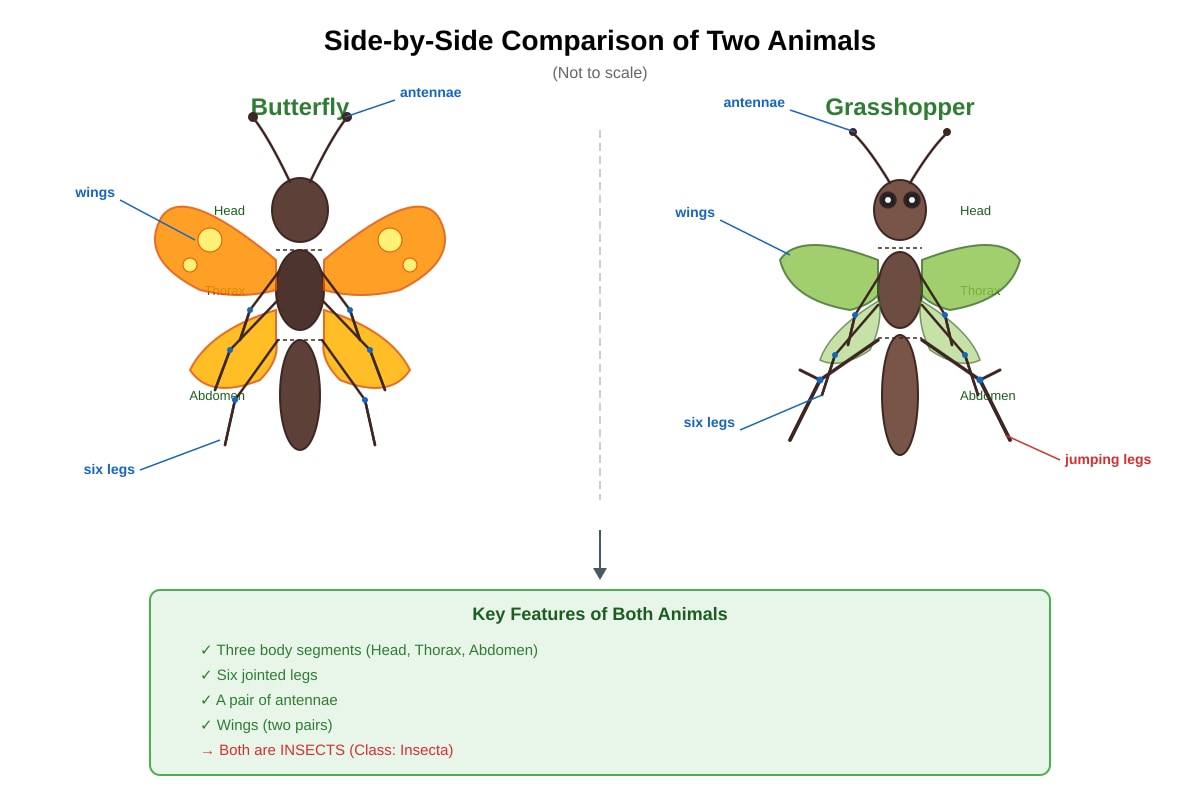
2. The diagram below shows two animals.
<image_placeholder> id: Q2-fig1 type: diagram linked_question: Q2 description: Side-by-side comparison of a butterfly and a grasshopper, showing body structure labels: Butterfly - wings, antennae, six legs; Grasshopper - wings, antennae, six legs, jumping legs values: Not to scale must_show: Both animals with clear labels of body parts, both showing three body segments, both showing jointed legs </image_placeholder>
Based on the diagram, which group do both animals belong to?
| A | Fish | | B | Birds | | C | Insects | | D | Mammals |
Answer: _______
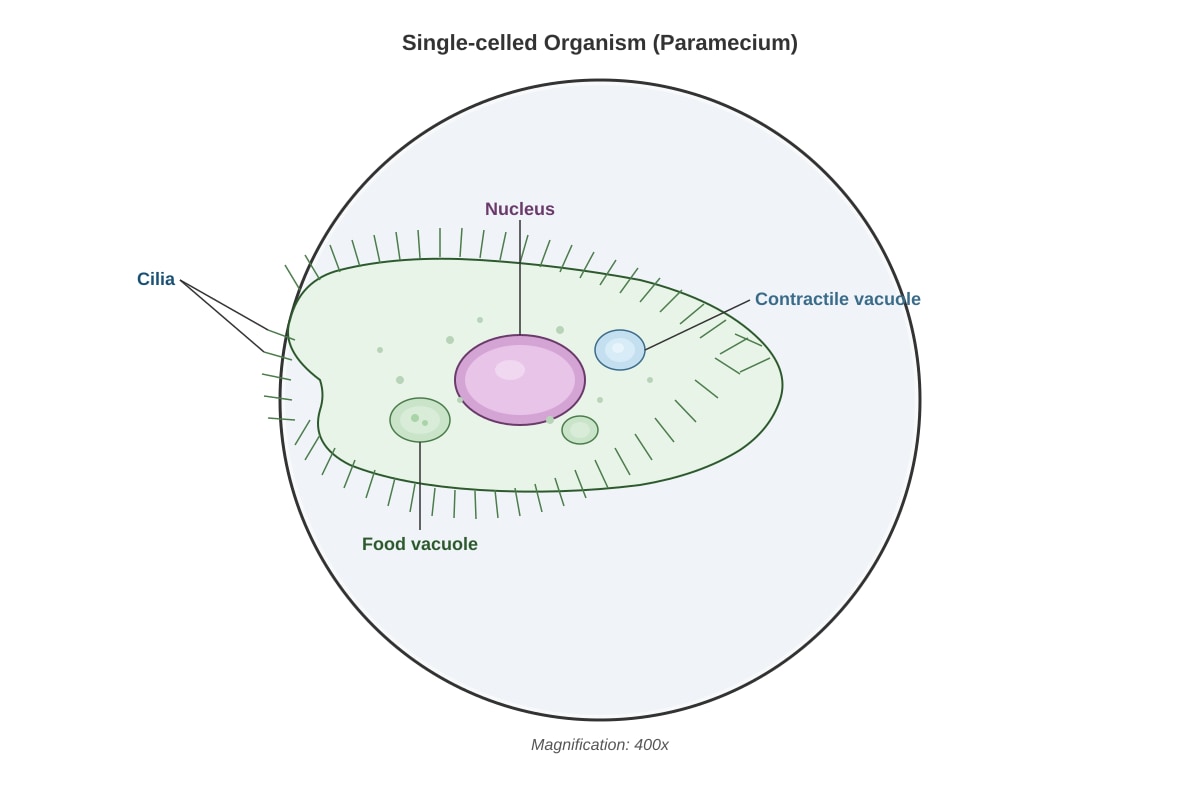
3. A student found the organism below in a pond.
<image_placeholder> id: Q3-fig1 type: diagram linked_question: Q3 description: A microscope view of a single-celled organism with cilia, food vacuole, nucleus, and contractile vacuole visible labels: Cilia, Nucleus, Food vacuole, Contractile vacuole values: Magnification 400x must_show: Elongated slipper-shaped body, hair-like cilia surrounding the body, clear nucleus in centre, food vacuole and contractile vacuole labeled </image_placeholder>
The organism uses cilia to move and has a contractile vacuole to remove excess water. What type of organism is this?
| A | Fungus | | B | Bacterium | | C | Paramecium | | D | Virus |
Answer: _______
4. Which of the following correctly matches the organism to its method of reproduction?
| Organism | Method of Reproduction | |
|---|---|---|
| A | Butterfly | Budding |
| B | Hydra | Spores |
| C | Mould | Binary fission |
| D | Grass | Seeds |
Answer: _______
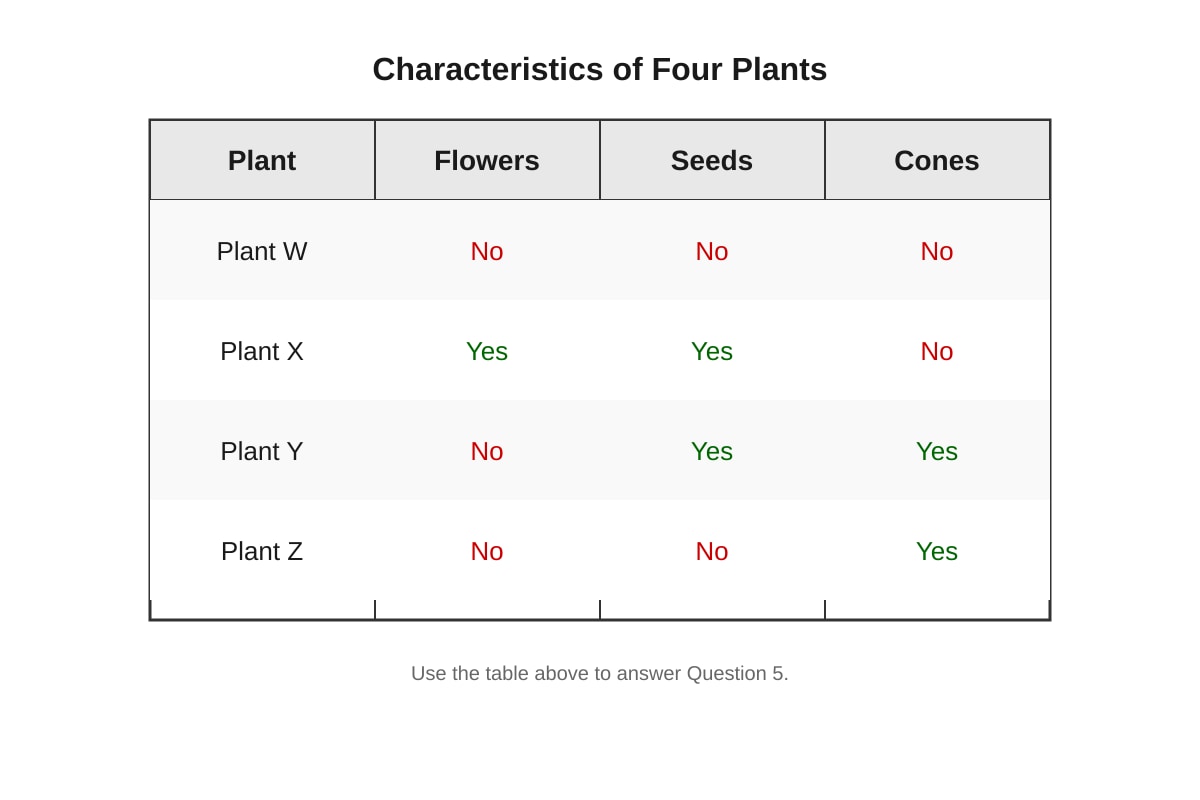
5. The table below shows some characteristics of four plants.
<image_placeholder> id: Q5-fig1 type: table linked_question: Q5 description: Table comparing four plants with yes/no for flowers, seeds, and cones labels: Plant W, Plant X, Plant Y, Plant Z; Characteristics - Flowers, Seeds, Cones values:
- Plant W: Flowers - No, Seeds - No, Cones - No
- Plant X: Flowers - Yes, Seeds - Yes, Cones - No
- Plant Y: Flowers - No, Seeds - Yes, Cones - Yes
- Plant Z: Flowers - No, Seeds - No, Cones - Yes must_show: Complete table with all four plants and three characteristics columns </image_placeholder>
Which plant is a flowering plant?
| A | Plant W | | B | Plant X | | C | Plant Y | | D | Plant Z |
Answer: _______
6. Why is biodiversity important for an ecosystem?
| A | It makes the ecosystem look beautiful | | B | It ensures that organisms can compete with each other | | C | It allows the ecosystem to remain stable when conditions change | | D | It prevents all organisms from dying |
Answer: _______
7. A student observed the following animals in a garden: earthworms, snails, spiders, and centipedes. Which of these animals does NOT belong to the group Arthropoda?
| A | Spider | | B | Snail | | C | Centipede | | D | All belong to Arthropoda |
Answer: _______
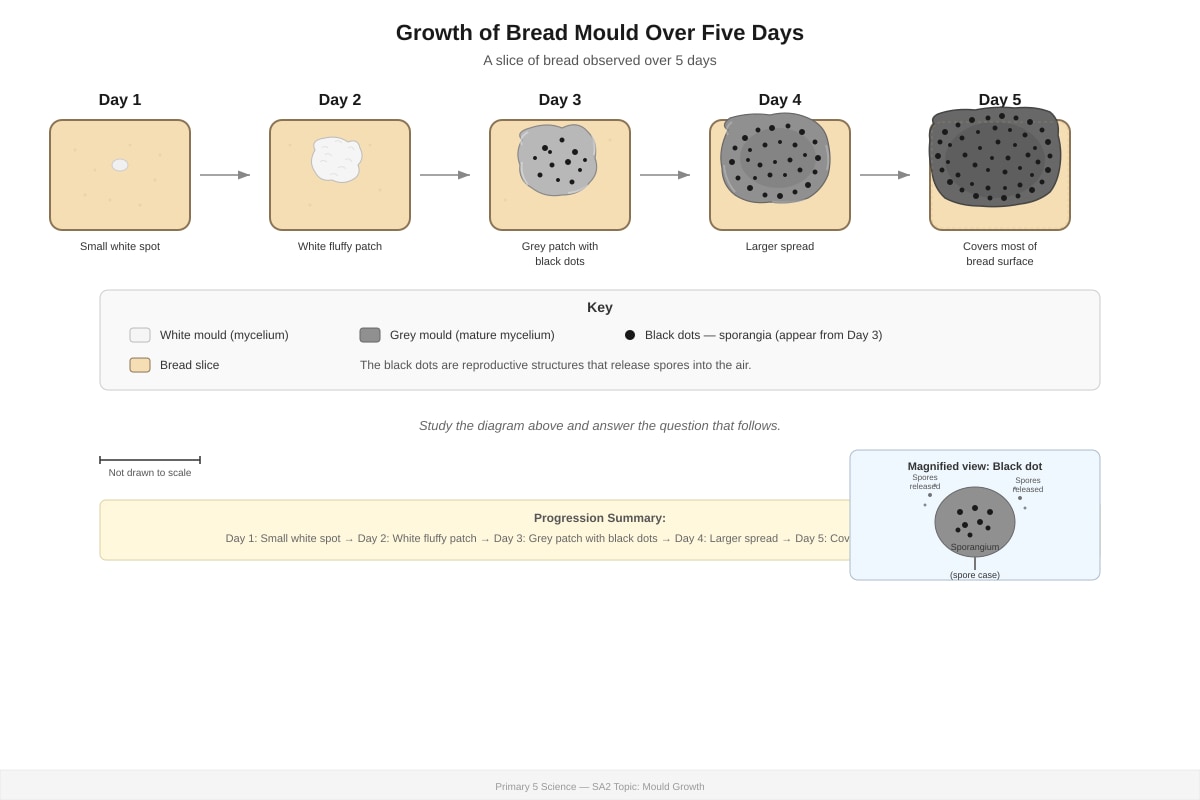
8. The diagram shows how bread mould grows on a slice of bread over five days.
<image_placeholder> id: Q8-fig1 type: diagram linked_question: Q8 description: Series of five diagrams showing progression of bread mould growth from day 1 to day 5 labels: Day 1 (small white spot), Day 2 (white fluffy patch), Day 3 (grey patch with black dots), Day 4 (larger spread), Day 5 (covers most of bread surface) values: Black dots appear day 3 onward must_show: Progressive growth stages, clear transition from white fuzzy to grey with black sporangia, bread slice outline consistent across all five stages </image_placeholder>
What are the black dots that appear from Day 3 onwards?
| A | Seeds | | B | Spores | | C | Eggs | | D | Pollen grains |
Answer: _______
9. Which pair of organisms shows the correct classification relationship?
| A | Fern and moss — both are fungi | | B | Pigeon and bat — both are birds | | C | Whale and dolphin — both are mammals | | D | Crocodile and lizard — both are amphibians |
Answer: _______
10. A scientist discovered a new organism. It has the following features:
- Body made of many cells
- Cannot make its own food
- Has cell walls
- Reproduces by spores
To which kingdom does this organism most likely belong?
| A | Animal | | B | Plant | | C | Fungus | | D | Bacterium |
Answer: _______
Section B: Structured Questions (Questions 11-16)
24 marks
Answer all questions in the spaces provided. Show your working clearly.
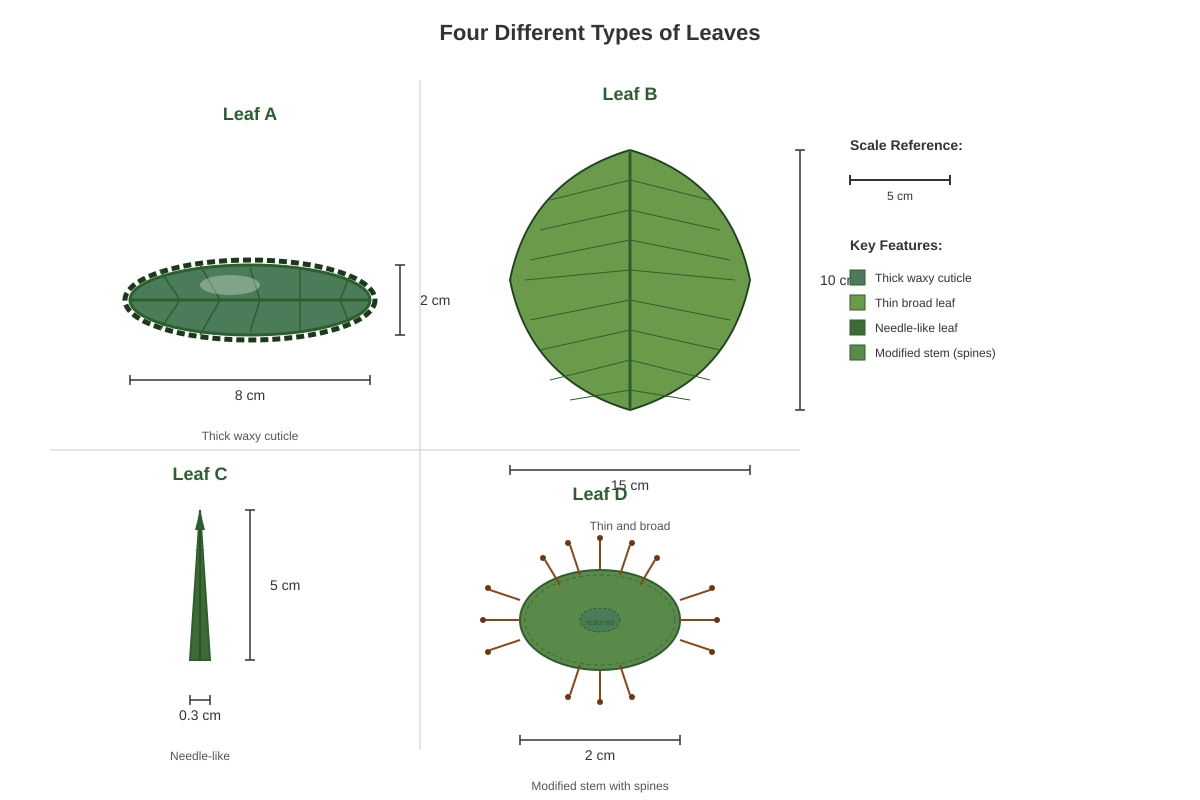
11. The diagram shows four different types of leaves from plants found in Singapore.
<image_placeholder> id: Q11-fig1 type: diagram linked_question: Q11 description: Four leaves showing different adaptations - A (thick waxy), B (thin broad), C (needle-like), D (spines) labels: Leaf A, Leaf B, Leaf C, Leaf D; width measurements shown values: Leaf A: 8cm x 2cm, thick cuticle shown; Leaf B: 15cm x 10cm, thin; Leaf C: 5cm x 0.3cm, needle; Leaf D: modified stem with spines 2cm must_show: All four leaves with clear size differences, leaf shapes distinct, Leaf D clearly showing reduced/modified leaf structure </image_placeholder>
(a) Which leaf, A, B, C, or D, is most likely from a plant living in a very dry environment? Give a reason for your answer. [2 marks]
(b) Describe one advantage of Leaf B's shape for the plant. [2 marks]
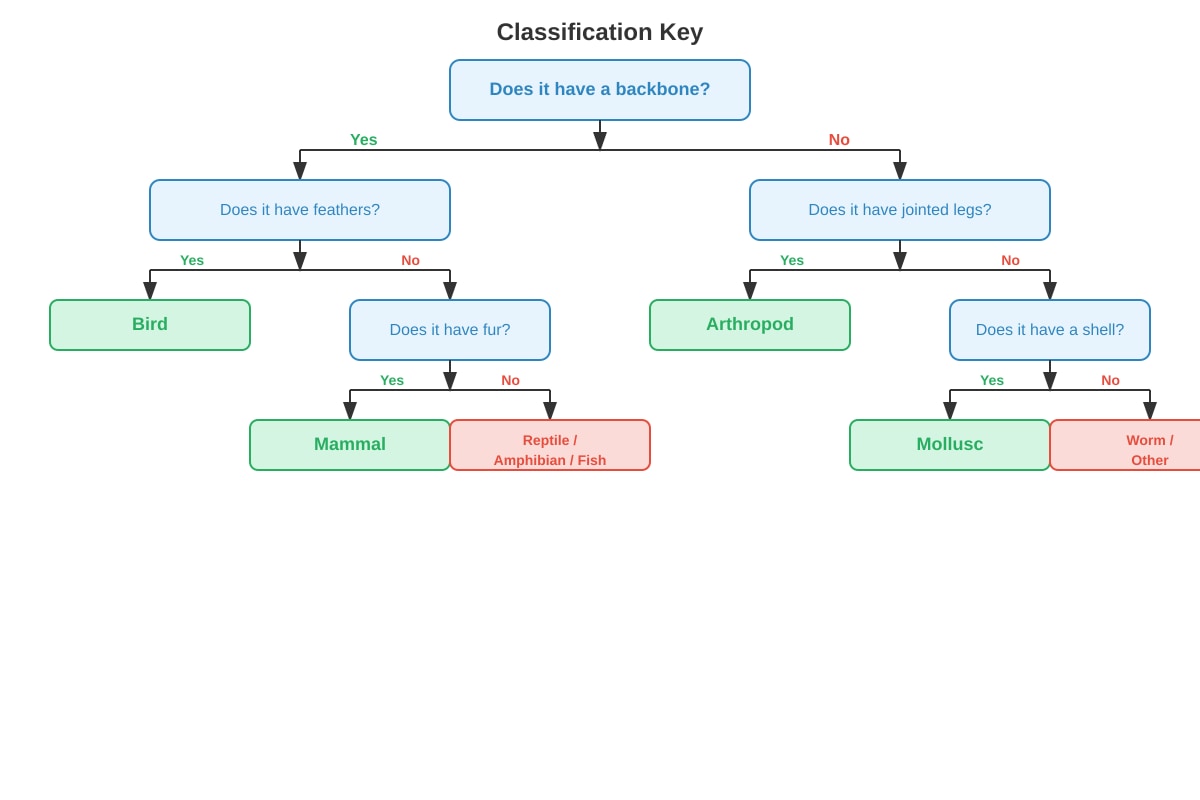
12. Study the classification key below.
<image_placeholder> id: Q12-fig1 type: diagram linked_question: Q12 description: Dichotomous classification key in flowchart style with yes/no branches labels: Start - Does it have a backbone? Yes/No branches leading to further questions values:
- Backbone Yes → Does it have feathers? Yes = Bird, No → Does it have fur? Yes = Mammal, No = Reptile/Amphibian/Fish branch
- Backbone No → Does it have jointed legs? Yes = Arthropod, No → Does it have a shell? Yes = Mollusc, No = Worm/Other must_show: Clear binary choice structure, all branches leading to named groups, arrows connecting choices </image_placeholder>
(a) An earthworm is placed in this key. Follow the key and state which group it belongs to. [1 mark]
(b) Explain why a grasshopper and a spider are placed in the same group using this key, even though they look different. [2 marks]
(c) James found an animal with a backbone and scales. It lives in water. Use the key to identify which group it belongs to. Explain your answer. [2 marks]
13. The table below shows information about four microorganisms.
| Microorganism | Structure | Harmful or Useful | Example of Role |
|---|---|---|---|
| Bacteria | Single-celled, no nucleus | Can be both | Decomposition, cause disease |
| Fungi | Thread-like hyphae, spores | Can be both | Decomposition, food production |
| Protozoa | Single-celled, with nucleus | Mostly harmful | Cause diseases like malaria |
| Viruses | Non-living, need host cell | Harmful | Cause flu, COVID-19 |
(a) Bacteria and protozoa are both single-celled. State one way they are different from each other based on the table. [1 mark]
(b) Explain why viruses are not considered living things. [2 marks]
(c) Give one example of how fungi are useful to humans. [1 mark]
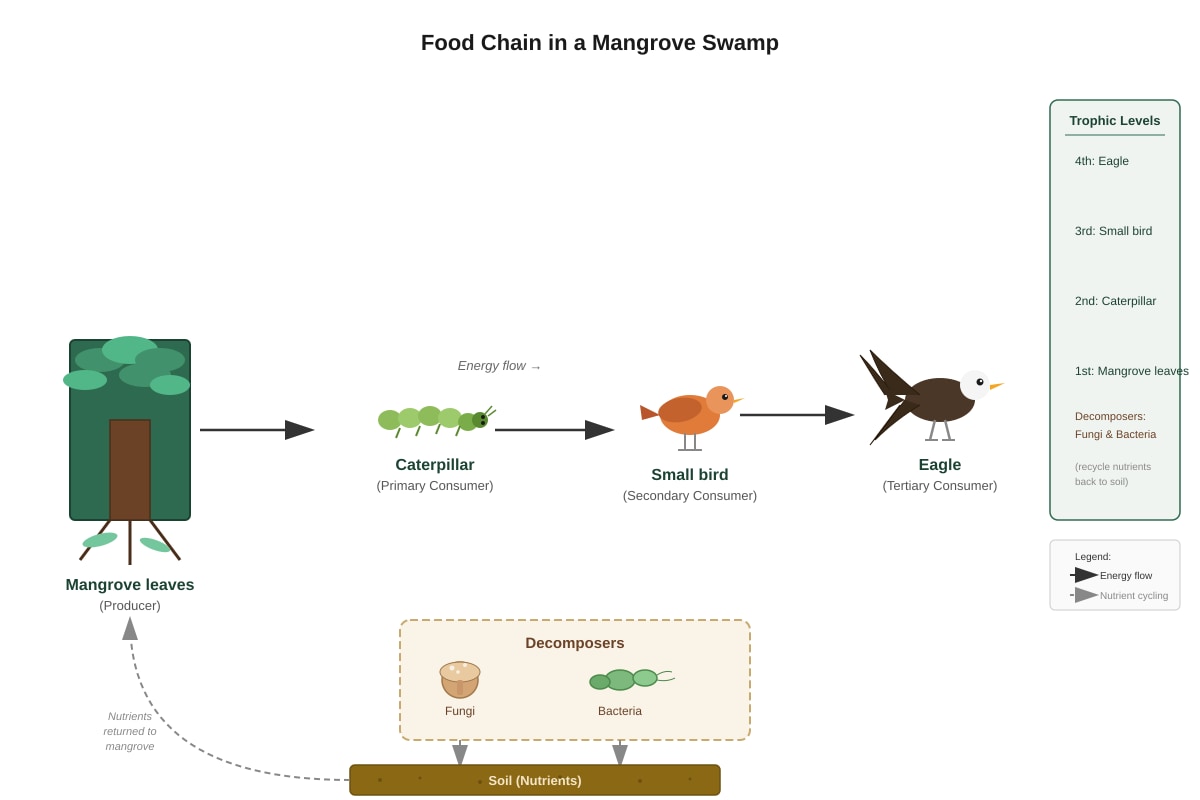
14. The diagram shows a food chain in a mangrove swamp in Singapore.
<image_placeholder> id: Q14-fig1 type: diagram linked_question: Q14 description: Food chain diagram showing mangrove ecosystem labels: Mangrove leaves → Caterpillar → Small bird → Eagle; Decomposers (fungi and bacteria) shown returning nutrients to soil values: Arrows showing energy flow direction must_show: Four trophic levels with arrows pointing from food to eater, decomposers shown with dashed arrows to soil/soil to mangrove, clear labels for each organism </image_placeholder>
(a) Name the producer in this food chain. [1 mark]
(b) Explain what would happen to the small bird population if all the eagles were removed from this ecosystem. [2 marks]
(c) State the role of decomposers in this food chain. [1 mark]
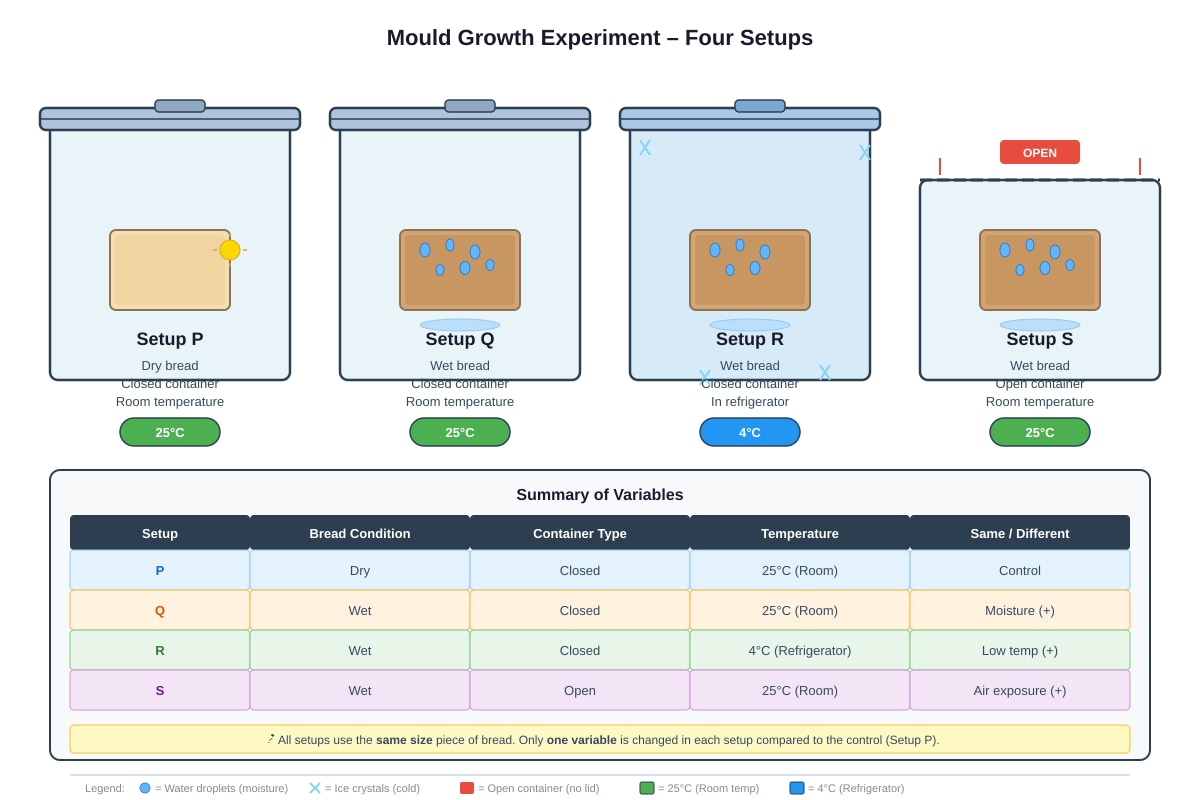
15. A group of students investigated the growth of mould on bread under different conditions. They placed pieces of bread in four different setups as shown below.
<image_placeholder> id: Q15-fig1 type: experimental_setup linked_question: Q15 description: Four setups showing bread in different conditions for mould growth experiment labels: Setup P - Dry bread in closed container at room temperature; Setup Q - Wet bread in closed container at room temperature; Setup R - Wet bread in closed container in refrigerator; Setup S - Wet bread in open container at room temperature values: Temperatures: Room temp = 25°C, Refrigerator = 4°C; All setups use same size bread piece must_show: All four setups clearly distinguished, container types obvious (closed vs open), water droplets visible on wet bread, temperature labels clear </image_placeholder>
The students observed the bread for one week.
(a) Which setup would you expect to have the most mould after one week? Explain your answer. [2 marks]
(b) Explain why Setup P is expected to have less mould than Setup Q. [2 marks]
(c) What is the purpose of including Setup R in this investigation? [1 mark]
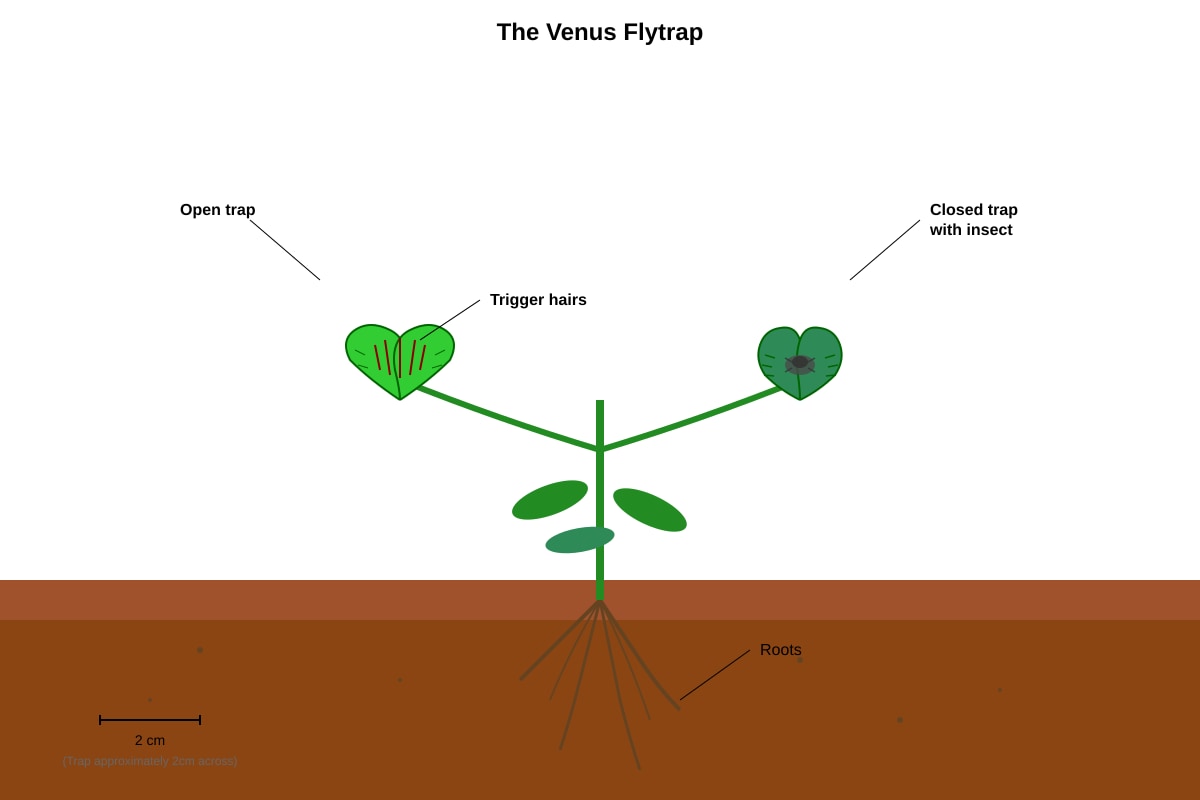
16. The photograph shows a Venus flytrap, a plant that traps and digests insects.
<image_placeholder> id: Q16-fig1 type: diagram linked_question: Q16 description: Venus flytrap plant showing open trap with trigger hairs inside, closed trap with insect, and roots in soil labels: Open trap, Trigger hairs, Closed trap with insect, Roots values: Trap approximately 2cm across must_show: Both open and closed trap states, trigger hairs clearly visible inside open trap, insect visible in closed trap, roots in soil showing plant is planted </image_placeholder>
(a) Venus flytraps can make their own food through photosynthesis. Explain why they still need to trap insects. [2 marks]
(b) Suggest what would happen to a Venus flytrap if it were planted in soil rich in nitrogen compounds. Explain your answer. [2 marks]
Section C: Open-Ended Questions (Questions 17-20)
16 marks
Answer all questions in the spaces provided.
17. A class of students went on a field trip to a nature reserve. They recorded the following organisms in their notebook:
- Ferns growing on tree trunks
- Mushrooms on rotting logs
- Moss on rocks
- Ants carrying leaves
- Monkeys in the trees
- Snakes on the ground
(a) The students wanted to classify these organisms into groups. Complete the table below by classifying THREE of the organisms into their correct kingdoms or groups. One has been done for you. [3 marks]
| Organism | Group/Kingdom | Reason |
|---|---|---|
| Ferns | Plant | Can make its own food; has leaves and roots |
(b) Explain why mushrooms are classified as fungi and not as plants, even though they grow from the ground and seem to have "roots." [2 marks]
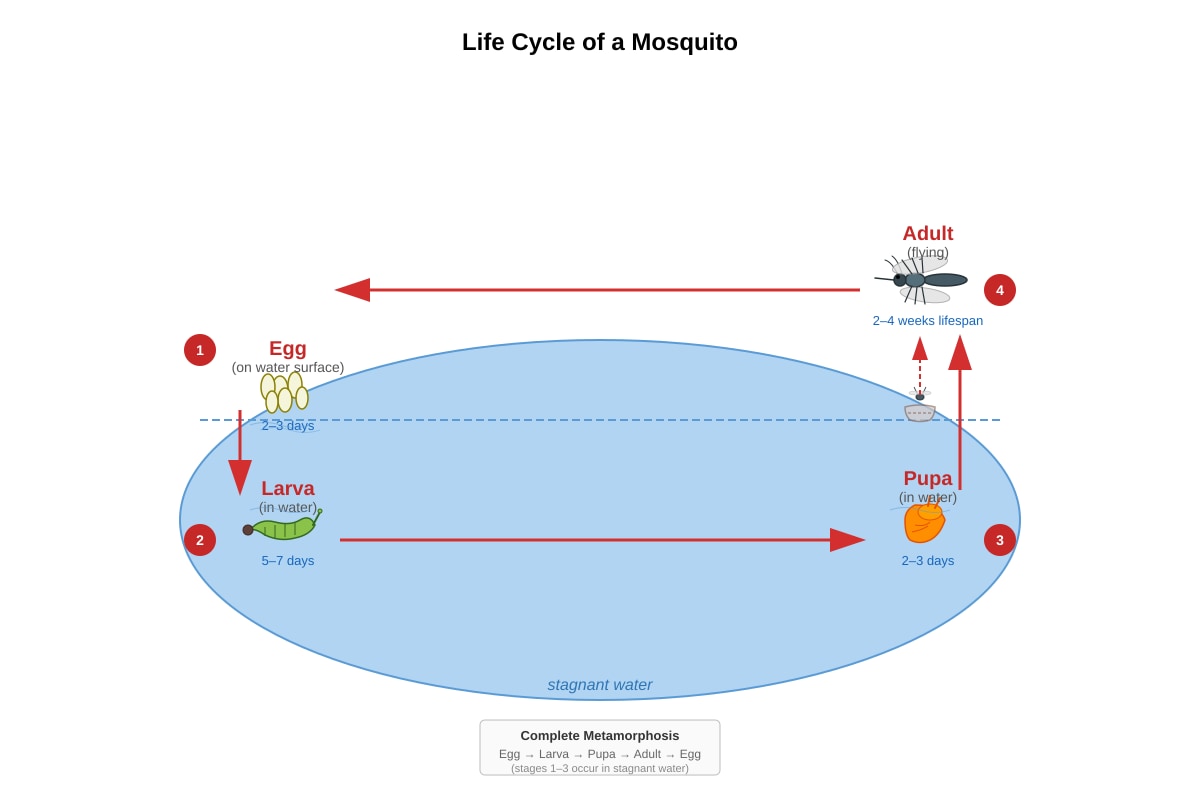
18. The diagram shows the life cycle of a mosquito.
<image_placeholder> id: Q18-fig1 type: diagram linked_question: Q18 description: Life cycle of mosquito showing four stages in circular arrangement with arrows labels: Egg (on water surface), Larva (in water), Pupa (in water), Adult (flying); stagnant water shown for first three stages values: Time indicated: Egg 2-3 days, Larva 5-7 days, Pupa 2-3 days, Adult 2-4 weeks lifespan must_show: All four stages with clear transitions, water environment for egg/larva/pupa, flying adult emerging from pupa case at water surface, time labels for each stage </image_placeholder>
(a) Name the type of life cycle shown in the diagram. Explain how you know. [2 marks]
(b) Explain why removing stagnant water is an effective way to control mosquito populations. [2 marks]
(c) In Singapore, the National Environment Agency checks for stagnant water around homes. Suggest one other method to reduce mosquito breeding and explain how it works. [2 marks]
19. The passage below describes an ecosystem in danger.
The coral reefs around Southeast Asia are home to over 3,000 species of fish and hundreds of types of coral. These reefs also provide food and income for millions of people who live nearby. In recent years, scientists have noticed that many coral reefs are dying. The water is becoming warmer, which causes the corals to lose the tiny algae living inside them. Without these algae, the corals turn white and eventually die. Pollution from nearby cities and overfishing are also damaging the reefs. When coral reefs die, many fish lose their homes and food sources. The people who depend on fishing may no longer be able to catch enough food.
(a) Explain why the loss of algae causes corals to die. [2 marks]
(b) Apart from warming water, name two other threats to coral reefs mentioned in the passage. [1 mark]
(c) Describe two ways that the death of coral reefs affects both marine life and humans. [2 marks]
20. A student made the following observation about the organisms in her school garden:
"All green plants are producers. Neither rabbits nor birds are decomposers. Only bacteria and fungi break down dead matter. Therefore, there are no decomposers that are green plants."
(a) Based on the student's statements, draw a Venn diagram or table showing the relationships between producers, decomposers, green plants, bacteria, fungi, rabbits, and birds. [2 marks]
(b) The student later found that some bacteria can make their own food using sunlight, similar to plants. Explain how this discovery would change the student's original conclusion about whether decomposers can be producers. [2 marks]
END OF PAPER
Answers
TuitionGoWhere Exam Practice (AI) - SA2 Version 4
Answer Key and Marking Scheme
Subject: Science
Level: Primary 5
Total Marks: 60
Section A: Multiple Choice (2 marks each)
| Question | Answer | Explanation |
|---|---|---|
| 1 | B | All living things can reproduce to continue their species. Flying, having legs, and swimming are specific features of certain animals, not universal characteristics of life. |
| 2 | C | Both butterfly and grasshopper have three body parts (head, thorax, abdomen), six jointed legs, and antennae—the defining features of insects. |
| 3 | C | Paramecium is a single-celled organism (protozoan) that uses cilia for movement and has a contractile vacuole for osmoregulation. It is commonly studied in P5 as an example of microorganisms. |
| 4 | D | Grass reproduces by seeds. Butterfly reproduces by laying eggs (not budding), Hydra reproduces by budding (not spores), and Mould reproduces by spores (not binary fission). |
| 5 | B | Plant X has flowers and seeds but no cones, making it a flowering plant (angiosperm). Plant Y is a conifer (gymnosperm), Plant Z is probably a non-seed plant like fern, and Plant W is probably algae or moss. |
| 6 | C | Biodiversity provides variety in an ecosystem, so if one species is affected by disease or environmental change, other species can continue functioning, maintaining ecosystem stability. |
| 7 | B | Snails belong to Mollusca (soft body, often with shell), not Arthropoda. Spiders and centipedes have jointed legs and hard exoskeletons, making them arthropods. |
| 8 | B | The black dots are sporangia containing spores for reproduction. Bread mould (Rhizopus) produces these black spore cases as part of its life cycle. |
| 9 | C | Whales and dolphins are mammals—they breathe air, give birth to live young, and nurse with milk. Bats are mammals (not birds), crocodiles and lizards are reptiles (not amphibians), ferns and moss are plants (not fungi). |
| 10 | C | The features match fungi: multicellular, heterotrophic (cannot make food), cell walls present, and reproduce by spores. Animals lack cell walls, plants make their own food, bacteria are single-celled. |
Section A Total: 20 marks
Section B: Structured Questions
Question 11 (4 marks)
(a) Answer: Leaf A [1 mark]
Reason: Leaf A has a thick waxy cuticle/layer that reduces water loss. [1 mark]
Teaching note: In dry environments, plants need to conserve water. The thick, waxy cuticle on Leaf A acts as a waterproof barrier, preventing water from evaporating from the leaf surface. The smaller size also reduces surface area for water loss.
(b) Answer: Leaf B is large and broad, which gives it a large surface area to capture more sunlight for photosynthesis. [2 marks]
Marking breakdown:
- Large surface area identified [1 mark]
- Link to photosynthesis/sunlight capture [1 mark]
Teaching note: Broad, thin leaves are typical of plants in shady or wet environments where water conservation is less critical. The large surface area maximises light absorption for photosynthesis, where plants convert light energy into food (glucose).
Question 12 (5 marks)
(a) Answer: Worm/Other group [1 mark]
Working: Earthworm → No backbone → No jointed legs → No shell → Worm/Other
(b) Answer: Both have jointed legs (and an exoskeleton). [1 mark] Following the key, this places them both in the Arthropod group. [1 mark]
Teaching note: A dichotomous key uses one characteristic at a time to split organisms into smaller groups. Despite looking different, grasshoppers and spiders share the key feature of jointed legs, which is the branch point used here. Other arthropod features include body segmentation and hard outer covering (exoskeleton).
(c) Answer: Reptile/Fish/Amphibian branch (or "the non-feather, non-fur group") [1 mark]
Explanation: It has a backbone but no feathers and no fur; scales suggest fish or reptile. Since it lives in water with scales, it is most likely a fish. [1 mark]
Teaching note: The key branches at "backbone → feathers → fur." Without feathers or fur, the animal falls into the remaining vertebrate category. Scales are found on fish and reptiles, but the aquatic habitat strongly indicates fish.
Question 13 (4 marks)
(a) Answer: Bacteria have no nucleus / protozoa have a nucleus (or bacteria are prokaryotes, protozoa are eukaryotes). [1 mark]
(b) Answer: Viruses are non-living / viruses cannot reproduce by themselves. [1 mark] They need to infect a host cell to reproduce. [1 mark]
Teaching note: Living things carry out life processes independently—nutrition, respiration, growth, reproduction, excretion, movement. Viruses lack cellular structure and cannot reproduce or carry out any life process without entering a living host cell. They are considered at the boundary of life.
(c) Answer: Yeast is used to make bread rise / mushrooms are eaten as food / fungi used to make antibiotics like penicillin / fungi decompose dead matter to recycle nutrients. [1 mark] (Any valid example accepted)
Question 14 (4 marks)
(a) Answer: Mangrove leaves / the mangrove plant. [1 mark]
Teaching note: Producers are organisms that make their own food through photosynthesis using sunlight, water, and carbon dioxide. All plants are producers.
(b) Answer: The small bird population would increase at first. [1 mark] Without eagles preying on them, more small birds would survive and reproduce. [1 mark]
Teaching note: This demonstrates predator-prey relationships in food chains. Removing a predator typically causes a population increase in the prey species. However, long-term, the small bird population might crash if they over-consume caterpillars or overpopulate their habitat.
(c) Answer: Decomposers break down dead organisms and waste materials, returning nutrients to the soil for producers to use. [1 mark]
Teaching note: Bacteria and fungi are decomposers in most ecosystems. They recycle nutrients by breaking down complex organic matter into simple substances that plant roots can absorb, completing the nutrient cycle.
Question 15 (5 marks)
(a) Answer: Setup Q. [1 mark]
Explanation: Setup Q has both moisture and warm temperature, which are ideal conditions for mould (fungi) to grow. [1 mark]
Teaching note: Mould growth requires: (1) moisture/water, (2) suitable temperature, (3) food source (bread). Setup Q provides all three optimal conditions. Fungi cannot grow in dry conditions and grow very slowly in cold conditions.
(b) Answer: Setup P is dry / lacks moisture. [1 mark] Mould (fungi) needs water to grow and reproduce. [1 mark]
Teaching note: While both setups have food and suitable temperature, water is essential for fungal life processes including spore germination and nutrient absorption through hyphae.
(c) Answer: To act as a control / to show the effect of temperature on mould growth / to compare with Setup Q to show that lower temperature slows mould growth. [1 mark]
Teaching note: A control or comparison setup ensures that any differences observed are due to the variable being tested. Here, Setup R (cold, wet) compared with Setup Q (warm, wet) isolates temperature as the variable affecting growth rate.
Question 16 (4 marks)
(a) Answer: Venus flytraps grow in soil that is poor in nutrients (especially nitrogen). [1 mark] The insects provide additional nutrients like nitrogen that the plant cannot get enough of from the soil. [1 mark]
Teaching note: Photosynthesis provides glucose (energy) but does not supply minerals. Plants normally absorb nitrates from soil for making proteins and other essential molecules. In nitrogen-poor bog habitats, Venus flytraps supplement their mineral nutrition by digesting insects.
(b) Answer: It would trap fewer insects / might not need to trap insects at all. [1 mark] The plant could obtain enough nitrogen from the soil instead. [1 mark]
Teaching note: This demonstrates how organisms' adaptations relate to their environment. The trapping mechanism is energetically expensive; if soil provides sufficient nutrients, there is no selective advantage to maintaining elaborate traps, and the plant may reduce this behaviour or grow larger through regular photosynthesis alone.
Section C: Open-Ended Questions
Question 17 (5 marks)
(a) [3 marks — 1 mark per correct row]
| Organism | Group/Kingdom | Reason |
|---|---|---|
| Ferns | Plant | (given) |
| Mushrooms | Fungi | Cannot make own food; reproduces by spores; feed on decaying matter [1 mark] |
| Moss | Plant | Can make own food; has simple leaves and stem structure [1 mark] |
| Ants | Animal | Cannot make own food; moves; has body segments and jointed legs [1 mark] |
| Monkeys | Animal | Cannot make own food; moves; has fur; gives birth to live young [1 mark] |
| Snakes | Animal/Reptile | Cannot make own food; has scales; cold-blooded; lays eggs [1 mark] |
(Any three correct rows accepted)
(b) [2 marks]
Mushrooms cannot make their own food / they are heterotrophic. [1 mark] They absorb nutrients from decaying matter through their hyphae (thread-like structures), unlike plants which use chlorophyll for photosynthesis. [1 mark] Their "roots" are actually hyphae for absorption, not true roots for anchorage and water uptake like plants.
Teaching note: A common misconception is that anything growing from soil is a plant. Fungi form a separate kingdom because they lack chlorophyll, have cell walls made of chitin (not cellulose), and obtain food by absorption (not photosynthesis).
Question 18 (6 marks)
(a) [2 marks]
Answer: Complete metamorphosis / complete life cycle. [1 mark]
Explanation: The mosquito has four distinct life stages (egg, larva, pupa, adult) that look very different from each other. [1 mark] The larva and pupa live in water and do not resemble the winged adult.
Teaching note: Incomplete metamorphosis (seen in grasshoppers) has three stages: egg → nymph → adult, where the nymph resembles a smaller adult. Complete metamorphosis has a dramatic transformation (pupa stage) between larval and adult forms.
(b) [2 marks]
Mosquitoes need water for their eggs, larvae, and pupae. [1 mark] Without stagnant water, mosquitoes cannot complete their life cycle / reproduce successfully. [1 mark]
Teaching note: Understanding life cycles helps control pests. Targeting the aquatic stages is most effective because mosquito eggs, larvae, and pupae are concentrated in water and cannot escape. Adult flying mosquitoes disperse widely and are harder to eliminate.
(c) [2 marks]
Suggested method: Use mosquito repellent / spray insecticide / install mosquito netting / introduce mosquito-eating fish / genetic modification of mosquitoes / regular cleaning of gutters. [1 mark]
Explanation: Repellents prevent mosquitoes from biting humans; netting blocks entry; fish eat larvae; insecticides kill adults; genetic methods reduce viable offspring. [1 mark]
Question 19 (5 marks)
(a) [2 marks]
The tiny algae living inside corals make food through photosynthesis. [1 mark] The corals depend on this food/nutrients from the algae. Without algae, the corals lose their food source and starve. [1 mark] (This process is called coral bleaching.)
Teaching note: Corals and algae have a mutualistic relationship—algae get protection and minerals from coral tissue; corals get up to 90% of their nutrition from algal photosynthesis. This symbiosis is the foundation of reef ecosystems.
(b) [1 mark]
Pollution from nearby cities; and overfishing. [1 mark] (Both required for full mark)
(c) [2 marks]
For marine life: Fish lose their homes and food sources / biodiversity decreases. [1 mark]
For humans: People who depend on fishing may not catch enough food / loss of income from tourism and fishing. [1 mark]
(Any two valid impacts, one for marine life and one for humans, accepted)
Question 20 (4 marks)
(a) [2 marks]
Venn diagram or table should show:
| Category | Includes |
|---|---|
| Producers | Green plants |
| Decomposers | Bacteria, Fungi |
| Neither/Consumers | Rabbits, Birds |
Or Venn diagram with:
- Producers circle: Green plants only
- Decomposers circle: Bacteria, Fungi only
- No overlap between producers and decomposers
- Rabbits and birds outside both circles
Marking: Correct classification of all seven organisms [1 mark]; clear diagram/table format with logical groupings [1 mark]
(b) [2 marks]
The student would need to change her conclusion. [1 mark] If some bacteria can make their own food using sunlight, then some decomposers (bacteria) can also be producers. This means the groups are not mutually exclusive. [1 mark]
Teaching note: This question tests logical reasoning and flexibility in classification. Scientific understanding evolves with new evidence. Some bacteria (like cyanobacteria/blue-green algae) are photosynthetic and can be considered both producers and decomposers depending on context, showing that biological classifications can have exceptions and overlaps.
Mark Allocation Summary
| Section | Marks |
|---|---|
| Section A (MCQ) | 20 |
| Section B (Structured) | 24 |
| Section C (Open-Ended) | 16 |
| Total | 60 |
Duration check: 75 minutes allows approximately:
- Section A: 1 minute per question = 10 minutes
- Section B: 3 minutes per question = 18 minutes
- Section C: 6-8 minutes per question = 25-32 minutes
- Reading and review = 15-20 minutes
This is manageable for prepared P5 students with review buffer.