From Real Exams Exam Paper
Primary 5 Science Semestral Assessment 2 (End of Year) Paper 4
Free P5 Science SA2 Paper 4, HY3 Exam version, with questions, answers, and syllabus-aligned practice for Singapore students.
These static practice materials are generated from the site's syllabus and paper-generation workflow, with source and model context shown so students and parents can evaluate the material before use.
Questions
TuitionGoWhere Exam Practice (AI) – Science Primary 5
SA2 Practice Paper (Version 4 of 5)
School: TuitionGoWhere Exam Practice (AI)
Subject: Science
Level: Primary 5
Paper: SA2 Practice Paper (Version 4)
Duration: 60 minutes
Total Marks: 60
Name: ______________________
Class: _________
Date: ____________
Instructions:
- This paper contains 20 questions on the topic of Diversity.
- Section A: 10 multiple-choice questions (1 mark each).
- Section B: 6 short-answer questions (2 marks each).
- Section C: 4 structured questions (total 28 marks as shown).
- Write your answers clearly in the spaces provided.
- Use the correct scientific terms taught in Primary 5.
Section A: Multiple Choice (10 × 1 = 10 marks)
-
Which of the following is a living thing?
A) A wooden chair
B) A fern plant
C) A plastic bottle
D) A cloud -
Which group do mushrooms belong to?
A) Plants
B) Animals
C) Fungi
D) Bacteria -
Which of these is NOT a characteristic of living things?
A) They need food
B) They can move from place to place
C) They reproduce
D) They grow -
A robin and a rose bush are both living things. What do they have in common?
A) They both make food using sunlight
B) They are both animals
C) They are made of cells and reproduce
D) They both have wings -
Which of the following is a non-living thing that was once part of a living thing?
A) A cotton shirt
B) A dog
C) A leaf on a tree
D) A frog -
Which group of animals lays eggs and has feathers?
A) Mammals
B) Reptiles
C) Birds
D) Fish -
Which of these is a correct way to group objects by living and non-living?
A) Living: rock, cat; Non-living: book
B) Living: mango tree, mosquito; Non-living: eraser
C) Living: water, bird; Non-living: table
D) Living: shoe, plant; Non-living: snail -
Bacteria are best described as:
A) Large animals that can be seen without a microscope
B) Tiny living things made of one or few cells
C) A type of plant
D) Non-living particles in the air -
Which of the following shows diversity among plants?
A) Some plants are tall trees, some are small herbs
B) All plants have the same leaf shape
C) All plants grow only in water
D) Plants do not reproduce -
Why do scientists group living things into categories?
A) To make them look the same
B) To organise them by shared characteristics
C) To count them easily only
D) Because they are all the same inside
Section B: Short Answer (6 × 2 = 12 marks)
- Name two characteristics that show a cat is a living thing.
- State one difference between plants and animals in how they get food.
- Give one example of a fungus and one example of a bacterium.
- Explain why a bicycle is non-living although it has moving parts.
- List two groups of living things taught in Primary 5 Diversity.
- A snail and a sunflower are both living. State one similarity and one difference between them.
Similarity: __________________________________________________
Difference: __________________________________________________
Section C: Structured Questions (28 marks)
Question 17 (7 marks)
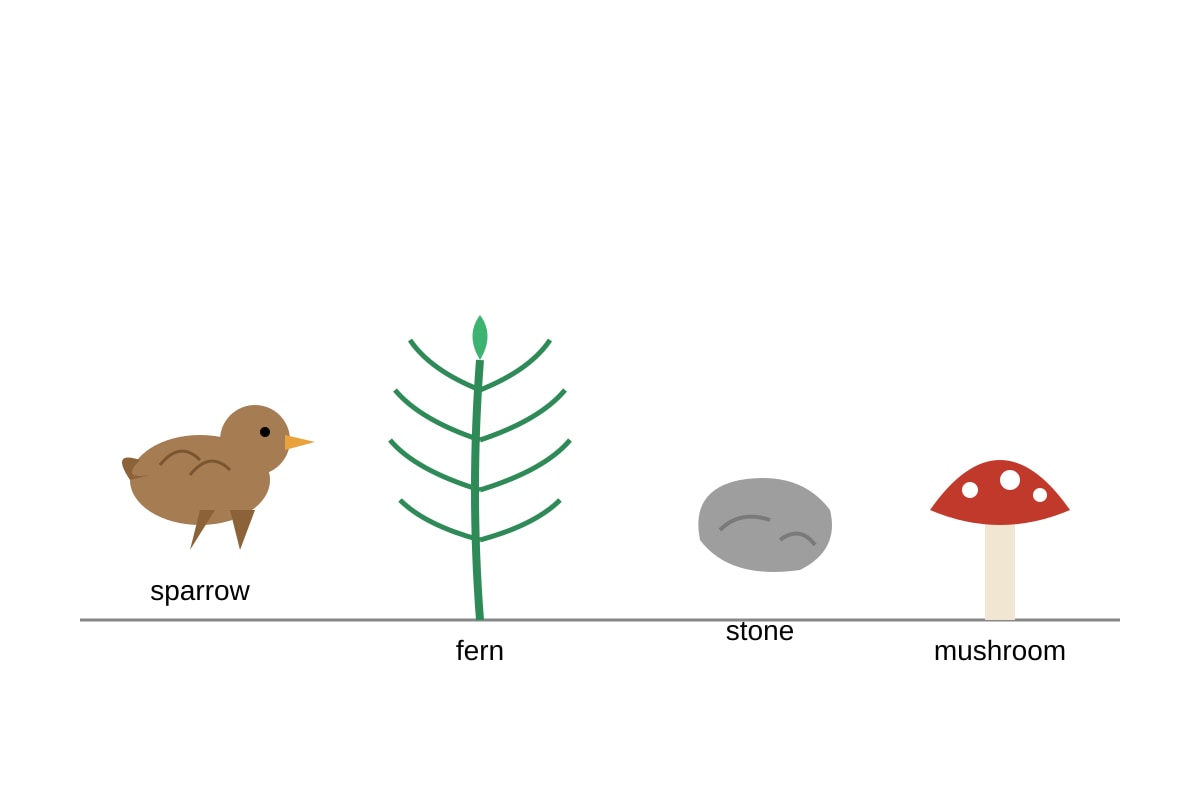
The diagram below shows four objects found in a park.
Image pending generation: diagram for 17.
(a) Classify the four objects as living or non-living. (2 marks)
Sparrow: _________ Fern: _________ Stone: _________ Mushroom: _________
(b) Which two of the four are NOT plants? Give a reason for each. (3 marks)
(c) State one characteristic that the sparrow, fern, and mushroom share. (2 marks)
Question 18 (7 marks)
Study the table of living things.
| Living thing | Group | Moves? | Makes own food? |
|---|---|---|---|
| Rose | Plant | No | Yes |
| Eagle | Animal | Yes | No |
| Yeast | Fungus | No | No |
(a) Based on the table, state one way fungi are different from plants. (2 marks)
(b) Explain why the eagle is placed in the animal group. (3 marks)
(c) Give one example of a bacterium and state one characteristic of bacteria. (2 marks)
Question 19 (7 marks)
Priya collected the following items: a dead leaf, a live goldfish, a wooden spoon, and a mouldy bread slice.
(a) Which two items are living or were once living? (2 marks)
(b) The mould on the bread belongs to which group of living things? (1 mark)
(c) Explain how you can tell the goldfish is a living thing and the wooden spoon is non-living. (4 marks)
Question 20 (7 marks)
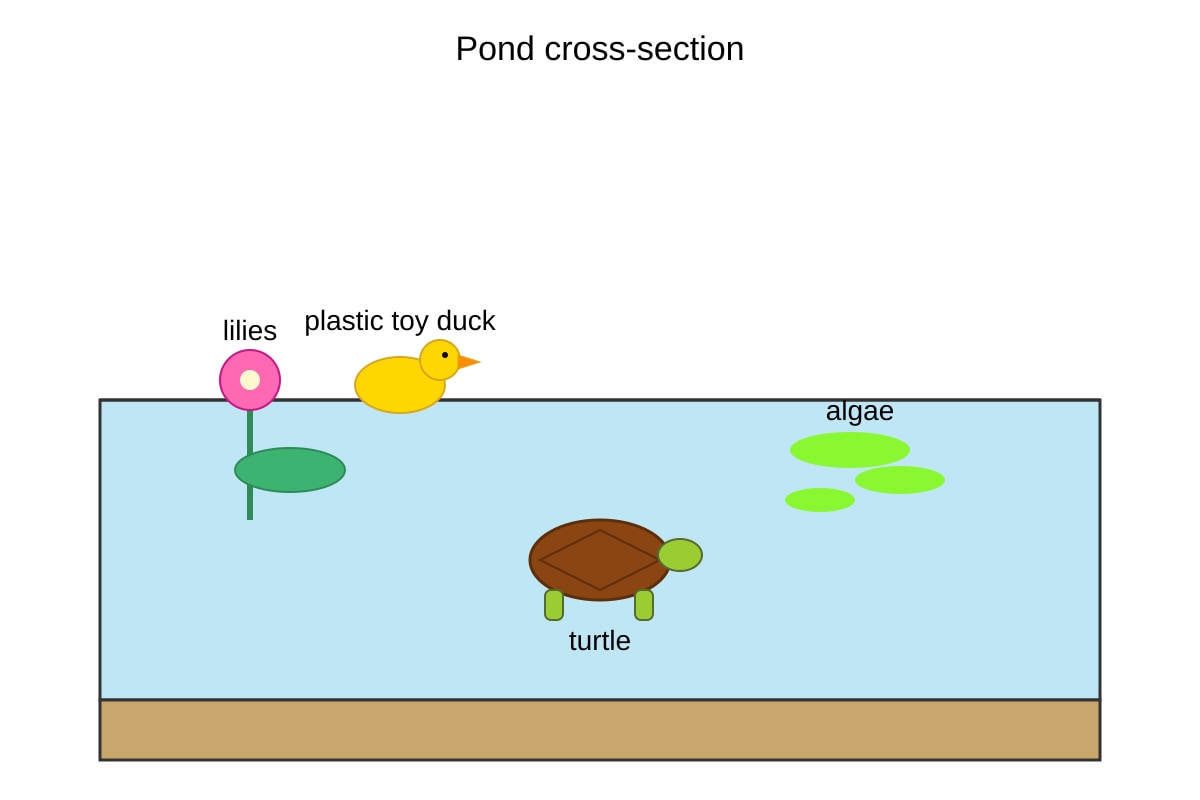
The picture shows a pond with lilies, a turtle, algae, and a plastic toy duck.
Image pending generation: diagram for 20.
(a) List the living things shown. (2 marks)
(b) Why is the plastic toy duck non-living even though it floats? (2 marks)
(c) State two groups of living things found in the pond and one member of each. (3 marks)
End of Paper
Answers
TuitionGoWhere Exam Practice (AI) – Science Primary 5
SA2 Practice Paper (Version 4) – Answer Key
Total Marks: 60
Section A: Multiple Choice (10 marks)
- B (1) – Fern plant is living; others are non-living.
- C (1) – Mushrooms are fungi, not plants/animals.
- B (1) – Not all living things move from place to place (e.g., plants).
- C (1) – Both are made of cells and reproduce; only plants make food via sunlight.
- A (1) – Cotton shirt comes from cotton plant (once living).
- C (1) – Birds lay eggs and have feathers.
- B (1) – Mango tree & mosquito are living; eraser is non-living.
- B (1) – Bacteria are tiny living things, usually microscopic.
- A (1) – Diversity means variety; plant sizes differ.
- B (1) – Grouping helps organise by shared traits.
Section B: Short Answer (12 marks)
- (2) e.g., "It breathes" and "It reproduces". [1 mark each] Teaching: Living things show life processes; cat shows respiration and reproduction.
- (2) e.g., "Plants make their own food using sunlight; animals eat other things." [1 for plant, 1 for animal] Teaching: Plants are producers; animals are consumers.
- (2) Fungus: mushroom/yeast/mould; Bacterium: E. coli / lactobacillus. [1 each]
- (2) "It does not grow, reproduce, or need food; movement is from rider not life processes." [1 movement external, 1 no life processes]
- (2) e.g., Plants and Animals; or Fungi, Bacteria. [1 each]
- (2) Similarity: both are living / made of cells. Difference: snail is animal (moves, eats), sunflower is plant (makes food). [1+1]
Section C: Structured (28 marks)
Q17 (7) (a) Sparrow: living (1); Fern: living (1); Stone: non-living (0 if wrong); Mushroom: living (1). [2 total] (b) Stone (non-living, not alive) and Sparrow (animal, not plant) OR Mushroom (fungus). Accept two non-plant: stone & sparrow or stone & mushroom. Reason: stone never lived; sparrow is animal; mushroom is fungus not plant. [3: 1 id + 2 reason] (c) They are living things / made of cells / reproduce. [2]
Q18 (7) (a) Fungi do not make their own food but plants do. [2] (b) Eagle moves and does not make food, fits animal group. [3: 1 move, 1 no make food, 1 group match] (c) Example: E. coli; Characteristic: tiny, single-celled living thing. [2: 1 ex, 1 char]
Q19 (7) (a) Dead leaf (once living), live goldfish (living). [2] (b) Fungus. [1] (c) Goldfish: breathes, moves, reproduces (living). Wooden spoon: from tree but no life processes now. [4: 2 for goldfish, 2 for spoon]
Q20 (7) (a) Lilies, turtle, algae. [2: 1 each, max 2] (b) It is made by humans, does not grow/reproduce. [2] (c) Plants: lilies; Animals: turtle; (Fungi not shown). [3: 2 groups + 1 member each]
Marking Notes: Deduct if wrong group names. Accept any clear scientific term.
Free quiz and exam paper access
Enter your details to view this paper
Your access is remembered on this device.