TuitionGoWhere Practice Paper - Science Primary 5 (SA2)
TuitionGoWhere Exam Practice (AI)
Subject: Science
Level: Primary 5
Paper: SA2 Practice Paper - Version 4 (Topic Focus: Diversity)
Duration: 60 minutes
Total Marks: 50 marks
Name: ______________________
Class: ______________________
Date: ______________________
Score: ____________ / 50
Instructions to Students
- Answer ALL 20 questions.
- For Section A, write the letter (A, B, C or D) of your chosen option in the brackets provided.
- For Sections B, C and D, write your answers in the spaces provided.
- Marks for each question are shown in brackets. The paper carries a total of 50 marks.
- Check your work before handing in your paper.
Section A: Multiple-Choice Questions (Questions 1–5) — 10 marks
Question 1 (2 marks)
Ravi kept a slice of bread in a sealed plastic bag. After five days, he made four observations about the bread. Which observation shows that the thing growing on the bread is a living thing?
- A It appears white in colour at first.
- B It spreads and becomes larger over several days.
- C It feels soft when touched.
- D It gives off an unpleasant smell.
Answer ( ______ )
Question 2 (2 marks)
Four animals live in water: dolphin, shark, penguin and seahorse. Which two animals are grouped together because both are covered with scales and breathe using gills?
- A dolphin and shark
- B shark and seahorse
- C penguin and dolphin
- D seahorse and penguin
Answer ( ______ )
Question 3 (2 marks)
Ali wants to make a raincoat. Which property makes plastic sheet more suitable than paper for making the raincoat?
- A Plastic is cheaper than paper.
- B Plastic does not absorb water, but paper absorbs water.
- C Plastic is lighter in colour than paper.
- D Plastic tears more easily than paper.
Answer ( ______ )
Question 4 (2 marks)
Hibiscus, orchid and rose are classified into one group, but fern is not placed in this group. What is the reason?
- A Fern does not bear flowers.
- B Fern grows in soil.
- C Fern has green leaves.
- D Fern needs water to survive.
Answer ( ______ )
Question 5 (2 marks)
Which object is made from a material that was once part of a living thing?
- A glass jar
- B steel spoon
- C rubber band
- D plastic bag
Answer ( ______ )
Section B: Short-Answer Questions (Questions 6–10) — 10 marks
Question 6 (2 marks)
Besides being able to move by themselves, state two characteristics that all living things have.
Question 7 (3 marks)
Complete the table below about three animals.
| Animal | Body covering | Reproduction |
|---|
| Dog | (a) ______________ | Live young |
| Eagle | Feathers | (b) ______________ |
| Snake | Dry scales | (c) ______________ |
Question 8 (2 marks)
A remote-control car can move, uses energy from its battery and moves towards the controller when a button is pressed. Give two reasons why the car is not a living thing.
Question 9 (1 mark)
State one property of plastic that makes it suitable for making drinking-water bottles.
Question 10 (2 marks)
Mould is growing on a piece of old bread. Mei says, "Mould is a plant because it grows and has a colour." Is she correct? Explain your answer.
Section C: Data-Based and Structured Questions (Questions 11–15) — 15 marks
Question 11 (2 marks)
Study the classification chart below.
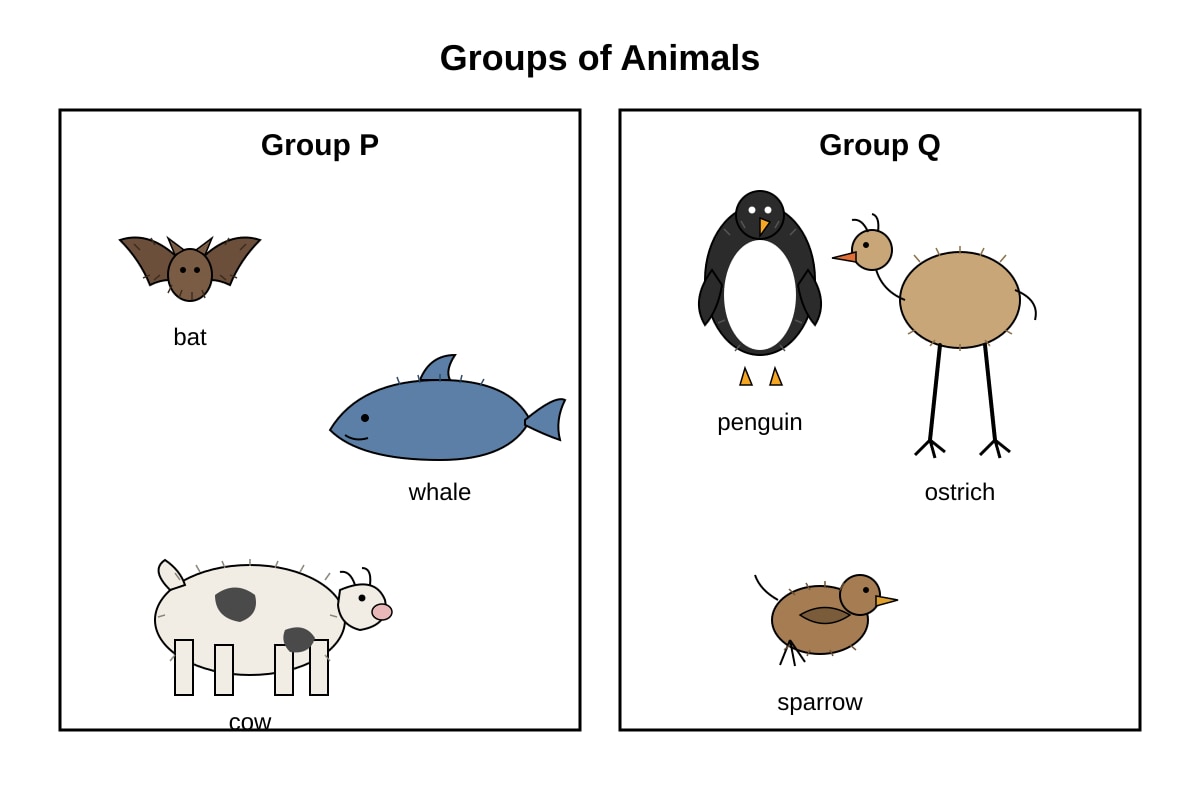
Generated chart for Q11.
Based on the chart, state one characteristic that all the animals in Group P share.
Question 12 (3 marks)
Complete the classification table by filling in blanks (a), (b) and (c).
| Organism | Does it bear flowers? | How it reproduces | Group it belongs to |
|---|
| Hibiscus | Yes | Seeds formed in fruits | Flowering plant |
| Fern | No | (a) ______________ | Non-flowering plant |
| Mushroom | No | (b) ______________ | (c) ______________ |
Question 13 (3 marks)
Sita tested four strips of different materials. Each strip was of the same size and thickness. She hung the same weight at the end of each strip and recorded her observations.
| Material | Observation when the weight was hung |
|---|
| Metal strip | Bent slightly |
| Wooden strip | Did not bend |
| Plastic strip | Bent a lot and returned to shape |
| Glass strip | Broke |
(a) Which material is the most flexible? (1 mark)
(b) Which material is the least flexible? (1 mark)
(c) Sita wants to make a phone case that can bend without breaking. Using the results, which material should she choose? Explain your choice. (1 mark)
Question 14 (3 marks)
A fish and a dolphin both live in the sea, but scientists classify them into different groups.
(a) Give two differences that scientists use to classify the fish and the dolphin into different groups. (2 marks)
Difference 1: _____________________________________________________
Difference 2: _____________________________________________________
(b) Name the group that the dolphin belongs to. (1 mark)
Question 15 (4 marks)
Ben sorted six objects into two groups, but he hid the group headings.
| Group X | Group Y |
|---|
| Sponge | Metal spoon |
| Tissue paper | Glass tile |
| Cloth | Plastic sheet |
He dipped one object from each group into water and observed what happened.
(a) Based on his observation, suggest a suitable heading for Group X. (1 mark)
(b) Suggest a suitable heading for Group Y. (1 mark)
(c) Ben adds a piece of rubber boot. Into which group should he place it? Explain your answer. (1 mark)
(d) Suggest one other property that Ben could use to sort the same six objects into two different groups. Give an example of objects that would go into each group. (1 mark)
Section D: Open-Ended Application Questions (Questions 16–20) — 15 marks
Question 16 (3 marks)
During a nature walk, pupils observed four organisms: grass, moss, fern and mushroom. Classify the four organisms into three groups and state one reason for each group.
| Group | Organisms | Reason |
|---|
| Group 1 | ____________ | ____________ |
| Group 2 | ____________ | ____________ |
| Group 3 | ____________ | ____________ |
Question 17 (4 marks)
Mei is choosing a material to make her new school bag. She must carry many heavy books and walks to school in the rain. She collected information about three materials.
| Material | Strength | Flexibility | Weight | Absorbs water? |
|---|
| Canvas | Strong | Flexible | Light | Yes |
| Leather | Very strong | Stiff | Heavy | Partly |
| Nylon fabric | Strong | Very flexible | Very light | No |
Which material is the most suitable for Mei's school bag? Explain your answer using two pieces of information from the table.
Question 18 (3 marks)
A pot plant was placed beside a classroom window. After two weeks
<stage3_exam_md>
TuitionGoWhere Practice Paper - Science Primary 5 (SA2)
TuitionGoWhere Exam Practice (AI)
Subject: Science
Level: Primary 5
Paper: SA2 Practice Paper - Version 4 (Topic Focus: Diversity)
Duration: 60 minutes
Total Marks: 50 marks
Name: ______________________
Class: ______________________
Date: ______________________
Score: ____________ / 50
Instructions to Students
- Answer ALL 20 questions.
- For Section A, write the letter (A, B, C or D) of your chosen option in the brackets provided.
- For Sections B, C and D, write your answers in the spaces provided.
- Marks for each question are shown in brackets. The paper carries a total of 50 marks.
- Check your work before handing in your paper.
Section A: Multiple-Choice Questions (Questions 1–5) — 10 marks
Question 1 (2 marks)
Ravi kept a slice of bread in a sealed plastic bag. After five days, he made four observations about the bread. Which observation shows that the thing growing on the bread is a living thing?
- A It appears white in colour at first.
- B It spreads and becomes larger over several days.
- C It feels soft when touched.
- D It gives off an unpleasant smell.
Answer ( ______ )
Question 2 (2 marks)
Four animals live in water: dolphin, shark, penguin and seahorse. Which two animals are grouped together because both are covered with scales and breathe using gills?
- A dolphin and shark
- B shark and seahorse
- C penguin and dolphin
- D seahorse and penguin
Answer ( ______ )
Question 3 (2 marks)
Ali wants to make a raincoat. Which property makes plastic sheet more suitable than paper for making the raincoat?
- A Plastic is cheaper than paper.
- B Plastic does not absorb water, but paper absorbs water.
- C Plastic is lighter in colour than paper.
- D Plastic tears more easily than paper.
Answer ( ______ )
Question 4 (2 marks)
Hibiscus, orchid and rose are classified into one group, but fern is not placed in this group. What is the reason?
- A Fern does not bear flowers.
- B Fern grows in soil.
- C Fern has green leaves.
- D Fern needs water to survive.
Answer ( ______ )
Question 5 (2 marks)
Which object is made from a material that was once part of a living thing?
- A glass jar
- B steel spoon
- C rubber band
- D plastic bag
Answer ( ______ )
Section B: Short-Answer Questions (Questions 6–10) — 10 marks
Question 6 (2 marks)
Besides being able to move by themselves, state two characteristics that all living things have.
Question 7 (3 marks)
Complete the table below about three animals.
| Animal | Body covering | Reproduction |
|---|
| Dog | (a) ______________ | Live young |
| Eagle | Feathers | (b) ______________ |
| Snake | Dry scales | (c) ______________ |
Question 8 (2 marks)
A remote-control car can move, uses energy from its battery and moves towards the controller when a button is pressed. Give two reasons why the car is not a living thing.
Question 9 (1 mark)
State one property of plastic that makes it suitable for making drinking-water bottles.
Question 10 (2 marks)
Mould is growing on a piece of old bread. Mei says, "Mould is a plant because it grows and has a colour." Is she correct? Explain your answer.
Section C: Data-Based and Structured Questions (Questions 11–15) — 15 marks
Question 11 (2 marks)
Study the classification chart below.
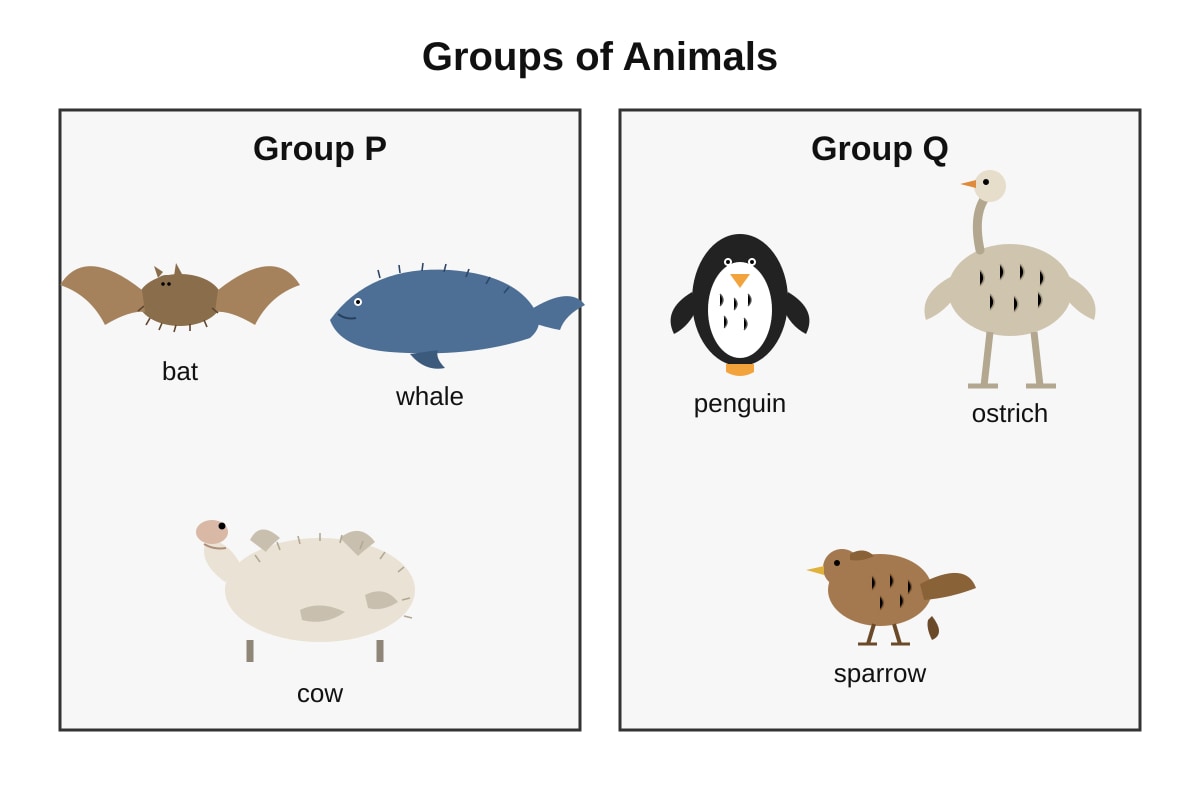
Generated chart for Q11.
Based on the chart, state one characteristic that all the animals in Group P share.
Question 12 (3 marks)
Complete the classification table by filling in blanks (a), (b) and (c).
| Organism | Does it bear flowers? | How it reproduces | Group it belongs to |
|---|
| Hibiscus | Yes | Seeds formed in fruits | Flowering plant |
| Fern | No | (a) ______________ | Non-flowering plant |
| Mushroom | No | (b) ______________ | (c) ______________ |
Question 13 (3 marks)
Sita tested four strips of different materials. Each strip was of the same size and thickness. She hung the same weight at the end of each strip and recorded her observations.
| Material | Observation when the weight was hung |
|---|
| Metal strip | Bent slightly |
| Wooden strip | Did not bend |
| Plastic strip | Bent a lot and returned to shape |
| Glass strip | Broke |
(a) Which material is the most flexible? (1 mark)
(b) Which material is the least flexible? (1 mark)
(c) Sita wants to make a phone case that can bend without breaking. Using the results, which material should she choose? Explain your choice. (1 mark)
Question 14 (3 marks)
A fish and a dolphin both live in the sea, but scientists classify them into different groups.
(a) Give two differences that scientists use to classify the fish and the dolphin into different groups. (2 marks)
Difference 1: _____________________________________________________
Difference 2: _____________________________________________________
(b) Name the group that the dolphin belongs to. (1 mark)
Question 15 (4 marks)
Ben sorted six objects into two groups, but he hid the group headings.
| Group X | Group Y |
|---|
| Sponge | Metal spoon |
| Tissue paper | Glass tile |
| Cloth | Plastic sheet |
He dipped one object from each group into water and observed what happened.
(a) Based on his observation, suggest a suitable heading for Group X. (1 mark)
(b) Suggest a suitable heading for Group Y. (1 mark)
(c) Ben adds a piece of rubber boot. Into which group should he place it? Explain your answer. (1 mark)
(d) Suggest one other property that Ben could use to sort the same six objects into two different groups. Give an example of objects that would go into each group. (1 mark)
Section D: Open-Ended Application Questions (Questions 16–20) — 15 marks
Question 16 (3 marks)
During a nature walk, pupils observed four organisms: grass, moss, fern and mushroom. Classify the four organisms into three groups and state one reason for each group.
| Group | Organisms | Reason |
|---|
| Group 1 | ____________ | ____________ |
| Group 2 | ____________ | ____________ |
| Group 3 | ____________ | ____________ |
Question 17 (4 marks)
Mei is choosing a material to make her new school bag. She must carry many heavy books and walks to school in the rain. She collected information about three materials.
| Material | Strength | Flexibility | Weight | Absorbs water? |
|---|
| Canvas | Strong | Flexible | Light | Yes |
| Leather | Very strong | Stiff | Heavy | Partly |
| Nylon fabric | Strong | Very flexible | Very light | No |
Which material is the most suitable for Mei's school bag? Explain your answer using two pieces of information from the table.
Question 18 (3 marks)
A pot plant was placed beside a classroom window. After two weeks, Mei noticed that the plant had grown taller and its leaves were turned towards the window.
(a) State two observations that show the pot plant is a living thing. (2 marks)
Observation 1: ____________________________________________________
Observation 2: ____________________________________________________
(b) In the third week, Mei forgot to water the plant and it wilted. Explain why watering is important for the plant. (1 mark)
Question 19 (2 marks)
Aminah found four things: a robot toy, some mould, a wooden stool and a fern. Which two things are living? Give one reason for your answer.
Question 20 (3 marks)
Mr Tan wants to choose a material to make umbrellas. He tested three materials and recorded his results.
| Material | Absorbs water? | Flexibility | Strength |
|---|
| Paper | Yes | Stiff | Tears easily |
| Cotton cloth | Yes | Very flexible | Strong |
| Plastic-coated fabric | No | Very flexible | Strong |
Which material is the most suitable for making umbrellas? Explain your answer using two properties from the table.
— END OF PAPER —