From Real Exams Exam Paper
Primary 5 Science Semestral Assessment 2 (End of Year) Paper 3
Free P5 Science SA2 Paper 3, Nemo3 Exam version, with questions, answers, and syllabus-aligned practice for Singapore students.
These static practice materials are generated from the site's syllabus and paper-generation workflow, with source and model context shown so students and parents can evaluate the material before use.
Questions



Free quiz and exam paper access
Enter your details to view this paper
Your access is remembered on this device.
Answers
TuitionGoWhere Practice Paper - Science Primary 5 (SA2 Version 3) - Answer Key
Total Marks: 100
Section A: Multiple-Choice Questions (56 marks)
1. (1) Ovary
Explanation: After fertilisation, the ovary develops into the fruit. The ovule develops into the seed. The stigma receives pollen, and the anther produces pollen.
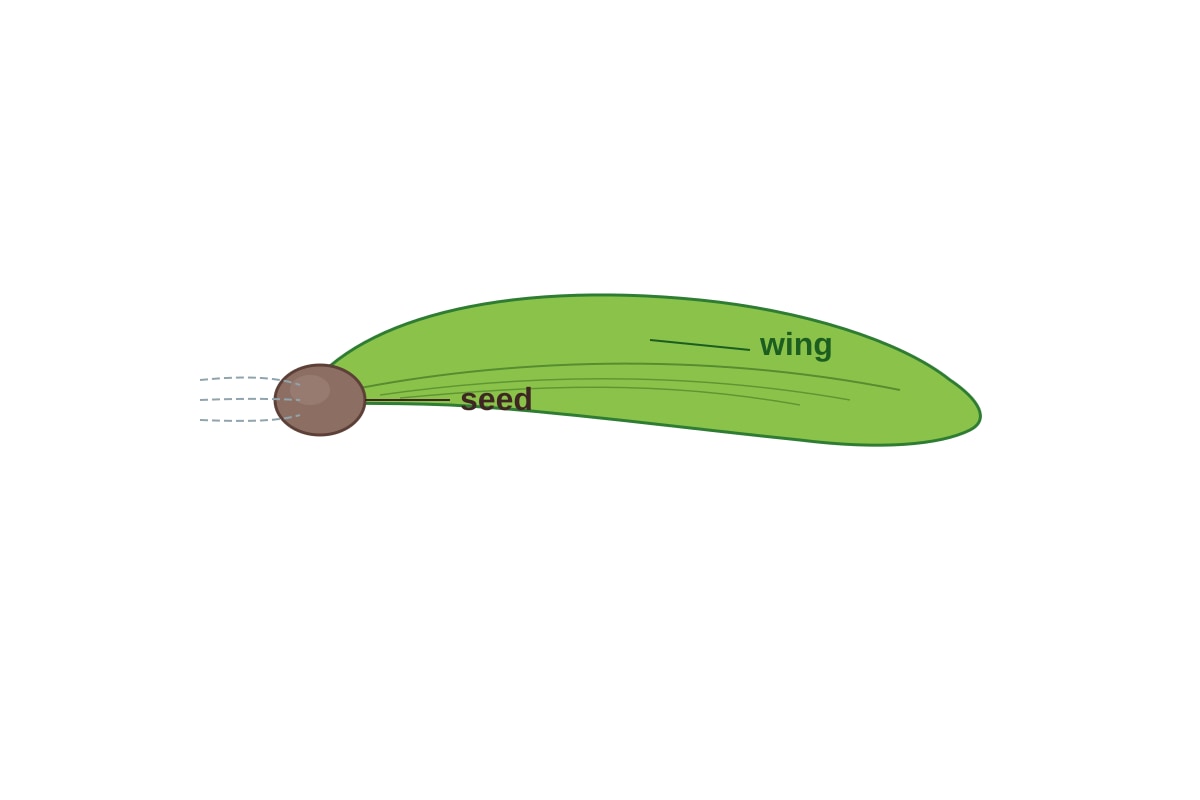
2. (1) W
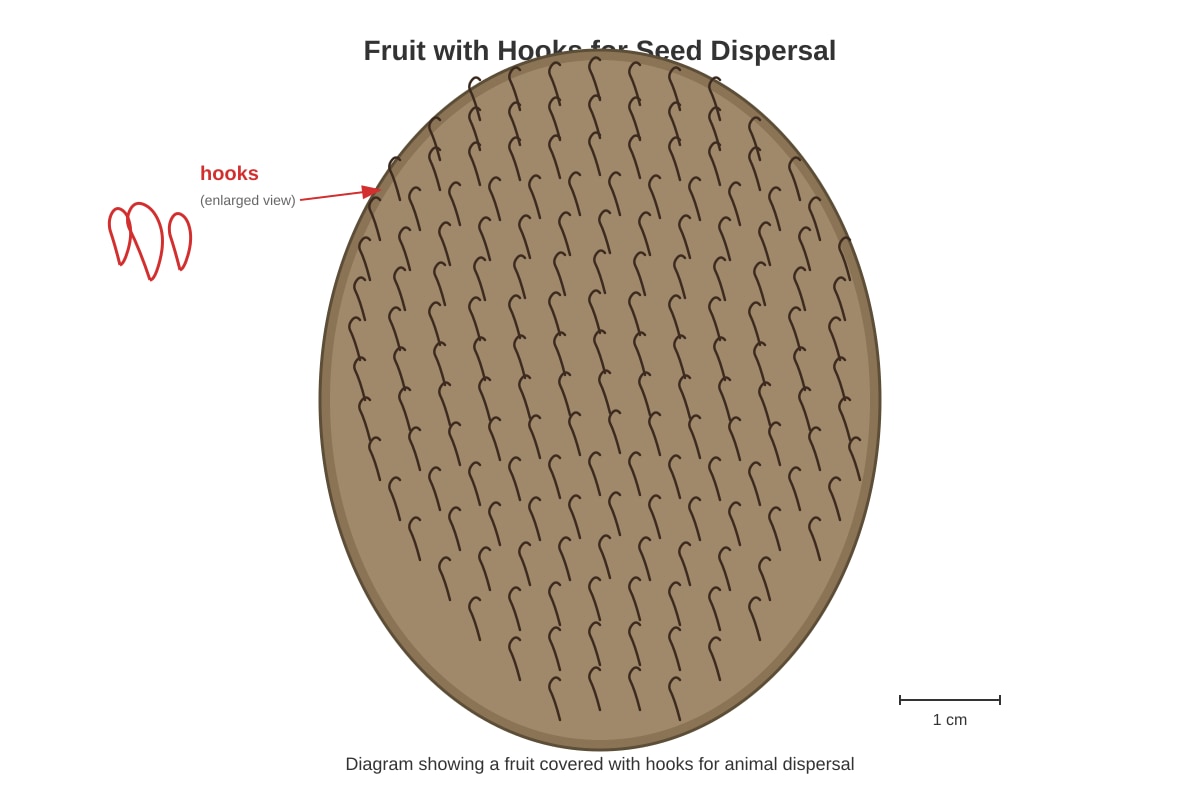
Explanation: Fruits dispersed by wind are typically light and have wing-like structures (e.g., maple, angsana) or parachute-like hairs (e.g., dandelion). Fruit W has a wing-like structure. Fruit X (fibrous husk) is dispersed by water. Fruit Y (fleshy) is dispersed by animals eating it. Fruit Z (hooks) is dispersed by animals carrying it on fur.
3. (2) Fallopian tube
Explanation: Fertilisation in humans usually occurs in the fallopian tube (oviduct), where the sperm meets the egg. The fertilised egg then travels to the uterus for implantation and development.
4. (3) The ovule develops into the seed after fertilisation.
Explanation:
- (1) is incorrect: Pollination occurs before fertilisation.
- (2) is incorrect: The pollen grain contains the male reproductive cell.
- (4) is incorrect: The anther produces pollen grains; the stigma receives them.
5. (3) Sunlight
Explanation: Germination requires water (to activate enzymes), oxygen (for respiration), and suitable temperature (for enzyme activity). Sunlight is not needed for germination; it is needed for photosynthesis after the seedling emerges.
6. (2) B only
Explanation: Flowering plants reproduce by seeds and have flowers. Organism B has both characteristics. Organism A reproduces by spores (e.g., ferns, mosses, fungi). Organism C reproduces by seeds but has no flowers (e.g., conifers/gymnosperms).
7. (3) Ovary – egg
Explanation: The ovary produces eggs (female reproductive cells). The testis produces sperm (male reproductive cells). Ovules are in plants; sperm is male.
8. (3) Anther
Explanation: The anther is part of the stamen (male reproductive part) and produces pollen grains, which contain the male reproductive cells. The stigma receives pollen, the ovule contains the female reproductive cell, and the ovary contains ovules.
9. (2) Ferns
Explanation: Ferns are non-flowering plants that reproduce by spores. Mosses also reproduce by spores but are non-vascular. Fungi are not plants. Algae are simple plant-like organisms.
10. (2) Fertilisation
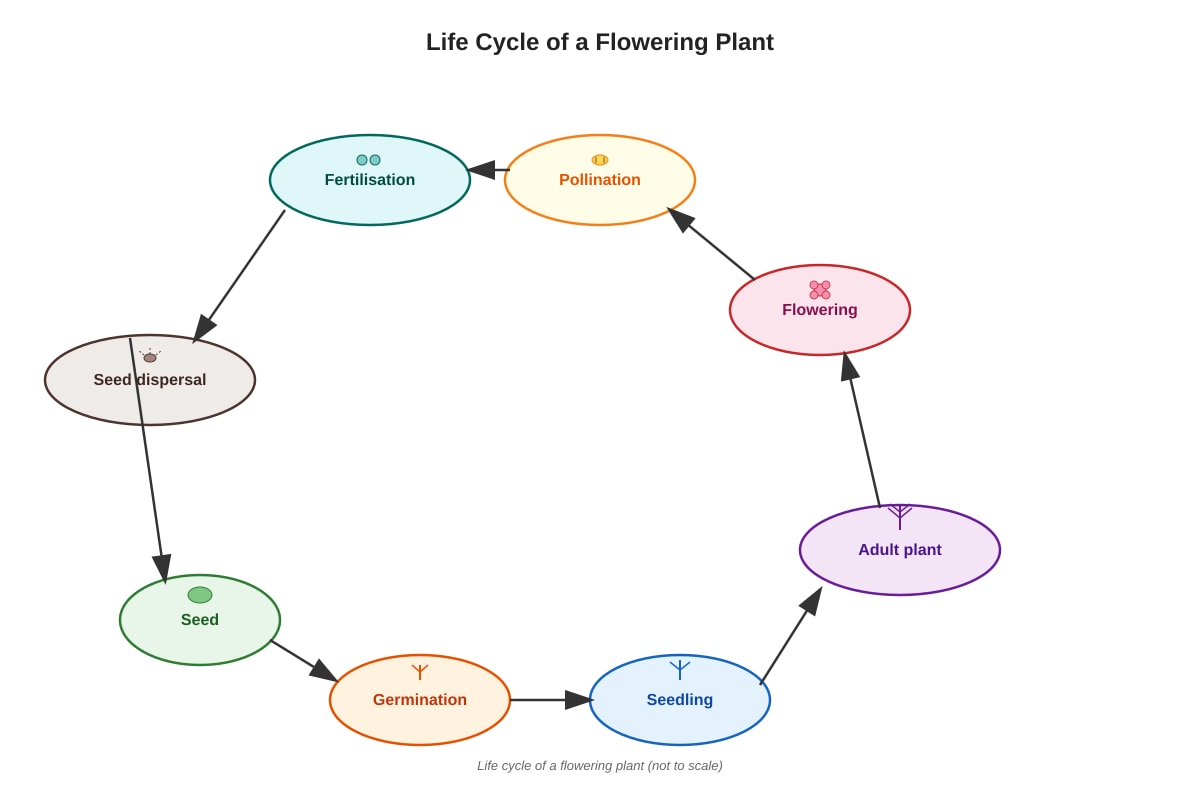
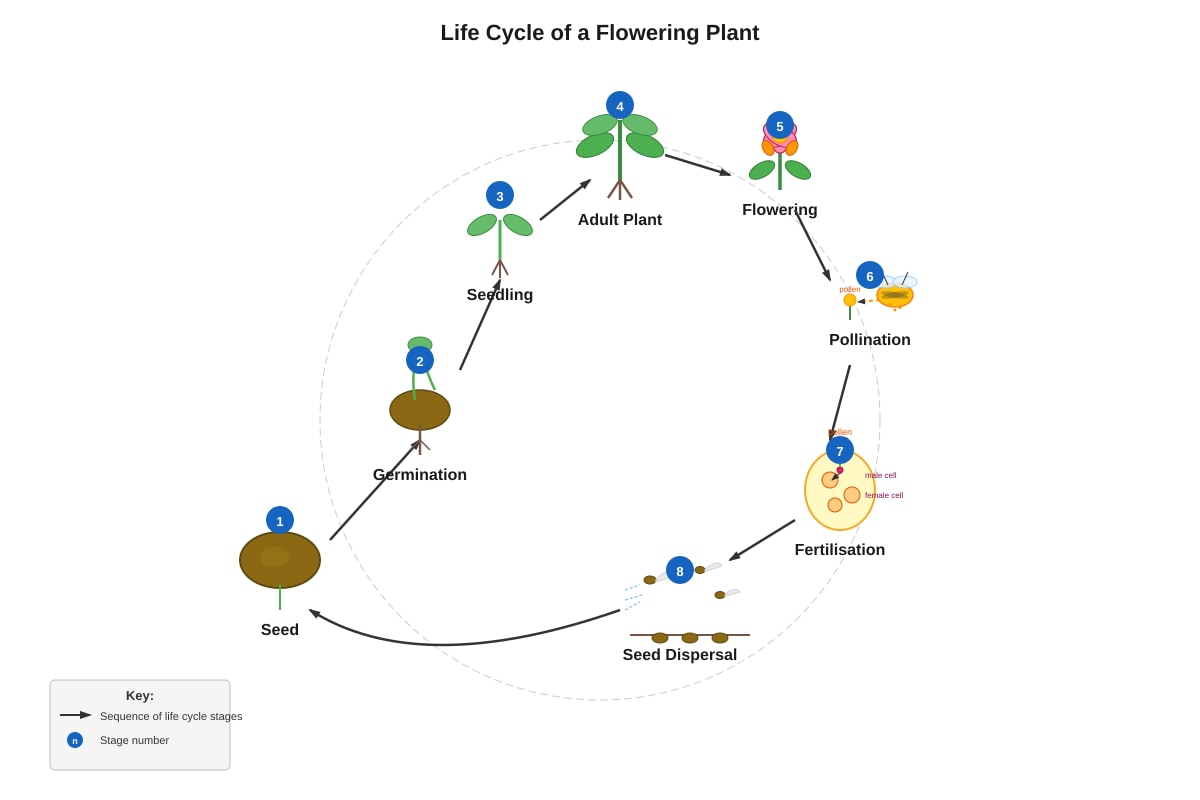
Explanation: The life cycle order is: Pollination → Fertilisation → Seed development → Seed dispersal → Germination. Fertilisation occurs immediately after pollination when the pollen tube reaches the ovule.
11. (2) Stores food for the embryo
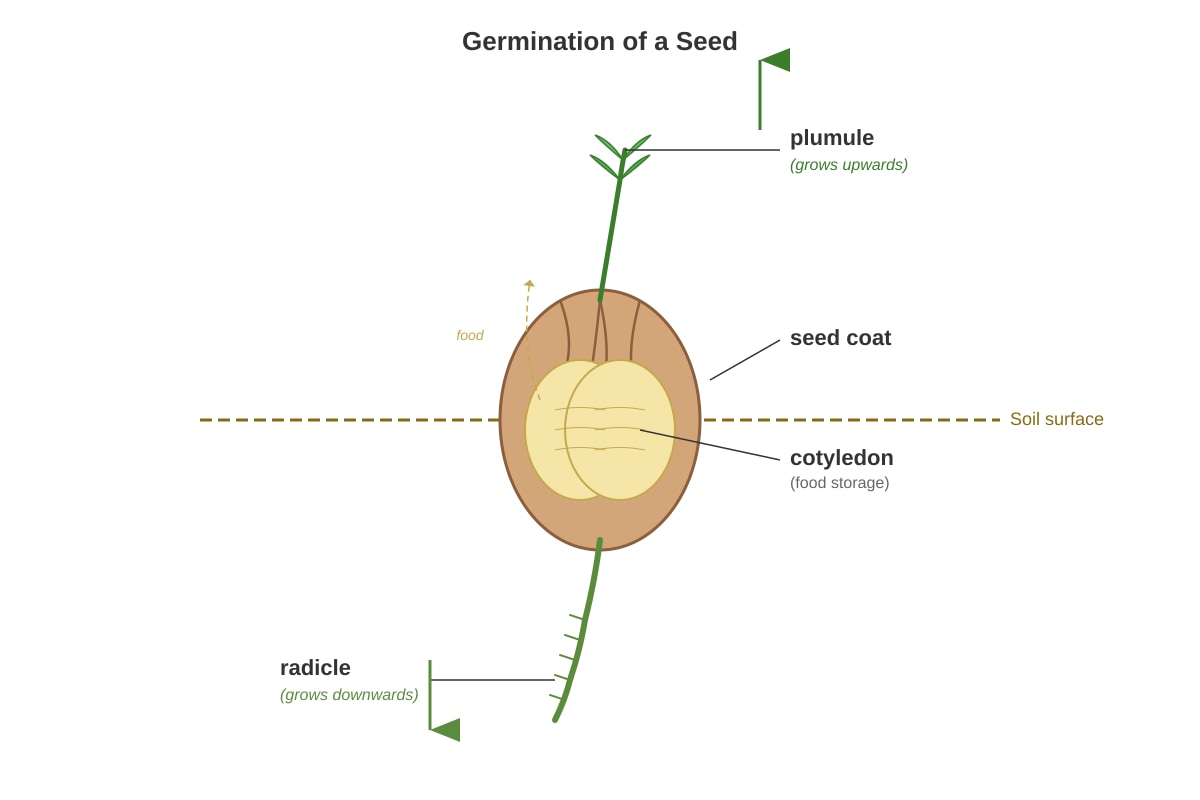
Explanation: The cotyledon (seed leaf) stores food (starch, proteins, oils) for the developing embryo during germination. The seed coat protects the embryo. The radicle develops into the root.
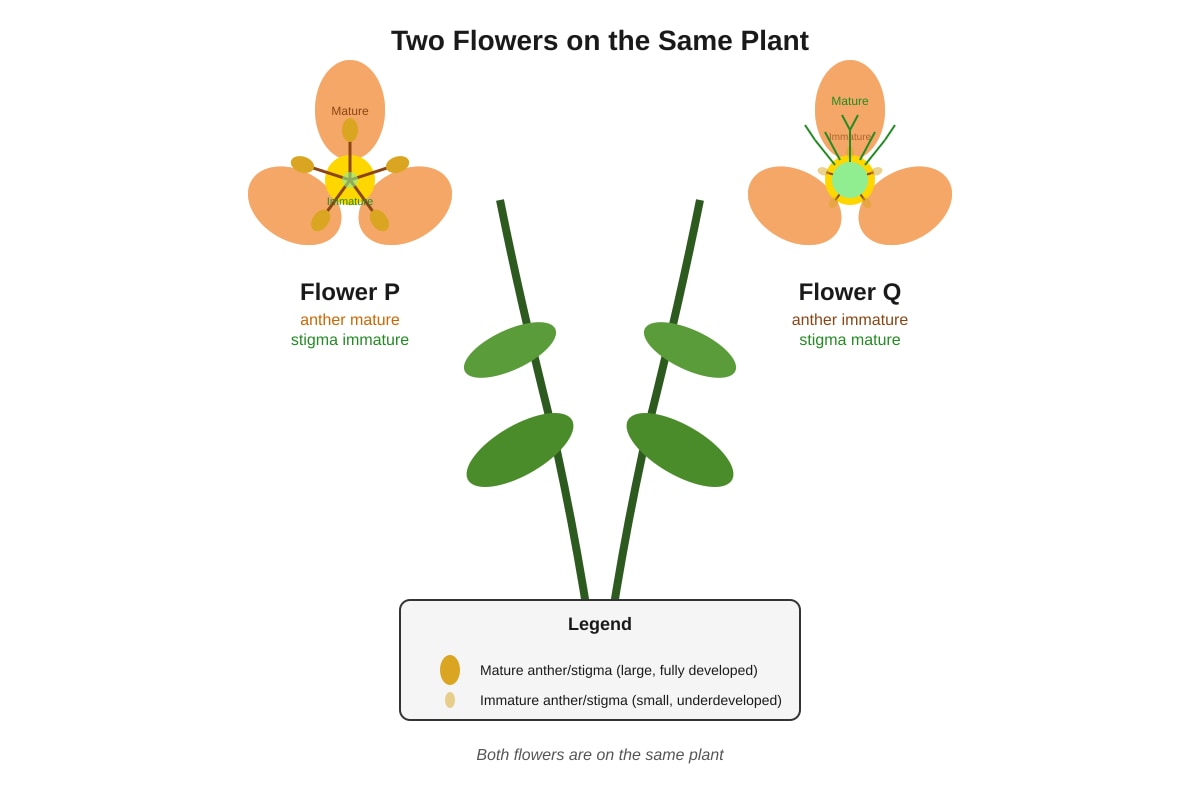
12. (2) It increases the chance of cross-pollination.
Explanation: When anther and stigma mature at different times (dichogamy), it prevents self-pollination and promotes cross-pollination (transfer of pollen between different plants), which increases genetic diversity.
13. (3) Uterus
Explanation: After fertilisation in the fallopian tube, the fertilised egg (zygote) travels to the uterus, implants in the uterine lining, and develops into an embryo and then a foetus.
14. (1) By wind
Explanation: Fruits with wing-like structures (samaras) are adapted for wind dispersal. The wing causes the fruit to spin/glide, carrying it away from the parent plant.
15. (3) Yeast is a type of fungus.
Explanation:
- (1) is incorrect: Many microorganisms are beneficial (e.g., yeast in bread, bacteria in yoghurt, decomposers).
- (2) is incorrect: Bacteria reproduce by binary fission, not spores (though some form endospores for survival).
- (4) is incorrect: Viruses need a host cell to reproduce; they cannot reproduce on their own.
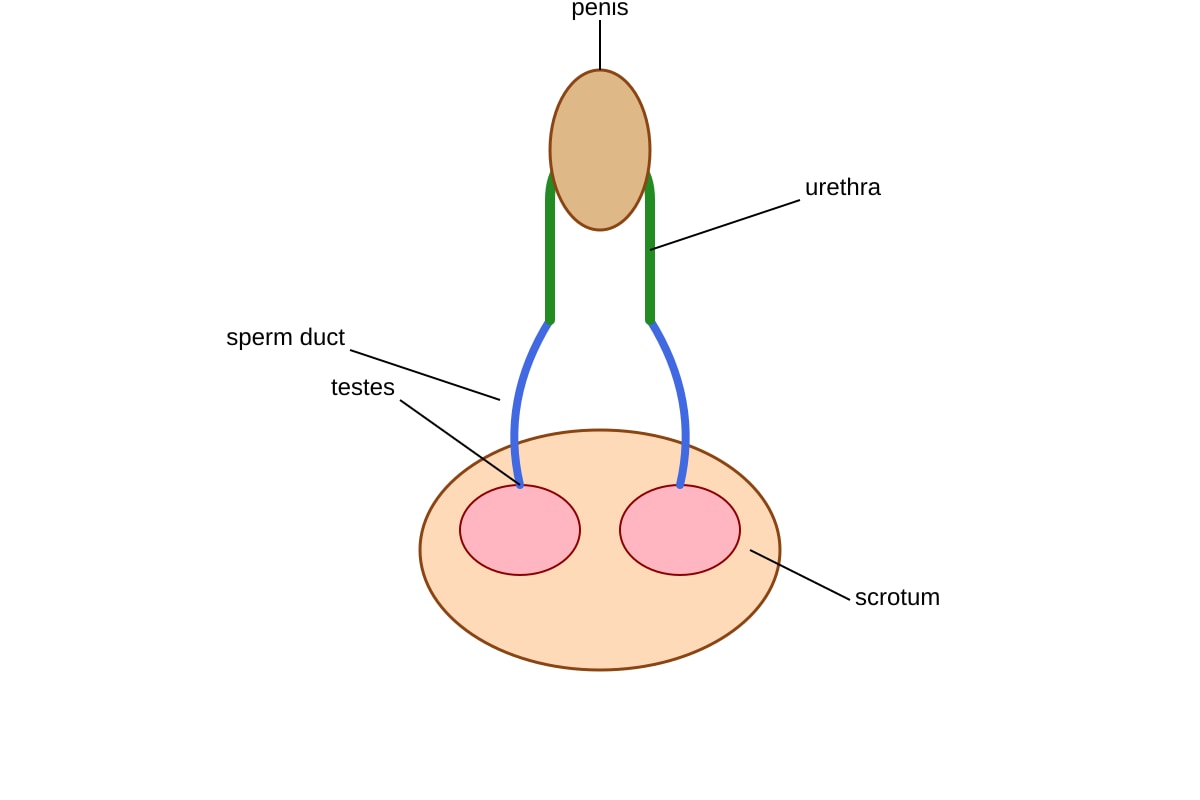
16. (3) Holds the testes outside the body to keep them cooler
Explanation: The scrotum holds the testes outside the body cavity at a temperature about 2–3°C lower than body temperature, which is necessary for sperm production. The testes produce sperm; the sperm duct carries sperm; testosterone is produced by the testes.
17. (3) Mould spores
Explanation: The black patches on bread are mould (a fungus) growing and producing spores. Mould spores are airborne and land on food, growing into visible colonies under warm, moist conditions.
18. (3) Movement from place to place
Explanation: All living things reproduce, grow, and respond to changes. However, not all living things move from place to place (e.g., plants are living but do not move from place to place; they move parts like leaves/flowers).
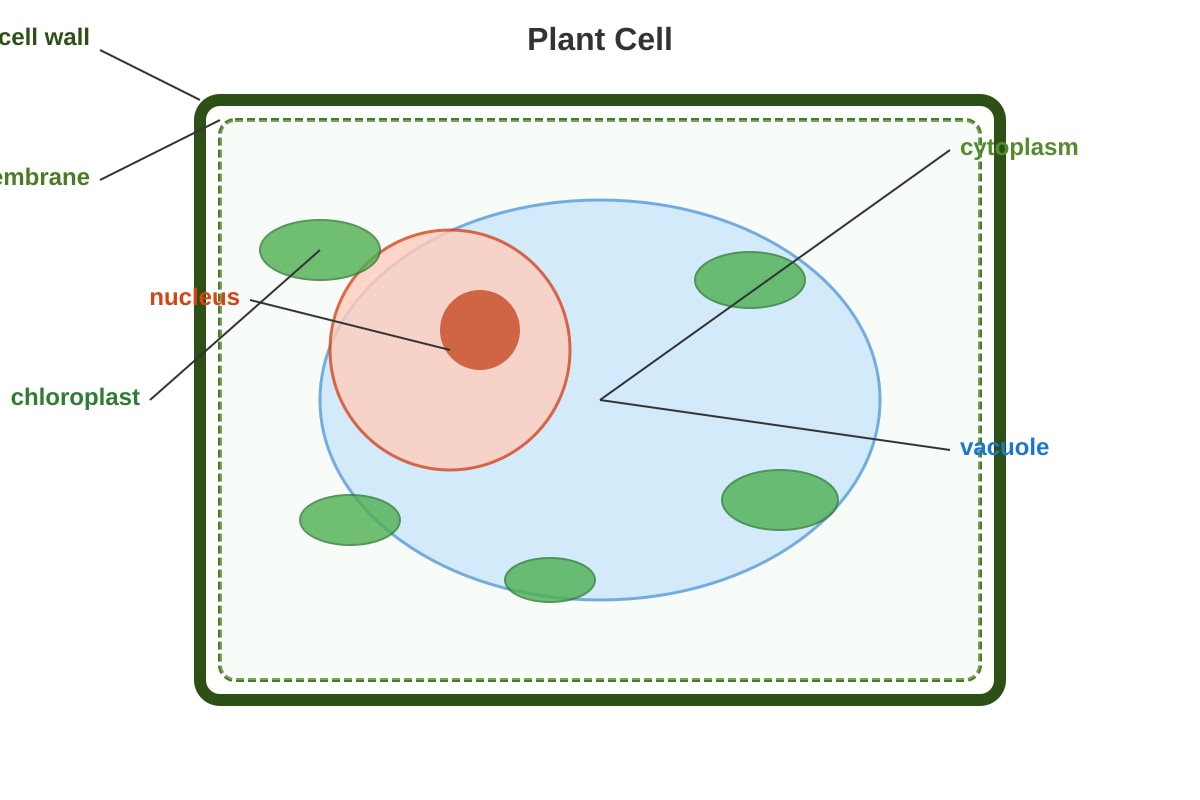
19. (3) Nucleus
Explanation: The nucleus contains genetic material (DNA) and controls all cell activities. The cell wall provides support (plants only). Cytoplasm is where chemical reactions occur. The vacuole stores substances.
20. (2) Q
Explanation: Ferns are non-flowering plants that reproduce by spores and do not make their own food (wait—ferns DO make their own food via photosynthesis and have chlorophyll). Let me re-check: Ferns are vascular plants that reproduce by spores, have chlorophyll, and make their own food. So R (Yes, Yes, Yes) fits ferns. Q (No, Yes, No) fits fungi (mould/yeast). P (Yes, No, Yes) fits flowering plants. S (No, No, No) fits animals. Correction: The correct answer is (3) R. Ferns make their own food (photosynthesis), reproduce by spores, and have chlorophyll.
21. (1) sperm, egg
Explanation: In human fertilisation, the sperm (male reproductive cell) fuses with the egg (female reproductive cell). Options (3) and (4) refer to plant reproduction (pollen and ovule).
22. (2) It is searching for light and cannot make chlorophyll without light.
Explanation: The seedling in the dark grows tall and thin (etiolation) as it tries to reach light. Without light, chlorophyll cannot be produced, so it appears pale yellow. It is not growing faster; it is growing weakly.
23. (1) Egg → Larva → Pupa → Adult
Explanation: Mosquitoes undergo complete metamorphosis: egg hatches into larva (wriggler), larva becomes pupa (tumbler), pupa emerges as adult mosquito.
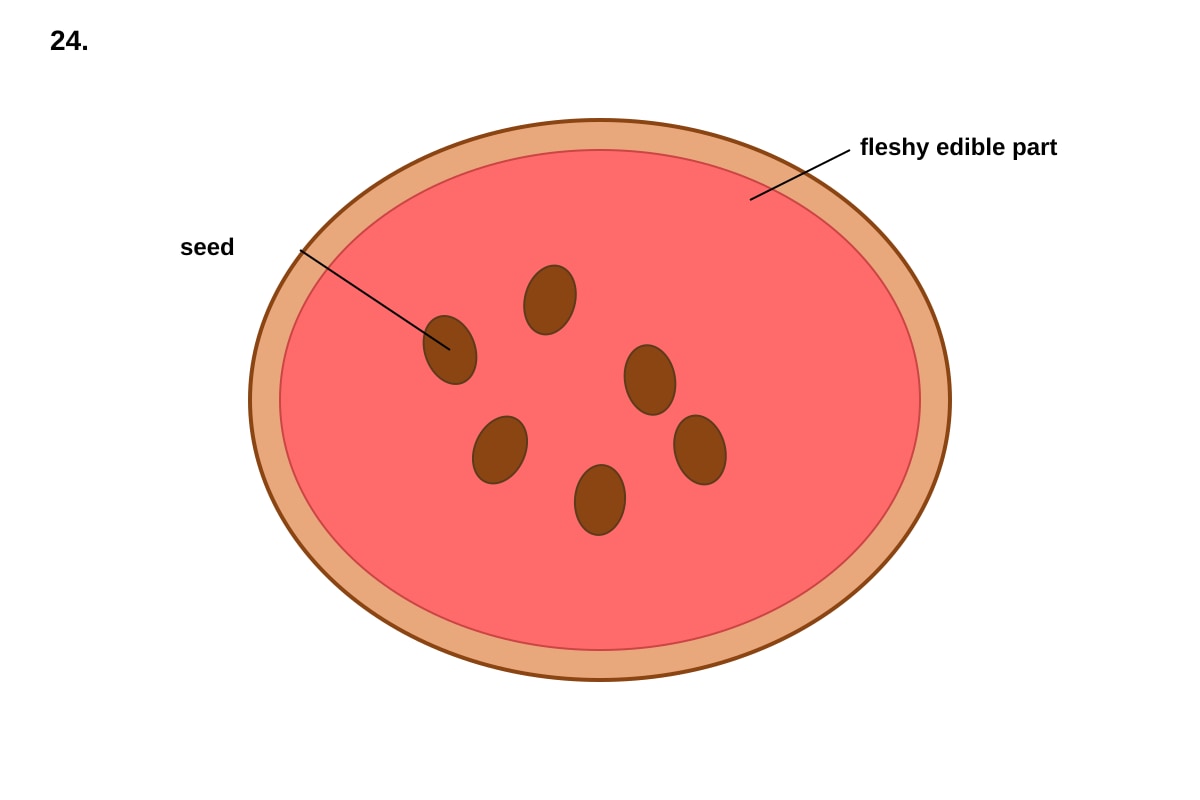
24. (3) By animals eating the fruit
Explanation: Fruits with fleshy edible parts and hard seeds inside (e.g., papaya, watermelon, mango) are adapted for animal dispersal. Animals eat the fruit, seeds pass through the digestive tract unharmed, and are deposited elsewhere in faeces.
25. (2) anther, stigma
Explanation: Pollination is the transfer of pollen grains from the anther (male part) to the stigma (female part) of a flower.
26. (2) Bacteria
Explanation: Bacteria reproduce asexually by binary fission (splitting into two). Yeast reproduces by budding. Mould reproduces by spores. Ferns reproduce by spores.
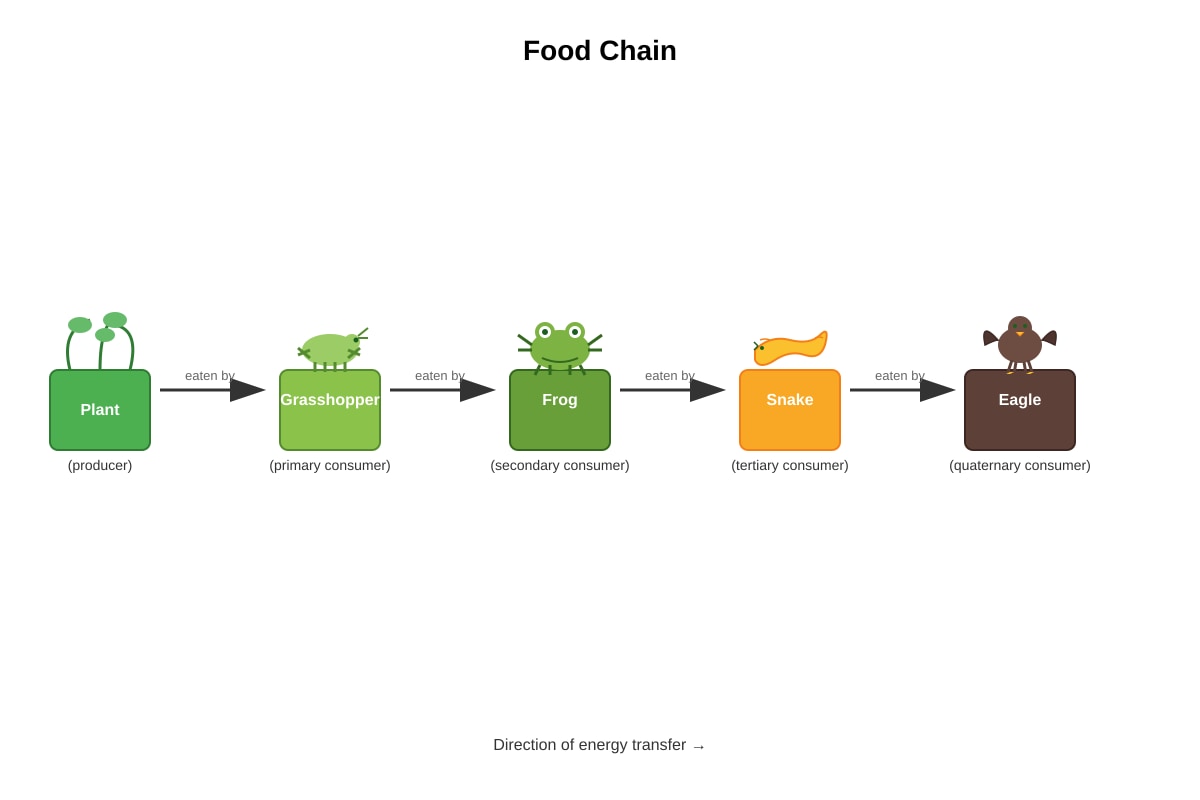
27. (3) Plant
Explanation: Producers (plants) make their own food through photosynthesis and form the base of the food chain. All other organisms are consumers.
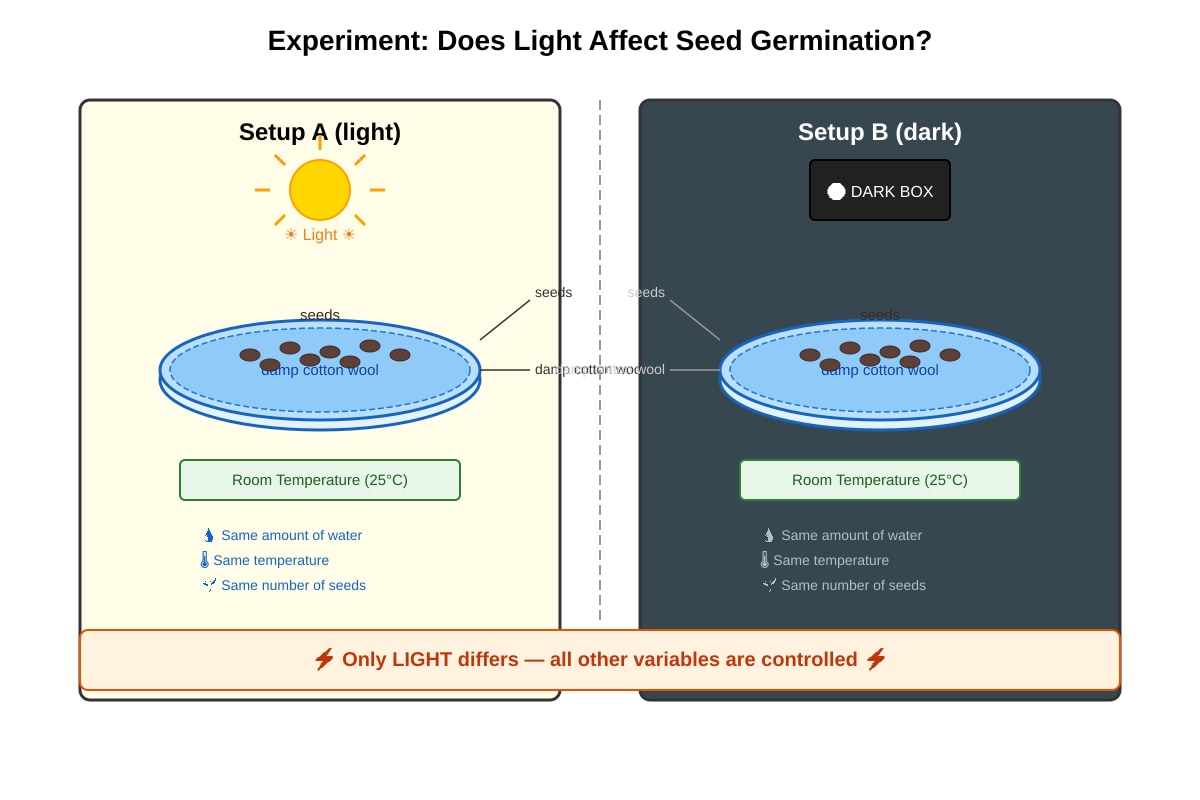
28. (3) Presence of light
Explanation: The independent variable is the one that is changed. In this experiment, Setup A has light, Setup B has no light. All other variables (water, temperature, seeds) are kept the same (controlled variables).
Section B: Open-Ended Questions (44 marks)
29.
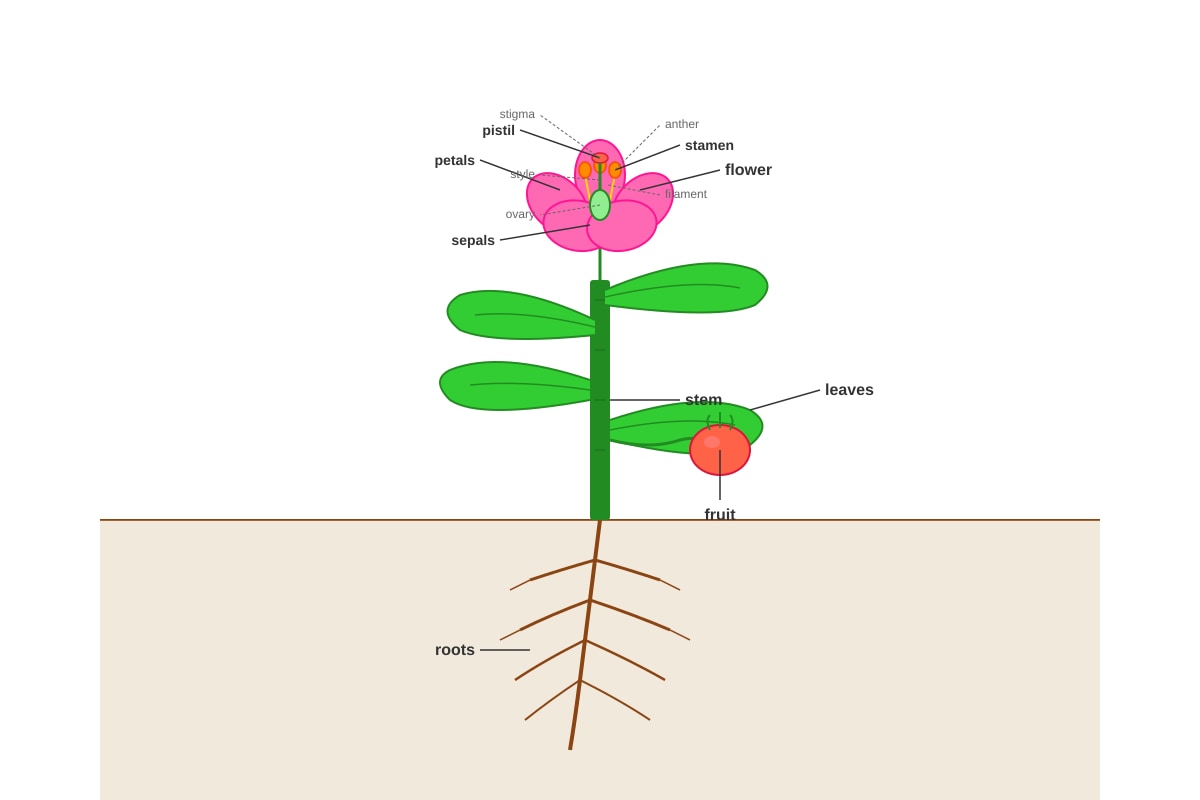
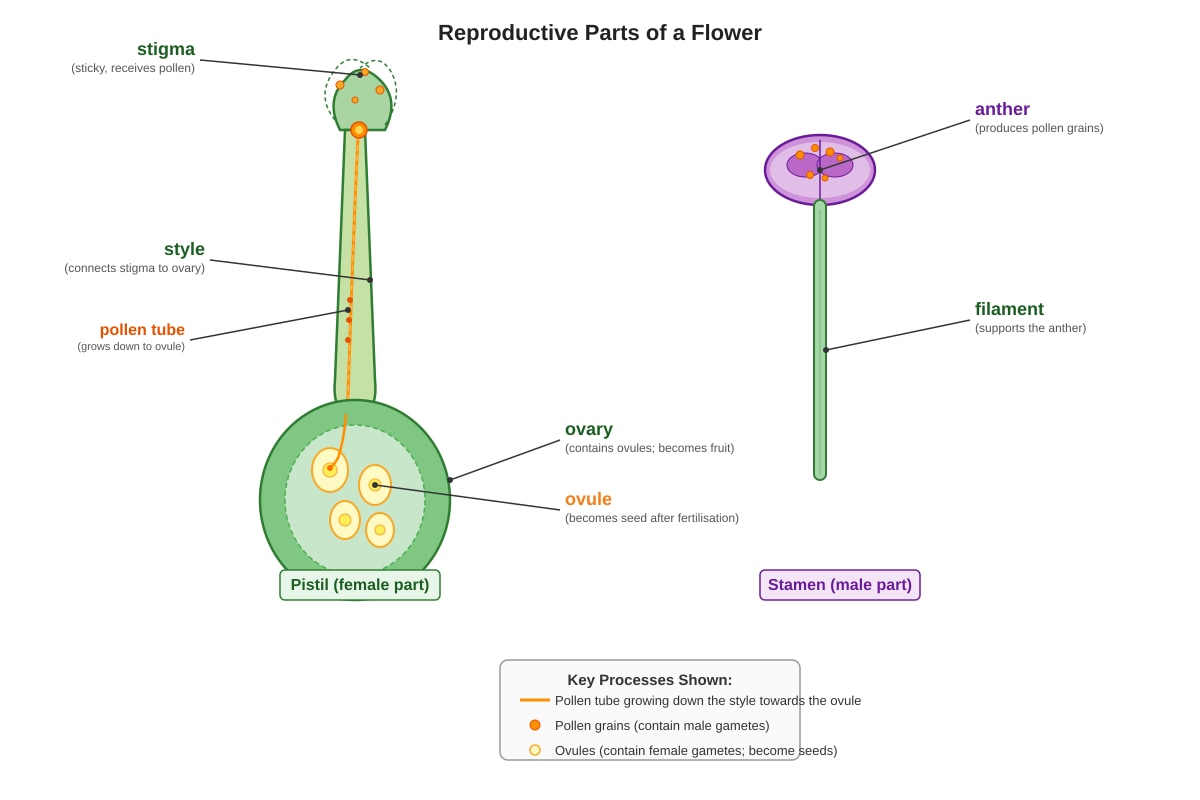
(a) Stigma [1] Explanation: The sticky top part of the pistil is the stigma. Its function is to receive pollen grains during pollination.
(b) Ovary [1] Explanation: The swollen base of the pistil is the ovary. It contains ovules (female reproductive cells) and develops into the fruit after fertilisation.
(c) The male reproductive cell in the pollen grain travels down the pollen tube and fuses with the female reproductive cell in the ovule. [2] Mark breakdown:
- 1 mark: Male reproductive cell travels down pollen tube
- 1 mark: Fuses with female reproductive cell in ovule Explanation: After pollination, the pollen grain germinates and grows a pollen tube down the style. The male reproductive cell moves down the tube to the ovule, where it fuses with the female reproductive cell (egg) — this is fertilisation.
(d) seed, fruit [1] Explanation: After fertilisation: ovule → seed; ovary → fruit. The seed contains the embryo and food store; the fruit protects the seeds and aids dispersal.
30.
(a) Water [1] Explanation: Fruits with fibrous husks that are waterproof (e.g., coconut) are adapted for water dispersal. The fibrous husk traps air, making the fruit buoyant.
(b) Being light allows the fruit/seed to be easily carried by wind over long distances. [1] Explanation: Wind dispersal requires the fruit/seed to be airborne. Light structures (wings, parachutes) increase air resistance and keep the seed aloft longer, allowing wind to carry it further from the parent plant.
(c) The hooks catch onto the fur of passing animals. The fruit is carried away and eventually falls off or is groomed off, dispersing the seeds away from the parent plant. [2] Mark breakdown:
- 1 mark: Hooks catch on animal fur
- 1 mark: Carried away and fall off elsewhere Explanation: This is epizoochory (external animal dispersal). The hooks are adaptations for clinging to fur/feathers.
(d) Splitting / Explosive action [1] Explanation: Some fruits (e.g., rubber, balsam, pea) dry up and split open explosively, scattering seeds. This is called explosive dispersal or splitting.
31.
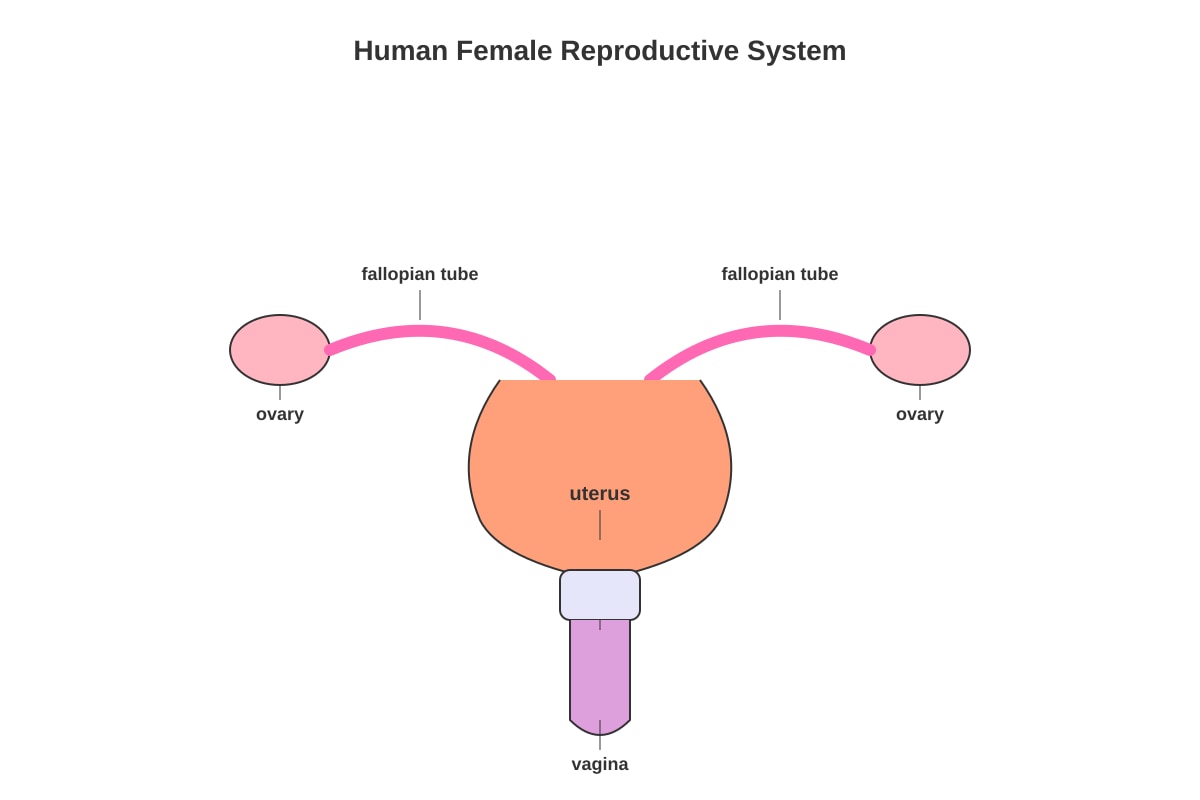
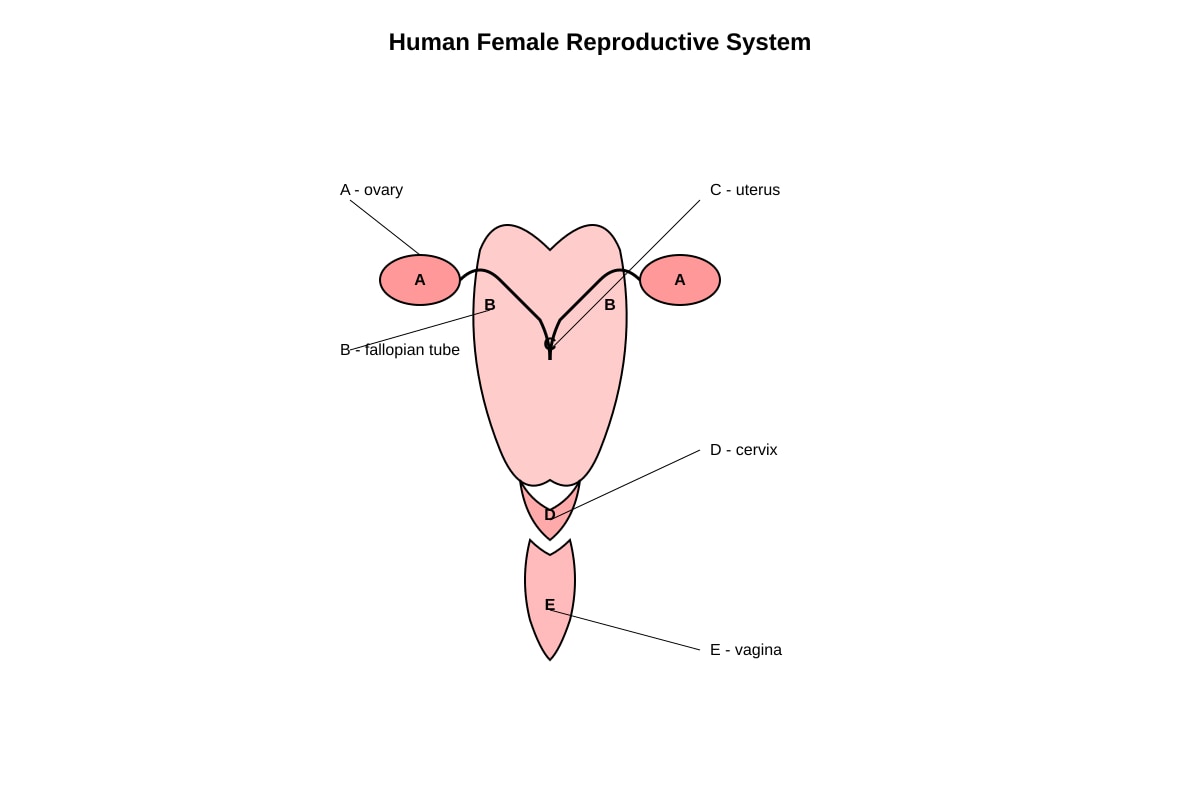
(a) A [1] Explanation: The ovary (A) produces eggs (female reproductive cells).
(b) B [1] Explanation: Fertilisation usually occurs in the fallopian tube (B), where the sperm meets the egg.
(c) C [1] Explanation: The fertilised egg implants in the uterus (C) lining and develops into a baby there.
(d) The cervix (D) is the entrance to the uterus; it dilates during childbirth to allow the baby to pass through. [1] Alternative answer: Produces mucus that helps sperm travel / protects uterus from infection. Explanation: The cervix connects the vagina to the uterus. It has important functions during menstruation, fertilisation (mucus changes), and childbirth.
32.
(a) Setup A [1] Explanation: The control has all conditions present (water, oxygen, suitable temperature, light). It shows that germination occurs when all conditions are met. Other setups test the absence of one condition each.
(b) To find out the conditions necessary for seed germination. [1] Explanation: The experiment tests which conditions (water, oxygen, temperature, light) are needed by removing one at a time.
(c) Water, oxygen, and suitable temperature. [1] Explanation:
- Setup B (no water) → no germination → water needed
- Setup C (no oxygen) → no germination → oxygen needed
- Setup D (low temperature) → no germination → suitable temperature needed
- Setup A (all present) → germination
(d) The temperature (5°C) is too low for the enzymes in the seed to work, so respiration and growth cannot occur. [1] Explanation: Enzymes controlling germination work best at suitable temperatures (usually 20–30°C). At 5°C, enzyme activity is too slow.
(e) Yes, I agree. Setup A (with light) and Setup B (without light — wait, both have light). Actually, the table shows both A and B have light. To test light, we need a setup with all conditions except light. The table does not have a "no light" setup with water, oxygen, and suitable temperature. So we cannot conclude from this experiment alone. [2] Mark breakdown:
- 1 mark: Correct conclusion (agree/disagree with reasoning)
- 1 mark: Correct use of results Explanation: The experiment as shown does NOT test light because all setups have "Yes" for light. A proper test would need a setup with water, oxygen, suitable temperature, but NO light. Since that setup is missing, the student cannot conclude about light from these results. This is a fair test / experimental design question.
33.
(a) Pollination [1] Explanation: Transfer of pollen grains from anther to stigma.
(b) Fertilisation [1] Explanation: Fusion of male and female reproductive cells.
(c) Pollination is the transfer of pollen (physical process), while fertilisation is the fusion of reproductive cells (cellular process). [1] Alternative: Pollination occurs before fertilisation; pollination involves pollen grains, fertilisation involves reproductive cells. Explanation: Key difference: pollination = pollen transfer; fertilisation = cell fusion. Pollination can occur without fertilisation (e.g., wrong species, sterile pollen).
(d) Seed dispersal spreads seeds away from the parent plant, reducing overcrowding and competition for light, water, nutrients, and space, which increases the chances of survival for the species. [2] Mark breakdown:
- 1 mark: Reduces overcrowding/competition
- 1 mark: Increases survival chances / colonises new areas Explanation: If all seeds fall near the parent, seedlings compete with each other and the parent. Dispersal allows colonisation of new habitats.
34.
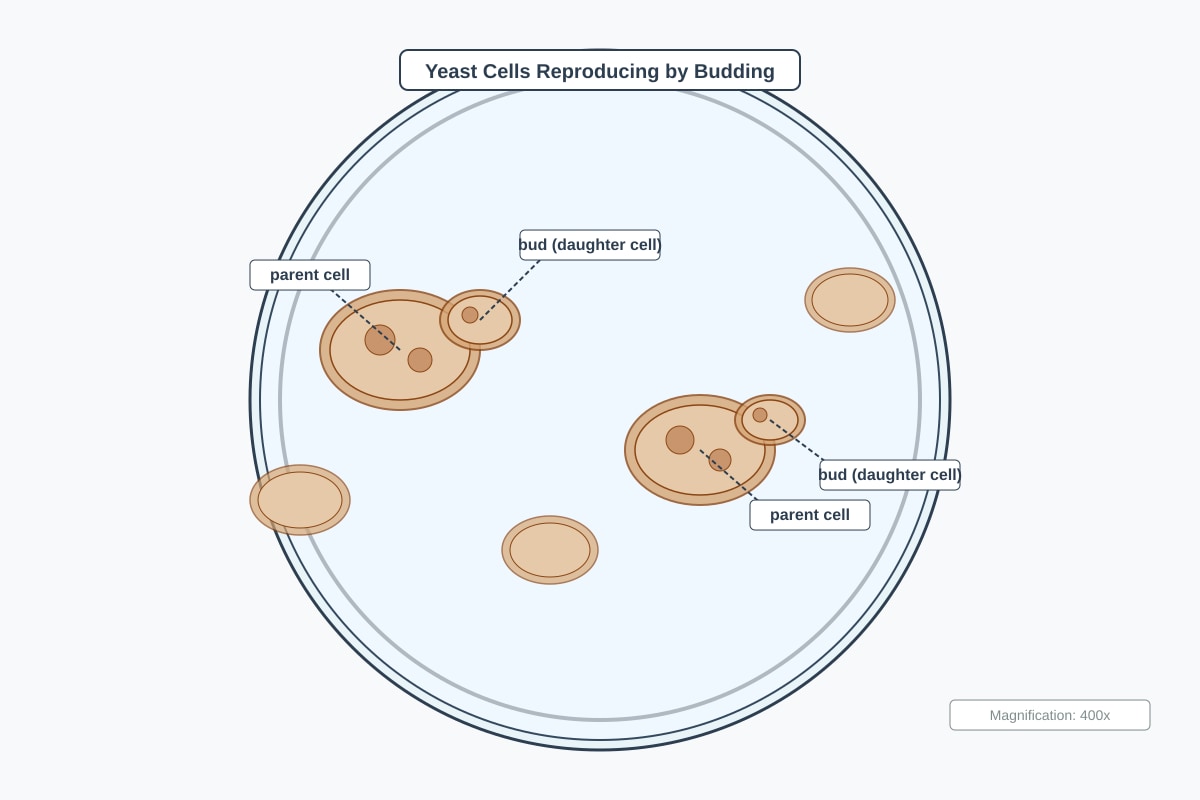
(a) Yeast [1] Explanation: Yeast cells are oval and reproduce by budding (a small bud grows from the parent cell).
(b) Budding [1] Explanation: Asexual reproduction where a new cell grows as an outgrowth (bud) from the parent.
(c) Yeast is used in bread-making (produces carbon dioxide to make dough rise) / brewing (produces alcohol) / making yoghurt (wait, that's bacteria). [1] Acceptable answers: Bread-making (CO₂ causes rising), beer/wine making (fermentation produces alcohol).
(d) Microorganisms can cause food spoilage / food poisoning / diseases. [1] Explanation: Bacteria and fungi decompose food (spoilage). Pathogenic microorganisms cause illnesses (e.g., Salmonella, E. coli).
35.
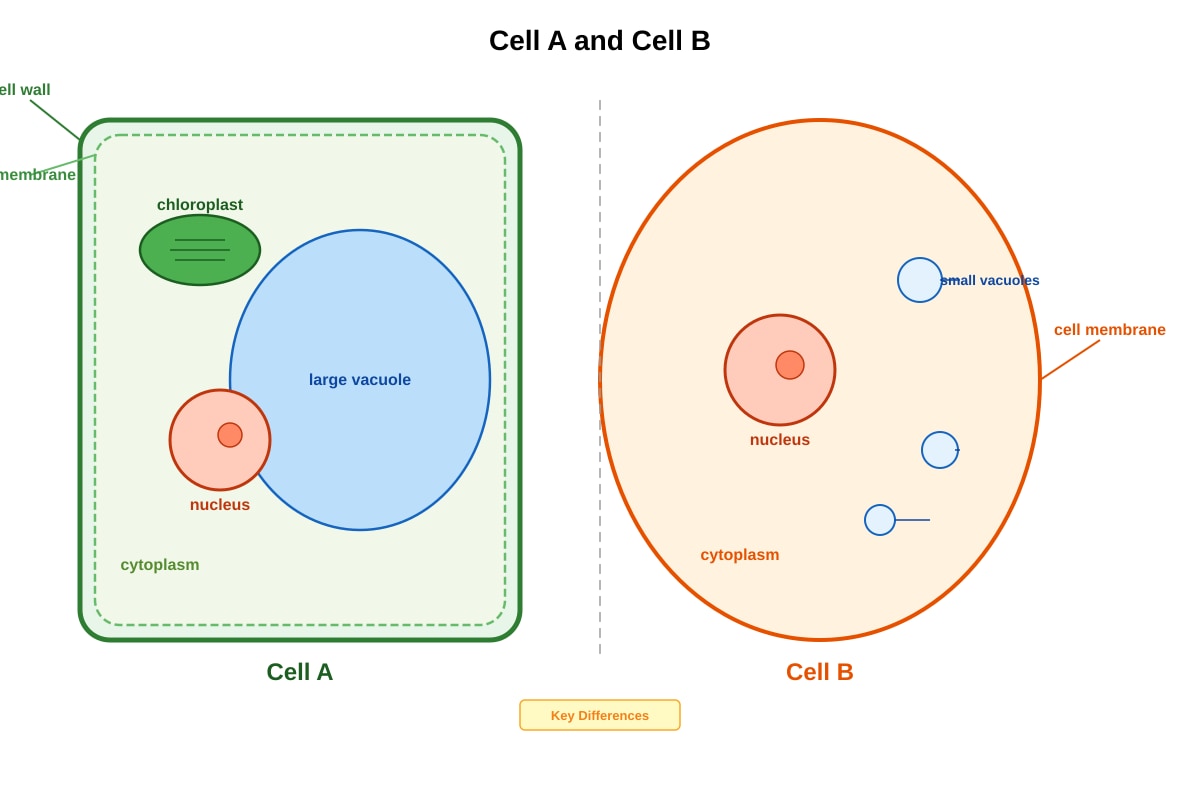
(a) Cell A [1] Explanation: Cell A has a cell wall, chloroplasts, and a large central vacuole — features of plant cells. Cell B lacks these (animal cell).
(b) Cell wall and chloroplast (or large vacuole) [2] Explanation: Plant cells have: cell wall (cellulose), chloroplasts (photosynthesis
<stage3_exam_answers_md>
TuitionGoWhere Practice Paper - Science Primary 5 (SA2 Version 3) - Answer Key
Section A: Multiple-Choice Questions (56 marks)
| Question | Answer | Explanation |
|---|---|---|
| 1 | (1) Ovary | After fertilisation, the ovary develops into the fruit. |
| 2 | (1) W | Wing-like structures are adaptations for wind dispersal. |
| 3 | (2) Fallopian tube | Fertilisation usually occurs in the fallopian tube. |
| 4 | (3) The ovule develops into the seed after fertilisation. | Correct statement: ovule → seed, ovary → fruit. Pollination occurs before fertilisation; pollen grain contains male cell; anther produces pollen. |
| 5 | (3) Sunlight | Germination requires water, oxygen, and suitable temperature. Light is not needed for germination (though needed for seedling growth). |
| 6 | (2) B only | Flowering plants reproduce by seeds and have flowers. Organism B fits both criteria. |
| 7 | (3) Ovary – egg | Ovary produces eggs (female gametes); testis produces sperm (male gametes). |
| 8 | (3) Anther | The anther produces pollen grains (male reproductive cells). |
| 9 | (2) Ferns | Ferns are non-flowering plants that reproduce by spores and can grow on tree bark (epiphytic ferns). Mosses also reproduce by spores but are non-vascular; fungi are not plants. |
| 10 | (2) Fertilisation | After pollination (transfer of pollen to stigma), the pollen tube grows and fertilisation occurs. |
| 11 | (2) Stores food for the embryo | The cotyledon stores food (starch, proteins, lipids) for the developing embryo. |
| 12 | (2) It increases the chance of cross-pollination. | Dichogamy (different maturation times) reduces self-pollination and promotes genetic diversity. |
| 13 | (3) Uterus | The fertilised egg (zygote) implants in the uterus lining and develops there. |
| 14 | (1) By wind | Wing-like structures (samaras) enable wind dispersal by spinning/gliding. |
| 15 | (3) Yeast is a type of fungus. | Yeast is a unicellular fungus. Not all microorganisms are harmful; bacteria reproduce by binary fission; viruses need a host to reproduce. |
| 16 | (3) Holds the testes outside the body to keep them cooler | The scrotum maintains testes at a temperature slightly lower than body temperature for sperm production. |
| 17 | (3) Mould spores | The black patches are sporangia containing spores of mould (a fungus). |
| 18 | (3) Movement from place to place | Not all living things move from place to place (e.g., plants). All living things reproduce, grow, and respond to changes. |
| 19 | (3) Nucleus | The nucleus contains genetic material (DNA) and controls all cell activities. |
| 20 | (2) Q | Ferns reproduce by spores, do not make their own food (they are plants but the table says "No" for Q - wait, ferns DO make their own food via photosynthesis. Let's re-evaluate: P: makes food, no spores, has chlorophyll → flowering plant. Q: no food, spores, no chlorophyll → fungus (mould/yeast). R: makes food, spores, chlorophyll → fern (ferns make food, reproduce by spores, have chlorophyll). S: no food, no spores, no chlorophyll → animal. Correction: Answer is (3) R. |
| 21 | (1) sperm, egg | Fertilisation is the fusion of a sperm (male gamete) with an egg (female gamete). |
| 22 | (2) It is searching for light and cannot make chlorophyll without light. | Etiolation: seedlings grow tall/spindly in dark searching for light; chlorophyll synthesis requires light, so they appear pale/yellow. |
| 23 | (1) Egg → Larva → Pupa → Adult | Mosquitoes undergo complete metamorphosis with these four stages. |
| 24 | (3) By animals eating the fruit | Fleshy, edible fruits with seeds inside are adapted for animal dispersal (endozoochory). |
| 25 | (2) anther, stigma | Pollination is the transfer of pollen from anther (male part) to stigma (female part). |
| 26 | (2) Bacteria | Bacteria reproduce asexually by binary fission. Yeast buds; mould produces spores; ferns produce spores. |
| 27 | (3) Plant | Producers (autotrophs) make their own food via photosynthesis. Plants are producers. |
| 28 | (3) Presence of light | The independent variable is the one deliberately changed: light vs. dark. All other variables (water, temperature, seeds) are kept constant. |
Section B: Open-Ended Questions (44 marks)
29. Reproductive Parts of a Flower
(a) Stigma [1]
(b) The ovary contains ovules (female reproductive cells) and develops into the fruit after fertilisation. [1]
(c) The male reproductive cell from the pollen grain travels down the pollen tube and fuses with the female reproductive cell (egg) in the ovule. [2]
Key points: male cell moves down tube; fusion with egg in ovule.
(d) After fertilisation, the ovule develops into the seed and the ovary develops into the fruit. [1]
30. Seed Dispersal Methods
(a) Water [1]
(b) Being light allows the fruit/seed to be easily carried by air currents over long distances. [1]
(c) The hooks catch onto the fur of animals or clothing of humans. The fruit is carried away and eventually falls off or is removed, dispersing the seeds away from the parent plant. [2]
Key points: hooks attach to animals/humans; carried away; fall off at new location.
(d) Splitting / Explosive action / Self-dispersal [1]
31. Human Female Reproductive System
(a) A (Ovary) [1]
(b) B (Fallopian tube) [1]
(c) C (Uterus) [1]
(d) The cervix is the narrow lower part of the uterus that opens into the vagina. It allows menstrual flow to exit, sperm to enter, and dilates during childbirth to allow the baby to pass through. (Any one valid function) [1]
32. Conditions for Seed Germination
(a) Water [1]
Comparing Setup A (germinated) and Setup B (no water, did not germinate) shows water is needed.
(b) Oxygen [1]
Comparing Setup A (germinated) and Setup C (no oxygen, did not germinate) shows oxygen is needed.
(c) Suitable temperature (warmth) [1]
Comparing Setup A (25°C, germinated) and Setup D (5°C, did not germinate) shows suitable temperature is needed.
(d) Light is not necessary for germination. [1]
Evidence: Setup A (with light) and a hypothetical setup without light (not shown but implied) would both germinate if water, oxygen, and temperature are suitable. The results show germination occurs in Setup A with light, but the absence of light was not tested as a variable here. Standard knowledge: germination does not require light.
(e) The aim is to find out if light is needed for germination. [1]
Since water, oxygen, and temperature are kept constant (same in A and the implied dark setup), the only variable changed is light.
33. Microorganisms
(a) Fungus / Fungi [1]
Mould is a multicellular fungus.
(b) Bacteria reproduce by binary fission (asexual reproduction where one cell divides into two identical cells). [1]
(c) Usefulness: Yeast is used in baking (produces CO₂ to make bread rise) and brewing (ferments sugar to alcohol). Bacteria are used in making yogurt/cheese (fermentation) and in decomposition/recycling nutrients.
Harmfulness: Some bacteria cause diseases (e.g., Salmonella food poisoning, tuberculosis). Some fungi cause diseases (e.g., athlete's foot, ringworm) or food spoilage (mould on bread). [2]
Need one useful and one harmful example for full marks.
(d) Viruses are non-living outside a host cell. They cannot reproduce, carry out respiration, or feed on their own. They need to infect a living host cell to replicate. [1]
34. Life Cycles
(a) Mosquito: Egg → Larva → Pupa → Adult (Complete metamorphosis, 4 stages, young looks very different from adult, lives in water).
Grasshopper: Egg → Nymph → Adult (Incomplete metamorphosis, 3 stages, young resembles adult but smaller/no wings, lives on land). [2]
Key differences: number of stages; nymph vs larva/pupa; habitat of young; resemblance to adult.
(b) The nymph moults several times. Each time it moults, it grows larger and its wing buds develop further until it becomes an adult with fully developed wings. [1]
(c) The larval stage (e.g., caterpillar, maggot, mosquito larva) is the main feeding and growing stage. It eats a lot to store energy for the non-feeding pupal stage and for the adult stage. [1]
35. Cells
(a) Cell wall and Chloroplasts (Large central vacuole also accepted) [2]
Plant cells have these; animal cells do not.
(b) Chloroplasts contain chlorophyll which traps light energy for photosynthesis (making food/glucose). [1]
(c) The cell membrane controls the movement of substances in and out of the cell. It is partially permeable, allowing only certain substances to pass through. [1]
(d) Red blood cell (or root hair cell, nerve cell, muscle cell, etc.)
Adaptation: Red blood cell has no nucleus (more space for haemoglobin), biconcave shape (large surface area for oxygen diffusion), contains haemoglobin to bind oxygen. [2]
Must name a specific cell and describe its adaptation for its function.
36. Matter / Water Cycle (Context: Changes of State)
(a) Evaporation [1]
Water gains heat from surroundings and changes from liquid to gas.
(b) Condensation [1]
Water vapour loses heat to the cooler surface and changes from gas to liquid.
(c) The water cycle ensures a continuous supply of fresh water on Earth. It distributes water across the globe, supports life, and regulates climate. [1]
(d) Melting [1]
Ice (solid) gains heat to become water (liquid).
37. Energy / Forces (Context: Photosynthesis / Food Chains)
(a) Photosynthesis [1]
(b) Light energy → Chemical energy (stored in food/glucose) [1]
(c) The population of grasshoppers would decrease (less food). Consequently, the populations of frogs, snakes, and eagles would also decrease due to less food available at each trophic level. [2]
Energy transfer up the chain is disrupted.
(d) Decomposers (bacteria and fungi) break down dead organisms and waste, returning nutrients to the soil for plants to reuse. They recycle nutrients in the ecosystem. [1]
38. Heat / Temperature (Context: Thermometers / Conduction)
(a) Mercury or Alcohol [1]
(b) The liquid expands when heated and contracts when cooled, rising or falling in the narrow tube to indicate temperature. [1]
(c) Metal is a good conductor of heat. It conducts heat away from the hand quickly, making it feel colder than wood (a poor conductor) at the same temperature. [1]
(d) Conduction [1]
Transfer of heat through a solid by molecular vibration/collision.
39. Magnets / Electricity (Context: Electromagnets / Circuits)
(a) Increase the number of coils of wire around the nail / Increase the current (use more batteries / higher voltage) / Use a soft iron core. (Any one) [1]
(b) Steel retains its magnetism (hard magnetic material) and becomes a permanent magnet. Iron loses its magnetism easily (soft magnetic material) when the current is switched off. [1]
(c) Open circuit / Broken circuit / Switch is open / Bulb fused / Battery flat. (Any one valid reason) [1]
(d) Parallel circuit [1]
In a parallel circuit, each bulb has its own path; if one fuses, others stay lit. In series, one fused bulb breaks the circuit for all.
40. Application / Experiment Skills (Fair Test / Variables)
(a) Changed variable (Independent): Type of material (e.g., metal, wood, plastic) [1]
(b) Measured variable (Dependent): Time taken for the thumbtack to drop / Distance the heat travels / Temperature at the other end. [1]
(c) Constant variables: Length/Thickness of rods, Size of thumbtack, Amount of wax, Distance from heat source, Room temperature. (Any two) [1]
(d) To ensure a fair test so that any difference in the result is due only to the changed variable (type of material) and not other factors. [1]
End of Answer Key