From Real Exams Exam Paper
Primary 5 Science Semestral Assessment 2 (End of Year) Paper 3
Free P5 Science SA2 Paper 3, Kimi2.6 Exam version, with questions, answers, and syllabus-aligned practice for Singapore students.
These static practice materials are generated from the site's syllabus and paper-generation workflow, with source and model context shown so students and parents can evaluate the material before use.
Questions
Free quiz and exam paper access
Enter your details to view this paper
Your access is remembered on this device.
Answers
TuitionGoWhere Exam Practice (AI) — SA2 Practice Paper Version 3
PRIMARY 5 SCIENCE — ANSWER KEY
Total Marks: 60
Duration: 1 hour
SECTION A: MULTIPLE-CHOICE QUESTIONS (20 marks)
Each question carries 1 mark.
| Question | Answer | Explanation |
|---|---|---|
| 1 | B | Flowering plants reproduce by seeds, bulbs, and runners. Spores are used by non-flowering plants like ferns and mosses, not flowering plants. Common mistake: confusing spore reproduction with seed reproduction. |
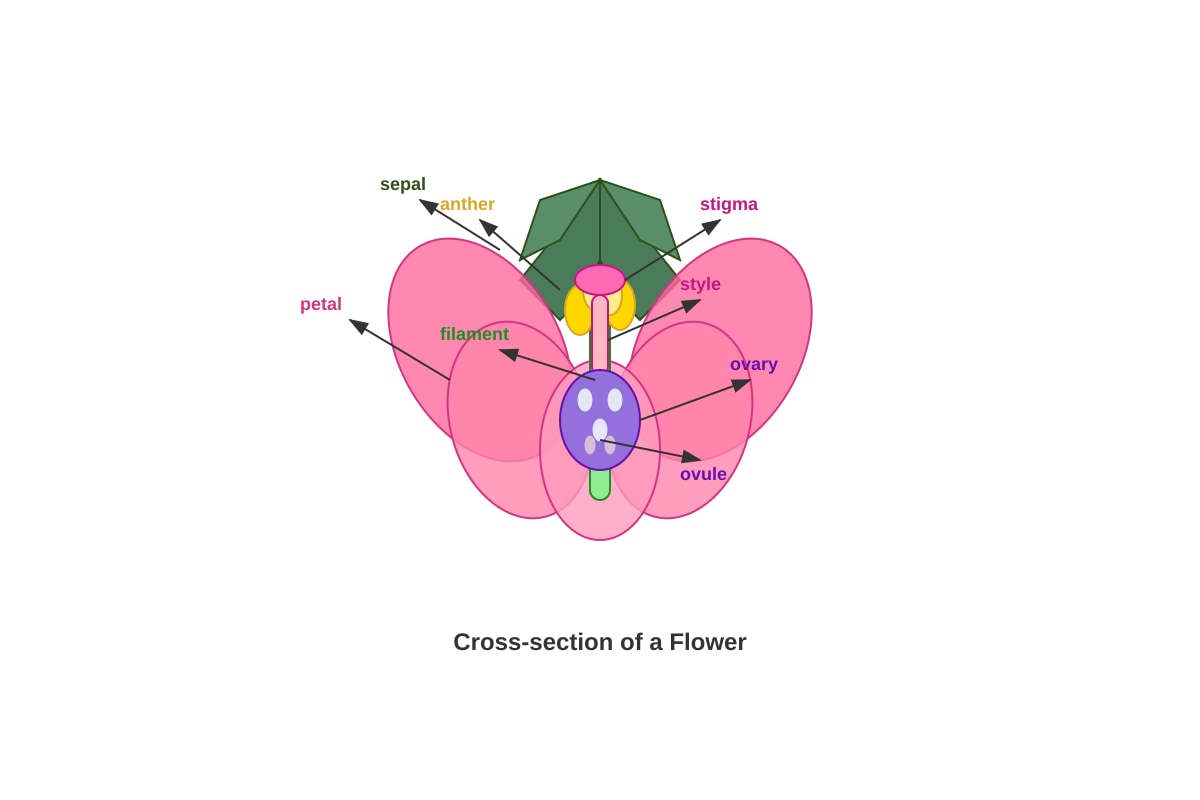
| 2 | B | The anther produces pollen grains. The ovary contains ovules, petals attract pollinators, and nectar is produced by nectaries. |
| 3 | C | Pollination is the transfer of pollen from the anther (male part) to the stigma (female part). |
| 4 | B | The ovary develops into the fruit after fertilisation. The ovule becomes the seed. The stigma and anther do not develop into fruit. |
| 5 | C | Self-pollination occurs when pollen is transferred from the anther to the stigma of the same flower. Cross-pollination is between different flowers; wind is just a method, not a definition. |
| 6 | D | Grass seed carried by wind is an example of wind dispersal, not animal dispersal. Burrs cling to animals, coconuts float (water dispersal, sometimes assisted by animals), and cherries are eaten by birds. |
| 7 | B | Seed dispersal prevents competition between young plants and the parent plant for light, water, and nutrients. It does not directly help the parent plant. |
| 8 | C | The male reproductive cell is a sperm (plural: sperm). An egg/ovum is the female reproductive cell. An embryo forms after fertilisation. |
| 9 | B | Fertilisation is the fusion of a sperm with an egg. Ovulation is egg release; implantation is when the embryo attaches to the womb; birth is delivery of the baby. |
| 10 | B | Correct sequence: Ovulation (egg released) → Fertilisation (sperm meets egg) → Implantation (embryo attaches to womb) → Birth. |
| 11 | B | The testis (plural: testes) produces sperm. The penis delivers sperm; ureter and bladder are part of the urinary system. |
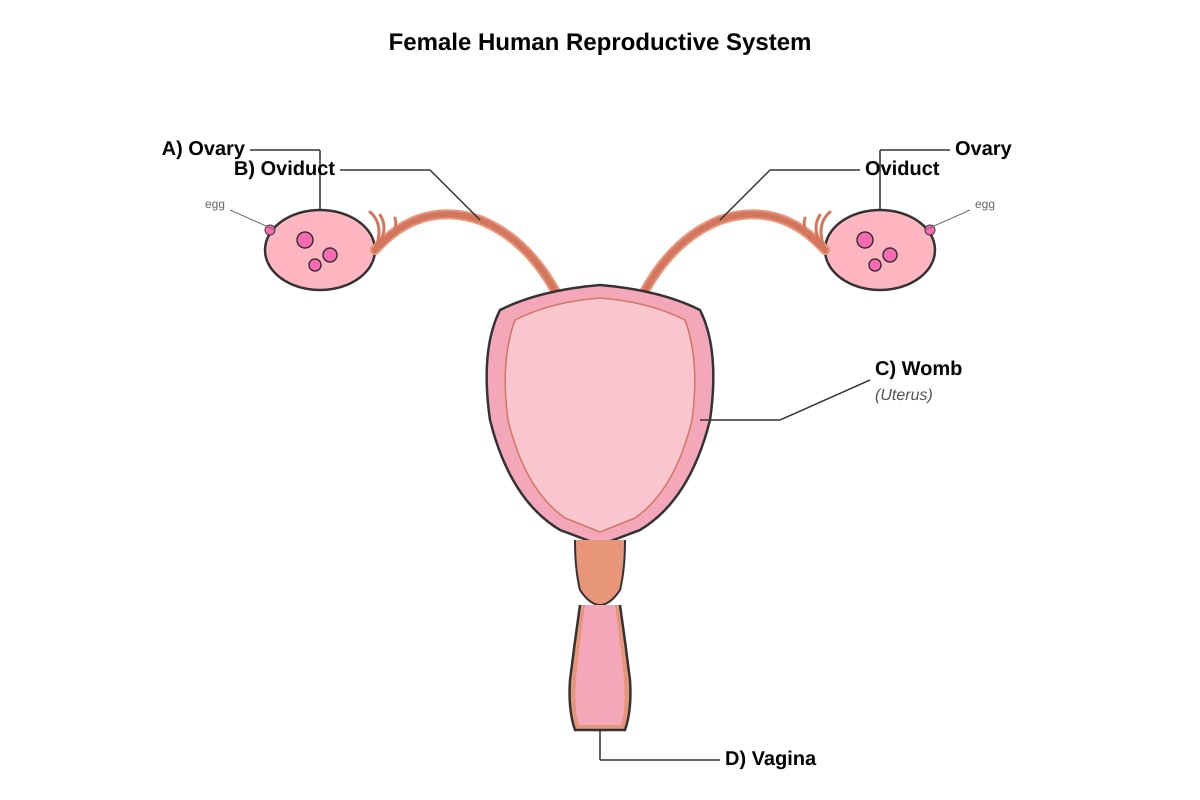
| 12 | B | Fertilisation usually takes place in the oviduct (also called Fallopian tube). The ovary releases the egg; the womb is where development occurs; the vagina is the birth canal. |
| 13 | C | After fertilisation, the fertilised egg travels to the womb/uterus where it implants and develops. |
| 14 | C | Brightly coloured petals attract insects. Insect-pollinated flowers have sticky, heavy pollen (not light), sticky stigmas (not feathery), and usually have scent. |
| 15 | D | Wind-pollinated flowers have small or no petals (no need to attract insects), large feathery stigmas to catch wind-borne pollen, and light, smooth pollen grains. They do not produce nectar. |
| 16 | D | Seeds need water, suitable temperature, and air to germinate. Sunlight is NOT needed for germination—this is a very common misconception. Seeds germinate in darkness underground. |
| 17 | B | Only Q and R are flowering plants. Plant P reproduces by spores, so it is a non-flowering plant (e.g., fern). Flowering plants reproduce by seeds or vegetative methods like bulbs. |
| 18 | D | By roots is not a seed dispersal method. Seeds can be dispersed by wind, water, animals, and by explosion/self-dispersal. Roots (runners/tubers) are a method of vegetative reproduction, not seed dispersal. |
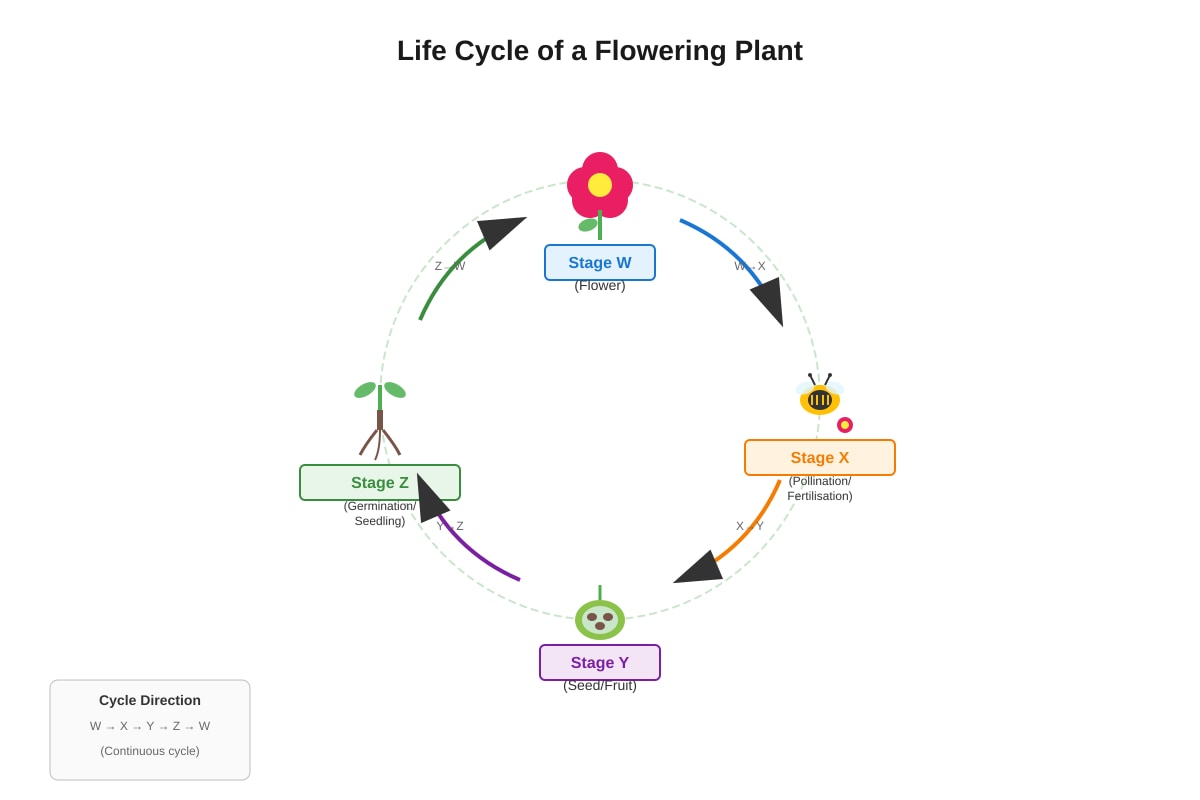
| 19 | D | Seed dispersal is not explicitly shown in the four stages. The cycle shows: W = flower (produces pollen), X = pollination/fertilisation, Y = seed/fruit (contains seeds), Z = germination. Seed dispersal would occur between Y and Z, or after Y, but is not labelled as a separate stage. |
| 20 | C | Reproduction ensures continuity of the species—without it, species would die out. Plants and animals can both reproduce sexually; not all plants use seeds; fertilisation is essential for sexual reproduction. |
SECTION B: OPEN-ENDED QUESTIONS (40 marks)
Question 21 [Total: 6 marks]
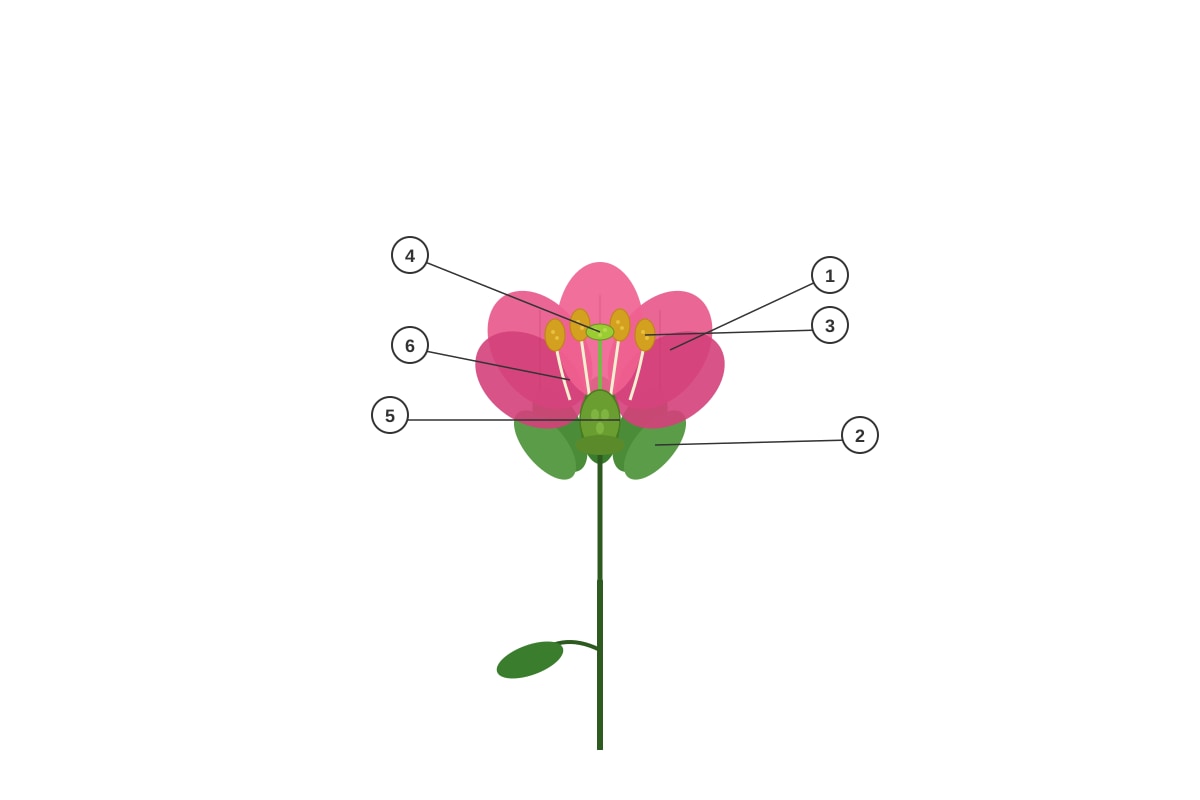
(a) Label the parts [3 marks]
| Part | Answer | Mark |
|---|---|---|
| 1 | Petal | 1 |
| 3 | Anther | 1 |
| 5 | Ovary | 1 |
Teaching note: Petals attract pollinators with colour and scent. The anther is the top part of the stamen that produces pollen. The ovary is the swollen base of the female part that contains ovules.
Common error: Confusing ovary (contains ovules) with ovule (becomes seed).
(b) Function of part 3 (anther) [1 mark]
- The anther produces pollen grains / releases pollen. [1]
Teaching note: The anther is the male reproductive part. When it matures, it splits open to release pollen grains, which contain the male reproductive cells.
(c) What happens after fertilisation [2 marks]
| Structure | Development | Mark |
|---|---|---|
| Ovary | Develops into a fruit | 1 |
| Ovule | Develops into a seed | 1 |
Teaching note: After fertilisation, the flower's job is complete. The ovary swells and changes into a fruit to protect the seeds. Each fertilised ovule becomes a seed. This is how flowering plants produce the next generation.
Question 22 [Total: 5 marks]
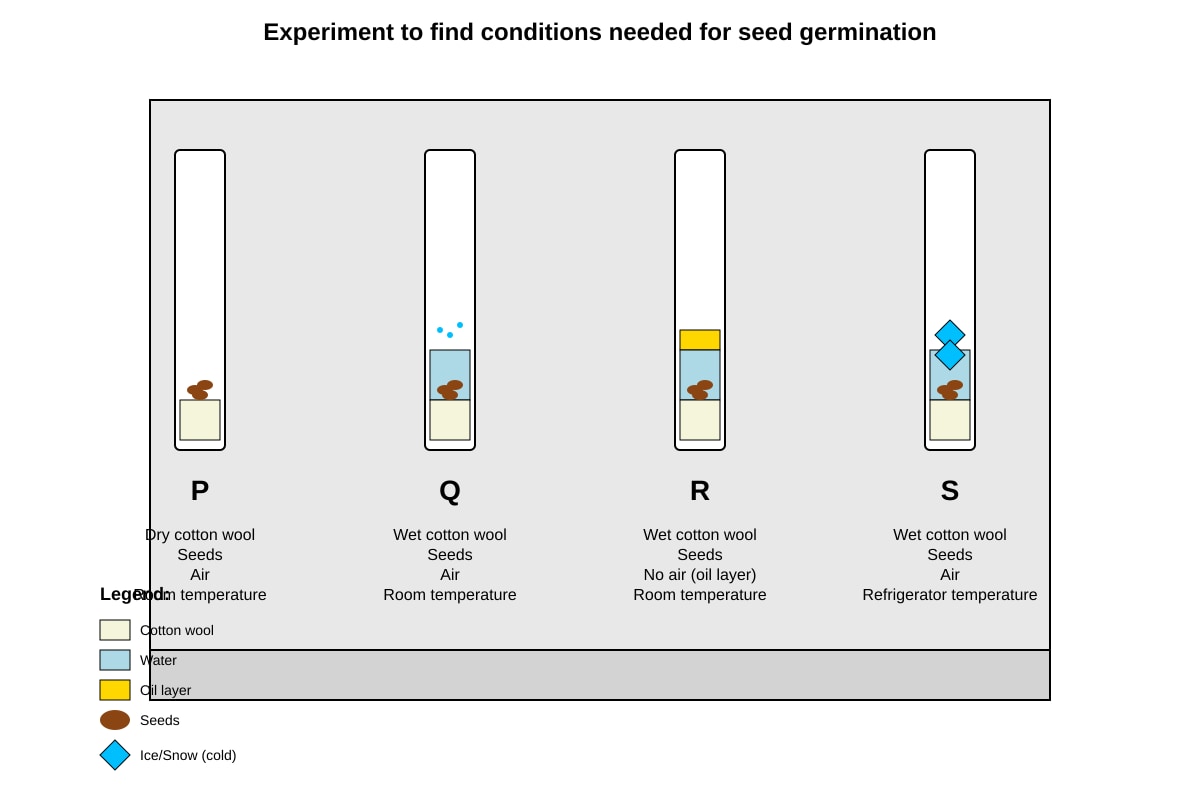
(a) Which test tube(s) show germination? [1 mark]
- Tube Q [1]
Teaching note: Tube Q has all three necessary conditions: water, air (oxygen), and suitable (room) temperature.
(b) Why seeds in tube R do not germinate [2 marks]
- Tube R has no air/oxygen [1]
- because the oil layer prevents air from reaching the seeds [1]
- Oxygen is needed for respiration to release energy for growth [1]
Accept any 2 marks from above 3 points.
Teaching note: Seeds need to respire to get energy for germination. Respiration requires oxygen. The oil layer in tube R forms a seal that stops air (which contains oxygen) from dissolving in the water and reaching the seeds.
(c) Suggest setup for tube T to test light [2 marks]
- Tube T should have: wet cotton wool, seeds, air, room temperature, but kept in complete darkness [1]
- All other conditions the same as Q, only light is changed/removed [1]
- This makes it a fair test with only one variable changed [1]
Accept any 2 marks from above 3 points.
Teaching note: To test if light is needed, all other conditions must stay the same (fair test principle). Use a box or cupboard to block all light, or wrap the tube in black paper. Compare with Q which has light.
Question 23 [Total: 4 marks]
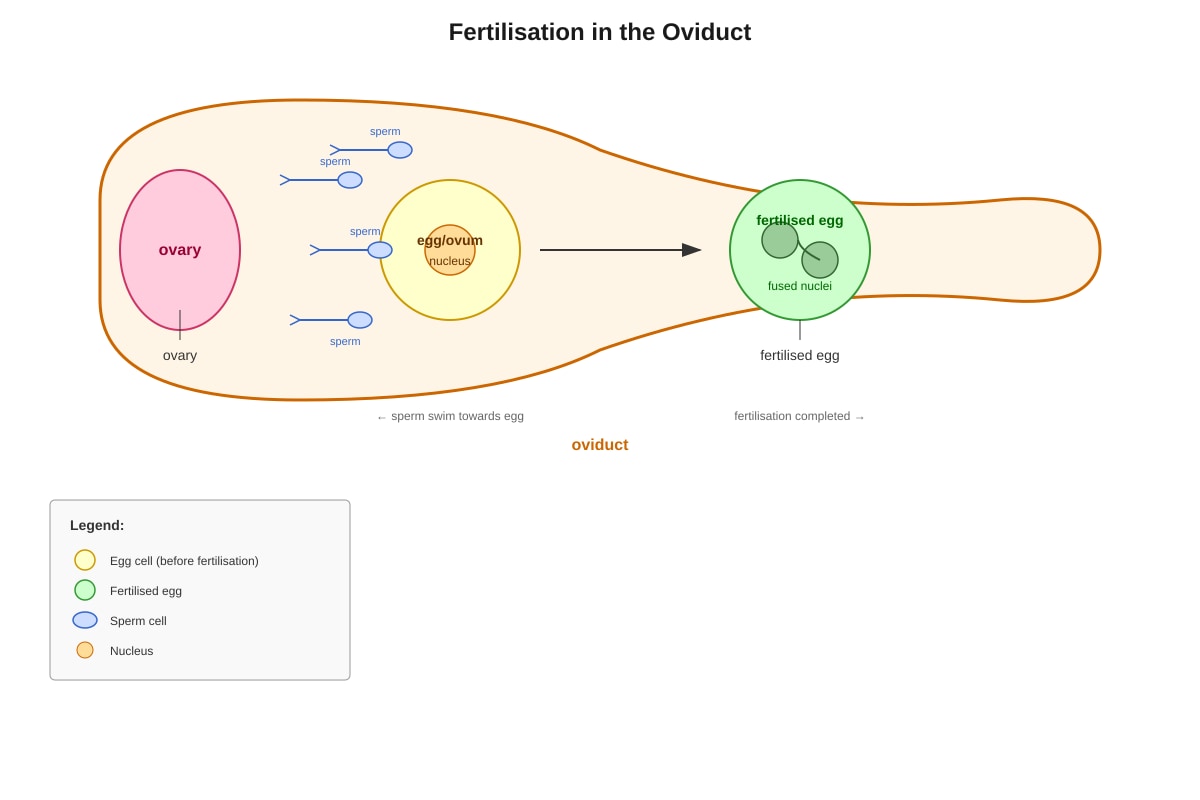
(a) Where fertilisation takes place [1 mark]
- Oviduct (Fallopian tube) [1]
Teaching note: The egg is released from the ovary and moves into the oviduct. Sperm travel up to meet the egg here. This is where the two gametes fuse.
(b) What happens during fertilisation [2 marks]
- The male reproductive cell (nucleus of sperm) fuses with the female reproductive cell (nucleus of egg) [1]
- to form a fertilised egg / zygote [1]
Teaching note: Fertilisation is specifically the fusion of the two nuclei (genetic material), not just the meeting of the cells. The result is a single cell with complete set of chromosomes—half from mother, half from father.
(c) Where fertilised egg develops [1 mark]
- Womb / uterus [1]
Teaching note: After fertilisation in the oviduct, the fertilised egg travels down to the womb and implants in the thickened lining. It develops there for about 9 months.
Question 24 [Total: 4 marks]
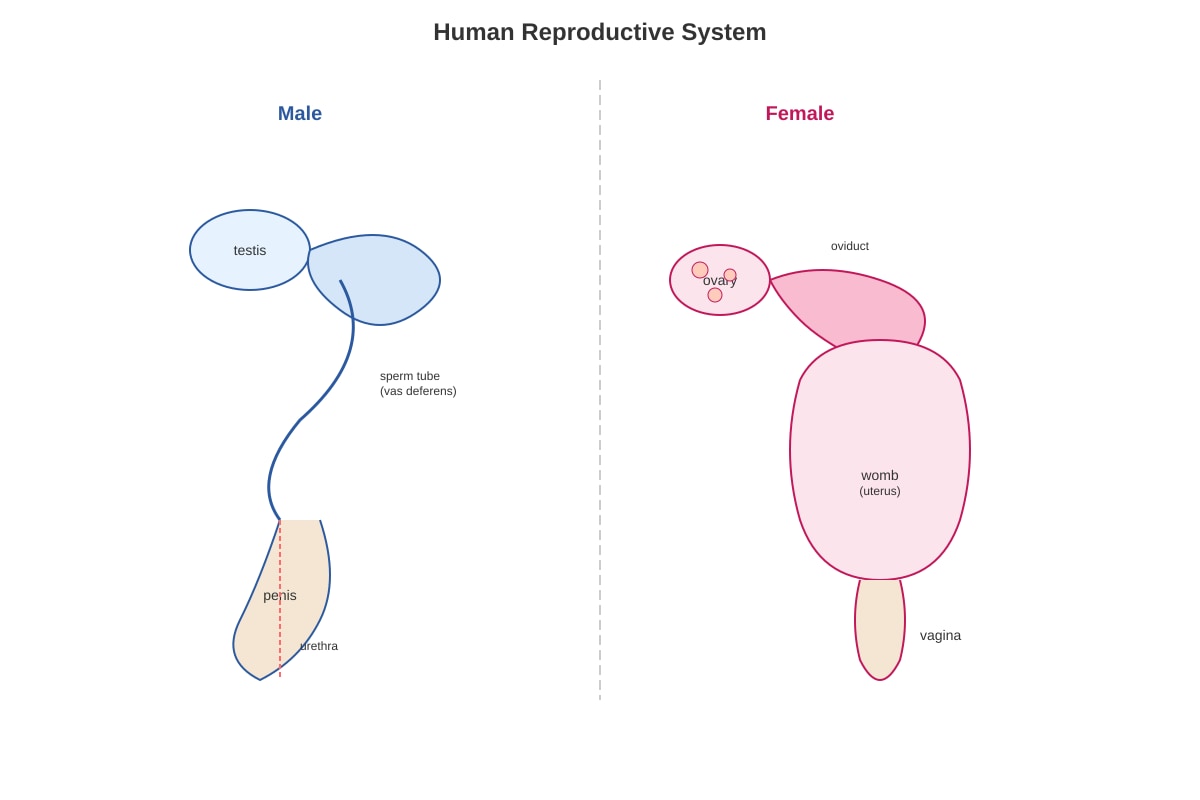
(a) Where gametes are produced [2 marks]
| Sex | Organ | Mark |
|---|---|---|
| Male | Testis / Testes | 1 |
| Female | Ovary / Ovaries | 1 |
Teaching note: These are the primary reproductive organs (gonads). The testes produce sperm continuously from puberty. The ovaries produce eggs, usually releasing one per menstrual cycle.
(b) Why offspring are different from parents [2 marks]
- Offspring inherit genetic material from both parents / half from mother, half from father [1]
- The mixing/combination of genes is different each time, so offspring are not identical to either parent [1]
Teaching note: Sexual reproduction involves two parents, so the offspring gets a unique combination of characteristics. This is different from asexual reproduction where offspring are genetically identical to the single parent (clones).
Question 25 [Total: 6 marks]
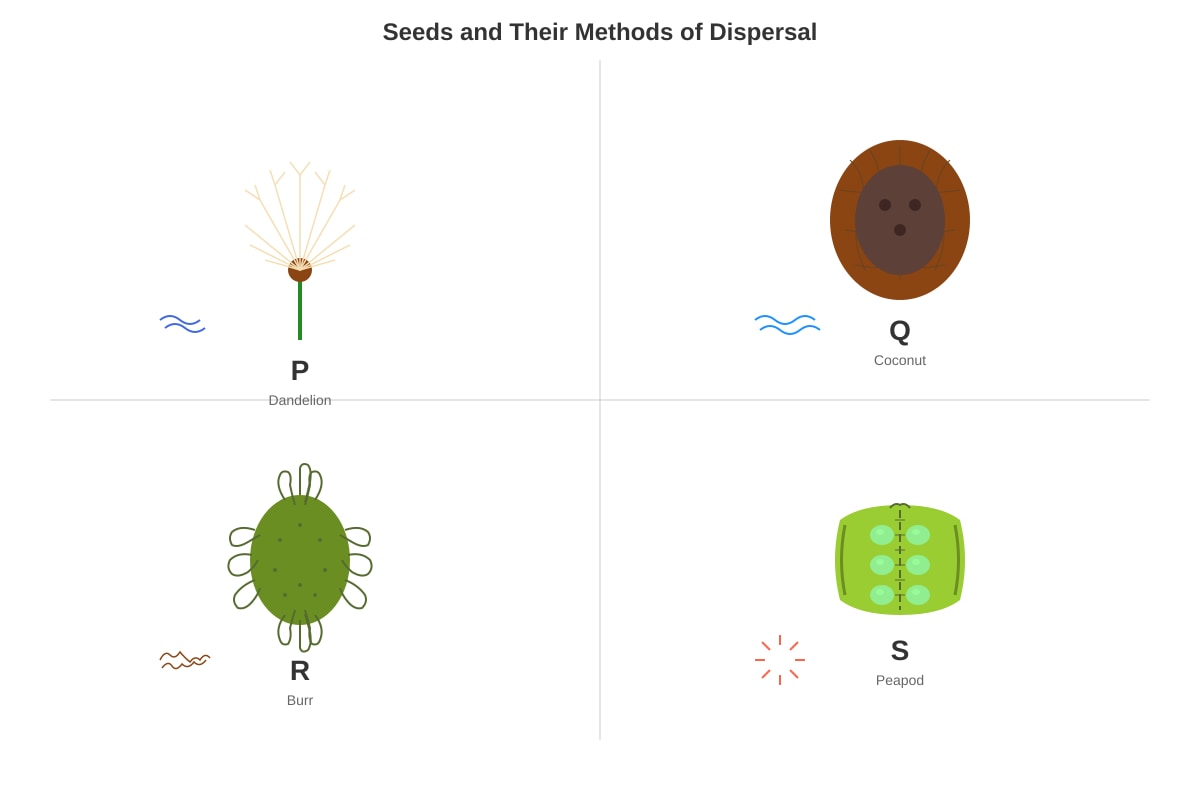
(a) Match seeds to dispersal methods [3 marks]
| Seed | Method of dispersal |
|---|---|
| P | By wind ✓ (given) |
| Q | By water [1] |
| R | By animals [1] |
| S | By explosion / self-dispersal [1] |
Teaching note:
- P (dandelion): feathery parachute catches wind.
- Q (coconut): large, buoyant with fibrous husk floats on water.
- R (Xanthium/burr): hooks/spines cling to animal fur.
- S (peapod): dries and splits open forcefully, shooting seeds out.
(b) Structural feature of Q for water dispersal [1 mark]
- It has a fibrous husk / air spaces / large size that helps it float on water [1]
Teaching note: The coconut's fibrous husk contains many air spaces, making it buoyant. This allows it to float across oceans to reach new islands, spreading the species to new habitats.
(c) Why seed dispersal is important [2 marks]
- Prevents competition between young plants and parent plant for light, water, and nutrients [1]
- Allows plants to colonise new areas/habitats [1]
- Increases chances of survival/species continuity [1]
Accept any 2 marks from above 3 points.
Teaching note: If all seeds fell directly under the parent, they would compete for limited resources and many would die. Spreading out gives each seedling better chance to survive and grow.
Question 26 [Total: 3 marks]
(a) Difference in gametes produced [1 mark]
- Males produce sperm (small, many, with tails) / Females produce eggs/ova (larger, fewer, no tails) [1]
- OR: Males produce many/millions of sperm; females produce one egg at a time (usually) [1]
Teaching note: Sperm are tiny, mobile cells with flagella (tails) to swim. Eggs are much larger, round cells with nutrient stores to feed early development. One ejaculation contains millions of sperm, but typically only one egg is released per cycle.
(b) Why only one sperm fertilises the egg [2 marks]
- If more than one sperm fertilised the egg, the fertilised egg would have too many chromosomes / wrong amount of genetic material [1]
- This would cause abnormal development / the embryo would not develop properly [1]
- The egg has mechanisms to block other sperm once one enters [1]
Accept any 2 marks from above 3 points.
Teaching note: Normal human cells have 46 chromosomes (23 pairs). The egg and sperm each contribute 23. If two sperm entered, there would be 69 chromosomes, which is incompatible with normal human development. The egg membrane changes after fertilisation to prevent polyspermy (multiple fertilisation).
Question 27 [Total: 6 marks]
(a) Define cross-pollination [2 marks]
- Cross-pollination is when pollen is transferred from the anther of one flower [1]
- to the stigma of another flower of the same species / another flower on the same plant [1]
Teaching note: The key points are: (1) different flower, not same flower—that's self-pollination; (2) same species—pollen from different species usually won't work. Between flowers on the same plant is still cross-pollination genetically, though some definitions distinguish this.
(b) Differences between wind and insect-pollinated flowers [2 marks]
| Feature | Wind-pollinated | Insect-pollinated |
|---|---|---|
| Petals | Small / absent / dull coloured [0.5] | Large / brightly coloured / scented [0.5] |
| Pollen | Light / smooth / small / produced in large amounts [0.5] | Heavy / sticky / spiky / produced in smaller amounts [0.5] |
Half mark per correct cell, total 2 marks.
Other valid answers:
- Stigma: feathery / hangs out (wind) vs. sticky / inside flower (insect)
- Nectar: absent (wind) vs. present (insect)
(c) Why wind-pollinated pollen is light and small [2 marks]
- Light and small pollen can be carried easily by wind over long distances [1]
- Heavier pollen would fall to the ground and not reach other flowers [1]
- Wind is a less directed/less reliable pollinator than insects, so more pollen must be produced and it must travel well [1]
Accept any 2 marks from above 3 points.
Teaching note: Wind pollination is inefficient—most pollen doesn't reach a stigma. So plants produce huge amounts of light pollen to compensate. Insect pollinators are "aimed" directly at flowers, so sticky, heavy pollen works better as it clings to the insect's body.
Question 28 [Total: 4 marks]
(a) Two differences between fern and butterfly reproduction [2 marks]
| Difference | Fern | Butterfly | Mark |
|---|---|---|---|
| 1. Method | Uses spores (no seeds/eggs) | Uses eggs / internal development | 1 |
| 2. Water needed? | Needs water for male/female cells to meet | Does not need water for reproduction | 1 |
| OR: Sperm/egg production | Produces cells that need water to move | Produces sperm that can swim in female body | 1 |
| OR: Offspring | Spore grows into intermediate heart-shaped plant first | Egg hatches directly into caterpillar | 1 |
Any two valid differences, 1 mark each.
Teaching note: Ferns are seedless vascular plants—an older evolutionary strategy. Their sperm must swim through water to reach the egg, limiting them to moist environments. Butterflies are insects with internal fertilisation—sperm is transferred directly, no external water needed.
(b) Why fern needs water but butterfly does not [2 marks]
- Ferns produce male cells that must swim through water to reach female cells [1]
- Butterflies use internal fertilisation / male butterfly deposits sperm directly into female [1]
- Butterfly's sperm does not need to swim through external water to reach the egg [1]
Accept any 2 marks from above 3 points.
Teaching note: This reflects a major evolutionary advance—internal fertilisation freed animals from needing water for reproduction, allowing colonisation of dry land. Ferns still depend on moist conditions for this critical step.
Question 29 [Total: 5 marks]
(a) Two conditions present for germination [2 marks]
| Condition | Evidence from question | Mark |
|---|---|---|
| Water | "wet cotton wool" [1] | |
| Suitable temperature | "in a cupboard" at room temperature (implied, not refrigerated) [1] | |
| Air | Implicit (not sealed, normal setup) — accept if stated |
Accept any 2 from: water, suitable temperature, air/oxygen.
(b) Why light was not needed for germination [2 marks]
- Germination needs food/energy stored in the seed (cotyledons or endosperm) [1]
- The seedling has not yet developed leaves to photosynthesise [1]
- Light is only needed when leaves grow and photosynthesis begins [1]
Accept any 2 marks from above 3 points.
Teaching note: This is a crucial concept. Seeds are self-contained packages with stored food. They can germinate in complete darkness underground. Only when the shoot reaches light does the seedling begin making its own food by photosynthesis. If left too long in darkness, the seedling will turn yellow and die (etiolation) as it runs out of stored food.
(c) Suggestion after germination [1 mark]
- Move to sunlight / place near window / transplant to soil with nutrients [1]
Teaching note: Once germinated, seedlings need light for photosynthesis to make their own food, and soil minerals for healthy growth. The stored food in the seed is finite.
Question 30 [Total: 6 marks]
(a) Process in first sentence [1 mark]
- Pollination [1]
Teaching note: The first sentence describes pollen landing on the stigma—this is pollination. Fertilisation is the later fusion of nuclei. Students often confuse these two processes.
(b) What is formed in ovule after fusion [1 mark]
- Seed / embryo / fertilised egg / zygote [1]
Teaching note: Technically, the zygote (fertilised egg) forms first, then develops into an embryo, all within the ovule. The whole ovule becomes the seed. Primary level—"seed" or "embryo" accepted.
(c) How stigma structure helps [2 marks]
- The stigma is sticky / has a rough surface [1]
- This catches/traps pollen grains that land on it [1]
- (For wind-pollinated: feathery/sticky to catch airborne pollen; for insect-pollinated: sticky to attach to insect body) [1]
Accept any 2 marks from above 3 points.
Teaching note: The stigma is specially adapted to receive pollen. Its sticky surface holds the pollen grain in place so the pollen tube can grow down to the ovary. Different species have different stigma shapes matching their pollination method.
(d) Why petals wither after process [2 marks]
- The flower's job of attracting pollinators is complete / no longer needed [1]
- Energy goes to developing the fruit and seeds instead [1]
- Petals are not needed to protect the reproductive parts anymore [1]
Accept any 2 marks from above 3 points.
Teaching note: Plants are efficient with resources. Once pollination and fertilisation are done, the flower "shuts down" parts it no longer needs. The ovary becomes the priority for resource allocation as it swells into fruit protecting the developing seeds.
MARK SUMMARY
| Section | Marks |
|---|---|
| Section A (Q1–20) | 20 |
| Section B (Q21–30) | 40 |
| Total | 60 |
Duration check: Estimated time allocation:
- Section A: 20 questions × ~1.5 min = 30 minutes
- Section B: 10 questions × ~2.5 min average = 25 minutes
- Review buffer: 5 minutes
- Total: 60 minutes ✓
END OF ANSWER KEY