From Real Exams Exam Paper
Primary 5 Science Semestral Assessment 2 (End of Year) Paper 3
Free P5 Science SA2 Paper 3, HY3 Exam version, with questions, answers, and syllabus-aligned practice for Singapore students.
These static practice materials are generated from the site's syllabus and paper-generation workflow, with source and model context shown so students and parents can evaluate the material before use.
Questions
TuitionGoWhere Exam Practice (AI) – SA2 Practice Paper
TuitionGoWhere Exam Practice (AI)
Subject: Science
Level: Primary 5
Paper: SA2 Practice Paper (Version 3 of 5)
Duration: 60 minutes
Total Marks: 60
Name: ______________________
Class: _________
Date: ___________
Instructions:
- This paper contains 20 questions on the topic of Diversity.
- Section A: 10 multiple-choice questions (1 mark each).
- Section B: 6 short-answer questions (2 marks each).
- Section C: 4 structured questions (total 28 marks).
- Write your answers in the spaces provided.
- Use the correct scientific terms taught in Primary 5.
Section A (10 marks)
For each question, choose the correct answer and write its letter in the box provided.
1. Which of the following is a correct example of diversity among living things?
A. A cat can run faster than a snail
B. There are many different types of birds with different beaks
C. Water can be frozen into ice
D. A bulb lights up in a closed circuit
□
2. Which group below shows organisms that are all plants?
A. Fern, mushroom, rose
B. Grass, tulsi, mango tree
C. Yeast, algae, cabbage
D. Moss, frog, palm
□
3. Animals can be grouped by their body covering. Which animal has feathers?
A. Lizard
B. Eagle
C. Earthworm
D. Fish
□
4. Which of these is a characteristic used to group animals into vertebrates and invertebrates?
A. Colour of skin
B. Presence of a backbone
C. Number of legs
D. Type of food eaten
□
5. A student groups objects as living and non-living. Which of the following should be placed under non-living?
A. Bacteria
B. Rock
C. Fungus
D. Insect
□
6. Which of the following is a correct pair of materials grouped by whether they let light pass through?
A. Wood – transparent; glass – opaque
B. Clear plastic – opaque; metal – transparent
C. Glass – transparent; wood – opaque
D. Paper – transparent; water – opaque
□
7. Plants are grouped as flowering and non-flowering. Which is a non-flowering plant?
A. Hibiscus
B. Fern
C. Sunflower
D. Orchid
□
8. Which property is used to group materials as magnetic or non-magnetic?
A. Whether it floats on water
B. Whether it is attracted to a magnet
C. Whether it can be bent
D. Whether it feels cold
□
9. Which of the following shows diversity in the same group of animals?
A. All insects have six legs
B. Some beetles are red, some are green
C. Fish live in water
D. Birds lay eggs
□
10. Why do scientists group living things?
A. To make them look the same
B. To study their differences and similarities more easily
C. To change their characteristics
D. To count the number of legs only
□
Section B (12 marks)
Answer each question in the space provided. Each question is worth 2 marks.
11. Name two ways we can group plants.
12. State one difference between a vertebrate and an invertebrate.
13. List two materials that are good conductors of electricity and one that is an insulator.
14. Give one example of a living thing and one example of a non-living thing found in a pond.
15. Name two properties that can be used to group materials.
16. Why is it useful to group animals by their body covering?
Section C (28 marks)
Answer all questions. Show your working or explanation where needed.
17. (a) Classify the following into living and non-living: ant, stone, banana plant, spoon. [2]
Living: ___________________________________________________
Non-living: ________________________________________________
(b) Give one reason why the banana plant is living. [1]
18. A class carried out an investigation to group materials by whether they are magnetic.
They tested: iron nail, rubber band, steel paper clip, plastic ruler.
(a) Which two items are magnetic? [1]
(b) Draw a table to show the grouping of the four items as magnetic or non-magnetic. [3]
| Magnetic | Non-magnetic |
|---|---|
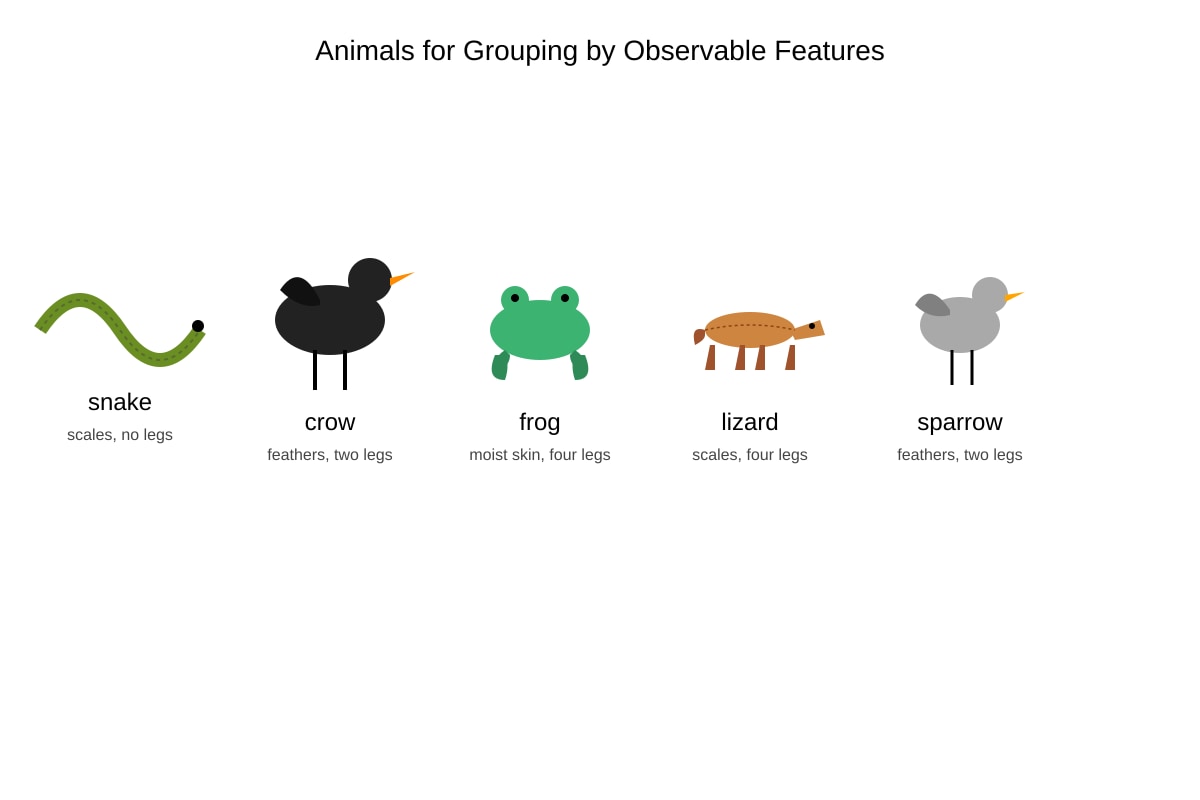
19. The diagram below shows some animals.
Image pending generation: diagram for 19.
(a) Group the animals that have feathers. [1]
(b) Group the animals that have scales. [1]
(c) Explain why we group animals by such features. [2]
20. Complete the table to show how objects can be grouped by whether they are transparent, translucent, or opaque. Give one example for each. [4]
| Group | Meaning | Example |
|---|---|---|
| Transparent | ||
| Translucent | ||
| Opaque |
(b) State why grouping materials this way is helpful in daily life. [2]
21. (Note: not used; total kept at 20)
End of Paper
Answers
SA2 Practice Paper – Answer Key (Version 3)
Topic: Diversity
Level: Primary 5 Science
Total Marks: 60
Section A (10 marks)
-
B [1]
Teaching note: Diversity means variety. Different birds with different beaks show variety among living things. A is a ability difference, C is state of matter, D is electrical system. -
B [1]
Grass, tulsi, mango tree are all plants. Mushroom/yeast are fungi, frog is animal. -
B [1]
Eagle (bird) has feathers. Lizard has scales, earthworm has moist skin, fish has scales. -
B [1]
Vertebrates have backbone; invertebrates do not. -
B [1]
Rock is non-living. Bacteria, fungus, insect are living. -
C [1]
Glass is transparent (light passes), wood is opaque (no light passes). -
B [1]
Fern is non-flowering. Others are flowering plants. -
B [1]
Magnetic means attracted to magnet. -
B [1]
Different colours of beetles show diversity within same group. -
B [1]
Grouping helps study similarities and differences.
Section B (12 marks)
-
[2] Any two: flowering / non-flowering; by size; by where they grow (land/water); by type of leaves.
Marking: 1 mark per correct grouping. -
[2] Vertebrate has backbone; invertebrate does not. (1 mark each side or 2 for clear difference)
-
[2] Conductors: iron, copper (or steel); insulator: rubber (or plastic, wood). 1 mark for two conductors, 1 for insulator.
-
[2] Living: fish / water plant; non-living: stone / water (if object). 1 mark each.
-
[2] Examples: magnetic/non-magnetic; transparent/opaque; hard/soft; conductor/insulator. 1 mark each.
-
[2] Body covering (feathers, scales, skin, shell) helps identify animal group and their adaptations. 1 for idea, 1 for usefulness.
Section C (28 marks)
-
(a) [2] Living: ant, banana plant. Non-living: stone, spoon. (1 mark each group correct)
(b) [1] It grows / needs water / reproduces. (any life process) -
(a) [1] Iron nail, steel paper clip.
(b) [3] Table: | Magnetic | Non-magnetic | |----------|--------------| | Iron nail, steel paper clip | Rubber band, plastic ruler | (2 marks for correct placement, 1 for table format) -
(a) [1] Crow, sparrow.
(b) [1] Snake, lizard.
(c) [2] Features show similarities/differences; help classify and study animals. 1 for reason, 1 for elaboration. -
[4] Table: | Group | Meaning | Example | |-------|---------|---------| | Transparent | Light passes clearly | Glass, clear plastic | | Translucent | Some light passes | Frosted glass, tissue | | Opaque | No light passes | Wood, metal | (1 mark per row)
(b) [2] Helps choose right material for windows, curtains, etc. 1 for example, 1 for reason.
Note: Question 21 listed in paper as unused note; actual count 20.
Free quiz and exam paper access
Enter your details to view this paper
Your access is remembered on this device.