From Real Exams Exam Paper

Primary 5 Science Semestral Assessment 2 (End of Year) Paper 2

Free Exam-Derived NVIDIA Nemotron 3 Ultra 550B A55B Free Primary 5 Science Semestral Assessment 2 (End of Year) Paper 2 practice paper with questions and answers for Singapore students. This page is rendered as a direct URL so the questions and answers can be discovered without pressing in-page buttons.

These static practice materials are generated from the site's syllabus and paper-generation workflow, with source and model context shown so students and parents can evaluate the material before use.

Primary 5 Science From Real Exams Generated by NVIDIA Nemotron 3 Ultra 550B A55B Free Updated 2026-06-07

Questions

<!-- TuitionGoWhere generation metadata: stage=3-1; model=nvidia/nemotron-3-ultra-550b-a55b:free; model_label=NVIDIA Nemotron 3 Ultra 550B A55B Free; generated=2026-06-05; Sources: Stage 2-1 real exam-derived templates and Stage 2-2 exam-enriched syllabus. -->

TuitionGoWhere Practice Paper - Science Primary 5

TuitionGoWhere Exam Practice (AI)

Subject: Science
Level: Primary 5
Paper: SA2 (Semestral Assessment 2) - Version 2
Duration: 1 h 45 min
Total Marks: 100

Name: ________________________
Class: Primary 5 ________
Date: ________________________


INSTRUCTIONS TO CANDIDATES

  1. Do not turn over this page until you are told to do so.
  2. Follow all instructions carefully.
  3. Answer all questions.
  4. The number of marks is given in brackets [ ] at the end of each question or part question.
  5. The total marks for this paper is 100.

BOOKLET A (56 marks)

Questions 1 to 28 carry 2 marks each. For each question, four options are given. Choose the correct answer and write its number (1, 2, 3 or 4) in the brackets provided.

Section A: Multiple-Choice Questions (28 × 2 marks = 56 marks)

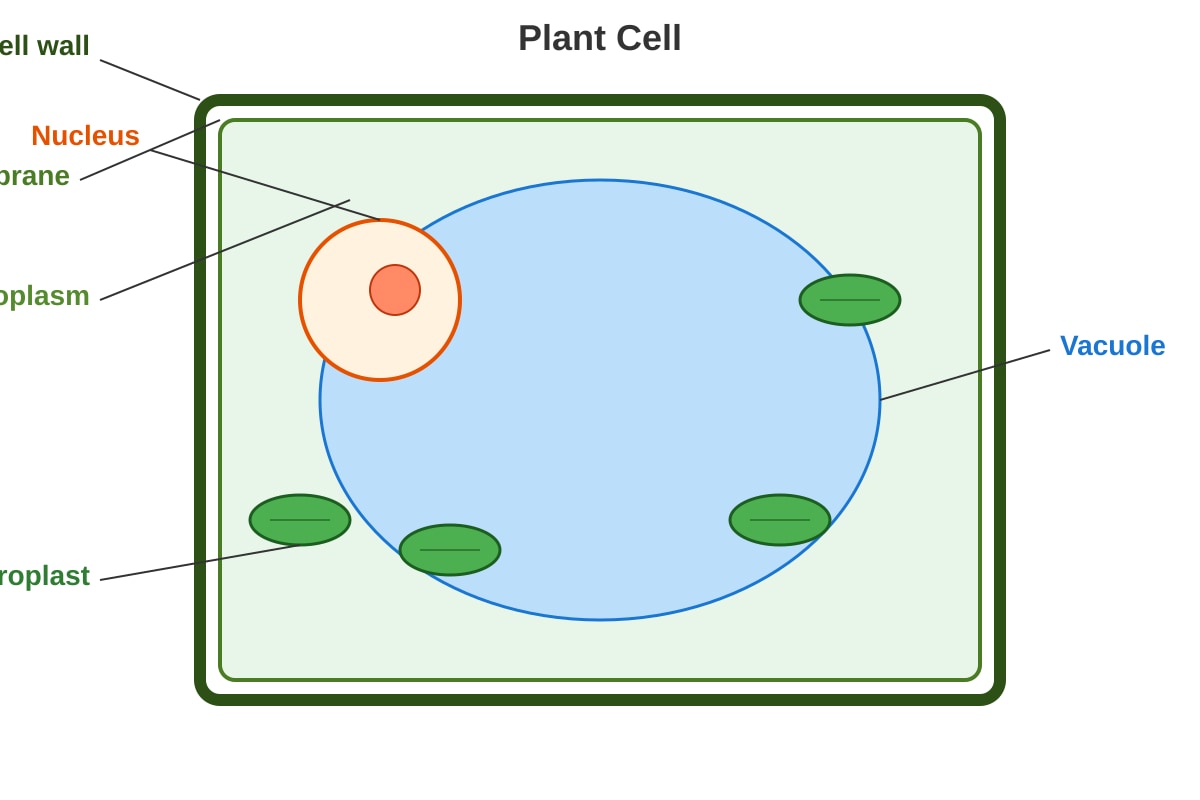
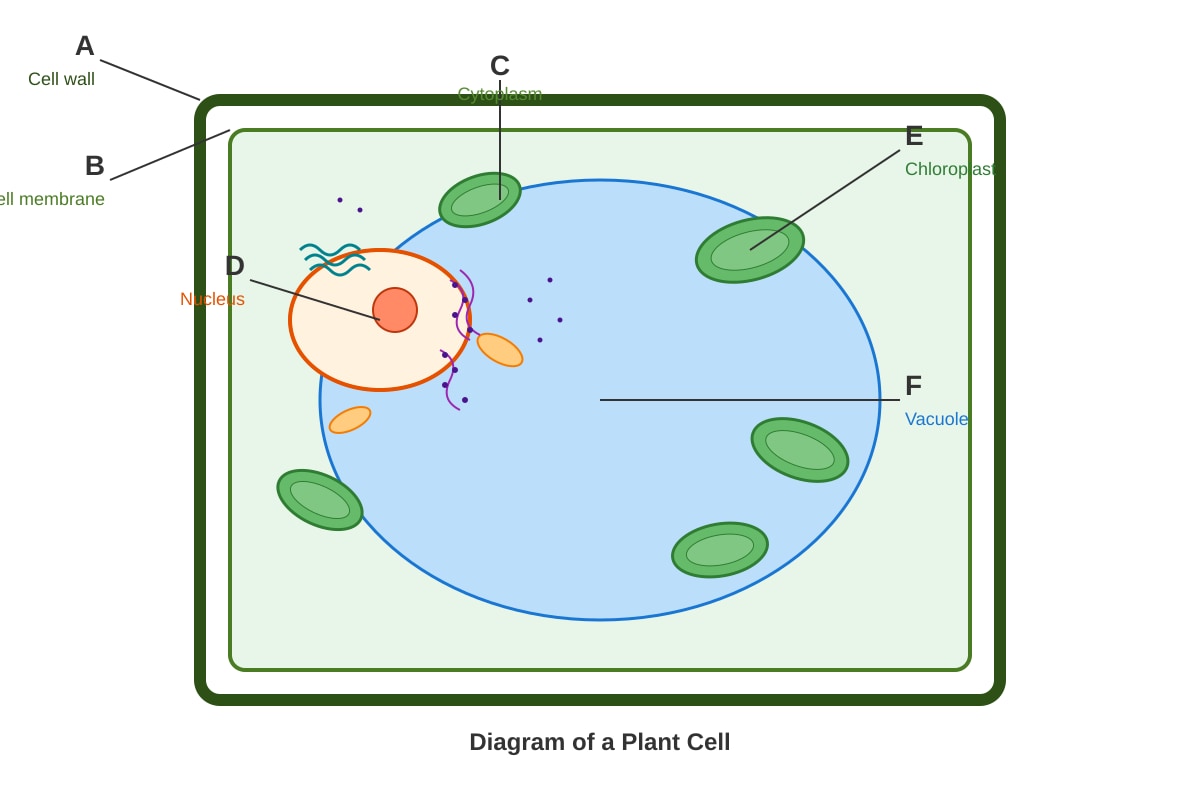
1. The diagram below shows a cell.

<image_placeholder> id: Q1-fig1 type: diagram linked_question: Q1 description: A typical plant cell with labelled parts: cell wall, cell membrane, cytoplasm, nucleus, chloroplast, vacuole. Part X points to the chloroplast. labels: Cell wall, Cell membrane, Cytoplasm, Nucleus, Chloroplast (X), Vacuole values: None must_show: Clear distinction between plant cell structures; Part X clearly on chloroplast </image_placeholder>

Which part, labelled X, contains chlorophyll and traps light energy for photosynthesis?

(1) Nucleus
(2) Cytoplasm
(3) Chloroplast
(4) Vacuole

[2]

2. Which of the following statements about respiration is correct?

(1) Respiration occurs only in animals.
(2) Respiration occurs only in the presence of light.
(3) Respiration releases energy from food in all living cells.
(4) Respiration produces oxygen and glucose.

[2]

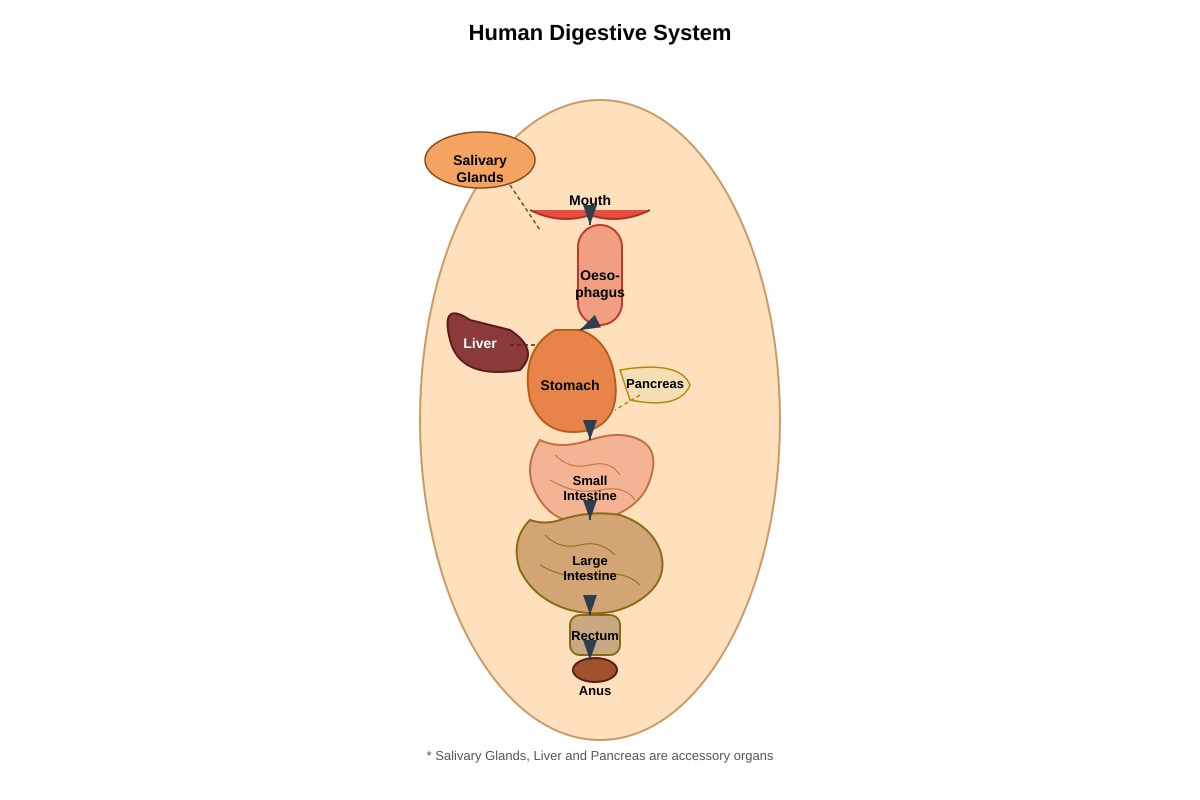
3. The diagram below shows the human digestive system.

<image_placeholder> id: Q3-fig1 type: diagram linked_question: Q3 description: Human digestive system with labels: A - Mouth, B - Oesophagus, C - Stomach, D - Small intestine, E - Large intestine, F - Anus labels: A, B, C, D, E, F values: None must_show: All major digestive organs clearly labelled </image_placeholder>

In which labelled part does most absorption of digested food take place?

(1) A
(2) C
(3) D
(4) E

[2]

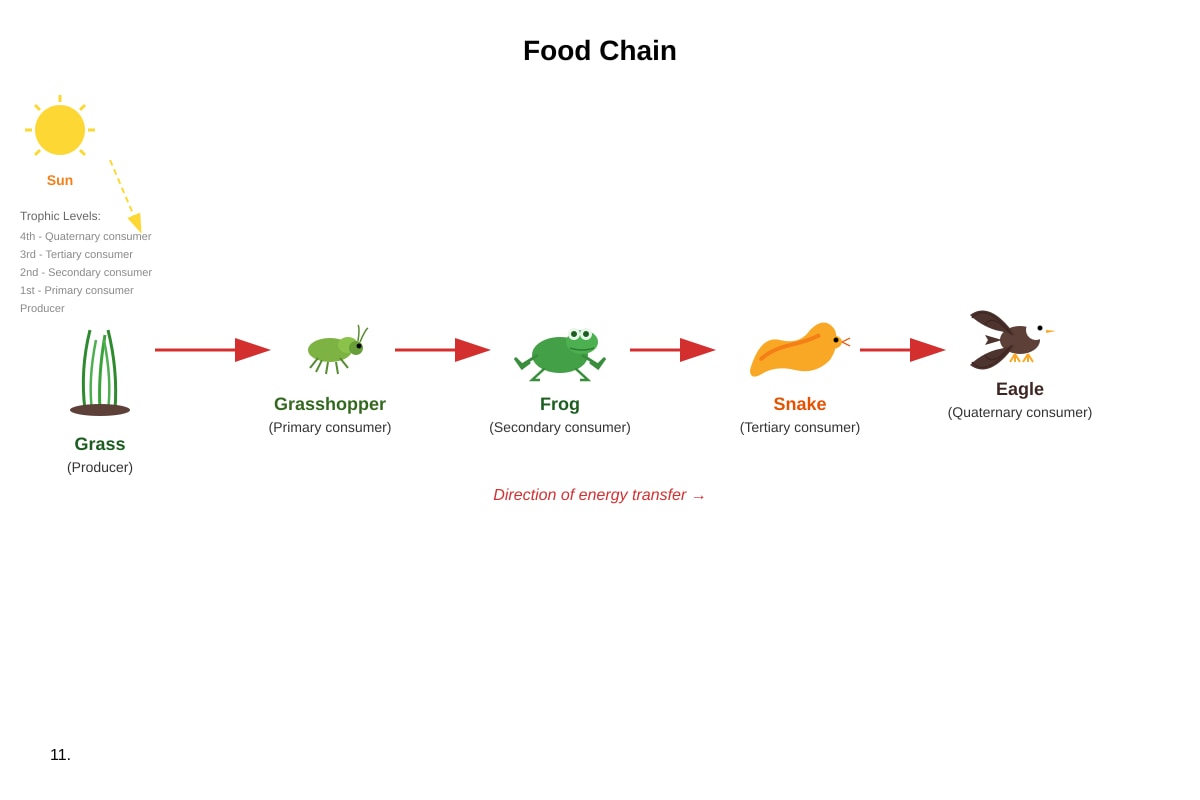
4. Study the food chain below.

Grass → Grasshopper → Frog → Snake → Eagle

If a disease kills most of the grasshoppers, what will most likely happen to the frog population?

(1) It will increase because there are more snakes.
(2) It will decrease because there is less food.
(3) It will remain the same because frogs eat other animals.
(4) It will increase because there is less competition.

[2]

5. Which of the following shows the correct order of the stages in the life cycle of a flowering plant?

(1) Seed → Seedling → Adult plant → Flower → Fruit → Seed
(2) Seed → Flower → Seedling → Adult plant → Fruit → Seed
(3) Seedling → Seed → Adult plant → Flower → Fruit → Seed
(4) Seed → Adult plant → Seedling → Flower → Fruit → Seed

[2]

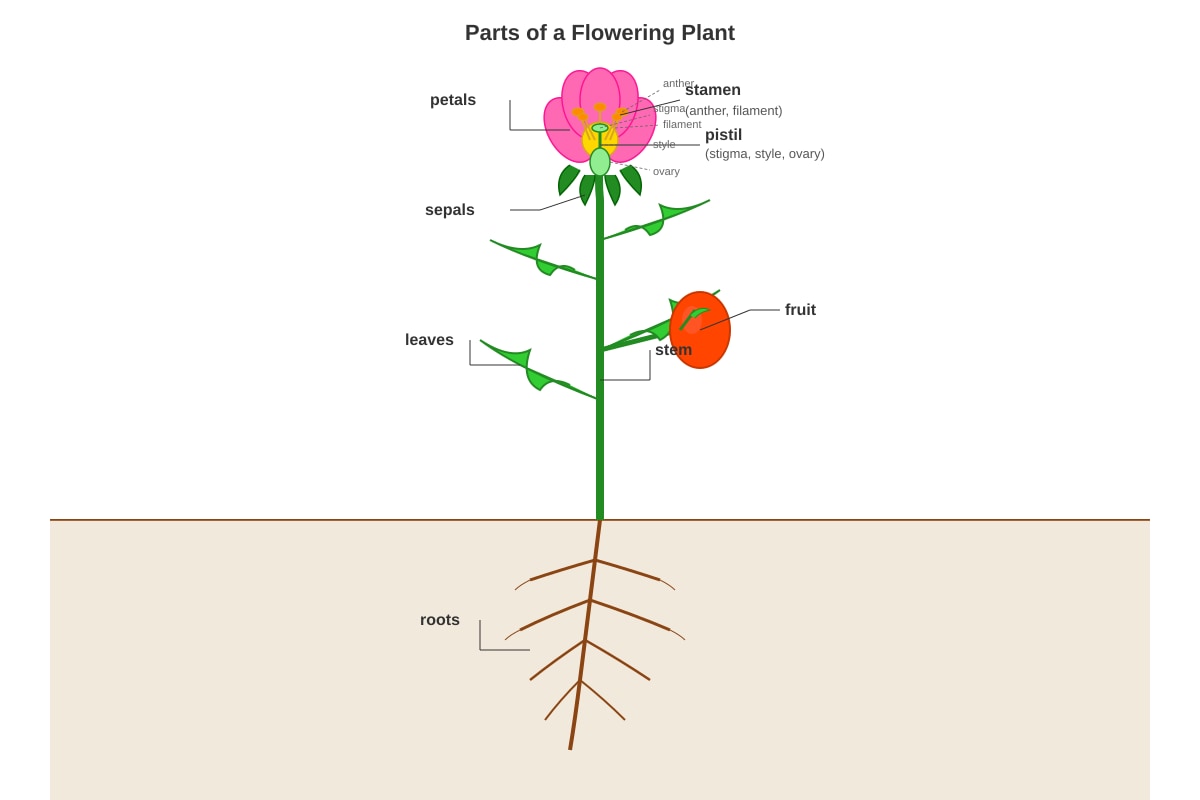
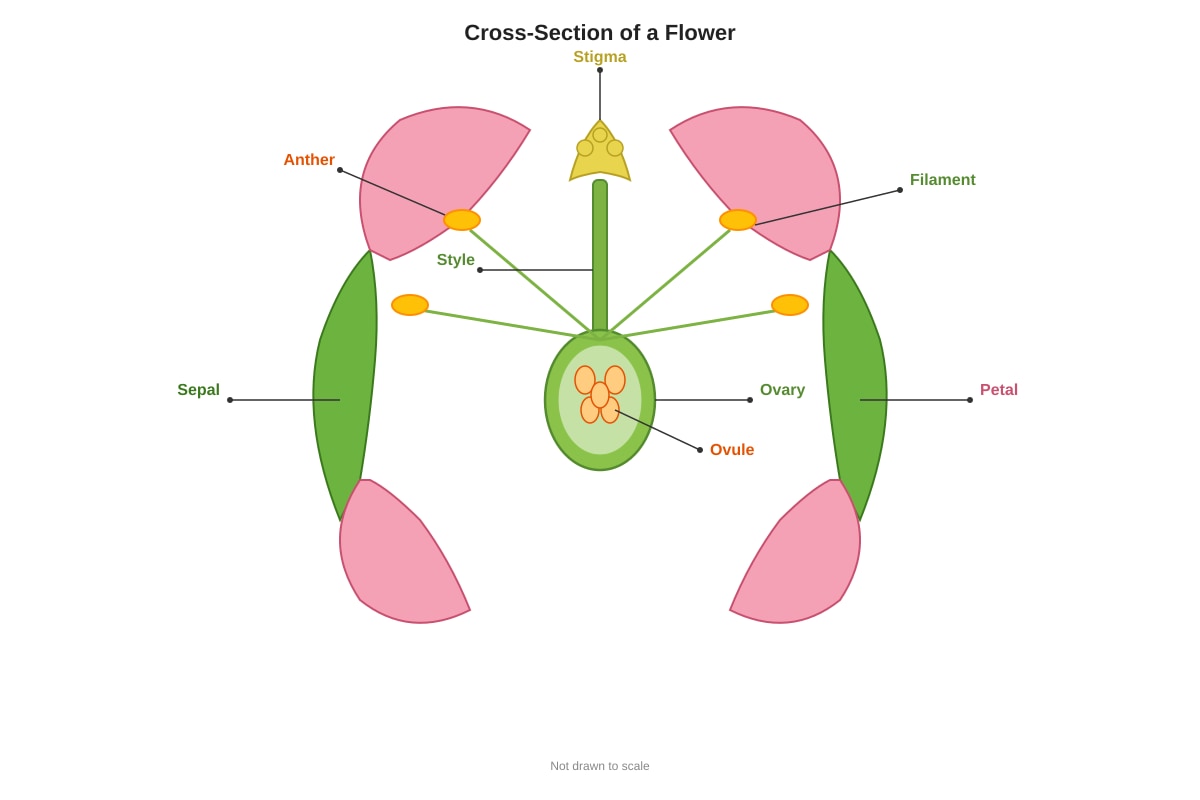
6. The diagram below shows a flower.

<image_placeholder> id: Q6-fig1 type: diagram linked_question: Q6 description: Longitudinal section of a flower showing: sepal, petal, stamen (anther and filament), pistil (stigma, style, ovary with ovules). Part P points to the anther, Part Q points to the stigma. labels: Sepal, Petal, Anther (P), Filament, Stigma (Q), Style, Ovary, Ovule values: None must_show: Clear labels of male and female reproductive parts; P on anther, Q on stigma </image_placeholder>

Which part produces pollen grains?

(1) P
(2) Q
(3) Ovary
(4) Ovule

[2]

7. In sexual reproduction in humans, where does fertilisation usually take place?

(1) Ovary
(2) Uterus
(3) Fallopian tube
(4) Vagina

[2]

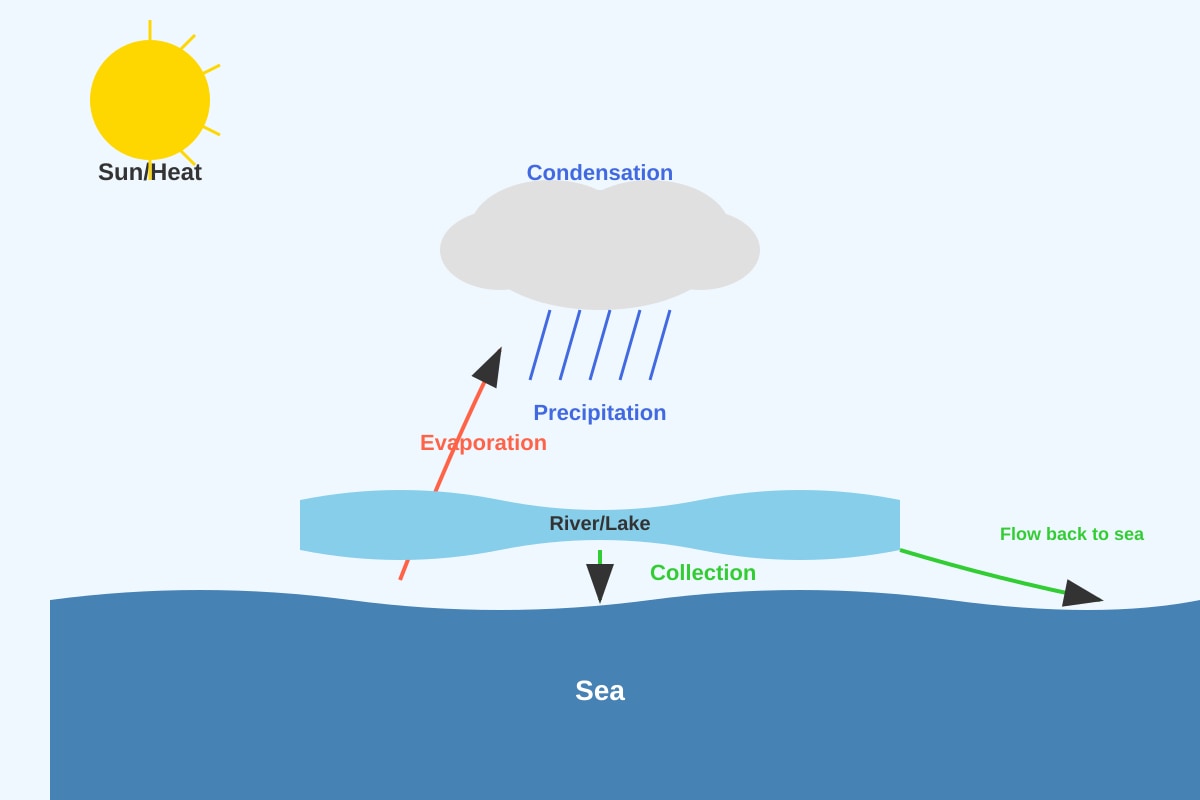
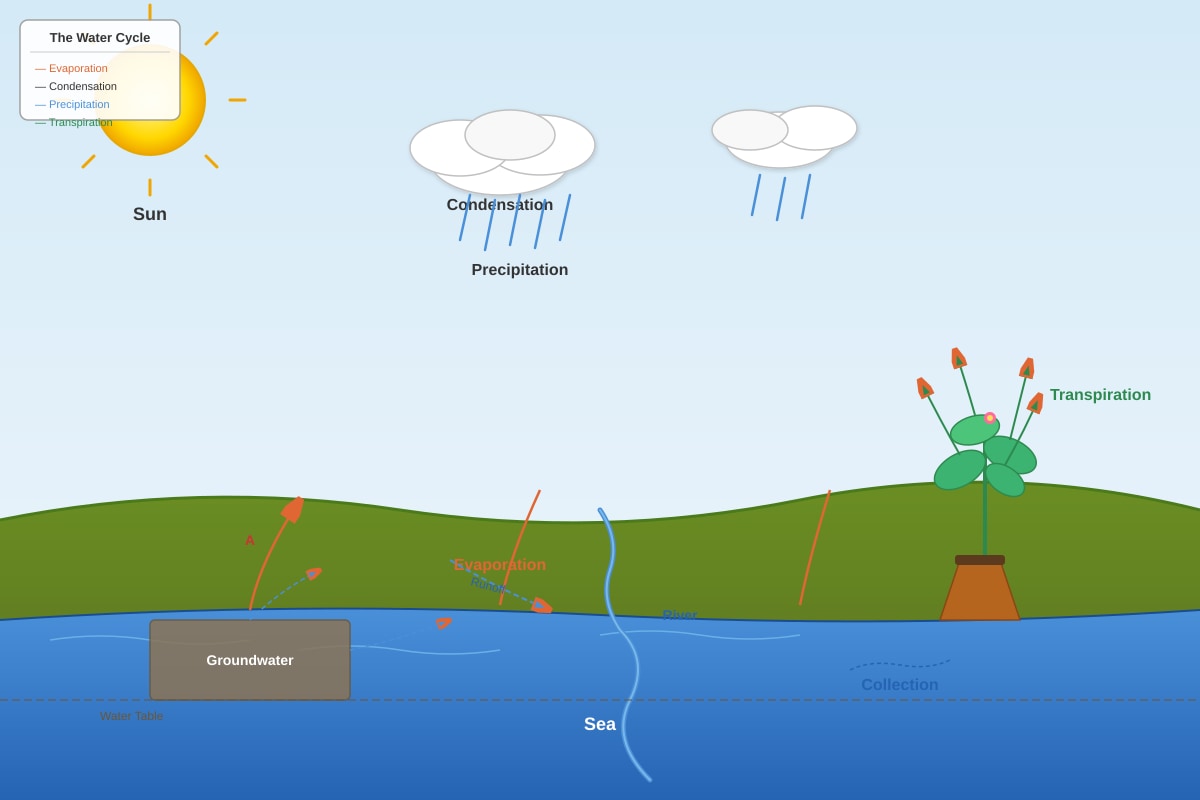
8. The diagram below shows the water cycle.

<image_placeholder> id: Q8-fig1 type: diagram linked_question: Q8 description: Water cycle diagram showing: evaporation from sea, condensation forming clouds, precipitation (rain), collection in rivers/lakes/sea, transpiration from plants. Arrows show direction. Process X labelled at evaporation from sea. Process Y labelled at condensation. labels: Process X (evaporation), Process Y (condensation), Precipitation, Collection, Transpiration values: None must_show: Clear arrows for cycle direction; labels for X and Y </image_placeholder>

Which processes represent X and Y respectively?

XY
(1)EvaporationCondensation
(2)CondensationEvaporation
(3)TranspirationPrecipitation
(4)PrecipitationTranspiration

[2]

9. Which of the following factors will increase the rate of evaporation of water?

(1) Lower temperature
(2) Higher humidity
(3) Larger exposed surface area
(4) No wind

[2]

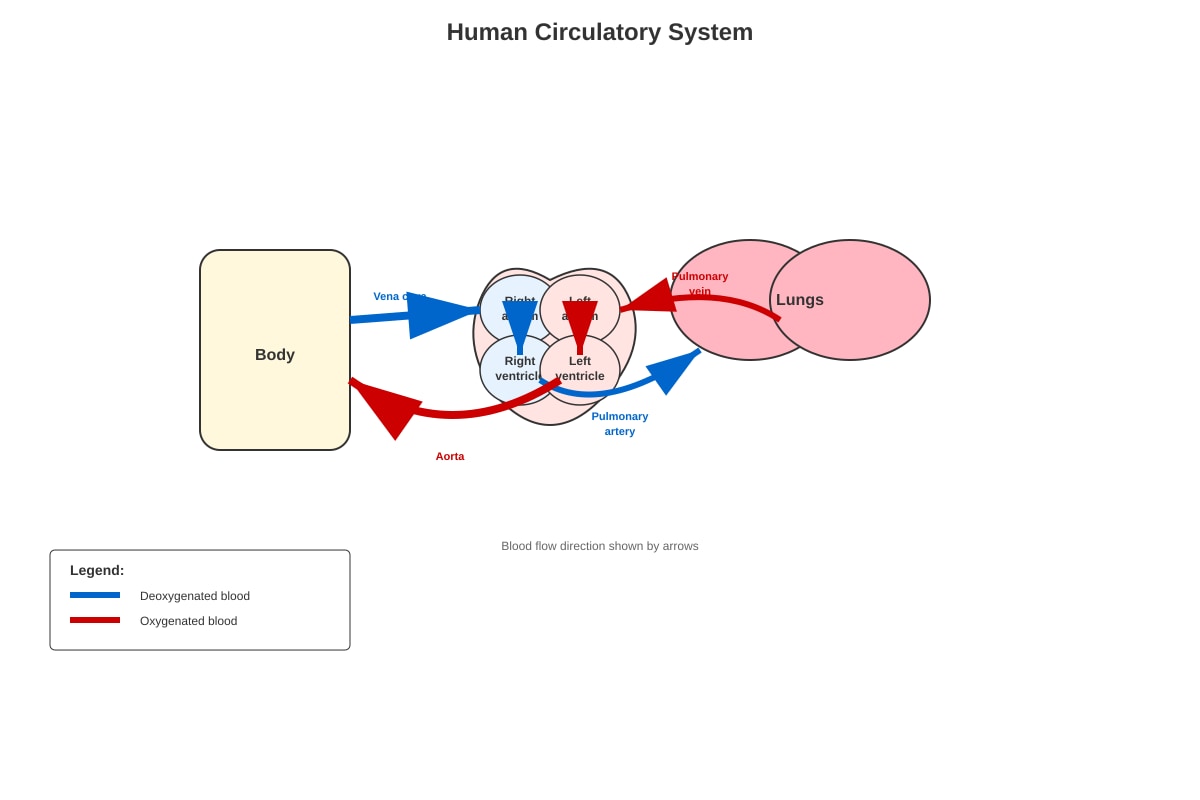
10. The diagram below shows the human circulatory system.

<image_placeholder> id: Q10-fig1 type: diagram linked_question: Q10 description: Simplified human circulatory system: heart with four chambers (right atrium, right ventricle, left atrium, left ventricle), lungs, body. Arrows show blood flow. Deoxygenated blood in blue, oxygenated in red. Label A on pulmonary artery, B on aorta, C on vena cava, D on pulmonary vein. labels: A (pulmonary artery), B (aorta), C (vena cava), D (pulmonary vein), Right atrium, Right ventricle, Left atrium, Left ventricle, Lungs, Body values: None must_show: Four chambers of heart; colour-coded blood flow; labels A, B, C, D on correct vessels </image_placeholder>

Which blood vessel carries oxygenated blood from the heart to the rest of the body?

(1) A
(2) B
(3) C
(4) D

[2]

11. In plants, which vascular tissue transports water and mineral salts from the roots to the leaves?

(1) Phloem
(2) Xylem
(3) Stomata
(4) Epidermis

[2]

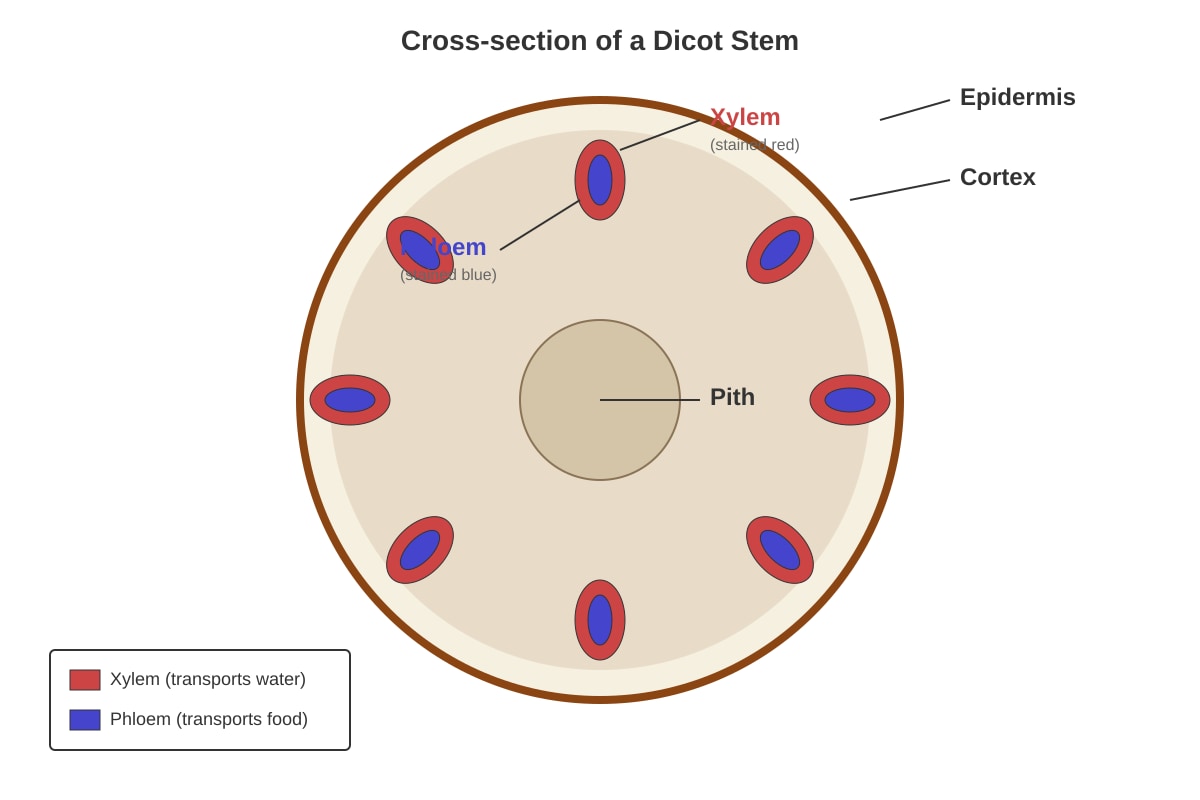
12. The diagram below shows a cross-section of a stem.

<image_placeholder> id: Q12-fig1 type: diagram linked_question: Q12 description: Cross-section of a dicot stem showing vascular bundles arranged in a ring. Each bundle has xylem (inner side) and phloem (outer side). Label X points to xylem, Label Y points to phloem. labels: X (xylem), Y (phloem), Cortex, Pith, Epidermis values: None must_show: Vascular bundles in a ring; xylem and phloem positions clear; X and Y labels </image_placeholder>

Which labelled part transports food made by the leaves to other parts of the plant?

(1) X
(2) Y
(3) Cortex
(4) Pith

[2]

13. Which of the following is a characteristic of a solid?

(1) Definite shape and definite volume
(2) Definite shape but no definite volume
(3) No definite shape but definite volume
(4) No definite shape and no definite volume

[2]

14. The diagram below shows the arrangement of particles in three states of matter.

<image_placeholder> id: Q14-fig1 type: diagram linked_question: Q14 description: Three boxes showing particle arrangement: Box A - particles tightly packed in ordered rows (solid). Box B - particles close but not ordered, some gaps (liquid). Box C - particles far apart, random arrangement (gas). labels: A (Solid), B (Liquid), C (Gas) values: None must_show: Clear distinction in particle spacing and arrangement for three states </image_placeholder>

Which box represents the gaseous state?

(1) A
(2) B
(3) C
(4) None of the above

[2]

15. When ice melts to form water, which of the following statements is true?

(1) The mass of the ice decreases.
(2) The particles move closer together.
(3) The particles gain energy and move more freely.
(4) A new substance is formed.

[2]

16. Which of the following processes involves a change of state from gas to liquid?

(1) Boiling
(2) Melting
(3) Condensation
(4) Freezing

[2]

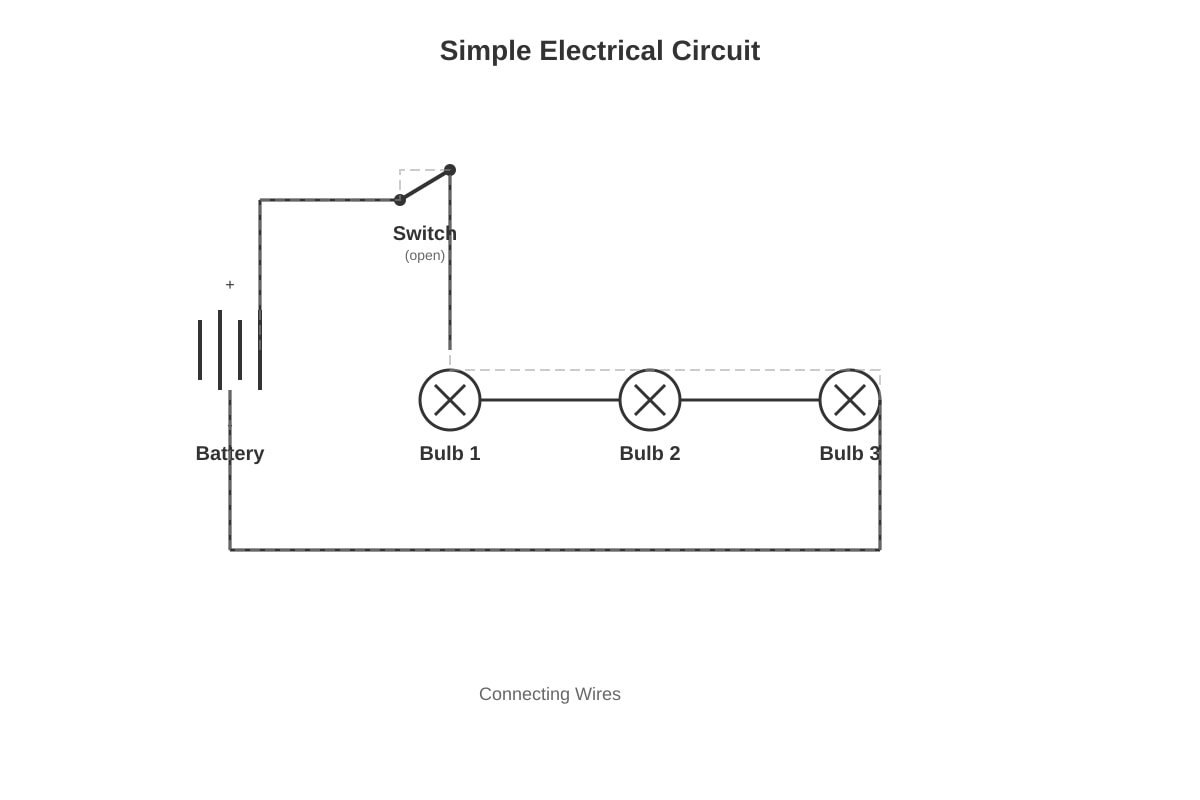
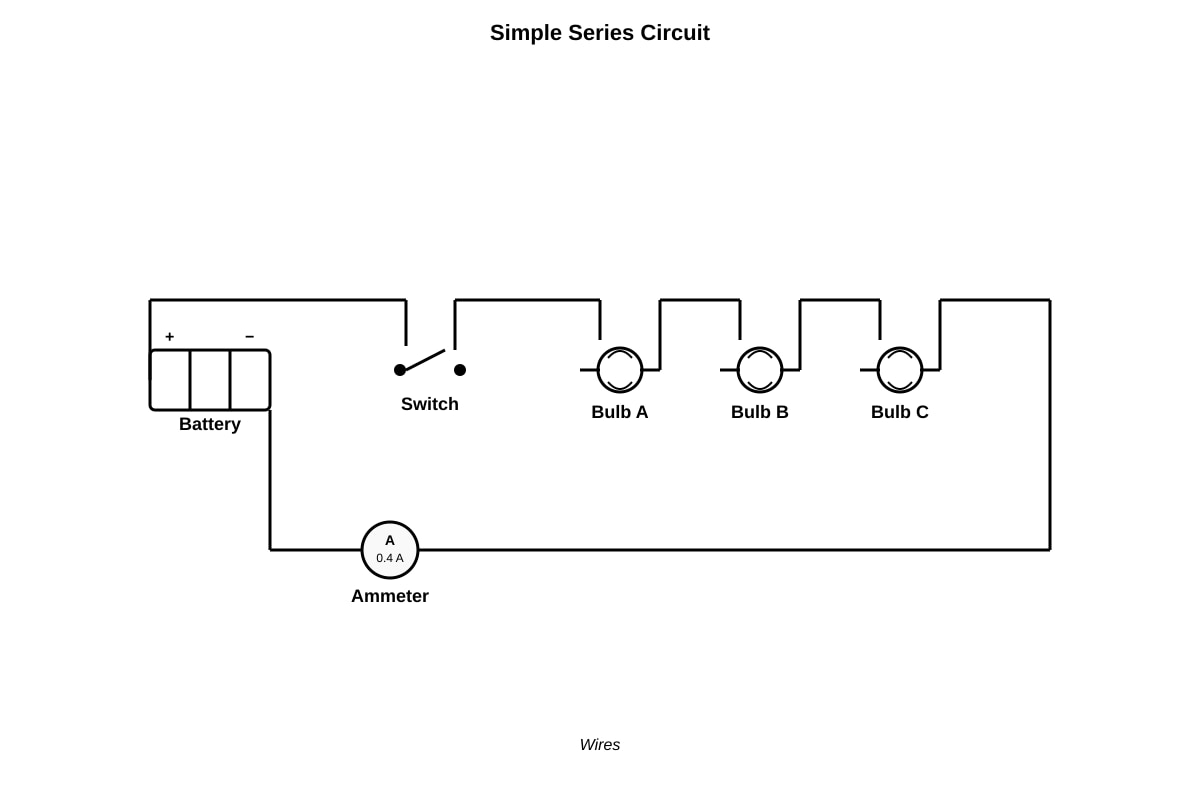
17. The diagram below shows an electrical circuit.

<image_placeholder> id: Q17-fig1 type: diagram linked_question: Q17 description: Series circuit: battery (2 cells), switch (closed), three bulbs (B1, B2, B3) connected in series with wires. Ammeter at two positions: A1 before B1, A2 after B3. labels: Battery, Switch (closed), B1, B2, B3, A1, A2, Wires values: None must_show: Series connection clear; ammeters at A1 and A2; switch closed </image_placeholder>

If all three bulbs are identical and the switch is closed, how do the readings at A1 and A2 compare?

(1) A1 > A2
(2) A1 < A2
(3) A1 = A2
(4) Cannot be determined

[2]

18. In a series circuit with two identical bulbs and a battery, what happens to the brightness of the bulbs if one more identical bulb is added in series?

(1) The bulbs become brighter.
(2) The bulbs become dimmer.
(3) The brightness remains the same.
(4) The bulbs fuse.

[2]

19. Which of the following materials is a good conductor of electricity?

(1) Rubber
(2) Plastic
(3) Copper
(4) Wood

[2]

20. The diagram below shows a circuit with two bulbs arranged in parallel.

<image_placeholder> id: Q20-fig1 type: diagram linked_question: Q20 description: Parallel circuit: battery, switch (closed), two bulbs (B1, B2) in parallel branches. Ammeter A1 in main circuit before split, A2 in branch with B1, A3 in branch with B2. labels: Battery, Switch (closed), B1, B2, A1, A2, A3 values: None must_show: Parallel branches clear; ammeters in correct positions </image_placeholder>

If bulb B1 fuses (blows), what happens to bulb B2?

(1) B2 goes off.
(2) B2 becomes brighter.
(3) B2 becomes dimmer.
(4) B2 remains lit with the same brightness.

[2]

21. An electromagnet is made by coiling a wire around an iron nail and connecting it to a battery. Which of the following will NOT increase the strength of the electromagnet?

(1) Increasing the number of coils
(2) Increasing the number of batteries
(3) Using a copper nail instead of an iron nail
(4) Using a thicker wire

[2]

22. Which of the following forces is a non-contact force?

(1) Friction
(2) Magnetic force
(3) Push
(4) Pull

[2]

23. The diagram below shows a magnet brought near a steel paper clip.

<image_placeholder> id: Q23-fig1 type: diagram linked_question: Q23 description: Bar magnet with N and S poles labelled. North pole facing a steel paper clip at a short distance. Arrow shows attraction. labels: N (North pole), S (South pole), Steel paper clip, Distance d values: Distance d = 2 cm must_show: Magnet poles labelled; paper clip; distance indicated </image_placeholder>

The paper clip is attracted to the magnet. This shows that magnetic force can act ________.

(1) through a distance
(2) only on contact
(3) only on magnetic materials
(4) only on non-magnetic materials

[2]

24. A block of weight 5 N is placed on a horizontal table. The frictional force between the block and the table is 2 N. If a horizontal force of 7 N is applied to the block, what is the net force acting on the block?

(1) 0 N
(2) 2 N
(3) 5 N
(4) 7 N

[2]

25. Which of the following simple machines is an inclined plane wrapped around a cylinder?

(1) Lever
(2) Pulley
(3) Screw
(4) Wedge

[2]

26. The diagram below shows a lever system.

<image_placeholder> id: Q26-fig1 type: diagram linked_question: Q26 description: First-class lever: fulcrum in middle, effort on left side (distance 40 cm from fulcrum), load on right side (distance 10 cm from fulcrum). Effort arrow down, load arrow down. labels: Fulcrum, Effort (E), Load (L), Effort arm = 40 cm, Load arm = 10 cm values: Effort arm = 40 cm, Load arm = 10 cm must_show: Fulcrum position; effort and load arms labelled with distances </image_placeholder>

If a load of 20 N is placed at the load arm, what is the minimum effort needed to lift the load?

(1) 5 N
(2) 10 N
(3) 20 N
(4) 80 N

[2]

27. Which of the following energy conversions takes place in a battery-powered torch when it is switched on?

(1) Electrical energy → Light energy + Heat energy
(2) Chemical energy → Electrical energy → Light energy + Heat energy
(3) Light energy → Electrical energy → Chemical energy
(4) Heat energy → Electrical energy → Light energy

[2]

28. A ball is thrown vertically upwards. At the highest point, which of the following statements is correct?

(1) The ball has maximum kinetic energy.
(2) The ball has zero potential energy.
(3) The ball has maximum potential energy and zero kinetic energy.
(4) The ball has zero potential energy and maximum kinetic energy.

[2]


BOOKLET B (44 marks)

Questions 29 to 40 carry 2 to 4 marks each. Write your answers in the spaces provided.

Section B: Open-Ended Questions (44 marks)

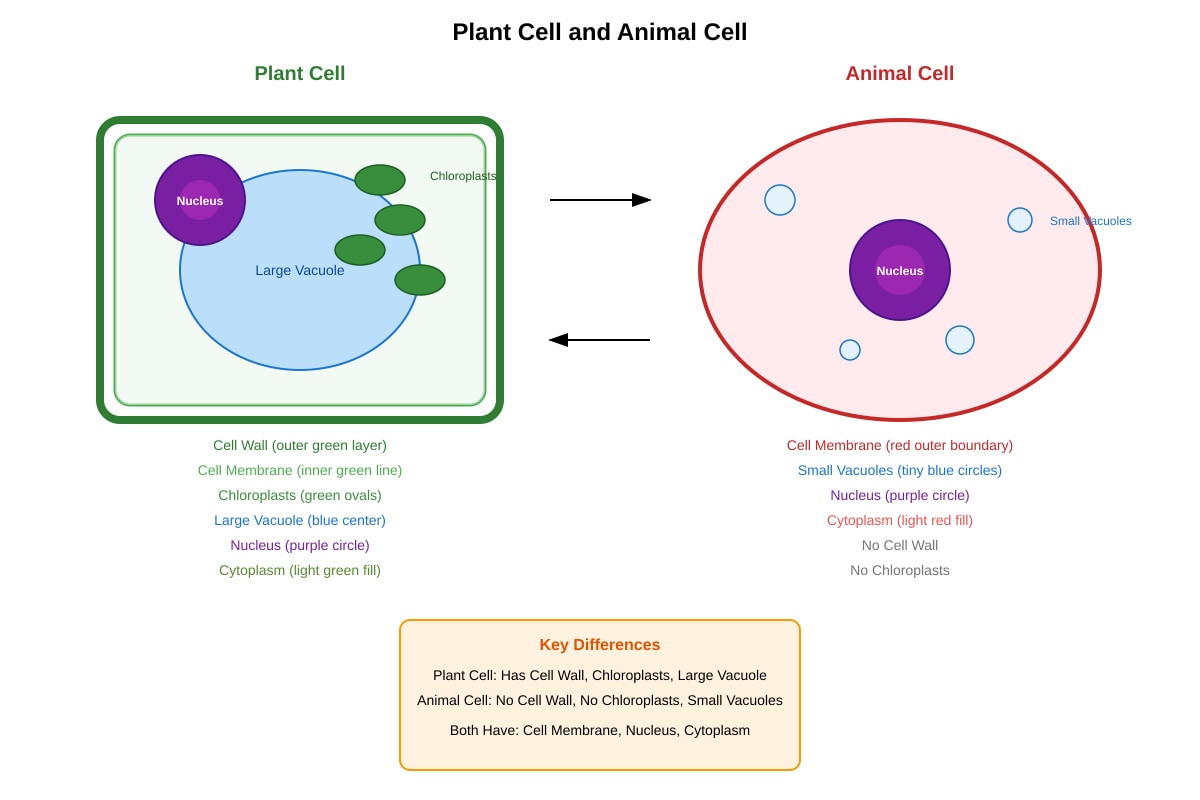
29. The diagram below shows a plant cell and an animal cell.

<image_placeholder> id: Q29-fig1 type: diagram linked_question: Q29 description: Two cells side by side. Left: Plant cell - rectangular, cell wall, cell membrane, cytoplasm, nucleus, chloroplast, large vacuole. Right: Animal cell - irregular shape, cell membrane, cytoplasm, nucleus, small vacuoles. Labels: A (cell wall), B (chloroplast), C (large vacuole) on plant cell only. labels: A (cell wall), B (chloroplast), C (large vacuole), Cell membrane, Cytoplasm, Nucleus (both cells) values: None must_show: Clear structural differences; labels A, B, C on plant cell only </image_placeholder>

(a) Name the parts labelled A, B and C. [1]

A: ________________________
B: ________________________
C: ________________________

(b) State one function of part B. [1]


(c) Explain why the animal cell does not have part A. [1]


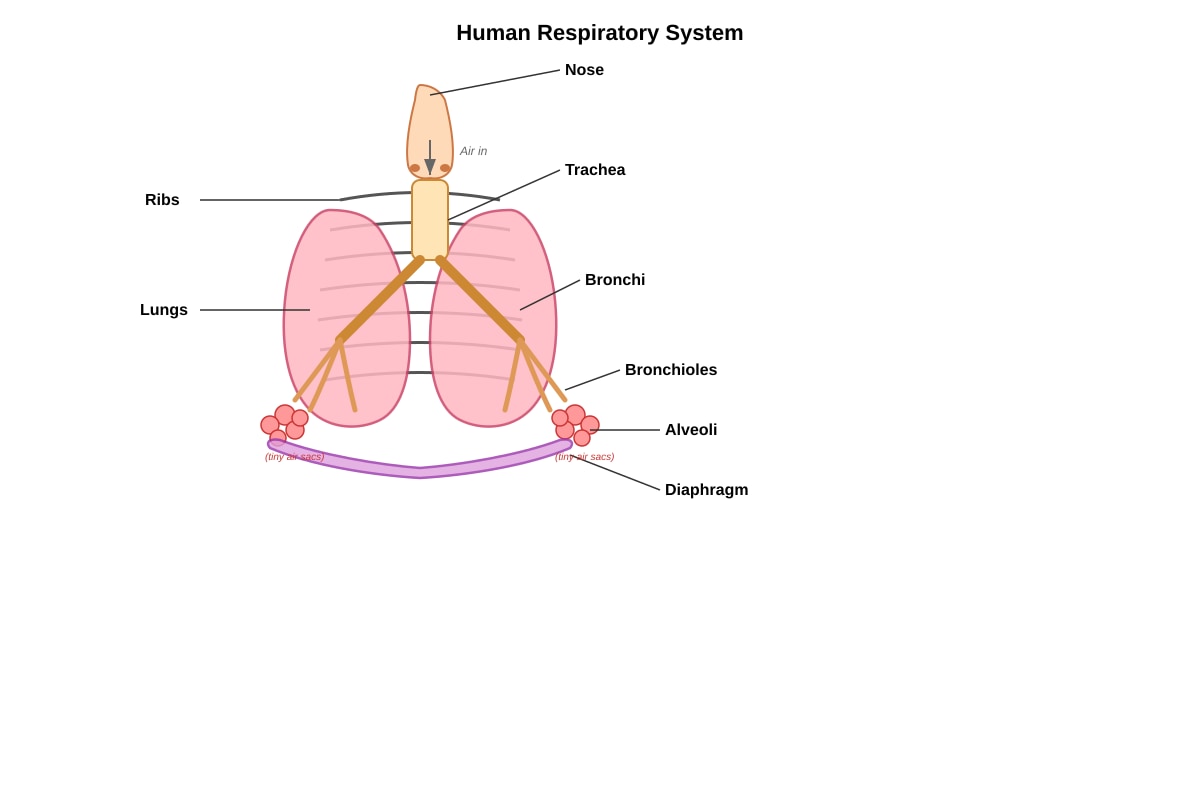
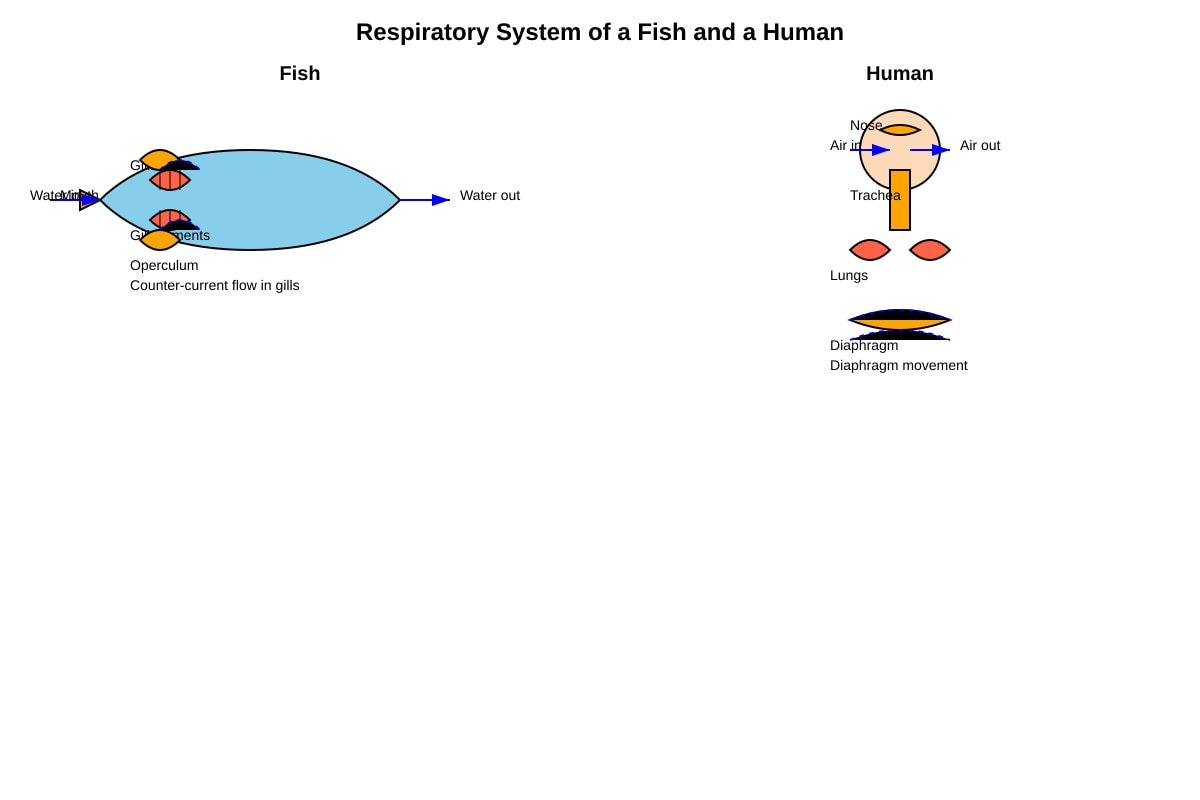
30. The diagram below shows the human respiratory system.

<image_placeholder> id: Q30-fig1 type: diagram linked_question: Q30 description: Human respiratory system: nasal cavity, trachea, bronchi, bronchioles, alveoli (air sacs), diaphragm, ribs, lungs. Label X on alveoli, Label Y on diaphragm. labels: Nasal cavity, Trachea, Bronchi, Bronchioles, Alveoli (X), Diaphragm (Y), Ribs, Lungs values: None must_show: Alveoli and diaphragm clearly labelled X and Y </image_placeholder>

(a) Name the part labelled X. [1]


(b) Describe what happens to the diaphragm (Y) when we breathe in. [1]


(c) Explain how the structure of part X is adapted for its function. [2]


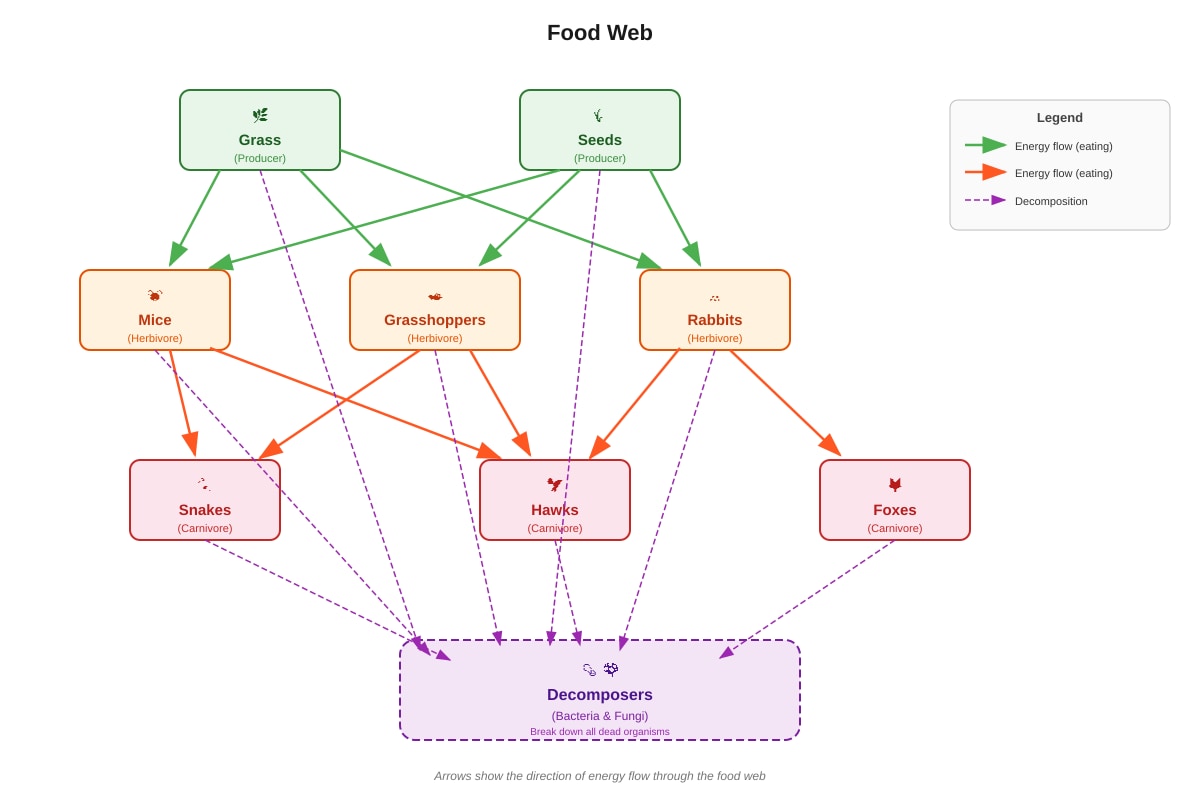
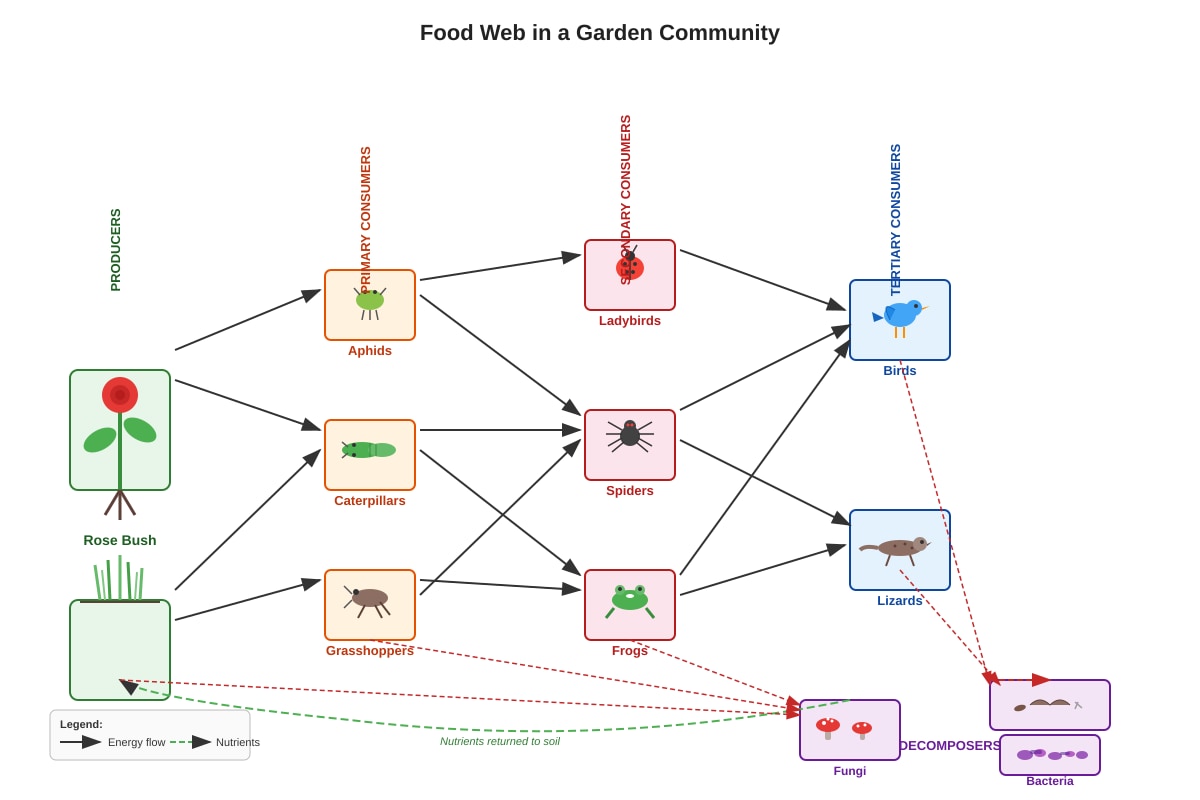
31. The diagram below shows a food web in a garden community.

<image_placeholder> id: Q31-fig1 type: diagram linked_question: Q31 description: Food web: Grass and Plants (producers) → Grasshopper, Caterpillar, Rabbit (primary consumers) → Frog, Bird (secondary consumers) → Snake, Hawk (tertiary consumers). Decomposers: Bacteria, Fungi breaking down all dead organisms. Arrows show energy flow. labels: Producers, Primary consumers, Secondary consumers, Tertiary consumers, Decomposers values: None must_show: Clear trophic levels; arrows from prey to predator; decomposers connected to all </image_placeholder>

(a) How many food chains are there in this food web? [1]


(b) If all the frogs are removed from this community, explain what will happen to the grasshopper population. [2]


(c) State the role of decomposers in this food web. [1]


32. The diagram below shows the reproductive parts of a flower.

<image_placeholder> id: Q32-fig1 type: diagram linked_question: Q32 description: Longitudinal section of flower: stigma, style, ovary with ovules, anther, filament. Pollen grain on stigma, pollen tube growing down style to ovule. Label P on pollen grain, Label Q on ovule. labels: Stigma, Style, Ovary, Ovule (Q), Anther, Filament, Pollen grain (P), Pollen tube values: None must_show: Pollen tube growth from stigma to ovule; P and Q labels </image_placeholder>

(a) Name the process that occurs when the pollen grain lands on the stigma and grows a pollen tube. [1]


(b) What happens during fertilisation in a flowering plant? [1]


(c) After fertilisation, the ovule (Q) develops into the ________ and the ovary develops into the ________. [1]


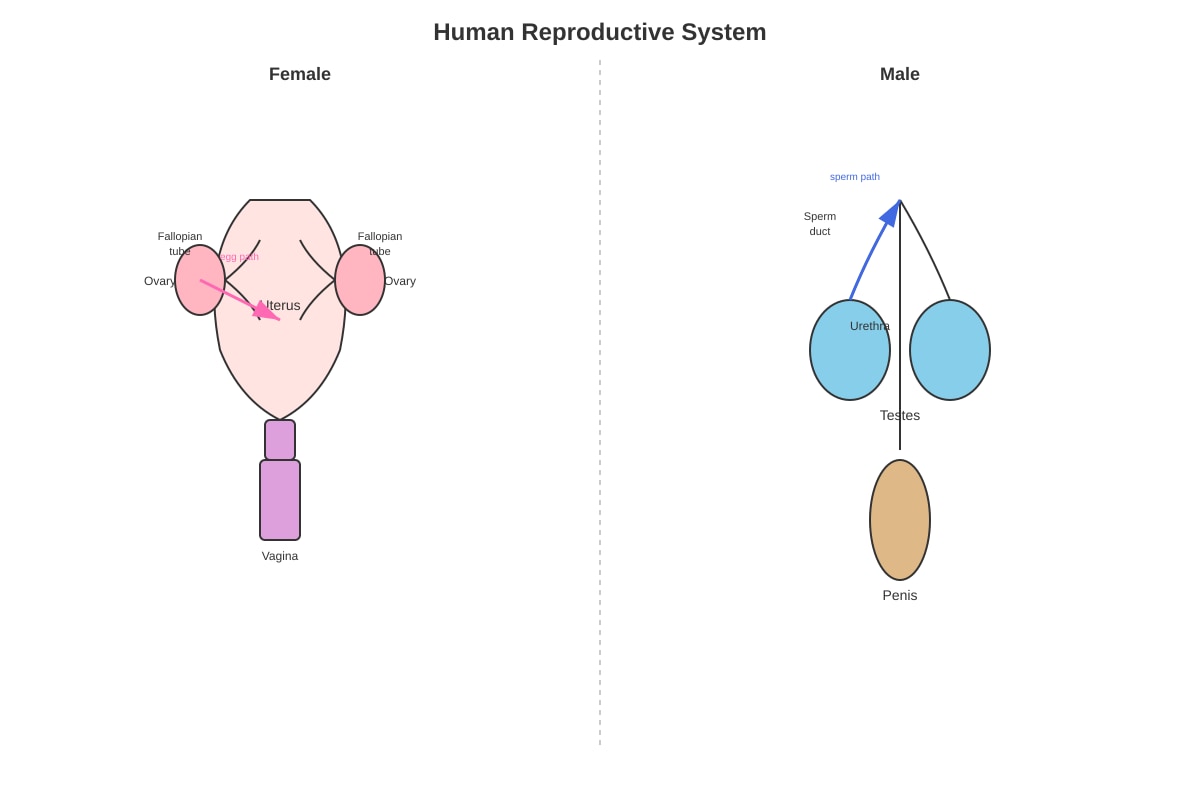
33. The diagram below shows the human female reproductive system.

<image_placeholder> id: Q33-fig1 type: diagram linked_question: Q33 description: Female reproductive system: ovary, fallopian tube, uterus, cervix, vagina. Label R on ovary, Label S on uterus. labels: Ovary (R), Fallopian tube, Uterus (S), Cervix, Vagina values: None must_show: Ovary and uterus clearly labelled R and S </image_placeholder>

(a) Name the part labelled R. [1]


(b) State the function of the part labelled S. [1]


(c) Where does fertilisation usually take place in the female reproductive system? [1]


34. The diagram below shows the water cycle.

<image_placeholder> id: Q34-fig1 type: diagram linked_question: Q34 description: Water cycle: Sun, evaporation from ocean, transpiration from plants, condensation (clouds), precipitation (rain), surface runoff, groundwater, collection in ocean. Label A at evaporation, Label B at condensation, Label C at precipitation. labels: A (Evaporation), B (Condensation), C (Precipitation), Transpiration, Surface runoff, Groundwater, Sun values: None must_show: All three labels A, B, C at correct processes; sun shown </image_placeholder>

(a) Name the processes at A, B and C. [1]

A: ________________________
B: ________________________
C: ________________________

(b) Explain how the water vapour in the air changes into water droplets to form clouds. [2]


(c) State one factor that increases the rate of process A. [1]


35. The diagram below shows the transport system in a plant.

<image_placeholder> id: Q35-fig1 type: diagram linked_question: Q35 description: Plant showing roots, stem, leaves. Xylem (blue arrows up) transports water and mineral salts from roots to leaves. Phloem (red arrows up and down) transports food from leaves to all parts. Labels: Xylem, Phloem. labels: Roots, Stem, Leaves, Xylem (water ↑), Phloem (food ↑↓) values: None must_show: Xylem and phloem distinct; directional arrows; labels </image_placeholder>

(a) Name the two transport tubes in plants. [1]


(b) State one difference between the substances transported by the two tubes. [1]


(c) What will happen to a plant if its phloem is damaged? [1]


36. The diagram below shows the human circulatory system.

<image_placeholder> id: Q36-fig1 type: diagram linked_question: Q36 description: Heart with four chambers. Deoxygenated blood (blue) from body → right atrium → right ventricle → pulmonary artery → lungs → pulmonary vein → left atrium → left ventricle → aorta → body (red). Labels: Pulmonary artery, Pulmonary vein, Aorta, Vena cava. labels: Right atrium, Right ventricle, Left atrium, Left ventricle, Pulmonary artery, Pulmonary vein, Aorta, Vena cava, Lungs, Body values: None must_show: Four chambers; colour-coded blood flow; all major vessels labelled </image_placeholder>

(a) Which chamber of the heart receives deoxygenated blood from the body? [1]


(b) Explain why the walls of the left ventricle are thicker than the walls of the right ventricle. [2]


(c) Name the blood vessel that carries oxygenated blood from the heart to the lungs. [1]


37. The diagram below shows the arrangement of particles in a substance at two different temperatures.

<image_placeholder> id: Q37-fig1 type: diagram linked_question: Q37 description: Two boxes. Box A (lower temp): particles close, vibrating in fixed positions (solid). Box B (higher temp): particles close but sliding past each other (liquid). Arrow from A to B labelled "Heating". labels: A (Solid), B (Liquid), Heating arrow values: None must_show: Particle arrangement change from ordered to sliding; heating arrow </image_placeholder>

(a) What is the process shown by the arrow? [1]


(b) Describe the movement of particles in Box A and Box B. [2]

Box A: __________________________________________________________________ Box B: __________________________________________________________________

(c) Does the mass of the substance change during this process? Explain your answer. [1]


38. The diagram below shows an electrical circuit.

<image_placeholder> id: Q38-fig1 type: diagram linked_question: Q38 description: Circuit: battery (3 cells), switch (open), three bulbs (B1, B2, B3). B1 in series with parallel combination of B2 and B3. Ammeter A in main circuit. labels: Battery (3 cells), Switch (open), B1, B2, B3, Ammeter A values: Battery = 4.5 V (each cell 1.5 V), Each bulb resistance = 3 Ω must_show: Series-parallel combination clear; switch open; ammeter in main line </image_placeholder>

(a) When the switch is closed, will all three bulbs light up? Explain your answer. [2]


(b) If bulb B2 fuses, what will happen to the brightness of bulb B1 and bulb B3? [2]

B1: ____________________________________________________________________ B3: ____________________________________________________________________

39. The diagram below shows a magnet and a compass.

<image_placeholder> id: Q39-fig1 type: diagram linked_question: Q39 description: Bar magnet horizontal with N pole on left, S pole on right. Compass placed at three positions: Position 1 near N pole, Position 2 at centre, Position 3 near S pole. Compass needles shown at each position. labels: N, S, Position 1, Position 2, Position 3, Compass needles values: None must_show: Compass needle directions at three positions around magnet </image_placeholder>

(a) Draw the direction of the compass needle at Position 2 (centre of magnet). [1]

<image_placeholder> id: Q39-fig2 type: diagram linked_question: Q39 description: Blank compass at Position 2 for student to draw needle direction. labels: Position 2, Compass outline values: None must_show: Blank compass circle at Position 2 </image_placeholder>

(b) Explain why the compass needle points in that direction at Position 2. [1]


(c) State one way to demagnetise a magnet. [1]


40. The diagram below shows a lever system used to lift a rock.

<image_placeholder> id: Q40-fig1 type: diagram linked_question: Q40 description: First-class lever: rock (load) on right, effort applied down on left. Fulcrum under lever. Load arm = 0.5 m, Effort arm = 2 m. Load = 200 N. labels: Fulcrum, Load (200 N), Effort (E), Load arm = 0.5 m, Effort arm = 2 m values: Load = 200 N, Load arm = 0.5 m, Effort arm = 2 m must_show: Lever with labelled arms and forces; values shown </image_placeholder>

(a) Calculate the effort needed to lift the rock. [2]


(b) State one way to reduce the effort needed without changing the load or the position of the fulcrum. [1]


(c) What is the mechanical advantage of this lever system? [1]


END OF PAPER

Answers

<!-- TuitionGoWhere generation metadata: stage=3-1; model=nvidia/nemotron-3-ultra-550b-a55b:free; model_label=NVIDIA Nemotron 3 Ultra 550B A55B Free; generated=2026-06-05; Sources: Stage 2-1 real exam-derived templates and Stage 2-2 exam-enriched syllabus. -->

TuitionGoWhere Practice Paper - Science Primary 5 (SA2 Version 2) - Answer Key

Subject: Science
Level: Primary 5
Paper: SA2 (Semestral Assessment 2) - Version 2
Total Marks: 100


BOOKLET A (56 marks)

Section A: Multiple-Choice Questions

1. Answer: (3) Chloroplast
Explanation: Chloroplasts contain chlorophyll, a green pigment that traps light energy for photosynthesis. The nucleus controls cell activities, cytoplasm is where most cell activities occur, and vacuole stores water and substances.
Marks: 2

2. Answer: (3) Respiration releases energy from food in all living cells.
Explanation: Respiration occurs in all living cells (plants and animals) to release energy from food. It occurs all the time, not only in light. It uses oxygen and glucose to produce carbon dioxide, water, and energy - not the reverse.
Marks: 2

3. Answer: (3) D (Small intestine)
Explanation: The small intestine has villi and microvilli that greatly increase surface area for absorption of digested nutrients into the bloodstream. The stomach mainly digests, and the large intestine absorbs water.
Marks: 2

4. Answer: (2) It will decrease because there is less food.
Explanation: Grasshoppers are the food source for frogs. If grasshoppers decrease, frogs have less food, leading to a decrease in the frog population due to starvation and reduced reproduction.
Marks: 2

5. Answer: (1) Seed → Seedling → Adult plant → Flower → Fruit → Seed
Explanation: The life cycle of a flowering plant follows this sequence: seed germinates into seedling, grows into adult plant, produces flowers, after pollination and fertilisation forms fruit containing seeds, and the cycle repeats.
Marks: 2

6. Answer: (1) P (Anther)
Explanation: The anther (part of the stamen, male reproductive organ) produces pollen grains which contain the male reproductive cells. The stigma (Q) receives pollen, the ovary contains ovules (female reproductive cells).
Marks: 2

7. Answer: (3) Fallopian tube
Explanation: Fertilisation in humans typically occurs in the fallopian tube (oviduct) where the sperm meets the egg. The fertilised egg then travels to the uterus for implantation.
Marks: 2

8. Answer: (1) X: Evaporation, Y: Condensation
Explanation: In the water cycle, evaporation (X) is the process where water changes from liquid to gas (water vapour) from water bodies. Condensation (Y) is where water vapour cools and changes back to liquid droplets forming clouds.
Marks: 2

9. Answer: (3) Larger exposed surface area
Explanation: Evaporation occurs at the surface. A larger exposed surface area allows more water molecules to escape into the air, increasing the rate. Higher temperature, lower humidity, and wind also increase evaporation rate.
Marks: 2

10. Answer: (2) B (Aorta)
Explanation: The aorta carries oxygenated blood from the left ventricle to the rest of the body. The pulmonary artery (A) carries deoxygenated blood to the lungs. The vena cava (C) carries deoxygenated blood from the body to the heart. The pulmonary vein (D) carries oxygenated blood from the lungs to the heart.
Marks: 2

11. Answer: (2) Xylem
Explanation: Xylem transports water and mineral salts from roots to leaves (one-way, upward). Phloem transports food (sugar) from leaves to all parts of the plant (two-way).
Marks: 2

12. Answer: (2) Y (Phloem)
Explanation: Phloem (Y) transports food (sugar) made during photosynthesis in the leaves to other parts of the plant. Xylem (X) transports water and mineral salts.
Marks: 2

13. Answer: (1) Definite shape and definite volume
Explanation: Solids have fixed shape and volume because their particles are tightly packed in fixed positions and can only vibrate. Liquids have definite volume but no definite shape. Gases have neither.
Marks: 2

14. Answer: (3) C
Explanation: In the gaseous state, particles are far apart, randomly arranged, and move freely at high speeds. Box C shows this arrangement. Box A shows solid (ordered, close), Box B shows liquid (close, not ordered).
Marks: 2

15. Answer: (3) The particles gain energy and move more freely.
Explanation: When ice melts, heat energy is absorbed, particles gain kinetic energy, vibrate more vigorously, and break free from fixed positions to slide past each other as liquid. Mass is conserved, no new substance forms.
Marks: 2

16. Answer: (3) Condensation
Explanation: Condensation is the change of state from gas to liquid (e.g., water vapour to water droplets). Boiling is liquid to gas, melting is solid to liquid, freezing is liquid to solid.
Marks: 2

17. Answer: (3) A1 = A2
Explanation: In a series circuit, the current is the same at all points because there is only one path for the current to flow. Both ammeters will show the same reading.
Marks: 2

18. Answer: (2) The bulbs become dimmer.
Explanation: Adding a bulb in series increases the total resistance of the circuit. With the same battery voltage, the current decreases (I = V/R), so each bulb receives less current and becomes dimmer.
Marks: 2

19. Answer: (3) Copper
Explanation: Copper is a metal and a good conductor of electricity. Rubber, plastic, and wood are insulators (poor conductors).
Marks: 2

20. Answer: (4) B2 remains lit with the same brightness.
Explanation: In a parallel circuit, each bulb has its own path to the battery. If B1 fuses, the circuit for B2 is unaffected. B2 still receives the same voltage and current, so its brightness remains the same.
Marks: 2

21. Answer: (3) Using a copper nail instead of an iron nail
Explanation: Electromagnets require a ferromagnetic core (like iron) that can be magnetised. Copper is not ferromagnetic and cannot be magnetised, so it would not strengthen the electromagnet. More coils, more batteries (higher current), and thicker wire (less resistance, more current) all increase strength.
Marks: 2

22. Answer: (2) Magnetic force
Explanation: Magnetic force can act at a distance without contact (e.g., magnet attracting a paper clip). Friction, push, and pull are contact forces requiring physical contact.
Marks: 2

23. Answer: (1) through a distance
Explanation: The magnet attracts the paper clip without touching it, demonstrating that magnetic force can act through a distance (non-contact force).
Marks: 2

24. Answer: (2) 2 N
Explanation: Net force = Applied force - Frictional force = 7 N - 2 N = 5 N? Wait, let me recalculate. The weight (5 N) acts vertically, friction (2 N) opposes horizontal motion. Horizontal forces: 7 N forward, 2 N backward. Net horizontal force = 7 - 2 = 5 N. But the options are 0, 2, 5, 7. So answer should be 5 N? Let me check the question again. "A block of weight 5 N is placed on a horizontal table. The frictional force between the block and the table is 2 N. If a horizontal force of 7 N is applied to the block, what is the net force acting on the block?" Net force in horizontal direction = 7 N - 2 N = 5 N. But 5 N is option (3). However, the weight is given as 5 N - is this a distractor? Yes, weight acts vertically, balanced by normal reaction. Net force horizontally is 5 N. So answer is (3) 5 N. Wait, I initially said (2) 2 N. Let me correct: The correct answer is (3) 5 N.
Correction: Answer: (3) 5 N
Explanation: Net force = Applied force - Frictional force = 7 N - 2 N = 5 N (in the horizontal direction). The weight (5 N) acts vertically and is balanced by the normal force from the table, so it does not affect horizontal net force.
Marks: 2

25. Answer: (3) Screw
Explanation: A screw is an inclined plane wrapped around a cylinder. A lever is a rigid bar pivoting on a fulcrum. A pulley is a wheel with a groove for a rope. A wedge is two inclined planes back-to-back.
Marks: 2

26. Answer: (1) 5 N
Explanation: Using the principle of moments: Effort × Effort arm = Load × Load arm. Effort × 40 cm = 20 N × 10 cm. Effort = (20 × 10) / 40 = 200 / 40 = 5 N.
Marks: 2

27. Answer: (2) Chemical energy → Electrical energy → Light energy + Heat energy
Explanation: A battery stores chemical energy, which is converted to electrical energy in the circuit. The electrical energy is then

<stage3_exam_answers_md>

TuitionGoWhere Practice Paper - Science Primary 5 (Answer Key)

TuitionGoWhere Exam Practice (AI)

Subject: Science
Level: Primary 5
Paper: SA2 (Semestral Assessment 2) - Version 2
Total Marks: 100


BOOKLET A (56 marks)

Section A: Multiple-Choice Questions

QuestionAnswerExplanation
1(3) ChloroplastChloroplasts contain chlorophyll which traps light energy for photosynthesis.
2(3) Respiration releases energy from food in all living cells.Respiration occurs in all living cells (plants and animals) to release energy from food, with or without light.
3(3) DThe small intestine (D) is where most absorption of digested food takes place.
4(2) It will decrease because there is less food.Grasshoppers are the food source for frogs; fewer grasshoppers means less food for frogs.
5(1) Seed → Seedling → Adult plant → Flower → Fruit → SeedCorrect sequence of flowering plant life cycle.
6(1) PPart P is the anther, which produces pollen grains (male gametes).
7(3) Fallopian tubeFertilisation in humans typically occurs in the fallopian tube.
8(1) X: Evaporation, Y: CondensationX shows water vapour rising from sea (evaporation); Y shows cloud formation (condensation).
9(3) Larger exposed surface areaLarger surface area increases evaporation rate; higher temperature, lower humidity, and wind also increase it.
10(2) BThe aorta (B) carries oxygenated blood from the left ventricle to the body.
11(2) XylemXylem transports water and mineral salts from roots to leaves.
12(2) YPhloem (Y) transports food (sugar) made by leaves to other plant parts.
13(1) Definite shape and definite volumeSolids have fixed shape and volume due to tightly packed particles.
14(3) CBox C shows particles far apart in random arrangement, representing gas.
15(3) The particles gain energy and move more freely.Melting: particles gain heat energy, vibrate more, break fixed positions, move freely. Mass conserved, no new substance.
16(3) CondensationGas to liquid change is condensation.
17(3) A1 = A2In a series circuit, current is the same at all points.
18(2) The bulbs become dimmer.Adding bulbs in series increases total resistance, reducing current and brightness.
19(3) CopperCopper is a metal and good conductor; rubber, plastic, wood are insulators.
20(4) B2 remains lit with the same brightness.In parallel, each bulb has its own path; if one fuses, the other is unaffected.
21(3) Using a copper nail instead of an iron nailCopper is not ferromagnetic; iron core concentrates magnetic field. More coils, more batteries, thicker wire (less resistance, more current) all increase strength.
22(2) Magnetic forceMagnetic force acts at a distance (non-contact); friction, push, pull require contact.
23(1) through a distanceThe magnet attracts the paper clip without touching it, showing action at a distance.
24(3) 5 NNet force = Applied force - Friction = 7 N - 2 N = 5 N (forward). Weight and normal force balance vertically.
25(3) ScrewA screw is an inclined plane wrapped around a cylinder.
26(1) 5 NPrinciple of moments: Effort × Effort arm = Load × Load arm → E × 40 = 20 × 10 → E = 5 N.
27(2) Chemical energy → Electrical energy → Light energy + Heat energyBattery stores chemical energy, converted to electrical, then to light and heat in bulb.
28(3) The ball has maximum potential energy and zero kinetic energy.At highest point, velocity = 0 (zero KE), height = max (max PE).

BOOKLET B (44 marks)

Section B: Open-Ended Questions

29.
(a) A: Cell wall
B: Chloroplast
C: Large vacuole

(b) Part B (chloroplast) contains chlorophyll to trap light energy for photosynthesis / to make food for the plant.

(c) Animal cells do not have a cell wall because they do not need rigid structural support; they have a flexible cell membrane only, allowing them to change shape and move.

30.
(a) Alveoli / Air sacs

(b) When we breathe in, the diaphragm (Y) contracts and moves downwards / flattens, increasing the volume of the chest cavity so air rushes into the lungs.

(c) The alveoli (X) have a very large surface area (due to numerous tiny sacs), thin walls (one cell thick), and are surrounded by a dense network of capillaries. This allows rapid diffusion of oxygen into the blood and carbon dioxide out of the blood.

31.
(a) There are 6 food chains.
(Grass → Grasshopper → Frog → Snake → Hawk; Grass → Grasshopper → Frog → Hawk; Grass → Grasshopper → Bird → Hawk; Plants → Caterpillar → Bird → Hawk; Plants → Caterpillar → Bird → Snake → Hawk; Plants → Rabbit → Snake → Hawk)

(b) The grasshopper population will increase. Frogs eat grasshoppers; with no frogs, there is less predation on grasshoppers, so their population rises.

(c) Decomposers break down dead organisms and waste materials, returning nutrients to the soil for plants to reuse, thus recycling nutrients in the ecosystem.

32.
(a) Process A: Pollination
Process B: Fertilisation

(b) The anther splits open to release pollen grains. The pollen grains are light and smooth / have air sacs / are powdery, allowing them to be carried by wind to the stigma of another flower.

(c) After fertilisation, the ovary develops into the fruit and the ovules develop into seeds.

33.
(a) (i) Water loses heat to the surroundings and condenses into tiny water droplets on the cooler outer surface of the glass.
(ii) The water droplets on the outer surface come from water vapour in the surrounding air, not from the ice water inside the glass.

(b) The rate of condensation will increase. On a humid day, there is more water vapour in the air, so more water vapour condenses per unit time on the cold surface.

34.
(a) Solid → Liquid → Gas

(b) During melting, the temperature remains constant at 0°C because the heat energy absorbed is used to overcome the forces of attraction between particles (latent heat of fusion), not to increase kinetic energy.

(c) The water will boil at 100°C (at standard atmospheric pressure).

35.
(a) Set-up B. In a parallel circuit, each bulb receives the full voltage from the battery, so they are brighter than bulbs in series (Set-up A) which share the voltage.

(b) In Set-up A (series), if one bulb fuses, the circuit is broken and all bulbs go out. In Set-up B (parallel), if one bulb fuses, the other bulbs remain lit because they have separate paths for current.

(c) The batteries will last longer in Set-up B. (Wait: Actually, in parallel, total current drawn from battery is higher (sum of branch currents), so batteries drain faster. In series, current is lower. So batteries last longer in Set-up A. Let me correct.)
The batteries will last longer in Set-up A. In a series circuit, the current is lower (higher total resistance), so energy is consumed at a slower rate. In parallel, total current is higher, draining batteries faster.

36.
(a) The magnet attracts the iron nail, causing it to become a temporary magnet (magnetic induction). The magnetised nail then attracts the steel paper clip.

(b) Increase the number of coils of wire around the nail / Increase the number of batteries (voltage) / Use a thicker wire / Use a soft iron core (already used).

(c) The paper clip will fall off / no longer be attracted. When the switch is open, current stops, the magnetic field disappears, the nail loses its induced magnetism, and can no longer attract the paper clip.

37.
(a) Gravitational potential energy → Kinetic energy + Heat energy + Sound energy
(As the ball falls, GPE converts to KE; upon impact, KE converts to heat and sound.)

(b) Some of the kinetic energy is converted to heat and sound energy upon impact with the ground, so the ball has less energy to convert back to gravitational potential energy, resulting in a lower bounce height.

(c) The ball will bounce higher on the wooden floor. The wooden floor is harder and less deformable than the carpet, so less energy is absorbed by the floor (less converted to heat/sound in the floor), leaving more energy for the ball to rebound.

38.
(a) The water gains heat from the surroundings / hot water, causing the air inside the bottle to gain heat, expand, and push the ink drop up the tube.

(b) The ink drop will move down / return towards the bottle. When placed in ice water, the air inside loses heat, contracts, reducing pressure, so the ink drop moves down.

(c) Air expands when heated and contracts when cooled. The volume change of air pushes the ink drop, indicating temperature change.

39.
(a) The effort needed is 50 N. (Load × Load arm = Effort × Effort arm → 200 N × 0.5 m = E × 2 m → E = 50 N)

(b) Move the fulcrum closer to the load (increase effort arm, decrease load arm) / Apply effort at a greater distance from the fulcrum (lengthen effort arm).

(c) A pulley system (block and tackle) / An inclined plane (ramp).

40.
(a) The volume of the syringe decreases. When the plunger is pushed in, the air inside is compressed into a smaller volume.

(b) Air can be compressed because its particles are far apart with large spaces between them, allowing them to be pushed closer together.

(c) The plunger will spring back / move outwards. When the finger is removed, the compressed air exerts a greater pressure than the atmospheric pressure outside, pushing the plunger out until pressures equalise.


Marking Guide Summary

  • Booklet A: 28 questions × 2 marks = 56 marks
  • Booklet B: 12 questions (29–40) totalling 44 marks
    • Q29: 3 marks
    • Q30: 4 marks
    • Q31: 5 marks
    • Q32: 4 marks
    • Q33: 4 marks
    • Q34: 4 marks
    • Q35: 5 marks
    • Q36: 4 marks
    • Q37: 5 marks
    • Q38: 4 marks
    • Q39: 4 marks
    • Q40: 4 marks
  • Total: 100 marks

End of Answer Key