From Real Exams Exam Paper
Primary 5 Science Semestral Assessment 2 (End of Year) Paper 2
Free P5 Science SA2 Paper 2, HY3 Exam version, with questions, answers, and syllabus-aligned practice for Singapore students.
These static practice materials are generated from the site's syllabus and paper-generation workflow, with source and model context shown so students and parents can evaluate the material before use.
Questions
TuitionGoWhere Exam Practice (AI) — Science Primary 5
SA2 Practice Paper — Version 2
School: TuitionGoWhere Exam Practice (AI) Subject: Science Level: Primary 5 Paper: SA2 Practice (Version 2 of 5) Duration: 60 minutes Total Marks: 60
Name: ______________________ Class: ______________________ Date: ______________________
Instructions:
- This paper contains 20 questions on the topic of Diversity.
- Section A: 10 multiple-choice questions (1 mark each).
- Section B: 6 short-answer questions (2 marks each).
- Section C: 4 structured questions (1 × 3 marks, 3 × 4 marks).
- Write your answers clearly in the spaces provided.
- Marks for each question are shown at the end.
Section A (10 marks)
Choose the correct answer. (1 mark each)
-
Which of the following is a way to group living things based on diversity? A. By the colour of their school bags B. By whether they have backbones C. By the number of books they read D. By their favourite food [ ]
-
Which group of animals are vertebrates? A. Insects B. Worms C. Fish D. Jellyfish [ ]
-
A mango tree and a fern are both plants. How are they different in reproduction? A. Mango tree reproduces from seeds, fern reproduces from spores B. Both reproduce from spores C. Both reproduce from seeds D. Mango tree reproduces from spores, fern from seeds [ ]
-
Which of the following is NOT a characteristic used to show diversity among living things? A. Body covering B. Number of legs C. Type of phone used D. How they reproduce [ ]
-
Fungi such as mushrooms are grouped separately from plants because they A. can move from place to place B. do not make their own food using sunlight C. have backbones D. reproduce using seeds [ ]
-
Which of these is an example of a microorganism? A. Elephant B. Bacteria C. Sunflower D. Eagle [ ]
-
We can show diversity of animals by grouping them into those with and without A. hair B. backbones C. tails D. ears [ ]
-
Which of the following pairs are both non-flowering plants? A. Rose and orchid B. Fern and moss C. Tomato and papaya D. Grass and tulip [ ]
-
Diversity in nature is important because A. it makes the environment look messy B. different living things play different roles to keep nature balanced C. only one type of animal is needed D. it reduces the number of plants [ ]
-
Which statement about classification is correct? A. Classification hides differences among living things B. Classification helps us organise living things by their features C. Only animals can be classified D. Classification is not useful in science [ ]
Section B (12 marks)
Answer the following. (2 marks each)
-
Name two groups of animals based on the presence of a backbone, and give one example for each.
-
State one difference between flowering plants and non-flowering plants.
-
List two characteristics that can be used to show diversity among animals.
-
Explain why bacteria are considered microorganisms.
-
Give one example of a fungus and state how it is different from a green plant.
-
Why do scientists group living things into categories?
Section C (38 marks)
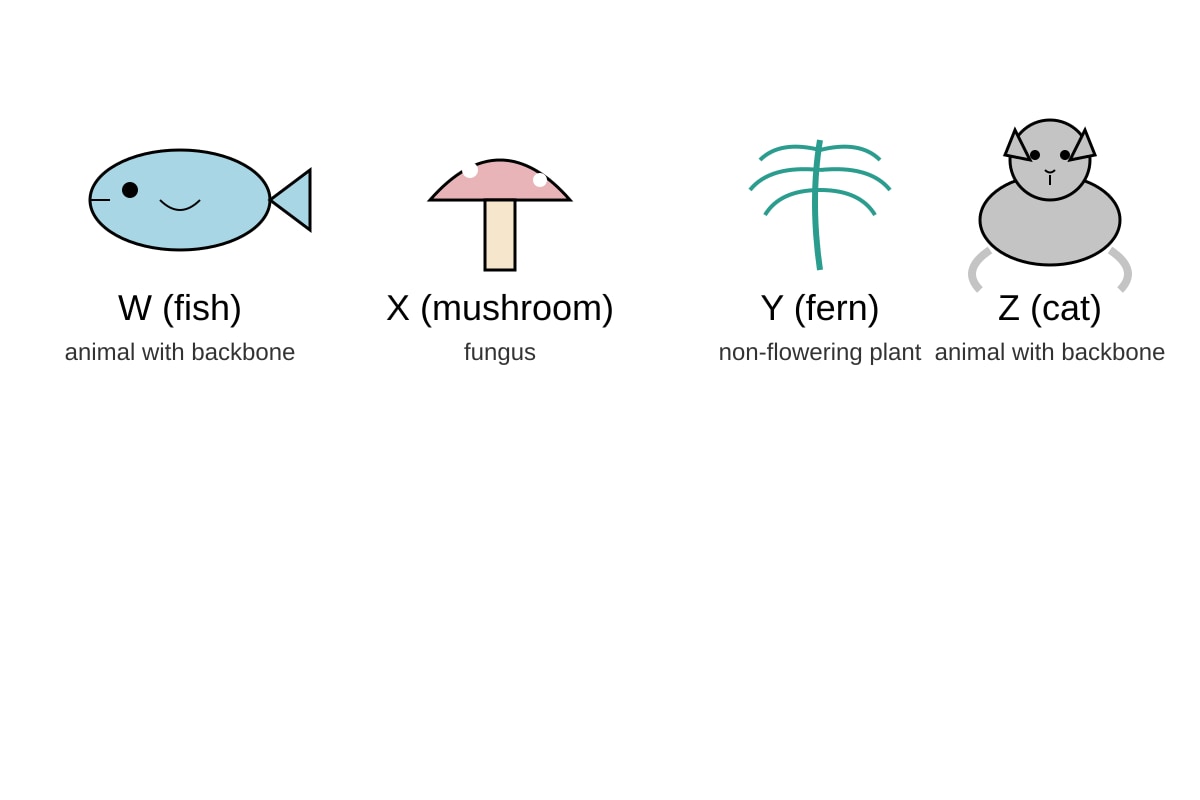
Question 17 (3 marks) 17. The diagram below shows four living things labelled W, X, Y and Z.
Image pending generation: diagram for Q17.
(a) Which two are animals? ______ and ______ (1 mark) (b) Which one is a non-flowering plant? ______ (1 mark) (c) Which one is a fungus? ______ (1 mark)
Question 18 (4 marks) 18. A student collected the following living things from a park: a lizard, a rose bush, a mushroom, and a fern. (a) Group them into plants and animals. (2 marks) (b) Among the plants, state which are flowering and which are non-flowering. (2 marks)
Question 19 (4 marks) 19. Complete the table to show how living things can be grouped by diversity.
| Group | Example | Feature used |
|---|---|---|
| Vertebrates | ______ | has backbone |
| Invertebrates | ______ | ______ |
| Flowering plants | ______ | ______ |
| Non-flowering plants | ______ | ______ |
(4 marks: 1 for each correct row completion)
Question 20 (4 marks) 20. Explain how we can use diversity to classify a butterfly, a bacteria, a tomato plant, and a dog. (a) Which are animals? Why? (2 marks) (b) Which are plants? Which is a microorganism? (2 marks)
Answers
TuitionGoWhere Exam Practice (AI) — Science Primary 5
SA2 Practice Paper — Version 2: Answer Key
Total Marks: 60
Section A (10 marks)
-
B — By whether they have backbones. (1 mark) Teaching note: Diversity means variety. Scientists group living things by real biological features such as presence of backbone, not by human objects.
-
C — Fish. (1 mark) Fish have backbones, so they are vertebrates. Insects, worms, jellyfish do not.
-
A — Mango tree reproduces from seeds, fern from spores. (1 mark) Flowering plants (mango) use seeds; non-flowering plants (fern) use spores.
-
C — Type of phone used. (1 mark) Phone is not a biological feature; others are valid diversity traits.
-
B — do not make their own food using sunlight. (1 mark) Fungi absorb food; plants make food by photosynthesis.
-
B — Bacteria. (1 mark) Bacteria are tiny living things seen only under microscope = microorganisms.
-
B — backbones. (1 mark) Vertebrates/invertebrates split is by backbone.
-
B — Fern and moss. (1 mark) Both are non-flowering; others are flowering.
-
B — different living things play different roles to keep nature balanced. (1 mark)
-
B — Classification helps us organise living things by their features. (1 mark)
Section B (12 marks)
-
(2 marks: 1 for each group + example) Vertebrates — e.g. cat; Invertebrates — e.g. insect. Teaching: Backbone presence is a main diversity divider.
-
(2 marks) Flowering plants produce flowers and seeds; non-flowering do not produce flowers (e.g. use spores). (1 for each side)
-
(2 marks) Any two: body covering (feathers, scales), number of legs, presence of backbone, how they reproduce. (1 each)
-
(2 marks) Bacteria are too small to be seen with eyes alone (1) and are living things studied as microorganisms (1).
-
(2 marks) Example: mushroom (1). Different: does not make food using sunlight / not green (1).
-
(2 marks) To organise them by features (1) and study similarities/differences (1).
Section C (38 marks)
-
(3 marks) (a) W and Z (fish, cat) (1) (b) Y (fern) (1) (c) X (mushroom) (1) Image note: W/Z drawn with backbone hint, X cap-stem fungus, Y leafy non-flower.
-
(4 marks) (a) Animals: lizard; Plants: rose bush, mushroom, fern (2: 1 for animal, 1 for plant list) (b) Flowering: rose bush; Non-flowering: mushroom (fungus), fern (2: 1 each) Teaching: Mushroom is fungus, not plant, but commonly grouped separately from flowering plants in P5 diversity.
-
(4 marks) Vertebrates — e.g. cat — has backbone Invertebrates — e.g. worm — no backbone Flowering plants — e.g. rose — produces flowers/seeds Non-flowering plants — e.g. fern — no flowers/spores (1 mark per cell correctly filled)
-
(4 marks) (a) Animals: butterfly, dog (1). Because they are living things that move and do not make their own food (1). (b) Plants: tomato plant (1). Microorganism: bacteria (1). Teaching: Diversity classification uses size, structure, reproduction.
Free quiz and exam paper access
Enter your details to view this paper
Your access is remembered on this device.