TuitionGoWhere Practice Paper - Science Primary 5
TuitionGoWhere Exam Practice (AI)
Subject: Science
Level: Primary 5
Paper: SA2 Practice Paper — Theme: Diversity (Version 2 of 5)
Duration: 60 minutes
Total Marks: 50
Name: ______________________ Class: ____________ Date: ____________
Instructions
- Answer ALL 20 questions.
- Section A: Write the letter (A, B, C or D) of your answer in the space provided.
- Sections B and C: Write your answers in the spaces given.
- The marks for each question or part-question are shown in brackets.
- Check your work before handing in the paper.
Section A: Multiple-Choice (Questions 1–10, 20 marks)
Each question carries 2 marks.
1. Which characteristic is used to place an animal in the mammal group?
A It lays eggs.
B Its body is covered with dry scales.
C It has hair and its young drink its milk.
D It breathes through gills.
Answer: __________ [2]
2. The table shows information about four animals.
| Animal | Body covering | Reproduction |
|---|
| P | Feathers | Lays eggs |
| Q | Dry scaly skin | Lays eggs |
| R | Hair | Gives birth to live young |
| S | Wet, smooth skin | Lays eggs |
Which animal is a reptile?
A P B Q C R D S
Answer: __________ [2]
3. Organism X is made of many cells. It cannot make its own food. It grows on damp, decaying logs and reproduces by spores. Into which group is X classified?
A Plants B Animals C Fungi D Bacteria
Answer: __________ [2]
4. Which statement is true for ALL living things?
A They all make their own food.
B They all respond to changes around them.
C They all move from place to place.
D They all give birth to live young.
Answer: __________ [2]
5. A science club sorted some animals into two groups, G and H, using one characteristic only.
- Group G: shark, eagle, rabbit, snake
- Group H: ant, earthworm, snail
What was the characteristic used?
A What the animal eats
B Whether the animal has a backbone
C Where the animal lives
D The number of legs the animal has
Answer: __________ [2]
6. Mei wants to make a cover for her school file. The cover must bend easily without breaking and must keep rain out. Which material is most suitable?
A Hard board B Plastic sheet C Tissue paper D Woollen cloth
Answer: __________ [2]
7. Plant P has no flowers and reproduces by spores. Plant Q bears flowers that develop into fruits containing seeds. Which classification is correct?
| Option | Plant P | Plant Q |
|---|
| A | Flowering plant | Flowering plant |
| B | Non-flowering plant | Flowering plant |
| C | Flowering plant | Non-flowering plant |
| D | Non-flowering plant | Non-flowering plant |
Answer: __________ [2]
8. A dolphin lives in the sea and swims like a fish, but scientists place it in the mammal group. Which observation supports this classification?
A It has flippers.
B It swims very fast.
C Its young drink its milk.
D It hunts smaller sea animals.
Answer: __________ [2]
9. Use the key below to identify Animal W.
| Step | Question | If YES | If NO |
|---|
| 1 | Does it have feathers? | Bird | Go to Step 2 |
| 2 | Does it have hair? | Mammal | Go to Step 3 |
| 3 | Does it have scales and live in water? | Fish | Reptile |
Animal W: its body is covered with dry scales, it lives on land, it lays eggs and it breathes through lungs. Which group does Animal W belong to?
A Bird B Mammal C Fish D Reptile
Answer: __________ [2]
10. Four sheets of the same size, made of different materials, were laid flat on a table. Five drops of water were placed on each sheet. After 10 minutes, the underside of each sheet was checked. Which observation shows that a sheet is waterproof?
A The water spread out over the sheet.
B The water stayed on top as droplets and the underside stayed dry.
C The sheet became wrinkled.
D The drops of water disappeared into the sheet.
Answer: __________ [2]
Section B: Short Answer (Questions 11–15, 10 marks)
Each question carries 2 marks.
11. State two differences between a bird and a fish. Your answers should be about their body parts, not their size or where they live.
Difference 1: ________________________________________________
Difference 2: ________________________________________________ [2]
12. Raju collected five animals: bat, eagle, shark, snake, frog. Complete the table by writing one animal in each group.
| Group | Animal |
|---|
| Mammal | |
| Bird | |
| Fish | |
| Reptile | |
| Amphibian | |
[2]
13. Yeast is a fungus. Its cells have cell walls, like plant cells. Give one reason why yeast is not classified as a plant.
________________________________________________________________ [2]
14. Explain why rubber, and not glass, is used to make car tyres. Give two reasons.
Reason 1: ______________________________________________________
Reason 2: ______________________________________________________ [2]
15. Aminah found a small animal with 8 legs and 2 body parts. She said, "This animal is an insect." Is Aminah correct? Explain your answer.
________________________________________________________________ [2]
Section C: Structured Questions (Questions 16–20, 20 marks)
16. Some pupils collected living things in the school garden and grouped them in a chart.
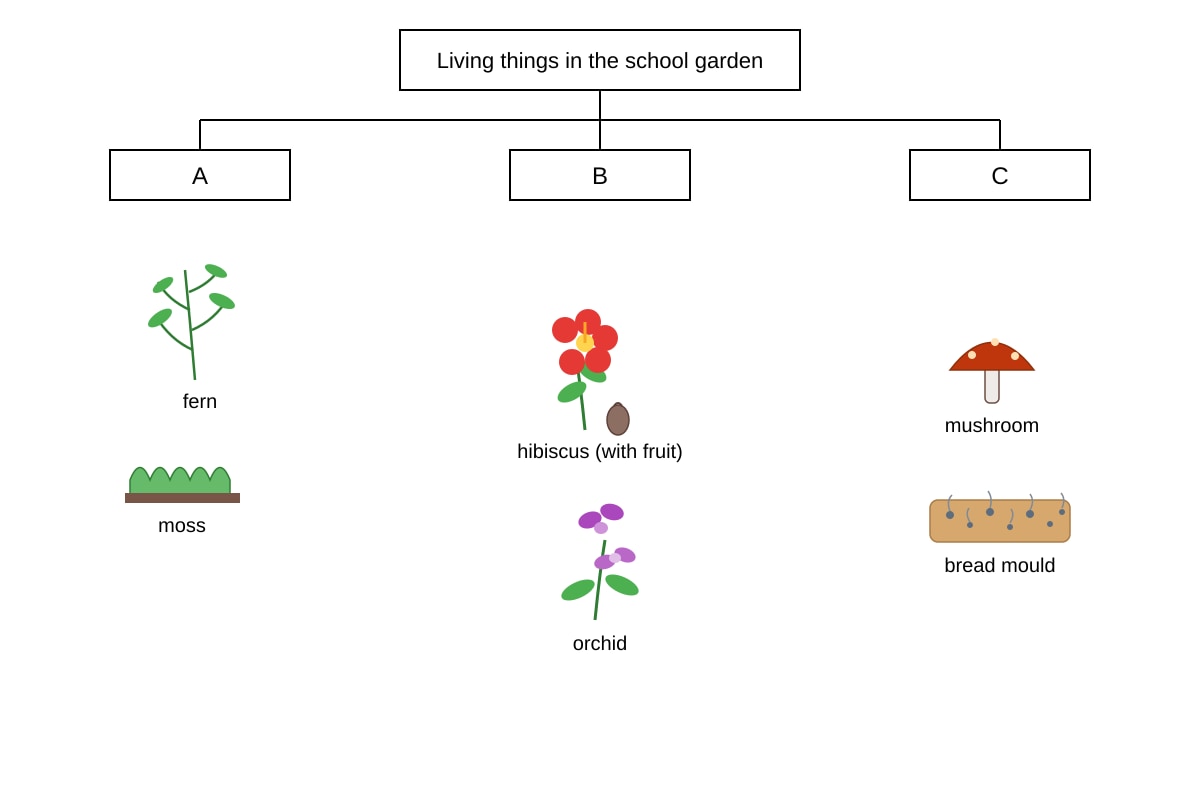
Generated diagram for Q16.
(a) Write the correct heading for each box in the chart.
Box A: ________________________________________________
Box B: ________________________________________________
Box C: ________________________________________________ [3]
(b) State one difference between the plants in Box A and the plants in Box B.
________________________________________________________________ [1]
17. The table shows the properties of four materials, W, X, Y and Z.
| Material | Can bend without breaking? | Waterproof? | Strong? |
|---|
| W | Yes | Yes | No |
| X | No | Yes | Yes |
| Y | Yes | No | Yes |
| Z | Yes | Yes | Yes |
(a) Which material is most suitable for making a raincoat? __________ [1]
(b) Which material is most suitable for making a window frame? __________ [1]
(c) Material Y is used to make an umbrella. Explain why it is not suitable.
________________________________________________________________ [2]
18. Ali put two identical slices of bread in separate sealed bags. He placed Bag A in a warm, damp cupboard and Bag B in a refrigerator. After one week, he compared the slices.
(a) On which slice would he expect to see more grey fuzzy patches? __________ [1]
(b) Explain your answer in (a).
________________________________________________________________ [2]
(c) Bread mould is classified as a fungus, not a plant. Give one reason.
________________________________________________________________ [1]
19. The table shows information about a duck and a whale.
| Animal | Body covering | How it breathes | Reproduction |
|---|
| Duck | Feathers | Lungs | Lays eggs |
| Whale | Skin with some hair | Lungs | Gives birth to live young; young drink milk |
Both animals live in water, but scientists place them in different groups.
(a) Based on the table, state two differences that show why the duck and the whale are in different groups.
Difference 1: ________________________________________________
Difference 2: ________________________________________________ [2]
(b) A seahorse lives in water and breathes through gills. Which group does it belong to?
Group: __________ [1]
(c) Give a reason for your answer in (b).
________________________________________________________________ [1]
20. Ben's toy robot moves across the floor when it is switched on. When Ben claps, the robot flashes its lights. Ben says, "The robot is a living thing because it moves and responds."
(a) Do you agree with Ben? Circle one: Yes / No [1]
(b) Give two reasons based on the characteristics of living things to support your answer.
Reason 1: ______________________________________________________
Reason 2: ______________________________________________________ [2]
(c) State one other characteristic of living things.
________________________________________________________________ [1]
--- END OF PAPER ---